Simplify your logistics with scalable, tech-driven solutions tailored for Indian businesses. From warehousing to last-mile delivery—grow faster, ship smarter.
Every shipment has two weights. One is your product’s real weight. The other is what the courier charges for. Mix these up and you’ll run into billing disputes.
Below, you’ll see what each term means, the formulas, and how they matter for sellers shipping within India or abroad.
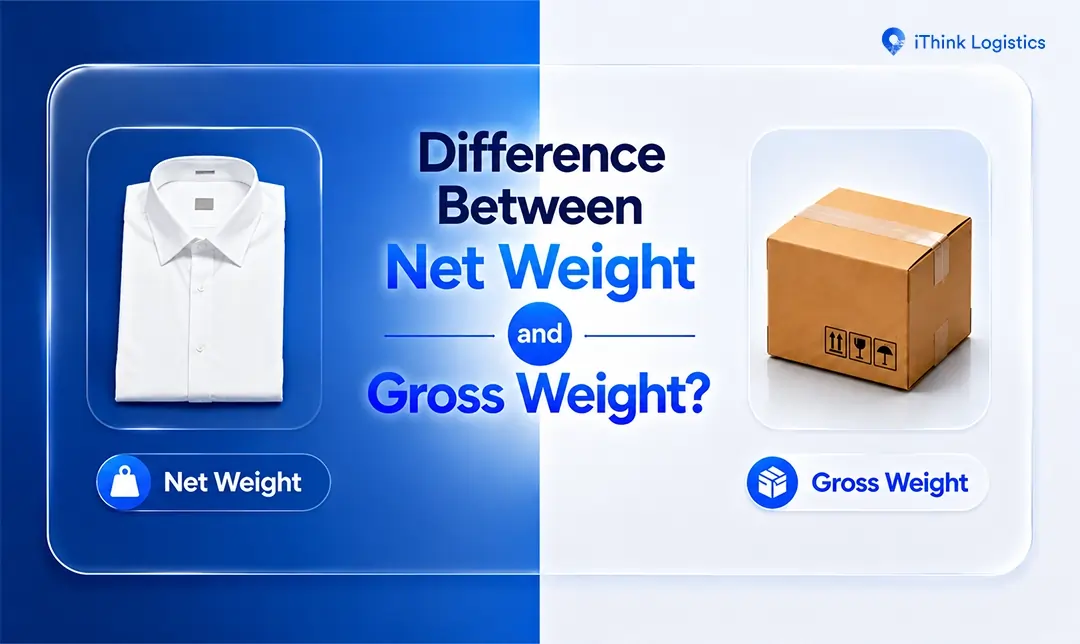
What Is the Difference Between Net Weight and Gross Weight?
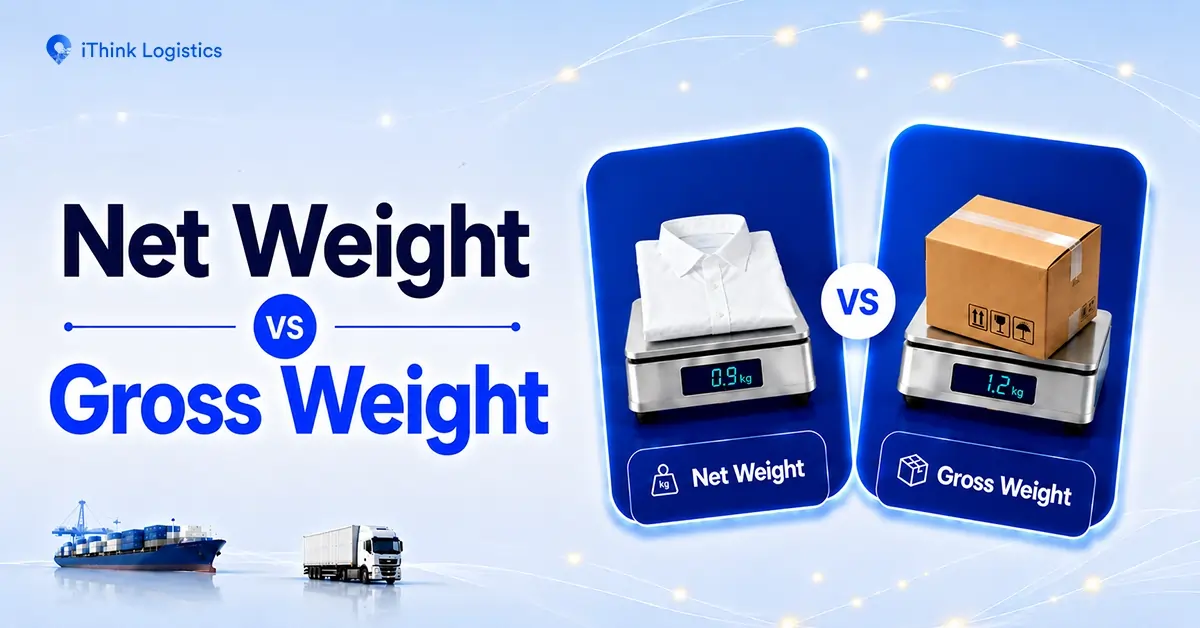
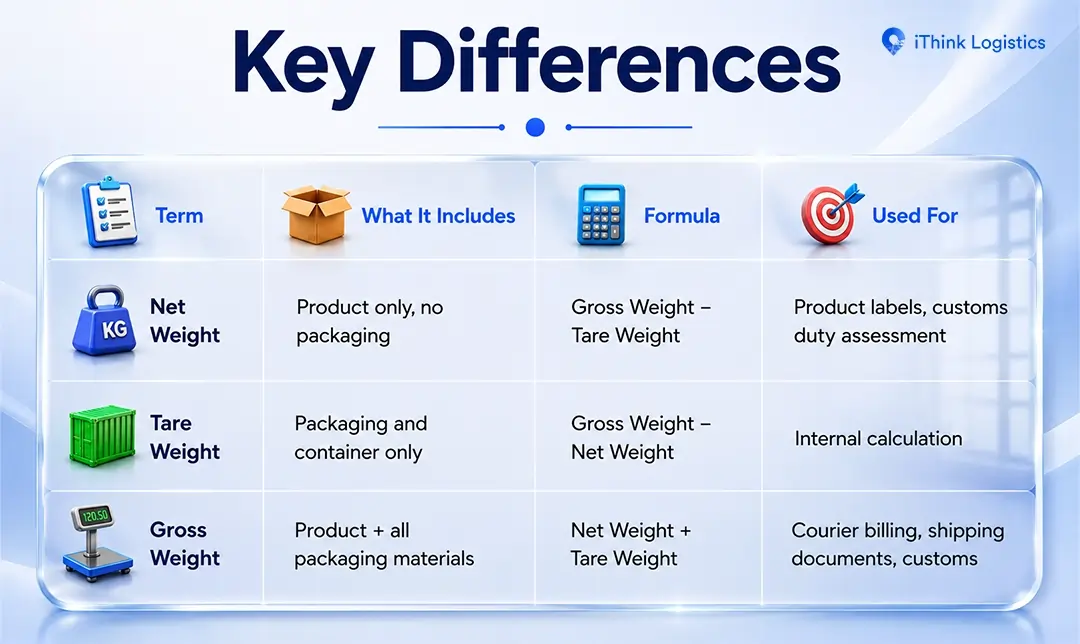
Net weight is the product. Nothing else. Gross weight is the product plus every packaging material you used to protect and ship it.
This difference decides what goes on your label and what your courier charges. If you sell or manufacture, keep these terms clear to avoid compliance issues and extra costs.
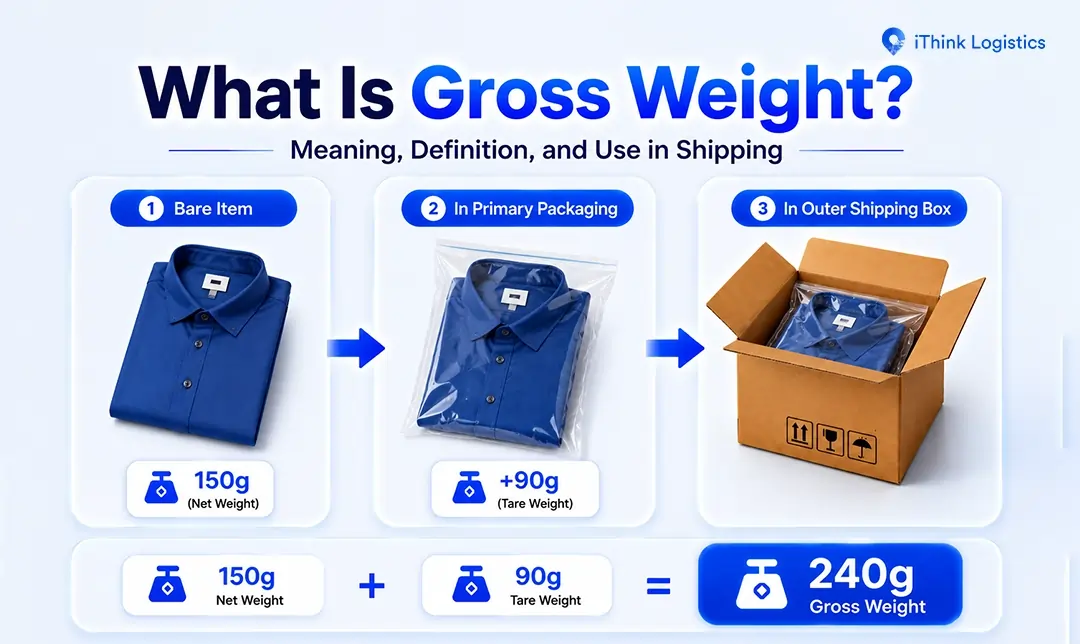
Example: A 500g protein sachet is 500g net weight. Pack it in a box with bubble wrap and tape, and the total becomes 680g. That’s your gross weight. The 180g in between is tare weight, or just the packaging.
Your courier charges for 680g, not 500g. Your label shows 500g. Both are right, but for different reasons.
The relationship between all three follows a fixed formula:
Gross Weight = Net Weight + Tare Weight
Net Weight = Gross Weight − Tare Weight
Gross weight is commonly abbreviated as G.W. and net weight as N.W. on international shipping documents. Both appear as standard column headers on packing lists and export invoices.
What Is Net Weight? Meaning, Definition, and Abbreviations
Net weight is the weight of the product itself, excluding packaging. No box, no poly bag, no bubble wrap, no tape. Just the product a customer receives and uses.
This is the number that goes on your product label. If you sell a 200ml face serum, the net weight printed on the bottle is 200ml. The bottle, pump, and outer carton are not included.
Net weight is abbreviated as Net Wt. on Indian product packaging and as N.W. on international packing lists and export documents.
The British-English spelling, nett weight, means exactly the same thing and appears on shipping documents from Commonwealth trade partners.
For sellers shipping internationally from India, net weight is the figure declared for the actual goods on export documentation. The gross weight of the consignment is declared separately.
The duty calculation methodology varies by destination country and product category your freight forwarder will confirm which applies to your specific shipment before filing.
Net weight stays the same regardless of how you pack the shipment. A 300g candle weighs 300g whether you ship it in a mailer bag or a double-walled box. Only gross weight changes when packaging changes.
What Is Gross Weight? Meaning, Definition, and Use in Shipping
Gross weight is the total weight of everything in the shipment. Product, primary packaging, outer box, bubble wrap, air pillows, foam inserts, and tape. Every gram of packaging adds to it.
When you create a shipment on a courier platform or aggregator, you declare this figure. The courier picks up based on your declared weight.
If the shipment then passes through an automated weighing system at the sorting hub and the scanned weight differs from what you declared, the difference is raised as a weight discrepancy charge on your invoice.
Gross weight changes with your packaging. Use a poly bag instead of a box, and it drops. Add bubble wrap, and it goes up. Net weight stays the same. You control gross weight with your packaging choices.
On international packing lists and export documents, gross weight and net weight appear as separate declared columns.
Tare weight is the mathematical difference between the two and is not always listed as a separate line item.
Once you know gross weight, the next question is: what does your courier actually bill for?
What Is Tare Weight and How to Calculate Net and Gross Weight
Tare weight is the weight of the packaging alone, with nothing inside it. Empty box, poly bag, bubble wrap roll, foam sheet, tape.
Everything you use to pack the product, but it is not the product itself.
Tare weight is the difference between net weight and gross weight. Once you know any two of the three figures, you can always calculate the third.
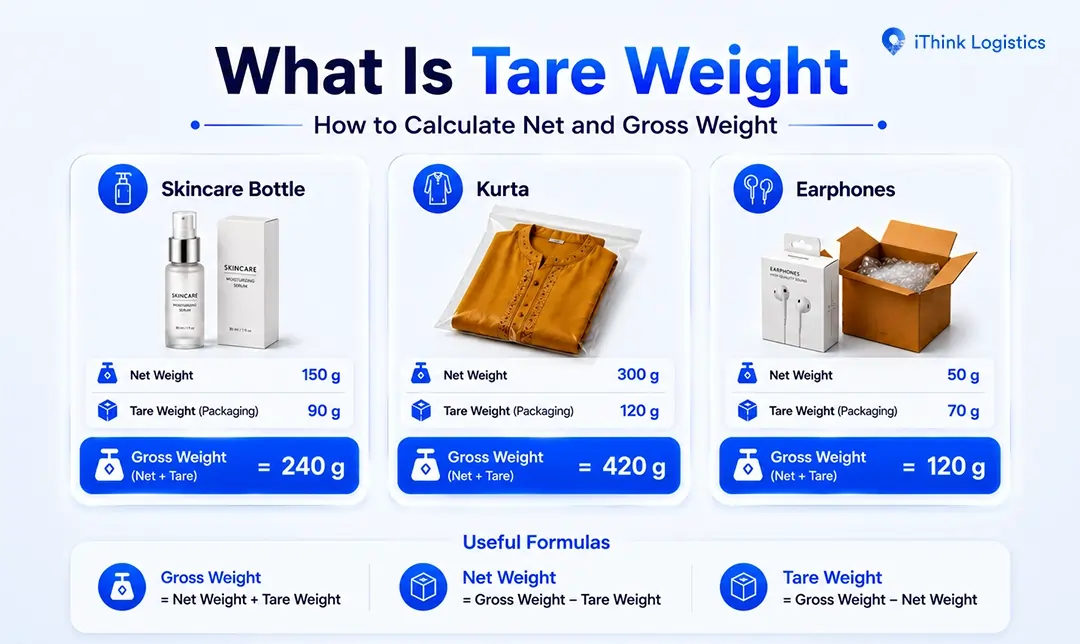
The three formulas are:
Gross Weight = Net Weight + Tare Weight
Net Weight = Gross Weight − Tare Weight
Tare Weight = Gross Weight − Net Weight
Here is how those formulas work across three products a typical Indian seller might ship:
In each case, the courier bills on gross weight. The product label declares net weight. Tare weight sits in the middle, as the packaging costs your shipment incurs every time it moves.
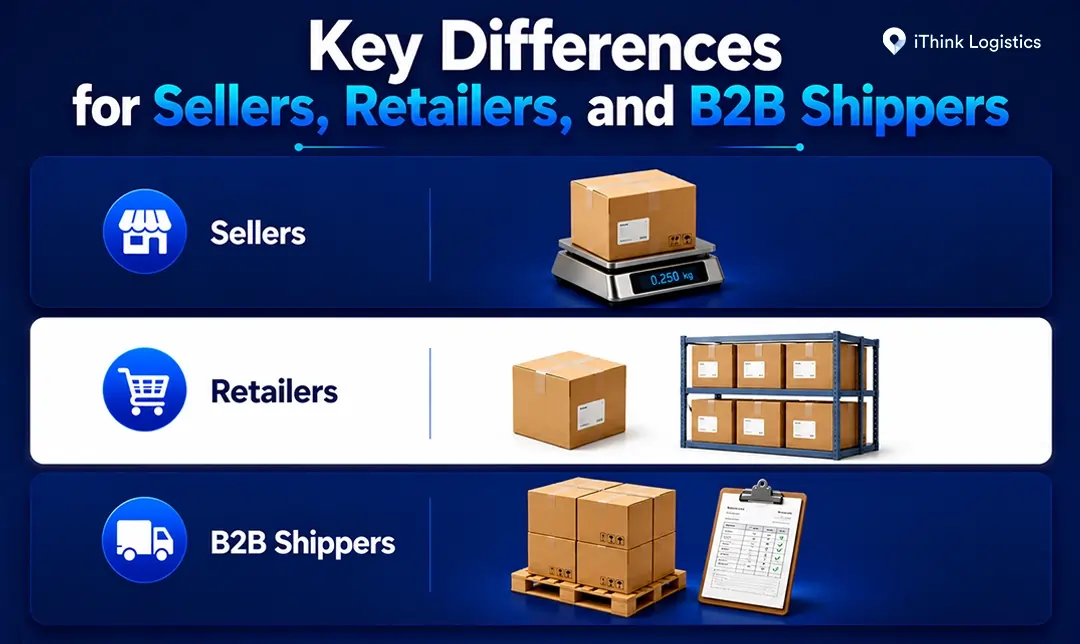
Net Weight vs Gross Weight: Key Differences for Sellers, Retailers, and B2B Shippers
If you know the difference, you’ll print the right label, declare the right weight, and avoid extra charges.
On Product Labels and Retail Packaging
Indian sellers selling packaged goods are governed by the Legal Metrology (Packaged Commodities) Rules, 2011. These rules require net weight or net quantity to appear on the principal display panel.
As seen on real Indian products, Dukes Digestive shows “Net Wt.: 1 Kg” and Unibic shows “NET WEIGHT: 500g.” Gross weight does not appear on consumer packaging.
For food and beverage products, FSSAI labeling standards apply on top of this. Net weight must be declared accurately.
Understating net weight on a food label is a compliance violation, not just a labeling error.
If you’re a retailer, check that the net weight on your supplier invoice matches the product label. Any mismatch is a compliance risk.
In Domestic and International Shipping
For domestic shipments, always enter the gross weight when booking a courier. Every Indian courier platform, whether booked directly or through an aggregator, expects the declared weight to include all packaging.
The weight field at order creation — labeled “Physical Weight” on some platforms — expects the shipment’s total gross weight.
Declaring net weight instead means your declared figure is lower than the actual shipment weight, which can result in a discrepancy charge when the package is scanned at the sorting hub.
For international shipments, declare both net weight and gross weight on your invoice and packing list. Gross weight also goes on customs documents. Duty rules change by country and product, so check with your freight forwarder before you file.
For B2B exports, both weights are mandatory on invoices and packing lists. In commodity trade, buyers check net weight to confirm they got the right quantity.
Gross Weight vs Volumetric Weight: What Indian Couriers Actually Bill
Gross weight is not always the number your courier charges for. Indian couriers calculate two weights for every shipment: the actual gross weight and the volumetric weight. They bill whichever is higher.
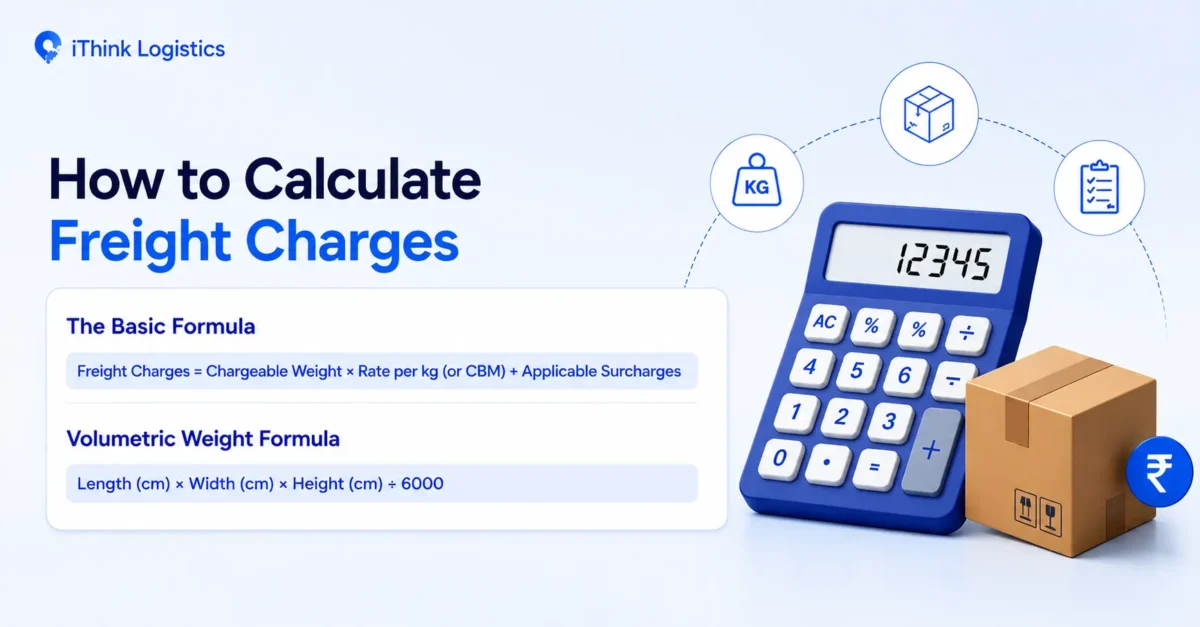
Volumetric weight is calculated using the dimensions of your package:
Measure length, breadth, and height in centimeters. The result is in kilograms. Most Indian couriers use 5,000 as the divisor. DHL Express uses 5,000. DHL eCommerce sometimes uses 6,000. FedEx International uses 5,000 for most services. Always check the divisor with your carrier before you calculate.
Here is where sellers get surprised. A product with a 400g gross weight, packed in a large box, can be billed at 1,500g due to volumetric weight.
The seller packed, keeping the net weight in mind. The courier is billed by volumetric weight.
The gap between what the seller expected to pay and what appeared on the invoice is a direct result of failing to account for box size.
The fix is straightforward. Use the right-sized packaging for your product. A box that fits the product without excess space reduces volumetric weight significantly.
For sellers shipping internationally from India, this matters even more because air freight rates amplify the cost difference between a well-fitted box and an oversized one.
iThink Logistics shows both actual gross weight (also known as dead weight/physical weight) and volumetric weight at the time of booking, so sellers know the billable weight before the shipment moves, whether they are shipping domestically or internationally from India.
FAQs
Q.1: Is Net Weight or Gross Weight Used for Shipping?
A: Gross weight is used for shipping. Every courier, domestic or international, charges based on the total weight of the shipment, including all packaging. For most Indian couriers, the billable weight is the higher of gross weight and volumetric weight, not gross weight alone.
Q.2: Can Gross Weight and Net Weight Be the Same?
A: Yes. When a product is shipped without any packaging, such as bulk raw materials or unpackaged industrial machinery, the tare weight is zero. Gross weight and net weight are equal in that case.
Q.3: What Does Net Quantity Mean?
A: Net quantity is the broader term. It can be expressed as weight (grams, kilograms), volume (millilitres, litres), or count (pieces, units). Net weight is always a weight measurement. On Indian product labels, both net weight and net quantity example, 1U, 2U (1 units, 2 Units), unit example may appear depending on the product category and applicable regulations.
Q.4: What Is the Difference Between Gross Weight and Net Weight in Gold?
A: In gold jewellery, net weight refers to the weight of the gold metal only. Gross weight includes the stone settings, clasps, and any non-gold components. Hallmarked jewellery certifications in India reference net gold weight for purity grading and pricing. A buyer paying for gold by weight should always ask for the net weight figure, not the gross weight of the piece.
Q.5: What Is Nett Weight?
A: Nett weight is the British-English spelling of net weight. Both mean the same thing: the weight of the product excluding all packaging. The spelling nett weight is common on imported product labels and on shipping documents originating from the UK or Commonwealth countries.
Conclusion
Gross weight is for shipping. Net weight is for labels. The tare weight is the packaging that sits between them.
The formula holds regardless of what you sell or where you ship: Gross Weight = Net Weight + Tare Weight.
When booking any courier shipment, always declare gross weight that means the product plus all packaging. For international shipments from India, declare both net weight and gross weight on your commercial invoice. Right-size your packaging so that volumetric weight does not quietly inflate your per-shipment cost.
iThink Logistics helps D2C sellers, retailers, and B2B businesses ship across India and internationally, with full visibility into weight-based billing before every shipment is dispatched.
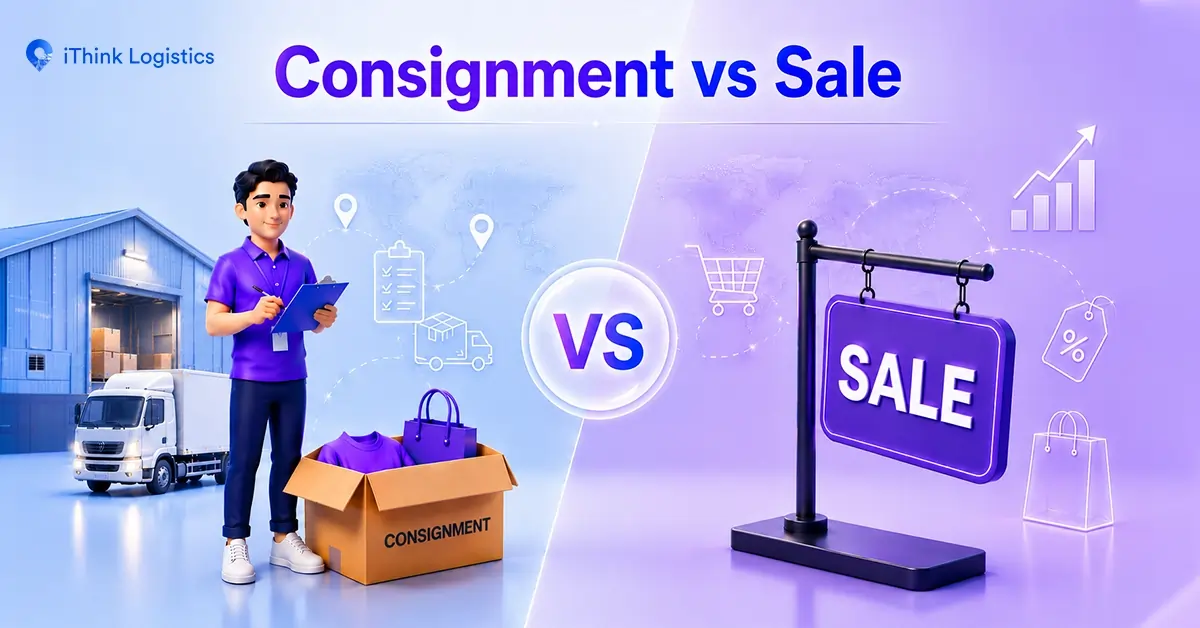
You ship goods to a store. Either they buy and own them from day one, or they just hold and try to sell them, paying you only for what actually moves. The first is a sale. The second is consignment.
The difference between Consignment and sale is about three things: who owns the goods, who takes the risk, and when you get paid. Get this wrong, and you’ll end up with dead stock or chasing money that was never yours.
Let’s break down how both work and which one actually fits your business.
What Is the Meaning of Consignment? Definition Explained
Consignment is a commercial arrangement where the owner of goods, called the consignor, sends those goods to an agent, called the consignee, to sell on their behalf. Ownership stays with the consignor until the goods are sold to the end customer.
In Simple terms, Consignment means you (the owner) send goods to someone else to sell for you. You keep ownership until the goods are sold to the final customer.
It’s a trust setup. You hand over the goods, but not ownership. The agent just holds and sells them, earning a commission only when something sells.
They never own the goods. That one fact changes everything. The consignor generally bears the loss because ownership remains with them, unless the consignee is negligent or the agreement provides otherwise.
That’s why consignment is common when you’re entering new retail markets. Retailers who won’t buy unknown stock up front will still put it on their shelves if the risk is zero.
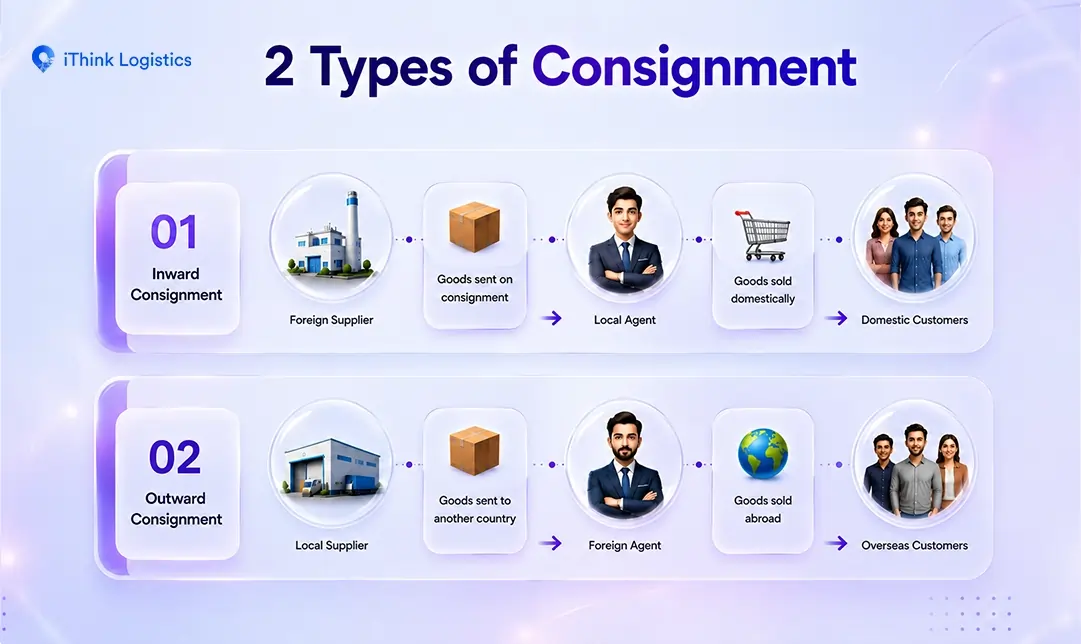
There are 2 types of consignment:
Outward consignment is when a consignor sends goods to an agent in another country for international sale.
Inward consignment is when a local agent receives goods from a foreign supplier to sell domestically.
Still not clear how this is different from a regular sale? Read on for a quick definition and a side-by-side comparison.
What Is a Sale? Definition and Meaning Explained
A sale is a transaction in which the seller transfers ownership of goods to the buyer immediately in exchange for an agreed-upon price. Once the transaction closes, the buyer owns the goods in full and bears all risk from that point forward.
In a simple way, A sale is simple. You transfer ownership to the buyer as soon as the deal is done. They own the goods and take all the risk from that moment.
No agent, no commission, no returns for unsold stock. You get paid, the buyer gets the goods, and that’s it.
This is the big split. In a sale, everything is final at the time of the transaction. In consignment, it’s only final when the end customer buys.
The gap between when goods move and when ownership moves is what every difference in this guide comes back to.
Consignment vs Sale: Key Differences, Quick Comparison and Detailed Breakdown
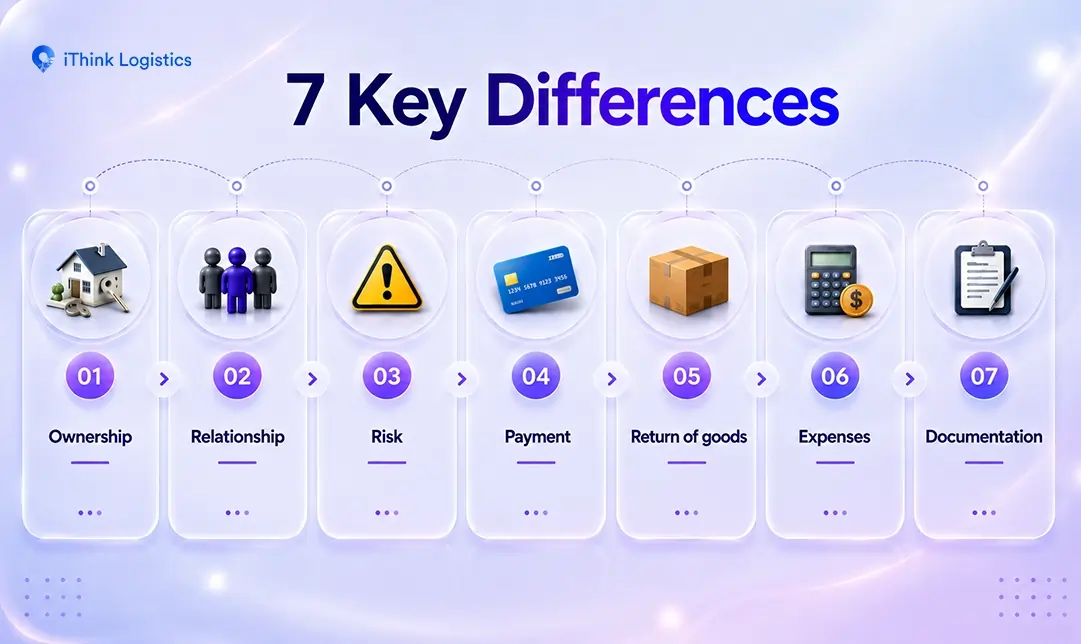
Both models move goods from you to someone else. But ownership, risk, and payment work differently. Here’s the full comparison.
Basis of Difference
Consignment
Sale
Ownership
Stays with the owner until sold to end customer
Passes to the buyer immediately
Relationship
Owner (Manufacturer/ Brand) and selling agent/ retailer/ store owner/ 3rd party
Buyer and seller (debtor-creditor)
Risk
The owner pays if goods are lost, damaged, or unsold
Buyer takes on all risk after delivery
Payment
After goods are sold, minus commission
At purchase or on agreed credit terms
Return of goods
Unsold stock returned to owner as standard
No return unless seller agrees upfront
Expenses
Owner covers all costs
Buyer covers all costs after delivery
Documentation
Delivery challan, account sales statement, and other consignment-related documents
Tax invoice and sale-related documents
Commission
Consignee earns commission (ordinary or del credere)
No commission — buyer earns profit margin
Unsold Stock Valuation
Valued at cost + proportionate expenses (in consignor’s books)
N/A — buyer owns stock
Nature of Transaction
Not a sale until end customer buys
Complete and final at the point of transaction
Applicable Law
Agency principles under Indian Contract Act, 1872 (Sec. 182)
Sale of Goods Act, 1930
Accounting Treatment
Goods remain in consignor’s books as inventory until sold
Goods removed from seller’s books on sale
Each row is a real legal and financial difference. Here’s what it means for your business.
Ownership of Goods
This is where the consignment and sale split. In consignment, you keep legal ownership even while your goods sit in someone else’s store. Ownership only passes to the end customer when they buy.
In a sale, ownership moves the moment the deal closes. The buyer owns the goods from day one. Any loss or damage after delivery is their problem, not yours.
Relationship Between the Parties
In consignment, you call the shots. The agent sells on your instructions, not as a buyer. You decide, and the agent acts accordingly.
A sale is direct: buyer and seller, no middleman. Once payment is made and goods are delivered, you’re done. If it’s a credit sale, you wait for payment, but otherwise, there are no strings attached.
Transfer of Risk
In consignment, you hold all the risk. If goods get damaged, stolen, or don’t sell after 60 days, it’s your problem.
Even if the agent takes care and something still goes wrong, you take the loss unless your contract says otherwise. The agent is only required to take reasonable care, not guarantee outcomes.
In a sale, risk moves at delivery. If a retailer buys 500 units and 200 don’t sell, that’s their loss.
Payment, Consideration, and Settlement Terms
In a sale, you get paid upfront or on credit. What happens to the goods after delivery doesn’t affect your payment.
In consignment, you get paid only after the item sells to the end customer. The agent deducts their commission and expenses, then sends you the rest. Depending on how fast things move, this can take 30 to 90 days (depends on owner and store agreement).
Return of Unsold Goods
Under consignment, unsold stock automatically comes back to you. No negotiation needed as the agent never owned it.
In a sale, the buyer owns the goods from day one. Returns only happen if you agreed to them upfront, the goods are defective, or your return policy allows them.
Expenses and Charges
In a consignment arrangement, the owner covers transportation, insurance, loading, and storage costs. These are either paid directly or reimbursed to the agent through the account sales settlement.
In a sale, the buyer pays all costs after delivery. Storage, insurance, and distribution are their responsibility once they have the goods.
Documentation Required
Consignment uses two documents. You send a pro forma invoice showing quantity and estimated value.
After the sale, the agent sends you an account sales statement showing sales, expenses, commission, and the net amount due.
A sale just needs one document: a standard tax invoice at the time of the transaction.
Key Features of Consignment and Sale
Know the key features before you sign any agreement. It’s the only way to be sure which model you’re in.
Key features of consignment:
Consignor retains ownership until goods reach the end customer.
Consignee acts as an agent, not a buyer.
The retailer earns a commission, not profit, on the goods.
You pay all costs, take all the risk, and absorb any losses on unsold stock.
Unsold goods come back to you as standard.
Key features of a sale:
Ownership moves to the buyer as soon as the deal is done.
Buyer bears all risk and expenses after delivery.
The seller earns direct profit from the transaction.
Goods cannot be returned unless the seller agrees up front.
On paper, both look similar. The real differences show up when things go wrong.
Stock doesn’t sell, goods get damaged, or payment is late. The next section breaks down what happens in each case.
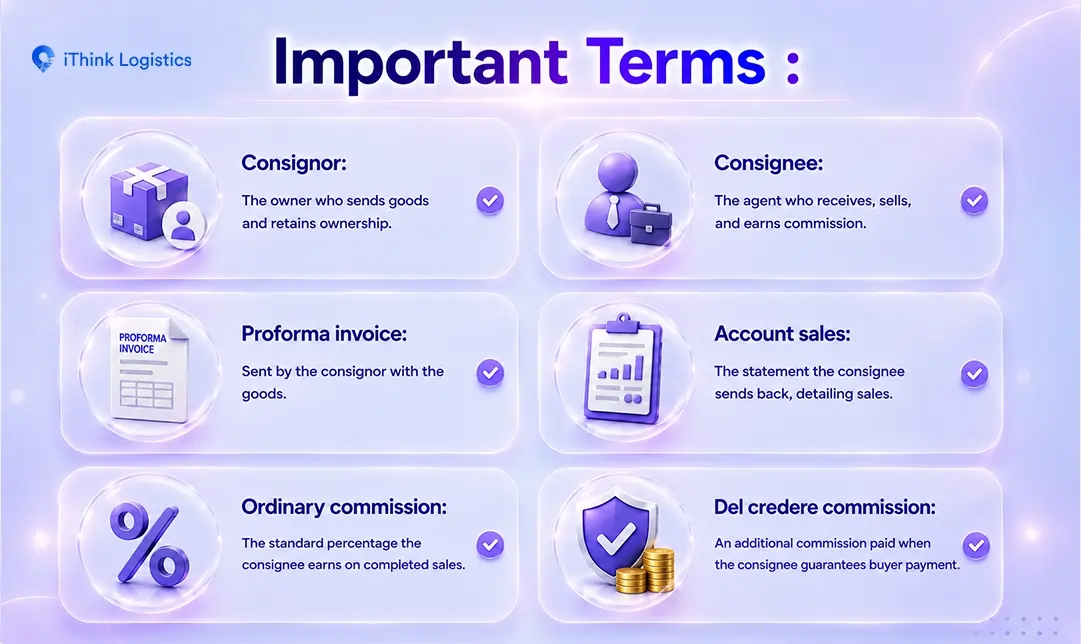
Important Terms in Consignment: Consignor, Consignee, and Del Credere Commission
These terms appear in every consignment contract. Knowing them prevents costly misreads.
Consignor: The owner who sends goods and retains legal ownership throughout the consignment period.
Consignee: The agent or store that receives, displays, and sells your goods. They never own the goods. They only earn commission on what they sell.
Proforma invoice: You send this when goods are dispatched. It shows quantity and estimated value. It’s not a payment demand as no money is owed yet.
Account sales: The agent sends this after selling. It lists gross sales, expenses, commission, and the net amount you get.
Ordinary commission: The standard cut the agent earns on each sale.
Del credere commission: Extra commission you pay the agent if they guarantee payment from the end customer. If the customer doesn’t pay, the agent covers the loss. You get protection from bad debt, but pay a higher commission.
This is more common in wholesale and B2B consignment arrangements where buyers purchase on credit terms, not in standard retail.
When Should a Business Choose Consignment Over an Outright Sale?
Choosing between consignment and sale depends on your market position, cash flow, and the level of inventory risk you can handle. Here’s a practical way to decide.
Choose consignment when
Choose a direct sale when
You’re entering a new market and buyers are hesitant to commit
Demand is established and buyers can commit upfront
You want to test a new product without forcing inventory risk on a retailer
You need immediate cash flow
Your buyer lacks working capital to purchase stock upfront
You want a clean, final transaction with no returns
You’re expanding through local agents in distant or unfamiliar markets
The buyer has capacity to manage their own stock
2 real scenarios where the choice plays out:
Scenario 1: You’re a new skincare brand entering modern trade. Most retailers won’t buy unknown SKUs upfront as they don’t want the risk. But, going with Consignment gets your products on shelves without asking the retailer to take a chance, since they don’t have to pay. You carry the inventory risk, but you get market access.
Scenario 2: You’re an established apparel brand selling to a retail chain. Demand is proven, the buyer has cash, and both sides want a clean deal. Direct sale is better. You get paid faster and don’t worry about unsold stock at the retailer’s end.
Conclusion: How to Distinguish Between Consignment and Sale for Your Business
The core difference is ownership. In a sale, it moves to the buyer the moment the deal closes. In consignment, it stays with you until the end customer buys.
Before you sign any supply or distribution agreement, know which model you’re in. That single fact determines your risk, your payment timeline, and your rights over unsold stock.
Choose consignment when you need market reach without asking buyers to carry your inventory. Choose a direct sale when you need cash now, and your buyer is ready to commit.
FAQs
Q.1: Is Consignment the Same as a Sale?
A: No. In consignment, the owner retains ownership and the agent earns commission on what they sell. In a sale, ownership transfers immediately to the buyer at the point of transaction. They are distinct legal and commercial arrangements with different risk, payment, and return structures.
Q.2: Who Bears the Risk in a Consignment Arrangement?
A: The owner bears all risk throughout the consignment period. Damage in transit, theft from the agent’s premises, or stock that fails to sell all fall on the owner. The agent is only required to take reasonable care of the goods.
Q.3: What Is the Relationship Between Consignor and Consignee?
A: The relationship between consignor and consignee is that of a principal and agent. The consignor is the principal who owns the goods and sets the terms. The consignee is the agent who sells on their behalf and earns a commission on completed sales only.
Q.4: Can Consigned Goods Be Returned to the Consignor?
A: Yes. Since the consignee never owned the goods, returning unsold stock is a standard part of every consignment arrangement. No special agreement is needed. In a completed sale, the buyer cannot return goods without prior written agreement from the seller.
Q.5: What Is the Difference Between Consignment and Joint Venture?
A: Consignment is a principal-agent arrangement where one party sells goods on behalf of another for commission. A joint venture is a partnership where 2 or more parties pool resources, share ownership, and split both profits and losses on a specific project. Ownership and risk work differently in each.
Q.6: What Does 60/40 Consignment Mean?
A: In a 60/40 consignment arrangement, the sale proceeds are split between the consignor and the consignee. The consignor receives 60%, and the consignee keeps 40% as their commission. The exact split depends on what both parties agree upfront; like 60/40, 70/30, and 80/20 are all common depending on the product category and how much selling effort the agent puts in.
Q.7: What Is the Difference Between Consignment and Ordinary Sale?
A: In an ordinary sale, ownership transfers to the buyer immediately when the transaction is complete. In consignment, ownership stays with the original owner and only transfers when the end customer buys from the agent. The term “ordinary sale” is used in commerce textbooks specifically to contrast with consignment; the word “ordinary” just means a standard direct sale, not a special arrangement.
Q.8: Which law governs consignment and sale in India?
A: Consignment is based on agency principles under the Indian Contract Act, 1872. Section 182 defines an agent as a person who acts on behalf of another person (the principal), which reflects the relationship between a consignee and consignor. A sale, on the other hand, is governed by the Sale of Goods Act, 1930, which regulates the transfer of ownership, risk, and the rights and obligations of buyers and sellers.
Q.9: Is GST applicable on consignment transactions in India?
A: GST implications can arise in consignment transactions depending on the nature of the principal-agent relationship. Under Schedule I of the CGST Act, 2017, certain transactions between a principal and an agent may be treated as a supply even when made without consideration. This includes situations where an agent undertakes to supply goods on behalf of the principal or receives goods on the principal’s behalf. Businesses operating on a consignment model should evaluate the applicable GST provisions before dispatching goods or determining tax liability.
Q.10: Is an e-way bill required when goods are sent on consignment?
A: An e-way bill is generally required for the movement of goods when the consignment value exceeds ₹50,000, subject to applicable GST rules and exemptions. Businesses operating on a consignment model should verify the applicable e-way bill requirements before transporting goods.
Air transport accounts for 35% of global trade by value. That sounds impressive until you realize it accounts for less than 1% of the total freight volume. The math tells you everything: air transport is fast, secure, and expensive, built for shipments where time matters more than cost.
For businesses deciding between air, sea, and road, the choice is rarely obvious. This guide breaks down the real advantages and disadvantages of air transport so you can make that call with confidence.
What Is Air Transport?
Air transport is the movement of people and goods using aircraft. This includes commercial passenger planes, dedicated cargo aircraft, and helicopters. It operates through a global network of airports and air corridors that connect virtually every country.
In India, major air cargo hubs in Mumbai, Delhi, Bengaluru, Chennai, and Hyderabad handle domestic courier shipments and international freight. For sellers, this typically means either domestic air express or international air freight.
Advantages of Air Transport
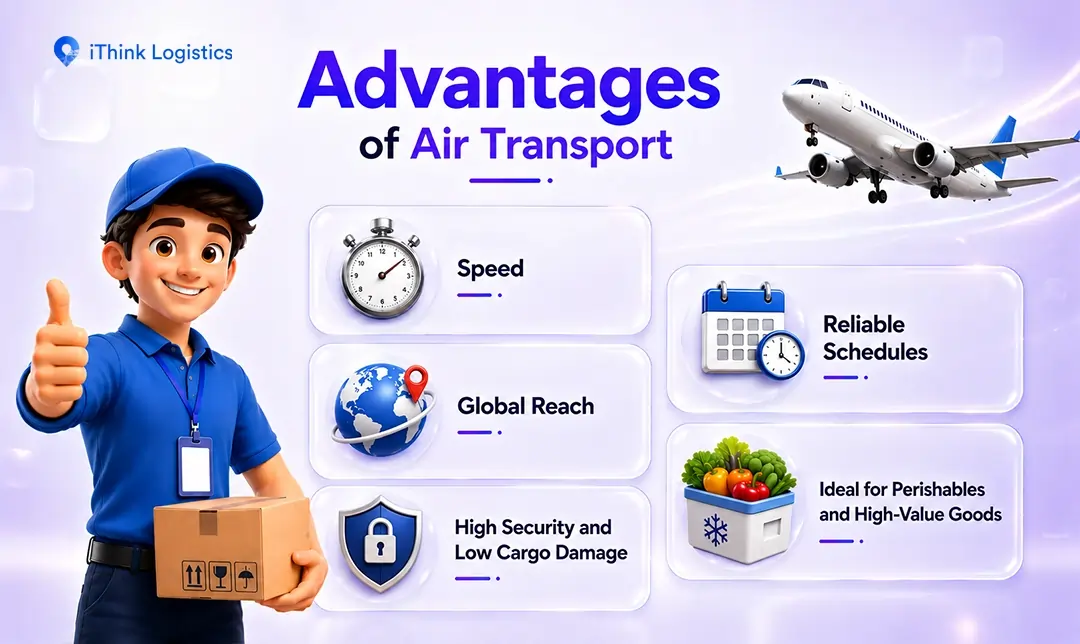
The advantages of airways and air freight go beyond just speed. Here are the five that matter most for businesses and sellers.
1. Speed
Air is the fastest way to move goods over long distances. International shipments arrive in 1 to 3 days by air, compared to 2 to 6 weeks by sea.
On domestic routes in India, air express cuts transit from 3 to 5 days by surface down to next-day or two-day delivery across most major cities. When a shipment is time-sensitive, no other mode comes close.
2. Global Reach
Aircraft cross oceans, mountains, and remote terrain that road transport cannot handle. Air transport connects virtually every country in the world through an extensive global network of airports and air routes.
For Indian sellers shipping internationally, this opens markets that surface or sea routes make impractical.
3. High Security and Low Cargo Damage
Airports run strict screening and limit cargo access. Air freight typically involves fewer handling points and shorter transit times, which can help reduce the risk of damage and cargo loss.
4. Reliable Schedules
One of the core advantages of air travel is schedule reliability. Airlines operate on fixed departure windows, and even when a flight is missed, the next departure is usually a few hours away.
This predictability matters for businesses running lean inventory. You can plan restocking without large buffers for transit uncertainty.
5. Ideal for Perishables and High-Value Goods
Fresh produce, flowers, pharmaceuticals, and temperature-sensitive products need to move fast. Air gets them to the destination before quality degrades. For high-value products, the faster transit also means lower inventory holding costs. Less stock sits idle in the supply chain.
Speed is the strongest card here. But that advantage comes with real trade-offs on the other side.
Disadvantages of Air Transport
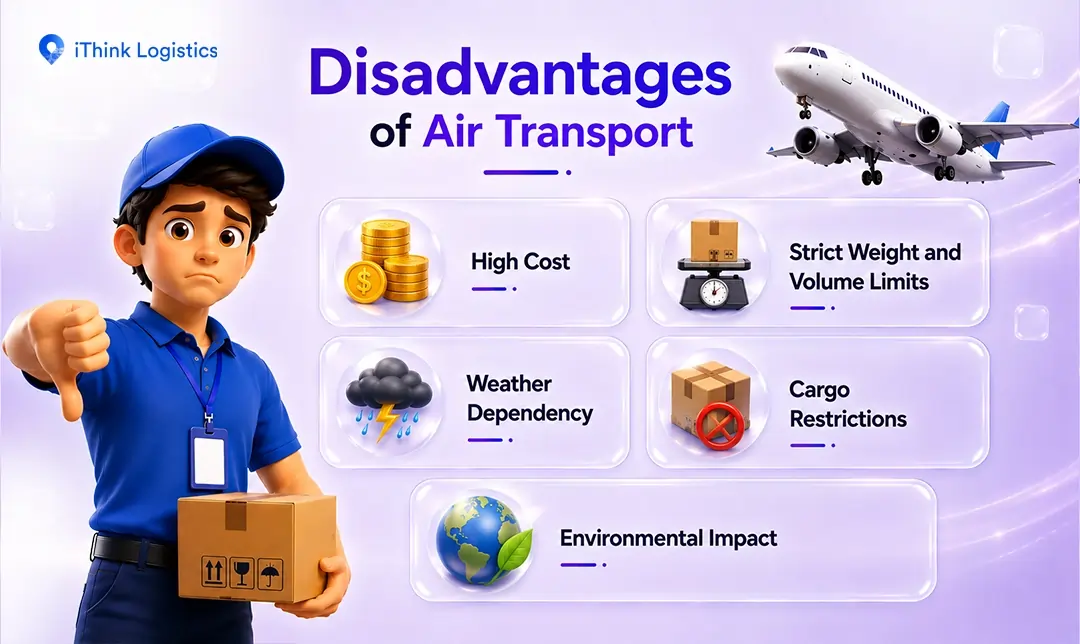
Every mode of transport has limits. The disadvantages of airways are consistent across cargo types and worth understanding before you commit.
1. High Cost
Air freight is significantly more expensive than ocean freight, making it best suited for urgent or high-value shipments.
For domestic air express in India, the premium over surface courier runs 2 to 3 times higher for similar weights. Low-margin products, heavy goods, and bulk shipments rarely justify it.
2. Strict Weight and Volume Limits
Aircraft hold a fixed amount of cargo by weight and dimension. Oversized items, heavy machinery, and large quantities of raw materials cannot be moved economically by air. Air freight is generally most cost-effective for lighter, higher-value shipments.
3. Weather Dependency
Fog, storms, and severe weather can ground entire fleets. Disruptions at major airport hubs can affect flight schedules and connected routes across wider airline networks.
Air networks are more vulnerable to cascading failures than road or sea when conditions hit a single hub.
4. Cargo Restrictions
This catches many sellers off guard. The IATA Dangerous Goods Regulations ban or heavily restrict a long list of goods from being flown. Lithium batteries shipped separately, aerosols, flammable liquids, certain chemicals, and petroleum-based products face strict limits or outright bans.
Sellers in beauty, personal care, and electronics regularly hit these restrictions. Always verify compliance with the IATA DGR before booking air freight for a new product category.
5. Environmental Impact
Aircraft burn significant fuel and release CO₂ at high altitudes, where their warming effect is greater than the same emissions at ground level. According to the International Energy Agency (IEA), aviation accounts for around 2.5% of global energy-related CO₂ emissions.
For businesses with sustainability commitments or ESG reporting requirements, aviation’s carbon footprint is a real operational consideration. Understanding these limits helps you choose at the right moment, not by default. A quick side-by-side comparison makes that decision easier.
Air Transport vs Road vs Sea: At a Glance
No mode of transport wins across every situation. The table below shows where each one fits.
Factor
Air
Sea
Road
Speed
1 to 3 days
2 to 6 weeks
3 to 10 days
Cost
Highest
Lowest
Moderate
Cargo capacity
Limited
Massive
Moderate
Weather risk
High
Moderate
Low
Best for
Urgent, high-value, low-weight
Bulk, non-urgent
Regional, domestic
Environmental impact
Highest
High
Moderate
For most Indian ecommerce sellers, the choice comes down to air versus surface for domestic shipments, and air versus sea for international shipments. The table makes the trade-offs clear at a glance.
Conclusion
The importance of air transport becomes clear when speed and security matter more than cost. It works best for time-sensitive shipments, high-value products, and routes where no practical ground or sea alternative exists.
For bulk goods, low-margin products, or restricted categories, other modes make more financial sense.For Indian ecommerce brands shipping internationally, the right freight partner matters as much as the right shipping mode.
iThink Logistics offers shipping across 180+ countries, built for D2C sellers who need reliable cross-border delivery.
FAQ
These are the questions sellers and students ask most.
Q.1: What are the advantages of air transport?
A: Speed, global reach, schedule reliability, high cargo security, and suitability for perishable and high-value goods. It is the fastest mode of freight movement over long distances, making it the right choice when delivery timelines are non-negotiable.
Q.2: What are the disadvantages of air transport?
A: High cost, strict weight and volume limits, weather-related disruptions, cargo restrictions on hazardous goods, and a significant environmental footprint. It also depends on ground transport at both ends, which adds time and cost to the total door-to-door journey.
Q.3: What is the main disadvantage of an air journey?
A: Cost is the primary disadvantage. Air freight is considerably more expensive per kilogram than ocean freight. Cargo restrictions are a close second. Goods like lithium batteries, aerosols, and flammable liquids face IATA bans or heavy restrictions, creating compliance challenges for sellers in electronics, beauty, and personal care.
Every time a customer orders from your store, at least two types of logistics kick in before the package reaches their door. Most D2C sellers manage these daily without knowing what each is called or how it affects their costs and delivery performance.
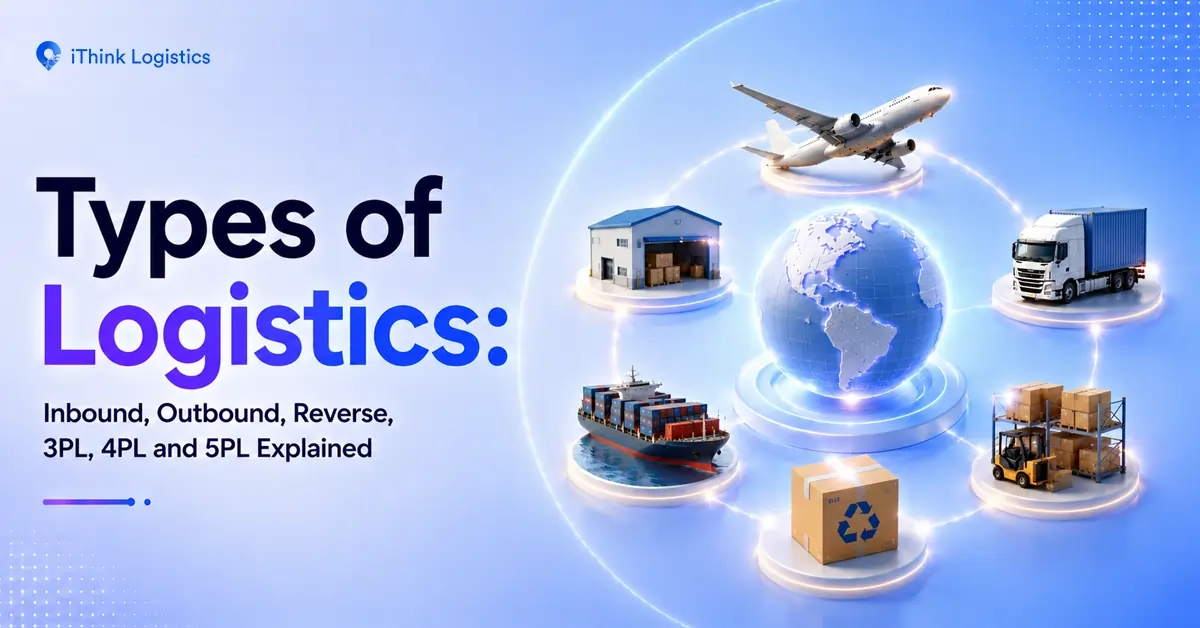
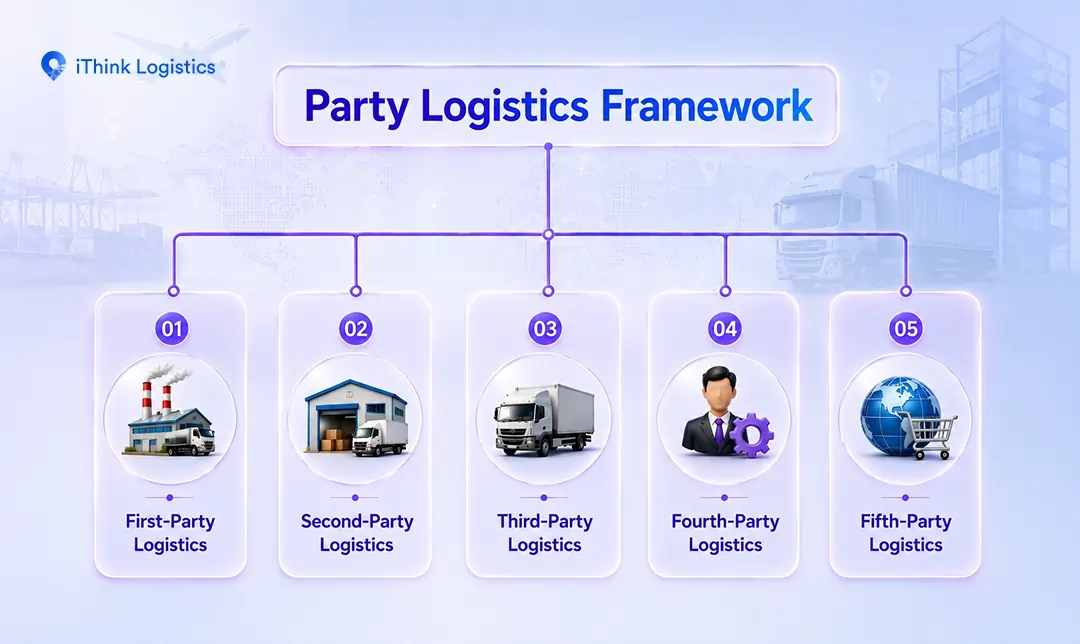
There are two frameworks worth knowing: the direction goods move (inbound, outbound, reverse) and who handles the movement (1PL through 5PL). This blog breaks down all types of logistics, with examples tailored to Indian ecommerce sellers.
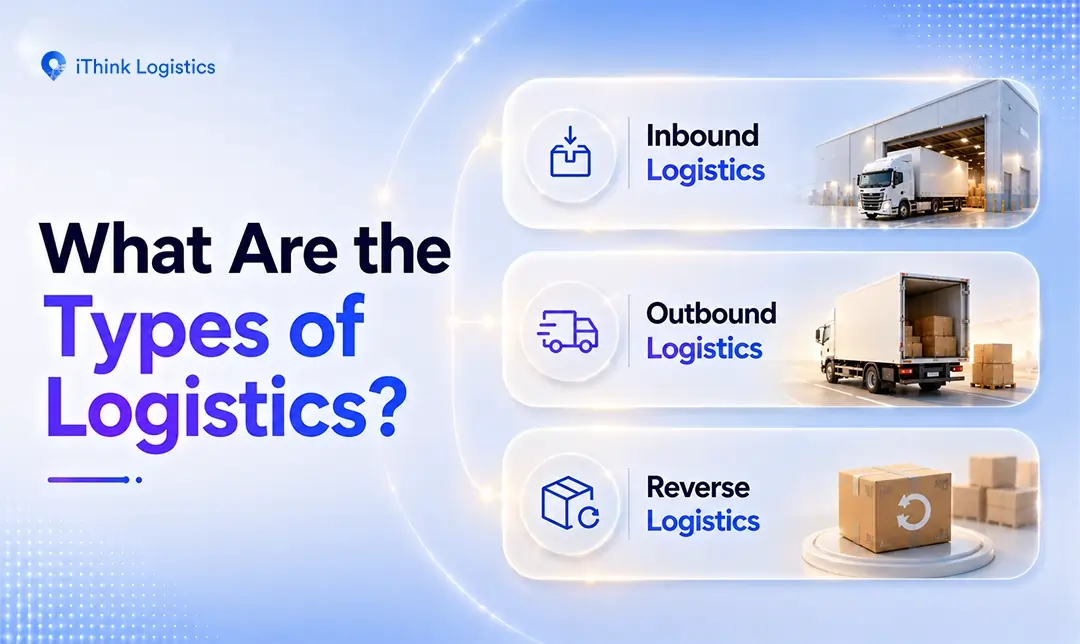
What Are the Types of Logistics?
The types of logistics are distinct operational models that define how goods move through a supply chain, with each determined by either the direction of movement (inbound, outbound, or reverse) or the level of outsourcing (1PL through 5PL).
Think of them as two separate questions your business needs to answer.
The first: Which direction are your goods moving? Goods coming into your warehouse from suppliers are inbound. Orders going out to customers are outbound. Products returned by customers are reversed.
The second: who is managing that movement? You handle it yourself (1PL), you hire a carrier for one leg (2PL), you outsource fulfillment entirely (3PL), someone manages your 3PLs for you (4PL), or a platform aggregates your shipping across multiple couriers for better rates (5PL).
Let’s break down each type with real examples.
Inbound Logistics
Inbound logistics is the process of getting goods from your supplier into your warehouse. It starts with placing a purchase order and ends when the stock is shelved and ready to ship.
This covers procurement, freight booking, stock receipt, quality checks, and inventory updates. All of this happens before a customer even places an order.
For a D2C seller in India, inbound logistics looks like this: you run low on a bestselling kurta. You place an order with your Surat supplier. The supplier dispatches the stock via surface freight. It arrives at your warehouse in 3 days. Your team checks quantities, updates your inventory system, and the SKUs go live. That entire sequence is inbound logistics.
If inbound fails, you feel it later. Late supplier dispatch? You run out of stock. Stockouts during a sale? Lost revenue and canceled orders. Nail your inbound, and your outbound keeps moving.
Once stock hits your shelves, outbound starts.
Outbound Logistics
Outbound logistics is the process of fulfilling customer orders. It covers picking, packing, dispatching, and delivering finished goods from your warehouse to the customer’s doorstep.
It starts when an order comes in. It ends when the customer gets their package.
For a D2C seller, the flow looks like this. A buyer places an order on your Shopify store at 11am. Your team picks the SKU, packs it, prints the label, and hands it to the courier by 5pm. The courier picks it up, moves it through their network, and delivers it in 2 to 4 days. That entire sequence is outbound logistics.
Your customer does not care about your inbound process. They care about this one. A slow pick-pack means a late dispatch. A wrong courier means extra transit days. Both end up in your reviews before you even know there is a problem.
Keep the outbound process quick, and customers return. Let it slip, and they won’t.
But not every order makes it. When shipments return, reverse logistics takes over.
Reverse Logistics
Reverse logistics is the process of moving goods backward through the supply chain. It covers customer returns, RTOs (return to origin), repairs, refurbishments, and recycling.
Most guides talk only about returns. For Indian D2C sellers, RTOs are the real headache.
An RTO happens when a courier cannot deliver an order. The customer was unavailable, the address was wrong, or the buyer refused the package. The courier marks it undelivered and ships it back to you. You pay the outbound shipping cost. You pay the return shipping cost. The product sits unsold in your warehouse.
In Indian fashion and apparel, RTO rates are among the highest in e-commerce. That means a significant chunk of your shipments come back before a customer ever opens them.
This is why NDR management matters. “NDR” means “non-delivery report.” When a courier marks an order as undelivered, a good NDR system calls the buyer, investigates the issue, and attempts redelivery before it becomes an RTO. Most D2C sellers ignore this tool.
Reverse logistics is not just about handling returns cleanly. It is about stopping unnecessary ones before they happen.
Now that the three directional types are clear, the next question is who manages them. That is where the 1PL-to-5PL framework comes in.
Who Actually Handles Your Shipments? 1PL to 5PL
This framework answers one thing: who runs your logistics?
Each level adds a layer of outsourcing. Most D2C sellers in India operate on a 2PL or 3PL model without realizing it.
1PL: First-Party Logistics
1PL means you do everything yourself. You own the vehicles, run the warehouse, and control every step. No outside help.
This works when your operation is large enough, consistent enough, and concentrated enough in one geography to justify it. A brand operating its own delivery fleet in a single city is a 1PL operation. For most D2C sellers, this model is too capital-heavy to be practical.
2PL: Second-Party Logistics
2PL means hiring an asset-based carrier to handle one part of your supply chain. They own the vehicles & infrastructure. You pay for the transportation, not for the entire management.
A surface freight company moving bulk stock from your Surat supplier to your warehouse in Mumbai is a 2PL arrangement. You are not outsourcing fulfillment. You are paying for transport. Most sellers use 2PL for inbound freight without naming it that.
3PL: Third-Party Logistics
3PL means outsourcing your warehousing, fulfillment, and shipping to an external provider. The 3PL stores your inventory, picks and packs orders, and dispatches them through their courier network.
You focus on selling. They handle the rest. This works when your orders outgrow your setup, but you’re not ready for your own warehouse or don’t want warehouse management.
For example, a skincare brand in Bangalore stores its inventory at a 3PL warehouse in Mumbai. Orders placed on the website get picked, packed, and shipped without you touching a single box.
You know, iThink Logistics is also a 3PL. Here we connect you to 25+ courier partners on our platform with automated courier allocation, NDR management, and real-time tracking, so you get the rate access and flexibility of multiple couriers without managing each one separately.
4PL: Fourth-Party Logistics
4PL means outsourcing the management of your entire supply chain to a single provider. The 4PL does not just run operations. It manages your 3PLs, carriers, technology, and strategy.
Think of 4PL as your supply chain manager, sitting above all your logistics partners.
A fashion brand shipping across 15 states works with 6 courier partners, 2 warehouse operators, and multiple freight vendors. A 4PL coordinates all of them under a single dashboard, a single invoice, and a single point of contact. The brand stops managing logistics and starts reviewing reports.
4PL works best when your supply chain is complex and managing your vendors takes more time than growing your business.
5PL: Fifth-Party Logistics
5PL is an enterprise-level model in which a technology platform orchestrates multiple supply chains, 3PL networks, and freight systems simultaneously using AI, automation, and big data.
Unlike a 3PL that manages your shipments, a 5PL manages whole logistics ecosystems for many businesses. It pools demand from large corporate clients to negotiate bulk rates across global carrier networks, warehouses, and freight channels.
Picture a multinational brand shipping to 20 countries using a single AI system. That’s the 5PL scale. For most Indian D2C sellers, a 3PL aggregator offers the same core benefits, but tailored to your business.
Conclusion
Every order you ship touches at least one of these logistics types. Most touch three or four.
Knowing the framework helps you spot where your operation leaks. Slow inbound causes stockouts. Weak outbound inflates delivery times. High RTOs drain margin on every return.
If you are a D2C seller looking to tighten logistics without building infrastructure from scratch, start with a 3PL aggregator.
Which logistics type is your biggest challenge right now? Drop it in the comments.
FAQs
Q.1: How many types of logistics are there?
A: There is no single fixed number. The most practical way to count is by framework. By direction of flow, there are 3 types: inbound, outbound, and reverse. By outsourcing model, there are 5 levels: 1PL through 5PL. Add specialist types like e-commerce logistics, cold chain, and green logistics, and the total goes beyond 10. Most businesses use 3 to 4 simultaneously.
Q.2: What are the 4 types of logistics?
A: The 4 most commonly cited types are inbound, outbound, reverse, and third-party logistics (3PL). This framing comes from the supply chain management view of how goods flow and who handles them. Some frameworks replace 3PL with distribution logistics as the fourth type. Both are valid depending on context.
Q.3: What is the difference between inbound and outbound logistics?
A: Inbound logistics manages goods coming into your business from suppliers to your warehouse. Outbound logistics manages goods going out from your warehouse to the customer. Inbound focuses on procurement and receiving. Outbound focuses on order fulfillment and delivery. Both share warehouse space but serve opposite ends of the supply chain.
Q.4: What is the difference between 3PL and 4PL?
A: A 3PL handles physical execution: warehousing, picking, packing, and shipping. A 4PL manages the layer above that. It coordinates your 3PLs, carriers, and technology on your behalf. With a 3PL, you outsource operations. With a 4PL, you outsource the management of those operations. Most D2C sellers need a 3PL. 4PL suits brands with complex, multi-vendor supply chains.
Q.5: What is a logistics aggregator, and how is it different from a 3PL?
A: A logistics aggregator connects your store to multiple courier companies through one integration. You get access to several couriers, compare rates, and allocate shipments automatically without managing each courier relationship separately. A traditional 3PL owns or operates a warehouse and fulfillment infrastructure. A logistics aggregator does not. It sits at the courier access layer, not the warehousing layer.
Q.6: What is 2PL in logistics?
A: 2PL stands for second-party logistics. It means hiring an asset-based carrier to move goods for one specific leg of your supply chain. The carrier owns the vehicles or infrastructure: a shipping line, airline, or surface freight company. You pay for the transport, not full logistics management. Most Indian D2C sellers use 2PL for inbound freight from the manufacturer to the warehouse without realizing it has a name.
Q.7: What are the types of logistics in supply chain management?
A: In supply chain management, logistics is split by stage rather than direction. The main stages are procurement logistics (sourcing raw materials), production logistics (moving goods within manufacturing), distribution logistics (moving finished goods to market), sales logistics (delivering to the end customer), and reverse logistics (handling returns). These stages map to different parts of the same product journey, from the factory to the customer.
Q.8: What is reverse logistics, and why does it matter for D2C sellers in India?
A: Reverse logistics is the process of moving goods backward through the supply chain from the customer back to the seller or warehouse. For Indian D2C sellers, the bigger problem is RTOs. Every RTO incurs both outbound and return shipping fees for the seller. Managing reverse logistics well means reducing RTOs through NDR follow-ups before they trigger and processing genuine returns fast enough to resell the inventory.
Q.9: What is the difference between 3PL and 5PL?
A: A 3PL handles logistics for one business: warehousing, fulfillment, and shipping. A 5PL operates at an entirely different scale. It orchestrates entire supply chain networks across multiple companies using AI, automation, and big data. 5PL is built for large enterprises and global marketplaces, managing distribution across multiple countries. For most Indian D2C sellers, a 3PL or 3PL aggregator covers everything they need.
Q.10: Which type of logistics should a D2C seller in India start with?
A: Start with a 3PL aggregator for outbound. It gives you access to multiple couriers from one platform without negotiating individual contracts. As volumes cross 500 orders a month, move to a 3PL fulfillment center and set up NDR management to keep RTOs under control.
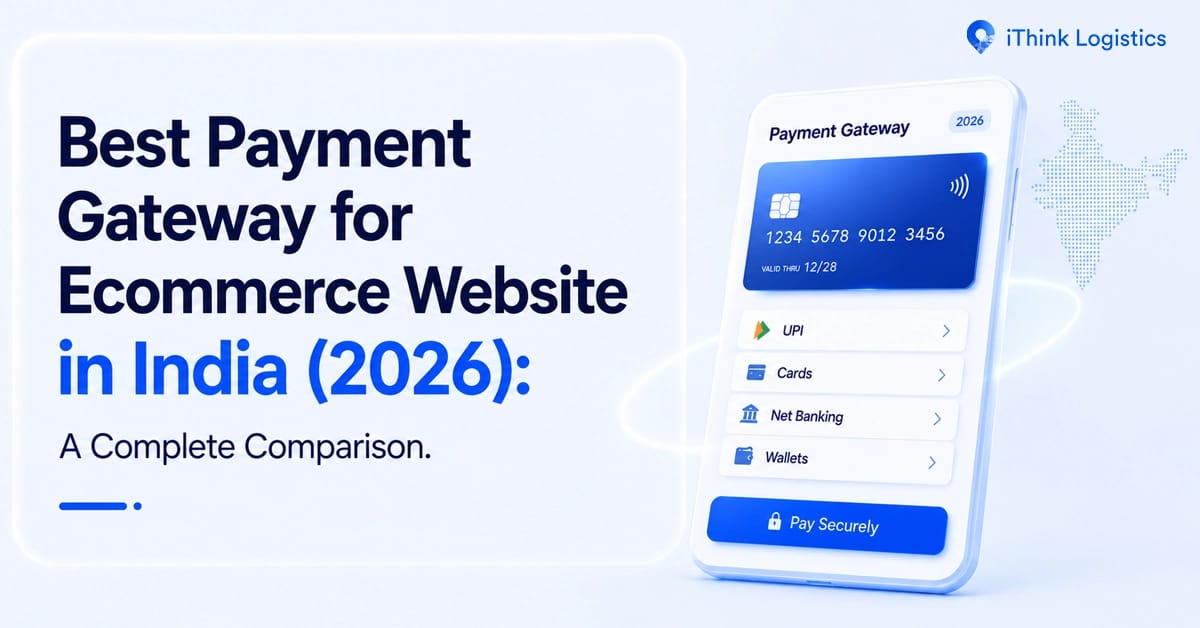
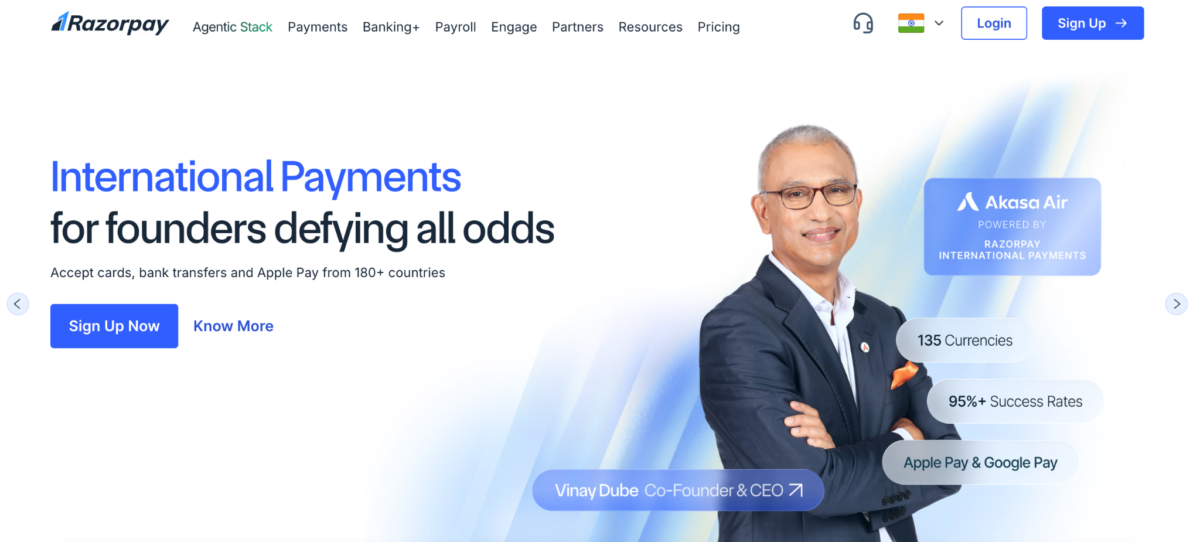
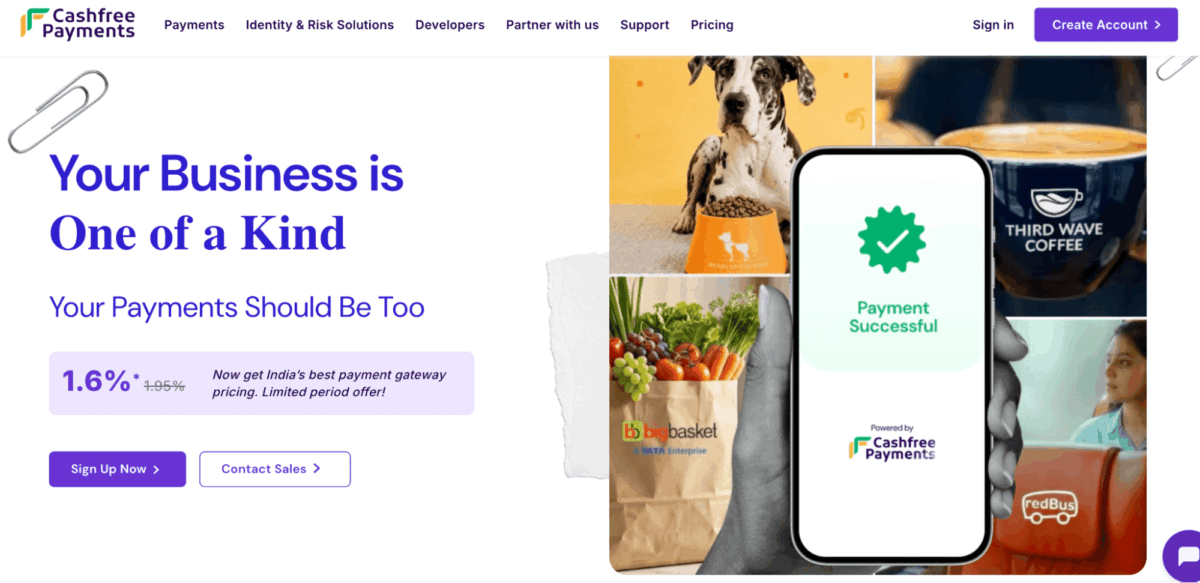
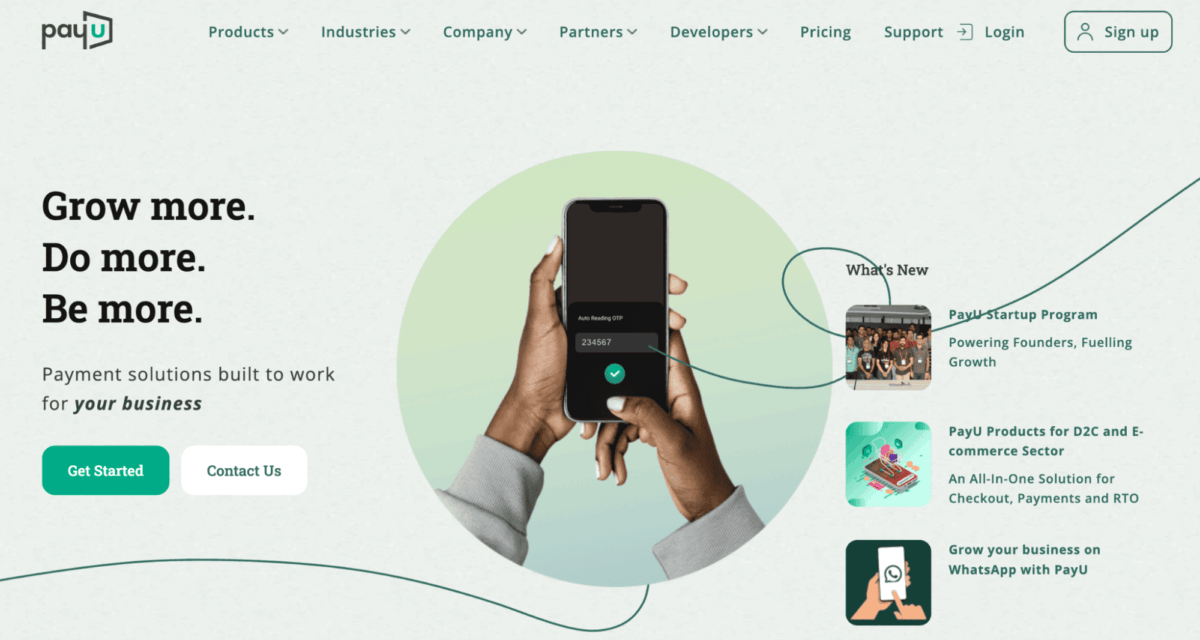
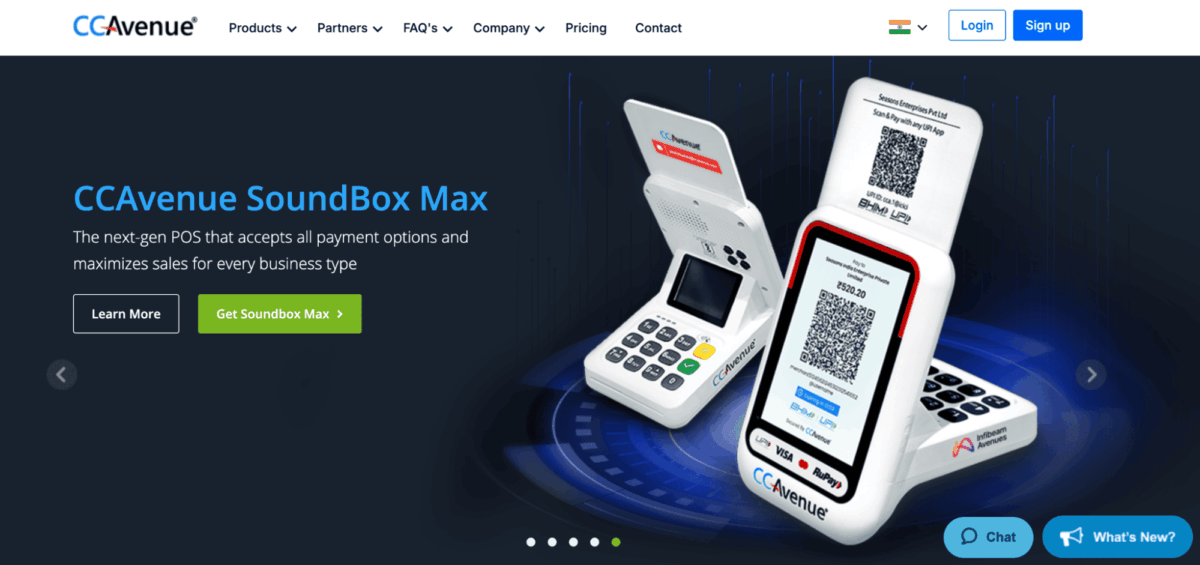
The best payment gateway for an ecommerce website in India in 2026 is Razorpay for most stores, because it combines strong UPI success rates, clean documentation, and broad payment method support at a standard 2% domestic fee. The right choice depends on your business model: Razorpay suits new and growing D2C stores, Cashfree wins on the lowest published fees and marketplace payouts, PayU leads on EMI and international transactions, and CCAvenue serves enterprise and bank-heavy use cases.
This guide explains what an ecommerce payment gateway actually does, the types of electronic payment systems available, current fees, and how to pick the gateway that fits your store.
What Is an Ecommerce Payment Gateway?
An ecommerce payment gateway is a service that securely authorizes and processes online payments between a customer and a merchant. It encrypts the customer’s card or UPI details, routes the transaction to the bank for approval, and confirms whether the payment succeeded, all within a few seconds.
In simple terms, the gateway is the digital equivalent of a card machine in a physical shop. It sits between your website’s checkout and the banking system, making sure money moves safely from the buyer’s account to yours.
How Does an Ecommerce Payment System Work?
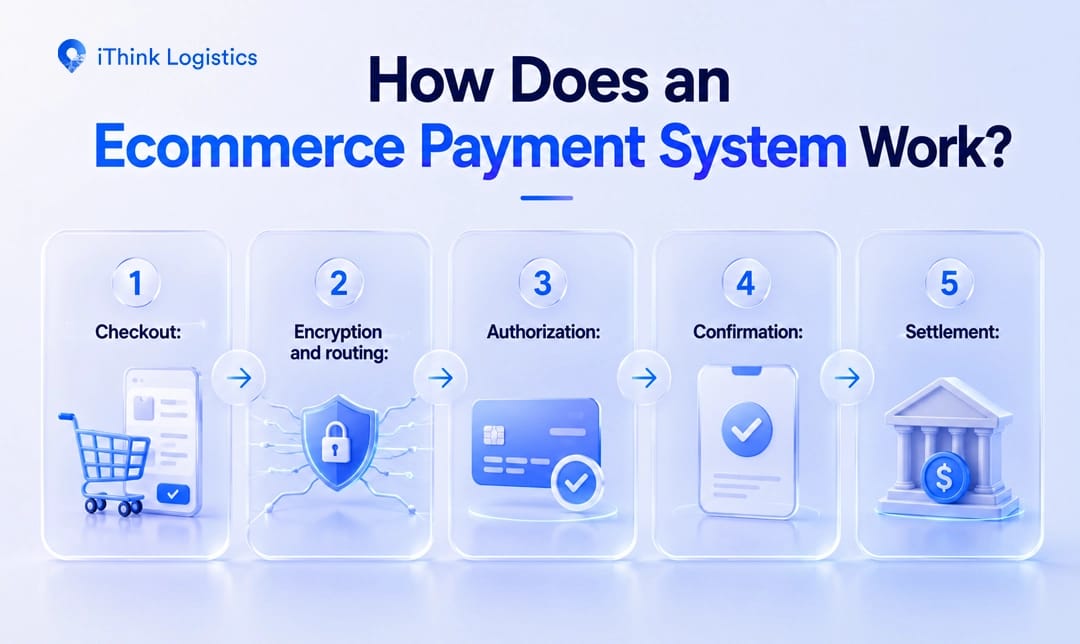
An ecommerce payment system works by passing a transaction through five steps, from checkout to settlement. Understanding this flow helps you diagnose where payments fail and why some gateways convert better than others.
Checkout: The customer selects a payment method (UPI, card, net banking, or wallet) and enters their details on your site.
Encryption and routing: The payment gateway encrypts the data and sends it to the payment processor and the customer’s bank.
Authorization: The bank verifies funds and either approves or declines the transaction.
Confirmation: The gateway returns the result to your website, and the order is created.
Settlement: The gateway transfers the collected funds to your bank account, typically within one to three business days (T+1 to T+3).
A misconfigured webhook at step four is the most common cause of “silent” payment failures, where the customer pays but the order never appears in your system.
Types of Electronic Payment Systems in Ecommerce
There are six main types of electronic payment systems used in Indian ecommerce. A good payment gateway supports most or all of them, since a shopper may prefer UPI today and EMI tomorrow.
Payment Type
How It Works
Best For
UPI
Instant bank-to-bank transfer via apps like PhonePe, Google Pay, Paytm
Most Indian transactions, especially mobile
Credit and debit cards
Visa, Mastercard, RuPay processed through the gateway
Higher-value purchases
Net banking
Direct transfer from the customer’s bank account
Customers without cards or UPI
Mobile wallets
Prepaid balance in Paytm, PhonePe, MobiKwik
Small, fast transactions
EMI and Pay Later
Splitting payment over time, or BNPL via LazyPay, Simpl
UPI dominates the Indian e-commerce payment landscape. UPI processed 228.3 billion transactions in 2025 with over 500 million unique users, which means a gateway without strong UPI support turns away a large share of buyers.
Why UPI Matters Most for Indian Ecommerce Transactions
UPI is the single most important payment method for Indian ecommerce because it has the highest success rate and the lowest cost to merchants. UPI accounted for 75% of India’s digital payments in 2025, and its instant, app-based flow reduces checkout drop-offs compared to card entry.
There is also a cost advantage built into the rules. On UPI, banks bear the merchant discount cost (not the merchant) up to ₹2,000 per transaction as per RBI rules. For stores with low average order values, this can make a meaningful share of transactions effectively free to process.
Best Payment Gateway for Ecommerce Website in India: 2026 Comparison
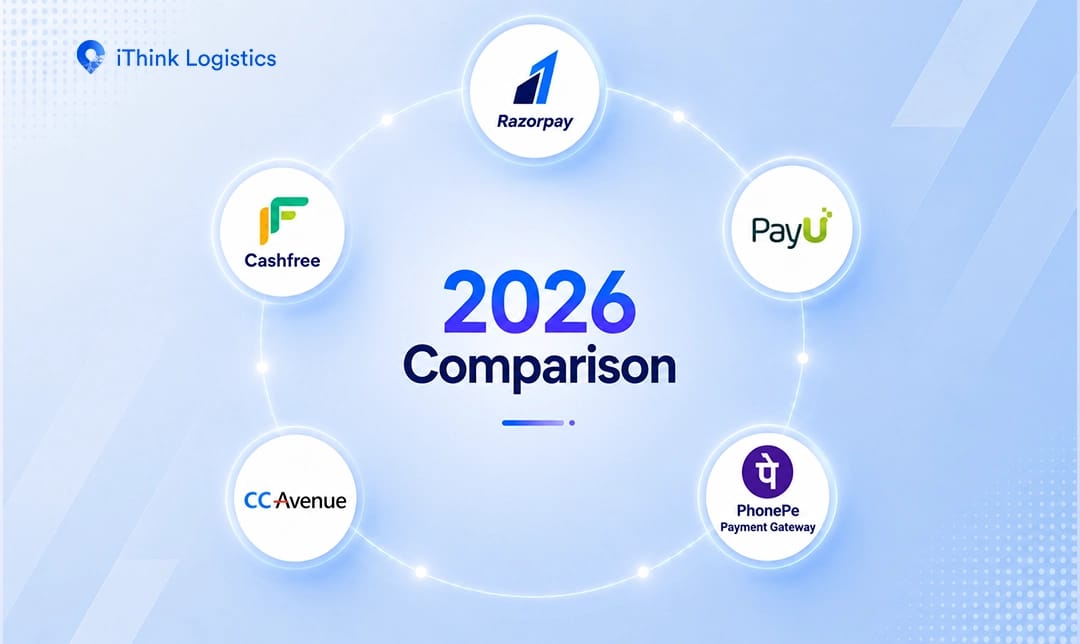
The five most widely used payment gateways for ecommerce websites in India are Razorpay, Cashfree, PayU, CCAvenue, and PhonePe Payment Gateway. Each leads in a different area, so the “best” one depends on your specific needs.
Gateway
Standard Domestic Fee
Strongest For
Watch Out For
Razorpay
~2% per transaction
New and growing D2C stores, developer experience
Standard pricing until you negotiate at scale
Cashfree
~1.75% to 1.95%
Lowest published fees, marketplace payouts
Newer player, smaller brand recognition
PayU
~2% (negotiable)
EMI, BNPL, international payments
Onboarding can take longer
CCAvenue
~2.5% standard MDR
Multi-currency, bank acceptance breadth, enterprise
Poor developer experience, negotiate the MDR
PhonePe Payment Gateway
Competitive, UPI-focused
UPI-heavy, mobile-first customer bases
Best when most customers use UPI
Razorpay: Best Overall for Most Stores
Razorpay is the most recommended gateway for new Indian ecommerce stores in 2026. Its transaction fee is around 2% per transaction across domestic cards, UPI, and net banking, and it offers strong documentation, recurring billing, and RBI-compliant UPI AutoPay for subscriptions.
Cashfree: Lowest Fees and Best for Marketplaces
Cashfree has carved out a clear niche on price and payouts. It has the edge for marketplace payouts and the lowest published transaction fees at 1.75%. If you run a marketplace that needs to split and distribute funds to multiple sellers or vendors, its payout API is purpose-built for that.
PayU: Best for EMI and International
PayU leads on flexible payment options. Its EMI tie-ups and BNPL integrations are the strongest among the major gateways, and the conversion lift from offering these on big-ticket items often outweighs any small fee difference. It is also a strong choice for stores selling internationally.
CCAvenue: Best for Enterprise and Multi-Currency
CCAvenue is one of the oldest gateways in India and supports a very wide range of payment options and currencies. It suits enterprise, government, and education use cases. The trade-off is a dated developer experience, so it fits traditional businesses more than developer-led startups.
How To Choose a Payment Gateway for Your Ecommerce Website
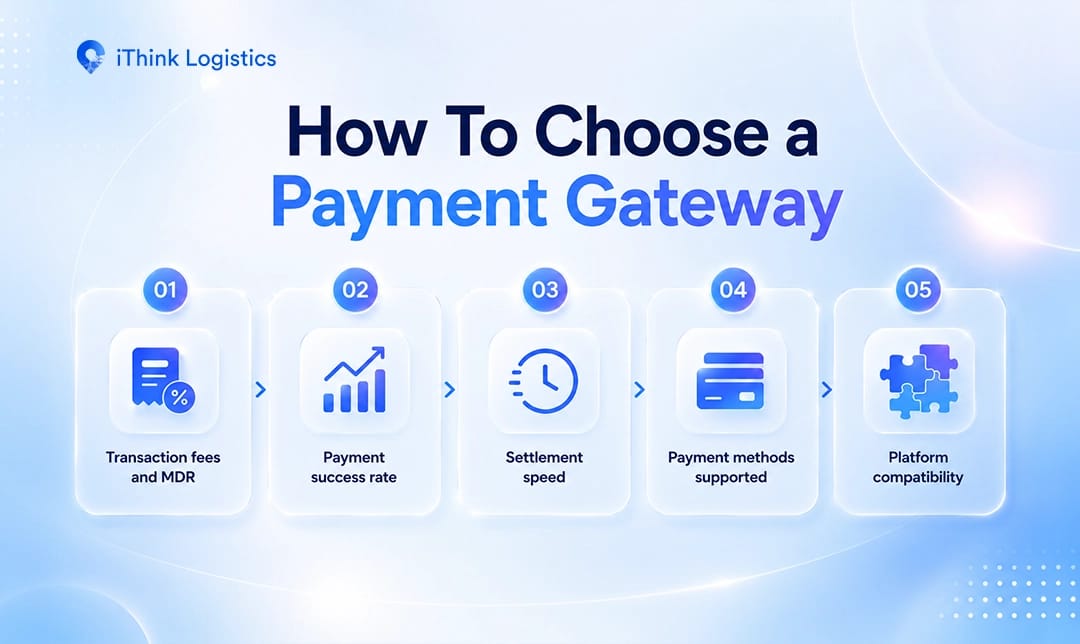
To choose a payment gateway for your ecommerce website, weigh five factors against your business model rather than chasing the lowest advertised fee. The cheapest sticker price is often not the cheapest gateway once hidden costs are included.
Transaction fees and MDR: Even a 0.25% difference adds up. On ₹1 lakh of monthly sales, 0.25% is ₹250 per lakh, which compounds across a year.
Payment success rate: A higher success rate directly recovers lost sales. This is the cost most founders overlook.
Settlement speed: Faster settlement (T+1 versus T+3) improves your working capital, which matters most for growing stores.
Payment methods supported: Confirm UPI, all major cards, net banking, wallets, and EMI or BNPL are covered.
Platform compatibility: Make sure the gateway integrates cleanly with your platform, whether Shopify, WooCommerce, or a custom site.
The Shopify India Consideration
If you sell on Shopify in India, factor in an extra cost. Because Shopify Payments is not available in India, Shopify charges an extra 2% transaction fee on every order on top of your gateway’s 2%, so Indian Shopify sellers effectively pay around 4% per order unless they use a platform without that surcharge.
Cheap vs. Best: Why the Lowest Fee Is Not Always the Cheapest
A gateway with a lower percentage fee can cost more once fixed charges are included. The right goal is the best net return per rupee at checkout, not the lowest headline rate.
Consider a real comparison. A gateway at 1.8% with a ₹4,999 annual maintenance charge costs a startup processing ₹1 lakh per month a total of ₹26,599 per year, while a gateway at 2% with zero AMC costs ₹24,000 per year, making the “cheaper” 1.8% option actually 11% more expensive. Always calculate total annual cost, including setup and maintenance fees, before deciding.
Should You Use More Than One Payment Gateway?
Many Indian ecommerce stores use two gateways, and this is a sound strategy past a certain scale. A common setup is one domestic gateway like Razorpay or Cashfree for Indian customers, plus a second gateway like PayU or Stripe for international buyers or EMI.
A practical rule: start with a single well-supported gateway, and add a second once you cross roughly ₹50 lakh per month or need a specific capability your first gateway handles weakly, such as marketplace payouts or USD settlement.
Frequently Asked Questions
What is the cheapest payment gateway for ecommerce in India?
At standard pricing, Cashfree (around 1.75% to 1.95%) and similar low-fee gateways are among the cheapest for domestic transactions. However, the true cost depends on annual maintenance charges, setup fees, and your payment success rate, so calculate the total yearly cost rather than comparing percentages alone.
Is UPI free for ecommerce merchants?
UPI is effectively free to the merchant on transactions up to ₹2,000, because banks bear that cost under RBI rules. Above ₹2,000, or on cards and net banking, the gateway’s merchant discount rate applies and comes out of your revenue.
How long does it take to receive money from an ecommerce payment gateway?
Most Indian gateways settle funds to your bank account within T+1 to T+3 business days. Some gateways offer faster or instant settlement options, often for an additional fee.
Which payment gateway is best for a Shopify store in India?
Razorpay is the most commonly recommended gateway for Indian Shopify stores because of its official integration and reliable UPI support. Remember that Shopify adds its own 2% transaction fee on top of the gateway fee for Indian sellers, so factor in the combined cost.
What is the difference between a payment gateway and a payment system?
A payment gateway is the specific service that authorizes and processes a single transaction at checkout. An ecommerce payment system is the broader setup that includes the gateway, the payment methods you accept, the bank settlement process, and the security and reconciliation around it.
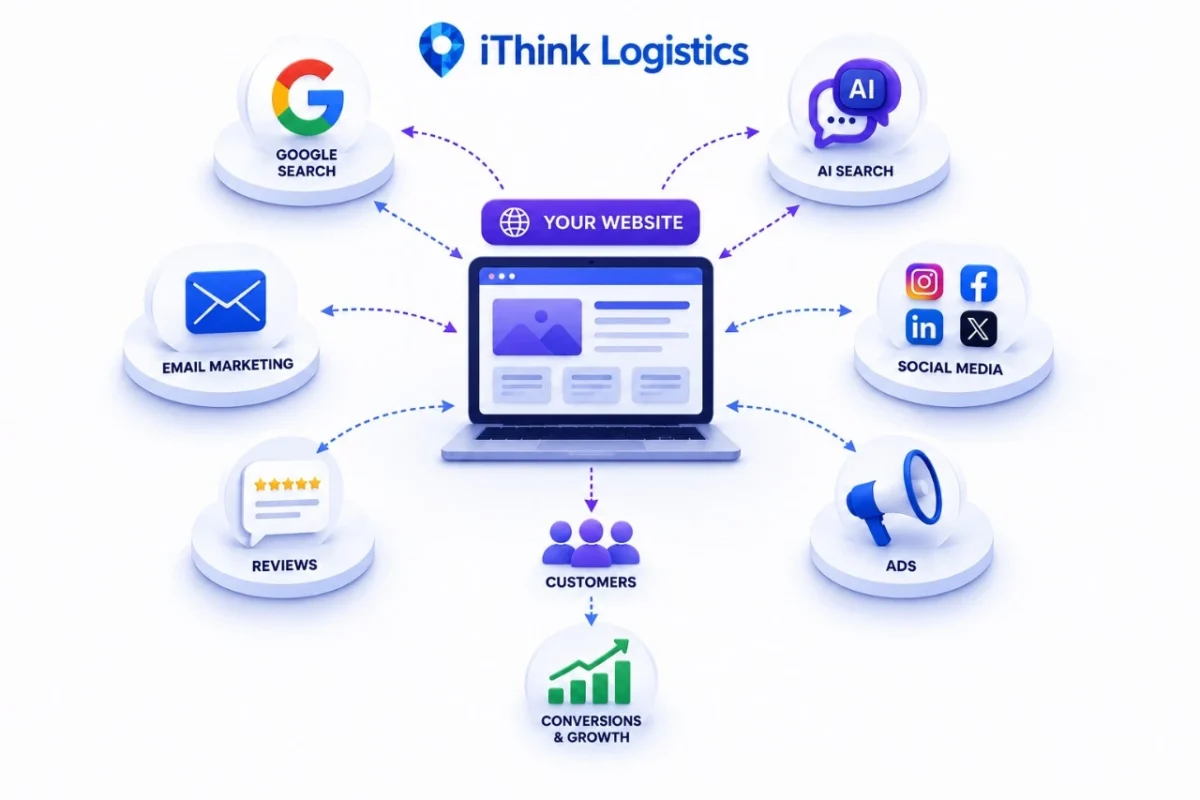
To promote your business in 2026, you combine AI search optimization, local visibility tactics, social media content, and owned channels like email into one connected system. The most effective approach treats your website, Google Business Profile, social platforms, and AI answer engines as a single visibility loop rather than separate channels. Businesses that show up across Google, ChatGPT, and local search win more customers than those relying on a single platform.
This guide covers the exact content marketing methods that work right now, from free local tactics to paid campaigns, with specific steps you can act on this week.
What Is the Fastest Way To Promote Your Business in 2026?
The fastest way to promote your ecommerce business is to claim and optimize your free profiles first, then layer paid promotion on top. Free channels like Google Business Profile, organic social posts, and email cost nothing and start working within days. Paid channels like ads scale faster but require a budget.
Here is the order that produces results quickest:
Claim your Google Business Profile and complete every field. This is the single highest-return action for local businesses.
Set up one social media profile where your customers actually spend time, not all of them at once.
Start collecting email addresses from existing customers through a simple signup.
Ask your happiest customers for reviews on Google and relevant platforms.
Publish one helpful piece of content that answers a question your customers ask often.
How To Promote Your Business Locally
To promote your business locally, you optimize for “near me” searches, build a strong Google Business Profile, and earn local reviews. Local promotion targets customers within driving distance who are ready to buy, which makes it one of the highest-converting forms of marketing for physical businesses.
Optimize Your Google Business Profile
Your Google Business Profile is the foundation of local promotion. Complete your business name, address, phone number, hours, categories, and services. Add photos of your storefront, products, and team. Post weekly updates, since active profiles rank higher in the local map pack.
Earn and Respond to Reviews
Reviews drive both rankings and trust. Ask every satisfied customer to leave a Google review, and respond to all reviews within 48 hours. Businesses with 50 or more reviews convert significantly better than those with fewer than 10.
Build Local Citations
A citation is any online mention of your business name, address, and phone number. List your business consistently across directories like Justdial, Sulekha, IndiaMART, and industry-specific platforms. Inconsistent details across these listings confuse search engines and lower your local ranking.
Local Promotion Tactics Compared
Tactic
Cost
Time to Results
Best For
Google Business Profile
Free
1 to 2 weeks
All local businesses
Local SEO content
Low
2 to 4 months
Service businesses
Local Google Ads
Medium to High
Immediate
Urgent demand (plumbers, clinics)
Community events
Low
1 to 3 months
Restaurants, retail, salons
Local influencer posts
Medium
2 to 6 weeks
Cafes, boutiques, gyms
How To Promote Your Business Online
To promote your business online, you build visibility across four channels: search engines, AI answer engines, social media, and email. Each channel reaches customers at a different stage, so combining them creates a system where prospects encounter your brand repeatedly before they buy.
Optimize for AI Search and Answer Engines
In 2026, a growing share of buyers ask ChatGPT, Gemini, and Perplexity for recommendations instead of scrolling through Google links. To get cited in these AI answers, your content needs clear definitions, structured data, and standalone facts that an AI can extract. Write content that directly answers the questions your customers ask, using specific numbers and named details rather than vague claims.
Build a Conversion-Ready Website
Your website is the only channel you fully own. Make sure it loads in under three seconds, works on mobile, and tells visitors exactly what you do within the first screen. Every page should have a clear next step, whether that is a call button, a form, or a purchase option.
Start an Email List
Email returns more per rupee spent than almost any other channel. Collect addresses through a discount offer, free resource, or simple newsletter signup. Send a useful email at least twice a month so subscribers remember you when they are ready to buy.
How To Promote Your Business on Social Media
To promote your business on social media, you pick one or two platforms where your audience is active, post consistently, and focus on content that solves problems or entertains rather than just selling. Spreading yourself thin across every platform produces weak results, while going deep on the right one builds a real audience.
Choose the Right Platform
Match the platform to your business type and audience:
Instagram and Reels work for visual businesses: food, fashion, fitness, beauty, travel, and design.
LinkedIn works for B2B services, consultants, and professional brands targeting decision-makers.
YouTube works for businesses that can teach, demonstrate, or explain, building long-term searchable content.
WhatsApp Business works for direct customer relationships, order updates, and local retail in India.
Facebook still works for community groups, local services, and older demographics.
Post Content That People Actually Want
The most effective social content falls into a few proven categories: behind-the-scenes looks at your business, answers to common customer questions, customer success stories, quick tips related to your field, and timely takes on industry news. Aim for an 80/20 balance, where 80% of posts provide value and only 20% directly promote your offers.
Be Consistent, Not Constant
A realistic posting rhythm beats sporadic bursts. Three to four quality posts per week on one platform outperforms daily posting that you cannot sustain. Consistency signals reliability to both the algorithm and your audience.
How To Promote a Brand vs. a Product
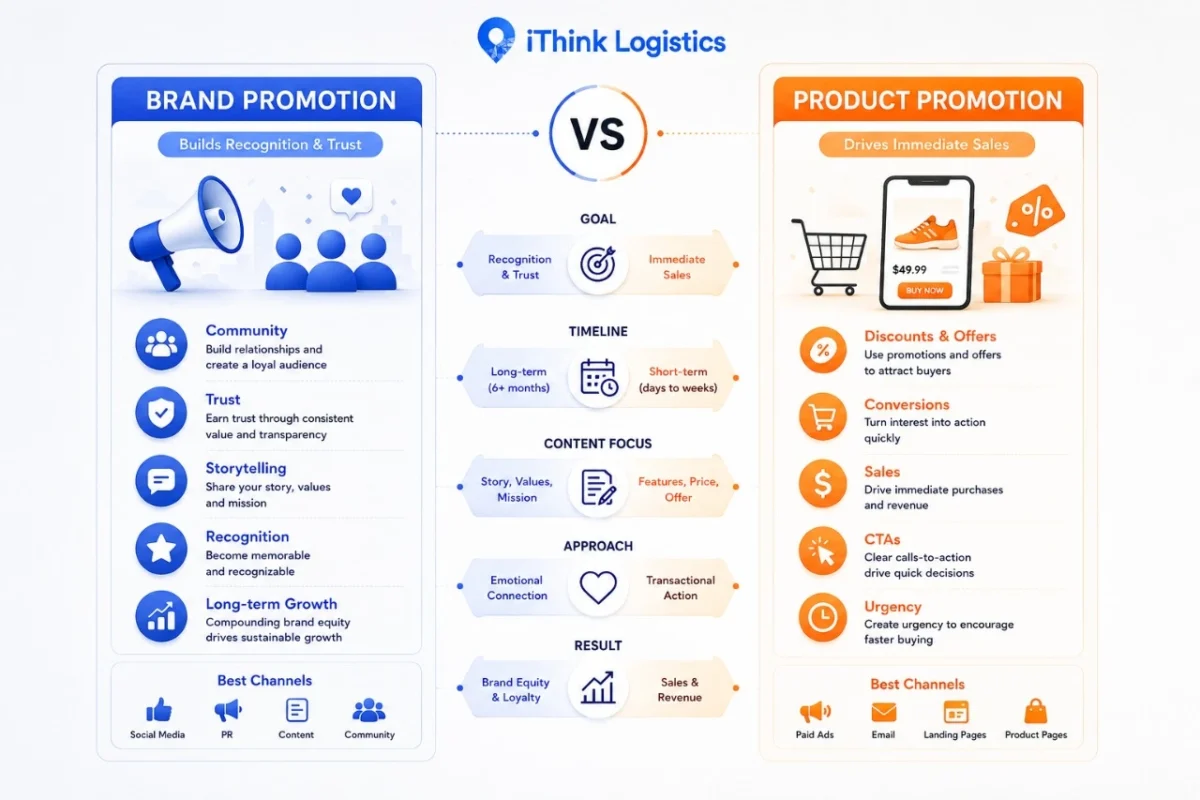
Promoting a brand and promoting a product require different approaches, though they support each other. Brand promotion builds long-term recognition and trust, while product promotion drives immediate sales. A healthy strategy invests in both.
Dimension
Brand Promotion
Product Promotion
Goal
Recognition and trust
Immediate sales
Timeline
Long-term (6+ months)
Short-term (days to weeks)
Content focus
Story, values, mission
Features, price, offer
Best channels
Social, PR, content
Ads, email, landing pages
How to measure
Branded search, recall
Conversions, revenue
To promote a brand, you tell a consistent story across every touchpoint. Use the same name, tone, colors, and core message everywhere a customer might find you. This consistency is what turns scattered marketing into a recognizable identity.
Free vs. Paid Promotion: Which Should You Use?
Both free and paid promotion have a place, and the right mix depends on your budget and timeline. Free methods build durable, compounding visibility but take months. Paid methods deliver immediate traffic but stop the moment you stop paying.
A practical approach for scaling ecommerce businesses in 2026 is to invest 70% of effort into free, owned channels that compound over time, and 30% into paid promotion to accelerate growth and test what converts. As your free channels mature, you can shift more budget toward paid scaling.
A 90-Day Plan To Promote Your Business
Here is a realistic sequence to promote your business over your first 90 days:
Days 1 to 14: Claim and fully optimize your Google Business Profile, set up one social platform, and build a simple one-page website if you do not have one.
Days 15 to 30: Start collecting email addresses, publish your first three pieces of helpful content, and request reviews from past customers.
Days 31 to 60: Establish a consistent social posting rhythm, send your first email campaign, and list your business across relevant local directories.
Days 61 to 90: Launch a small paid ad test, double down on the content and channels showing traction, and set up tracking to measure what works.
Frequently Asked Questions
How can I promote my business with no money?
You can promote your business for free using your Google Business Profile, organic social media posts, email to existing contacts, customer reviews, and helpful content that ranks in search. These methods take time but cost nothing beyond your effort.
How long does it take to see results from business promotion?
Paid ads can drive traffic the same day, while free methods like SEO and organic social typically take two to four months to gain momentum. Local tactics like Google Business Profile optimization often show results within one to two weeks.
Which is better for promotion: social media or Google?
Both serve different purposes. Google captures people actively searching for what you offer, while social media builds awareness among people who are not yet looking. Most successful businesses use both rather than choosing one.
How do I promote my business on social media without paying for ads?
Post valuable content consistently on one platform, engage with comments and other accounts in your niche, use relevant hashtags and keywords, collaborate with complementary businesses, and share customer stories. Organic reach rewards consistency and engagement.
You found a product that sells. Customers want it, margins look good, and orders are picking up. But then your supplier delivers late. The next batch has quality issues. Suddenly, your bestseller has 3-star reviews and a stockout warning.
That’s a sourcing problem.
Sourcing means finding and picking the right suppliers. When you get it right, your costs, quality, and delivery timelines work in your favor. Get it wrong, and the rest of your business pays the price.
Here’s what sourcing really means, the main types, how the process works, how it’s different from procurement, and what it looks like for Indian ecommerce sellers.
What Is Sourcing?
Sourcing is the process of identifying, evaluating, and selecting suppliers to provide the goods and services a business needs to operate. It serves as the foundational phase of supply chain management (SCM), occurring before any purchasing.
That’s the sourcing meaning at its simplest. But in practice, it covers a lot of ground.
Day to day, sourcing involves researching the market for potential suppliers, comparing their capabilities and pricing, negotiating contract terms, and checking whether they can consistently meet your quality standards.
It is the groundwork that decides who you buy from, at what price, and under what conditions.
The term applies to two main contexts. In business and supply chain management, sourcing means finding vendors for products, raw materials, or services.
In HR and recruitment, it means proactively finding job candidates for open roles. Both share the same core idea: identifying the best resource before committing.
This guide focuses on business sourcing, specifically for sellers and business owners who source products to sell or materials to manufacture.
Before going further, one confusion needs to be cleared up. Sourcing and procurement are not the same thing.
Sourcing vs Procurement: What’s the Difference?
These two terms get used interchangeably, but they refer to different stages of the supply chain.
Sourcing is the “who.” It is the research and strategy phase where you find and evaluate vendors and negotiate terms. Procurement is the “what.”
It is the transactional phase where you place orders, receive goods, process invoices, and make payments. Sourcing decides where to buy from. Procurement handles the actual buying.
Once you understand that sourcing is the selection phase, the next question is, what types of sourcing can a business use?
6 Types of Sourcing
Businesses choose their sourcing approach based on what they sell, where their suppliers are, and how much control they need over quality and cost.
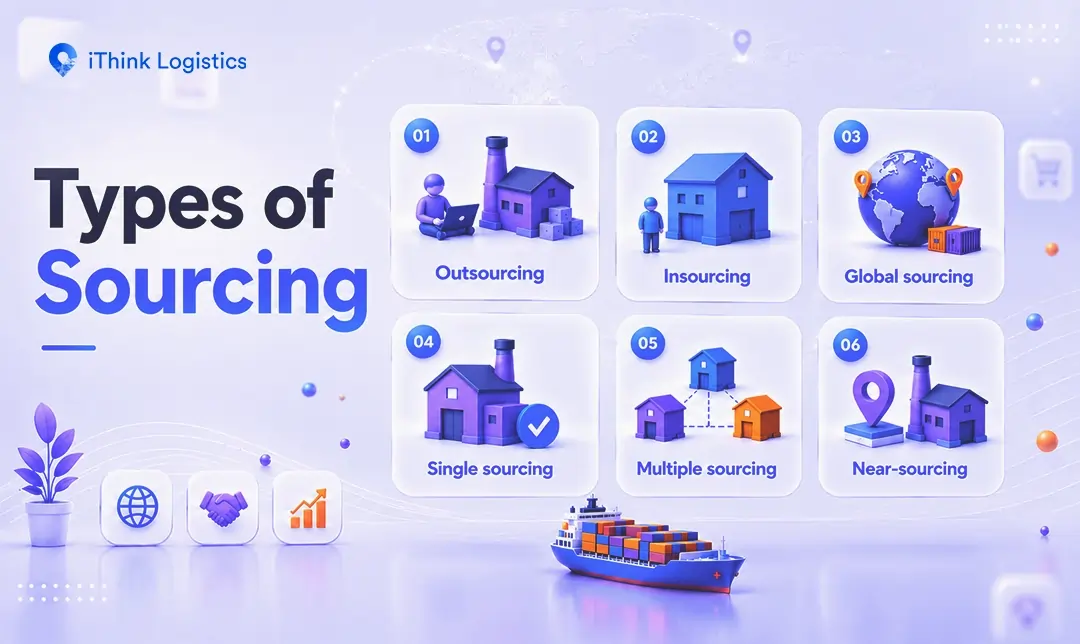
Here are the six most common types of sourcing in supply chain management.
1. Outsourcing
Hiring a third party to handle tasks your business doesn’t do in-house. For online sellers, this often means outsourcing manufacturing while you focus on branding, marketing, and sales.
It frees up time but gives you less direct control over production quality.
2. Insourcing
Handling production or operations internally instead of hiring an external vendor.
If a clothing brand buys its own screen printing equipment instead of paying a vendor, that’s insourcing. You control quality and output, but you’ll need to invest more upfront in equipment and staff.
3. Global sourcing
Buying products or raw materials from other countries to get better prices or expertise. Material sourcing from overseas is common among Indian D2C brands, whether it’s electronics from Shenzhen or fabrics from Bangladesh.
The catch: longer lead times, customs paperwork, and currency fluctuation risks.
4. Single sourcing
Relying on one supplier for a product or material. You build a strong relationship, simplify operations, and often get better pricing for your loyalty.
The risk is obvious: if that one supplier fails, your entire supply chain grinds to a halt.
5. Multiple sourcing
Working with several suppliers for the same product or material. This spreads your risk and gives you more leverage, as no single supplier can call the shots.
The downside: more coordination, more quality checks, and more relationships to manage.
6. Near-sourcing
Sourcing from suppliers in your region or nearby. You cut transport costs, get faster deliveries, and can actually visit the factory if needed.
For an Indian seller based in Mumbai, sourcing garments from Surat rather than importing from China is a near-sourcing option.
Most businesses don’t pick one model. A D2C skincare brand might source ingredients globally, have printing and labeling done by a local vendor, and outsource manufacturing to a contract facility.
The right mix depends on your product, margins, and how much risk you can absorb.
Knowing the types helps you pick a model. But the actual sourcing work follows a structured process.
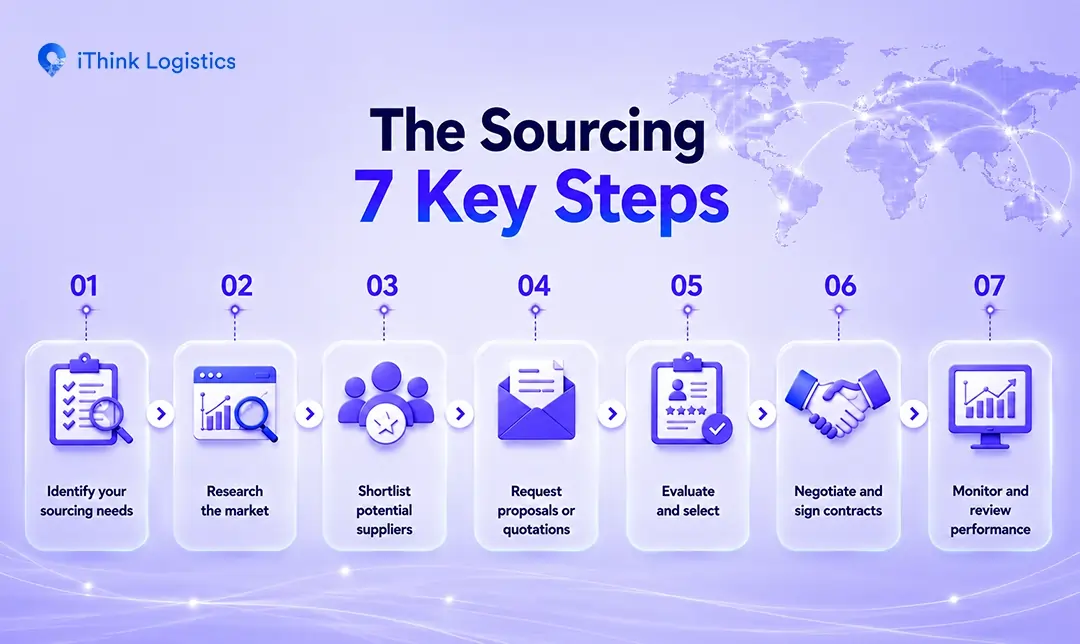
The Sourcing Process: 7 Key Steps
Whether you’re sourcing for the first time or switching suppliers, the steps are the same.
1. Identify your sourcing needs
List exactly what you need, like products, materials, quantities, quality standards, and lead times. This sets the scope for everything else.
2. Research the market
Find suppliers who fit your needs. For product sourcing, this means checking IndiaMART or Alibaba, talking to industry contacts, visiting trade shows like the Canton Fair, or searching manufacturer directories.
3. Shortlist potential suppliers
Filter by capacity, price, location, reputation, and minimum order size. Always ask for samples before you commit.
4. Request proposals or quotations
Send RFQs (Request for Quotation) or RFPs (Request for Proposal) to your shortlisted suppliers. This way, you compare everyone on the same terms.
5. Evaluate and select
Compare proposals for price, quality, delivery, payment terms, and reliability. Cheapest isn’t always best. Pick the supplier who gives you the most value overall.
6. Negotiate and sign contracts
Lock in pricing, minimum order quantities, delivery schedules, payment terms, quality benchmarks, and penalties for non-compliance. Get everything in writing before your first order.
7. Monitor and review performance
Track delivery, quality, and your supplier’s responsiveness. Review regularly. If a supplier keeps missing the mark, start looking for a backup before you’re in urgent need of a material or product.
Good sourcing is not a one-time exercise. It means continuously evaluating your suppliers and the market, especially as your order volumes grow and your quality standards tighten.
That’s the process for tactical, day-to-day sourcing. Strategic sourcing takes it a level deeper.
What Is Strategic Sourcing?
Strategic sourcing is a long-term, data-driven approach to supplier selection that looks beyond the lowest price.
Instead of picking the supplier with the cheapest quote, this approach evaluates total value: can this supplier deliver consistently as your business scales from 100 orders a month to 10,000? Will they hold quality, meet deadlines, and adjust pricing as your volumes grow?
That’s the difference from tactical sourcing. Tactical is short-term. You need raw materials this month, so you need to find the fastest available option.
Strategic sourcing is the opposite. You evaluate the full market, test multiple vendors, lock in long-term contracts, and regularly review performance.
For e-commerce sellers, this shift usually happens once your first supplier relationship is stable and you start thinking about growth, backup options, and better terms.
Strategy is one part of good sourcing. But where you source from also carries responsibilities around ethics and sustainability.
Responsible and Ethical Sourcing
Where you source from says as much about your brand as what you sell.
Responsible sourcing means choosing suppliers who follow fair labor practices, maintain environmentally sustainable production, and conduct business transparently.
It is not just a corporate buzzword. Customers, marketplace platforms, and regulators are all paying closer attention to how products are made.
For Indian e-commerce sellers, this is becoming harder to ignore. Platforms like Amazon and Flipkart have compliance and quality documentation requirements for sellers.
D2C brands that can trace their supply chain and prove ethical sourcing practices have an edge in customer trust, especially in categories like food, personal care, and apparel.
A related concept worth knowing is impact sourcing. This involves intentionally employing people from underserved or disadvantaged communities as part of your supply chain operations.
It is more common in BPO and services, but the principle applies wherever sourcing includes hiring decisions.
Ethics aside, sourcing also has very practical challenges every business faces.
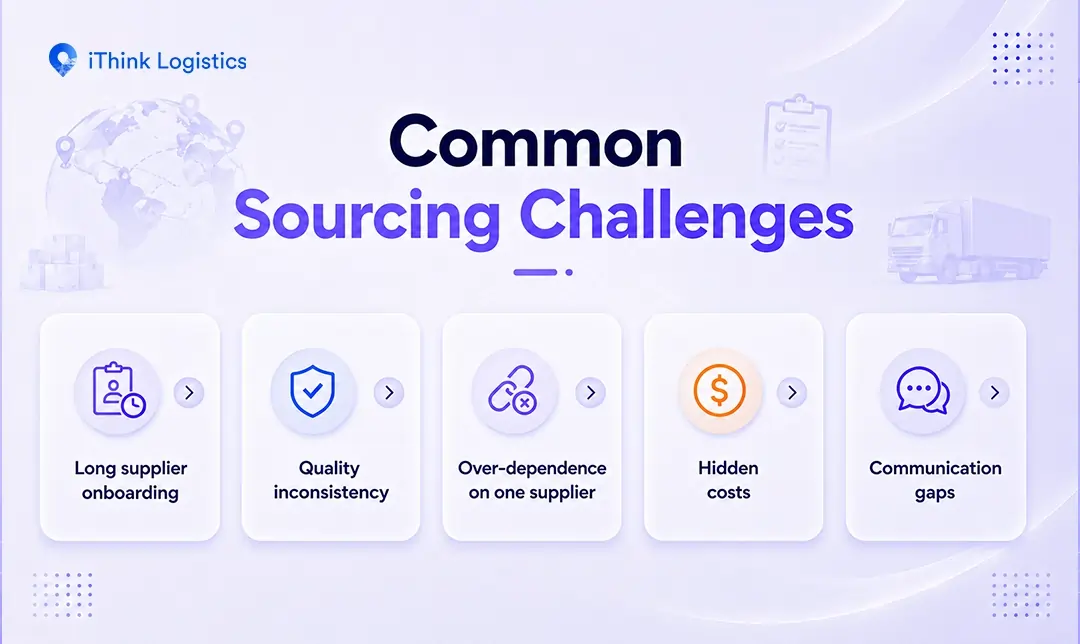
Top 5 Common Sourcing Challenges
Even with the right vendor in place, sourcing comes with its own set of problems.
1. Long supplier onboarding
Vetting, sampling, negotiations, and approvals can stretch across weeks or months before your first order ships. For a business owner launching a new product, this delay can mean missing an entire sales season.
2. Quality inconsistency
A vendor sends perfect samples, then drops standards on bulk orders. The risk increases when your vendor is overseas, and you cannot inspect production in person.
3. Over-dependence on one supplier
If your only supplier faces a production halt, floods, a factory shutdown, or a raw material shortage, your entire business stops with them.
4. Hidden costs
The quoted price per unit rarely tells the full story. Customs duties, shipping charges, packaging, defect replacements, and minimum order quantity (MOQ) requirements can significantly increase your actual landed cost, sometimes by 15-30% over the original quote, depending on the product category and country of origin.
5. Communication gaps
Timezone differences, language barriers, and slow response times create delays that ripple through your restocking schedule. One missed email from a supplier can push your next shipment back by a week.
These challenges are exactly why sourcing matters more than most sellers realize. Here’s what good sourcing actually does for your business.
4 Benefits of Effective Sourcing
When sourcing is done right, it affects everything from your product margins to your customer reviews.
1. Lower costs
Strategic supplier selection and negotiation directly reduce your unit cost. Even a small improvement in sourcing terms compounds across hundreds or thousands of orders every month.
2. Better product quality
The right vendor delivers consistent output that matches your brand expectations. Fewer defects mean fewer returns, fewer refunds, and better ratings on your product listings.
3. Supply chain reliability
Strong supplier relationships mean predictable delivery schedules. You restock on time, avoid stockouts, and keep your listings active, rather than losing ranking to an “out of stock” tag.
4. Reduced risk
Working with multiple vetted suppliers means one disruption does not shut down your entire operation. If Supplier A faces a delay, Supplier B keeps your orders moving.
Competitive advantage
Better sourcing gives you better products at better prices. That shows up on your product page, in your reviews, and in your repeat purchase rate.
All of this matters most when you’re sourcing products to sell online. Here’s what that looks like in practice.
Sourcing for Ecommerce Sellers: What It Looks Like in Practice
Most sourcing guides are written for procurement teams at large companies. If you run an ecommerce business or a D2C brand, the reality looks different.
What does supplier sourcing mean for most Indian sellers? It starts with finding a manufacturer or supplier for the product they want to sell.
That could mean browsing IndiaMART for a private-label skincare manufacturer, visiting a trade fair in Delhi for textile suppliers, or negotiating directly with a factory in Surat for custom apparel.
Some sellers source finished goods from wholesalers on platforms like Alibaba. Others source raw materials and get them assembled by a contract manufacturer.
The model varies, but the sourcing fundamentals stay the same: find a reliable supplier, negotiate fair terms, and verify quality before committing.
What most guides miss is that sourcing does not end when you pick a supplier. Where your supplier is located, how they package products, and how quickly they can produce and dispatch directly affect your shipping costs and lead times.
A supplier in Jaipur shipping to a customer in Kochi has very different logistics math than a supplier based in the same city as your warehouse.
Once your products are sourced and ready to ship, logistics platforms like iThink Logistics help you compare courier rates, automate tracking, and manage delivery exceptions from a single dashboard.
Conclusion
Sourcing is one of those things that quietly shapes every part of your business. The product your customer holds, the price they paid, and whether it arrived on time all trace back to the supplier you chose.
How do you source your products? Found a reliable supplier or still figuring it out? Tell us in the comments.
If you’re an ecommerce seller looking to streamline shipping after sourcing, iThink Logistics helps you compare multi-carrier rates, automate tracking, and manage NDRs from a single dashboard.
Have more questions about sourcing? Here are the ones people ask about most.
FAQs
Q.1: How do I find reliable suppliers in India as a first-time seller?
A: Start with IndiaMART for domestic manufacturers and Alibaba for international ones. Attend trade shows like the India International Trade Fair (Delhi) or the Canton Fair (China) for face-to-face vetting. Always request product samples before placing a bulk order, and check the vendor’s GST registration, business age, and client references before signing anything.
Q.2: What legal or compliance checks should I do before finalizing a supplier?
A: Verify GST registration, business registration documents (like the Udyam certificate for MSMEs), and any category-specific licenses (FSSAI for food, BIS for electronics). If you sell on Amazon or Flipkart, check their seller compliance requirements as well, since both platforms can suspend listings that lack proper documentation.
Q.3: What negotiation tactics work best with Indian suppliers?
A: Get quotes from at least 3-4 vendors before negotiating. Use competing quotes as bargaining chips. Negotiate not just unit price but also payment terms (net-30 vs advance), MOQ flexibility, defect replacement policies, and delivery penalties. Longer commitments often unlock better rates, so offering a 6-month or 12-month volume projection can help.
Q.4: How do I handle supplier quality drops after the first few orders?
A: Set clear benchmarks in your contract: acceptable defect rates, material specifications, and packaging standards. Inspect a random sample from every bulk order before accepting it. If a vendor consistently misses benchmarks after 2-3 orders, start sourcing a backup before you’re stuck.
Q.5: Are there sourcing platforms beyond IndiaMART and Alibaba for Indian sellers?
A: Yes. TradeIndia and ExportersIndia are domestic alternatives. For global sourcing, Global Sources and Made-in-China are widely used. For niche categories, industry-specific directories and local manufacturer associations often feature vendor listings that don’t appear on the big platforms.
Q.6: What is the difference between direct and indirect sourcing?
A: Direct sourcing means buying materials or products used in your final product, like fabric for a clothing brand. Indirect sourcing means buying items your business needs to operate but does not sell, such as office supplies, software subscriptions, or logistics services.
Q.7: What does sourcing mean in supply chain management?
A: In supply chain management, sourcing is the first step where businesses find and select vendors for raw materials, components, or finished goods. It sets the foundation for procurement, manufacturing, and distribution. Everything that happens downstream in the supply chain depends on who you choose to source from.
Shipping a product costs money. But how much, and why, is where most businesses lose track.
Freight charges show up on every invoice, every shipment, and every quarter-end cost review. Yet most business owners cannot fully explain what they are paying for, which mode is cheapest for their cargo type, or how to bring those numbers down.
This guide answers exactly that: what is freight charges, what types exist (air, ocean, rail, and container), what actually drives costs, how to calculate them, and what Indian businesses specifically need to know before their next shipment.
What Are Freight Charges? Meaning and Definition
Freight charges are the fees paid by a shipper or consignee to a carrier or logistics provider for transporting goods from a point of origin to a destination by air, sea, rail, or road.
Freight charges are also referred to as “freight costs,” “shipping fees,” “transportation charges,” or “logistics expenses,” depending on the mode of transport and industry context.
Carriers calculate them based on the weight, volume, distance, mode of transport, and nature of goods being moved.
In simpler terms, it is the price of your cargo (parcel) pays to deliver from one place to another.
Freight charges apply every time a product moves from manufacturer to warehouse, warehouse to fulfillment center, or seller to customer.
A 500g package delivering to a customer in Pune carries a freight charge. So does a full truckload moving between your warehouses. They show up on every shipping invoice, affect every product’s final cost, and directly impact how competitively a business can price its goods.
Freight Amount, Freight Value, Freight Expenses: What are the differences?
These terms appear across invoices, accounting sheets, and trade documents. They are related but not the same.
Term
What It Means
Where You Will See It
Freight charges
The total fee paid to transport goods
Shipping invoices, logistics contracts
Freight amount
The exact rupee or dollar figure billed for a specific shipment
Invoice line items
Freight value
The declared worth of goods being shipped, used for insurance and customs duty calculation
Customs declarations, insurance forms
Freight expenses
How transportation costs are recorded in a company’s books
P&L statements, accounting ledgers
Freight Charges Meaning in Accounting
Freight charges sit under operational expenses in business accounting, but where exactly depends on the direction of the shipment.
Freight-in covers the cost of bringing goods into your business. Raw materials arriving at your factory, inventory reaching your warehouse. Businesses add this to their cost of goods sold (COGS), which directly affects gross margin.
Freight-out covers the cost of sending goods to customers or other locations. This sits under selling or distribution expenses on your P&L, separate from COGS.
Getting this distinction right is not just accounting hygiene. Misclassifying freight-in as freight-out distorts gross margin reporting and leads to pricing decisions built on wrong numbers.
Freight Prepaid: the shipper (seller) pays the freight charges before dispatch
Freight Collect: the consignee (buyer) pays upon delivery
FOB Origin: the buyer takes ownership at the origin point and bears all freight costs from there
FOB Destination: the seller retains ownership until delivery and covers all freight charges
For most ecommerce businesses in India shipping domestically, the seller pays freight charges upfront and either absorbs them into product pricing or passes them on as a visible shipping fee at checkout.
Understanding what freight charges mean is step one. The next question is what type of freight charge applies to your shipment, because air, ocean, rail, and container freight each work very differently.
Types of Freight Charges in Logistics and Shipping
The mode of transport your business chooses determines how costs are calculated, what surcharges apply, and how much flexibility you get on delivery timelines.
Air Freight Charges: Speed vs Cost
Air freight is the fastest way to move goods across long distances. Shipments typically reach international destinations within 1 to 3 days.
Airlines charge based on chargeable weight, whichever is higher between actual weight and volumetric weight.
Volumetric weight formula: Length (cm) x Width (cm) x Height (cm) divided by 6000
A lightweight but bulky package will have a higher volumetric weight than its actual weight. In that case, the airline charges you for the volumetric weight, not the actual weight.
Packaged cushions or assembled furniture parts are common examples where this happens, and many first-time air freight shippers end up paying more than expected because of it.
Air freight rates: in India vary significantly depending on airline, route, season, cargo type, and fuel prices.
Best for: High-value, low-weight goods (electronics, pharmaceuticals, jewellery), time-sensitive shipments, perishables with short shelf lives.
Not ideal for: Bulky, low-margin goods where freight cost would exceed product value.
Sea freight charges are quoted per TEU (Twenty-foot Equivalent Unit), one standard 20-foot container. Rates vary by trade lane, shipping line, port of origin, and destination.
Component
What It Covers
Base ocean freight rate
The core charge per container or per kg/CBM for LCL
BAF (Bunker Adjustment Factor)
A fuel surcharge that shipping lines add to cover rising or falling global oil prices
THC (Terminal Handling Charges)
Port loading and unloading fees at origin and destination
Bill of Lading fee
Documentation charge per shipment
Destination charges
Port fees, customs, and inland transport at the receiving end
Typical rates: Typical India–UAE sea freight rates can range from approximately ₹1.2 lakh to ₹2.5 lakh for a 20ft FCL container, depending on season, demand, and carrier pricing.
Best for: Large volume shipments, raw materials, heavy machinery, non-perishable goods with flexible timelines.
Railway Freight Charges in India
Indian Railways operates one of the largest rail freight networks in the world. For bulk domestic shipments like coal, cement, steel, food grains, and fertilizers, it remains the most cost-effective option.
Indian Railways freight pricing varies by commodity type and is often calculated on a tonne-per-kilometer basis. The Ministry of Railways revises these rates periodically.
Key factors that influence railway freight charges:
Distance: Longer routes get marginal rate benefits after a threshold
Wagon type: Open wagons, flat wagons, and covered wagons carry different tariffs
Loading type: Full rake versus partial rake affects per-unit cost significantly
Best for: Bulk commodities, heavy industrial goods, long-distance domestic movement where speed is secondary to cost.
Limitation: Rail freight works best for point-to-point movement between rail-connected facilities. Last-mile delivery still requires road transport.
Container Freight Charges: FCL vs LCL
Container freight applies to both ocean and rail shipping. Every shipper eventually faces the FCL vs LCL decision.
Factors
FCL (Full Container Load)
LCL (Less than Container Load)
What it means
You book the entire container
Your cargo shares space with other shippers
Pricing basis
Fixed rate per container
Per CBM (cubic metre) or per tonne
Best for
Large shipments filling 15+ CBM
Smaller shipments under 15 CBM
Transit time
Faster, no consolidation wait
Slightly longer, consolidation adds time
Risk
Lower, only your cargo inside
Slightly higher, shared handling
Cost at low volume
Expensive, paying for unused space
Cheaper, pay only for what you use
LCL freight pricing varies significantly depending on route, carrier, season, and cargo category.
If your cargo fills more than half a 20-foot container, FCL almost always works out cheaper per unit than LCL.
Choosing the wrong freight mode does not just slow your shipment. It inflates your per-unit logistics cost across every order you send. But the mode itself is only one side of the equation. The other side is what actually makes those charges go up or come down.
Key Components That Affect Freight Charges and Freight Prices
Two shipments going to the same destination can carry very different freight charges. Here is what drives the difference.
Weight and Volume are the starting point. Carriers charge based on whichever is higher between actual weight and volumetric weight. Dense shipments get charged on actual weight. Light but bulky shipments get charged on volumetric weight. Always calculate both before booking, because getting this wrong on air freight can double your cost.
Distance and Route determine your base rate, but route matters as much as raw distance. A shipment moving through a congested port or a high-demand trade lane costs more than one on a well-serviced route, even over a similar distance. Mumbai to Dubai and Chennai to Dubai will quote differently despite similar mileage.
Mode of Transport sets your cost floor. Air is fastest and most expensive. Sea is slowest and most economical for bulk. Rail sits between the two for domestic bulk movement. Road handles last-mile in almost every case. The wrong mode for your cargo type is one of the most expensive mistakes in logistics, and one of the most common.
Nature of Goods affects what carriers charge beyond the base rate. Fragile, hazardous, oversized, or temperature-sensitive cargo needs special handling, packaging, and documentation. A seller shipping industrial chemicals pays more per kg than one shipping cotton apparel on the same route.
Fuel Surcharges move with global oil prices and can add 10 to 25 percent on top of your base rate. In ocean freight this is called BAF (Bunker Adjustment Factor). In air freight it is called FSC (Fuel Surcharge). Both apply automatically and both fluctuate, which is why a freight rate quoted today may differ from the rate when your shipment actually moves.
Port and Terminal Handling Charges apply every time cargo moves through a port or terminal, covering loading, unloading, storage, and equipment use. On international shipments, these charges hit at both ends, origin and destination, and are often not included in the headline freight rate you receive first.
Seasonal Demand is one of the most underestimated factors. Peak seasons like Diwali, Christmas, and Chinese New Year push demand for cargo space sharply higher. Businesses that plan shipments outside peak windows consistently pay less for identical routes.
Customs duties and taxes do not appear in your carrier’s freight invoice, but they land in your total cost. On cross-border shipments, customs duties, GST, and import taxes can significantly change the economics of a shipment, especially for first-time exporters who budget only for the carrier quote.
Once you know what is driving your freight costs, the logical next step is calculating exactly what a shipment will cost before you book it.
How to Calculate Freight Charges
Freight charge calculation is straightforward once you know which weight applies and what the carrier’s rate is.
The Basic Formula
Freight Charges = Chargeable Weight x Rate per kg (or CBM) + Applicable Surcharges
Chargeable weight is always the higher of actual weight or volumetric weight.
Volumetric Weight Formula: Length (cm) x Width (cm) x Height (cm) divided by 6000
Example 1: Air Freight
A seller ships a box with dimensions 60cm x 50cm x 40cm, actual weight 8kg, at an air freight rate of Rs. 180 per kg.
Volumetric weight = 60 x 50 x 40 divided by 6000 = 20kg
Chargeable weight = 20kg (higher than actual 8kg)
Freight charge = 20 x Rs. 180 = Rs. 3,600
Without calculating volumetric weight first, the seller would have expected to pay Rs. 1,440. The difference is Rs. 2,160 on a single shipment.
Example 2: Ocean Freight LCL
A shipment of 3 CBM is moving from Mumbai to Dubai. LCL rate: Rs. 5,000 per CBM. THC and documentation: Rs. 4,500 fixed.
Most courier aggregators and freight platforms offer built-in rate calculators where you enter dimensions, weight, origin, and destination to get instant quotes across multiple carriers. Comparing rates before every booking is the single fastest way to reduce freight costs without changing anything else about your shipment.
Once you know what you are paying, it is worth understanding the difference between what the carrier charges you and what your goods are actually worth, because these two numbers serve very different purposes.
Freight Value vs Freight Amount: What Is the Difference?
These two terms appear on the same documents but serve completely different purposes.
Freight value is the declared worth of the goods inside the shipment. Customs authorities use it to calculate import duties. Insurance providers use it to determine coverage and premium. It has nothing to do with what you pay the carrier.
The freight amount is the actual charge the carrier bills you for moving the shipment. This is what appears as a line item on your shipping invoice.
For example: A business shipping Rs. 200,000 worth of electronics pays a freight amount of Rs. 4,500 to the courier. The Rs. 200,000 is the freight value. Rs. 4,500 is the freight amount.
Confusing the two leads to errors in customs declarations and insurance claims, both of which create delays that cost more than the original mistake.
Knowing the difference also matters inside your own accounts, because freight charges need to land in the right place on your books.
Freight Expenses Meaning in Accounting and Business
Every rupee spent on freight needs to sit in the right place in your accounts. Getting this wrong distorts your margins and leads to pricing decisions built on inaccurate data.
Freight-in covers the cost of receiving goods into your business. Raw materials arriving at your factory, inventory reaching your warehouse. This gets added to COGS and directly affects gross margin.
Freight-out covers the cost of sending goods to customers or distribution points. This sits under selling and distribution expenses on your P&L, separate from COGS.
How freight expenses affect margins
Take an ecommerce business selling a product at Rs. 800 with a landed cost of Rs. 500. A Rs. 60 freight-out charge reduces net margin from 37.5 percent to 30 percent. Scale that across 10,000 monthly orders and the number is not small. Businesses that track freight expenses at this level of granularity find cost-reduction opportunities that those looking at blended monthly averages consistently miss.
Freight expenses do not exist in isolation either. Several external forces determine how high or low those costs run across any given period.
Factors Influencing Freight Prices
Freight prices do not move in a straight line. They respond to a set of forces that operate independently and often simultaneously.
Global fuel prices set the floor for freight costs across every mode. When crude oil rises, surcharges follow within weeks across air, ocean, and road freight.
Supply chain disruptions create sudden rate spikes. Red Sea disruptions in 2024 sharply increased ocean freight rates on Asia-Europe trade lanes. Port congestion and carrier capacity cuts produce similar effects, often with little warning.
Trade route demand determines how competitive pricing is on any given lane. High-volume routes like India to UAE or India to USA have more carriers competing, which keeps rates relatively stable. Thin or indirect routes have fewer options and less pricing leverage for shippers.
Geopolitical factors including trade sanctions, tariff changes, and border restrictions reroute cargo and create unexpected cost spikes on affected lanes. Shippers with diversified carrier networks absorb these disruptions better than those dependent on a single route or provider.
Knowing what moves freight prices globally helps you anticipate cost changes before they hit your invoice. What determines how those prices play out specifically for Indian businesses is a slightly different set of factors.
Freight Charges in India: What Businesses Should Know
India’s logistics landscape has characteristics that directly shape how freight charges work, both domestically and for cross-border trade.
Road freight dominates last-mile delivery
According to NITI Aayog, over 71 percent of India’s domestic freight moves by road. Road freight rates depend on truck type, route, diesel prices, and toll costs. For ecommerce businesses, the final delivery leg is almost always road-based regardless of what mode carries the primary haul.
Railway freight remains the most cost-efficient option for bulk
Indian Railways periodically revises freight charges, and businesses shipping coal, cement, steel, or agricultural products should track these revisions closely. A rate revision can change the landed cost on bulk orders materially, especially over long distances.
Ocean freight for international trade moves through four major ports
JNPT (Mumbai), Mundra, Chennai, and Nhava Sheva handle the bulk of India’s export and import container traffic. Ocean freight charges from these ports vary by trade lane and season. Exporters who compare rates across multiple shipping lines before booking consistently pay less than those who accept the first quote.
GST on freight charges follows a specific structure
GST on freight charges varies based on the mode of transport and the type of logistics service used.
In India, Goods Transport Agency (GTA) services are taxed under specific GST slabs, and businesses should verify the applicable rate and input tax credit eligibility before calculating total shipping costs.
For ecommerce businesses specifically, domestic freight is also shaped by RTO (Return to Origin) rates. High RTOs mean paying freight charges twice on the same order, once for delivery and once for the return.
Reducing freight costs does not always mean negotiating harder. Most of the time it means shipping smarter.
Consolidate shipments
Five small shipments in a week cost more than one consolidated shipment. Each booking carries its own base charges, documentation fees, and handling costs. Consolidation eliminates most of that duplication.
Match the mode to the cargo
Air freight on a low-value, heavy product is one of the most expensive and common mistakes in logistics. Use air for urgent, high-value, low-weight cargo. Use sea or rail for bulk, non-perishable goods with flexible timelines. Getting this right alone can reduce freight cost per unit by 30 to 60 percent on the right shipment profile.
Optimise your packaging dimensions
Since volumetric weight drives charges on air and most courier shipments, a smaller box directly lowers your freight cost. Switching from a 30cm x 30cm x 30cm box to a 25cm x 25cm x 25cm box cuts volumetric weight by nearly 42 percent, with no change to the product inside.
Compare rates across carriers before every booking
Platforms like iThink Logistics give you instant access to rates from 25+ courier partners in one place, so the best rate is visible before you commit rather than after.
Negotiate volume-based contracts
Once your monthly shipment volume crosses a consistent threshold, carriers will negotiate. Volume commitments in exchange for rate discounts are standard practice. Most businesses wait too long to start that conversation.
Conclusion
Freight charges touch every part of your business. They affect how you price products, how competitively you can offer free shipping, how accurately your books reflect true margins, and how efficiently your supply chain runs.
The businesses that manage freight costs well are not the ones with the biggest shipping volumes or the most negotiating power. They are the ones that understand what they are paying for, match the right mode to each shipment, calculate chargeable weight before booking, and compare rates across carriers consistently.
If you ship regularly and want to stop leaving money on the table, start with one step: compare rates across carriers before your next booking. iThink Logistics gives you instant access to rates from 25+ courier partners in one place, so the best rate is always visible before you commit.
Which freight mode does your business rely on most, and has the cost ever surprised you? Drop it in the comments below.
FAQs
Q.1: What is freight charges, and what do they mean?
A: Freight charges are the fees paid to a carrier for transporting goods from one location to another. The charge covers the cost of moving cargo by air, sea, rail, or road and varies based on weight, volume, distance, and mode of transport. Freight charges are also called “freight costs,” “shipping charges,” or “transportation fees” depending on the context.
Q.2: How are freight charges calculated?
A: Carriers calculate freight charges by multiplying the chargeable weight (whichever is higher between actual weight and volumetric weight) by the applicable rate per kg or CBM, then adding surcharges like fuel, handling, and documentation fees.
Q.3: What is the difference between freight value and freight amount?
A: Freight value is the declared worth of the goods being shipped, used for customs and insurance purposes. The freight amount is the actual charge billed by the carrier for moving the shipment. The two are separate figures that appear on different documents.
Q.4: Why do freight prices fluctuate?
A: Freight prices fluctuate due to changes in global fuel prices, seasonal demand spikes, carrier capacity, port congestion, geopolitical disruptions, and trade route demand. No freight rate is permanently fixed, which is why comparing rates before every booking matters.
Q.5: Which is cheaper: air freight or sea freight?
A: Sea freight is significantly cheaper for large or heavy shipments. Air freight is significantly more expensive than sea freight on a per-kg basis. For urgent, high-value, low-weight cargo, air freight’s speed often justifies the higher cost.
Q.6: Are freight charges and shipping charges the same?
A: They are often used interchangeably, but “freight charges” typically refer to bulk or commercial cargo movement, while “shipping charges” refer to smaller parcel or courier deliveries. In e-commerce, shipping charges usually include freight plus last-mile delivery costs.
Q.7: What are freight charges per kg?
A: Freight charges per kg refer to the rate a carrier applies for every kilogram of chargeable weight. For air freight in India, typical rates range from Rs. 120 to Rs. 300 per kg depending on the airline, route, and season. For domestic courier shipments, per-kg rates vary by zone and carrier.
Q.8: What are freight charges in accounting?
A: In accounting, freight charges are operational expenses split into freight-in (cost of receiving goods, added to COGS) and freight-out (cost of sending goods, recorded under selling expenses). The distinction matters for accurate gross margin reporting.
If you’re selling on Meesho or planning to start, this guide covers everything you need, from creating your seller account to setting up product pages, managing orders, and even deleting your account if needed.
By the end, you’ll know how to set up your Meesho seller account step by step, optimize your product listings, understand product IDs and style codes, and use the platform like a pro. Meesho charges 0% commission and lets you start with zero investment, so there’s really no barrier to getting started.
Let’s get into it.
How to Create a Meesho Seller Account (Step-by-Step)
Want to start selling on Meesho? Here’s everything you need to set up your seller account from scratch, with requirements, steps, and tips to get it right the first time.
Meesho Seller Account Requirements (GST, Bank, Pickup Address)
Before you start, make sure you have these ready:
Mobile number + Email ID: You’ll need these for OTP verification and login
GSTIN: If you’re GST-registered, great! If not, you can still go with the GST Enrollment ID or UIN instead.
Active bank account: With account number and IFSC, this is where your payments go
Pickup address: The location from where your orders will be picked up
How to Create a Meesho Supplier Account (supplier.meesho.com)
Here’s how to create your Meesho seller account step by step:
Enter your mobile number, get a One-Time Password (OTP), and verify it.
Step 1: Add Business details: If you have a GSTIN number, then fill it up; if not, then select the No button
After proceeding to add details, you will see a pop-up form. Fill in all details and click “Submit Details.”
After that, you will get the OTP Popup and get back to the Business Details Screen:
Check all details and click “Continue”. You can confirm that your Enrollment ID/UIN has been sent to your email.
Step 2: Pickup Address: Enter the location where you want Meesho to pick up your products for delivery.
Step 3: Bank Account Details: Fill your bank details like Account Number, Name, IFSC Code, as per Pan, and the Bank should match, and Captcha. This is for transactions.
Step 4: Supplier Details: Enter your Store Name, Full Name, Email ID, & Business Type, then Submit. To figure out how to choose your store name, check the next section.
After completing all steps, here’s your Meesho Seller Dashboard!
Want a complete guide on how to sell and grow on Meesho? Let us know in the comments or write to us at ifaraz@ithinklogistics.com, and we’ll put together an actionable guide with free resources.
Choosing Your Store Name on Meesho
Your store name is visible to all buyers on Meesho, so pick it carefully.
Go with something professional and related to what you sell, like “Priya Cotton Collections” instead of “Shop12345.”
Keep it short, easy to remember, and skip the special characters. Take some time to decide on your store name, as changing it later may require Meesho support, so it’s better to get it right the first time.
Tip: Think of it like your brand name; buyers will see it on every product you list.
Meesho Enrollment ID: What It Is & How to Get One
Without GST registration, you can still sell on Meesho.
When you select “No” in the Business Details step during signup, Meesho asks you to enter your name (as per PAN), PAN card number, email address, and address. Once you submit these details and verify via OTP, Meesho automatically generates your Enrollment ID. You’ll receive it in your email, and on the next screen, it will auto-fill along with your name, PAN number, and registered address.
No need to visit the GST portal or apply for anything separately. Meesho generates enrollment IDs during the signup process.
Meesho Product Page: Complete Seller Guide
Once your seller account is set up, it’s time to focus on what actually gets you sales on your product page. This section covers everything from images and titles to product IDs, pricing, and how buyers discover your listings.
What Is a Meesho Product Page?
The Meesho product page is the main screen where customers see your product details, images, price, description, ratings, size, delivery info, and more. This is where customers decide whether to buy from you.
As a seller, every element you optimize on this page directly affects your sales. Better images, clearer titles, and the right pricing can make the difference between a scroll-past and a purchase.
How to Add Good Product Images on Meesho
Images are the first thing customers notice. The better your image, the more likely someone is to click and buy.
Follow these steps to upload great product images:
Upload up to 4 images.
Show the front, back, and close-up of the product.
Use a plain background.
Show variations if available (e.g., red/blue/green).
Bonus: Add one image showing size or usage (e.g., model wearing the kurti).
How to Write a Good Product Title on Meesho
This way to write a powerful Meesho product title:
Example: “This soft cotton kurti is perfect for daily wear. Sleeveless, regular fit. Hand washing is recommended.”
How to Add Size, Price Options & Variations in One Listing
Don’t create a new product for every color or size. Meesho lets you add product variations to a single listing, which is exactly what you should do.
You can set different prices for each size. Example:
M = ₹295
L = ₹310
XL = ₹320
You can also create variations for:
Color (Red, Blue, Black)
Size (S, M, L)
Fabric (Cotton, Rayon)
This helps customers shop easily and keeps your store neat. Plus, keeping all variants under one listing means your reviews, ratings, and views stay together instead of being split across multiple listings.
Let buyers choose the size that fits and the price they prefer.
When setting your price, keep in mind that the total price shown on the product page usually includes shipping. Here’s what buyers see on your listing and why it matters:
Total Price: Set this competitively. Check what similar products are listed for before deciding on yours.
Free Delivery Tag: If no extra shipping is added.
Ratings: More stars = higher trust. Products with 4+ stars appear higher in search results.
Pro Tip: Products with 4+ stars and free delivery sell the fastest on Meesho.
What are Product ID, Style Code & Variation ID in Meesho?
Every product on Meesho has a unique product ID (like s-489558378). If someone shares this ID, just type it into the search bar, and you’ll see that product directly.
Took at any product image on the bottom left side; product ID will be there
Product ID helps in:
Reordering
Responding to customer queries
Tracking listings
But that’s not the only ID you’ll come across. Here’s a quick breakdown:
Product ID: the unique number Meesho gives to your product. You’ll find it on your product page and in the supplier panel.
Style Code: This is the same as the product ID in most cases. You’ll see it in your supplier panel dashboard when editing catalogs. It’s in “Product, Size and Inventory” that you can put the style code as you want.
Variation Name: the label for each variant you create (like “Red – XL” or “Blue – M”). This is what buyers see when they select options.
Variation ID: each specific variant (say, Red in size M) gets its own unique ID. You’ll need this when tracking inventory or responding to order-specific queries in the supplier panel.
ID Type
What It Is
Where to Find It
Product ID
Unique number Meesho gives your product
Product page + Supplier Panel
Style Code
Same as Product ID in most cases
Supplier Panel dashboard
Variation Name
Label for each variant (like “Red – XL”)
What buyers see when selecting options
Variation ID
Unique ID for each specific variant
Supplier Panel, inventory tracking
You can find all these IDs in your Meesho Supplier Panel under the product catalog section.
How Buyers Find & Buy Your Products on Meesho
Understanding how buyers discover your products helps you sell better.
When a buyer searches on Meesho, the app shows products based on keywords, ratings, price, and delivery speed. This is why using popular keywords in your product title matters, and it’s how your listing shows up in search results.
Make sure your first 2 images and title are strong; that’s all buyers see in search results before deciding to click.
Once a buyer lands on your product page, the Buy Now button lets them place an order instantly. And if someone visits your product but doesn’t order, Meesho may show it again later using abandonment cards, basically retargeting that buyer for you.
This increases your chances of getting a sale, even if not immediately. Your job? Make sure the first impression is strong: good images, a clear title, and a competitive price.
How to Login & Manage Your Meesho Seller Account
Once your account is created, log in, use your dashboard, and manage your day-to-day selling on Meesho.
Meesho Seller Login: Web, App & Supplier Panel
To log in to your Meesho seller account:
Go to the supplier. meesho.com.
Enter your mobile number or email address and password, or request an OTP.
Press Login and you’ll land in your Meesho seller login account or Meesho supplier login panel.
You can also log in using the Meesho Supplier app, download it from the Play Store, use the same credentials, and manage everything from your phone.
Forgot your password? Click Forgot Password on the login page, verify with OTP, and set a new one.
What You Can Do from the Meesho Seller Dashboard
With your Meesho dashboard, you can:
Upload product catalogs: add products one at a time or in bulk using CSV for faster listing.
Manage orders and shipments: view new orders, track dispatch status, and handle returns from one place.
Track payments: Meesho releases your payment 7 days after delivery confirmation. You can check payment status and history anytime.
Earn 100% profit: Meesho charges 0% commission, so whatever margin you set is yours to keep.
Managing Orders, Payments & Shipments
Meesho supports shipping across 19,000+ pincodes pan-India, so your products can reach buyers almost anywhere.
The order flow works: once a buyer places an order, it shows up in your dashboard. You pack and dispatch it, Meesho’s logistics partner picks it up, and the buyer receives it.
Meesho’s NDD program rewards fast dispatchers with better listing visibility. Meesho typically delivers within 5-7 business days, depending on the pincode.
Tip: The quicker you ship, the higher Meesho ranks your product. Enroll in the NDD Program through the panel support and ship products quickly to improve ranking and support.ort.
How to Delete or Deactivate Your Meesho Account
Want to delete your Meesho account, or just need a break? Here’s how to do both — and what to expect.
How to Delete/ Deactivate Meesho Seller Account
To delete your Meesho seller account:
Log in to your account.
Go to Support > Accounts > Other issues, then click Raise a Ticket.ket.
Ask support to delete your seller account.
Support will raise your ticket and start processing account deletion. Once deleted, you’ll lose access to your orders, address book, payment history, seller ratings, and all your product listings. This action is permanent, and you won’t be able to recover your account or data after confirmation. Deletion usually takes effect within 24-48 hours.
Same Steps applied for account deactivation.
Make sure to withdraw any pending payments before you delete.
Tips to Improve Your Meesho Sales & Shipping
Setting up your Meesho store is the first step. Here’s how to actually grow your sales and handle logistics as you scale.
How to Rank Your Products Higher on Meesho
Want more visibility? Here are a few things that help your products rank better on Meesho:
Use keyword-rich product titles that include what the product is, who it’s for, and the material.
Upload clear, high-quality images with a plain background.
Dispatch orders fast as Meesho pushes quick sellers higher in search.
Collect good ratings by delivering exactly what’s shown in the listing.
Price competitively by checking what similar products are listed for.
Tip: Most of these come down to getting your product page right. If you’ve followed the guide above, you’re already halfway there.
Why Shipping Speed Matters for Meesho Sellers
Meesho’s Next Day Dispatch (NDD) program prioritizes sellers who ship within 24 hours. That means better placement in search results and more orders coming your way.
On the flip side, late dispatches hurt your seller rating, and once that drops, so does your visibility.
For sellers handling their own logistics outside Meesho’s system, a courier aggregator like iThink Logistics gives you access to 25+ courier partners with auto-allocation, so you can select the fastest and cheapest option for every pincode.
Handling Returns & Reducing RTOs on Meesho
Returns and RTOs (Return to Origin) can eat into your profits fast. Here’s how to keep them low:
Confirm orders via call or WhatsApp before shipping, especially for COD.
Use accurate product descriptions and real images so buyers know exactly what they’re getting.
Verify high-value COD orders before dispatch to avoid fake orders.
Tools like iThink Logistics offer automated NDR management and COD reconciliation to help sellers cut RTO rates without extra manual work.
Conclusion
Selling on Meesho is not just about uploading a product. It’s about showing it smartly, using the platform’s tools to your benefit, and making it easy for buyers to say “yes.”
This guide covered everything from setting up your Meesho seller account to optimizing your product page, managing orders, and handling deletions. If you follow these steps, you’re already ahead of most sellers on the platform.
Ready to start? Head to the supplier. meesho.com and create your account, or if you’re already selling outside Meesho and want faster shipping with 25+ courier partners, check out iThink Logistics.
FAQs
Got questions? Here are the most common ones sellers ask about Meesho.
Q.1: Do I need GST to sell on Meesho?
No, GST registration is not mandatory. If you don’t have a GSTIN, you can sign up using your GST Enrollment ID or UIN instead. You get the Enrollment ID via the No GST option during Signup, then follow the steps to fill in the details with Pan, and Meesho will email you the Enrollment ID.
Q.2: How long does Meesho seller approval take?
Once you submit all your documents and complete verification, Meesho usually approves your seller account within 1-2 business days. Make sure your GSTIN (or Enrollment ID), bank details, and pickup address are correct, as incomplete info can delay the process.
Q.3: Can I have multiple Meesho seller accounts?
Meesho typically allows one seller account per set of documents (GSTIN/Enrollment ID + bank account). Creating multiple accounts with the same details can lead to suspension. If you have separate businesses with different GST registrations, those can have their own accounts.
Q.4: What is SKU ID in Meesho?
SKU stands for Stock Keeping Unit; it’s a unique code you assign to each product variant for your own inventory tracking. It’s different from the Product ID Meesho automatically assigns. Think of it this way: Product ID is Meesho’s way of identifying your product, SKU ID is your way. (See: Product IDs, Style Codes & Variation IDs explained)
Q.5: What to write in the inventory in Meesho?
Inventory is simply your stock count, like how many units you have available for each size or color variant. For example, if you have 50 pieces of size M and 30 pieces of size L, enter those numbers in the inventory field in your supplier panel. Keep this updated to avoid overselling.
Q.6: Can I recover a deleted Meesho account?
If you permanently delete your account, recovery is usually not possible, and yourdata, listings, and ratings are gone. But if you only deactivated your account, you can reactivate it at any time by logging back in. That’s why we recommend deactivating first if you’re unsure. (See: Delete or Deactivate your account)
When an order shows “NDR” on your courier dashboard, it usually comes without context. Just a failed delivery update and an order that didn’t reach the customer. At that moment, most sellers think the same thing: will this still get delivered, or is it going to come back as RTO with extra cost?
In logistics, NDR (Non-Delivery Report) is raised when a delivery attempt fails due to reasons like an incorrect address, the customer not being available, or refusal at the doorstep. It simply means the delivery didn’t go through and needs action.
For most eCommerce businesses, this is where things get tricky. Once the shipment is handed over to a courier partner, visibility becomes limited. And if the issue is not handled quickly, that NDR often turns into a return.
Most NDR cases are recoverable but only if the right action is taken within the first attempt window
What Is NDR? Full Form and Meaning in Logistics
NDR (Non-Delivery Report) is a status used in logistics when a courier is unable to deliver a shipment after a delivery attempt. It notifies the seller about a failed delivery and the reason behind it.
NDR does not mean the order is cancelled. It means the delivery has failed for now and can still be recovered if the issue is resolved in time.
Why NDR Happens in eCommerce Deliveries
NDR is usually the result of a failed delivery attempt, but the reason behind that failure can vary from order to order. Knowing these reasons matters because it helps you decide whether the order can still be recovered or is likely to return.
These reasons can also vary based on order type, location, and courier partner performance.
Some of the most common reasons include:
Call did not receive to drop shipment:
Delivery rescheduled by customer: The customer requests a later delivery date, which delays the process and increases the chances of multiple failed attempts.
Incorrect or Changed Address: Missing house numbers, wrong PIN codes, or unclear landmarks make it difficult for the delivery agent to locate the customer.
Customer not available: The delivery attempt is made, but no one is present to receive the order at that time.
COD Payment unavailable: The customer doesn’t have COD payment available during delivery time, so it gets marked for reattempt later as customer payment availability.
Phone number unreachable: If the delivery agent cannot contact the customer because the phone is ringing, it is not picked up, or the phone number has changed or is unreachable, then it is marked as NDR.
Order refused at delivery: More common in COD orders where customers change their mind at the doorstep. This is one of the highest-cost NDR reasons since the shipment has already completed its forward journey.
Fake delivery attempt: In some cases, a delivery agent marks the order as undelivered without actually visiting the address. This is more common in Tier 2 and Tier 3 cities and is one of the harder NDR causes to detect without courier-level tracking.
Damages/Lost Product: When products get damaged during shipping or get lost, it is marked as NDR.
Operational or service issues: Routing problems, hub delays, natural disasters, closed premises, temporary inaccessible areas, or misrouted shipments from the courier side can also trigger an NDR with no fault on the customer’s end.
In most cases, these issues are not final. The order is still in transit, and the delivery depends on how quickly the right action is taken, and most courier partners allow only 12 to 36 hours before a pending NDR moves toward RTO.
How NDR Leads to RTO and What It Costs
An NDR does not immediately mean the order will be returned. In most cases, courier partners attempt delivery again after the first failure. However, if the issue behind the NDR is not resolved, repeated failed attempts eventually lead to the shipment being marked as RTO (Return to Origin).
The flow is simple. A delivery attempt fails, an NDR is raised, and the courier may try again. If the same issue continues, the shipment is sent back to the seller.
This is where the real impact begins.
Every return to origin means you are paying for both forward and reverse logistics without completing the delivery. Along with that, there is a loss of revenue, possible product damage, and a negative customer experience.
In practical terms:
Situation
Outcome
NDR resolved on time
Order gets delivered
NDR ignored or delayed
Shipment moves to RTO
Repeated failure (especially COD)
Return with full cost impact
For most sellers, this is not just an operational issue. It directly affects margins, especially at scale, where even a small percentage of failed deliveries can lead to significant losses.
At this point, the focus shifts from understanding NDR to controlling it before it turns into a return.
Cost Impact of NDR on Sellers
When an NDR turns into an RTO, the impact goes beyond operations. It directly affects your cost and margins on every order.
Here’s what sellers typically face:
Forward shipping loss: You pay for shipping the order to the customer, even if it is not delivered.
Reverse shipping cost: Once marked as RTO, you also bear the cost of bringing the shipment back.
Product damage risk: Multiple handling and transit increase the chances of damage, especially for fragile or high-value items.
Lost revenue: The sale does not go through, and in many cases, the same customer may not reorder.
For high-volume sellers, even a small percentage of NDRs turning into RTO can significantly reduce overall profitability.
In a COD-heavy business, this adds up fast industry data suggests over 25% of COD orders across eCommerce end up as RTO, meaning close to half your cash-on-delivery shipments may never convert into revenue.
At this point, the focus shifts from understanding the impact to actively reducing NDR before it leads to these losses.
How iThink Logistics Helps Manage NDR
Once NDR starts impacting delivery and costs, the focus shifts to how quickly and efficiently these cases are handled. This is where having the right system in place makes a difference.
This becomes especially useful for sellers handling high order volumes across multiple regions.
Typically, NDR teams proactively resolves delivery issues by identifying failed attempts, coordinating with customers, and ensuring successful order fulfillment.
But with iThink Logistics, logistics management is not handled courier by courier. It is managed from a single dashboard across multiple delivery partners.
Multi-courier dashboard: View and manage all NDR orders in one place instead of logging into different courier panels.
Real-time alerts: Get notified as soon as an NDR is raised, so action can be taken without delay.
Automated reattempts: Trigger delivery reattempts based on predefined rules, reducing manual follow-ups.
Address intelligence: Identify incomplete or risky addresses early to avoid delivery failures.
Courier-level visibility: Track which courier partners have higher NDR rates across specific pin codes or order types.
This last point becomes important at scale. When you can compare performance across couriers, you can make better decisions on which partner to use for different regions.
Instead of reacting after a delivery fails, the focus shifts to preventing repeat failures and improving overall delivery success.
How to Reduce NDR in eCommerce Deliveries
Reducing NDR is less about reacting after a failed delivery and more about preventing issues before they happen. Most delivery failures follow patterns, and once you identify them, they can be controlled with the right steps.
Here are some practical ways to reduce NDR:
Address validation at checkout
Ensure customers enter complete and accurate address details, including house number, landmark, and correct pin code. Even small gaps here often lead to failed deliveries.
COD confirmation before dispatch
For cash-on-delivery orders, a quick confirmation call or message helps reduce last-minute refusals.
Clear customer communication
Sending order updates through SMS or WhatsApp keeps the customer informed about delivery timelines and reduces missed deliveries.
OTP-based delivery for high-risk orders
Adding an OTP verification step at the time of delivery helps reduce fake attempts and ensures the order is handed over to the right person.
Courier selection based on pin code performance
Not all couriers perform the same across regions. Choosing the right courier for specific pin codes can significantly reduce delivery failures.
These steps do not eliminate NDR completely, but they help reduce its frequency and improve delivery success rates over time.
In addition to these steps, having visibility into NDR cases in real time helps take faster action when issues do occur.
At this stage, it also becomes important to address some common questions sellers have around NDR and how it works in real scenarios.
Conclusion
NDR is not the end of a delivery. It is an early signal that something needs attention.
For most sellers, the difference between a successful delivery and a return comes down to how quickly the issue is handled. Acting early on NDR cases can help recover orders, reduce returns, and protect margins.
With the right visibility and control across courier partners, managing NDR becomes more predictable and less reactive. Instead of dealing with repeated returns, the focus shifts to improving delivery success over time.
If you want better control over how NDR is handled across your shipments, having a centralized system that gives you real-time insights and control can make a measurable difference.
FAQs
Q.1: What is the full form of NDR in logistics?
A: NDR stands for Non-Delivery Report. In logistics and eCommerce, it is a status generated by a courier partner when a delivery attempt fails. The NDR notifies the seller about the failure and the reason behind it — such as an incorrect address, customer unavailability, or refusal at the doorstep — so that the right action can be taken before the shipment is returned.
Q.2: What is the difference between NDR and RTO?
A: NDR (Non-Delivery Report) is raised when a delivery attempt fails. At this stage, the shipment is still in transit and can be recovered. RTO (Return to Origin) happens when all delivery attempts are exhausted without a resolution — the shipment is then sent back to the seller. Think of NDR as the warning and RTO as the outcome. Every RTO starts as an NDR, but not every NDR has to become an RTO.
Q.3: How many delivery attempts are made before an order becomes RTO?
A: Most courier partners make up to three delivery attempts before marking a shipment as RTO. However, the number can vary by courier and order type. More importantly, sellers typically have a window of 12 to 36 hours after each NDR is raised to take action — provide updated address details, confirm customer availability, or request a reattempt. If no action is taken within this window, the shipment moves closer to RTO with each failed attempt.
Q.4: What should a seller do immediately after an NDR is raised?
A: The first step is to identify the reason behind the failed delivery — whether it is an address issue, the customer being unreachable, or a refusal. Once the reason is clear, the seller should contact the customer directly to collect correct details or confirm availability, and then pass that information to the courier partner before the next attempt.
Acting within the first 12 to 24 hours gives the best chance of a successful reattempt. Sellers managing high volumes should have a centralised system that flags NDRs in real time so no case is missed or delayed.