iThink Logistics | Blogs

Categories
E-commerce Logistics

Impact of US Tariffs on India. What It Means for Indian D2C & E-Commerce Brands

Introduction

When the U.S. announced new tariff hikes on Indian imports, most coverage focused on fears of export losses, trade tension, and manufacturing slowdowns. However, the core story for Indian D2C and e-commerce brands is about how these businesses are making strategic adjustments and uncovering unexpected opportunities.

While there is pressure and costs are rising, some Indian products now face steep tariff increases of up to 50%, the situation is not one-dimensional. Here is an additional perspective that is often missed:

Every tariff has a ripple effect, and some ripples create waves of opportunity.

In other words, Indian D2C brands are not retreating; they are adapting more quickly, intelligently, and profitably than expected.

For example, agricultural exporters are shifting to value-added products, and apparel sellers are pivoting to specialty categories with better margins. Indian exporters are beginning to treat tariffs as a filter rather than a barrier.

If you are a growing e-commerce or D2C brand, this period is less about reacting and more about repositioning for the future.

Below, we break down the effects of these U.S. tariffs on India and, more importantly, examine how Indian sellers are strategically leveraging the situation.

1. What’s happening now that the US is imposing steep tariffs on India

In early 2025, the U.S. announced a phase of reciprocal duties and penalties, declaring that Indian exports would face additional tariffs in some cases up to 50%.

For example, the consultancy KPMG notes that “the U.S. imposed a 25 % tariff along with an additional 25 % levy on India … bringing tariffs as high as 50%”. A recent Reuters report confirms that Indian exports to the U.S. fell 8.6% year-on-year to $6.3 billion in October 2025, following the 50% tariffs that came into effect early this year 2025.

2. Why this move matters in the trade context & India’s export profile

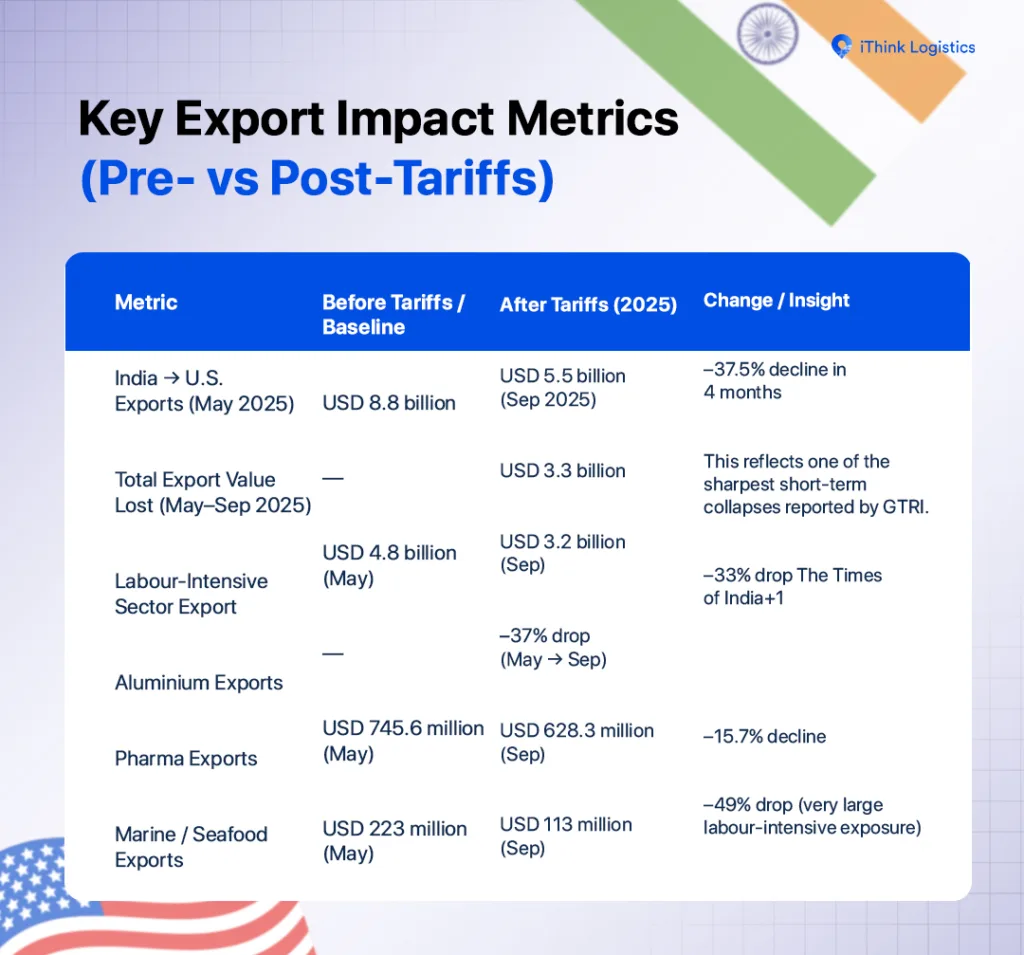
It’s not just a headline. The U.S. is one of India’s largest export destinations: while exact figures vary, data shows that exports to the U.S. account for a significant share of India’s labour-intensive manufacturing and D2C-friendly goods. For instance, an Economic Times report found that India’s exports to the U.S. fell 37.5% between May and September 2025 from USD 8.8 billion to USD 5.5 billion.

Why did the U.S. act? Multiple reasons:

  • The U.S. cited trade imbalance and higher Indian import duties as justifications.
  • It also linked tariffs to India’s continued purchase of Russian oil, making tariffs part of a broader geopolitical calculus.
  • With the U.S. and India negotiating a possible trade deal(“US-India trade deal”), this tariff move increases leverage in the talks.

3. Which export sectors & D2C goods are most exposed

From our iThinkLogistics data and external reports, here’s how exposure looks:

  • Textiles, apparel, and readymade garments: major drop in U.S. orders, while buyers are calling to absorb an additional 20-30% in IT costs.
  • Gems & jewellery: one of the worst-hit.
  • Marine products / seafood: significant exposure to U.S. demand.
  • Engineering goods, metals, chemicals: while exposed, somewhat insulated because several face global tariffs. For example, aluminum exports fell 37% in a single period.

For D2C brands in India that export: if your product falls into any of these categories (fashion/accessories, home-lifestyle, jewellery, luxury goods, niche engineering / specialty goods), you must recognize that “U.S. tariffs on India imports” means your export to the U.S. is now costlier and more risky.

Also Read: Complete Guide to International Shipping from India

4. The silver lining & strategic pivot opportunities

Now here’s where we at iThinkLogistics believe there is real opportunity (not just risk).

a) Market diversification pays off

Recent research shows India is widening its export base. As U.S. shipments slowed after tariff hikes, exports to other countries have increased significantly. According to an SBI export-basket report, India’s merchandise exports overall rose in 2025, while the share destined for the U.S. fell — signalling a shift.

India’s export share to the U.S. has fallen, while the UAE, Vietnam, Bangladesh, etc., are gaining ground.

b) Premiumization & moving up the value chain

Tariffs hit commoditized, low-margin goods hardest, making it difficult to be profitable and hold the US market. D2C brands need to shift to premiumised, branded offerings where consumers are willing to pay higher prices or add services (e.g., customization, subscriptions).

Premium buyers don’t mind spending extra to get the value of the product and services regardless of the tariff. This is important to implement as commodity products, something US customers can get for cheaper. 

c) Domestic & export logistics optimization

With tariff and demand uncertainties, exporters are rethinking how they move goods globally. Many are optimizing by redirecting export flows to markets beyond the U.S., reducing dependence on a single region, and effectively hedging risk.

For example, sectors such as marine products (seafood, shrimp) have seen a surge in demand from non-U.S. buyers, helping spread risk and reducing the impact of U.S.-specific trade shocks.

5. What Indian D2C & e-Commerce Sellers Should Do Now? Step by step

Here’s your operational checklist as an Indian seller:

Step 1: Export-SKU Audit & Compliance Readiness

Begin by identifying risks and establishing a robust compliance framework, as the penalties for non-compliance are now more significant than before.

  • Map Tariff Risk & Margin Impact: Immediately identify every SKU you export (or plan to export) to the U.S. and map them to the High-Tariff Risk category (e.g., fashion, home-lifestyle, jewellery). For these products, determine the exact new Landed Cost Per Unit (LCPU) to reveal which are no longer competitive under the full duty load.
  • Mandatory Compliance Upgrade: The simplified shipping methods are obsolete. Ensure all product documents include accurate HSN (Harmonized System) Codes and precise valuation. You cannot afford customs delays or penalties now.

Step 2: Re-map Distribution Geographies & Trade Diplomacy

Right now, diversification is the best option. Reducing over-reliance by leveraging existing preferential agreements and growing demand in other countries.

  • Diversify Export Basket: While maintaining a strategic focus on the U.S., aggressively expand into high-potential alternative geos with better trade terms: the Middle East, Australia, the UK/EU, and Southeast Asia. This pivot is the direct answer to the impact of U.S. tariffs on India.
  • Set Measurable Targets: Set an ambitious, clear goal to export volume  of trade outside the U.S. within the next 12 months. This diversification is your insurance policy against the next trade shock.
  • Leverage Government Support: Actively track and apply for benefits under new national export promotion schemes to secure the finance you need to scale new markets and mitigate the cost pressure from the US imposing tariffs on India.

Step 3: Review Pricing, Value Proposition, and Premiumization

Tariffs impact low-margin sellers the most. If possible, promote a premium brand that customers are willing to pay more for. Focus on transitioning from low-value to high-value products.

  • Scenario-Based Pricing: Model multiple pricing scenarios based on whether you absorb the tariff cost (margin reduction) or pass it to the customer (which risks losing customers to a lower price for the same product from different countries). This will inform your ultimate pricing strategy to counter the US tariff impact on India.
  • Pivot to Value-Add: Shift your production from commoditized goods to high-margin, branded, specialized SKUs (e.g., customization, ethical sourcing, specialty craft).

Step 4: Optimize Logistics & Duty Planning (Bulk Strategy)

The previous strategy of relying on individual, low-cost shipments is now outdated. Your approach should now prioritize efficient, consolidated, and duty-prepaid systems.

Use Duty-Paid Shipping (DDP): Hidden customs charges scare U.S. buyers at delivery and lower conversions. With Delivered Duty Paid (DDP), duties are paid upfront before the order reaches the customer. This keeps prices clear, prevents delivery surprises, and makes buyers more confident.

Step 5: Track Performance & Build Resilience

Now, the metrics you track will determine your ability to withstand tariff pressure. Move beyond traditional metrics and measure those that protect your margins.

Watch the Metrics That Matter

Create simple dashboards that monitor:

  • Growth in non-U.S. markets (your real diversification score)
  • Landed Cost per Unit (LCPU) for U.S. shipments
  • Margin per Unit for high-tariff categories like apparel, lifestyle, and jewellery

These are the numbers that tell you whether you’re growing smart or not growing.

Prepare for Trade Shifts

Trade talks around the U.S.-India deal may reduce duties later, but your strategy shouldn’t wait for policy changes.

Stay ready to scale U.S. volumes if tariffs are removed, but build operations assuming they won’t be.

That’s how resilient brands plan: flexible if things improve, stable if they don’t.

6. Where trade negotiations stand & what it signals

Regarding “US-India trade agreements” and “US-India trade deal”: the negotiation climate is evolving. Recent reports show that India’s resilient domestic economy has given it space to negotiate.

Industry analysts believe that any successful deal could reduce tariffs, ease export pressure and restore competitiveness.

For e-commerce sellers, this means staying agile: if a deal emerges, you may get tariff relief, but you must act now because timing matters.

7. Final thoughts: Seize the moment

Yes, the impact of US tariffs on India is real and substantial. It’s shifting exports, raising costs, and disrupting familiar trade flows. But for Indian D2C & e-commerce brands, this moment also opens a strategic window:

  • Those who view it as a wake-up call (not just a threat) will diversify, upgrade, and optimize.
  • By acting now, auditing exports, shifting geographies, refining logistics, and telling stronger brand stories, you’ll not just safeguard your business; you may come out stronger than competitors stuck in old paradigms.

If your brand is exporting, or planning to, then this is your strategic moment. Analyze your risk, act fast, upgrade your export systems and don’t wait for a deal to save you. You’ll save yourself.

Categories
E-commerce Logistics

Top 10 Apparel Brands in India (2026): Your Complete Shopping Guide

Ever stood in front of your wardrobe wondering why nothing fits right, even though you’ve spent ₹15,000 on clothes this season?​

Here’s the thing: you’re not buying wrong. You’re just buying from the wrong brands for YOUR style.​

India’s apparel market hit 115.7 USD Billion in 2024, and it’s only getting bigger. But with 100s of brands shouting for your attention—from ₹299 Zudio tees to ₹8,000 Zara blazers—how do you actually know which brand deserves your money?​

This isn’t another “top brands” listicle. This is the guide to finding brands that match your style, budget, and lifestyle, whether you’re hunting for that perfect Friday-office look, ethnic fusion for Diwali, or gym wear that doesn’t look boring.​

Let’s break it down.

Top 10 Apparel Brands in India (2026)

These aren’t the biggest apparel brands by revenue or by popularity only. Our selection is based on popularity, affordability, innovation, accessibility, and relevance in 2026. The list includes overall global giants, desi Indian brands, and fast-fashion disruptors that fit all criteria.

1) H&M: Trendy Without the Budget Burn

Walk into any mall feeling lost and getting overwhelmed, where to start? H&M is that “safe pick from where you walk out with trend-driven outfits without blowing half your salary on a jacket you’ll wear exactly twice in a year.

Why it dominates: They move fast. Instead of seasonal new collections, they refresh collections frequently based on global data, demand, and availability. They offer 12-16 clothing collections each year and refresh them every week.

Why this brand fits YOU: If you love trying new clothes before buying them, then H&M lets you try styles before you make a decision. Now online, they have Google Virtual try-on on selected products so you can be satisfied before making a decision.

Price Range: ₹399 – ₹4,999

Best For: Fashion explorers on a budget.

2) Zara: Premium Looks Without Luxury Prices

Zara is where you go when you want that “I have a meeting with investors” look without spending investor-level money.

Why it dominates: Over 3,000 stores worldwide, including 23 in India, with Excellent tailoring. Their jackets, blazers, and trousers feature better design cuts, and their vertical supply chain delivers new designs from concept to store in 2-3 weeks, the fastest in the industry.

Why this brand fits YOU: If you want “middle range formal wear,” Zara offers premium aesthetics without the high price tag.

Price Range: ₹1,250 – ₹9,990

Best For: Young professionals who want attire that’s good for both the office and a party.

3) Adidas: Athleisure That Actually Works Everywhere

Adidas has quietly moved beyond the gym. At this point, half the crowd wearing Adidas joggers isn’t running anywhere; they’re in cafes, airports, and meeting friends.

Why it dominates: Their “athleisure” lines are functional and stylish. One pair of joggers works at workouts, grocery runs, and brunch. And around 1800 products, you get a lot of options to choose from, while not with other brands.

Why this brand fits YOU: If you don’t want multiple wardrobes (gym, travel, casual), separately, then Adidas is the one-outfit-fits-all solution.

Price Range: ₹659 – ₹14,999 (Most)

Best For: Fitness enthusiasts who value comfort + vibes.

4) Puma: Best Value in Sportswear

Think of Puma as today’s “smart money” pick in sportswear: not cheap, not premium, just solid. Less expensive than Nike and Adidas, yet loved by millions.

Why it dominates: Puma is known for its fusion of sports and lifestyle fashion. Stylish, performance-focused, and more affordable than Nike and Adidas.

Why this brand fits YOU: Want branded-quality sportswear without feeling like you’re paying too much for a brand name? Then Puma is the perfect brand with bold style, performance, and lightweight materials.

Price Range: ₹1,299 – ₹8,999

Best For: Budget-conscious athletes who still want brand value.

5) Nike: Reputation + Performance That Lasts

Nike doesn’t just sell sports gear; they sell identity. It is a status symbol, especially in tier 1 metro cities, where Nike products are mostly used by Gen Z and millennials.

Why it dominates: A premium brand known for innovative designs, durability, and engineering. The popular Air Jordan Shoes have made the brand’s name.

Why this brand fits YOU: If you have money to purchase premium, quality, branded sportswear, then buy Nike products.

Price Range: ₹2,499 – ₹15,999

Best For: Serious athletes and streetwear collectors.

6) Levi’s: Denim That Doesn’t Play Guessing Games

Levi’s is a well-known brand for jeans. No questions, experiments, or sizing problems.

Why it dominates: They invented blue jeans and an Iconic 501 jean. These jeans are very durable and don’t fade quickly, even when unpredictable fast-fashion trends are in play. If you need durable, long-lasting jeans, then Levi’s is the answer.

Why this brand fits YOU: If you’re tired of random sizing and stiff denim that rags and fades in six months, Levi’s is a safer long-term investment.

Price Range: ₹449 – ₹18,999

Best For: Anyone who wants jeans that survive years, not months.

7) Fabindia: India’s Sustainable Staple

Fabindia doesn’t sell clothes; they sell craftsmanship. Every purchase you make supports real artisans in rural India. No machines or factories are used in their apparel; all are hand-made products.

Why it dominates: They are famous for their handmade clothes, which sets them apart from other brands.

Why this brand fits YOU: If you want clothes that age beautifully, look elegant, and aren’t “festival only,” Fabindia fits both everyday and occasion needs.

Price Range: ₹799 – ₹24,999

Best For: Lovers of breathable, sustainable ethnic wear.

8) Van Heusen: Corporate Wear Without the Tailor

If your week is filled with presentations, spreadsheets, and client calls, Van Heusen  corporate wear is a good fit to start.

Why it dominates: It dominates the ready-to-wear Shirt category for corporate style in India.

Why this brand fits YOU: When you don’t have time to fuss over formalwear or time for tailoring, Van Heusen gives plug-and-play office outfits that look sharp with zero effort and no tailoring needed.

Price Range: ₹799 – ₹34,999

Best For: Busy working professionals.

9) Allen Solly: Casual Office Wear That Actually Feels Modern

Allen Solly is famous for the Friday Dressing concept. These colored and relaxed fits fit into office fashion before it was cool.

Why it dominates: Their “smart casual” designs work for presentations AND after-work plans without looking sloppy.

Why this brand fits YOU: Perfect if you hate stiff formals but still need to look professional. You look sharp without looking like you’re attending a funeral, but casual formal, which works on multiple occasions.

Price Range: ₹400 – ₹24,999

Best For: Young professionals building stylish corporate wardrobes.

10) Zudio: Budget Fashion That’s Hard to Ignore

Zudio is the brand people don’t brag about but love shopping from. Owned by the Tata Group, they’re disrupting India’s fast-fashion market without ads, without an online business. Especially Gen Z and Millennials love the brand’s clothes for their affordable prices and good quality.

Why it dominates: Prices that simply don’t make sense in 2026. Trendy pieces at ₹199–₹999 with surprisingly decent quality for the range.

Why this brand fits YOU: If you like refreshing your wardrobe every few months without breaking the bank, Zudio lets you experiment on a realistic budget.

Price Range: ₹199 – ₹1,999

Best For: Affordable trend seekers across Tier-1 to Tier-3 cities.

Best Apparel Brands in India by Category

But your wardrobe isn’t built solely from the ten big names above; different occasions call for different brands. Here’s a breakdown of the best brands in each category, depending on what you need most.

A. Best Ethnic & Traditional Wear Brands

Perfect for festivals, weddings, and contemporary Indian looks:

  1. Fabindia
  2. BIBA
  3. W for Woman
  4. Anita Dongre
  5. Manyavar
  6. Global Desi

For everyday ethnic wear, BIBA and Fabindia offer the best value. For weddings, Manyavar (men) and Anita Dongre (women) are worth the premium.

B. Best Formal & Casual Wear Brands

Trusted apparel brand names for office, business, and everyday wear:

  1. Van Heusen
  2. Allen Solly
  3. Raymond
  4. Peter England
  5. Mufti
  6. Flying Machine

Build your core wardrobe with Van Heusen and Peter England. Add Allen Solly for variety. Save Raymond for important presentations.

C. Best Youth & Streetwear Brands

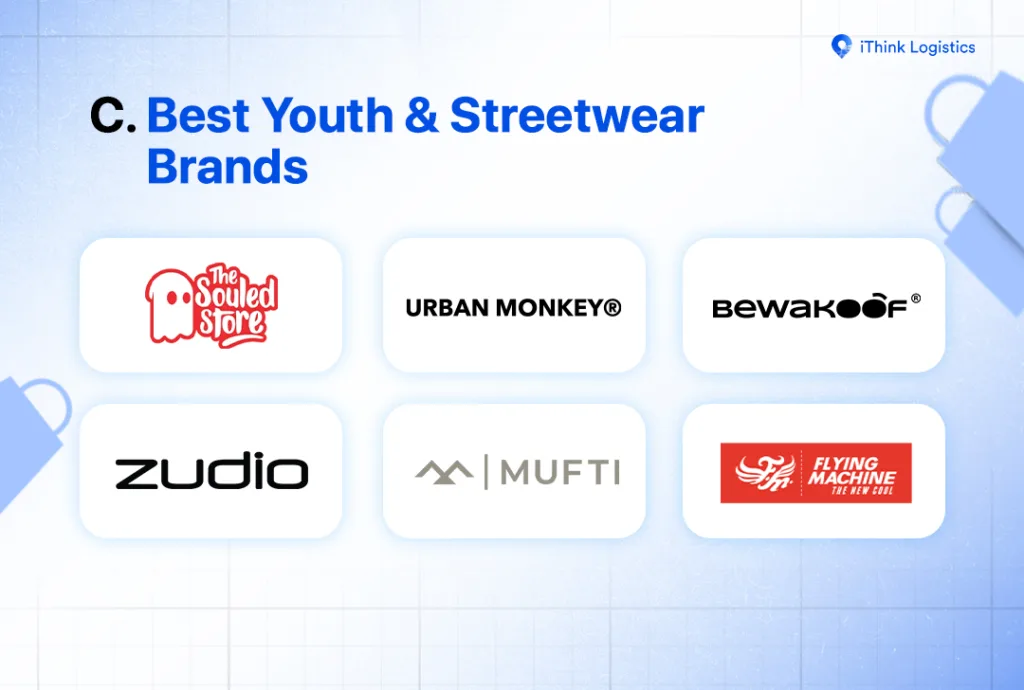
Popular among Gen Z and millennials, these young brand apparel options dominate:

  1. The Souled Store
  2. Urban Monkey
  3. Bewakoof
  4. Mufti
  5. Flying Machine
  6. Zudio

India’s streetwear market hit around $200 million (about 400 crore rupees) in 2024, and you can thank Instagram culture and hip-hop for the boom. These brands? They rode that wave like pros.

D. Best Sports & Athleisure Brands

When it comes to training, fitness, or just rocking athleisure, these sports apparel brands in India are running the show:

  • Nike
  • Adidas
  • Puma
  • Reebok

Decathlon gives you crazy good value (₹299-2,999) for stuff you’ll actually sweat in. Keep your Nike and Adidas purchases for those lifestyle pieces where the logo actually counts.

E. Best International Fashion Brands Available in India

Leading international and luxury apparel brands with strong demand:

  1. H&M
  2. Zara
  3. Uniqlo
  4. Levi’s
  5. Mango

Plus: Nike, Adidas, Puma, and Reebok (international sportswear)

F. Top Emerging Sustainable Apparel Brands

These new apparel brands are eco-friendly, gaining popularity for ethical production:

  1. No Nasties
  2. The Summer House
  3. Doodlage
  4. Okhai

The sustainable shift: Right now, the global sustainable fashion market sits at USD 9.65 billion in 2024. Where’s it headed? Experts say it’ll jump to USD 47.65 billion by 2032—that’s a CAGR of 22.1% between 2025 and 2032. And in India? Millennials and Gen Z are leading the charge, caring more and more about ethical production with every purchase.

Conclusion

India’s apparel market continues to expand with a diverse mix of global retailers, established Indian apparel brands, sportswear giants, and dynamic youth-led labels. The Top 10 Apparel Brands in India (2026), from H&M and Zara to Fabindia and Zudio, reflect the country’s diverse style preferences and evolving fashion culture.

So the next time you pick clothes, don’t go after a discount or logo. Use this guide to match your brand, style, and budget to the apparel you need.

With category-wise recommendations and insights into what makes each brand special and unique, this guide gives you the complete perspective to navigate India’s growing fashion landscape. Shopping for corporate formals, ethnic dresses, streetwear, or sustainable fashion, you now know exactly which brands deliver the best value for your specific needs.

Remember: there’s only one “best” brand which suits YOUR style, budget, and lifestyle, so choose smart, shop informed, and let your requirements fill your wardrobe.

FAQs

Q.1: Which is the No.1 apparel brand in India in 2026?

A: H&M and Zara lead the fast-fashion category, while Adidas and Nike dominate sportswear. Overall, H&M ranks highest in popularity, accessibility, and search demand in 2026. But you choose a brand which checks all your boxes, not others.

Q.2: What are the top 10 apparel brands in India?

A: The top 10 include H&M, Zara, Adidas, Puma, Nike, Levi’s, Fabindia, Van Heusen, Allen Solly, and Zudio.

Q.3: Which are the best Indian apparel brands?

A: Fabindia, BIBA, Manyavar, Van Heusen, Raymond, and Allen Solly are leading Indian brands.

Q.4: What are the best sportswear and athleisure brands in India?

A: Nike, Adidas, Puma, and Reebok dominate India’s sportswear category with performance gear and athleisure collections.

Q.5: Which brand is best for formal and office wear in India?

A: Van Heusen, Raymond, Peter England, and Allen Solly remain the top picks for premium workwear, business formals, and smart-casual office clothing.

Q.6: Which youth or streetwear brands are trending in India?

A: Currently, Zudio is very popular among Gen Z and millennials. Some other brands include The Souled Store, Flying Machine, Urban Monkey, and Bewakoof, all well-known and loved by many consumers for their streetwear and youth-focused fashion.

Q.7: What are the top ethnic and traditional wear brands in India?

A: Top ethnic and traditional wear brands are Fabindia, BIBA, Global Desi, W for Woman, and Manyavar.

Q.8: Are sustainable and eco-friendly apparel brands growing in India?

A: Yes. Eco-conscious brands like No Nasties, The Summer House, Doodlage and Okhai are gaining traction as consumers prioritise sustainable fashion.

Q.9: How were the Top 10 apparel brands selected?

A: Rankings were determined using parameters such as brand popularity, search trends, e-commerce presence, product quality, innovation, cultural relevance, and customer trust.

Q.10: How does logistics influence the success of apparel brands in India?

A: Apparel brands depend on fast delivery, return management, multi-courier optimisation, and real-time tracking. Platforms like iThink Logistics help reduce RTO and ensure efficient nationwide delivery.

Categories
E-commerce Logistics

Top 10 Baby Product Brands in India (2026): A Complete Guide for Parents

Buying baby products is no longer a simple decision. With established brands, trendy new players, and clinical product lines vying for your attention, choosing the right brand is as important as selecting a family doctor.

Here’s what’s really happening: The baby-care market in India is growing fast. According to IMARC Group, it was worth USD 4.4 billion in 2024 and is expected to keep growing strongly. Meanwhile, Data Bridge Market Research says the market could reach USD 15.84 billion by 2032.

That’s not just a big number; it means more choice for parents, but also more noise to cut through. And for e-commerce sellers, it’s a huge opportunity if you pick the right brands.

We’ll walk you through the Top 10 Baby Product Brands in India (2026), not just by popularity, but by how safe they are, how good their ingredients are, and how much parents trust them. Whether you’re building a baby-care shopping list for your little one or planning to sell baby products, you’ll find clear, honest advice.

Why Choosing the Best Baby Care Brand Matters

When parents look for products for their little one, they’re not just buying a name or cute packaging. What truly counts is safety, skin-friendly ingredients, and proven results.

Think about a newborn’s skin for a moment—it’s incredibly thin and delicate. A soap that smells too strong or a lotion with harsh chemicals? That’s often all it takes to trigger rashes, dryness, or irritation. This is exactly why smart parents look beyond fancy packaging and nice fragrances. They want products that have actually been tested and proven safe.

So what separates a truly great brand from the rest?

A credible baby care brand doesn’t just slap “safe” on the label and call it a day. Real safety comes from scientific backing, not clever marketing. Here’s what experts actually look for:

  • Pediatric & Dermatologist Validation: This means proper safety testing with real medical professionals involved—not just a vague “dermatologist tested” claim with no proof.
  • pH-Appropriate Formulation (5.5): Your baby’s skin has a natural protective barrier. A pH of 5.5 helps maintain that barrier and keeps their delicate microbiome healthy.
  • Clinically Proven Toxin-Free Ingredients: No parabens, phthalates, sulfates, artificial dyes, or synthetic fragrances. And we’re talking about products backed by independent safety tests, not just brand promises.
  • Full Ingredient Transparency: Every ingredient should be clearly listed, along with certifications like MadeSafe, EWG, or ISO. You should be able to verify the product’s contents yourself.

These aren’t nice-to-haves or bonus features. When it comes to baby care, these are absolute must-haves.

The Importance of Safe Baby Products Brands in India

Here’s what catches many global brands off guard: India isn’t just hot, but it’s a mix of extreme humidity, scorching heat, and pollution that can really take a toll on a baby’s skin. These aren’t minor factors. They actually make babies much more prone to irritation, rashes, and discomfort.

And parents are noticing. There’s been a real shift in how Indian parents shop for baby care now. They’re no longer just picking up whatever’s trending internationally. Instead, they’re hunting for gentle, low-irritant products built to withstand our specific climate. Because honestly, what works in cooler, drier countries doesn’t always cut it here.

Safe baby product brands? They’re not a luxury or something you splurge on if you have extra budget. They’re absolutely essential. When you’re dealing with unpredictable weather—sudden humidity spikes, intense summer heat, monsoon dampness—and a baby’s paper-thin sensitive skin, the right formulation isn’t just helpful. It can genuinely make all the difference between a happy baby and one dealing with constant skin troubles.

According to a recent report by Economic Times, nearly two-thirds of urban Indian households now prefer buying baby care products online, especially products that advertise “paraben-free,” “no preservatives,” or “clinically safe.”

Key Factors to Look for in the Best Baby Products Brands

Knowing what is “best” is straightforward; finding it among many options is harder. Evaluate brands based on the following criteria to choose safe, reliable products:

Look for:

  • Safety certifications & dermatologist testing
  • Ingredient transparency & clean, toxin-free formulations
  • Brand reputation, parent reviews & clinical trust
  • Suitability for the Indian climate & baby skin types
  • Fair pricing, availability & accessibility

Safety Certifications & Dermatologist Testing

Credible baby brands often have certifications (such as BIS, CPC, EN 1888, OEKO-TEX,and GOTS) or state that their products are dermatologist-tested. These assurances are especially important when choosing products for newborns.

Ingredient Transparency & Clean Formulations

A top brand will list all its ingredients openly. Look for formulations that are free from parabens, phthalates, synthetic fragrances, and other potentially harmful chemicals.

Brand Reputation, Customer Trust & Reviews

Trust isn’t negotiable. Established brands with years of track record (or emerging ones with strong D2C credibility) consistently invest more in research and quality control. Always read parent reviews, check e-commerce ratings, and verify whether pediatric or dermatology experts genuinely endorse them.

Suitability for Indian Climate & Baby Skin Types

Formulations must feel light in summer, stay non-greasy in high humidity, and perform effectively across varying weather conditions. This is critical in India. The “best baby skin care products brand” for an Indian parent differs significantly from what’s rated best globally.

Price Range, Availability & Accessibility

It’s no use picking a brand that’s out of reach or too expensive for repeat buys. Check where the brand sells (online or in pharmacies) and whether its average online price aligns with your budget.

Top 10 Baby Product Brands in India (2026)

Here are ten of the most trusted and high-potential baby product brands in India (2026), evaluated on safety, trust, product strength, and overall brand product quality.

  1. Johnson’s Baby
  2. Mamaearth
  3. Himalaya BabyCare
  4. Sebamed
  5. Cetaphil
  6. Baby Dove
  7. Chicco
  8. Mee Mee
  9. Mother Sparsh
  10. Pigeon

1. Johnson’s Baby

Why Parents Trust It: Johnson’s Baby is a legacy brand that sells its products worldwide and is trusted by multiple generations. Its products are mostly pediatrician-recommended and undergo rigorous safety testing across different markets.

Best Baby Skin Care Products:

  • Johnson’s Baby Lotion (For Moisturization)
  • Johnson’s Baby Oil
  • & Soap

Price Range (Online Price): ~ ₹62 – ₹300 (depending on size, product, and quantity)

Best For: Parents who prefer a trusted, time-tested global brand, especially for basic baby care staples.

2. Mamaearth

Why Parents Trust It: Mamaearth is well-known for its commitment to toxin-free, plant-based baby formulations. The brand emphasizes safer ingredients, toxin-free, natural, and sustainable practices.

Best Baby Skin Care Products:

  • Mamaearth Moisturizating Daily
  • Dusting Powder for Babies
  • Mamaearth Diaper Rash Cream

Price Range (Online Price): ~  ₹100 – ₹500 (For these 3 products mentioned above)

Best For: Parents looking for natural, eco-conscious, D2C baby care options.

3. Himalaya BabyCare

Why Parents Trust It: Himalaya uses Ayurvedic and herbal ingredients in its baby care range. Its long history in India and emphasis on gentle botanical formulations give parents confidence.

Best Baby Care Products:

  • Himalaya Baby Massage Oil
  • Himalaya Diaper Rash Cream

Price Range (Online Price): ~ ₹150 – ₹250 (may very as price changes)

Best For: Families seeking affordable, herbal-inspired baby care rooted in traditional ingredients.

4. Sebamed

Why Parents Trust It: Sebamed is a German skincare specialist with over 50 years of experience. Its baby line is centered on a pH 5.5 formulation that aligns with infants’ natural skin barrier, clinically proven to maintain the acid mantle, minimize moisture loss, and limit the growth of harmful bacteria.

Their formulations are soap-free, tear-free, and free from many harsh irritants.

Best Baby Skin Care Products:

Price Range (Online Price): ₹500 – ₹1300 (prices may vary)

Best For: Babies with very sensitive, dry, or atopic-prone skin, and parents who want clinically proven skin-barrier protection.

5. Cetaphil

Why Parents Trust It: Cetaphil Baby is part of Galderma, a brand known for gentle skincare. Its baby products are hypoallergenic, non-irritating, and widely recommended by dermatologists, especially for infants.

Best Baby Skin Care Products:

  • Cetaphil Baby Daily Lotion
  • Cetaphil Baby Wash & Shampoo
  • Cetaphil Baby Massage Oil

Price Range (Online Price): ₹600 – ₹1,200 (for larger sizes)

Best For: Infants and toddlers with sensitive or eczema-prone skin (dryness, itchiness, and redness).

6. Baby Dove

Why Parents Trust It: Baby Dove products are dermatologist- and pediatrician-tested, with gentle, pH-neutral formulas that aim to support a baby’s skin barrier and healthy microbiome. According to its product description, Baby Dove lotion has no parabens, phthalates, or sulphates.

Best Baby Skin Care Products:

  • Baby Dove Head‑to‑Toe Wash
  • Baby Dove Rich Moisture Lotion
  • Baby Dove Rich Moisture Bathing Bar

Price Range (Online Price): ₹50 – ₹300 (for above products)

Best For: Parents looking for daily-use, gentle, non-irritating baby skin care that’s pH balanced and free from common harmful additives.

7. Chicco

Why Parents Trust It: Chicco is a globally recognized brand (Italian Origin) with decades of experience in baby care. While they create other kinds of products, they are also known for baby products and are known for high safety standards, a wide range, and consistent quality. As a well-established brand, they maintain rigorous quality and testing norms.

Best Baby Skin Care Products:

  • Chicco Baby Cream (nourishing cream) — also useful for massages.
  • Chicco Baby Bath Cleanser
  • Chicco Gentle Body Wash and Shampoo

Price Range (Online Price): ₹150 – ₹500 depending on the product and size

Best For: Parents looking for a premium global brand with a wide range of products, not just skincare, but feeding gear, toys, and more.

8. Mee Mee

Why Parents Trust It: Mee Mee is an Indian brand (Me N Moms Pvt. Ltd.) known for delivering dermatologically tested, gentle baby care at accessible prices. Their products are often pH-balanced and designed for newborns and toddlers.

Best Baby Skin Care Products:

  • Mee Mee Mild Baby Shampoo
  • Mee Mee Baby Body Wash
  • Mee Mee Caring Baby Wet Wipes

Price Range (Online Price): ₹75 – ₹300

Best For: Parents on a budget who want a safe, gentle, and well-known brand.

9. Mother Sparsh

Why Parents Trust It: Mother Sparsh is a well-known Indian D2C brand that stands by chemical-free,natural, plant-based, and eco-friendly baby products. Their baby wipes are particularly popular because they are 99% pure water, unscented, and free from harsh chemicals. 

Best Baby Skin Care Products:

  • Mother Sparsh 99% Pure Water Unscented Baby Wipes
  • Mother Sparsh tummy roll on
  • Mother Sparsh Daily Moisturizing Milky Soft Baby Lotion

Price Range (Online Price): ₹100 – ₹200 depending on pack sizes

Best For: Parents who want ultra-pure, no-additive baby skincare products, especially for their newborns and diaper care routine.

10. Pigeon

Why Parents Trust It: Pigeon is a highly respected global brand (of Japanese origin) that focuses intensely on practical utility, safety, and hygiene, qualities that are absolutely critical for new parents.

Best Baby Skin Care & Essentials:

  • Baby Skincare Wipes
  • Baby Powder (Hypoallergenic)
  • Baby Powder

Price Range (Online Price): ₹100 – ₹300

Best For: Parents who need trusted, affordable essentials like wipes, cleansers, and daily-use baby items.

Comparison Table: Top 5 Baby Products Brands in India (2026)

Here’s how the top 5 compare on key parameters:

Which Brand Is Best for Baby Products in India?

If you want a safe, clinically backed baby care brand, Sebamed or Cetaphil Baby may be your best bet, especially if skin sensitivity or eczema (dryness, redness, itchy skin) is a concern.

If you prefer a natural approach, Mamaearth is a leading choice. For trusted, classic formulations, Johnson’s Baby still holds major ground.

If affordability and Ayurveda appeal to you, Himalaya BabyCare offers a great balance.

How to Choose the Best Baby Skin Care Products Brand in India

Here are smart steps you can take:

  1. Read the ingredient list: Avoid harsh chemicals, prioritise pH-balanced products.
  2. Look for certifications: Dermatologist testing, toxin-free claims, and transparent labels matter.
  3. Consider your baby’s age and skin type: Newborns need gentler formulas; toddlers can handle richer creams.
  4. Test in small batches: Especially if the baby has reactive skin, test new products in small amounts.
  5. Buy from trusted channels: Stick to reputable e-commerce stores or pharmacies to avoid counterfeit baby products.

Final Thoughts

The baby care market in India isn’t just getting bigger; it’s getting smarter. With rising awareness of potential toxins in the products they use for their kids, it may just be a marketing gimmick brands are using, so now parents are looking for long-term product safety rather than just “cute packaging” with a baby face.

The key is to use the product that matches your baby’s unique needs, your budget, and the realities of the challenging Indian climate. For that, you have  global giants like Johnson’s, dermatology-backed brands like Sebamed, or eco-conscious D2C options like Mamaearth. So you have to choose which brand products you want to use and for how long, or if you decide to have multiple brand products, the best one for your kid.

Choosing the right baby product brand isn’t just a simple purchase you do every day, but an investment in your newborn’s health and comfort during those precious first years.

FAQs

Q.1: Which is the best baby products brand in India?

A: It depends on your priorities for clinical safety, Sebamed / Cetaphil; for natural ingredients, Mamaearth; for legacy trust, Johnson’s.

Q.2: What are the safest baby products brands for newborns?

A: Brands that emphasize gentle, pH-balanced, chemically minimal formulations (such as Cetaphil Baby, Sebamed) are often safest for newborns.

Q.3: Which baby products brand is best for sensitive skin?

A: Cetaphil Baby and Sebamed are among the most recommended for sensitive or eczema-prone baby skin (dry, itchy, and redness), due to their dermatologically tested and hypoallergenic formulas.

Q.4: Which baby skin care brand is safest in India?

A: “Safest” can mean different things: Sebamed and Cetaphil are clinically trusted; Mamaearth is trusted for natural purity; Johnson’s is trusted for reliability.

Q.5: Are Indian baby products brands safe and reliable?

A: Absolutely, yes. Many domestic Indian brands, including established players like Himalaya BabyCare and newer D2C brands like Mamaearth and Mother Sparsh, have significantly stepped up their quality and safety standards.

Q.6: What should parents look for in baby care product brands?

A: Key things: ingredient transparency, safety certifications, age-appropriateness, clinical testing, and climate-appropriate formulations.

Categories
E-commerce Logistics

Ultimate Guide to Mastering Logistics – logistics management

Ask any online seller in India, and you’ll hear the same thing: making a sale isn’t the toughest part, but delivering is. The real struggle begins right after the customer taps “Order Confirmed.”

Logistics challenges are late deliveries, wrong courier assignments, damaged parcels, inaccurate addresses, and COD refusals erode margins, hinder growth, discourage repeat purchases, and make scaling costly.

We’ve watched this play out across India’s fast-growing e-commerce brands. Some businesses doubled their revenue without new campaigns, heavy discounts, or even expanding their product range. All they did was strengthen their logistics, fixing warehouse placement, courier selection, packaging quality, and RTO prevention.

And once they stopped treating logistics as a cost center and started treating it as a growth strategy, two things changed instantly:

  • Their delivery costs decreased while their order volume increased.
  • Their customer loyalty increased without running discounts or offers.

In a market where countless sellers offer similar products, your real differentiator isn’t what you sell, it’s how you deliver.

This guide breaks down logistics management as a strategic lever for Indian e-commerce and D2C businesses, grounded in reality rather than textbook theory.

What Is Logistics Management? (And Why It Matters for Sellers)

Logistics management involves planning, executing, and controlling the movement of goods from your warehouse to the customer’s location, ensuring they remain safe throughout the journey and that the right item reaches the right buyer, without damage, at the right time, for the lowest possible cost.

It matters for e-commerce products not to produce or source, but to get the product delivered safely, on time, and at a lower cost, as even the best products can get stuck in transit, return pipelines, or poor warehouse management, costing you money and reputation.

In other words, logistics management in e-commerce is the end-to-end handling of storage, shipping, and returns at the lowest possible cost.

Logistics vs Supply Chain Management

So, what is logistics and supply chain management for e-commerce sellers? Many sellers use “logistics” and “supply chain” as if they were interchangeable. In practical business terms, however, they are different:

In simple terms, logistics and supply chain management work together. Supply chain management sets the strategy, while logistics executes it.

Put simply, the supply chain provides the strategy (‘the brain’), while logistics provides the action (‘the muscle’). Even the smartest strategy fails without strong action.

Why Logistics Management Is Crucial for Indian E-Commerce Sellers

The importance of logistics management goes far beyond delivery; it directly affects profitability, brand trust, and repeat orders. In India, online buyers don’t return because the product was bad; they return because it arrived late, arrived damaged, or didn’t arrive at all.

For this reason, logistics now drive revenue—not just delivery expenses.

Industry studies show:

This means warehouse location, courier selection, address verification, and tracking transparency directly impact:

  • Profitability
  • Repeat purchases
  • Customer satisfaction
  • Return rates (RTO)
  • Brand perception

Your product delivery experience matters more to your customers than your product quality does. Even if a competitor has a better product, you will still win the market if the competitor’s delivery experience is very bad.

The Core Objectives of Logistics Management for E-Commerce

Focus on these key objectives: deliver products quickly and reliably.

  • Minimize delivery and storage costs.
  • Avoid stockouts or overstocking.
  • Reduce damage and returns.
  • Enhance transparency and tracking for customers.
  • Build a scalable return & reverse logistics mechanism.
  • Use real-time data to drive decisions.

Aligning logistics with these goals transforms the supply chain into a lean, efficient, and profitable growth engine.

Key Functions & Components of Logistics Management

Below are the essential functions and their components:

1. Transportation Management

Function: Moves goods between suppliers, warehouses, and customers

Core Components:

  • Route planning
  • Courier partner allocation
  • Freight cost optimization
  • Mode choice (air, road, rail, ocean)

Transportation accounts for nearly 50–60% of total logistics costs in India, while for Sweden it’s 30% around and for South Korea it’s 70% of total cost.

2. Warehousing & Storage

Function: Safe storage and efficient movement of goods

Core Components:

  • Warehouse location planning (near demand clusters)
  • Inventory zoning & picking flow design
  • Safety stock & climate control for sensitive products

Strategically placing warehouses shortens delivery distances and speeds up shipping. This helps reduce RTOs and improve customer satisfaction.

3. Inventory Management

Function: Ensures the right stock quantity at the right time

Core Components:

  • Demand forecasting
  • Reorder planning
  • Buffer stock management
  • SKU-level inventory tracking across warehouses

This is important: overstocking raises holding costs, while understocking results in lost sales and delivery delays due to back-ordering.

4. Order Fulfillment

Function: Manages the journey from order placement to customer delivery

Core Components:

  • Order receiving and prioritization.
  • Picking, packing & dispatch
  • Allocation to the best courier partner

A streamlined fulfillment process leads to fewer errors, faster deliveries, and better customer experiences.

5. Packaging & Handling

Function: Safeguards product integrity and enhances brand value

Core Components:

  • Material selection (corrugated, bubble wraps, tamper-proof bags)
  • Right-size packaging to reduce volumetric weight
  • Fragile handling, cushioning & labeling

Evidence shows that poor packaging often causes transit damage and product returns. This is why packaging should be considered a key logistics investment rather than just an expense.

6. Information Flow & Tracking

Function: Enables visibility and decision-making across the supply chain.

Core Components:

  • Real-time tracking
  • Proof-of-delivery (POD) systems
  • Automated customer notifications
  • Order, return & shipment analytics

Transparent tracking reduces customer inquiries like ‘Where is my order?’ It builds customer trust and reduces operational friction.

7. Reverse Logistics

Function: Handles returns, exchanges, recycling & resale.

Core Components:

  • Pickup scheduling & return shipping
  • Inspection & re-packaging
  • Refund or exchange management
  • Non-delivery resolution (NDR) system

India has one of the highest RTO & return rates globally, especially for COD orders. A strong reverse logistics process protects profits and enhances customer lifetime value.

How These Work Together

Types of Logistics Models That Work for Indian E-Commerce

Depending on your business stage and product mix, you can use or combine:

1. Inbound Logistics

Inbound logistics focuses on moving goods from suppliers to your warehouse or fulfillment center.

It includes activities such as:

  • Raw material procurement (for manufacturers)
  • Finished goods supply from brands/distributors (for sellers)
  • Freight coordination and storage planning

Why it matters for e-commerce sellers: Strong inbound logistics keep your shelves stocked, stop backorders before they happen, and help you list your fast-moving products confidently without worrying about stockouts.

Example: Brands using regional procurement hubs shorten replenishment time, helping them maintain stock during sale seasons like Big Billion Days or Amazon Great Indian Festival.

2. Outbound Logistics

Outbound logistics is about delivering the final product from your warehouse to the customer.

It involves:

  • Order processing
  • Picking and packing
  • Courier selection
  • Shipment tracking & final delivery

Why it matters: Fast and accurate outbound logistics directly influence:

  • Customer reviews
  • Repeat purchases
  • RTO rates (especially in COD)

In India, the winner is rarely the brand with the best product… It’s the one that delivers faster, safer, and more transparently.

3. Reverse Logistics

Reverse logistics deals with products moving from the customer back to the seller.

It includes:

  • Returns (refunds/exchange)
  • Repair or refurbishing
  • Repackaging and resale
  • Disposal/recycling of unsellable units

Why it matters: India records some of the highest return rates in the world, especially in categories such as apparel, footwear, and accessories, as well as COD orders.

  • Reduce loss from damaged returns.
  • Recover value through refurbishing or resale.
  • Improve customer retention with hassle-free returns.

For an online customer, an “easy return experience” is as crucial as delivery speed.

4. Third-Party Logistics (3PL)

3PL refers to outsourcing logistics operations to expert companies that handle fulfillment, warehousing, shipping, and returns.

What 3PLs usually offer:

  • Multi-location warehouses
  • Courier allocation engine
  • Automated tracking and NDR/return systems
  • Packing, labeling & order processing

Why e-commerce brands choose 3PL: Brand outsourcing logistics to free up time to focus on product, marketing, and growth while experts handle storage, fulfillment, and delivery.

Example: Many D2C brands moving from 50 to 5,000 orders a day shift to a 3PL because it lowers their delivery costs and helps them manage order spikes during sale seasons without problems.

5. Fourth-Party Logistics (4PL)

4PLs take logistics outsourcing one step further. They don’t just execute logistics; they strategize, manage partners, optimize the supply chain, and make data-driven decisions on your behalf.

They handle:

  • Complete supply chain design
  • Vendor coordination (warehouses + couriers + tech)
  • Logistics analytics and cost restructuring

Who needs 4PL? Brands scaling nationwide or internationally, where logistics becomes a strategic function, not just operational.

6. Ecological (Green) Logistics

Green logistics focuses on reducing the environmental impact of logistics activities.

It includes:

  • Reusable / recyclable packaging
  • Consolidated shipments to reduce carbon footprint
  • Smart routing to reduce fuel use
  • Recycling returned items

Why it matters today: Consumers are choosing brands that operate responsibly and sustainably, so investing in eco-friendly logistics not only reduces your environmental impact but also strengthens long-term customer trust and reduces waste-related costs.

Step-by-Step Logistics Process: From Order to Delivery (and Back)

Below is the step-by-step logistics journey described from order to delivery in details:

1) Procurement: Sourcing Products

Before anything can be sold, products must be sourced from wholesalers, manufacturers, or raw material suppliers.

Key activities:

  • Negotiating prices and lead times
  • Checking product quality
  • Planning seasonal and bulk purchases
  • Aligning supplier capacity with forecasted demand

Why it matters: Strong procurement avoids stock delays, improves product quality, and reduces manufacturing or buying costs.

2) Warehousing: Storing Goods Smartly

Once products arrive in the warehouse, they get organized for fast picking and dispatching.

  • Receiving and verifying stock
  • Organizing items by SKU, size, or demand
  • Segregating fast-moving products into pick zones
  • Maintaining safety stock

Smart warehousing equals fewer errors, faster shipping, and better order accuracy.

3) Inventory Management: Maintain Stock Levels

Too much inventory drains cash. Too little inventory kills sales. Inventory management requires a balanced approach in:

  • Tracking stock in real time
  • Forecasting demand for the upcoming months
  • Setting reorder alerts when stock dips
  • Avoiding dead stock (slow-moving units)

4) Order Fulfillment: Turning an Order into a Shipment

When a customer clicks “Buy Now,” a structured backend process begins.

Order fulfillment includes:

  • Order Processing: The system verifies payment, SKU availability, and address.
  • Picking: Warehouse staff locates the product (often using barcodes or mobile scanners).
  • Packing: Items are packaged safely in size-appropriate boxes, with cushioning and branding elements.

Strong fulfillment reduces damage returns, customer complaints, and negative reviews.

5) Transportation & Delivery: Reaching the Customer

Once packed, the order moves from the warehouse into the delivery network. This phase is the customer’s first physical interaction with your brand.

It includes:

  • Selecting the best courier based on location, cost, serviceability, and speed
  • Dispatching shipments for first-mile pickup
  • Managing tracking updates and delivery attempts
  • Completing last-mile delivery to the doorstep

Delivery speed and reliability directly influence repeat orders and brand loyalty.

6) Reverse Logistics: Handling Returns Efficiently

Not every product delivered stays with the customer. Managing returns responsibly protects revenue and customer trust.

Reverse logistics activities:

  • Return pickup and tracking
  • Inspection for damage or resale potential
  • Repackaging or refurbishing, if possible
  • Issuing refunds or replacements

Smooth returns build customer confidence and increase conversions on COD and high-value orders.

7) Analysis & Optimization: Continuous Improvement

The best logistics strategies evolve with data, not assumptions.

Brands should continually track:

  • Delivery time vs. promised time
  • RTO (Return-to-Origin) percentage and reasons
  • Courier performance by pin-code
  • Customer feedback on delivery & packaging
  • Warehouse picking accuracy

Continuous optimization reduces hidden costs and transforms logistics into a profit driver.

How a Logistics Management System Helps You Scale

To manage this complexity, you need a Logistics Management System (LMS), the digital brain behind your operations.

Key features:

  • Dashboard & Analytics: Track delivery SLA, courier performance, return rates
  • Automated Courier Allocation: Based on performance, pin codes, and cost
  • Warehouse Management (WMS): Real-time stock location, picking logic
  • Order Management: From your store or marketplace → fulfillment
  • Return Management: Capturing reason codes, automating RTO pickup or inspections
  • Notification Engine: For customers (tracking updates) + operations team

Sellers who adopted a robust LMS (Logistics Management System) saw reductions in logistics costs and improvements in first-attempt delivery success, per our internal analysis.

Common Logistics Challenges in Indian E-Commerce & How to Overcome Them

Why Logistics Management Is Your Competitive Advantage

For e-commerce sellers in India, logistics isn’t just about moving parcels, it’s about building:

  • Trust: Prompt, reliable delivery makes customers come back.
  • Efficiency: Smarter logistics = lower costs without compromising service.
  • Scalability: With a strong logistics system, you can expand across geographies and SKUs.
  • Resilience: You can handle returns, pin-code failures, and courier issues proactively.

While many sellers try to win only on pricing or marketing, the real winners are those who master logistics.

Final Thoughts

  1. Audit your current logistics: Look at delivery costs, returns, courier mix, and warehouse locations.
  2. Adopt a Logistics Management System (LMS): Start small, scale gradually.
  3. Use data to decide everything: Choose couriers, set up warehouses, and manage inventory, all based on real metrics.
  4. Plan for returns and reversals: Don’t ignore returns, build processes, and don’t panic.
  5. Continually optimize: Review performance monthly; tweak courier mix, routing, inventory, and packaging.

When logistics becomes your growth engine, not just a cost center, your business gains. You spend less, deliver faster, keep customers happier, and scale smarter.

FAQs

Q.1: What is logistics management?

A: Logistics management is planning and controlling how products move from your warehouse to customers, including storage, shipping, and returns, in the most efficient and cost-effective way.

Q.2: What are the functions of logistics management?

A: The main functions are transportation, warehousing, inventory management, order fulfillment, packaging, information flow, and reverse logistics.

Q.3: What are the objectives of logistics management?

A: They include delivering on time, reducing cost, optimizing inventory, minimizing damage, improving satisfaction, and creating a scalable return system.

Q.4: What does a logistics management system do?

A: An LMS evaluates and allocates couriers, tracks delivery performance, manages warehouse inventory, processes returns, and provides real-time analytics so you can make data-driven logistics decisions.

Q.5: Why is logistics management so important for e-commerce?

A: Because in e-commerce, delivery experience is customer experience. Great logistics means fewer failed orders, lower returns, better reviews, and more repeat buyers.

Categories
E-commerce Logistics

AI Statistics for 2026: Top Ecommerce Trends

🚀 The Future Isn’t Coming — It’s Already Delivering

If you’ve been wondering whether Artificial Intelligence (AI) is really changing eCommerce or if it’s just another tech buzzword, here’s your sign: it’s already reshaping how India sells, ships, and scales online.

At iThink Logistics, we’ve been tracking thousands of shipments, seller interactions, and customer journeys every single day. What our internal analytics show mirrors the global data. AI isn’t the future; it’s the framework of tomorrow’s commerce.

So, let’s have a quick look at the AI statistics for 2026 that every Indian eCommerce seller should know with a healthy dose of optimism, real numbers, and iThink insights.

💡 AI in Today’s World is the “Status Update” you as a seller can’t Ignore

In 2025 alone, India witnessed a 3X rise in AI adoption among D2C and SME sellers. (Source)

At iThink Logistics, we analyzed over 1.2 million shipments and found that sellers using AI-driven courier allocation and predictive NDR tools experienced:

📦 19% faster order resolutions

💬 31% fewer failed deliveries

💰 Up to 11% higher profit margins due to smarter route selection and COD follow-ups.

Now imagine what happens when this power scales across every stage of the eCommerce funnel — from marketing to delivery. That’s the AI-first world we’re entering in 2026.

🧠 AI Fact: According to MarketsandMarkets, the global AI industry is projected to grow from $371.7 billion in 2025 to a whopping $2.4 trillion by 2032 that’s a 30.6% CAGR and eCommerce will be one of its biggest beneficiaries.

📊 The Big Picture: AI Market Share & Size (2026 Snapshot)

Let’s look at the landscape sellers are stepping into:

Metric20252026 (Projected)Source
Global AI Market Size$371.7 B$521 BMarketsandMarkets
AI in eCommerce$8.6 B$9.9 BSellersCommerce
India’s AI Market$12.3 B$15.9 BNASSCOM-BCG

By 2026, AI will touch every fourth decision made in online retail — from ad optimization to delivery allocation.

From Buzzword to Business Partner — AI in eCommerce Gets Real

Let’s make it tangible. Here’s how AI is showing up in real Indian eCommerce workflows, validated by iThink’s logistics data and partner network:

  1. Smart Courier Allocation
    → Our internal algorithm, powered by machine learning, predicts delivery success rates by pin code, carrier, and order value.
    Result: Sellers saw 15–20% fewer RTOs (Read more: The NDR Triangle Explained).
  2. AI-Based NDR Follow-Ups
    → Our predictive system automatically categorizes NDR (Non-Delivery Reports) and follows up through IVR, WhatsApp, and SMS in real-time.
    Result: 76% of delayed orders converted to successful deliveries for brands like Dr. Rashel and House of Makeup.
  3. Inventory Forecasting & Seasonal Demand
    → With AI-assisted predictive insights, sellers plan dispatch volumes around peak events (Diwali, IPL, Big Billion Day), avoiding overstocking.
  4. Generative AI in Marketing
    → Sellers using AI tools for content, ad copy, and A/B testing reported up to 2.5x higher ad CTRs (as per EY’s 2025 Retail AI report).

🧩 AI Statistic Verified by iThink: Indian sellers who use automation for courier allocation and NDR handling have 3x higher repeat delivery success than those relying on manual decisions.

🌍 Advantage of Ai to Indian Sellers for the year 2026

While the West debates regulation, India is busy implementing. Along with UPI, ONDC, and digital payments powering 130 billion+ annual transactions, AI in logistics and retail is getting richer datasets than anywhere else in the world.

According to EY India, 48% of Indian businesses already run GenAI pilot projects the highest in Asia. And with eCommerce projected to hit $200 billion by 2027, this synergy of AI + logistics + commerce will shape a trillion-dollar ecosystem.

For context:

  • 90% of Indian consumers now expect same-day or next-day delivery.
  • AI-backed route planning at iThink has already reduced average SLA by 18% across metro corridors.
    (Read also: How Packaging Mistakes Kill Profit Margins)

🔮 Top 5 AI Trends Defining eCommerce in 2026

1️⃣ Predictive Logistics Becomes Default
Every parcel you ship will soon be backed by probability ETA predictions, success rates, and optimized courier mapping, all powered by AI.

2️⃣ Conversational AI Will Replace Static Tracking Pages
Chatbots and voice assistants will deliver live tracking updates, handle NDRs, and process returns instantly, 24×7 that too with less manpower.

3️⃣ Dynamic Pricing and Hyper-Personalized Offers
AI will study buyer intent and deliver tailored pricing turning the browsing audience into buying ones.

4️⃣ Visual Search and AR Try-Ons
Consumers will shop using their camera, not their keyboard or phone screens. Sellers implementing AI-powered visual search see up to 40% higher conversion rates.

5️⃣ GenAI-Driven Brand Communication
From email to WhatsApp automation — GenAI will ensure that your brand never sleeps and keeps on evolving.

⚙️ Challenges: Not a Red Flag, Just a Speed Bump

AI isn’t magic, it’s a mathematics meeting experience.
Sellers must still:

  • Train data correctly (garbage in = garbage out)
  • Protect customer privacy
  • Balance automation with human empathy

At iThink Logistics, our approach is Human-in-the-Loop AI letting data predict, but people decide. That’s how we maintain trust while scaling intelligence.

🧭 What Should Sellers Do Right Now?

If you’re reading this in 2025, congratulations you are almost ready for 2026 after reading this blog. Here’s what you should do now:

  1. Automate your courier allocation on the basis of data — it’s the fastest ROI move.
  2. Enable predictive NDR & COD recovery tools — don’t let missed deliveries burn your profit.
  3. Start experimenting with AI-generated creatives and personalized offers.
  4. Audit your logistics data monthly. The smarter your dataset, the sharper your AI becomes.

🌟 Wrapping Up: The AI Era Isn’t Replacing Humans — It’s Rewarding the Smart Ones

The progress in artificial intelligence isn’t about replacing effort, it’s about amplifying and optimising it. The eCommerce brands that blend human creativity with machine precision will win 2026.

At iThink Logistics, we’re already seeing it happen across millions of deliveries, data points, and happy sellers.

So the question isn’t “When should you adopt AI?”
It’s “How soon can you start using it to deliver better?”

Book A Demo!

Categories
Logistics

What is Consignment Number in India Post: Your Complete Tracking Guide

Standing in a post office near you with the shipping receipt and wondering what on earth you’re supposed to do with it? You’re not alone. Every day, thousands of Indians send parcels and documents through India Post, but few actually know what that mysterious number means or how powerful it is.

That little combination of letters and digits is your India Post consignment number. It tells you exactly where your package is, when it was dispatched, and when it will reach its destination. In short, it’s your package’s tracking number and knowing how to use it can save you a lot of stress about it’s location.

What is Consignment Number in India Post: The Essential Definition

Let’s start with the basics. What is the consignment number in India Post? It’s a unique 13-character alphanumeric code assigned to every parcel sent via Speed Post service. Think of it as your package’s unique identity number.

This isn’t just a random string of characters. Each element of the consignment number in India Post tells a story about your package. The code typically starts with 2 uppercase letters, followed by 9 computer-generated digits, and ends with 2 uppercase letters.

Here’s what makes this number so powerful: it’s your direct window into your package’s journey. From the moment your parcel is accepted at the post office counter until it’s delivered to the recipient’s hands, every scan, every transit point, and every status update is tied to this unique identifier.

But understanding what is consignment number in India Post goes deeper than just knowing it’s a tracking code. It’s your proof of posting, your reference for complaints, your tool for customer service inquiries, and your way to ensure accountability throughout the delivery process.

India Post handles the logistics of a nation with over 1.4 billion people. Without systematic tracking through consignment numbers, the entire system would collapse into chaos. That 13-digit code is what keeps your package from getting lost among the millions of other parcels moving through the postal network simultaneously.

Decoding the Consignment Number in India Post: What Each Character Means

Now that you know what is consignment number in India Post, let’s decode what those letters and numbers actually represent. This knowledge transforms that seemingly random code into meaningful information.

Let’s take a sample consignment number: EK403807171IN

The First Letter: Service Type

The first letter indicates the type of postal service. For instance, ‘E’ represents Speed Post for articles booked by individual customers. Here are the common prefixes:

  • E = Speed Post (individual customer)
  • C = Courier items
  • R = Registered post or insured articles
  • P = Passport-related documents
  • EP = Express Parcel service
  • EM = International EMS (Express Mail Service)

The Second Letter: Origin State

The second letter signifies the origin state of booking. For example, ‘K’ stands for Karnataka, indicating that the letter was sent from a post office in Karnataka state. Each Indian state has its designated letter code, making it easy to identify where a package originated.

The Nine Middle Digits: Unique Identification

The nine numbers in the middle are computer-generated and completely unique. This is the actual identification number that distinguishes your package from every other consignment. These digits are randomly assigned when your package is booked, ensuring no duplicates exist in the system.

The Last Two Letters: Destination Country

The final two letters are always IN, representing India. For international shipments leaving India, you might see different country codes at the end, but for domestic Speed Post, it’s always “IN.”

Understanding this structure helps you quickly verify if you’ve noted down the consignment number in India Post correctly. If it doesn’t follow this 13-character format with the right pattern, something’s wrong.

Where is Consignment Number in India Post: Locating Your Tracking Code

Knowing what is consignment number in India Post is step one. But where is consignment number in India Post receipts and documents? Let me show you exactly where to look.

On Your Speed Post Receipt

When you submit your parcel for delivery through the Speed Post service, you get a receipt in return. The consignment number is mentioned in the second line of this receipt. It’s usually printed prominently, often labeled as “Consignment No.” or “Article ID.”

The receipt is typically a multi-part form. Make sure you keep your copy safe it’s your proof of posting and contains all the details you need for tracking and any potential complaints.

In Email Confirmations

If you booked your Speed Post online through India Post’s website or through e-commerce platforms, you may get an automated email that includes your consignment number for easy reference. Check your inbox (and spam folder) for emails from India Post or the booking platform.

On E-commerce Order Pages

When online retailers ship products via India Post, the consignment number is linked to the specific order within most e-commerce platforms. Look for a “Tracking” or “Shipment Details” section on your order page. Major platforms like Amazon, Flipkart, and others display this information prominently once items ship.

Via SMS Notifications

India Post also sends automated SMS updates to the mobile number provided during booking. These messages typically include the consignment number along with booking confirmation or delivery updates.

Pro Tips for Finding Your Consignment Number

Lost your receipt? Contact the sender and ask them to share the number. If you’re the sender and lost your receipt, visit the post office where you booked the package. Provide details like booking date, recipient name, and your contact information they can retrieve the consignment number from their system.

Screenshot everything: Whenever you receive a consignment number via email or SMS, immediately take a screenshot. Store it in a dedicated folder on your phone. This simple habit has saved me countless times when trying to track packages weeks later.

Forward to recipients: If you’re sending something to someone else, immediately share the consignment number with them via WhatsApp or text. They’ll appreciate being able to track the package themselves and anticipate its arrival.

How to Find Consignment Number in India Post?

Sometimes despite your best efforts, you need to figure out how to find consignment number in India Post after the fact. Maybe you’ve misplaced the receipt, deleted the email, or never received the information in the first place.

Method 1: Contact the Post Office Directly

Visit or call the post office where the package was booked. Bring some form of identification and be ready to provide:

  • Approximate date of booking
  • Sender’s name and address
  • Recipient’s name and address
  • Phone number used during booking

The postal staff can search their system and retrieve your consignment number. This method works best if you visit in person within a few days of booking, while the records are fresh.

Method 2: Check Your Bank or Payment Records

If you paid digitally for the Speed Post service, check your bank statement or payment app transaction history. While the consignment number won’t appear there, the transaction timestamp helps you pinpoint exactly when you booked the service, making it easier for the post office to locate your record.

Method 3: Ask the Recipient to Check Delivered Package

If the package has already been delivered, the consignment number might appear on the delivery slip given to the recipient or on the package itself. Sometimes postal staff write the tracking number on the outer packaging.

Method 4: Search Email and SMS History

Use search functions in your email and messaging apps. Try searching for:

  • “India Post”
  • “Speed Post”
  • “Consignment”
  • “Tracking”
  • The recipient’s name

Often, automated notifications get buried in message threads, but a targeted search can uncover them.

How to Check Consignment Number in India Post: Complete Tracking Guide

Now comes the most practical part how to check consignment number in India Post systems to track your package. India Post offers multiple tracking methods to suit different preferences and technological comfort levels.

Online Tracking via Official Website

The primary method for tracking is through India Post’s official website:

Step 1: Visit www.indiapost.gov.in Step 2: Look for “Track & Trace” or “Track Consignment” on the homepage Step 3: Enter your 13-digit consignment number in the search box Step 4: Complete the CAPTCHA verification Step 5: Click “Track” or “Search”

Within seconds, you’ll see detailed status updates showing:

  • Current location of your package
  • Date and time of each scan/update
  • Expected delivery date
  • Delivery status (if already delivered)
  • Name of the person who received it (upon delivery)

The interface is straightforward and works well on both desktop and mobile browsers. The real-time nature of updates means you’re getting the most current information available in India Post’s system.

Tracking via SMS

For those who prefer not to use the internet or want quick updates on the go, SMS tracking is incredibly convenient:

Format: Send “POST TRACK <13-digit consignment number>” to 166 or 51969

For example: POST TRACK EK403807171IN

You’ll receive an automated reply with the current status of your package. Note that some carriers charge standard SMS rates for this service, though it’s typically minimal.

Mobile App Tracking

India Post offers the official “Postinfo” mobile application for both Android and iOS devices. Download it from your app store, and you can:

  • Track multiple consignments simultaneously
  • Save frequently tracked numbers for quick access
  • Receive push notifications for status updates
  • Access other India Post services

Third-party apps like MySpeedPost also offer enhanced tracking features, including WhatsApp notifications and email alerts when your package status changes.

Third-Party Tracking Websites

Several reliable third-party platforms offer India Post tracking with additional features:

  • MySpeedPost.com
  • Ship24.com
  • SpeedPosts.in

These platforms often provide cleaner interfaces, historical tracking data, and multi-courier tracking if packages transfer between different postal services.

Understanding Tracking Status Updates for Your Consignment Number in India Post

Once you know how to check consignment number in India Post, interpreting the status messages is crucial. Here’s what common tracking statuses mean:

“Item Booked”: Your package has been accepted and registered in the India Post system. This is the starting point of your package’s journey.

“Item Received”: The package has arrived at a sorting facility or transit post office.

“Dispatched to [Location]”: Your package is on the move to the next location, whether that’s another sorting facility or the destination post office.

“Out for Delivery”: Great news! Your package is on a delivery vehicle and will be delivered today.

“Item Delivered”: Success! The package has been handed over to the recipient. The name of the person who accepted it is usually shown.

“Attempted Delivery”: The delivery person went to the address but couldn’t deliver (recipient wasn’t home, address unclear, etc.). They’ll typically leave a notice and attempt again.

“Available for Collection”: The package is at the local post office waiting for the recipient to collect it, usually after failed delivery attempts.

“Returned to Sender”: The package couldn’t be delivered after multiple attempts and is being sent back to the sender’s address.

Understanding these statuses helps you take appropriate action. For instance, if you see “Attempted Delivery,” you can make arrangements to be available for the next attempt or visit the post office to collect it yourself.

Why Understanding What is Consignment Number in India Post Matters So Much

Beyond just tracking packages, knowing what is consignment number in India Post systems offers several practical benefits:

Filing Complaints and Claims

If something goes wrong delayed delivery, damaged package, or lost consignment the consignment number is your primary reference. Without it, filing a complaint or insurance claim becomes extremely difficult. India Post’s complaint management system is entirely built around consignment numbers.

Proof of Delivery

For important documents like legal papers, applications, or contracts, the consignment number provides verifiable proof that items were sent and delivered. The tracking history with timestamps serves as documentation in case disputes arise.

Customer Service Excellence

If you’re running a business and shipping products via India Post, providing customers with consignment numbers and proactively sharing tracking links demonstrates professionalism. It reduces anxiety, decreases “where is my order” inquiries, and builds trust.

Planning and Coordination

When expecting important deliveries, tracking allows you to plan your day. If you see “Out for Delivery” status in the morning, you know to stay available. This prevents missed deliveries and the hassle of rescheduling.

Accountability and Transparency

The consignment number in India Post system creates accountability at every step. Each scan represents a touchpoint where postal staff handled your package. This transparency has significantly improved India Post’s service quality over the years.

Common Issues and Solutions When Working with Consignment Numbers in India Post

Even with this knowledge about what is consignment number in India Post, you might encounter issues. Here are common problems and practical solutions:

Issue 1: “Invalid Consignment Number” Error

Cause: Typo in entering the number, or the system hasn’t updated yet (especially for recently booked packages).

Solution: Double-check every character. If you just booked the package within the last hour, wait 2-3 hours for the system to update, then try again.

Issue 2: Tracking Shows No Updates for Days

Cause: Package stuck at a sorting facility, scanning missed at transit points, or delays due to weekends/holidays.

Solution: Wait 24-48 hours. If still no update, contact India Post customer care at 1800 11 2011 or visit your local post office with the consignment number.

Issue 3: Status Stuck at “Item Booked”

Cause: Package hasn’t been dispatched yet, possibly due to cutoff time or high volume.

Solution: This usually resolves within 24 hours. If it persists beyond 48 hours, contact the originating post office.

Issue 4: “Available for Collection” but Recipient Wasn’t Notified

Cause: Incorrect phone number during booking, or notification delivery failure.

Solution: If you’re tracking regularly, you’ll catch this status. Inform the recipient to visit their local post office with ID proof to collect the package.

The Technology Behind Consignment Numbers in India Post

Understanding what is consignment number in India Post from a technical perspective reveals impressive modernization efforts. India Post has invested heavily in digitization, implementing barcode scanning systems across post offices, handheld devices for delivery personnel, and centralized tracking databases.

Every time your package moves from acceptance to sorting to transit to delivery it gets scanned. These scans upload in real-time (or near real-time) to India Post’s servers, which then update the tracking information accessible through their website and apps.

The system integrates with international postal networks for overseas shipments, allowing seamless tracking even when packages move between different countries’ postal systems. This interoperability is managed through universal postal conventions that standardize consignment number formats and tracking protocols globally.

Conclusion: Empowering Your Shipping Experience

Understanding what is consignment number in India Post transforms you from a passive shipper hoping your package arrives to an informed participant actively monitoring your delivery. That 13-digit code is more than just a number it’s your direct line to transparency, accountability, and peace of mind.

Whether you’re sending birthday gifts to family, important documents for work, or running an e-commerce business shipping products nationwide, mastery of consignment tracking makes the process smoother, reduces anxiety, and helps you provide better service to others.

The next time you visit a post office to send a Speed Post, you’ll look at that receipt differently. You’ll understand that consignment number in India Post systems isn’t just bureaucratic data it’s your personal tracking tool, your proof of service, and your insurance against uncertainty.

Take a moment today to locate any pending consignment numbers you might have. Track those packages. Experience the satisfaction of knowing exactly where your important items are. Share this knowledge with friends and family who regularly use India Post services.

The postal service has evolved tremendously, but the fundamental value of reliable tracking remains constant. Your consignment number is your key to unlocking that reliability. Use it wisely, track actively, and never wonder “where is my package?” again.

Start tracking smarter today. Your packages and your peace of mind deserve nothing less.

Categories
E-commerce Logistics

DTDC Courier Charges: Your Complete Guide to Smart Shipping

My friend Priya runs a small handmade jewelry business from her home in Pune. Last month, she called me frustrated. “I just paid ₹300 to send a 500-gram package to Delhi! Is that normal?” I asked which courier she used. When she said it wasn’t DTDC, I knew immediately where her money was going wrong.

Understanding DTDC courier charges can literally save you thousands of rupees annually whether you’re shipping birthday gifts to family or running a full-fledged e-commerce business. And in 2026, with courier costs constantly fluctuating, knowing exactly what you’re paying for has never been more important.

DTDC has grown into one of India’s most trusted courier networks, covering over 14,000 pin codes across India and servicing over 220 countries worldwide through partnerships with global logistics providers like UPS and DHL. But here’s what most people don’t realize: DTDC offers different service tiers with vastly different pricing. Choose the wrong one, and you’re overpaying. Choose wisely, and you’re getting reliable delivery at unbeatable rates.

Let me walk you through everything you need to know about DTDC courier charges in 2026 from domestic rates to international shipping, weight calculations to hidden fees, and smart strategies that’ll keep more money in your pocket.

Service TierApproximate Base Rate for ~500 g*Indicative Delivery TimelineKey Notes
Lite₹ 40 – ₹ 100 (for ~500 g) Standard/ground (longer)Cost-effective, non-urgent shipments.
Plus₹ 60 – ₹ 150 (for ~500 g) Faster (next business day in major cities)Premium over Lite; better speed.
Blue~ ₹ 70 – ₹ 200 (for ~500 g) Expedite (2 business days or zonal faster) Positioned between Plus and Prime in terms of urgency.
Prime~ ₹ 80 – ₹ 250 (for ~500 g) Top-tier priority, time-definite (very urgent) Highest cost, fastest delivery.

Understanding DTDC Courier Service Charges: The Basics

Before we look at the specific numbers, let’s talk about how DTDC courier service charges actually work. Unlike a flat-rate system, DTDC uses a sophisticated pricing model based on multiple factors.

Think of it like this: sending a 500-gram envelope to your neighbor costs dramatically less than sending a 5-kilogram box across the country. Makes sense, right? But beyond weight and distance, several other factors influence your final bill.

The Four Pillars of DTDC Courier Charges

Weight: This is your primary cost driver. DTDC uses weight slabs up to 500 grams, 1 kilogram, 2 kilograms, and so on. Domestic DTDC courier rates start from ₹40 for a 500g package, but that’s just the baseline for local deliveries.

Distance: DTDC divides India into zones. Local shipments (within your city) cost the least. Regional shipments cost more. Cross-country deliveries to remote areas cost the most. The farther your package travels, the higher the DTDC courier charges.

Service Type: Want your package delivered tomorrow? You’ll pay premium rates. Can it wait 4-5 days? You’ll save significantly. DTDC offers four main service tiers: Lite (economy), Blue (standard), Plus (express), and Prime (premium fastest).

Additional Services: Cash on delivery, insurance, special handling, SMS notifications each add-on increases your total DTDC domestic courier charges. Understanding which services you actually need versus which are optional can save you 15-20% on every shipment.

Here’s something most people miss: DTDC also calculates volumetric weight for large but lightweight packages. The volumetric weight is calculated using the formula: (Length × Width × Height) / 5000 for air express and international shipments. So that big box of stuffed toys that weighs just 1 kilogram? If its dimensions calculate to 2 kilograms volumetrically, you’re paying for 2 kilograms.

DTDC Domestic Courier Charges: What You’ll Actually Pay

Let’s get specific with DTDC domestic courier charges in 2026. I’ll break down the pricing by service type so you can choose what fits your needs and budget.

DTDC Lite: The Budget-Friendly Option

DTDC Lite is perfect when speed isn’t critical but reliability still matters. It’s the service tier I recommend for most personal shipments and non-urgent business deliveries.

Local Delivery (Same City):

  • Up to 500g: ₹40-60
  • 1kg: ₹80-120
  • 2kg: ₹140-200

Intra-State (Within Your State):

  • Up to 500g: ₹60-90
  • 1kg: ₹120-180
  • 2kg: ₹200-320

Inter-State (Across States):

  • Up to 500g: ₹80-120
  • 1kg: ₹180-280
  • 2kg: ₹320-520

Delivery typically takes 4-6 working days depending on distance. For Priya’s jewelry business, DTDC Lite would have cost her ₹90-110 for that 500g Delhi package saving her nearly ₹200 compared to what she paid.

DTDC Plus: The Balanced Choice

DTDC Plus strikes the perfect middle ground faster than Lite, cheaper than Prime. This is what most e-commerce businesses default to because it offers reliable 2-3 day delivery at reasonable rates.

The DTDC courier weight charges for DTDC Plus are approximately 30-40% higher than Lite, but delivery is nearly twice as fast. Worth it? That depends on your customer expectations.

DTDC Prime: When Speed Matters Most

DTDC Prime guarantees next-day delivery to major metros and 1-2 day delivery across most of India. The DTDC fast courier charges for Prime service reflect this premium speed expect to pay 2-3 times what you’d pay for Lite service.

A 500g package from Mumbai to Bangalore costs approximately ₹120-180 via Prime, versus ₹50-70 via Lite. But if you’re shipping urgent documents or time-sensitive business materials, that premium buys you peace of mind.

DTDC International Courier Charges: Sending Packages Abroad

Shipping internationally is where things get interesting and expensive. But understanding DTDC international courier charges helps you budget accurately and avoid nasty surprises.

DTDC divides international destinations into zones, with pricing varying dramatically by region. Let me break down the DTDC courier charges international structure:

Zone-Based International Pricing

SAARC Countries (Pakistan, Bangladesh, Sri Lanka, Nepal, etc.):

  • 500g document: ₹800-1,200
  • 1kg parcel: ₹1,400-2,000

Middle East (UAE, Saudi Arabia, Qatar, etc.):

  • 500g document: ₹1,200-1,600
  • 1kg parcel: ₹2,000-2,800

Europe and Americas:

  • 500g document: ₹1,800-2,400
  • 1kg parcel: ₹3,200-4,500

Australia and Far East:

  • 500g document: ₹2,000-2,600
  • 1kg parcel: ₹3,500-5,000

Remember, these are base rates for documents. Merchandise attracts higher charges plus potential customs duties, taxes, and clearance fees at the destination country.

Document vs. Merchandise: A Critical Distinction

Here’s something that catches many first-time international shippers off guard: DTDC document courier charges are significantly lower than parcel charges. A 500g document envelope to the USA costs approximately ₹2,000, while a 500g merchandise package costs ₹2,400-2,800.

The difference? Documents face minimal customs scrutiny and faster clearance. Merchandise requires detailed declarations, may attract duties, and takes longer to process.

DTDC Air Courier Charges: Premium Speed, Premium Price

When ground transportation won’t cut it, DTDC air courier charges offer rapid delivery through air networks. This service uses dedicated air cargo space for faster transit times.

The DTDC air courier charges typically run 40-60% higher than surface courier rates for domestic shipments. For a 2kg package from Delhi to Chennai:

  • Surface courier: ₹280-350 (3-5 days)
  • Air courier: ₹480-600 (1-2 days)

For international shipments, air is standard; most overseas packages travel by air anyway. But within India, air courier is a premium option you pay extra for when time absolutely cannot be compromised.

How to calculate DTDC Courier Weight Charges?

Understanding DTDC courier weight charges is crucial because weight determines your base cost. But remember: DTDC charges based on whichever is higher actual weight or volumetric weight.

Let me show you how this works with a real example. Suppose you’re shipping a large but lightweight box of cushions:

Actual weight: 1.5 kg Box dimensions: 40cm × 30cm × 25cm Volumetric weight calculation: (40 × 30 × 25) / 5000 = 6 kg

In this case, you’d be charged for 6 kilograms, not 1.5 kilograms. That’s a massive difference in DTDC courier charges!

Smart Packaging Strategies to Reduce Weight Charges

Here’s where you can save real money:

Compress when possible: Vacuum-sealed clothing packages reduce both weight and volume significantly.

Right-size your boxes: Using a box that’s too large inflates volumetric weight. Choose packaging that fits snugly.

Strip unnecessary packaging: That thick cardboard and excessive bubble wrap? It’s adding weight you’re paying for.

A clothing retailer I consulted, reduced her average DTDC courier weight charges by 25% simply by switching to vacuum-sealed poly mailers instead of oversized boxes. Same products, dramatically lower shipping costs.

Factors That Increase DTDC Courier Charges

Beyond the obvious weight and distance calculations, several hidden factors can inflate your final DTDC courier service charges:

Fuel Surcharges

Like most courier companies, DTDC applies fuel surcharges that fluctuate with diesel prices. This typically adds 8-12% to your base rate. While you can’t avoid it, factoring it into your pricing prevents budget surprises.

Remote Area Delivery Charges

Shipping to tier-3 cities or rural locations often attracts additional charges of ₹30-100 per shipment. DTDC maintains comprehensive coverage, but reaching remote pin codes costs more.

Cash on Delivery (COD) Fees

COD is incredibly popular for e-commerce, but it’s not free. DTDC charges approximately 2-2.5% of the COD amount collected, with minimum fees of ₹30-50 per transaction. For a ₹2,000 COD order, you’re paying ₹40-50 extra just for that service.

Insurance Charges

Standard shipments include basic insurance (typically up to ₹1,000). Declaring higher values attracts additional insurance fees, usually 1-2% of the declared value. Shipping a ₹50,000 laptop? Expect ₹500-1,000 in additional insurance charges.

Reweighing and Address Correction Penalties

If DTDC finds your declared weight is incorrect or the delivery address is incomplete requiring corrections, penalty charges apply. Always weigh packages accurately and double-check addresses.

DTDC Courier Charges vs. Competition

In the competitive Indian courier market, how do DTDC courier charges you? Let me give you an honest comparison.

DTDC vs. Blue Dart: Blue Dart is faster and has premium branding, but you’ll pay 30-50% more for comparable services. For urgent metro-to-metro deliveries, Blue Dart’s speed advantage might justify the premium. For everything else, DTDC offers better value.

DTDC vs. Delhivery: Delhivery has gained massive e-commerce market share with competitive pricing and tech-forward solutions. Their rates are comparable to DTDC for most routes, sometimes slightly lower. The choice often comes down to which courier has better coverage for your specific pin codes.

DTDC vs. India Post Speed Post: India Post offers the absolute lowest rates often 40-60% cheaper than DTDC. However, Speed Post has reputation issues with reliability and tracking in some regions. DTDC’s marginally higher DTDC courier charges buy you better service consistency and customer support.

The verdict? DTDC sits in the sweet spot of being more reliable than India Post, more affordable than Blue Dart, with coverage competitive with any major player.

Courier500 g1 kg2 kgDelivery Range
DTDC₹100₹180₹3001–3 days (local/regional)
Blue Dart₹150₹250₹4001–2 days (premium express)
Delhivery₹90₹160₹2802–4 days (pan-India)
India Post (Speed Post)₹59₹106₹2122–5 days (nationwide, including remote areas)

Smart Strategies to Reduce Your DTDC Courier Charges

Now for the good stuff practical ways to reduce your DTDC courier charges without compromising delivery quality:

Negotiate Volume Discounts

If you ship regularly, DTDC offers substantial volume discounts. Shipping just 20-30 packages monthly? Approach your local DTDC franchise about corporate rates. You can secure 10-20% discounts easily with consistent volume.

Choose the Right Service Tier

Don’t default to DTDC Plus or Prime for everything. Analyze your actual delivery urgency needs. Maybe 70% of your shipments could go via DTDC Lite at significant savings, with only genuinely urgent items via faster tiers.

Optimize Packaging to Minimize Volumetric Weight

As mentioned earlier, this single change can reduce DTDC courier weight charges dramatically. Invest in proper packaging materials that protect items without adding unnecessary bulk.

Leverage Technology Platforms

Platforms like Shiprocket, Nimbuspost, and others aggregate multiple couriers including DTDC. They negotiate bulk rates that even medium-volume shippers can access. You might get DTDC services at 15-25% below standard rates through these aggregators.

For businesses that want to simplify their courier management, platforms like iThink Logistics offer an all-in-one solution. As a leading eCommerce courier aggregator, it allows you to compare real-time rates across multiple courier partners (including DTDC), choose the best option for each shipment, and manage everything — from order pickup to delivery tracking — through a single dashboard. This not only saves time but also ensures you always ship at the most cost-effective rates.

Prepaid vs. Cash on Delivery

If possible, encourage prepaid orders. The 2-2.5% COD fee adds up quickly. On 100 monthly orders averaging ₹1,500, you’re paying ₹3,000-3,750 monthly just in COD fees. That’s ₹36,000-45,000 annually!

Understanding DTDC’s Rate Structure

The courier industry is expanding rapidly, with DTDC handling more than 12.5 million packages every month across 10,000+ pin codes in India. This massive scale allows DTDC to maintain competitive DTDC courier charges while investing in infrastructure improvements.

DTDC continues refining their pricing model to balance affordability with service quality. Recent updates include:

More granular weight slabs: Instead of jumping from 1kg to 2kg, DTDC now offers 500g increments for many services, giving you finer control over costs.

Dynamic zone-based pricing: Rates now adjust based on actual distance and route efficiency, not just broad zones. This means some regional routes actually got cheaper.

Transparent fuel surcharge indexing: DTDC now publishes their fuel surcharge calculation formula, so you can predict total costs more accurately.

Here’s how to ship with DTDC courier

Understanding DTDC courier charges is just the beginning. Here’s your action plan:

If you’re an occasional shipper:

  1. Use DTDC’s online rate calculator before sending packages
  2. Choose DTDC Lite for non-urgent shipments to save 40-60%
  3. Always weigh packages accurately to avoid reweighing penalties

If you’re a small business (5-50 packages monthly):

  1. Open a corporate account with DTDC for immediate 10-15% discounts
  2. Consider courier aggregation platforms for additional savings
  3. Analyze your delivery data quarterly to optimize service tier selection

If you’re a medium to large e-commerce seller:

  1. Negotiate directly with DTDC for volume-based contracts
  2. Implement automated shipping software that selects optimal couriers by pin code
  3. Review your DTDC domestic courier charges and DTDC international courier charges monthly to spot optimization opportunities

The Bottom Line: DTDC Courier Charges Offer Real Value

Smart shipping isn’t about choosing the cheapest courier—it’s about getting reliable delivery at fair prices. DTDC offers that perfect balance between affordability and dependability, especially when you choose the right service tier for each shipment.

And the smartest way to manage it all? Use a centralized platform like iThink Logistics. Instead of juggling multiple courier partnerships, ITL lets you access DTDC, Blue Dart, India Post, and more—all in one place, with bulk rates, unified tracking, and AI-driven delivery optimization. Whether you’re a small seller or a growing brand, one platform can streamline your shipping and help you save more while delivering better.

Categories
E-commerce Logistics

Speed Post Charges 2026: Latest Rates & Pricing Guide for India

Want to send a 500g envelope to Chennai? It costs ₹70 with Speed Post. Not ₹200. Not ₹150. Just ₹70.

Most people don’t know this. They assume India Post is expensive or unreliable, so they overpay private couriers without comparing prices.

Here’s what actually happens: A private courier quotes ₹180 for the same delivery. Speed Post delivers it in the same timeframe for less than half the price – with tracking, insurance options, and a 99% delivery success rate.

If you’re shipping documents for job applications, sending products as a small business, or couriering gifts to family in 2025-2026, you’re leaving money on the table by not understanding Speed Post charges.

This guide breaks down exactly what you’ll pay based on weight, distance, and service type – with real examples and a simple calculator approach so you never overpay again.

WeightSpeed Post (India Post)Private Courier (Typical Range)
250 g (up to 500 g slab)₹35 – ₹59₹40 – ₹100
500 g₹59 – ₹71₹100 – ₹200
1 kg₹77 – ₹106₹200 – ₹300+
2 kg₹112 – ₹212₹250 – ₹450+

What Makes Speed Post Charges So Competitive in 2026?

India Post operates the world’s most extensive postal network with approximately 1.55 lakh post offices covering even the remotest corners of the country, according to research from Shiprocket. This vast infrastructure allows them to maintain speed post charges that are significantly lower than private couriers.

Here’s what makes the speed post courier charges structure unique:

Unlike private courier companies that operate on profit-maximization models, India Post functions as a government service prioritizing accessibility and affordability. This fundamental difference translates directly into your wallet. A 500-gram parcel from Delhi to Mumbai costs approximately ₹70-80 via Speed Post, while the same shipment through a private courier might set you back ₹150-200.

But affordable doesn’t mean slow or unreliable. Speed Post delivers most items within 24 to 72 hours depending on the destination’s accessibility. The service includes free tracking, insurance coverage up to ₹1 lakh, and proof of delivery features that private couriers often charge extra for.

Think about it this way: if you send just five parcels per month, choosing Speed Post over premium couriers could save you ₹3,000-4,000 annually. For small businesses shipping 50-100 packages monthly, we’re talking about savings exceeding ₹50,000 per year.

Understanding Speed Post Charges in India: The 2026 Rate Structure

The speed post charges list operates on a transparent, tiered system based on two primary factors: weight and distance. Let me break this down in the simplest way possible.

Domestic Speed Post Charges: How Much Will You Actually Pay?

India Post has implemented what they call “One India, One Rate” for basic weight categories. Here’s how the speed post parcel charges work:

Local Area (Within the Same City):

  • Up to 50 grams: ₹15
  • 51-200 grams: ₹24
  • 201-500 grams: ₹28
  • Additional 500 grams: Add according to distance slab

Up to 200 Kilometers:

  • Up to 50 grams: ₹35
  • 51-200 grams: ₹40
  • 201-500 grams: ₹45
  • Every additional 500 grams or part thereof: ₹20

201-1000 Kilometers:

  • Up to 50 grams: ₹35
  • 51-200 grams: ₹55
  • 201-500 grams: ₹70
  • Every additional 500 grams: ₹35

1001-2000 Kilometers:

  • Up to 50 grams: ₹35
  • 51-200 grams: ₹60
  • 201-500 grams: ₹80
  • Every additional 500 grams: ₹45

Above 2000 Kilometers:

  • Up to 50 grams: ₹35
  • 51-200 grams: ₹70
  • 201-500 grams: ₹90
  • Every additional 500 grams: ₹50

Important Note: All these rates are exclusive of GST and applicable taxes as notified by the Central Government. The final speed post charges you pay will include these taxes, typically adding about 18% to the base rate.

Let me give you a real-world example. My cousin runs an online jewelry business in Pune. She regularly ships lightweight packages (around 200 grams) to customers across India. For a typical shipment to Kolkata (approximately 1,800 kilometers), she pays around ₹60 base rate plus taxes approximately ₹71 total. A private courier quoted her ₹180 for the same service. Over 100 shipments monthly, she saves over ₹10,000 just on courier charges.

Speed Post International Courier Charges: Sending Packages Abroad

The speed post international courier charges follow a different structure, divided by destination zones and content type (documents vs. merchandise). This is where Speed Post truly shines for small businesses and individuals who need reliable international shipping without breaking the bank.

How International Speed Post Charges Work

International shipments are calculated in 250-gram weight slabs, and rates vary significantly based on the destination country. India Post classifies countries into different zones for simplified pricing.

Sample International Speed Post Rates (Documents):

  • To USA/Canada/UK (250g): Approximately ₹1,820
  • To Australia/New Zealand (250g): Approximately ₹1,650
  • To SAARC countries (250g): Approximately ₹950
  • To Middle East (250g): Approximately ₹1,200

For Merchandise (Same destinations): Merchandise rates are typically 20-30% higher than document rates due to customs processing and additional handling requirements.

Here’s something most people don’t realize: the maximum weight allowed for International Speed Post is 35 kilograms for most destinations, though some countries have lower restrictions. This makes it feasible to ship substantial packages internationally at reasonable rates.

A friend who sells handmade crafts on Etsy ships regularly to the United States. She told me that sending a 500-gram package via Speed Post costs her approximately ₹2,400, while international courier services quoted anywhere from ₹4,000 to ₹6,000 for the same shipment.

Destination ZoneExample CountriesApprox. Base Rate (250 g)
Zone A – South AsiaNepal, Bhutan, Sri Lanka, Bangladesh, Maldives₹700 – ₹900
Zone B – East & Southeast AsiaSingapore, Malaysia, Thailand, China, Japan, Indonesia₹900 – ₹1,200
Zone C – Middle East & AfricaUAE, Saudi Arabia, Qatar, South Africa, Kenya₹1,000 – ₹1,300
Zone D – EuropeUK, Germany, France, Italy, Netherlands₹1,200 – ₹1,600
Zone E – North AmericaUSA, Canada₹1,400 – ₹1,800
Zone F – OceaniaAustralia, New Zealand₹1,300 – ₹1,700
Zone G – South AmericaBrazil, Argentina, Chile₹1,600 – ₹2,000

How to Calculate Speed Post Charges: Your Step-by-Step Guide

Understanding rates is one thing, but knowing how to calculate speed post charges for your specific shipment ensures you’re never caught off guard at the post office counter.

Using the Speed Post Charges Calculator

The most accurate way to determine exact speed post charges is using the official speed post charges calculator available on multiple platforms. Here’s how to use it effectively:

Step 1: Weigh Your Package Accurately Invest in a small digital scale if you ship regularly. Even being off by 50 grams can bump you into the next weight slab. I keep a kitchen scale specifically for this purpose it cost me ₹500 and has saved me hundreds in overcharges.

Step 2: Determine the Distance You’ll need to know either the exact distance between origin and destination or simply the PIN codes. The calculator does the rest.

Step 3: Use Online Calculators Several reliable options exist:

  • India Post’s official website calculator
  • FindPincode.net’s Speed Post calculator
  • Third-party logistics platforms like Shiprocket or Bigship

Step 4: Account for Additional Services Remember to add charges for optional services like:

  • Cash on Delivery (COD): Additional percentage of the invoice value
  • Insurance beyond standard coverage: Varies by declared value
  • SMS notifications: Usually included free
  • Home pickup: Free for commercial accounts, small fee for others

Let me show you a practical calculation example:

Suppose you’re sending a 1.2-kilogram package from Mumbai to Bangalore (approximately 850 kilometers away). Here’s how to calculate speed post charges:

  1. Base weight category: 201-500 grams = ₹70
  2. Additional weight: 700 grams (1200g minus the first 500g)
  3. This gets rounded up to 1,000 grams (two additional 500g slabs)
  4. Additional charge: 2 × ₹35 = ₹70
  5. Subtotal: ₹70 + ₹70 = ₹140
  6. Add 18% GST: ₹140 × 1.18 = ₹165.20
  7. Final speed post charges: Approximately ₹165

Compare this to ₹350-450 that most private couriers would charge for the same shipment.

Understanding Speed Post Parcel Charges Per Kilogram

Many businesses and regular senders want to understand speed post parcel charges on a per-kilogram basis to budget their shipping costs more effectively. While the official structure uses weight slabs, let’s break down the effective per-kilogram costs:

For Short Distances (Up to 200 km):

  • First kg: Approximately ₹85-95 (including base rate and first additional weight)
  • Subsequent kg: Approximately ₹40-45 per kg

For Medium Distances (201-1000 km):

  • First kg: Approximately ₹135-145
  • Subsequent kg: Approximately ₹70-75 per kg

For Long Distances (Above 2000 km):

  • First kg: Approximately ₹170-180
  • Subsequent kg: Approximately ₹100-110 per kg

Notice how the first kilogram is always proportionally more expensive? That’s because it includes the base handling charge. This pricing structure actually benefits those sending heavier packages the per-kilogram cost decreases as weight increases.

A practical tip I learned from a bookseller friend: if you’re sending multiple items to the same destination, consolidate them into one package rather than sending several small ones. You’ll pay the higher base rate only once, making the effective speed post charges per item much lower.

Hidden Benefits That Make Speed Post Charges Worth Every Rupee

Beyond the obvious cost savings, the speed post courier charges include several value-added services that you’d pay extra for with private couriers:

1. Automatic Insurance Coverage

Every Speed Post consignment comes with insurance coverage up to ₹1,00,000. If something happens to your package, you’re protected. Private couriers often charge 1-2% of the declared value for similar coverage.

2. Free Tracking and Notifications

You get a 13-digit consignment number that allows real-time tracking through the India Post website, mobile apps, or even SMS. No hidden tracking fees, no premium charges for notification services.

3. Delivery Guarantees with Refunds

Speed Post offers a money-back guarantee if delivery doesn’t happen within published norms. How many courier services stand behind their promises like that?

4. Free Home Collection for Regular Users

If you’re a regular sender or commercial client, Speed Post provides free pickup services. You can schedule collections, and they’ll come to your doorstep without additional charges.

5. Credit Facilities for Businesses

Commercial partnerships can access credit facilities, meaning you can ship now and pay later. This cash flow advantage is massive for small businesses.

A local bakery owner I know uses Speed Post exclusively for shipping her specialty cakes to nearby cities. She told me, “The free insurance alone is worth it. Last month, one cake got damaged in transit. India Post compensated me the full value without any hassle. Try getting that from a private courier without buying expensive insurance.”

FeatureSpeed Post (India Post)Private Courier (e.g., DTDC, BlueDart, DHL)
Affordable Pricing✅ Very low cost❌ Usually higher charges
Nationwide Reach (including rural areas)✅ Excellent❌ Limited in remote areas
International Service Availability✅ Yes (Speed Post International / EMS)✅ Yes
Delivery Speed (Domestic)⚪ Moderate (1–4 days)✅ Faster (1–2 days)
Delivery Speed (International)⚪ Moderate (6–12 days)✅ Faster (2–6 days)
Real-Time Tracking✅ Available✅ Advanced tracking systems
Pickup Facility❌ Usually not available✅ Doorstep pickup available
Delivery Confirmation (Proof of Delivery)✅ Available✅ Available
Service Reliability (Damage/Loss)⚪ Moderate✅ High reliability
Customer Support⚪ Basic✅ 24×7 customer service options
Insurance Option✅ Available✅ Available
Online Booking / Payment✅ Available✅ Available
Ideal For✅ Small businesses, individuals, rural shipments✅ Businesses needing fast, premium logistics

Smart Ways to Reduce Your Speed Post Charges Even Further

While speed post charges in India are already competitive, savvy users employ several strategies to reduce costs even more:

Strategy 1: Take Advantage of Volume Discounts

If you ship regularly, India Post offers substantial volume discounts:

  • 5-10% discount for monthly shipments above certain volumes
  • Additional 1% discount if you prepay or use advance deposit
  • Extra 2% discount for customers with monthly revenue above ₹25 lakh

Even small businesses can negotiate bulk rates. I know a boutique clothing seller who ships about 150 packages monthly. She approached her local main post office and secured a 7% discount on all shipments. That’s ₹2,000-3,000 saved every month.

Strategy 2: Optimize Your Packaging

This is where most people lose money without realizing it. Here’s what I’ve learned:

Weight matters more than you think. Those fancy boxes with thick walls? They might add 100-200 grams unnecessarily. Switch to lighter packaging materials, and you could drop to a lower weight slab.

Use flat rate options when available. For documents and papers, the flat rate of ₹35 (up to 50 grams) covers most needs. Don’t overpack unnecessarily.

Vacuum-seal soft items. Clothing, textiles, and other compressible items can often be made significantly lighter and smaller through vacuum sealing. I watched a textile seller reduce her average shipping weight by 30% just by doing this.

Strategy 3: Leverage Local Speed Post Rates

If your recipient is in the same city, the local speed post charges are dramatically lower just ₹15 for up to 50 grams. Several businesses I know have started using Speed Post for same-city deliveries instead of expensive hyperlocal courier services, saving 60-70% on delivery costs.

Strategy 4: Time Your Shipments Strategically

While Speed Post doesn’t have peak pricing like ride-sharing apps, booking in advance (when you’re not rushed) helps you:

  • Properly weigh and package items to avoid overcharges
  • Choose regular parcel post for non-urgent items (even cheaper than Speed Post)
  • Take advantage of any promotional offers India Post occasionally runs

Speed Post Charges vs. Private Couriers: The 2026 Reality Check

Let’s address the elephant in the room: why would anyone use a private courier when speed post charges are so much lower?

I’ll be honest there are situations where private couriers make sense. They often have:

  • Slightly faster delivery in metro-to-metro routes
  • More convenient pickup scheduling through apps
  • Better brand recognition and marketing

But here’s the reality check: for 80% of shipments, Speed Post delivers equivalent or better value.

According to recent logistics industry data, Speed Post maintains highly competitive pricing while serving over 1.55 lakh locations nationwide far more than any private player.

Consider this comparison for a 1-kilogram package from Delhi to Mumbai:

Speed Post:

  • Cost: ₹140-150 (including taxes)
  • Delivery: 2-3 days
  • Tracking: Yes (free)
  • Insurance: Yes (up to ₹1 lakh, free)
  • Total: ₹150

Premium Private Courier:

  • Cost: ₹300-350
  • Delivery: 1-2 days
  • Tracking: Yes (included)
  • Insurance: Additional 1-2% if needed
  • Total: ₹300-350

You’re paying double for what amounts to maybe one day faster delivery. For most non-urgent shipments, that math doesn’t add up.

When Private Couriers Actually Make Sense

I believe in being balanced, so here are scenarios where private couriers might justify their higher charges:

  1. Extremely time-sensitive documents: If you absolutely need overnight delivery to a major metro, some private couriers are marginally faster.
  2. High-value items with specific handling needs: Some specialized couriers offer white-glove service for fragile or expensive items that justify premium pricing.
  3. Integrated e-commerce platforms: If you sell on Amazon or Flipkart, their built-in logistics might be more convenient despite higher costs.
  4. Remote locations with poor postal service: Sadly, some very remote areas have understaffed post offices with irregular service. In these specific cases, private couriers with better last-mile networks might be worth the premium.

But for everything else? Speed Post’s combination of reliability, reach, and reasonable speed post charges is hard to beat.

Real Stories: How People Are Saving with Smart Speed Post Usage

Nothing drives home the value of understanding speed post charges better than real examples. Here are three stories from people I know personally:

The Online Bookstore Owner: ₹75,000 Annual Savings

Rajesh runs a used bookstore with an online presence. He ships 200-250 packages monthly to customers across India. Books are heavy typically 500 grams to 2 kilograms.

Before switching to Speed Post, he was using a popular aggregator platform that charged ₹90-140 per shipment depending on weight and distance. His monthly courier expenses were approximately ₹22,000.

After I helped him understand the speed post parcel charges structure and set up a commercial account with his main post office, his monthly expenses dropped to approximately ₹15,500 a saving of ₹6,500 per month or ₹78,000 annually.

His advice: “Initially, I was skeptical. But the free pickup service, reliable tracking, and genuine savings convinced me. I’ve had maybe two delivery issues in 18 months, compared to four or five issues I’d have with private couriers during that same period.”

The Document Courier Service: Surprising Profitability

Meera started a small document courier service helping students and professionals send academic transcripts, legal documents, and certificates. Her entire business model relies on keeping costs low while ensuring reliability.

She calculated that using speed post charges for most deliveries and charging customers a small service fee (₹50-100 depending on urgency) creates a sustainable business. Her average cost per delivery is ₹80-100, and she charges customers ₹150-200.

“Everyone assumes courier businesses need to partner with expensive private companies,” she explained. “But Speed Post’s reliability, proof of delivery, and insurance coverage actually work better for document delivery. My customers get tracking, legal proof, and compensation if anything goes wrong all included in reasonable pricing.”

The Gift Sender: Personal Savings Add Up

This one’s personal. My mother loves sending homemade pickles, snacks, and clothes to relatives across India. She used to dread the courier charges ₹200-300 per package really added up when you’re sending to five or six cousins during festivals.

I showed her how to use the speed post charges calculator, taught her to package efficiently, and helped her understand weight slabs. Last Diwali, she sent packages to seven different cities. Her total cost? ₹1,250 instead of the ₹1,800-2,000 she’d budgeted.

“It’s not just about the money,” she told me. “The post office staff now know me by name. They help me pack properly, suggest better ways to package to stay under weight limits, and genuinely care that my packages reach safely. That personal touch is missing with app-based couriers.”

Navigating Common Confusions About Speed Post Charges

Despite Speed Post’s transparency, I’ve noticed several recurring confusions that lead people to either overpay or avoid the service unnecessarily. Let me clear these up:

Confusion 1: “Speed Post charges change constantly”

Reality: Rates are quite stable. The last major revision was in 2023 according to postal service updates, with only minor adjustments since. The core structure has remained consistent for years. Any changes are announced well in advance and posted clearly in post offices.

Confusion 2: “You can’t calculate speed post charges accurately”

Reality: The formula is straightforward once you understand weight slabs and distance categories. Online calculators make it even easier. The speed post charges calculator tools available on multiple platforms give you precise estimates in seconds.

Confusion 3: “International speed post is unreliable”

Reality: India Post’s International Speed Post (EMS) is part of a global network. While delivery times to some countries can be longer than express courier services, reliability has improved significantly. I’ve successfully sent packages to the US, UK, and Australia with consistent tracking and delivery.

Confusion 4: “Business users can’t get invoices or receipts”

Reality: Commercial accounts receive proper invoicing, can claim GST input credits, and get detailed reports. This makes speed post courier charges fully legitimate business expenses with proper documentation.

Confusion 5: “Heavier packages are always cheaper with private couriers”

Reality: Often the opposite is true. Because Speed Post’s per-kilogram charges decrease for additional weight, heavier packages (above 2-3 kg) can be significantly cheaper than volumetric weight-based pricing used by many private couriers.

The Future of Speed Post Charges: What to Expect in 2026 and Beyond

India Post hasn’t stood still. They’ve recognized that to remain competitive, they need to evolve beyond just offering low speed post charges in India.

Digital Integration and Enhanced Services

The postal department has rolled out several technological improvements:

Online Booking Portal: You can now book Speed Post entirely online, schedule pickups, pay digitally, and receive instant tracking numbers. No more standing in post office queues.

Mobile App Integration: The India Post mobile app lets you calculate charges, book services, track consignments, and even lodge complaints all from your smartphone.

Real-Time Tracking: Tracking has improved significantly with real-time updates at each transit point. The system now sends automatic SMS and WhatsApp notifications for key milestones.

OTP-Based Delivery: For valuable items, you can now enable OTP-based delivery, where the recipient must provide a one-time password before the package is handed over, adding extra security.

Green Initiatives and Sustainability

India Post has also committed to sustainability with electric vehicles for last-mile delivery in several cities, solar-powered post offices, and eco-friendly packaging options. For environmentally conscious businesses and individuals, this adds another dimension to the value proposition beyond just speed post charges.

What About Rate Changes?

Based on historical patterns, significant rate revisions happen every 2-3 years. Any increases are typically modest (10-15%) and still keep speed post parcel charges well below private courier rates. Given India Post’s commitment to accessibility and affordability, dramatic price increases seem unlikely.

That said, smart users should:

  • Bookmark the official India Post website for rate updates
  • Check rates quarterly if you’re a high-volume sender
  • Build in a 10% buffer when budgeting annual shipping costs

Your Action Plan: Making Speed Post Work for You

We’ve covered a lot of ground. Now, let me give you a practical action plan based on your specific needs:

For Occasional Senders (1-5 packages per month):

  1. Keep a simple reference: Bookmark a speed post charges calculator on your phone
  2. Know your local post office: Visit once to understand their working hours and any queue patterns
  3. Package properly: Invest ₹200-300 in basic packaging supplies sturdy envelopes, bubble wrap, and tape
  4. Weigh before you go: A small digital scale prevents surprises at the counter

For Regular Individual Senders (5-20 packages per month):

  1. Build a relationship: Get to know your post office staff by name they’ll often go out of their way to help regular customers
  2. Understand weight slabs: Keep a cheat sheet of speed post charges for your common destinations and weights
  3. Optimize packaging: Review your packaging approach monthly to see where you can reduce weight without compromising safety
  4. Track and analyze: Keep a simple spreadsheet of your shipping costs to identify patterns and optimization opportunities

For Small Business Owners (20-100 packages per month):

  1. Open a commercial account: This unlocks free pickups, credit facilities, and potential volume discounts
  2. Negotiate volume discounts: With consistent volumes, approach your main post office about bulk rates
  3. Integrate into operations: Factor accurate speed post parcel charges into your product pricing and customer shipping charges
  4. Use technology: Leverage the India Post API if you’re tech-savvy, or use third-party platforms that integrate Speed Post
  5. Have a backup: Maintain relationships with one private courier for urgent situations, but make Speed Post your primary option

For High-Volume Shippers (100+ packages per month):

  1. Partnership agreement: Formal partnerships with India Post can include dedicated account managers, customized pickup schedules, and significant discounts
  2. Hybrid strategy: Use Speed Post for standard deliveries and private couriers selectively for express services
  3. Software integration: Invest in logistics software that can automatically generate labels, calculate charges, and manage tracking
  4. Regular reviews: Quarterly reviews of your shipping patterns, costs, and delivery performance ensure you’re maximizing efficiency

Common FAQs About Speed Post Charges Answered

Let me address the questions I get asked most frequently:

Q: Can I send cash via Speed Post? A: No. Speed Post doesn’t accept currency, but you can send demand drafts, checks, or money orders. For cash transfers, India Post offers separate money transfer services.

Q: What happens if my package exceeds 35 kg? A: The maximum weight limit for Speed Post is 35 kg. For heavier items, consider India Post’s Parcel Post service or railway freight for bulk goods.

Q: Can I send liquids or food items? A: Yes, but they must be properly packaged to prevent leakage. Perishable food items should be clearly marked, and you should inform the booking staff. Some international destinations have restrictions on food items.

Q: How do I file a complaint if delivery is delayed? A: You can lodge complaints through the India Post website, mobile app, or at your local post office. For significant delays, Speed Post’s money-back guarantee may apply.

Q: Are there any items prohibited via Speed Post? A: Yes. Prohibited items include weapons, explosives, narcotics, live animals, and certain hazardous materials. The complete list is available on the India Post website.

Why Understanding Speed Post Charges Matters More Than Ever

In an era where every rupee counts, especially for small businesses and individuals, understanding and utilizing the most cost-effective shipping options isn’t just smart it’s essential.

The COVID-19 pandemic fundamentally changed how India shops and does business. E-commerce exploded, remote work became normalized, and the need to send and receive packages became a regular part of life for millions more Indians.

Private courier companies capitalized on this boom with heavy marketing and app-based convenience. But they also raised their rates significantly. Meanwhile, speed post charges have remained stable and competitive, even as service quality improved.

For small businesses operating on thin margins, the difference between paying ₹150 versus ₹80 per shipment can literally determine profitability. For individuals sending regular packages to family, that difference between ₹1,000 versus ₹500 monthly represents genuine household savings.

Beyond economics, there’s something to be said for supporting a public service that delivers to every corner of India from bustling metros to villages where no private courier ventures. When you use Speed Post, you’re not just saving money; you’re supporting a network that ensures connectivity and accessibility for all Indians, regardless of location.

The Bottom Line: Speed Post Charges Offer Unmatched Value

After analyzing rates, comparing services, and listening to dozens of real users, my conclusion is clear: for most domestic shipments in India, understanding and utilizing speed post charges in India offers unbeatable value.

Yes, private couriers have slicker marketing. Yes, their apps are sometimes more polished. But when you strip away the branding and look at what really matters reliable delivery, comprehensive tracking, insurance coverage, and cost Speed Post stands tall.

The ₹35 flat rate for up to 50 grams to anywhere in India is phenomenal. The per-kilogram rates for heavier packages remain competitive even as you scale up weight. The speed post international courier charges, while not the cheapest globally, offer excellent value with full tracking and delivery guarantees.

Most importantly, Speed Post’s extensive network means you can actually reach every PIN code in India. That small town where your college friend lives? Speed Post delivers there. That village where your grandparents retired? Speed Post reaches there too. No private courier can match that coverage.

So the next time you need to send a package, pause before automatically opening that courier app. Visit the speed post charges calculator. You might be surprised at how much you can save while supporting a truly national service that connects all of India.

The choice is yours. But now, it’s an informed choice. And in my experience, when people truly understand the speed post charges structure and the value it delivers, they rarely go back to paying premium courier prices for routine shipments.

Start small. Try it once. Calculate your savings. Then decide. I’m confident you’ll become another convert to India Post’s Speed Post joining millions of satisfied users who’ve discovered that smart shipping doesn’t have to be expensive shipping.

Happy sending, and may all your packages arrive safely, on time, and without breaking your budget!

Categories
E-commerce Logistics

10 Best AI Tools for Ecommerce Businesses

Last Tuesday at 3 AM, I got a message from an ecommerce friend: “My chatbot just closed a ₹50,000 sale while I was sleeping. This AI thing is insane.”

Five years ago, that would’ve sounded like science fiction. Today? It’s just another Tuesday for online store owners who’ve figured out how to use AI properly.

And no, you don’t need a tech team or a massive budget to join them.

I’ve spent the last two years testing AI tools with ecommerce businesses across India. Some tools were overhyped garbage. Others genuinely transformed how stores operate. This article covers the 10 that actually deliver results, backed by real numbers and honest insights from people running stores just like yours.

Here’s something that’ll blow your mind: the global AI ecommerce market hit $6.2 billion in 2023. By 2032, experts predict it’ll reach $22.6 billion. That’s not growth. That’s a total industry reset. And the businesses adapting right now are the ones who’ll dominate the next decade.

Ready? Let’s dig in.

Why AI in Ecommerce Matters More Than Ever

Think about your last online shopping experience. Remember those product recommendations that felt weirdly accurate? Or that chatbot that actually understood your question instead of giving you robotic responses? That’s AI doing its thing quietly in the background.

But here’s what most people miss: AI isn’t just about automation anymore. It’s about creating shopping experiences that feel personal, intuitive, and perfectly timed. Salesforce found that 84% of customers say being treated like an actual person (not account number 47382) is critical to winning their business.

AI makes that level of personalization possible without hiring 500 people.

What AI can actually do for your ecommerce business:

  • Predict what customers want before they even search for it
  • Handle customer questions 24/7 without your team losing sleep
  • Adjust pricing in real-time based on what competitors are doing
  • Write product descriptions that actually convert browsers into buyers
  • Analyze thousands of reviews to spot problems you’d never catch manually

Now let’s look at the tools making this happen.

1. Shopify Magic: Your Built-in AI Copywriter

If you’re on Shopify, you’ve already got AI sitting in your dashboard. You just might not be using it yet.

What it does: Shopify Magic uses AI to generate product descriptions, email subject lines, and blog content. It learns your brand voice over time, so the copy actually sounds like you wrote it.

Why it’s a game-changer: Imagine having a professional copywriter available 24/7. That’s basically what this gives you. I know a jewellery store owner in Mumbai who used to spend 30+ minutes crafting each product description. Now she generates a solid draft in 30 seconds, then spends her time adding those personal touches that make her brand unique.

The numbers: Shopify reports that merchants using their AI tools see an average 20% jump in conversion rates. That’s because AI-generated content is optimized for both search engines and human psychology.

Best for: Small to medium Shopify stores that need to scale content without hiring a full writing team.

2. ChatGPT: The Swiss Army Knife of Ecommerce AI

You’ve heard of ChatGPT. But have you actually explored what it can do for your store?

What it does: ChatGPT drafts customer service responses, creates marketing campaigns, analyzes feedback, brainstorms product bundles, writes abandoned cart emails, and helps with market research. It’s ridiculously versatile.

Why it’s transformative: The flexibility is unmatched. One ecommerce manager told me she copies negative reviews into ChatGPT and asks it to identify patterns. Suddenly she noticed three customers mentioning slow delivery in the same week. Something that would’ve taken hours of manual review happened in minutes.

Real impact: IBM research shows businesses using conversational AI like ChatGPT cut customer service costs by up to 30% while keeping satisfaction levels steady.

Practical example: Feed ChatGPT your sales data and ask it to create detailed buyer personas. Use those personas to sharpen your marketing messages. I’ve seen this simple exercise completely transform how stores talk to customers.

Best for: Any ecommerce business looking for a flexible AI assistant that adapts to multiple needs.

3. Klaviyo AI: Email Marketing That Predicts the Future

Email marketing isn’t dead. It’s just gotten scary smart.

What it does: Klaviyo uses machine learning to predict which customers are about to buy, who’s at risk of never coming back, and what product recommendations will resonate with each subscriber.

Why it stands out: Most email platforms let you segment by past behaviour. Klaviyo’s AI predicts future behaviour. Huge difference. Imagine knowing a customer has an 85% chance of buying in the next seven days. You can time your promotion perfectly.

Real impact: Retailers using predictive analytics in email see an average 15% increase in email revenue, according to Epsilon. Klaviyo users specifically report an average ROI of ₹3,000+ for every ₹100 spent on email marketing.

Real example: A fashion brand using Klaviyo noticed the AI identified customers who typically buy winter wear in September. They sent early-access promotions to this segment and sold out their most popular jackets three weeks earlier than previous years.

Best for: Brands serious about maximizing customer lifetime value through intelligent automation.

4. Dynamic Yield: Personalization That Actually Works

Ever wonder how Amazon seems to read your mind? You’re seeing personalization engines in action. Dynamic Yield brings similar capabilities to businesses of all sizes.

What it does: This platform personalizes everything on your website. Product recommendations, homepage banners, search results, even navigation menus, all customized based on individual customer behaviour.

Why it matters: Generic websites are dying. Customers expect experiences tailored to them. Dynamic Yield’s AI analyzes hundreds of data points in milliseconds to show each visitor the most relevant content.

Real impact: McKinsey research shows personalization can deliver 5-8x ROI on marketing spend and lift sales by 10% or more. One retail client reported a 35% increase in average cart value after implementing AI-driven product bundling.

How it works: A customer who bought running shoes sees a homepage featuring athletic wear. Someone who bought formal shoes sees dress socks and belts. All automatic. All real-time.

Best for: Mid-sized to enterprise stores ready for sophisticated personalization strategies.

5. Jasper AI: Content Creation at Scale

Content fuels ecommerce marketing. But creating it consistently? Exhausting.

What it does: Jasper creates blog posts, social media content, product descriptions, ad copy, and email campaigns. It’s trained on billions of content pieces and understands what makes copy convert.

Why brands love it: You can maintain a consistent publishing schedule without burning out. A skincare brand I know publishes three blog posts weekly using Jasper for first drafts. Before AI? They struggled to publish once a month.

Real impact: Companies using AI for content creation report 3.5x more output with the same team size, according to the Content Marketing Institute. More content means more chances to rank in search and connect with customers.

Smart use case: Create 20 variations of ad copy for A/B testing in minutes. Feed Jasper your product details, generate different Facebook ad headlines, test them all, and scale the winner.

Best for: Businesses needing high-volume, high-quality content across multiple channels.

6. Tidio: Chatbots That Don’t Annoy Customers

Customer service can make or break your store. Tidio brings AI to customer support in a way that actually feels helpful.

What it does: Tidio’s AI chatbot, Lyro, answers customer questions by understanding context and intent. It handles order tracking, product recommendations, and seamlessly hands off to humans when needed.

Why it’s different: Unlike rigid chatbots following scripted decision trees, Tidio uses natural language processing to understand what customers actually mean, even with typos and weird phrasing.

Real impact: Businesses using AI chatbots see a 70% reduction in response time and handle 4x more conversations with the same staff, according to Juniper Research. Tidio users report answering 47% of questions automatically without human involvement.

Real scenario: A customer asks “Where’s my stuff?” at midnight. The AI understands they want order status, pulls up their recent order, provides the tracking number, and gives the estimated delivery date. All without waking your support team.

Best for: Small to medium stores wanting professional customer service without a large support team.

7. Prisync: Dynamic Pricing for Competitive Edge

Pricing is psychology, math, and strategy combined. Prisync shows how AI can optimize one of your most critical business factors.

What it does: Prisync tracks competitor prices across the web and uses AI to suggest optimal pricing strategies, considering competitor prices, demand patterns, inventory levels, and profit margins.

Why it’s crucial: Static pricing leaves money on the table. If competitors drop prices and you don’t notice for a week, you’ve lost sales. If demand spikes and you could charge more, you’ve lost profit.

Real impact: Retailers using dynamic pricing see average profit increases of 25%, according to Simon-Kucher & Partners research. The key is responding to market changes in real-time.

How it works: You sell wireless headphones for ₹6,500. Prisync notices three competitors just dropped to ₹5,800. The AI suggests matching at ₹5,799 to stay competitive. Two weeks later, when they sell out and demand increases, the AI recommends raising to ₹6,900 to maximize margins.

Best for: Stores in competitive markets where pricing agility creates significant advantages.

8. Blueshift: Unified Customer Intelligence

Data powers AI in ecommerce, but raw data is meaningless without intelligence to interpret it. Blueshift creates a unified view of every customer and uses AI to orchestrate perfectly-timed marketing.

What it does: Blueshift combines customer data from your website, email, mobile app, and social channels, then uses AI to predict the best time, channel, and message for reaching each customer.

Why it’s powerful: Most businesses have customer data scattered everywhere. Blueshift brings it together and makes it actionable. The AI learns from every interaction and gets smarter.

Real impact: Forrester research shows businesses using AI-driven customer data platforms see 2.5x higher engagement rates. Blueshift clients report 35% increases in retention by sending the right message at the right moment.

Real example: A customer browses winter jackets on your mobile app but doesn’t buy. Two days later, they open your email on their laptop. Blueshift’s AI recognizes it’s the same person, knows they’re interested in jackets, and dynamically inserts jacket recommendations with a time-sensitive discount. Conversion probability just jumped.

Best for: Growing brands with customers across multiple touchpoints needing unified, intelligent marketing.

9. ViSenze: Visual Search That Converts

Sometimes words fail us. We know what we want when we see it, but describing it? Nearly impossible. ViSenze lets customers search using images instead of text.

What it does: ViSenze uses computer vision AI to understand images. Customers upload a photo of a dress they love, and your store shows similar items. It also powers “complete the look” suggestions that actually make sense.

Why visual AI matters: The visual search market is growing at 17.8% annually as mobile shopping makes image-based search more practical, according to MarketsandMarkets. Customers snap photos of products they see in real life and want to find them online.

Real impact: Retailers implementing visual search see conversion rates up to 30% higher than text-based search, according to Slyce data. Why? Visual search gets customers to the exact product faster with less frustration.

Customer journey: Someone spots a gorgeous coffee table at a friend’s house but doesn’t know the brand. They snap a photo, upload it to your furniture store’s visual search, and find three similar options in their price range. That’s a sale you’d never get through text search.

Best for: Fashion, furniture, home decor, and jewelry stores where visual appeal drives purchases.

10. Optimizely: Scientific Experimentation for Growth

The final tool embodies the scientific approach to ecommerce. Optimizely uses AI to run sophisticated tests that continuously improve your store’s performance.

What it does: Optimizely’s AI tests different versions of your website elements (headlines, images, layouts, checkout flows) and automatically sends more traffic to winning variations. It runs dozens of experiments simultaneously and makes optimization decisions in real-time.

Why experimentation matters: You might think a red “Buy Now” button beats a green one, but what if you’re wrong? Guessing costs money. Testing reveals truth. AI removes guesswork from decision-making.

Real impact: Companies using AI-driven experimentation achieve 15-25% improvements in conversion rates on average, according to VWO research. Optimizely reports clients seeing an average 20% revenue increase after implementing AI-driven optimization.

How it creates wins: An online bookstore tested checkout page layouts. The AI discovered that moving the “Apply Coupon Code” field below the payment button (instead of above) increased completed purchases by 12%. That counterintuitive finding, which no human predicted, added six figures to annual revenue.

Best for: Data-driven businesses committed to continuous improvement through experimentation.

The Shipping AI Connection: How iThink Logistics Fits In

Here’s something most ecommerce owners overlook: all the AI tools in the world won’t save you if your shipping experience is terrible. Fast, reliable delivery is the final piece of the customer experience puzzle.

That’s whereiThink Logistics comes in. As one of India’s most trusted shipping software platforms, iThink serves over 29,000+ pin codes across the country. Their combination of advanced logistics analysis, extensive market research, and relentless pursuit of excellence ensures your products reach customers quickly and safely.

Think of it this way: AI tools help you attract and convert customers. Smart shipping software ensures those customers actually receive their orders on time and come back for more. It’s the complete ecosystem working together.

Your AI Action Plan: Start Simple, Scale Smart

We’ve covered a lot. Chatbots, pricing engines, content creation, visual search. These tools represent the cutting edge of online retail today.

But here’s the truth: you don’t need all ten tools tomorrow. Trying to implement everything at once is a recipe for overwhelm and failure.

Start with your biggest pain point. Customer service drowning your team? Begin with Tidio. Struggling with content? Try Jasper or ChatGPT. Need better email results? Start with Klaviyo.

The businesses winning with AI share a common approach: they start small, measure results, and expand gradually. They view AI not as a replacement for human creativity but as an amplifier that makes everything more effective.

The Future Is Already Here

Everything I’ve shared is available right now. You don’t need to wait for some distant future where AI transforms ecommerce. It’s happening today, and you can start participating immediately.

Gartner predicts that by 2025, AI will power 95% of customer interactions in ecommerce. That’s not “if” but “when.” And honestly, we’re already well on our way.

The question isn’t whether AI will reshape your industry. It’s whether you’ll lead that change or scramble to catch up.

Your Next Step

Pick one tool from this list. Just one. Sign up for a free trial. Spend a week exploring what it can do for your specific business. Document the results, not just revenue, but time saved, stress reduced, and customer satisfaction improved.

AI isn’t here to make online selling more complicated. It’s here to make it simpler, smarter, and more profitable. These tools exist to give you back your time and amplify your effectiveness.

Your competitors are probably experimenting with some of these tools. But that’s okay. AI isn’t a zero-sum game. The store down the street using AI doesn’t prevent you from using it too. There’s never been a better time to start because the technology has matured, costs have dropped, and learning resources are abundant.

Start today. Pick your tool. Take the first step.

Your future self, running a more efficient, more profitable, less stressful ecommerce business, will thank you.

The AI revolution in ecommerce isn’t coming. It’s here. And you’re invited to join it.

Categories
E-commerce Logistics

Ultimate Guide to Selecting Best International Logistics Partners for Indian D2C Brands 

Looks like you have finally decided to take your home-grown desi D2C brand to international markets. 

But is international shipping stopping you in your tracks? 

Then this blog will solve your shipping challenges and set you up for e-commerce international shipping. 

Read to find out the best international logistics partners and best practices to smooth the international shipping journey. 

Introduction: The Importance of Reliable Export Logistics for Indian D2C Brands

Shipping is at the core of customer experience, directly affecting brand reputation, scalability, and profitability.

No business wants to lose international customers because of high shipping rates or risk their reputation because of shipping damage. More so, compliance, tracking cross-country orders, and managing returns are no less than a headache.

Let’s take a closer look at export logistics for D2C e-commerce sellers in India. 

How Export Logistics Works for Indian D2C Brands?

Export Logistics is the process of successfully delivering goods across international borders 

It’s different from domestic shipping because it requires different kinds of licenses, customs clearance, tariffs, etc., to get through to another country. Because of the longer distance, the packaging, warehousing, and shipping needs differ as well. 

What is Export Logistics?A Step-by-Step Overview

Step 1: Product Readiness & Compliance

  • Ensure product export eligibility: Certain products require special permissions or are restricted in a given country. 
  • Labelling & packaging compliance: Products must meet international labelling, packaging, and safety standards.
  • Obtain necessary certifications depending on the product you want to export (e.g., FSSAI, CE marking, ISO certifications).

Step 2: Documentation Preparation

Critical documents needed for smooth customs clearance:

  • Commercial Invoice
  • Packing List
  • Shipping Bill (filed electronically via the ICEGATE portal)
  • Bill of Lading or Airway Bill
  • Export License (if applicable)
  • Certificate of Origin
  • Insurance Certificate

Step 3: Selecting the Right Logistics Partner

  • Choose a reliable international courier/ freight forwarder/aggregator.
  • Factors to consider:
    • Shipping rates
    • Delivery speed
    • Global network coverage
    • Tracking capabilities
    • Customs clearance assistance

We will be discussing this at length in this blog’s upcoming section.

Step 4: Customs Clearance in India

  • File the Shipping Bill through the Indian Customs Electronic Gateway (ICEGATE).
  • Submit all required documents to the customs authorities.
  • Pay applicable duties/taxes (if required).

Step 5: Freight Movement & Export Handling

  • Your logistics partner handles:
    • Pickup from the warehouse
    • Consolidation & cargo handling
    • Transportation to the port/airport
    • Secure loading

Step 6: International Freight Transit

  • Goods are shipped via air, sea, or road, depending on destination and budget.
  • Real-time tracking is crucial to monitor shipment status.

Step 7: Customs Clearance in the Destination Country

  • Your logistics partner or importer handles:
    • Submission of required documents
    • Payment of import duties/taxes
    • Compliance with destination country regulations

Step 8: Last-Mile Delivery to Customer

  • After clearance, goods are handed over to local delivery partners for final delivery to the customer’s address.
  • Ensure a smooth, trackable last-mile delivery experience.

Step 9: Managing Returns & Reverse Logistics (Optional)

  • Plan for international returns by setting clear return policies.
  • Choose partners who offer affordable and efficient reverse logistics services.

How to Solve Challenges in the Export Logistics Process?

Shipping can make or break the business, especially for direct-to-consumer brands. When it comes to international shipping, the challenges intensify. 

  • Documentation Complexity: 

Exporting requires meticulous paperwork, which can be overwhelming. Even the smallest errors, such as a missing signature, can delay your packages or cause them to be held up at customs.

Solution: Use checklists, templates, or a logistics partner who knows how to make the paperwork smoother.

  • Infrastructure Limitations: 

Inconsistent transport infrastructure can lead to delays. 

Solution: Partnering with a logistics provider who has a reliable international carrier network. For example, iThink Logistics has a special partnership with FedEx for hassle-free international shipping. 

  • Last-Mile Delivery Issues: 

The final delivery stage can be unpredictable. 
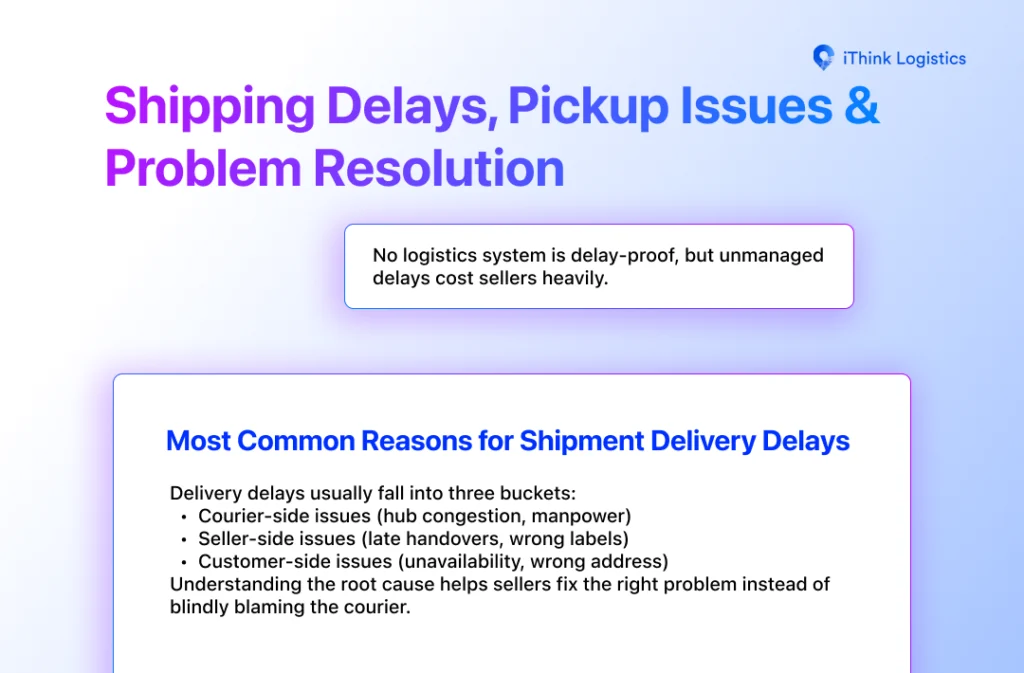
Solution: Choose a logistics partner laced with a robust delivery fleet and a strong track record of timely delivery and proactive communication.

  • High International Shipping Charges: 

Many Indian D2C brands struggle with raised shipping costs due to factors such as bulky packaging or poor rate negotiation with logistics providers. 

This eats into your margins and can make your products less competitive abroad.

Solution: Select an international shipping partner with strong coordination with local courier services. For instance, iThink has combined forces with FedEx to offer international shipping as smooth as local delivery. 

  • Customs Delays & Compliance Issues: 

Incomplete understanding of export documentation, country-specific regulations, or failure to meet compliance requirements often results in customs clearance delays. This not only slows down delivery but can also lead to penalties, returned shipments, or dissatisfied customers.
Solution: Stay updated on country-specific regulations and lean on expert support to ensure your documents and duties are in order.

  • Limited Tracking & Visibility: 

Not all logistics providers offer real-time tracking. When you or your customers don’t know where the parcel is, it creates anxiety, more support tickets, and a drop in trust.

Solution: Go for shipping partners with live tracking and proactive updates, so both you and your customers are informed.

E-commerce sellers must plan everything from precise documentation to customs clearance, cross-border taxes, etc. Otherwise, export logistics can become your worst nightmare. 

How to Stay Compliant with International Shipping Regulations

Clearly, there’s a lot that goes on behind the scenes when it comes to international shipping. Instead of wasting your time and resources on these unfamiliar operations, you are better off partnering with an international shipping company. Let’s go through a few options and how to pick an e-commerce partner for export logistics.
Which are the best international shipping companies for Indian D2C brands?

Expanding globally requires a reliable logistics partner to ensure timely deliveries and customer satisfaction. Here are seven top international shipping companies that cater to Indian Direct-to-Consumer (D2C) brands:

Best International Shipping Companies for Indian Sellers

  1. FedEx

    A globally recognised name, FedEx offers extensive international shipping services from India to numerous countries. Known for their reliable and time-definite deliveries, FedEx provides a range of shipping options, including express and economy services, catering to various business needs. Their advanced tracking systems and customs clearance expertise make them a dependable choice for Indian exporters. 
  1. iThink Logistics

    Tailored specifically for Indian D2C brands, iThink Logistics offers cost-effective international shipping solutions with real-time tracking, seamless eCommerce platform integrations, and robust Return to Origin (RTO) management. 

Their dedicated support team understands the unique challenges faced by Indian sellers, providing personalised assistance to streamline global expansion.

The differential factor with iThink Logistics is that they are a FedEx-compatible partner. This means that when you partner with ITL, you get the dual benefit of an exceptional international fleet with an Indian support team you can work closely with. 

Here’s what you will get – 

  1. Exclusive pricing discounts from FedEx

For packages<=68 kg

  • Express delivery with an EDD of 2-3 days across 220+ countries in the world. 
  • Economical delivery with an EDD of 4-5 days across 220+ countries. 

For packages > 68 kg

  • Fast shipping for bulk packages with an EDD of 4-5 business days. 
  • Affordable rates for bulk shipment are available as well. 
  1. Access to the largest fleet of planes, trucks, and ships globally. 
  2. Automation that builds efficient shipping workflows. 
  3. A single window for all your international shipping needs.
  1. Shiprocket
    Shiprocket is a prominent logistics aggregator in India to facilitate both domestic and international shipping. They offer a user-friendly platform with features such as automated order fulfilment, real-time tracking, and competitive shipping rates, making them a preferred choice for many Indian e-commerce businesses. 
  1. Blue Dart

    Blue Dart, South Asia’s premier express air and integrated transportation company, offers secure and reliable delivery of consignments to over 35,000 locations in India and more than 220 countries worldwide through their partnership with DHL. They provide a range of services, including time-definite deliveries and temperature-controlled shipping, catering to diverse business requirements. citeturn0search0
  2. ShipGlobal.in

    ShipGlobal.in is revolutionising international shipping for Indian exporters, SMEs, and D2C brands by offering seamless global shipping solutions. With services starting from 50 grams, they cater to a wide range of shipping needs, enabling businesses to expand their reach internationally with ease and efficiency.
  3. Aramex

    Aramex is a leading global provider of comprehensive logistics and transportation solutions. With a strong presence in India, they offer international shipping services characterised by flexibility, reliability, and timely deliveries. Aramex’s expertise in customs clearance and tailored solutions makes it a valuable partner for Indian D2C brands aiming for global expansion.

How to Choose the Right International Shipping Partner?

Consider the following factors while choosing the Right International Shipping Partner:

  • Service Coverage: Ensure the shipping company services your target markets and offers comprehensive coverage.
  • Shipping Rates: Compare costs to find a partner that aligns with your budget without compromising on service quality.
  • Delivery Speed: Assess transit times to meet customer expectations for timely deliveries.
  • Tracking Capabilities: Opt for partners with advanced tracking systems to provide real-time updates to customers.
  • Customer Support: Reliable customer service is essential for promptly addressing any shipping issues.
  • Technology Integration: Seamless integration with your eCommerce platform can streamline order processing and fulfilment.

Comparing International Shipping Charges: Finding the Best Rates

Shipping costs can significantly impact your profitability. To secure the best rates:

  • Obtain Multiple Quotes: Request detailed pricing from several shipping companies to compare.
  • Analyse Fee Structures: Be aware of additional charges such as fuel surcharges, customs fees, and handling costs.
  • Negotiate Terms: Leverage your shipping volume to negotiate better rates or discounts.
  • Consider Aggregators: Platforms like iThink aggregate services from multiple carriers, potentially offering more competitive rates.
  • Evaluate Service Levels: Balance cost with service quality to ensure customer satisfaction isn’t compromised.

By carefully evaluating these factors and partnering with a logistics provider that aligns with your business needs, Indian D2C brands can effectively navigate the complexities of international shipping and achieve successful global expansion.

How can International Shipping Help my D2C Business Expand Globally?

Expanding your Direct-to-Consumer (D2C) brand internationally unlocks new markets and revenue streams. However, navigating the complexities of global logistics requires strategic planning and execution. This guide outlines essential practices to ensure seamless international shipping and highlights how iThink Logistics can be your ideal partner in this journey.

Importance of Shipping Tracking and Transparency

Effective tracking and transparency are vital in international shipping. They enhance customer satisfaction, build trust, and reduce inquiries about order status. Providing real-time updates ensures customers are informed, leading to a positive shopping experience.

Best Practices for Seamless Order Tracking

To optimise order tracking for global customers:

  • Implement Robust Tracking Systems: Utilise advanced tracking technologies that offer real-time updates and comprehensive visibility into the shipping process.
  • Communicate Proactively: Send timely notifications about order status changes, including dispatch, transit milestones, and delivery estimates.
  • Provide Accessible Tracking Information: Ensure customers can easily access tracking details through your website or dedicated portals.

Optimizing Packaging and Fulfillment

Efficient packaging and fulfilment processes are crucial for hassle-free international shipping:

  • Standardise Packaging: Use uniform packaging to streamline handling and reduce shipping costs.
  • Ensure Compliance: Adhere to international shipping regulations, including accurate labelling and documentation.
  • Leverage Technology: Implement fulfilment software to manage inventory and automate order processing.

Why Choose iThink Logistics?

For Indian D2C brands aiming for global reach, iThink Logistics offers tailored solutions:

  • Customised for Indian D2C Brands: iThink understands the unique challenges faced by Indian sellers and provides features designed to address them.
  • Cost-Effective Services: Competitive pricing without hidden fees ensures affordability without compromising quality.
  • Advanced Tracking Systems: Real-time tracking capabilities keep you and your customers informed throughout the shipping process.
  • Robust RTO Management: Data-driven strategies minimise Return to Origin (RTO) rates, enhancing profitability.
  • Seamless Integrations: Easy integration with major eCommerce platforms simplifies order processing.
  • Dedicated Support: A responsive support team familiar with local markets ensures timely assistance.
  • Hassle-free Documentation: With IThink, the list of documents needed is drastically reduced. You only share a letter of undertaking,  Government ID cards, and the IEC code.

By partnering with iThink Logistics, you gain a reliable ally equipped to navigate the complexities of international shipping, enabling seamless global expansion for your brand.

The Best International Logistics Partner for Your D2C Brand

For Indian D2C brands aiming to grow globally, the right logistics partner makes all the difference. It impacts your delivery timelines, shipping costs, customer satisfaction, and overall brand reputation.

iThink Logistics offers a clear advantage here. Built for Indian sellers, it combines affordable international shipping rates, real-time tracking, smooth integrations, and strong RTO management—all in one platform. 

Unlike other players, iThink prioritises personalised support and hassle-free operations tailored to the unique challenges of Indian eCommerce brands.

If you’re looking to scale faster, cut costs, and deliver a reliable experience to your global customers, iThink is the partner to count on.

Simplify your export logistics. Choose iThink today.

Exit mobile version