Simplify your logistics with scalable, tech-driven solutions tailored for Indian businesses. From warehousing to last-mile delivery—grow faster, ship smarter.
Coronavirus, also known as COVID-19, is a large family of viruses that is capable of causing illness starting from the common cold to severe conditions like respiratory syndrome, kidney disease, etc.
According to the W.H.O, the disease is known to be zoonotic, which states that it is a virus that is transferred to humans through animals. The first traces of coronavirus that were found in humans, is stated to be transferred through civet cats and dromedary camels. Several known coronaviruses are circulating in animals that have not yet infected humans.
Symptoms of Coronavirus
Some common symptoms of coronavirus include fever, cold, cough, and shortness of breath. If left untreated, human bodies can also develop a severe condition that includes Pneumonia, acute respiratory syndrome, kidney failure, and even death
Preventions
Here is a list of Dos and Don’ts for You. Since there is not enough information about the virus, it is always better to stay safe. Prevention is better than cure, and here is what you can do to stay healthy. Read on…
DOs
Wash your hands frequently for at least 20 sec. Don’t forget to use sanitizer before and after cooking, using the bathroom, sneezing, and coming from outside.
Do your research on the symptoms like flu, cold, shortness of breath, etc.
Do take precautions when you are out in the public. If you are below 18 or above 60, you need to be extra careful. In this age, you are more susceptible to the disease.
Carry a mask and put it on if you see anyone sneezing, coughing or showing and similar symptoms.
Avoid Crowded places and reconsider your visit to international countries.
DONTs
Do not panic. Panic can increase your heart rate and can cause other diseases and wouldn’t have happened otherwise.
Don’t self treat yourself. If you are showing signs of fever or flu, consider visiting a doctor before you take paracetamol or antibiotic. Ignoring minor symptoms can lead to something big.
Do not touch your face, mouth, and nose. Doing so can cause the virus to enter your body.
Do not use common towels, soaps, and handkerchiefs. Keep all the clothes washed and separated from other family members.
Precautions for Logistics and Supply Chains
If you are associated with logistics and supply chain, it is very important to keep an extra layer of protection to prevent the disease of spreading. International product shipping and exchange have high chances of bringing in the virus, so it is important to make sure that the products are sterilized before they are received. Various researches have shown that people in India who are affected with this virus have been somehow exposed to people who just completed an international tour. So here are few basic precautions that you must take while working in a logistics and supply chain sector.
Handle shipments with care. Make sure every product is properly sterilized.
Frequent disinfecting of the warehouses are important.
Any employee showing mild signs of illness should not be allowed to handle product shipping.
The delivery person must wear gloves and masks whenever they go for any delivery.
Self-hygiene is important. Wear masks throughout the working day.
Keep hand sanitizers. Use them frequently and especially during product handling
Wash your hands every 20-25 minutes.
Carry your own food and water. Avoid eating outside and do not share food.
Frequent blood tests should be done to confirm the good health of an employee.
Ecommerce business, also known as electronic trade or web business alludes to the selling of products, purchasing, and administrations utilizing the internet along with the exchange of cash and information to execute these business procedures. Ecommerce business is often used to imply the offer of products available on the web. However, it also portrays any sort of business exchange that is made or encouraged through the web.
While e-business refers to all parts of working, an internet business or online business refers to the exchange of enterprises and merchandise.
The history that lies behind the internet business ventures starts with the principal online deal. In the year 1994 on the 11th of August, a man sold a CD of the band Sting through his site known as the Net Market, which is an American retail platform to his companion. This is the main cause of a purchaser buying a particular item from a business through the Web—or “e-commerce business” as we know it today.
The mobile e-commerce business, or mCommerce, is a quickly developing new road of e-commerce that is for the most part determined by the growing business sector and impact of cell phones and recent smart devices associated with shopping on the web. In 2018, the mCommerce division appreciated a 39.1% expansion in deals contrasted with the earlier year.
Various types of e-commerce business
B2B type
It is also known as business to business e-commerce. B2B prevails when organizations offer a certain deal to other different organizations. This is mostly of stationery stores that sell office-related stationaries in a bunch to organizations. Typically, B2B organizations provide with a limited rate for every unit, if clients are purchasing in bulks. This, in turn, motivates the offices from which the benefits are being availed. Learn about different B2B business models.
B2C type
It is also known as business to consumer e-commerce. B2C is the most approach to the plan of action where traders offer to buyers who purchase a modest quantity of products. A well-known case of the B2C model would be grocery stores where purchasers purchase their required items one at a time. However, they typically never purchase their requirements in a bulk.
C2C type
It is also known as a consumer to consumer e-commerce. C2C is generally a new plan of action where shoppers who recently purchased something look to exchange those things to another buyer. Through commercial centers like eBay and Craigslist, the process is very simple and very worthwhile for selling those things that are not required anymore.
While most organizations offer their items to one of these classes, it’s workable for e-commerce business organizations to offer to more than one classification of purchasers. It is significant for e-commerce business organizations to comprehend who precisely they offer their items because it impacts significant choices, for example, their showcasing, their marking, their delivery strategies, their mark-ups, and so forth.
Benefits of e-commerce business
There is a motivation behind why e-commerce has shown such significant development in recent years. Surely, with the web turning into a basic prerequisite of regular daily existence, organizations are figuring out how to exploit the various advantages of e-commerce, the most eminent of which include:
Global market
A physical store will consistently be restricted by a geological region it can serve. An online store or some other kind of e-commerce business has the entire world as its market. Going from a neighborhood client base to a worldwide market at no extra expense is probably the best favorable position of exchanging on the web. In 2018, 11.9% of worldwide retail deals originated from online buys and this is just set to build year on year.
Availability
Another incredible advantage of maintaining an online business is that it is constantly open. For a trader, it is an emotional increment in deal openings and an accessible choice for the clients. Unlimited by the working hours, e-commerce organizations can serve clients all day, every day/365.
Reduced cost
Online business organizations profit by fundamentally lower running expenses. As there is no compelling reason to enlist deals staff or keep up a physical retail facade, the major e-commerce costs go to warehousing and item stockpiling. Moreover, those who are maintaining an outsourcing business value even degraded forthright venture requirements. Vendors can offer better limits to their clients and arrangements as they can save considerable amounts on operational costs.
Inventory management
Ecommerce business organizations can automate their stock administration by utilizing electronic devices to quicken requesting, conveyance and installment methodology. It is sparing the organization billions in operational and stock expenses.
Targeted marketing
With access to such an abundance of client information and a chance to watch out for client purchasing propensities just as the developing business patterns, e-commerce organizations can remain light-footed and shape their promoting endeavors to give a superior customized understanding and discover all the more new clients. Just consider that you get an opportunity to address all your clients by their specific first names; that is something as of now.
Niche markets
Running a special e-commerce business can be extremely challenging. Scaling a specialty item to get well known is effortful. By taking advantage of a worldwide market, then again, e-commerce retailers can fabricate an exceptionally productive specialty business with no further speculation. Utilizing the web search abilities, clients from any side of the world can discover and buy your items.
Working suitability
Maintaining an e-commerce business implies that you don’t have to sit in an office from 9 to 5 or endure a drive throughout every day. A PC and a proper internet connection are all you need to deal with your business ventures from anywhere on the planet.
Get started with an e-commerce business
There is a consistent question on how you should approach constructing an e-commerce online store. Even though a real online store cannot be constructed in a single day, people try to approach the procedure without proper knowledge. Investigating, building, propelling and growing a gainful e-commerce business is a multi-layered procedure including various advances and choices. Some pointers are discussed below:
Selecting and sourcing the right product
The initial step to begin an e-commerce business is choosing what items you’re going to sell. Finding a productive thought can be difficult work, so you need to set up to do some genuine burrowing and thinking. Fundamentally, you pick items with sound edges that will permit you to turn a benefit and scale the business later on. When you comprehend what you need to sell, you will have to choose how and where you are going to source the items. The four principle strategies for sourcing items and stock are making, assembling, discount and outsourcing.
Planning and conducting research
Your product planning will direct which parts of the market you have to inquire about, however probably the most significant territories to investigate will be your opposition, estimating methodology, and your remarkable incentive. Now, it is likewise a smart thought to draft a field-tested strategy that will assist you with envisioning your development procedure and distinguish any potential dangers or obstructions.
Frame your brand identity right
Since you have a promising item thought and a way for the market, it’s an ideal opportunity to begin considering the key components of your store, for instance, area name, your image identity, brand regulations, and your unique logo. Getting your image directly from the beginning can help quicken the development and vanquish the hearts of potential clients. Before directing your concentration toward building the store, you ought to invest some energy examining the essentials of SEO, with the goal that your business gets looking great so far.
Conclusion
Ecommerce business has developed to make items simpler to find and buy through online retailers and commercial centers. Autonomous specialists, private ventures, and enormous partnerships have all profited by e-commerce businesses, which empowers them to sell their products and enterprises at a scale that was unrealistic with conventional disconnected retail.
Worldwide retail internet business deals are anticipated to reach $27 trillion by 2020.
The courier department and logistics are one of the essential sectors in every nation. If our country lacks in the good logistics department, then we would not be able to grow. As the logistics sectors see the import and export across the world, it is necessary to have a suitable logistic department so that the business can expand largely. Let us discuss the top 10 logistics companies in India:
Top 10 Logistics Company in India
DHL
DHL stands for Dalsey, Hillblom, and lastly Lynn. DHL is a German logistics company in India that delivers parcels across the world. DHL expresses the department of mail of the German company known as Deutsche Post DHL. It is the largest logistics company in the world. To be very specific they excel in airmail and maritime. They are said to deliver almost 1.3 billion parcels every year and even more. It was first established in the year 1969 in the United States. DHL expanded its wings across the globe at the end of the 1970s. It comes in the first position in the top 10 list of the logistics company present in India.
Blue-Dart express
Another big brand that comes under the field of the top logistics companies present in India is Blue dart. Blue dart has been voted as the super brand for consecutively nine years. This is the most common and preferred company in the logistics industry as it provides all kinds of solutions related to logistics with the utmost guarantee and complete safety. More than 35,000 locations have been covered by Blue dart in the country. They have more than 85 warehouses in certain different locations, which makes it easier for them to do their job efficiently.
The company was first established in the year 1994. Blue dart had headquarters at Chennai in India. The packaging quality provided by Blue dart is designed to protect your material from external damages, moisture, and dust. It comes in the second position in the list of top logistic companies present in India.
Transportation Corporation, India limited
This Company comes under the top listed courier services company. It has a turnover of rupees 4300 crores and sometimes even more. It is one of the leading associates for providing multimodal logistics services along with supply chain components. As one of the leading companies in the industry, Transportation corporation India limited strives hard to improvise its systems, procedures, and productivity. It has been excelling in the market for over six decades now and has an infrastructure that consists of more than 1400 network chains. With an amazing and efficient team of 6000-trained individuals, TCI stands strong in pushing the boundaries of providing smooth multimodal transport services in the country and international markets. For the last 60 years, Transportation Corporation India limited is considered the best courier company present in India. It comes in the third position in the list of top logistics companies in India.
TNT Express
The Company was first established in the year 2011 on May 26 in the heart of Australia. TNT Express had its headquarters in Hoofddorp in the Netherlands. The company serves worldwide including India. In India, the head of TNT Express is located in Bangalore, Karnataka. It is one of the best companies for courier services as it offers its services in almost every area in the country. It provides shipping services, domestics, and international courier services, e-commerce solutions, supply chain services, premium express, train freight, airways freight, priority courier, reverse logistics, and many more. They provide road and air transportation services in America, the Pacific region of Asia, the middle-eastern region, Europe, and Africa. It is the fourth-best logistic company in the top lists of logistic Companies in India.
Agarwal packers and movers limited
It was founded in the year 1987 by the small segments of the company associated with Agarwal brood carriers. The company excels in removal and packaging services across the country. The services provided by the company are transport services, aviation logistics, storage, supply chain. Home storage, packaging, and relocation services in both national and international locations, over-dimensional cargo transport services, third-party logistics, and many more. We can easily trace the footprints of the Agarwal packers and movers limited if we look back in the year 1987. It comes in the fifth position in the list of top logistics companies in the country.
All cargo logistics limited
The Company was established in the year 1983. The head office of the company was located in the heart of India that is in Mumbai city. The company provides the following services: contract logistics, supply chain management services, shipping services in coastal regions, cargo station containers, engineering solutions for the ongoing project, airways freights, train freights, deport facilities for domestic containers, reverse logistics, and many more as such. This is one of the most trusted and reliable logistics companies now in India. They provide complete security for every shipment they provide. In the year 1993, Mr. Sashi Kiran, the chairperson of the “All cargo logistics limited” identified Allcargo logistics as an agent for cargo handling in Mumbai city. This company comes under the sixth position in the list of top logistic companies present in India.
DTDC
It is India’s very own courier service with its headquarters in Bangalore. It is also known as DTDC Express limited. It is recorded to provide over 12 million shipments per year. In 2012, it acquired a percentage of 52% stake in the Eurostar Express in UAE. In the Year, DTDC came out strong by acquiring 70 percent of logistics from the Nikkos. The path lead by DTDC has been full of great milestones, rapid growth, and development, along with pushing boundaries to the maximum level. It comes in the seventh position in the list of top logistics companies in India.
Gati
It is an Indian company providing multinational courier services. It has its headquarters in Hyderabad, India. It provides the following services: supply chain management, warehousing solutions and services, forwarding, cold chain, trade services, fulfillment, and e-commerce services. The company has offices in all the important cities in India and foreign countries like Singapore, China, Thailand, Nepal, and Hong Kong. It was first established and operated in the year 1983 by the renowned Mahendra Agarwal with its first landmarks in Madurai and Madras. Gati comes in the eighth position in the list of top logistics companies present in India.
FedEx
It is an American company providing multinational courier services. it was almost 46 years ago in the year 1971 by the renowned Frederick W. Smith. The company serves across the globe and has headquarters in the United States, Memphis, and Tennessee. FedEx is best known for its brilliant shipping services. FedEx is the market leader when it comes to providing reliable shipping services. It provides real-time information and updates about the particular package to its intended customer. The services of the company are available in more than 220 countries and it processes over 3.6 million shipments per day.
It provides both international and domestic shipping services in India. FedEx provides the following services: heavyweight courier services, lightweight courier services, standard deliveries, domestic and international courier services, priority courier, reverse logistics, airways freights, eCommerce logistics, e-commerce logistics, and many more. Although FedEx comes in the night position of the list of top logistic companies in India, it is estimated to have the brightest future in the upcoming years.
First flight
The first flight is good and well-developed in house courier company and logistics. It was formed in the year 1986 in November. The first flight had three major offices aligned up, namely: Mumbai, Kolkata, and Delhi. It came into force in the year 1986 with its three main offices but by then the company has built an extensively wide network within the country. It included services like International and domestic courier services, priority courier, reverse logistics, air cargo, e-commerce logistics, train cargo, and many more.
The company is considerate about your feelings and gives importance to the engagement of your family members. The first flight is one of the best logistic company for e-commerce. The company has educated and professional workers making them efficient in the logistics industry. They also come at very reasonable price rates, making them more credible for the common masses. The first flight is in the 10th position in the list of top 10 Logistics companies present in India.
Conclusion
The logistics sector is the most important and essential sector that submits to the economic development of the country. Logistics is the backbone of the e-commerce industry. The above-mentioned companies are the top ten companies in the logistics and courier services. These companies excel in every shipment venture and strive hard to provide the best shipment and delivery services to the customers.
When we talk about logistics, we refer to the process of planning, implementing, and managing the movement of goods, services, or information from one point to another. Essentially, logistics meaning revolves around ensuring that the right products are delivered to the right place, at the right time, in the most efficient way possible. But, what exactly is logistics?
What is Logistics?
At its core, logistics involves the coordination and management of resources such as goods, equipment, and personnel. So, when we ask, what is logistic? It refers to a system that handles various processes like transportation, warehousing, inventory management, and even packaging. Effective logistics ensures that the supply chain operates smoothly, keeping costs down and meeting customer demands.
The Meaning of Logistics in Business
Now, let’s dive deeper into the meaning of logistics in a business context. For companies, logistics plays a pivotal role in ensuring that products are transported efficiently from suppliers to customers. The logistics meaning extends beyond just transportation—it also encompasses managing the flow of information, handling returns, and optimizing delivery times. When businesses ask, what does logistics mean, they’re often referring to the entire supply chain process, which is critical for ensuring customer satisfaction and cost-efficiency.
Why Logistics is Essential
Understanding what is logistics and its importance can significantly impact a company’s bottom line. A well-optimized logistics system improves delivery speed, cuts costs, and ensures smooth operations. Whether you’re a small business or a large corporation, understanding the meaning of logistics and how it impacts your operations is crucial for long-term success.
A business that deals with selling products and services has to figure out a way to deliver them to customers. If the products and services are provided and sold online, then also they have to determine a way where the products move from one point to another through particular shipping services and logistics services.
If you are a single person operator then you might prefer the post office for the shipping services. However, at a certain point in time, you will want to upgrade to a better shipping process and ultimately opt for a shipping provider. When your business will eventually grow further, you will face more complexities while dealing with shipments through multiple carriers daily.
This is the point where the logistics providers come to the rescue. They are specially trained individuals who specialize in handling the shipment procedures for your enterprise. They help you to coordinate your products in their expected destinations in an efficient way.
Many procedures lay between the manufacturing of the product to the final stage of delivering it to the customers. Firstly, the products will be sent to the warehouse where it needs to wait for its order to be placed. The product spends a considerable amount of time in the warehouse or it can also be ordered as soon as it reaches the warehouse.
The next step that follows is to arrange for the most suitable means of transport for delivering the products to the postal carriers or retailers. The retailers or postal carriers in return deliver the product to customers. Whatsoever, logistics transportation services is a tricky process that has many elements to it. The important being the weather conditions. If the weather conditions are not favorable, then it can disrupt the whole transportation process, which in turn can bring about huge losses to the company.
The main purpose of the logistics services is to oversee all these matters. They coordinate logistics transportation services and keep the products flowing smoothly. For instance, if a particular client does not have many products to fill the entire truck, the logistics service providers strategically combine one customer’s shipments with another customer’s shipments, so that the truck can be fully utilized. This also avoids certain delays in the deliveries. Many logistic services companies have come a long way within the years to provide the best services for your company.
Mainly three types of logistics services are commonly used. The logistics industry is widely spread and it contains a vast range of services that have a direct impact on how the products are delivered from the maker to the particular recipients. It doesn’t matter where your business lies in between the shipment and production lines, it is always better to have that feel from how your products are getting from one point to another. Here we will discuss various types of logistics that influences the production processes:
Warehousing Services
The product is typically held at a warehouse or is consecutively transported through various warehouses before it is shipped. Many companies prefer their warehouses; whereas many companies work hand in hand with third-party logistics service providers. They tend to ship and store our products on behalf of their clients.
These help in eliminating the cost of paying for a complete warehouse. Although warehousing is a very flexible and non-complex aspect of the field, still it has certain elements that make the situation critical. The storage you require will determine the dynamic of space that your products need, the time aspects of your need for space, how easily your products are accessible, and many more.
Freight Shipping
Large items and large orders are mostly shipped with the help of freight shipping. This includes a combination of particular vehicles like ships, trains, cargo, trucks, and many more. For businesses that specialize in vehicle transportation, partnering with experienced car shipping logistics companies can streamline the entire process and ensure vehicles arrive safely at their destination. Freight services also include drayage services that enable your order to be transported from ports to particular warehouses for storage.
Just like warehousing, freight shipping is also full of complexities and involves constant fluctuations in labour shortages, demands, shipping timings, and many more. It is the logistics provider’s job to see that the products are delivered timely no matter what the situation is or what circumstances the company is facing. These enable brand loyalty and customer loyalty to remain constant.
Shipping and logistics services for couriers is one of the most popular shipping services opted by the company. Shipping and logistics services like UPS, FedEx, etc. are very popular now. Courier service is mostly available for smaller orders and for products that are very fragile and require extra care during delivery. Courier services have a faster pace than freight shipping. The reason is very simple : courier services take care of the smaller orders, not large scales of items. Many retailers tend to reserve the courier services for the last step when the particular product reaches directly to the intended customers from the warehouse.
Logistics management is one of the essential elements of supply chain management that is used to fulfil customer needs and demands by planning, controlling, and executing this effective movement. Logistics management is the management of the complete flow of goods and their particular services.
It provides full information on the complete movement of raw materials, and other respective activities in inventory. Logistics management and shipping and logistics services plays an important role in running your supply chain smoothly. It also tracks movement, location, and the status of the inventory. Logistics management helps organizations to cut out their expenses and enable better customer service. By adhering to the customer requirements and the standards laid by the industry, logistics management provides implementation, planning, and strategizing.
Conclusion
Logistic service providers ensure that all the above-mentioned services along with other activities associated with logistics go on smoothly. This requires a lot of determination and a great deal of time management, coordination, and organization. Many logistics service providers have strived hard for perfecting this over the years. All you have to do is look for the right one so that your business can flourish.
E-commerce has brought new revolutions to multi-functioning businesses. For instance, selling products on the web has become feasible enough; the e-commerce platform has become a run de Vu of the battlefield. Thousands of businesses have surfaced on the e-commerce platform with original contents and concepts of their business venture to find real-time success. When it comes to payment methods whether it is an e-commerce store or a startup business, cash on delivery is very popular and is considered the most feasible method from the customer’s point of view but with it comes with Cash on delivery issues. Customers often prefer this method as it seems to be fair and safer but sometimes they use it in a negative way that affects the business.
Many customers prefer COD available online shopping as it allows them to pay only upon receiving their items. Offering COD available online shopping can help retailers reach a wider audience, especially those hesitant to pay online upfront.
Not only you but also every other business seeking clients, desire to grow their businesses worldwide through the web. To improvise your client base and go ahead with your deals, the best option you can choose is an e-Commerce site. This can help you to set up your online game with certain outcome-driven e-Commerce web architecture associations. Whatever may be the process, it is very important that you strategies in a way that both satisfies your business ventures and your customer’s preferences. You must acknowledge your customer needs and desires.
In this blog, we will walk your way through some effective ways on how to avoid cash on delivery issues and reduce COD returns. Read on…
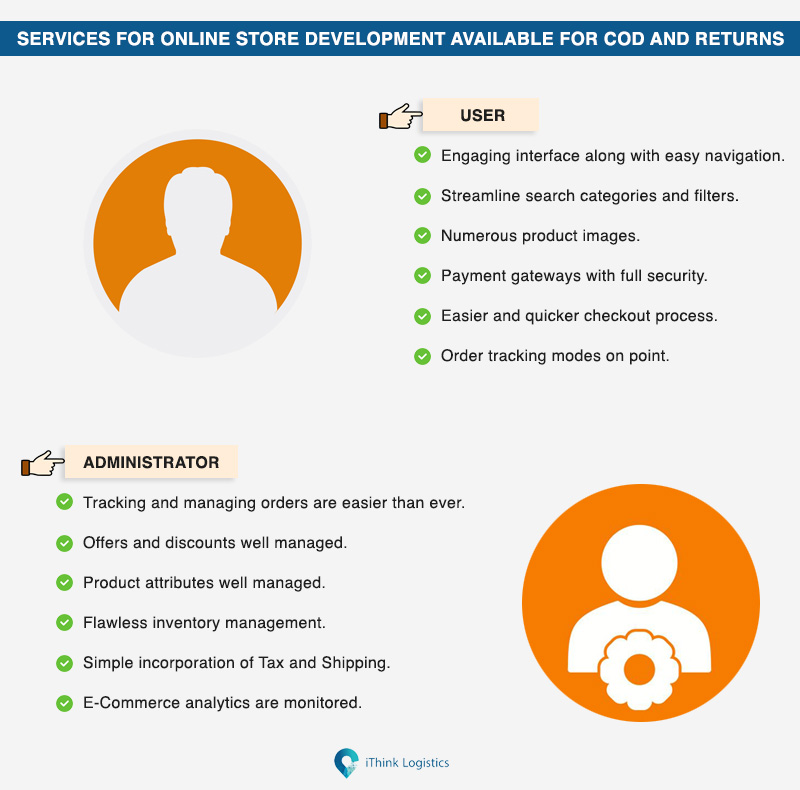
Services For Online Store Development Available For Cod Process And Returns
Giving the clients a tribulation comparable to that of a real physical store and giving the director the simplest of the administration offices, is the rudimentary proverb of any online store advancement. This can take care of both the essential requirements by providing the accompanying criteria for your online store development associations. This should be done with the utmost guarantee.
The User
Engaging interface along with easy navigation.
Streamline search categories and filters.
Numerous product images are commenced accordingly for real-life feelings.
Payment gateways with full security.
Easier and quicker checkout process.
Order tracking modes on point.
The Administrator
Tracking and managing orders are easier than ever.
Offers and discounts well managed.
Product attributes well managed.
Flawless inventory management.
Simple incorporation of Tax and Shipping.
E-Commerce analytics are monitored.
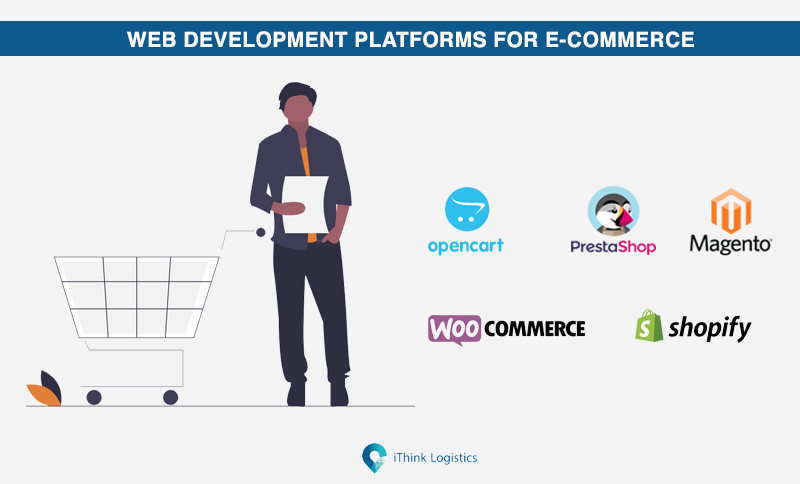
Web Development Platforms For E-Commerce
Magneto Development
Regarding the development processes of e-Commerce site improvement, Magneto is one of the most used enhancement stages today. It permits intense personalization of both front-end and back end, due to its most suitable structure in particular. It is well known for building an online trading hub where numerous seller accumulation is set up and in addition to that, it gives an unrivaled level of security due to its PA-DSS stability.
Prestashop Development
You need to manage a lot of expertise perspectives or complex levels of coding while using Prestashop. It is one of the most simplified development systems for use and it happens to be free. In addition to that, with its polyglot help, it enables you to offer your products or administrations in the global or international market. Expert e-Commerce site designers can produce one of the best e-commerce sites for your business, as they are very familiar with this stage.
WordPress Development
Although WordPress sites end up being to potential; they are the quickest and simplest to grow. By utilizing some excellent e-Commerce modules, which are approachable for WordPress, some great answers can be provided to independent companies.
OpenCart Development
Simplified customization is one of the key advantages of Open Cart. Sites produced using OpenCart are greatly light-weighted, due to the utilization of AJAX. It supports more than 14000 extra expansions, which can be downloaded along with the smallest amount of effort with premium modules. If you can convey marvelous OpenCart based online stores for any industry, you are good to go. You can do this with ease if you have a great deal of involvement as an e-Commerce web enhancement association in India.
Shopify Development
Shopify helps you in spreading worldwide with your business by providing online stores for the same with rapid succession. It is considered a standout amongst most available stages in e-Commerce site enhancement. Shopify helps you to form an e-Commerce store simply and understandably so that you can be led down your items on the web without any hazards. The affiliation is easy to utilize and is adjustable to your necessities. Lastly, all in one it comes with inbuilt security.
The Exploitation Of Cash On Delivery: How It Affects The Business?
Cash on delivery is the most common way of enticing customers to buy a particular product. Customers prefer this method because of the security it provides. However, at the same with greatness comes certain cash on delivery issues and misuses. One of the problems with cash on delivery is that Certain customers exploit the method by ordering high-priced products and simply reject them at the final time of delivery. This is a huge loss for the system. As the item is high-priced, so is its packaging price. Everything goes to waste starting from packing prices to transportations. This also stomps their morale for doing business. The high shipping prices that follow afterward takes away all the profit that the seller could have made on the particular product.
According to a report that was posted in Times of India, customers of Flipkart would order certain expensive products or items “just for fun” and ultimately refuse them at the time of delivery. In the beginning, it seemed hilarious from the customers but from the seller’s perspective, it is quite disheartening. For every return that is made and the afterward reattempt of it, the charges for the shipping process gets doubled that trims away the profit. Due to such problems with cash on delivery, this makes the cash on delivery method an insecure option for payment for the particular seller.
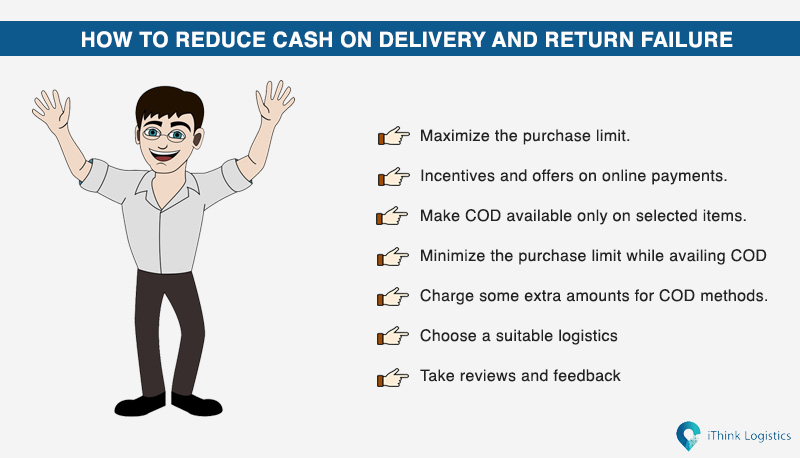
Measures Of Reducing Cod Process Failure And Returns
The main reason for incorporating the COD method in the business is that it helps in increasing the customer base at a rapid rate. Many people have no access to online payment methods, so the only method that they can rely on is cash on delivery. There are many negative aspects of the method but the advantages and profits it poses are impossible to ignore. Therefore, there are certain ways, which you can implement in your business to reduce cash on delivery problems and return failure.
One of the main cash on delivery problems is the high rate of returns, which can increase logistics costs for businesses. Additionally, cash on delivery problems often include delayed payments and potential risks of fraud or errors during cash handling.
Some of the ways are discussed below:
Maximize The Purchase Limit
In June 2013, Flipkart took a huge step to recognize the genuine customers from the herds of those who mocked the method and used it for their “fun purposes”. They created a purchase limit that effectively segregated the legit customers who valued the Cash on delivery process from the ones that just mocked the process for their little fun. Flipkart significantly announced that they are not going to fulfill COD orders that amount to more than 10,000 rupees in particular areas in Uttar Pradesh. It was a revolutionary step that Flipkart took and this helped them largely to reconcile their profit turnovers. This also spread awareness for not using cash on deliveries so lightly.
Incentives And Offers On Online Payments
This is a great way to get that confirmation about the credibility of your customers. By offering certain discount rates and offers that are only available for the online payment method, you can lure the other customers that are adhering to the Cash on delivery process. In this way, you reap the added benefits and reduce the chance of failures of cash on delivery. As your customers get the taste of the benefits of the online payment, they can probably switch their payment methods.
Make Cod Available Only On Selected Categories And Items
Making cash on delivery available for every category and item does not make any sense. Categories like beauty products, books, health care, etc. can be feasible enough to be paid through the Cash on delivery process. However, products like, electronic gadgets, mobile devices, televisions, refrigerators, etc. are high-priced and thus do not need the facility of the cash on delivery model. People, in general, are not very comfortable in handing out huge amounts. They feel quite insecure about it and thus tend to refuse the delivery of the particular items due to problems with cash on delivery.
Minimize The Purchase Limit While Availing Cash On Delivery
As there is an upper limit for people availing for cash on the delivery payment option, it is required to put a certain lower limit to it. By doing this, you can find out the genuine shoppers who will still shop even after the minimum category applied.
Charge Some Extra Amounts For Cod Payments
In the beginning, you should levy a certain amount for availing Cash on delivery process. This will eventually shift the people opting for cash on the delivery method to other online payment methods to cut out the extra baggage of cash on delivery payment option.
Choose A Suitable Logistics
You must choose the best logistics for delivering your products and services. It is one of the essential aspects of the success of your business. The delivery person assigned to make the delivery of the particular product must have the available denomination so that the product is not refused or rejected due to the unavailability of certain changes. You can use proper courier services for the delivery of the items.
Take Reviews And Feedback
It is very important that you follow-up with your customer after the delivery. You should always take feedback and reviews to improve your system for the betterment of the business and the suitability of the end customers. You are never aware of the exact reasons for the return. Listening to your customer’s acquisitions properly can help improve the missing thread that leads to this return.
To enhance your online stores and business, you must be at the same pace as your competitors or even at a higher pace. Making cash on delivery available can enhance your marketing strategies. The prime aspect of it helps you in increasing your sales in rapid succession. You should never hesitate to adopt newer trends of the businesses that can help you grow within the industry. However, you must analyze the aspects carefully and provide what is best for your customers because at the end of the day customers are the most important aspect of your business. Customers give the actual identity to your business.
Conclusion
The relevance that cash on delivery holds is very significant and it can no way be ignored. It holds profound advantages and helps your business to expand your customer engagement effectively. However, there are times that it poses certain losses to your business. Nevertheless, as every successful system comes with a little bitter taste to it, the cash on a delivery system that poses immense profit to it also has certain negative aspects to it that influences the business in a hazardous way. However, with certain prudent measures, you can use the Cash on delivery process to your benefit by canceling out the probability of unnecessary high shipping costs. This will help you to scale up your organization in the way you intended it to be. However, one thing that you should always keep in mind is the desires and preferences of the valued customers. There is nothing more important than your customers because they are the ones that give the real meaning to your business entity. Without them, your business holds absolutely no value at all. Therefore, whatever measures you adopt, you should always analyze the customer benefits along with it. If the measures seem favorable for both the company and the customers, then only proceed with it and not otherwise.
Reasons most business fail to maintain customer loyalty
Customer loyalty is one of the most important aspects of a business entity. A business is incomplete without its customers. Customers give validation to a business and they are the success what a business strives. Without potential customers, it is impossible to run a business. You need to have that support to get on the success path. It is a proven fact that holding on to customer loyalty is getting difficult with passing time. In the mad era of technological advancement, thousands of new companies are opening up every year. According to a recent survey on decreasing customer loyalty, it was found out that, only 13 percent of the customers are tending to stay loyal to a single brand. This survey showed that 87 percent of the customers preferred to shop around and 58 percent said to have changed their brand choices consecutively.
What could be the possible reason that people like to shop around and choose different brands each time a new one comes up? Why they get attracted to competitor’s products and services? It is high time that you take a closer look at your business and more importantly your customers.
Importance of customer loyalty
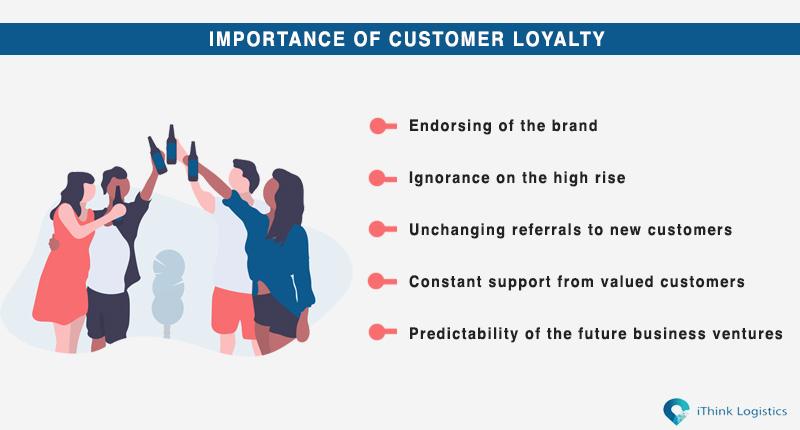
Gaining customer or brand loyalty is as important as your business entities. Thousands of benefits that lies under the covers of customer loyalty. When the marketers discuss upon the pointers of loyalty, they often suggest certain measurable metrics including sales increase, conversion rate, and enrolment increase. If all these factors are high in number, then it is easily suggestible that your business has successfully conquered the brand loyalty of potential customers. However, these factors do not narrate the whole customer loyalty Pictionary.
The conversion rate can determine the number of visitors that you have converted into sales, but they cannot show you the whole picture of whether your customers are captivated with your products and services. The conversion rate cannot determine whether your customers have developed trust in your brand or whether they are willing to purchase again. To truly see and understand the customer loyalty you need to look way beyond these conventional metrics. Some of the significant benefits of customer loyalty are discussed below:
Endorsing of the brand
This occurs when your customers become brand advocates. They become so diligently in tune with your brand that they go out of their way in promoting your brand without expecting any compensation on their part from the company. They start doing their branding through Social media platforms like Facebook, Instagram, etc. and direct referrals.
Ignorance on the high rise
This is a situation when the customers become very insensitive about the price rates of your brand. Here the customers are likely to purchase your product even if the price increases considerably. The customers trust your brand with their whole and they buy your stuff no matter what the price rates you apply.
Unchanging referrals to new customers
These referrals are new customers that are advised to use your products by customers that are already satisfied with your brand. This has a positive impact on your business and this has a direct link with the increase in sales. There are no additional charges for advertising to such customers, and they buy your products even if you do not invest in engaging them in your products. Simply put, this is an easy sale without any extra advertising or promotion.
Constant support from valued customers
Potential customers will listen to you anyway. You can communicate through email and they will directly respond to your offers you provide them. In this way, you can convince them of re-sales and even establish customer relationships.
Predictability of the future business ventures
If you a loyal base of customers, you can easily predict your sales for the year. This will help you determine the pointers that you need to increase your considerably.
Customer retention and its problems
What does it exactly mean to retain your customers? These statistics are generally defined as the percentage of long-term clients of a company. The long-term clients are more important than short-term customers because the reason being very obvious that is they tend to spend more money, costs way less for advertising the products, and they tend to make references of the company which fetches the business more valued customers. As they are familiar with the products, they feel to spend their money on the products and they enjoy doing so. Short-term clients might purchase the product for one time and then not return. This is the reason it costs less money to advertise through long-term customers.
There are certain things that you do that takes upsets your customers and make them dissatisfied with your brand services. In this way, you run the risk of losing customers. Customer retention is a worthy investment that a company makes. Retaining your old customers is much more important than getting new ones. If you can retain your old customers, you will have a potential customer that will have your back for a long time.
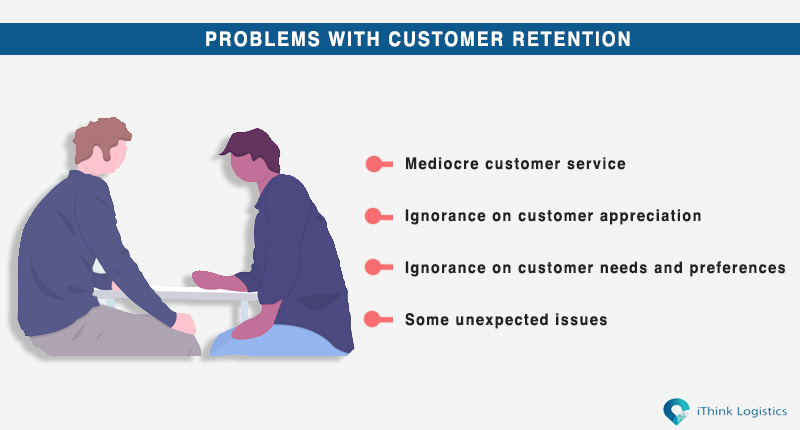
However, companies tend to draw away customers because of their poor customer retention abilities. Here are some of the major reasons why customer loyalty tends to fall back:
Mediocre customer service: Almost about 82 percent of the people have stopped using the product and services of the companies due to low-quality customer service. Customer service is the string that keeps your customer and the company connected. Therefore, you must have an efficient customer service team that can serve your clients sincerely and significantly.
Ignorance of customer appreciation: About 53 percent of people have switched to some other company because they felt unappreciated despite their continuous support. You must let your customers know that you are grateful for having them and they have been a great support in the success of the company. There are two reasons you do so: one because they really are the support systems of your business, and secondly to make them feel special like an old customer that had your back for the longest period.
Ignorance of customer needs and preferences: Most of the time companies fail to respond to customer complaints at a certain time. Often customer complaints are ignored and that what makes the customers switch to other brands that go well with their needs and preferences. You must take your customer’s tastes and preferences into account. As a customer, they need to feel valued and appreciated from time to time.
Some unexpected issues: Sometimes customers can run into problems that they were not expecting while signing up with your products and services. This probably leads to frustration and the customers tend to leave and switch brands.
So how do you plan to stop your customers from leaving you? You need to analyze the reason and come up with strategies that will effectively help you combat in customer retention. However, these strategies do not have to be complicated always, you can always come up with something subtle and it can work too. To acquire the long-term clients there are few easy strategies you can employ:
Always provide support to your customers under any circumstances. They need to know that you are always available to answer questions or solve problems they may be having.
Survey your customers. Measure customer satisfaction, ratings, and handle shortcomings. Make sure to require a reasoning section for cancellations or downgrades. You need to know why the customers are unhappy to the point of cancellation.
It is beneficial to provide discounts for your long-term customers when and where it is possible. Show them that their support has been instrumental in your business and it is your gift to them as customers.
Reasons for losing customers
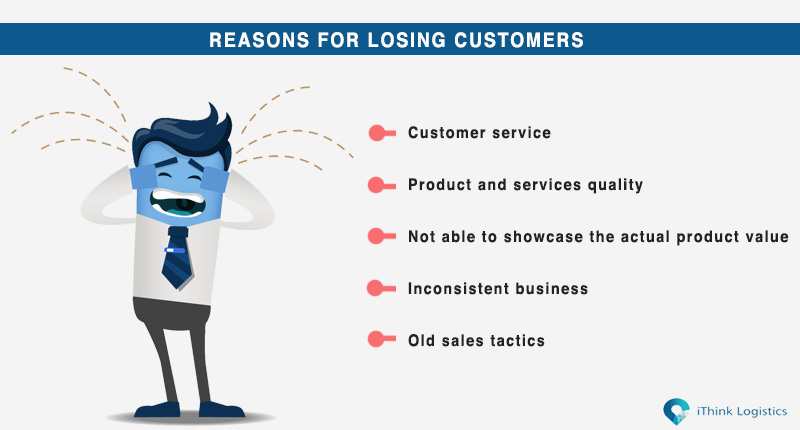
There are several reasons that companies do to fail at customer services. Here are critical areas that should be considered.
Customer service problems
There is no clear definition of what customer service looks like in the organization: You cannot just assume that you will give great customer services only if you decide to give so. You have to define what it is and how it looks, like and most importantly, what you want your customers to experience. It has to be crystal clear. A phrase goes “Always keep your customer first” should be the mantra of your company. Every employee should preach the same and the session should be ongoing.
Good people are in the wrong jobs: A customer service starts with the people and there are plenty of good people out there. However, some of them are not suited for a truly customer-focused organization. It begins by employing the right personnel for the right job. Make sure the current employees buy into the customer service definition and are ready and willing to be a part of the initiative.
There is a lack of proper training: Training is not something that you do one time. It is not something that gains from orientation only. It is an ongoing effort. The best companies have ongoing training and follow-ups to keep customer service at maximum importance.
They tend to treat customer service more like a department: For a focused culture to work, everyone has to be aware of how they influence the customer’s experience. Customer service is not a department but a philosophy to be embraced by every employee from the CEO to the most recently hired.
They treat employees in a certain way and expect the employees to treat customers a different way: This does not work. The behaviour of leadership and management towards employees is incongruent with the customer service initiative. The remedy is to treat your employees as you want them to treat customers and maybe even better.
Product and services quality-related problems
The products and services that your company produced are much less in quality than it was anticipated. As your products fail to meet the expectations of your clients, they tend to share their dissatisfaction with their friends who were most likely to become your new customers. Now, you not only lose your current customers but also blow off your new customers. Some angry customers may also take their dissatisfaction with social media. They can post a negative review about your products or services, which will affect your business globally and you might start losing customers from around the globe. The remedy here is to produce and design quality products that would exceed the expectations of your customers. You can also strategize your marketing tools and ventures.
You were not able to showcase the actual value
Customers pay for the product with an expectation of receiving equivalent value from it. It is not always important that you have the cheapest prices. Customers do not always go for the price but also value. The value of the product should do justice to its price rate. Customer service has nothing to do with the price rates but the value that is being conveyed to them. This is the reason why Apple products dominate the market when it comes to smartphones. About 87 percent of the industry is been captured by the Apple association and only 18 percent of the other brands. Customers are buying apple products despite their high price rate because they are getting the exact value from it. The only remedy is to determine your unique value proposition. You have to identify what unique you can do with your business to fetch as many customers as possible.
Inconsistent business
Not only in business but also life consistency matters a lot. The things that consistent over a long period can be easily relied upon. Moreover, things that can be easily relied upon do not need any worry. Inconsistency with your branding procedure can lead to failure. If you use your company’s logo and name in a different way and pattern while promoting can mislead your customers and can lead to confusion. Moreover, inconsistency when it comes to the quality of the product and services drives away the customer more. The remedy to this is to provide a proper customer guide to your employees, educate all your employees on branding and give them p[roper information about the industrial ventures, educate them, on customer retention and repeat sales, and the most important part is to build a strong customer relationship.
Old sales tactics
In this mad era of technological advancement, everyone tends to move faster and if you miss a little thing, it can leave way behind. When it comes to customer tactics, aggressive ways are not going to work. It will drive away customers than bringing them in. aggressive ways like dragging prospects all through the monotonous sales process, nagging into the purchase, etc. These ways used to work before because people had very fewer options when it came to certain products and services and that is the reason people used t6o put up with aggressive ways. Nevertheless, it is very different. Customers have thousands of options from which they can choose that is most suited for them. The remedy here is to build a strong relationship with customers and train the sales personnel on how to pursue the customers in a way that came very subtle and not aggressive.
Conclusion
Customers are the most important part of your company. You should always focus on keeping them happy and satisfied. Knowing how to convert a one time visitor to a lifetime customer can be a game-changer for your business. There are so many ways that might seem little for you but it might turn out to be that taboo that turns your business upside down. If you want to see that light of success, you need to focus more on your customers and the reasons behind decreasing customer loyalty. Plan strategies that work best with your customers and put them to test accordingly. Every successful business knows the worth of valuable customers. They can lead the business to a marvelous height. Without having customer loyalty your business cannot reach the peak of success. Gaining customer loyalty is one of the most important aspects of a business. It is very important that you set up a loyal customer base with proper engagement. Customer loyalty is the key to success. It is so important to have your customers come back to you, send you referrals, and write good reviews. If these things happen, your business is going to blow up.
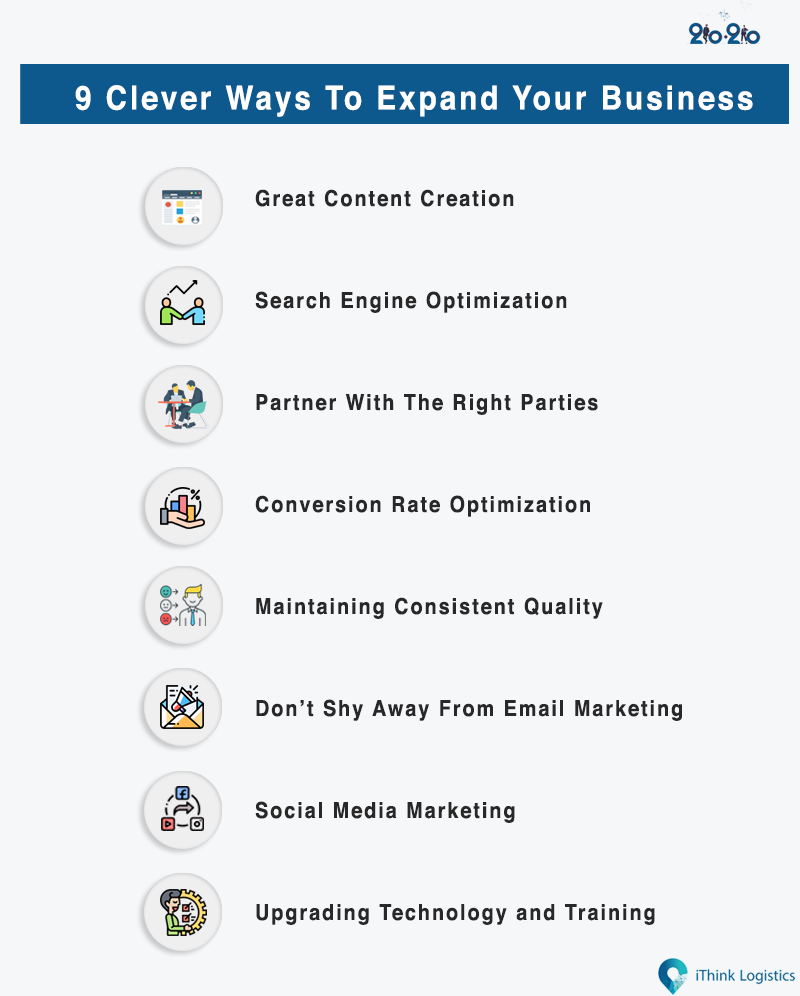
As the times have changed, so has technology, customer behavior, and expectations. Clients now expect the best of the best services that can be performed with ease by such new budding companies while they create new contacts and build capital quicker than their older competitors in the logistics market of India. New entrants in such ways have managed to capture their niche and so will the ones that come after them. As a budding industry, increasing competition is just a side effect you learn to deal with. How does one stay afloat and thrive in such challenging times? We have a list of 9 clever ways to expanding business in 2020, which will not only help you become better among your competitors but also, thrive in a constantly evolving environment. Our tips consist of online marketing and conventional tactics to help you become the best in the game.
Your website takes care of your online presence among other factors. Being one of the most important ingredients to online success, does it reflect who exactly you are and what you represent? High quality content that resonates with the core values of a logistics company is the key when it comes to business expansion. Your team of content creators needs to be top-notch to add value to your website such that it encourages the visitors to spend time on your pages. Good content ensures that the potential clients interact with your webpage, which plays a big role in generating leads and their conversion and expanding business in 2020.
A very useful tip for small businesses that cannot afford to hire and maintain their own content department is to outsource their jobs. Digital marketing experts have stellar quality content developers who understand the unique requirements of your organization. Outsourcing is not only a smart move but would also look after your budgeting. Content can consist of regular blogs that are released daily, weekly, bi-weekly or in a frequency that is best for your business requirements. Content marketing strategies address problems faced by your target audience, know-how, and informational blogs are incredible topics to increase traffic to your website.
Attention to Search Engine Optimization
As the name suggests, Search Engine Optimization is exactly that; this is a tool used to optimize your website in a way that it shows up in the top search list of Google and other search engines and expanding business in 2020. By using tactics such as keywords integration, backlinking and others, your company can divert the online traffic to your website and thus generate several leads. This also works in the form of organic and local SEO.
Organic SEO generates the results you want to bring traffic to your website by using the most searched terms related to your business in the content you publish on the site. Local SEO focuses on the audience situated within your establishment’s range to give them location-based suggestions of your business when they search for logistics companies around them. This is an excellent step towards expanding your business because it not only increases awareness but also helps you gain the upper hand in your local marketplace.
Partner With The Right Parties
Logistics can become a very competitive affair if faced alone. As small businesses, it is difficult to expand your reach due to the lack of storage space, staff and delivery operations personnel. In such instances, it is highly advised that you partner up with parties who have similar goals. This will help you spread your services over a larger geographical area rather than sticking to only a local zone. Collaborating with more delivery partners, a combined warehousing facility and a packing agency to run joint operations is the new smart in 2020. Don’t think of it as sharing your customers. When you share your client base, not only are you capable of picking up large-capacity orders and bulk orders that you couldn’t due to your previous limitation of staff and space, now you can cater to a larger audience and make it to the big leagues.
Collaborating with other smaller organizations in the logistics industries gives you a fighting chance in the face of rapid technological advancement. By joining hands to work together, your incomes increase exponentially and so does your ability to take bigger orders from farther locations. A bigger organization or a bigger logistics group, in this case, get greater discounts and better rates to purchase machinery, technology, and packaging items as well.
Conversion Rate Optimization
Conversion Rate Optimization or CRO refers to getting more value out of every site visitor. Once you have your website and amazing content ready, you’re prepared for the next step. CRO is the time taken to convert unresponsive or passive viewers into converted leads. Remarketing is an art when it comes to improving your CRO. You can also use tactics to bring old and existing customers to make repeat orders at your logistics company by putting them in the repeat sales funnel. The higher your conversions, the higher the CRO, and hence, the better your ROI. Ideas for CRO optimization would be planting your call to action button on pages that get the most traffic in your website. Using heat mapping tools, too, help to pinpoint the location where your browsers spend most of their time on your website.
Maintaining Consistent Quality
Quality assurance teams and timely audits to check the staff’s efficiency is fundamental to your expansion as a logistics business. By keeping regular checks on the quality of the work being put into packaging, transportation and other processes, you can keep business operations consistent. One of the most famous tactics used in successful logistics companies is the concept of individual accountability, where the personnel feels a personal responsibility to the work they do, thereby putting in more value and precision into their jobs. Maintaining a consistent quality of work rather than having random bursts of excellence in a mediocre trail of services will serve you longer and better in the long-run of your business.
Don’t Shy Away From Email Marketing
Using white hat marketing techniques to improve your mailing list can help you go a long way. By investing in a good digital marketing team or hiring an agency to do the work for you, you can sort and find several leads through email marketing. This involves sending useful content to people who have shown an interest in businesses similar to yours since random mailing lists often lead companies into the spam box. Several logistics companies get blacklisted by the mailing lists because they do not send content that provides any help to the potential customers. By creating newsletters to provide information both useful and essential for the audience, you can stay at the top of their inbox. By sorting the types of audience by bifurcating them into categories such as organizations and individual, their industry, geographic location and other factors, you can curate content to specifically target a solution to their pain points and individual requirements. Emails that sound more earnest and personal are the ones that get clicked on the most, which will deliver viewers straight to your landing page, thus giving your website a chance to convert them. You can use your emails for effective sales funnel wherein you pitch to a new prospect to convert them to customers, and remarket to them to make repeat purchases.
Social Media Marketing And Image Management
The social media represents your image online. By having a team of experts or hiring an agency to handle your social media accounts such as Facebook, LinkedIn, Twitter and Instagram among other popular platforms, you give your business a world-stage where they can present their best skills to invite investors, customers and business partners. Actively posting good quality content to make the audience engage with your page, monitoring reviews and attending to client grievances on social media will create a strong image of an organization that takes responsibility for their work and works towards creating a positive experience for their customers.
Upgrading Technology and Training
Technology keeps changing and getting better as the times change. This means that your organization will have to do away with older and obsolete machinery and technology that no longer serves your company’s highest good. Business owners who wish to expand their logistics companies must understand that upgrading does a lot more good than the expenses they pay to acquire it. Older technologies will not be as efficient as the ones that have been created to replace it, thereby decreasing your productivity. If you hold on to old machinery because they work alright, you’re creating a loss for you because your competitors are leagues ahead with the benefits of acquitting the latest upgrades. Training your staff to operate machinery by calling a member from the machinery’s origin company will similarly benefit your team rather than incurring losses while mishandling and damaging expensive equipment.
BONUS TIP: Streamline Your Business Operations
This may be an old school step but it always shows a hundred percent results. It is always worth streamlining your business operations by running through drills over and over again so that you have a seamless transition between processes. Try to focus on reducing the time wasted between processes by working on the reasons for minor and major delays and create a plan of action where your turnaround time reaches its best results. In the logistics business in India, timing means capital for all the companies as even a delay of seconds could go ahead and create an hours-worth delay in the big picture. By keeping in mind disturbances, breakdowns, roadblocks, and other problems, creating an alternative for every problem becomes easier. Once you have a plan B for every step, your operations will have lesser chances of hitting any major nerves in motion.
Conclusion
By putting into action the steps above, any small or medium logistics company in India can soon gain the success they aim for in their 2020 business expansion. Now that you’re well-versed with the steps of your new and effective business strategy, which aspect of your logistics company needed the most improvement? Let us know.
Warehouses are important links in a supply chain network at local or globalized market levels. The warehouse location in the supply chain network determines the efficiency and speed of supply chains. In the present context, supply chains are competing with each other, mainly in terms of delivery lead time and overall product cost. Warehousing processes contribute to the increased speed of material flows in supply chains. This is what you need to keep in mind while selecting a warehouse.
A warehouse is a large building where raw materials or manufactured goods may be stored before its distribution for sale. In general practice, goods from the manufacturing unit are sent to a warehouse from where they are issued to different sellers in accordance with the demand in the market. To succeed in certain demand areas, firms must have a warehouse presence. Supply chain management, besides being about the flow of goods, what to produce, how much to produce and to share information at different levels, is also about how much to store at each stage of the process, and most importantly, to select the location for the warehouse, be it local or global.
Every firm tries to make its supply chain more efficient to achieve certain objectives. In order to achieve supply chain objectives such as market expansion, market penetration, and customer support, factors related to warehouses play a major role. Thus, it becomes important for a firm to make various decisions about the layout, location, and design before selecting a warehouse. Supply chain management is highly influenced by site selection and product quality. Capital investment, operating expenses, and customer service are all affected by decisions regarding warehouse location selection.
Essentials of a Warehouse
Warehousing, in the present day, has become one of the most important enablers for an effective global supply chain network. Today, various dimensions of the supply chain, such as flexibility, shorter lead times, and at the same time, corporate profitability are easily achieved through warehousing, has observed that business is an economic enterprise and hence the main goal of its shareholders is to maximize profit.
The optimal location of the warehouse ensures the success of supply chains in terms of low cost and more profit. It becomes inevitable for the firm to lay stress on deciding the perfect location among various alternatives present for setting up and selecting a warehouse.
Thus, the amount of investment done in setting up and developing a warehouse should always follow a close analysis directed towards finding out the most optimal locations amongst the various location alternatives present. Adequate space, customer service, favourable traffic connections with suppliers and key markets, easy freeway access, proximity to trains and airports, and a qualified workforce are some of the factors that a warehousing location study must consider.
Warehouse location selection is a very challenging job because location selection, once implemented, is irreversible, and hence any wrong decision can lead to high losses for the firm. A firm, before setting up a warehouse, faces the challenge of finding the most optimal location for the warehouse.
A warehouse should be situated in such a location from where it increases the overall efficiency of the supply chain of the firm, and in no way causes a delay in the shipment process, or increases the cost of production. For example, in an automotive organization, a break in the production line causes huge losses to the organization. Thus, the warehouse should be situated in such a place where the production parts are delivered to the manufacturing plant without any delay.
If a company’s warehouse stores finished products, then it becomes necessary that the market is proximally situated so that there is never a shortage of the product in the market during the high demand situation, and the product is always delivered at the correct time in the market. A few have suggested a decision-support system (DSS) for selecting a warehouse for the design, management, and control of warehousing systems, but in the early stage, proper site selection of the warehouse is crucial to improve the performance of the entire supply chain.
Specifically, in the present situation of a globalized market and e-commerce, warehouse site selection has become the most important strategic decision for organizations across all manufacturing sectors.
Site Selection Criteria For Warehouse
A dynamic market scenario in terms of reducing product lifecycle, shorter delivery lead time, increasing stock-keeping units (SKUs), and increasing customer expectations in terms of service quality have created key challenges for manufacturing organizations to survive. In order to meet these challenges, organizations need to optimize their supply chain networks.
While optimizing the supply chain network, efficient product delivery from the manufacturing plant to the warehouse and then to retailers is very important. Therefore, the optimal location of a warehouse in a supply chain network has become a strategic decision for top management. The location of the warehouse also influences decisions related to lot sizing and scheduling issues in supply chains.
The selection of a warehouse can be an overwhelming and confusing experience. All companies are likely to have very specific warehousing needs and are difficult to understand all the complicated lingo and sales pitches to decide which warehouse locations are a good fit for the business. Below outlined are the most important considerations that should be thought about while choosing or selecting a warehouse.
10 Factors To Consider While Selecting A Warehouse Location
Location Of Warehouse
The warehousing location plays a crucial role in supply chain efficiency, so selecting the right warehousing location ensures reduced transportation costs, and a strategically chosen warehousing location enhances overall business operations.
Considering the current shipping locations of the company’s suppliers, as well as the delivery locations that are to be arranged for customers, is crucial for selecting a warehouse. Where are most of these deliveries being made? Are the warehouses located in the optimal shipping zones to reduce and optimize the costs for both the company and the client?
Access
Any public warehouse that is looking for contracting or is ready to convert as a major distribution centre will need to be easily accessible from major highway networks. Additionally, if the company has a majority of importing or exporting operations for a great deal of material, Warehouses should also be nearer to major port locations with strengths aligned to the product type that is being stored or manufactured.
Transportation costs of the materials can be largely affected by different kinds of variables, which can have an impact on how a business is. While choosing a warehouse, consider the following points in concern with the transportation of products, be it to or from the warehouse.
Accessibility to highways and exit ramps
Public transportation access
Highway interconnectivity
Average traffic speed and volume
Traffic peak hours
Proper road signs and signals
Road safety and conditions
Congested roads, highways, and bad signalling can skyrocket the fuel consumption and accident rates and is time-consuming as the situation is tried to get under control for the products to be delivered to the customers. This time wasted can increase shipping costs, and negatively affect the synergies with the customers.
Client Profile
Does the company recognize any of the existing warehouse clients? On average, what is the square area each of those clients occupies? If 50 customers who only occupy a small amount of the warehouse space exist, that is considered a warning sign that the warehouse doesn’t have the experience to attract larger companies with much more sophisticated requirements to command and maintain larger square footage utilization.
Storage Area
If the company has strict storage and firefighting requirements for materials that are hazardous or flammable, or even in the case of food items, it needs to make sure that the location chosen for the warehouse properly suits and handles the company’s needs. Being an e-commerce order fulfilment, or logistics tech company, one needs to understand the approaches to handle products that require a chemical system, versus a water-based system. These companies should also be considering the environment and should know if there are any streams or water bodies in close proximity.
A great deal of unwanted disaster is avoided by being proactive and checking the storage requirements of the warehouse location. It’s important to not only ask owners of the warehouse storage area but more specifically, what is presently available is also important. Do the owners of the warehouse anticipate any opening available for more storage area in the future to accommodate the projected growth?
Association Memberships
Are there any active members of well-known associations who can lend extra credibility options to the warehousing operations? If the companies demonstrate their commitment to being a member of the IWLA (International Warehouse Logistics Association), for example, it shows that they are interested in presenting themselves among similar flocks for learning, gaining resources for improvement, and demonstrating enriched value over time.
Experience
Check the established date of the existing warehouse to ensure a good balance of age, displaying their weathered qualities and the test of time, combined with the newness of the facility with modern technology and additions to make things flow efficiently. Aged setups can mean antiquated processes, but too new can mean that kinks need to be still worked out, so to speak.
Additionally, if they do have the experience, in which branch or industry did the warehouse area or structure be used for? It’s a simplistic example, but for food manufacturers and distributors crossing their FSMA, “T’s” would definitely want a warehouse with loads of experience meeting strict food grade standards.
Employees
Another essential aspect to consider while making decisions about warehouse location is to find out if they have a reliable and experienced workforce. Do the workers have the necessary skills to handle the products? Do the services and setup come at a reasonable price for the company? It should also consider the local demographics of the area. Aside from the cost and availability of the workforce, manufacturers should find out about the skills of the workforce.
A gap will result in low levels of customer service and reduced competitiveness and productivity. Compare the size of the facility to the number of employees to determine if it’s a good fit for the kind of service the company requires. Are the employees of the warehouse knowledgeable about the types of services that need to be provided? Will you have a “go-to” account representative whose primary responsibility is to help make specific needs (and the other clients’ requirements) be addressed?
Processes
How many points of entry do the warehouses have, and what is the system to manage the inbound vs. outbound traffic in the facility? Do these structures have a standard staging procedure? What are the standard services, included in the price vs. special assistance provided for an extra fee? Can these warehouses handle the inspection, storage, dispatch, stocking, reverse logistics, packaging, organization, or reporting duties?
Risk
While using an outsourced vendor for warehousing, it can remove a large part of the risks associated with logistics. The company partners will shoulder most of this burden as they provide assistance to resolve potential issues and work proactively to decrease the traditional problems associated with moving products with heavy machinery.
Nevertheless, the company’s role must be active, while mitigating that risk, by asking warehouse owners about the incident rates, safety plans, insurance coverage, and damage plans. Always ask to see copies of the insurance coverage, and make specific plans and reported incidents to marry with the company’s expectations. It is crucial to find out how they handle issues when the problems arise to practice due diligence in protecting the company from weak vendor choices.
Technology
What kind of Warehouse Management System do the warehouse owners use? Can the company’s system for processing orders and managing the supply chain integrate with theirs? Which kind of equipment are they utilizing for handling?
If the product lines are multiple with assorted SKUs, the company may need to search for warehouses that have integration with much-advanced robotics or sorting technologies like conveyor belt systems to decrease human error while loading the trucks.
In any case, the sophistication of the product lines, at a minimum, needs to seek a partner that can provide regular reporting regarding the company’s product moving into and out of their facility—preferably on a web-based platform that can be accessed at any time, from any location. As more advanced technology is integrated for the warehouse management and logistics sectors, much is up to warehouse managers and logistics firms to stay up-to-date on the latest innovations.
Many upcoming technologies, such as Pick-by-Vision, Electronic Data Exchange, and the utilization of drones, are soon to become mainstream in the industry. The implementation of adept technologies will be critical to the smooth operations of warehouses and supply chain processes.
Factors Affecting Warehouse Location
Several factors affecting warehouse location determine how efficiently a business operates. These include proximity to suppliers, transportation accessibility, and labor availability. Businesses must evaluate these factors affecting warehouse location to optimize logistics and reduce costs.
Factors to Consider When Choosing a Warehouse Location
When selecting a site, there are multiple factors to consider when choosing a warehouse location. These include infrastructure, cost, scalability, and local regulations. Proper analysis of factors to consider when choosing a warehouse location ensures improved operational efficiency and cost-effectiveness.
Warehouse Location Strategy
A strong warehouse location strategy is essential for business success. Companies should align their warehouse location strategy with their supply chain goals. An optimized warehouse location strategy leads to faster deliveries and enhanced customer satisfaction.
Warehouse Site Selection and Mapping
Warehouse site selection involves analyzing geographic advantages and economic factors. Strategic warehouse site selection ensures the best use of available resources. Additionally, warehouse location mapping helps visualize ideal warehouse positions, improving decision-making.
Warehouse Selection Process
Proper warehouse selection ensures businesses meet storage and distribution needs efficiently. Analyzing warehouse selection factors such as space, technology, and expansion potential is crucial for long-term success.
What Needs to Be Done Next?
There are no doubt retailers are going to need to expand warehouse space and think differently to meet evolving consumer expectations. Selecting the ideal warehousing and distribution center is not without its challenges. Still, by considering the factors above, companies can ensure they choose the space that best fits their needs and operations.
Conclusion
It is concluded that, whenever a warehouse location is considered, the factors of flow, accessibility, and space must be keenly crosschecked, balanced so that the demand for throughput, that is, the volume of products being handled and the time parameters to be fulfilled. Similarly, the most optimal flow of goods through the inbound and outbound supply chain should be first considered while deciding the necessary number and locations of warehouses.
Most importantly, concerns in the structural and capacity requirements of an individual for selecting a warehouse need special attention as it depends on some of the most critical service offerings, the characteristics of the products handled, and types of activity that are expected to be conducted within the facility.
The importance of customer loyalty in business is indescribable. You can go as far as to say that without a potential base of customers your business is almost non-existential. Every successful business knows the worth of valuable customers. They can lead the business to a marvelous height. Without having customer loyalty your business cannot reach the peak of success. Gaining customer loyalty is one of the most important aspects of a business. It is very important that you set up a loyal customer base with proper engagement.
Your company’s most valuable asset is its potential customers and their perspective about your company. Three terms are most essential in the business that is customer loyalty, customer retention, a repeat of sales and also good customer support. Because customer feedback can greatly improve sales. These three terms are all intertwined. Customer retention leads to brand loyalty, and which in turn leads the organization to consumer loyalty. The consumer is more likely to buy more from a brand or company they trust. How to gain customer loyalty? By developing a strong relationship with its clients. Let us discuss the important elements:
Customer retention
What does it exactly mean to retain your customers? These statistics are generally defined as the percentage of long-term clients of a company. The long-term clients are more important than short-term customers because the reason being very obvious that is they tend to spend more money, costs way less for advertising the products, and they tend to make references of the company which fetches the business more valued customers.
As they are familiar with the products, they feel to spend their money on the products and they enjoy doing so. Short-term clients might purchase the product for one time and then not return. This is the reason it costs less money to advertise through long-term customers.
To acquire the long-term clients there are few easy strategies you can employ:
1. Always provide support to your customers under any circumstances. They need to know that you are always available to answer questions or solve problems they may be having.
2. Survey your customers. Measure customer satisfaction, ratings, and handle shortcomings. Make sure to require a reasoning section for cancellations or downgrades. You need to know why the customers are unhappy to the point of cancellation.
3. It is beneficial to provide discounts for your long-term customers when and where it is possible. Show them that their support has been instrumental in your business and it is your gift to them as customers.
Once a customer is retained, the next step is customer loyalty.
Customer loyalty
Loyal customers are arguably the most important factor in achieving business success. From customer loyalty comes repeat business and more opportunities for more sales. The major strategy in increasing customer loyalty is keeping it personal and always following up. Factors essential for building customer loyalty:
1. Establishing trust with a client comes from forming a relationship with them. Start by developing a personal connection. After you finish talking, send a personalized email or a thank you note. It even helps remember significant things your clients have told you and follow up with them about it later. This shows that you not only care about clients as a sale but also as a person.
2. You must always follow up with your client. Make the connection right away. Do not wait until later. The moment you hang up the phone send a follow-up email re-establishing what you have talked about and what your next steps are. This is especially important if the client has reached out about an issue over the question.
3. Make sure you provide solutions or answers to the questions that they seek. Forgetting to do so can lead to a happy client and decreased sales. Remember loyal customers are your best salespeople. Spend the time in developing a connection and following up to questions and you will have a customer life. If they are satisfied, they may provide opportunities you did not have access to beforehand.
The last step after measuring customer loyalty is generating repeat sales.
Repeat sales: As mentioned earlier, it is much easier to sell products to loyal customers that is someone who values and trusts your company or brand. However, generating repeat sales does not just happen. It takes deliberate action to create an opportunity for repetition and loyalty. After all repeat sales are one of the major factors in boosting profit and generating new leads. To make more and more repeated sales there are a few techniques you should use:
Always deliver on your promises
Do what you saying you are going to do and make your priority the happiness of your customers. If you have their best interest at heart, they are more likely to trust you and your products.
Always make sure to use gestures
Gestures like thank you while dealing with your customers. It sounds simple enough but make your customers feel valued and important. Find a way to show appreciation for their business like customer loyalty techniques, building trust, and following up with your customers is incredibly important for repeat sales. Constantly reinforce your relationship with your customers by ensuring the quality of products, answering questions, meeting deadlines, and so on.
Meeting Customer expectations
Closing the deal is a high priority but not as high as exceeding customer expectations. Follow up with your customers so that they know that you are constantly thinking of them. Offer values and insights whenever possible
Certain tips on building customer loyalty
Customer loyalty is the key to success. It is so important to have your customers come back to you, send you referrals, and write good reviews. If these things happen, your business is going to blow up. Let us discuss some tips:
Let customers know what you are exactly doing for them
Perception is reality and if you do not tell them what you are doing, they may not realize what you are doing in the background scenes. So make sure you call them, send them frequent emails, text messages, or social media messages. Try to understand how they like to communicate and then communicate with them that way. It is very important to keep them updated, over-communicate if possible, and be proactive about your communication. This will effectively build your customer loyalty.
Remember special occasions
Get to understand them. Get information about their birthdays, anniversaries, achievements they have received, awards they have received. Get information about all these special occasions and save this in your calendar. Send them emails or call them on these particular days to congratulate or for wishing them. The reason is simple people do not care about how much you know until they know how much you care. So make sure you understand those milestones in their life and stay in touch.
Gifts are excellent follow-up tools
Make sure you are using gifts to please your customers. Don’t you want to spend a little amount for making thousands of bucks? So send people gift cards from their favorite restaurants. Just show them that you care and that you are thinking about them. So sending a gift is very important. If you are a salesperson and somebody is not ready to sign up for you, you can send him or her a card with his or her favorite restaurant. This will certainly make them stay, as customer loyalty is more of an emotional affair than logical. Gifts are hugely valuable and they are underrated, so take advantage of it. Send your best customers and leads a small gift to earn more business in the future.
Write personal notes
Write personal notes and send them more frequently. Personal handwritten notes are not that popular in these technological ages were there so many social media platform where a message is just a click away. Therefore, if you send your customer handwritten notes it is going to set you apart from your competitors because nobody else is doing it.
Keep it personal
Take it outside of the business relationship box and get it into more of the personal box. You want to get out of the service provider box into the friend box. You have to keep in mind that a customer stays for a month, but a friend stays for life. Therefore, you need to build more of a friendly base with your customers and this can help you in gaining customer loyalty.
Pass along more information
If you see something that your customer might be interested in, even if it has nothing to do with your business relationship, still pass it along. If you read an article you think they would enjoy or a movie you have watched you think they would like, pass it along. If you see an organization that they might want to be a part of, pass it along. This is called “Thinking of your moments”. The more “thinking of you moments” are there, the more your brand loyalty grows with each passing day.
Benefits of customer loyalty
Gaining customer loyalty is as important as your business entities. Thousands of benefits that lies under the covers of customer loyalty. When the marketers discuss upon the pointers of loyalty, they often suggest certain measurable metrics including sales increase, conversion rate, and enrolment increase. If all these factors are high in number, then it is easily suggestible that your business has successfully conquered the brand loyalty of potential customers. However, these factors do not narrate the whole customer loyalty Pictionary.
The conversion rate can determine the number of visitors that you have converted into sales, but they cannot show you the whole picture of whether your customers are captivated with your products and services. The conversion rate cannot determine whether your customers have developed trust in your brand or whether they are willing to purchase again. To truly see and understand the customer loyalty you need to look way beyond these conventional metrics.
Some of the significant benefits of customer loyalty are:
Brand Advocacy
This occurs when your customers become brand advocates. They become so diligently in tune with your brand that they go out of their way in promoting your brand without expecting any compensation on their part from the company. They start doing their branding through Social media or direct referrals.
Price disdain
This is a situation when the customers become very insensitive about the price rates of your brand. Here the customers are likely to purchase your product even if the price increases considerably. The customers trust your brand with their whole and they buy your stuff no matter what the price rates you apply.
Undeviating referrals
These referrals are new customers that are advised to use your products by customers that are already satisfied with your brand. This has a positive impact on your business and this has a direct link with the increase in sales. There are no additional charges for advertising to such customers, and they buy your products even if you do not invest in engaging them in your products. Simply put, this is an easy sale without any extra advertising or promotion.
Customer support
Potential customers will listen to you anyway. You can communicate through email and they will directly respond to your offers you provide them. In this way, you can convince them of re-sales and even establish customer relationships.
Predictability
If you a loyal base of customers, you can easily predict your sales for the year. This will help you determine the pointers that you need to increase your considerably.
Conclusion
Customers are the most important part of a business entity. If you have potential customers that believe and trust in your services, then your business is going to touch the height of success no matter what consequences come along the way. Customers are like family for your business. If you can please them successfully, you can always worry less about the other factors.
Warehouses are important links in a supply chain network at local or globalized market levels. The warehouse location in the supply chain network determines the efficiency and speed of supply chains. In the present context, supply chains are competing with each other, mainly in terms of delivery lead time and overall product cost. Warehousing processes contribute to the increased speed of material flows in supply chains. This is what you need to keep in mind while selecting a warehouse.
A warehouse is a large building where raw materials or manufactured goods may be stored before its distribution for sale. In general practice, goods from the manufacturing unit are sent to a warehouse from where they are issued to different sellers in accordance with the demand in the market. To succeed in certain demand areas, firms must have a warehouse presence. Supply chain management, besides being about the flow of goods, what to produce, how much to produce and to share information at different levels, is also about how much to store at each stage of the process, and most importantly, to select the location for warehouse, be it local or global.
Every firm tries to make its supply chain more efficient to achieve certain objectives. In order to achieve supply chain objectives such as market expansion, market penetration, and customer support, factors related to warehouses play a major role. Thus, it becomes important for a firm to make various decisions about the layout, location, and design before selecting a warehouse. Supply chain management is highly influenced by site selection and product quality. Capital investment, operating expenses, and customer service are all affected by decisions regarding warehouse location selection.
Essentials of a Warehouse
Warehousing, in the present day, has become one of the most important enablers for an effective global supply chain network. Today, various dimensions of the supply chain, such as flexibility, shorter lead times, and at the same time, corporate profitability are easily achieved through warehousing, has observed that business is an economic enterprise and hence the main goal of its shareholders is to maximize profit.
The optimal location of the warehouse ensures the success of supply chains in terms of low cost and more profit. It becomes inevitable for the firm to lay stress on deciding the perfect location among various alternatives present for setting up and selecting a warehouse.
Thus, the amount of investment done in setting up and developing a warehouse should always follow a close analysis directed towards finding out the most optimal locations amongst the various location alternatives present. Adequate space, customer service, favourable traffic connections with suppliers and key markets, easy freeway access, proximity to trains and airports, and a qualified workforce are some of the factors that a warehousing location study must consider.
Warehouse location selection is a very challenging job because location selection, once implemented, is irreversible, and hence any wrong decision can lead to high losses for the firm. A firm, before setting up a warehouse, faces the challenge of finding the most optimal location for the warehouse.
A warehouse should be situated in such a location from where it increases the overall efficiency of the supply chain of the firm, and in no way causes a delay in the shipment process, or increases the cost of production. For example, in an automotive organization, a break in the production line causes huge losses to the organization. Thus, the warehouse should be situated in such a place where the production parts are delivered to the manufacturing plant without any delay.
If a company’s warehouse stores finished products, then it becomes necessary that the market is proximally situated so that there is never a shortage of the product in the market during the high demand situation, and the product is always delivered at the correct time in the market. A few have suggested a decision-support system (DSS) for selecting a warehouse for the design, management, and control of warehousing systems, but in the early stage, proper site selection of the warehouse is crucial to improve the performance of the entire supply chain.
Specifically, in the present situation of a globalized market and e-commerce, warehouse site selection has become the most important strategic decision for organizations across all manufacturing sectors.
Site Selection Criteria For Warehouse
A dynamic market scenario in terms of reducing product lifecycle, shorter delivery lead time, increasing stock-keeping units (SKUs), and increasing customer expectations in terms of service quality have created key challenges for manufacturing organizations to survive. In order to meet these challenges, organizations need to optimize their supply chain networks.
While optimizing the supply chain network, efficient product delivery from the manufacturing plant to the warehouse and then to retailers is very important. Therefore, the optimal location of a warehouse in a supply chain network has become a strategic decision for top management. The location of the warehouse also influences decisions related to lot sizing and scheduling issues in supply chains.
The selection of a warehouse can be an overwhelming and confusing experience. All companies are likely to have very specific warehousing needs and are difficult to understand all the complicated lingo and sales pitches to decide which warehouse locations are a good fit for the business. Below outlined are the most important considerations that should be thought about while choosing or selecting a warehouse.
10 factors to consider while selecting a warehouse
1. Location
Considering the current shipping locations of the companies suppliers, as well as the delivery locations that are to be arranged for customers, is crucial for selecting a warehouse. Where are most of these deliveries being made? Are the warehouses located in the optimal zones to reduce and optimize the costs for both the company and the client?
2. Access
Any public warehouse that is looking for contracting or is ready to convert as a major distribution centre will need to be easily accessible from major highway networks. Additionally, if the company has a majority of importing or exporting operations for a great deal of material, Warehouses should also be nearer to major port locations with strengths aligned to the product type that is being stored or manufactured.
Transportation costs of the materials can be largely affected by different kinds of variables, which can have an impact on how a business is. While choosing a warehouse, consider the following points in concern with the transportation of products, be it to or from the warehouse.
Accessibility to highways and exit ramps
Public transportation access
Highway interconnectivity
Average traffic speed and volume
Traffic peak hours
Proper road signs and signals
Road safety and conditions
Congested roads, highways, and bad signalling can skyrocket the fuel consumption and accident rates and is time-consuming as the situation is tried to get under control for the products to be delivered to the customers. This time wasted can increase shipping costs, and negatively affect the synergies with the customers.
3. Client Profile
Does the company recognize any of the existing warehouse clients? On average, what is the square area each of those clients occupies? If 50 customers who only occupy a small amount of the warehouse space exist, that is considered a warning sign that the warehouse doesn’t have the experience to attract larger companies with much more sophisticated requirements to command and maintain larger square footage utilization.
4. Storage Area
If the company has strict storage and firefighting requirements for materials that are hazardous or flammable, or even in the case of food items, it needs to make sure that the location chosen for the warehouse properly suits and handles the company’s needs. Being an e-commerce order fulfilment, or logistics tech company, one needs to understand the approaches to handle products that require a chemical system, versus a water-based system. These companies should also be considering the environment and should know if there are any streams or water bodies in close proximity.
A great deal of unwanted disaster is avoided by being proactive and checking the storage requirements of the warehouse location. It’s important to not only ask owners of the warehouse storage area but more specifically, what is presently available is also important. Do the owners of the warehouse anticipate any opening available for more storage area in the future to accommodate the projected growth?
5. Association Memberships
Are there any active members of well-known associations who can lend extra credibility options to the warehousing operations? If the companies demonstrate their commitment to being a member of the IWLA (International Warehouse Logistics Association), for example, it shows that they are interested in presenting themselves among similar flocks for learning, gaining resources for improvement, and demonstrating enriched value over time.
6. Experience
Check established date of the existing warehouse to ensure a good balance of age, displaying their weathered qualities and the test of time, combined with the newness of the facility with modern technology and additions to make things flow efficiently. Aged setups can mean antiquated processes, but too new can mean that kinks need to be still worked out, so to speak.
Additionally, if they do have the experience, in which branch or industry did the warehouse area or structure was used for? It’s a simplistic example, but for food manufacturers and distributors crossing their FSMA, “T’s” would definitely want a warehouse with loads of experience meeting strict food grade standards.
7. Employees
Another essential aspect to consider while making decisions about warehouse location is to find out if they have a reliable and experienced workforce. Do the workers have the necessary skills to handle the products? Do the services and setup come at a reasonable price for the company? It should also consider the local demographics of the area. Aside from the cost and availability of the workforce, manufacturers should find out about the skills of the workforce.
A gap will result in low levels of customer service and reduced competitiveness and productivity. Compare the size of the facility to the number of employees to determine if it’s a good fit for the kind of service the company requires. Are the employees of the warehouse knowledgeable about the types of services that need to be provided? Will you have a “go-to” account representative whose primary responsibility it is to help make specific needs (and the other clients’ requirements) are addressed?
8. Processes
How many points of entry do the warehouses have, and what is the system to manage the inbound vs. outbound traffic in the facility? Do these structures have a standard staging procedure? What are the standard services, included in the price vs. special assistance provided for an extra fee? Can these warehouses handle the inspection, storage, dispatch, stocking, reverse logistics, packaging, organization, or reporting duties?
9. Risk
While using an outsourced vendor for warehousing, it can remove a large part of the risks associated with logistics. The company partners will shoulder most of this burden as they provide assistance to resolve potential issues and work proactively to decrease the traditional problems associated with moving products with heavy machinery.
Nevertheless, the company’s role must be active, while mitigating that risk, by asking warehouse owners about the incident rates, safety plans, insurance coverage, and damage plans. Always ask to see copies of the insurance coverage, and make specific plans and reported incidents to marry with the company’s expectations. It is crucial to find out how they handle issues when the problems arise to practice due diligence in protecting the company from weak vendor choices.
10. Technology
What kind of Warehouse Management System do the warehouse owners use? Can the company’s system for processing orders and managing the supply chain integrate with theirs? Which kind of equipment are they utilizing for handling?
If the product lines are multiple with assorted SKUs, the company may need to search for warehouses that have integration with much-advanced robotics or sorting technologies like conveyor belt systems to decrease human error while loading the trucks.
In any case, the sophistication of the product lines, at a minimum, needs to seek a partner that can provide regular reporting regarding the company’s product moving into and out of their facility—preferably on a web-based platform that can be accessed at any time, from any location. As more advanced technology is integrated for the warehouse management and logistics sectors, much is up to warehouse managers and logistics firms to stay up-to-date on the latest innovations.
Many upcoming technologies, such as Pick-by-Vision, Electronic Data Exchange, and the utilization of drones, are soon to become mainstream in the industry. The implementation of adept technologies will be critical to the smooth operations of warehouses and supply chain processes.
What Needs to Be Done Next?
There are no doubt retailers are going to need to expand warehouse space and think differently to meet evolving consumer expectations. Selecting the ideal warehousing and distribution center is not without its challenges. Still, by considering the factors above, companies can ensure they choose the space that best fits their needs and operations.
Conclusion
It is concluded that, whenever a warehouse location is considered, the factors of flow, accessibility, and space must be keenly crosschecked, balanced so that the demand for throughput, that is, the volume of products being handled and the time parameters to be fulfilled. Similarly, the most optimal flow of goods through the inbound and outbound supply chain should be first considered while deciding the necessary number and locations of warehouses.
Most importantly, concerns in the structural and capacity requirements of an individual for selecting a warehouse need special attention as it depends on some of the most critical service offerings, the characteristics of the products handled, and types of activity that are expected to be conducted within the facility.