Simplify your logistics with scalable, tech-driven solutions tailored for Indian businesses. From warehousing to last-mile delivery—grow faster, ship smarter.
In the age of digitalization, businesses have to follow the ongoing delivery culture that includes delivering products at the doorsteps, on-demand courier services, one-day courier services, etc. As the internet has progressed immensely, it has become a part of our lives. People tend to do every important business online. Due to this huge online penetration along with the excessive growth of smart devices, organizations have no choice other than to follow this on-demand courier culture. Thus, the business needs to maintain tracking cycles.
If the packaging cycles are not maintained, the business will get messy due to the huge number of deliveries that are being conducted every day. The increasing use of smart mobile devices and the immense increase of this mobile technology have resulted in the creation of myriad apps that are also related to courier or parcel packaging management. These apps are being created and being used by millions of people today. The fleet efficiency is being improved and tracing deliveries is easier than ever. The tracking software provides all information about the package where the customers can even track the exact location of each order they place.
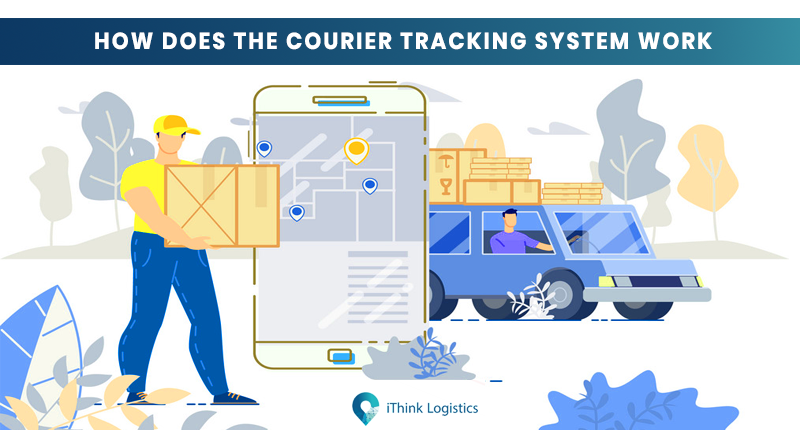
How does the courier or parcel tracking software work?
It has features like route optimization, real-time alerts, data analytics, and access to parcel data that enables the business stakeholders to get information about where a particular order is at any particular time. Moreover, as the courier process is expedited, the productivity of the organization also increases significantly. When a customer gets real-time information about the exact location of the vehicles and the delivery staff, they can easily estimate the exact time when the delivery will be completed. This not only improves transparency but also improves the communication process with the customers.
The courier-tracking software provides all the dynamics of the delivery with every recent update. The excellent combination of real-time information along with increased efficiency leads to quicker and proper delivery schedules. This increases customer delight, which in turn increases the loyal customer base. This provides more customers, repeat sales, better employee experience, and lastly generation of higher revenues.
Characteristics of the courier tracking system
The major benefit of having a creative courier-tracking system is that you can customize the system according to the various needs of the business at different intervals of time. The most common features of the courier-tracking system are discussed below:
Route optimization
A proper tracking system enables you to optimize the best routes available for a particular delivery. This also enables the customer to track the exact location of the order and the delivery personnel, thus allowing them to estimate the exact time when the delivery will be executed.
Vehicle parameters
The customers can visibly see where the vehicle is moving, which route the delivery personnel is following, how long it will take to reach the location, etc. Customers get the complete parameter of where the delivery personnel exactly reached.
The speed and the resting time of the vehicles
The tracker will provide real-time information about the speed and even the waiting time of the vehicle, that is being assigned for the delivery.
Reminders and alerts
The tracker will provide any recent reminder or alert concerning the delivery being executed.
Integration with different systems
The tracking system helps in integration with the other systems.
Visibility
A delivery-tracking system allows the customers to have full transparency regarding the delivery personnel and their respective vehicles. They visibly see the exact point where the delivery person is. This not only helps the customer to estimate the delivery time but also increases the overall efficiency of the organization.
Delivery status updates
The customers get the recent delivery update through the tracking system. If due to some unfortunate reason the delivery is being delayed, the customer can have an idea of the situation rather than just waiting for their delivery at an estimated time. The tracker provides real-time information.
Maintenance factors
The tracker will update your system with any maintenance factors that have to be conducted immediately.
The digital proof of every delivery
The tracker will provide a digital receipt of the delivery after it has been completed. This will help you and your business keep proof that the delivery has been completed.
The need for the tracking system
The concept of on-demand delivery is an ongoing trend that is popular among customers around the globe. In recent times business owners and entrepreneurs are expected to come up with newer and better marketing strategies for providing the best possible ways deliveries. Customers initially look forward to efficient delivery and if your business can serve them with the same, then you might have some loyal clients for life. Organizations striving hard for progress should come up with strategies that will improve overall business operations.
An efficient tracking system helps an organization to re-assimilate its regular operations, enhance the consumer experience, and eliminate extra steps while allowing them to work quickly and efficiently. It is always important to have a strong bonding with the delivery executives, customers, and business operators. The technological advancement of the tracking systems helps us to provide expert delivery to our customers, enhance operational administration, and ultimately lead to customer delight. This not only helps to provide customers with the best delivery experience but also helps in the growth and development of the organization.
Having an effective courier-tracking system not only ensures business growth but also creates a strong customer base for life. If you are running a business in this digitalized era, you must be well familiar with online trackers. In the age where everything is online, you must have an improvised delivery system which includes installing a tracker so that customers can get real-time information and updates regarding the delivery.
The significance of having a courier tracking system
As long as your business grows, you will need better resources and more effort to maintain the current standards. The more the number of orders will increase, the more requirement for skilled personnel for delivery will increase, and in return, the profit margins will increase considerably.
In a delivery concerning the business environment, success and progression mean involving more number of delivery vehicles, more skilled delivery personnel, and unprecedented or complex runs. Here the tracking system of vehicles and delivery staff must be on par. In this digitalized age, in order to increase the efficiency of the business, you need to keep your customers updated at every point in time.
These updates include the visual tracking system where the customers can visibly track the shipment process starting from than order being placed to the point when the delivery will be done. This will comprehend the effective management of the organization and will keep your customers satisfied with your enterprise at the same time. The tracking system plays a major role when it comes to business optimization. A tracker is a must if your business is a delivery-focused business and you want your customers to be fully satisfied with your enterprise.
Advantages of having a courier-tracking system
Having a tracking system that provides constant real-time updates about the courier personnel and the fleet is very essential to having an efficient delivery-based business. The main objective of this business is to be able to respond to customers with utmost promptness. To satisfy your customers you need to be unambiguous enough to respond to them quickly and efficiently. Some of the major advantages of having a good delivery-tracking system are discussed below:
The tracking system enables you to have a better interaction process among courier staff, fleet, and the customer. If the communication process of the business is on-point, then the other aspects can be handled easily. While running a business, you must have a strong communication base with every individual involved in the organization and more specifically in the delivery process.
This promotes an environment-friendly process, as it does not involve any paper use. It provides a digital receipt for both the customer and the courier agent. Thus, promotes a nature-friendly environment. It assures an effective and transparent communication process.
The delivery-tracking system provides an increased rate of customer satisfaction. This increases the accountability of the delivery staff. The tracking system improves vehicle maintenance, which is involved in the delivery procedure.
Lastly, an effective and efficient delivery tracker enhances the overall productivity and credibility of the organization.
Conclusion
It is an era where everything is online. People avoid going to stores for their daily needs and instead prefer the online system for the same. This is the evolutionary age of on-demand courier services and online purchases. With the immense rise in online purchases, there comes the demand for an accurate and steady courier system. Moreover, a courier system without a proper tracker is useless. A tracking system is a must to achieve the ultimate customer delight. It is very essential to have a suitable delivery tracking system to improvise the overall delivery system in a competitive market. A suitable tracking system will ensure you with proper management of parcels and fleet.
The first and foremost aim of every distribution and manufacturing firm is to prevent the manual labour of counting and instead of that use a cycle counting system to keep the inventory numbers up to date. Inventory management, counting tools, as well as inventory software, for instance, the barcode scanner can be a great help in achieving the objectives of the firm.
However, this does not eliminate the counting procedure of the inventories. Several devices can be effectively used to keep the inventory numbers in check daily. You just need to find the right device that will be suitable for your firm. If your inventory is checked regularly, then you can eliminate the monotonous procedure of manual counting.
If you are a business owner of a high developing brand, then it is very likely that you get very little time to interact directly with your customers. Therefore, it is also likely you cannot afford to spend days in inventory counting or checking for any discrepancy. There are various advantages of the cyclecounting method depending upon how popular your brand is. All you need is a proper system to implement all the advantages of the method.
What do you mean by cycle counting?
Cycle counting is an effective process that validates the accuracy of the inventory counts of a firm in the ERP or their accounting system by counting the inventories regularly. You can choose the cycle daily or every week, whatever suits your firm. If you install the system of cycle counting in the firm, then your inventories will be kept up to date, as it will be counted several times a year.
It is an auditing process for your inventories, which goes on throughout the entire year permitting you to focus on the subsets of the inventories. Cycle counting is way more efficient than annual counts and is less disruptive to daily business operations. Cycle counting helps in proper production execution and inventory accuracy. It also tailors the focus on important items that have a higher value, those which are critical to the business, or those with higher mobility volumes.
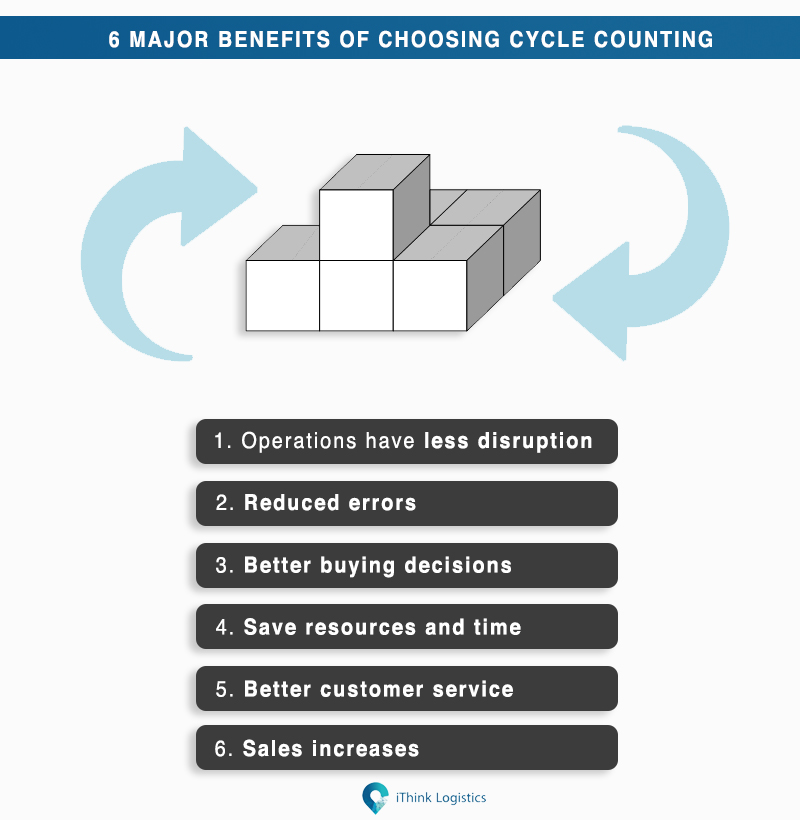
6 major benefits of choosing cycle counting over annual inventory counting
Cycle counting is way better than annual counting in every possible aspect. Let us discuss some of the pointers of the Benefits of cycle counting over Annual inventory counts:
Operations have less disruption
The primary benefit of using cycle counting is that you do not need to disrupt your regular operations to perform manual counting. In annual inventory counting, the firm needs to be shut down for some time so that the inventory counting could be done. If your company shuts down the regular operations of the firm, then it can be quite expensive for the firm to sustain that. If the cycle counts are integrated into your systems as a weekly routine, you will automatically face lesser discrepancies in your business. In the case of inventory counts, an entire day is allotted for counting the inventory. This can lead to huge losses for a company. Whereas in cycle counting, you can assess your inventory counts on an ongoing basis. This not only allows minimal disruption but also keeps ongoing communication among the team members.
Reduced errors
The cycle counting methods provide plenty of spare time in between each count, and so this time can be used to fix any other errors that might have taken place in the operations. However if by any circumstances the inventories are not accounted for exact numbers, it is way easier to identify errors with the cycle counting method than by the annual counting method. Using the cycle counting method also increases the accuracy of the number of inventories that are counted, because you are less likely to make any error while using the cycle counting method for counting the smaller amount of inventories. As you are shortening the period between each count, you are automatically decreasing the time an error could sustain in the operations. If you have an incorrect inventory account, waiting for months for the recovery of the same can cost you a lot of money and a lot of issues with your customers themselves. Therefore, using a cycle counting method can help you catch mistakes faster. This will help in the effective running of the business operations where you will know exactly when to send the purchase orders.
Better buying decisions
With the cycle counting method, the counting process takes place regularly. As you will be assessing your inventory counts regularly, you will have a better hold of the inventory subsets. Therefore, the buying decisions you will make for your firm will be way informative and profit-oriented. The cycle counting helps your firm to create a better report for your team as it helps you to restock the items on time without any inconvenience put forth.
When you are implementing a cycle counting method in your operations, you are forced to assess your inventories regularly. Having regular check-ins and updates on the inventory subsets helps you to make more targeted and focused buying decisions. The primary benefit of cycle counting is that it helps in deciphering items holding higher value and needs to be stocked more. Several cycle counting methods can be implemented. However, there is this one method that works for every brand that is categorizing inventories in three specific groups:
A: The items in this category fall under the best-seller segment. These items are counted often and have to be restocked frequently. They do not take much time in movement, and therefore they do not sit in the warehouse for long.
B: These items are also counted often within a year, but not as frequent as the A listed items. These items are sold quite regularly, but they take longer to move from the warehouse and therefore cost the company more holding costs.
C: These items are not counted frequently. These items do not sell regularly and take the longest time to move from the warehouse and therefore costs you the highest holding cost.
Save resources and time
Using manual labour or the annual inventory count method can be very critical and messy. It might be time-consuming and prone to errors. Moreover, if there is any default or error in the counting results, finding the same error can be a very difficult and monotonous process. Therefore, you must use the cycle counting method for counting inventories in your firm to avoid wastage of time and resources.
Better customer service
When you are well informed about all your data and stocks, you will know the exact number of available products and those that are needed to be restocked. Therefore, when a customer places an order, you can easily facilitate faster delivery. Quick and hassle-free deliveries attract more and more customers.
Sales increases
It is a known fact that if your clients are happy and satisfied with your products and services, they are bound to recommend them to their loved ones, resulting in increased sales in your firm. This is an indirect process of increasing your sales.
Implementing the cycle counting method
When it comes to inventory, it can be one of the most frustrating parts of a product-based company. If you are implementing minimum cycle counts, it helps your businesses to see the accuracy of the inventory counts as a vital part of the entire business operations. This improves the buying decisions that you make for your business. The main purpose of implementing cycle count is to have the exact reflection of inventory in your warehouse. If your brand is opting for manual counts, there is a hundred per cent chance the counts are not accurate. It is easier to count inventory lots in smaller chunks. This not only increases the accuracy of the inventory but also helps in serving your customers better.
The above-mentioned benefits are enough to include in your firm. It will not help you in your inventory counting process but also help you increase the profit margins of the firm. It is high time that you exclude the annual inventory methods and brings in the cycle counting method in force to ensure optimal management of the inventory. Here are some elements that you need to keep in mind before you dive into the cycle counting method plans:
To enforce the cycle counting method in your firm, you must include it in the daily or weekly routines of your firm. Many companies that include the method tend to fail anyway because they do not consider counting the inventory that often. If you are relying on sporadic counts, then it is obvious that you are going to get some sporadic results. Thus, this method is effective only when you consider counting your inventories on a regular or weekly basis.
The next important thing that you need to maintain is a schedule for the counting process. Every company is different, so you must identify the perfect schedule that suits your business operations. However, a weekly schedule of 13 weeks counting calendar is recommended. This means that every item in your warehouse will be counted on a cycle of 13 weeks.
The last and most important aspect is to prepare a plan before implementing the actual process. Preparation is very important to ensure that the process will work and generate positive results. Make sure that the inventory is properly organized in the warehouse and you have a proper plan that you can execute for authentic counting of the inventories.
How does the cycle counting method work?
The cycle counting method has many important variables that are to be taken into consideration:
The team capacity
Many cycle counters are employed in the firm due to the stock values and reduced write-offs.
Scope of counting
The number of inventory that will be counted is analyzed. Then it is decided how much will be counted annually or weekly and how that will be affecting the trading business.
Frequency
The higher the value of the item will be the higher will be its accuracy of counting. This will also help in identifying any mismanagement as quickly as possible.
Item location
Here the warehouse location is considered. The most frequent and bulkier items should be placed closer to the doorways. However, this will put these same items at a higher risk and therefore a higher stock quantity is necessary.
Many cycle counting methodologies can be used as per the organizational requirement. However, the following three steps are the most effective way to develop a proper organizational system:
Control group method of cycle counting: A small number of items are counted several times in a row within a short period. This repetitive counting unveils any mistakes or errors in the counting process. After these mistakes are resolved, the process can be applied in multiple places to various product categories.
Arbitrary sample method: In this approach of the cycle counting method, random items are selected periodically. This approach is mostly implemented in several warehouses containing a large number of the same items. This will also check the accuracy of the process and identify errors.
ABC analysis: This is the most common approach for analyzing inventory counts. A lot of prep goes into the process where the items are categorized into three subsections that are A, B, and C. The primary focus is put on the A-listed items that hold the highest stock value and has the fastest mobility pace. The least focus is put in C listed items that have lower stock values and have the slowest mobility pace. This is one of the classic and popular methods for organizing your inventories.
Conclusion
The stated benefits are way too convincing to any business to opt cycle counting over the regular annual counting. The benefits will nudge you to choose the cycle counting method. Cycle counting will not only help in your inventory counting but will also help your firm grow and develop. Cycle counting can save you plenty of time and resources. You should opt for the method to increase your profit margins considerably.
The global rush for businesses to provide to the customer’s demand is what driving companies across the globe. With more and more businesses coming up in the market, the overall network for supply and demand becomes more complex and busy. This directly urges the business leaders to keep a keen eye on their inventory at every point of time to maintain operational fluency. The to and fro motion of the raw materials coming in, getting processed and delivering the final product to the end-users requires a high standard of collaboration, accuracy and maintains quality up to the expectations of the customers. This brings to an important attribute of supply chain management and optimizing inventory management.
Business leaders often describe inventory management as the art of managing the inventory to ensure the continuous availability of raw materials and/or end products with a cost-effective approach towards lowering the overall investment while achieving a set service level goal for a large assortment of stock-keeping units (SKUs).
The goal for which inventory management was added up as an essential vertical of supply chain management is to ensure better control for the managers over the supply and demand volatility in the market. There is a range of benefits that comes along with optimizing the inventory. It has been evidently presented by manufacturers and distributors, that optimizing the inventory and keeping a closed control enhanced the standard of the service and also resulted in cost cuts.
With an increased level of service, customers get satisfied with the service easily giving a competitive advantage to the business. It further fuels a stronger and long term business relationship with the client. Optimizing the inventory to reduce unnecessary stocking definitely saves enough penny to impact the company’s total invested amount into supply chain management.
The best 13 Tips to optimize your inventory
Despite the best benefits that can come from optimizing the inventory, business leaders and managers often find themselves struggling while integrating inventory management and optimizations steps into their business. It is challenging to integrate optimizations solutions for inventory management that will collaborate with all other integral business operations. Here are the best 15 tips to be followed to optimize your inventory management to its highest levels.
Optimizing MRO Inventory
To manage the optimal fluency in any operations, the Maintenance, Repair, and Overhaul sectors play a vital role. In the case of inventory MRO, businesses need to have a unique management approach that ensures high prices, critical times, invariable usage, high-quality data and quality of the stock. Optimizing the MRO sector will involve the frequent collection of real-time data that facilitates an easy decision-making process and operational continuity. The expected result out of the practice includes cutting down of enormous costs and invested funds, reduction of obsolete stocks, improved availability of production requirements, saving time,
Criticality Analysis:
It is always important to plan the steps before implementing any management solutions into the existing business structure. As a analyze each and every attribute of the existing inventory management system to understand the strengths and potholes. Each and every stock item can be analyzed based on their application, classification of commodity, Supplier, and Price. The result would be an organized inventory with real-time data for each item in stock helping in easy deployment and decision-making process.
Demand Forecasting
Yet another gift of technology that makes things a lot more easier, Demand Forecasting refers to the science of evaluating a large real-time data set about the current state of supply and demand to evaluate the flow of demand in the future. In the course of implementing demand planner in order to optimize the current state of inventory management, select the most appropriate and needed algorithms that not only align with high demands but also works for low demands. The capability to predict the future based on the current inventory state allows business leaders to take essential steps to either be prepared for huge demand flow, increase productivity or deal with low demand surges.
Lead Time Forecasting
Predicting the time spent by each lead works as a key factor in optimizing the safety of the stocks. The process involves forecasting the average lead time by using the purchase history, eliminating unwanted data, and understand the lead timing at various service levels. All these data clubbed together gives a stronger framework to plan things ahead. Filtering and clipping techniques to organize and eliminate unwanted or vague data filtering the huge data sets for better business insights.
Issue Size Forecasting
The sample size of any delivery or the issue size is typically the essential factor in determining the quality and level of stocks. Utilizing the issue history and coordinating capabilities of override forecasting can greatly help in understanding the level of service. This can lead to optimized inventory management allowing the leaders and the procurement managers to make decisions. With the use of machine learning and advanced data analytics, calculating the issue size variables and variance will exceeding assist in utilizing important data at times of necessity.
Economic Modelling
Understanding the risk involved in any business operation always pays off through better decisions, judgments and planning ahead. Economic modeling throws in a duel benefit of preparing a solid investment structure along with identifying and preparing for any monetary risks that can fall ahead in time.
This method of optimizing inventory management practices gradually involves the “what if” statements that typically raises several questions towards inventory trade-off. Economic modeling segregates the total cost or expense to be invested for the inventory management into several categories including replenishment costs, expediting freight costs, holding costs for different types of items, stock-out costs, etc. Once all the accounting information is organized in their own respective subcategories, the model compares existing and optimized results. This allows the business leaders to determine the inventory value, stock levels, service level, and a lot more.
Optimization of Reordering Parameters
Replenishment items are one of the keys determining factors for optimal inventory outcomes. Calibrating the reordering and declining data to understand the flow reorders can result in a better inventory management outcome. It is easier to optimize the max and min stocking levels with proper selection of an appropriate algorithm. The process involves analyzing a large group of reorders instead of handling them one by one. Furthermore, if economic modeling is already included in the inventory management structure, it would allow understanding more in-depth analysis of the bin capacity, additional storage, and a lot more.
Exception Management
The exception management approach gives that surety that the inventory timings are mainly postulated towards the high valuation or the defective items. This is an efficient approach for larger and complex MRO inventories. The capabilities of this approach are as follows:
It provides the significant tools that will help users to determine the exact numbers of exception conditions along with the alert thresholds that are related to it.
It gives you the ability to use the exceptions to search, sort, filter, and analyze accordingly.
It provides with a phenomenon that helps you to prevent changes in reordering parameters in items with exception conditions.
Segmentation of inventory
Inventory segmentation is based on a management body that compartmentalizes different management techniques for different items and their profiles:
Segmentation of inventories should be done based on various features that include the use of the inventory, the holding value, and many more.
Organized policies and certain business rules should be applied to various inventory segments. The policies and rules include handling of special or fragile items manually, reviewing items, or stating items to be obsolete.
Assessment of risk for spares
There are certain MRO inventories that have high spare proportions that are quite critical and have different disadvantageous elements like high-cost rate, minimum usage, and need for longer lead times. Managing such items can be very tricky and requires special attention and techniques:
It requires the efficient ability to conclude stocking decisions by countermanding every input.
Managing risk of holding zero, one or two sets.
To be able to perform certain sensitivity analysis based upon the expected mean time that relies upon demand and the stockout costs.
The pooling of spares
The pooling of infrequent items or items with high valuation can result in a significant reduction in overall safety stock investment. Such arrangements can be facilitated by companies by following certain aspects:
The companies should be efficient enough to determine the common spares that will be quite suitable for sharing.
The optimal location should be determined for storing the spares.
Determine the optimal quantity of spares that has to be stored for pooling.
Capturing suitable knowledge
Before getting started with the actual process for the inventories, gathering proper knowledge about is a very important aspect in the business field. Without the proper knowledge, there is always a chance of mistakes that leads to re-investigations. Thus, companies should be very particular about the optimization of inventories and follow the steps:
Accumulate all the notes and commentaries required for the inventory items.
Be very particular in setting reminders when certain reviews are due.
Provide high-quality data when it comes to input parameters and classification codes.
Trails of an audit should be provided accordingly for certain decisions.
Reporting of the inventory KPIs
It is very important to track the improvements in inventory progress and therefore inventory KPI reporting is essential as it helps in providing the record of accomplishment for the same. The reporting should include the following aspects:
The credibility of capturing inventory KPIs automatically in large proportions.
Users should be able to customize reports and statistics accordingly.
Conclusion
In today’s competitive era, companies with intensive asset arrangements need to have a positive and optimistic outlook towards innovation and modernized technology. In such an era, technology is a very important aspect when it comes to any kind of business.
Without the technological support, companies are doomed to use manual processes, standard ERP functions of the system, and the ad hoc databases or spreadsheets that are most likely to slow down the progress considerably. All these manual approaches are quite impossible to be sustained on a regular and repetitive basis. Above all, they are heavily prone to mistakes.
Proper optimization of business cannot guarantee success but it can go as far as to reduce the chances for failure. Good optimization of the inventory can assure the ultimate success. Maintain and optimizing inventory management will not only help your business grow but will also increase its credibility in the industry considerable. Achieving an optimized inventory system is easy when done with the right tools and with the right type of assistance.
The most common and biggest mistake that is made by the businesses is that they focus more on quality, quantity, or cost rather than on value. Value combines the best aspects of both worlds. The primary focus should be on able to charge the best prices while maintaining the quality and vice versa. However, the shipping companies mostly fail to do so and end up compromising on one on either of the elements by cutting out corners. These shipping companies mainly try to cut out the big edge on the cost factor. As a result, it ends up compromising the quality of the products. Less cost can bring in more profits, but you need to keep in mind that quality sells more. If the sales itself decreases, then the profit margins are bound to fall. This pushes the situation to be worse than before. Let us discuss some of the primary mistakes that are made while reducing logistics costs.
A business needs to analyze all the pointers before taking decisions on cutting out edges for their benefits. They should have an unbiased view of the fact of what is actually right and what really needs to be improvised. Several common mistakes are made while reducing the cost of the logistics and as a result of some mistake the companies end up bearing more money and failure of shipping software.
4 absolute mistakes that should be avoided while reducing logistics costs
Let us clear the mist over this mystery by discussing the four most primary mistakes that are made in the logistical ventures.
“Do it yourself” decisions
The foremost mistake type in any business is the DIY list. Businesses forget that not everything can be done at the same time. They tend to ruin it by trying to accommodate everything under the same roof. The in-house logistics may allure you to think that they might help you in cutting edges in the logistics cost, but you need to think this through. Is this going to help your business grow or will it increase the profit margins? You are investing more and more time to maintain the logistics department by bringing more and more resources. These might be robbing you from investing your time in the right place. You should focus more on improvising the core functions that will uphold your business.
Overlooking the custom standards
Due to a lack of attentiveness during the classification of the administrations on the invoice, many businesses end up paying more tax duties than they were supposed to pay in the first place. You need to have more knowledge of the custom standards related to the goods and administrations that you are dealing with. If there is any default then the difference in the amount will be more noticeable in case of smaller shipments while the larger shipments can save some considerable amounts for your business.
Procurement errors
These errors result in refunds and returns. These errors can be a big blow to the bank if it occurs quite often. Procurement errors occur due to the lack of supervision in terms of packaging, inspection, and documentation. If your shipment process fails due to shipment of the wrong size of the product, or wrong color of the product, or if a product has a missing part, you are bound to repeat the whole shipment process, which will result in having to spend double the amount of shipment.
Primitive technology
If you are using a technology that does not provide you with seamless integration and complete automation, then there is a hundred percent chance that you are using primitive technology. Using a primitive technology can have a huge negative impact on your accounts more than you realize. Manual work is way too primitive and insufficient for your business in this technical era. It is not only time consuming but also is very prone to mistakes and errors. It is also one of the primary reasons your shipments are delayed that often. You need to have a complete integrated system to keep your internal data with complete security. An un-integrated system runs a risk of leaking your data.
Logistics mistakes made by the small businesses while reducing costs
Having to work in smaller corporate fields can be quite detrimental for both the logistics personnel and management. Depending upon the contracts that you get, you may not have a large base of long-term loyal customers. This affects the growth and development of the company. If you have a small business and even if you have not shipped overseas, there is, still a possibility that your company makes tons of logistical mistakes that are preventing your business from expanding beyond.
Executive management is not proper
If you are putting a non-logistic person in charge of your logistical operations, there is bound to be errors. A person who is completely unaware of the field will not be significant to carry out such a crucial job. You should always recruit trained personnel for handling logistics. Logistics is one of the important parts of your company, so you might as well be very particular about it.
People who do not have any experience in logistics are likely to be lost while scheduling the date, the load of paperwork, and the shipping manifest. There is always a probability of mixing up important documents. As small businesses already work on a tight budget, they must make sure that the people that are working for then know what they are doing. As your company is not a big corporate field, simple mistakes can cause a lot of problems in the whole business operations. You must be careful enough to transition personnel to a newer post and develop a team that believes in cooperation rather than individualization.
Miscalculating costs
You should have the proper knowledge of the various shipping costs of different countries. Miscalculating costs can cost your company a big time and can come back as a revenue loss that you cannot afford. Therefore, you must work on building strong bonds with reliable shipping companies. This is crucial if you do not have a distribution chain of networks of your own. These relations will help you and your clients to get reliable shipping services and sometimes discounted shipping services when needed. The same rule applies to the miscalculation of the price of the goods according to the customer’s needs.
Lack of complete automation
Automation is one of the major aspects of today’s business and shipping industries. It is very hard to track all your orders and shipments if you do not have suitable software to hold it up. Logistics is way different from online businesses that are prone to mistakes and errors. Your customer will expect instantaneous feedback on the shipment processes and when exactly the products will be delivered to them. You must set up a specialized software to avoid errors. This will also help you build a large base of loyal customers and also in reducing logistics cost.
Insignificant shipping plans (International)
Shipping anything internationally is quite a complex process that it seems to be. You need to identify the most suitable routes and shipping companies that will come at an effective price. The logistical part of shipping products online is much more prone to mistakes and errors than any other type of business. Before you ship anything serious abroad, you must do some trial runs to see the significance of your delivery. You should also find out your companies niche via specialized websites and partners. Knowing what others are suing for completing the delivery will help you to pinpoint the means that you can use while shipping overseas. Failing to do the same can result in returned shipments, revenue losses, even legal actions that can be taken against your company.
Ignorant of the market
It is important to stay true to the roots of your company, but at the same time, it is very essential that you follow the industrial trends. When it comes to the shipping and logistics industry, it is changing and upgrading every day. Thus, newer shipping techniques are also being developed and implemented. You need to make sure that you have complete knowledge of what your competitors, clients, and even partners are working with. Even small changes in the logistical operations can save you big time in terms of money and time in the long run. Make sure that you are open to any new change that comes along the path and makes sure that you follow the latest trends when it comes to handling logistics and shipments.
Conclusion
Therefore, if you are making any of the above-mentioned mistakes, then it is high time that you try to rectify it in order for your business to grow and develop. It is very important to find the best shipment providers. A suitable provider will help you process your business in a better way and powers your business with updated and integrated technological systems. You must get an e-commerce shipment software for the complete automation of the systems.
If you are not significantly aware of the common Domestic shipping terms that are used in the shipping industry, then most definitely you will be unfamiliar with the various trading practices that are conducted in respective countries all-round the world. It is very important to know all the shipping terms exactly, otherwise, any default, in this case, can lead to great disputes regarding payments of freights, shipment prices, or cost-related to any kind of insurance or security. The trade rules of the shipping processes are termed as the “International Commercial Terms or Incoterms”. This is a series of rules regarding the shipment processes laid down by the International Chamber of Commerce or ICC.
These rules are widely practiced in the International trading processes. These are a series of three-letter trade rules that are directly related to sales practices that are contractual. The Incoterms are implemented to communicate the costs, risks, and tasks associated with shipments of goods. These rules are approved by the government as well as by the legal practitioners and authorities for interpreting the terms related to international trading systems. These rules help in preventing uncertainties that arise from different ruling systems in different countries. Therefore, Incoterms are implemented in every sales contract all over the world. The Incoterms were first published in the year 1936. However, it has been updated since then, with its latest update being the “Incoterms 2010” publishes in the year 2011 on January 1st.
Incoterm 2010
The Incoterms according to the Government legislations:
In many jurisdictions, the duty costs associated with goods are calculated against a particular Incoterm. For instance, in Incoterm India, the duty cost is calculated against the customs value associated with goods. Similarly, in South Africa, it is calculated against the “Freight on Board” value associated with goods. Therefore, it is common for the countries to use these terms while indulging in any export contracts, even if they are not quite suitable according to the mode of transport that is been selected. The shipping terms are discussed below:
EXW (EX Works)
Related to (named place for delivery)
The sellers are responsible for making the goods available at the said address or at any other named place. Here the maximum obligations lie on the buyers and minimum obligations lie on the sellers. The Ex-works is used to refer to any particular sale of items without including the cost. EXW means that there is risk associated with the process of shipment and the risk is incurred by the buyers while completing the delivery of the administrations. Either the seller avoids loading of the items on the vehicle or it remains unclear of the export or the sellers load the goods but does so at the buyer’s risk. If they agree on the terms that the seller should be held responsible for loading goods and bearing the costs associated with it, then only the contract proceeds further. If this is done, then some extra disclaimers should be put in wording in the contract.
FCA (Free Carrier)
(Related to a named place for delivery)
The sellers deliver the items that are cleared for exports at a particular place including their premise. The goods or administrations can also be delivered by a carrier who is nominated by the buyer itself. In modern usage, the incoterms have replaced the wide usage of the FOB. However, the probability of risk is always there from loading up the vehicle for abroad ventures to the determined places. There is another pointer that should be kept in mind is that the place that is chosen has a direct impact on the loading and unloading procedures of the delivery of goods at that particular place. If the said delivery is conducted at the seller’s premises or is conducted under the seller’s guidance, then the whole process of loading and unloading of goods falls under the seller’s responsibility. Nevertheless, if the delivery is conducted at some other location, then the seller will only be responsible once to deliver the goods at the named place. Here, the buyer will be responsible for both unloading and loading the goods on their carrier.
CPT (Carriage paid to)
(Related to the named place of the location)
CPT takes place of the CFR terms associated with every shipping mode that is beyond the non-packed sea freight along with the C&F. the seller is bound to pay for the transportation of goods up to the said location. However, the goods are already considered as delivered when the items are handed over to the primary or main carrier. Henceforth, the risk passes on to the buyer who has assigned the primary carrier at the said location in the exporting country. The original cost including the freight cost for transport carriage to the said location and the export clearance depends upon the seller and it falls under is complete responsibility. The destination has to be agreed upon by both the buyer and the seller. If the buyer wants insurance from the seller, then the incoterm known as the “CIF” will be considered instead.
CIP (Carriage & Insurance Paid to)
(Related to the named terminal at the port or the final destination)
This term is quite a bit of a replica to the above term CPT. The only exception is that here the seller is bound to obtain insurance for the administrations or goods during the transit. Here the policy must be in a similar currency as the contract and must allow the seller, the buyer, or anyone with an uncertain interest in goods to make a claim. CIP can be used while using all modes of transport, but the incoterm CIP must only be used for the non-packed sea freight.
DAT (Deliver at the terminal)
(Related to the named terminal at the port or the final destination): This incoterm states that the seller is bound to deliver the goods and then unload it at the stated terminal. Here the seller is required to cover all the costs related to transporting including the export fees, unloading charges, carriage charges, and the destination terminal charges. They are also required to assume all the possible risks associated with the delivery until the delivery of goods is complete at the end terminal or destination port. The end terminal can be an Airport, interchanged inland freight, or a port. However, the terminal must have the facilities and the capabilities to receive shipments. If the seller is unable to conduct the shipment then the shipping is ought to be done under the DAP terms instead. Every other charge after the unloading is done are to be deemed by the buyer itself. However, it is essential to note that any default or delay charges at the final destination or the end terminal have to be deemed by the seller and not the buyer.
DDP (Delivered Duty Paid)
(Related to the named terminal at the port or the final destination)
The seller is bound to deliver the goods to the stated location in the particular country of the buyer. The seller bears all the cost of the delivery including the charges associated with taxes and import duties. However, the seller is not responsible for the unloading process of the goods. The most essential consideration of the term DDP is that the seller is bound to deliver the goods via customs in the buyer’s country.
Understanding basic terms of shipping
The whole process of ordering something online and then getting them delivered at your doorstep is an excellent process. The procedure requires immense coordination between the shipping company and the merchant. Some of the basic terminologies of shipping terms along with domestic delivery terms in India are discussed below:
Airway bill number (AWB number)
This number is a –digit tracking code used for tracking shipments. This number can be used to check the real-time status of the delivery and its exact positions. If your delivery is late, then you can use the AWB number to register you to complain to the logistics and the shipping company.
Shipping invoice
This document contains standard information that includes the address and the name of the receiver and the sender. It also reflects information about the ordered items, which includes the number of items, their price, any taxes that are applicable, any discounts that are been applied, and the final amount that is being paid.
Shipping Label
The shipping label is pasted right on top of the package. It describes the details of the package along with its original and destination address.
Shipping manifest
This document is proof that the shipment is handed over to the courier company. It has all the required information about the courier person including his name and contact details.
Freight bills
the freight bills are issued by the logistics and shipping company to the consignee. This bill contains all the details of the freight including the shipper’s name, actual weight, place of origin, the volumetric weight of the package, and lastly the final bill amount.
Ready to dispatch
This message is reflected when the shipment has left its place of origin. This message is provided after the AWB number has been processed and the shipment order is been assigned to the courier company.
COD label
Either this label is printed on the package or the delivery person carries the receipt. This label has complete information about the item, about the receiver, and the amount that is to be paid to the delivery person. The label also includes extra information like the weight and dimension of the product and the AWB number.
Generate pickup
This process reflects when the product that is order is confirmed and is finalized for shipping on a specific day.
Missing orders
These orders are the once that could not be processed in the initial steps of logistics and shipping company. The factors that are responsible for such error includes an error in the payment process or items not properly selected at the time of the checkout, etc.
Return to origin (RTO)
This contains the address where the products can be sent back. The products can be sent to their place of origin i.e. at the merchant’s address.
Conclusion
The incoterms are used to eliminate the unpredictability in the various interpretations of shipping terms in various countries having various languages. Therefore, the international chamber of commerce came up with these incoterms for making the shipping process easier and better. Since the time the Incoterms were published in the year 1936, it has been updated and reformed to make all the terms and practices current.
It is an era where everything is online. People avoid going to stores for their daily needs and instead prefer the online system for the same. This is the evolutionary age of on-demand delivery and online purchase. With the immense rise in online purchases, there comes the demand for an accurate and steady delivery system. Moreover, a delivery system without a proper tracker is useless. A tracking system is a must to achieve the ultimate customer delight. It is very essential to have a suitable delivery tracking system to improvise the overall delivery system in a competitive market. A suitable tracking system will ensure you with proper management of parcels and fleet.
Why is it essential?
The concept of on-demand delivery is an ongoing trend that is popular among customers around the globe. In recent times business owners and entrepreneurs are expected to come up with newer and better marketing strategies for providing with the best possible ways deliveries. Customers initially look forward to efficient delivery and if your business can serve them with the same, then you might have some loyal clients for life. Organizations striving hard for progress should come up with strategies that will improve overall business operations.
An efficient tracking system helps an organization to re-assimilate its regular operations, enhance the consumer experience, and eliminate extra steps while allowing them to work quickly and efficiently. It is always important to have a strong bonding with the delivery executives, customers, and business operators. The technological advancement of the tracking systems helps us to provide expert delivery to our customers, enhance operational administration, and ultimately lead to customer delight. This not only helps to provide customers with the best delivery experience but also helps in the growth and development of the organization.
The role of tracking software in a delivery-focused business arena
As long as your business grows, you will need better resources and more effort to maintain the current standards. The more number of the order will increase, the more requirement for skilled personnel for delivery will increase, and in return, the profit margins will increase considerably.
In a delivery concerning the business environment, success and progression mean involving more number of delivery vehicles, more skilled delivery personnel, and unprecedented or complex runs. Here the tracking system of vehicles and delivery staffs must be on par. In this digitalized age, in order to increase the efficiency of the business, you need to keep your customers updated at every point of time. These updates include the visual tracking system where the customers can visibly track the shipment process starting from than order being placed to the point when the delivery will be done. This will comprehend the effective management of the organization and will keep your customers satisfied with your enterprise at the same time. The tracking system plays a major role when it comes to business optimization. A tracker is a must if your business is a delivery-focused business and you want your customers to be fully satisfied with your enterprise.
Importance of management of the delivery cycle
In the age of digitalization, businesses have to follow the ongoing delivery culture that includes delivering products at the doorsteps, on-demand deliveries, one-day deliveries, etc. As the internet has progressed immensely, it has now been a part of our life. People tend to do every important business online. Due to this huge online penetration along with the excessive growth of smart devices, organizations have no choice other than to follow this on-demand delivery culture. Thus, the business needs to maintain delivery cycles.
If the delivery cycles are not maintained, the business will get messy due to the huge number of deliveries that are being conducted every day. The increasing use of smart mobile devices and the immense increase of this mobile technology have resulted in the creation of myriad apps that are also related to delivery management. These apps are being created and being used by millions of people today. The fleet efficiency is being improved and tracing deliveries is easier than ever. The tracking software provides every information about the delivery where the customers can even track the exact location of each order they place.
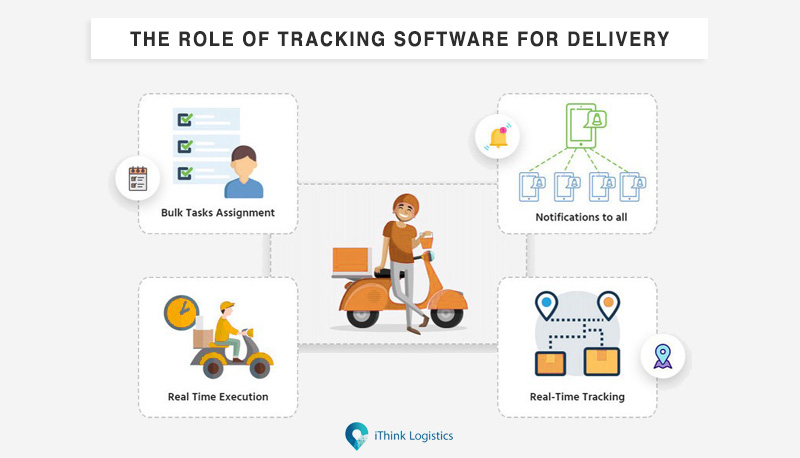
How does delivery-tracking software function?
It has features like route optimization, real-time alerts, data analytics, and access to delivery data that enables the business stakeholders to get information about where a particular order is at any particular time. Moreover, as the delivery process is expedited, the productivity of the organization also increases significantly. When a customer gets real-time information about the exact location of the vehicles and the delivery staff, they can easily estimate the exact time when the delivery will be completed. This not only improves transparency but also improves the communication process with the customers.
The delivery-tracking software provides all the dynamics of the delivery with every recent update. The excellent combination of real-time information along with increased efficiency leads to quicker and proper delivery schedules. This increases customer delight, which in turn increase the loyal customer base. This provides more customers, repeat sales, better employee experience, and lastly generation of higher revenues.
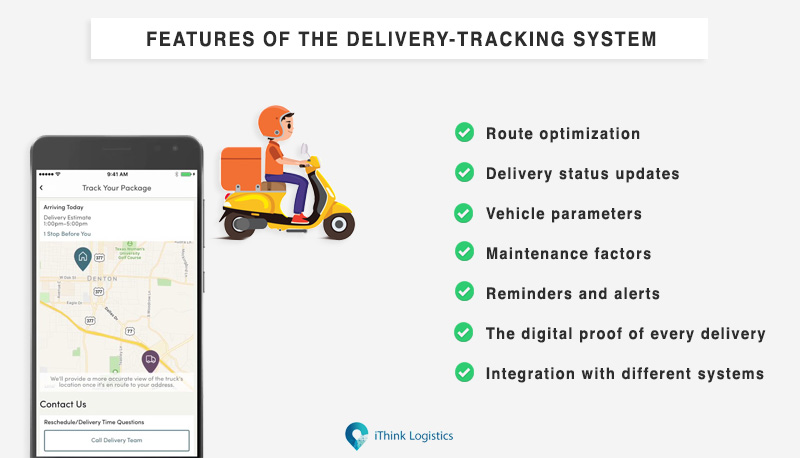
Features of the delivery-tracking system
The most major benefit of having a creative delivery-tracking system is that you can customize the system according to the various needs of the business at different intervals of time. The most common features of the delivery-tracking system are discussed below:
Route optimization
A proper tracking system enables you to optimize the best routes available for the particular delivery. This also enables the customer to track the exact location of the order and the delivery personnel, thus allowing them to estimate the exact time when the delivery will be executed.
Visibility
A delivery-tracking system allows the customers to have full transparency regarding the delivery personnel and their respective vehicles. They visibly see the exact point where the delivery person is. This not only helps the customer to estimate the delivery time but also increases the overall efficiency of the organization.
Delivery status updates
The customers get the recent delivery update through the tracking system. If due to some unfortunate reason the delivery is being delayed, the customer can have an idea of the situation rather than just waiting for their delivery at an estimated time. The tracker provides real-time information.
Vehicle parameters
The customers can visibly see where the vehicle is moving, which route the delivery personnel is following, how long it will take to reach the location, etc. Customers get the complete parameter of where the delivery personnel exactly reached.
Maintenance factors
The tracker will update your system with any maintenance factors that have to be conducted immediately.
The speed and the resting time of the vehicles
The tracker will provide real-time information about the speed and even the waiting time of the vehicle, that is being assigned for the delivery.
Reminders and alerts
The tracker will provide any recent reminder or alert concerning the delivery being executed.
The digital proof of every delivery
The tracker will provide a digital receipt of the delivery after it has been completed. This will help you and your business keep proof that the delivery has been completed.
Integration with different systems
The tracking system helps in integration with the other systems.
Benefits of the delivery-tracking system
Having a tracking system that provides constant real-time updates about the delivery personnel and the fleet is very essential to have an efficient delivery-based business. The main objective of this business is to be able to respond to customers with utmost promptness. To satisfy your customers you need to be unambiguous enough to respond to them quickly and efficiently. Some of the major advantages of having a good delivery-tracking system are discussed below:
The tracking system enables you to have a better interaction process among delivery staff, fleet, and the customer. If the communication process of the business is on-point, then the other aspects can be handled easily. While running a business, you must have a strong communication base with every individual involved in the organization and more specifically in the delivery process.
This promotes an environment-friendly process, as it does not involve any paper use. It provides a digital receipt for both the customer and the delivery agent. Thus, promotes a nature-friendly environment.
It assures an effective and transparent communication process.
The delivery-tracking system provides an increased rate of customer satisfaction.
This increases the accountability of the delivery staff.
The tracking system improves vehicle maintenance, which is involved in the delivery procedure.
Lastly, an effective and efficient delivery tracker enhances the overall productivity and credibility of the organization.
Conclusion
Having an effective delivery-tracking system not only ensures business growth but also creates a strong customer base for life. If you are running a business in this digitalized era, you must be well familiar with online trackers. In the age where everything is online, you must have an improvised delivery system which includes installing a tracker so that customers can get real-time information and updates regarding the delivery.
Coronavirus pandemic. A deadly disease with a dramatic increase in infected cases has put the entire world on standby. With more than 27 lacs people affected all over the world, the pandemic is being referred to as a serious acute respiratory syndrome (SARS-2).
While there are a thousand ways in which the disease has negatively affected humanity, but one of the major ways, in which people are getting affected other than health is the economy.
People are stuck in their homes with the least access to daily essentials. Most areas are getting sealed and people are being strictly prohibited to come out of their house.
Different eCommerce platforms are coming to the rescue during the crisis, and are delivering essential goods to people’s homes.
With the loss of life due to coronavirus ascending over the globe, individuals are taking careful steps to battle the spread of the fatal coronavirus. While people are taking careful steps, another logical investigation has discovered that COVID-19 can make due for a few hours to days on surfaces.
While the infection isn’t airborne, however, it can wait in beads on particles noticeable all around. The new investigation has discovered that COVID-19 can last as long as three hours in beads noticeable all around. Furthermore, keeping up a separation of six feet from others can help dodge particles spread through a hack or a wheeze.
Another logical examination which was distributed in the New England Journal of Medicine has said that individuals may procure the novel coronavirus through the air and furthermore in the wake of contacting polluted items. The researchers have found the infection is discernible for as long as three hours in pressurized canned products, as long as four hours on copper, as long as 24 hours on cardboard and up to a few days on plastic and tempered steel.
While the investigation of how the COVID-19 stays for a few hours to days on surfaces, here are some prudent steps one can take battling the coronavirus.
Some suitable precautions
There a few stages you can take to lessen your danger of introduction. Abstain from contacting your eyes, mouth, and face. Wash your hands with cleanser and water for at any rate 20 seconds and in case you’re not ready to wash your hands, use sanitizer. Spread hacks or sniffles with a tissue, and discard the tissue in the rubbish. Clean much of the time surfaces, similar to door handles and your telephone, with purifying wipes.
As indicated by the Johns Hopkins coronavirus tracker, the loss of life from the infection all-around has ascended to 13,044 with 307,104 cases detailed in 171 nations and domains. In India, as per the Indian Council of Medical Research (ICMR), 341 individuals have been affirmed positive among associated cases and contacts with referred to positive cases as of March 22. The Ministry of Health and Family Welfare had on Sunday expressed that six individuals have passed on because of the illness in the nation.
A Detailed Chart
Find out how long the coronavirus can stay on different surfaces. Read more…
In the retail industry, the most important factor that serves as the major pointer to showcase your company’s efficiency is the shipping timings you provide to your customers. The time when Amazon came up with this amazing one-day delivery idea, they saw a high rise in their customer base. Customers are very fond of quick deliveries. Customers feel benefited through quicker deliveries. One of the major reasons companies as such are seeing the light of success in no time is quicker deliveries. Companies are aiming at providing one-day or same-day deliveries. Customers are quite fascinated when it comes to this one-day shipping.
Items or products that are perishable like medicines, various food items, need to be delivered in the quickest way possible. There is no other way to go around these deliveries. The best way to complete such deliveries is to do it via the courier system. Courier services provide the opportunity of the door to door facilities where the products are picked up from the doorstep and is delivered to the concerned customer on the very same day. Of course, distance plays a major role in it.
These services are very beneficial when it comes to ordering flowers, or birthday cakes, or any other gift items that demand to be delivered on that particular day. If you take account of today’s competition where the customer base of the country is huge, you need to opt for some technique that can assure you with the efficient and smooth deliveries of items to every particular customer. The answer is quite simple, that is you need to have “multiple courier partners“. The reason is very simple; you cannot reach thousands of customers if you just have a single courier partner up your sleeves. The customer base so huge, that at the end of the day you will have many disappointed clients if you have a single courier service provider.
Courier services are mostly local and have a reach limit. However, within this limit, they can offer you efficient and hassle-free delivery to thousands of customers. The limited reach is a visible limitation of the system, and that is why you need to do business with multiple courier service providers.
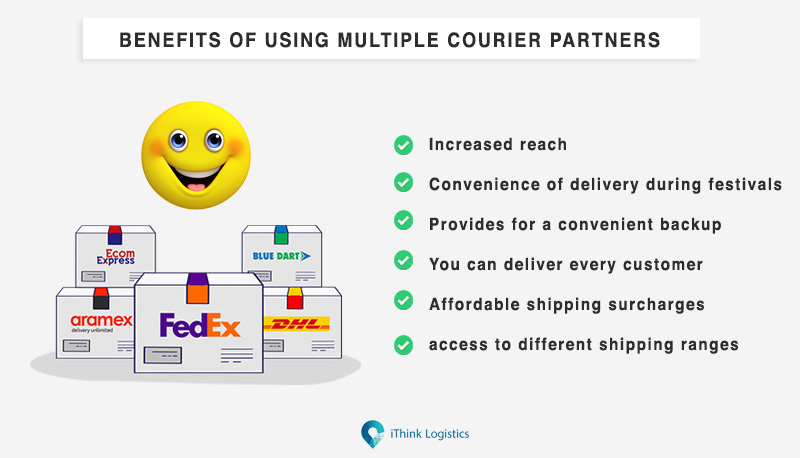
Benefits of multiple courier partners
It is similar to mathematics. If you combine multiple courier services in different countries, you can increase your delivery efficiency at a high rate.
Increased reach
If you have multiple courier partners, you can expand your business to different countries. You can make deliveries to a different country which will, in turn, help your business to grow wide with each day. Thus, you do not have to turn down customers that are far from your business or have a distant pin code. If you have multiple courier services, then you can make delivery possible at any place within a limited period. If you have local partners, then you increase the overall reach of your business by having potential customers at every corner of the country. Besides, this expanded reach can create an overall strong base of your valued customers.
The convenience of delivery services during festivals
During the festivals, the struggle and rush for deliveries are real. Whether it is a small start-up company or a big e-commerce giant, every company faces trouble in delivering a huge number of packages. Customers nowadays tend to shop online, so they find the festive seasons the perfect opportunity to buy online which is much more convenient than the retail stores. People now tend to avoid the huge crowds in clothing stores and prefer shopping online. Thus, the festive seasons get the busiest with thousands of delivery requests. At this point, companies can’t keep up with the delivery deadlines. If you have multiple courier partners, then this can be well handled and your customers stay satisfied with your company. Many courier services will deliver your items at your customer’s convenience.
Provides for a convenient backup
It is similar to having an extra pair of glasses, so that if you lose or damage the current glasses. Multiple courier partners will ensure you that you never have to give any kind of excuses to your customers. They will ensure that you never disappoint your customers when it comes to deliveries. There are thousands of possible difficulties that can arise in a day to day business, but if you have multiple courier service providers you can stay assured that your products and administrations will be delivered to your customers even if one of the partners is unavailable.
Best prices
A different carrier offers different prices for their services. This is how the competitive market works. Some carrier keeps a cheaper price point while some other carrier keeps a higher price point when it comes to shipping mid-sized packages. Some carriers straight-up refuse to carry oversized packages, whereas some carriers specialize in the same.
You can deliver every customer
Some carriers have preferred routes, and some carriers have preferred customer types too. All the carriers will not deliver items or products to Business to Consumer packages (B2C), while some carriers specialize in it and make a living through delivering this particular type of packages. Some courier services will assist the only business to business clients (B2B). As your delivery needs change, multiple couriers can provide suitable assistance for different consignments. You can choose a specialist from different partners for the exact type of delivery you want to commence.
Affordable shipping surcharges
It is a fact that every individual hates paying extra amounts for the shipping. When certain carriers add extra charges for delivering certain items or products, it negatively affects the business. Often carriers add this as an inconvenience cost, while other carriers don’t add an extra charge. If you have multiple carriers you will have better clarity for the end prices, and thus you can make the best decision for delivering packages to your customers.
You can have access to different shipping ranges
If you have access to different shipping modes, you can give the best assistance to your customers irrespective of their distances. Every customer is fascinated with the idea of one-day shipping. Multiple courier service can provide for all types of shipping modes from domestic services, same-day deliveries within 3 to 4 hours. International services, overnight air, road express, road economy, etc.
The All in One Solution
Considering all the above points in mind, the courier aggregators came into functioning. A single organization tied up with multiple courier companies. They acted as a catalyst to increase the efficient product delivery and reduce logistics returns.
Considering how fast this sector is growing, it is important to get a good understanding of exactly what a logistics aggregator company does and what its roles are in the e-commerce space. Typically, a logistics aggregator provides e-commerce shipping solutions in India and around the world.
A group of agents from this company might be responsible for processing all the operational components such as storage and transportation. They might be required to sort the products into categories, store and warehouse them as needed, and then to package and ship the goods safely when an order is placed.
If you opt for the right shipping policies, it can help your business grow wide. However, the wrong choice can break your business too. The main goal you need to focus on is to satisfy your customers and the other aspects can be aligned accordingly. If you start charging high shipping prices, you can be chopped off the market. On the other hand, if you are charging too little for shipping facilities, you cut out your profit margins. Maintaining the right balance is the key to success and that is why it is so important to have multiple carrier partners. Multiple carrier partners not only allow having the benefit of choosing the most suitable partners for particular deliveries but also help in increasing the overall organizational efficiency of your company. Through multiple courier services, you reach out to thousands of customers around the globe.
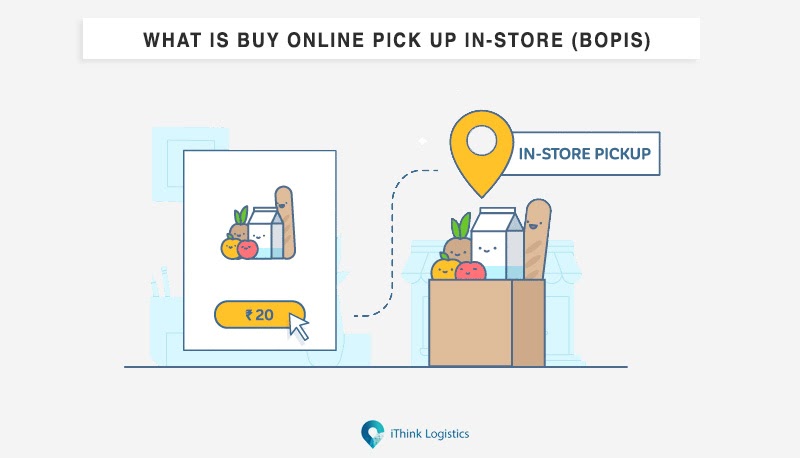
“Buy Online Pick-up In-store”, referred to as BOPIS, is a retail strategy that allows buyers to browse products online but collect them from a physical store. It is also called Click and Collect.
Customers today want the convenience and ease of online shopping.
However, they also want the in-person experience to ensure quality and reverse buyer remorse.
As per a recent study, more than 40% of shoppers dislike online shopping because they dislike impersonal shopping experiences.
Another leading complaint of online shoppers is high shipping prices and ecommerce delivery delays.
As an online e-commerce seller, how do you tackle these challenges?
The solution is BOPIS.
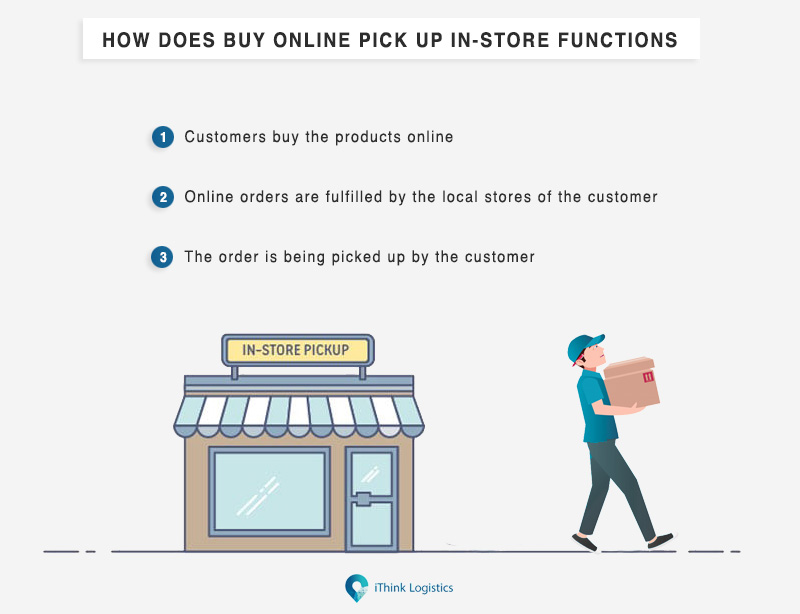
How does BOPIS work?
Customers browse online –
“We’ll waste our precious weekends circling the shelves and waiting in queues on the billing counters,” said no one ever.
Busy customers opt for a hassle-free online shopping experience and buy products in-app or on a website.
Fulfillment by store –
The staff at the store packs and holds the items for delivery after the customers place the order.
If the item is out of stock, the staff can source it from the warehouse or nearby store.
Once ready, they inform the customers via email/messages.
Customers pick the items –
Once the fulfilment is confirmed, customers can commute to the designated brick-and-mortar store to collect their deliverables.
Retailers can either opt for pick-and-go in-drive delivery. Or they can welcome customers into the store to collect their items.
Why do customers prefer Buy Online pick–up in-store (BOPIS) model?
Customers are spoilt for choice. BOPIS offers them the dual benefit of online convenience and offline shopping experience. Here’s why customers love BOPIS as an alternative –
1. Avoid shipping services costs
Buyers can source purchased items in person, eliminating the need for door to door delivery and the associated costs altogether.
2. In-stock insurance
It’s natural to get frustrated when you try to add an item to your cart, but it vanishes. Poof! Out of stock. BOPIS helps buyers get a hold of the bestseller items that run out of stock rapidly and frequently.
When buyers can buy online and pick it up in stores the same day, they are assured they’ll find what they need.
In-person shopping experience makes the process of spending money more pleasant or memorable for the buyer. Happy customers make the seller’s account happier.
4. Quality check
Customers can hold the items physically and ensure that all features match the online description. Size, colours, etc., are hard to decipher while seeing something on the screen.
Imagine trying to visualize the comfort of a couch. Buyers wouldn’t know unless they sat on it. Certain goods like perfume or glassware are hard to assess for quality unless seen or touched.
5. Fast delivery service
Customers can pick up their orders at their convenience while completing other errands or returning from work. There’s no unnecessary waiting period involved.
Why do retailers and sellers love BOPIS too?
61% of online retailers, following the lead of the retail giant Amazon, prefer BOPIS and BORIS (Buy Online Return In-store) now as part of their omnichannel retail strategy.
Online retailers have witnessed fierce competition in the past few years. They have realized it’s necessary to stand out from the noise.
Hence, they’re willing to augment their presence and customer experience. Here’s why e-commerce sellers are adopting BOPIS –
1. Omnichannel retail strategy
BOPIS is an intelligent way to serve clients on online and offline channels cohesively. It helps e-commerce sellers build a solid presence and stronger brand recall.
Consider how Sugar Cosmetics went through, beginning with online partner portals, dedicated kiosks, and high-street physical stores.
2. Increased Order value
It’s highly likely for a buyer to anticipate future needs or to be reminded of other necessary items and buy them. If someone has stepped into the physical store, they would want to prevent the hassle of future trips, thereby increasing the order value.
3. Brand loyalty
Since the customers are present in person in the store, retailers can provide an enhanced experience.
For instance, famous furniture retailer Ikea provides special cinnamon rolls to its users to induce pleasant feelings that customers will likely associate with the brand.
4. Reduced Logistics overhead
It is not only customers who don’t have to pay for shipping products. Even e-commerce sellers can reduce overhead like shipping tracking to nearby pin codes.
5. Customer satisfaction
Given the nature of personal interaction and enhanced customer experience, it’s natural for customers to leave with a higher level of satisfaction with speedy and convenient owning of their purchased items.
6. Increased user base
Given the number of users who avoid online shopping, BOPIS can be a clever tactic to encourage them to shop online with e-commerce sellers.
What do you need for the Buy Online pick–up in-store (BOPIS) model?
Online storefront –
A fully functional and dynamic website or app wherein customers can browse and shop online.
Tech-enabled inventory management
An integrated inventory management that captures both online and offline stock seamlessly.
Responsible Personnel
Trained staff who manage in-store delivery, ensure proper packaging and synchronies inventory management.
Modern established players like Lenskart have taken it to the next level with augmented reality to help check how their bespoke glasses look on buyers.
Technology can revolutionize this aspect of e-commerce by seamlessly integrating online and offline experiences.
Once you set up these systems and resources, you’re ready to provide BOPIS to your valued customers.
Final Thoughts
Retail sales channels have evolved heavily over the course of years. Buy Online pick-up in-store (BOPIS) has proven to be a game-changer in enhancing customer experience while slashing logistics overhead in e-commerce.
Are you looking to streamline logistics management for better returns and improved customer experience? Look no further than iThink Logistics Solutions.
Here are few blogs that you may read to make your operations better…
If you aspire to have a fruitful and prosperous online business nowadays, it is insufficient to just close the sales. You need to convince your clients so that they find your business more attractive than your competitors. This is how to make your customers happy. The process is not that simple, as it seems to be.
Nowadays everybody is looking at businesses that promote a “client-focused” agenda. However, when you directly get down to it, you can see the actual scenario. Half of the brands are failing to maintain the agenda and hence are massively failing to maintain customer loyalty. Almost 81% of organizations that provide good customer support have shown significant improvement over their rivals, as indicated by the 2009 “Client Experience Maturity Monitor” report from the Peppers and Rogers Group. Brilliant entrepreneurs realize that each client relationship lost, to either a contender or something else, costs them a normal of $289 every year.
In case you’re figuring out, you can simply compensate for that cost with new clients. Turns out, it costs six to multiple times more to obtain another client than it does to hold a current one. In case you are prepared to enable your clients to become completely enamored with your business, figure out more potential ways to do so in the future.
Guaranteeing that you can make your customers happy and keep them content with your business is a significant key to business achievement. Disappointed clients can form a barrier to your business ventures. First, they are never going to return and additionally they can direct adverse sentiments toward others that will shield them from doing business with you. Satisfied and happy clients are most likely to return, and the one’s satisfactory service more than once, they become loyal to your brand.
Satisfying clients isn’t tied in with having a ‘the client is always correct’ philosophy. That approach leads to ‘us’ versus ‘them’ outlook that can go wrong. Giving extraordinary client support isn’t about somebody being correct and somebody being off-base. It is tied in with doing all that you can to guarantee that clients’ needs are met. Genuine client assistance comes down to comprehending what clients require and expect – and ensuring that those necessities and desires are met.
To have potential clients, you should initially give items or administrations that proceed as guaranteed and the possibility of value comes in this place. As indicated by Quality Digest, one approach to characterize quality is essentially “addressing the client’s needs in a way that surpasses the client’s desires.”
At the point when you address client issues and desires, you will have fulfilled clients – and this ought to be a base adequate edge for any business. To give genuinely extraordinary client assistance, in any case, you should not stop by simply addressing needs. Excellent specialist centers on surpassing the client’s desires.
Tips for cultivating customer loyalty
Making your customers happy is one of the primary aspects that you should focus on. At the point where you focus on catering to the client’s needs so that you can surpass their desires, you are making it feasible for clients to go too far from being simply fulfilled to being glad – and that is the place where customer loyalty originates from.
Manage expectations
Sometimes client’s expectations and needs can be overwhelming. Therefore, service providers must analyze the client’s expectations so that they are realistic and sensible. If you persuade that, your products can convey more than it truly can and that makes way for client disappointment. To give successful client support, it is frequently important to help teach clients about what they can practically anticipate.
Take responsibility
Organizations – and their representatives – must assume liability for client assistance. The fact or the notion that customer service is the responsibility of a particular individual or a particular administration should be dispelled. Customer administration is everybody’s job. At the point when clients work with your organization, they are working with the association in general. The people they collaborate with are agents of the organization, and the words and activities of each organization delegate their general discernments and client experience.
Get your representatives prone to think that they must discover an answer instead of agonizing over whether a particular solicitation falls in their job description or not. Support them and give them the power to do so. Your accountant may not be responsible for fixing any broken parts of the business but at the same time, if a client requests help, they can guide the client to the best individual or division to deal with his/her problems. Moreover, occasionally a client simply needs an apology for the problems or the inconvenience they faced. Regardless of whether the organization was at fault or not, it is the customer service provider’s responsibility to respond with “I am sorry for your dissatisfaction” or “I am so sorry you are having this experience.”
Build an emotional connection
Emotional connections with customers are much more emphasized than the logical factors. People act on emotions and thus maintain a strong relationship with customers can guarantee success for your organization largely. Reasonable variables aren’t the main ones that impact the customer’s dynamic procedures. As per research, emotional factors have more than 50percent impact. An article regarding business strategies states that “Feelings shape the perspectives that drive choices and conduct. What’s more, they sway conduct undeniably more than specialized or useful variables.”
The keys to making an enthusiastic association begin with guaranteeing that all that you do – from the messages you convey to your representatives to your organization’s general procedures – are structured concerning the client’s interest. At the point when you speak with representatives about their obligations, do as such as far as how their activities sway clients. While setting up the methodology, consider how the procedure will appear to clients. This will better permit you to reliably show regard for clients and be receptive to their requirements. By putting your clients at the focal point of everything, you will create strong emotional bonds with your clients.
Communicate effectively
Discussing successfully with your clients includes both giving and learning. What you state to clients matters, as does how you say it – however listening to them is similarly as significant, possibly more so. It is certainly imperative to pick your words cautiously, picking the customer’s preferred language and a fitting tone. For instance, center around how your items and administrations address the clients’ issues, de-accentuating an emphasis on yourself or your organization to abstain from appearing to be self-serving or egotistical.
Listening to clients requires truly focusing on what your clients are stating – allowing them to talk, however taking care of their words and nonverbal messages. As CSM, an online magazine for client support experts brings up, “hearing isn’t equivalent to listening that is simply receiving sounds isn’t equivalent to focusing on them.” Effective listening includes setting aside the effort to ensure you truly comprehend clients’ points of view, requesting input from them, and reacting fittingly.
Be responsive
Clients are most satisfied with the administration who gives importance to them and are receptive to their requirements. Social media platforms have changed the entire way of living and thus expanded client expectations for responsiveness. No matter what the organizations need to adopt these changes to succeed. Since clients can connect (or vent) utilizing such a large number of online networking outlets, organizations must be proactive in observing and reacting to concerns of the customers. As per the Get Satisfaction blog,” clients expect a reaction from you each time they connect with you on any channel they choose…quickly.”
You should keep your business profiles updated in as many platforms as you can monitor. Further, social discussions with clients ought to be made accessible to different clients as fitting. It is essential to treat client care through social media as well as through phone correspondence. Respond every time clients start a discussion and follow up instantly until and unless the goal is accomplished.
It has been found out that 68 percent of the customers abandon a brand on emotional factors. They tend to leave the brand because of the ill-treatment or any inconvenience caused by the company’s part.
On an average basis, it has been found that loyal customers worth up to 10x times as their first purchase.
It has been found out 48 percent of the dissatisfied customers have shared their discontentment with more than ten other individuals.
Almost 64 percent of customers claimed that shared brand values are the primary reason for having a strong relationship with an organization.
It has been found out that 80 percent of the negative reviews come from customers who expect the company to respond to their issues in less than an hour. This is usually not possible for most of the companies due to huge amounts of requests.
It has been found out that more than 78 percent of customers cancel an intended transaction due to poor user experience on the website.
Research says that it takes up to 12 consecutive positive experiences to resolve one negative and unresolved issue.
Almost 68 percent of the customer abandons a particular brand or organization due to an indifferent attitude received from the manager, or the owner, or some employees of the organization.
To acquire a new customer is 6 to 7 times costlier than keeping the old customers.
It has been found out that almost 3 out of 5 individuals (that is almost 59 percent) tend to try out newer brands or organizations in expectation of a better customer care service.
Almost 70 percent of the buying experiences depends on how customers are being treated and how they feel about it.
Employees do not ask the customer’s name for almost 79 percent of the time.
According to research, customers tend to spend 20 to 40 percent more money on the organizations with which they can keep contact via social media platforms.
Almost 89 percent of the customers started doing business with other competitor companies due to poor or inconvenient customer care services.
It has been found out that 73 percent of consumers trust their family and friend’s verdicts and recommendations, and only 19 percent trust direct email.
Almost 50 percent of customers allows a company to respond to their query within a week and after that, they start doing business with some other enterprise.
Consumers tend to share their negative customer care experience 2x more time than that of a positive experience.
It has been found that a 5 percent increase in customer retention can bring about a 25 to 100 percent profits for the enterprise. This can be through repurchase, upsells, or even referrals.
No matter what industry or what business you are running, the customer retention rate is one of the major pointers in measuring how happy your customers are with your brands and how loyal are they going to be in the long run. If your customer retention capabilities are on point, you can make your customers happy.
According to research by Bain and Co. a small 5 percent increase in customer retention can lead up to 75 percent of overall organizational profit
According to a study by the Gartner Group statistics, almost 80 percent of the future revenues of the company come from only 20 percent of the existing customers of your company.
Retention rate: ((Ce – Cn)/Cs)) X 100
Ce= remaining number of customers at the end of the prevailing period
Cn= number of a newer customer acquired at the time of the period
Cs= number of customers at the beginning of the period
Customer retention increases the value of the customer’s lifetime. This multiplier increases the statistics exponentially. This deserves proper attention from every marketer.
You can and ought to follow your consistency standard and client lifetime esteem. However, we are going to look at the key execution markers (KPIs) that impact the degree of consistency, and are regularly neglected. You need to gauge consumer loyalty at whatever point you can, yet you would prefer not to overwhelm your clients with studies and surveys either. Rather, for progressively steady information, you can screen the accompanying KPIs to get a thought of how fulfilled your clients are without asking them.
Average retaliation time
Reaction times can assume a huge job in consumer loyalty and this is the greatest supporter of client maintenance. We are continually reminded that to make the last deal, you should be promptly accessible to your possibilities and development, yet that exertion should proceed significantly after they leave all necessary signatures. Nothing is more disappointing to a client than an organization that is unable to provide any assistance when they are facing certain issues. Regardless of whether it is disregarding a glitch that a client has announced, or neglecting to react to an inquiry in an email, this sort of carelessness can turn even the greatest supporter sharp on your association. Without your clients, you would have no business, so it’s imperative to ensure that they feel acknowledged and get quality assistance consistently.
You have to watch out for your correspondence outlets and be prepared and ready to respond to any inquiries, over any arrangements, or address any issues that may emerge in an opportune way. If your consumer loyalty rates are low, investigate your normal retaliation times. If they are high, this is a fast and basic spot for you to begin making upgrades. Consider separating your reaction times into your most mainstream outlets: telephone, email, and live visit.
Phone
Research has discovered that about 53% of clients accept three minutes to be a satisfactory reaction time when looking out for a client assistance operator to accept their call. Do you realize to what extent your business keeps its clients pausing? We as a whole know the sentiment of being stuck waiting for what appears to be a lifetime. Try not to resemble those organizations. Begin following your reaction time and attempt to keep it within a minimal amount of time.
Email
Responding to client messages is very easy and accessible. The general guideline states that a client should get a response within 24 to 48 hours if it is via email. However, most buyers now expect a response within one business day. Truth be told, the ideal email reaction time from shoppers is drawing nearer to 60 minutes. This could be overwhelming to respond to each client’s emails within 60 minutes. However, you do not have to stress over this as long as you respond to your clients within two to three business days. According to research on business analysis, half of the customers wait until a week before they give up on your organization surrender an organization and start framing a negative impression.
Live chat
Offering live visit support on your site is an exceptionally effective approach to give client care. It is way different and efficient than the calling system. However, you can help only a few clients on live talk. You can pose inquiries and investigate progressively, rather than sitting tight for reactions on the opposite end. There are many service providers available for your association to browse and keep logs of all collaborations with clients.
Customer referrals
In case you are not previously following client referrals, you have to begin. Your best clients are additionally your best salesmen. At the point when they are cheerful, they will give tributes, leave audits, and in particular, allude their companions, family, and colleagues to your image. If you have tons of client referrals, then it is assumable that you have high customer loyalty for your brand. If your clients are not recommending your brands to their friends and families, it doesn’t imply that they are not content with your item or administration. It just implies that maybe there is room for improvement.
Subsidiary or motivator programs are extremely important assets that advertisers have been utilizing until the end of time. In addition to the fact that they reward clients for furnishing you with new business, however, they furnish you with a few significant experiences. Referral projects probably won’t be perfect for a wide range of organizations, however, all organizations ought to follow client referrals to decide whether it ever could introduce a verbal promoting opportunity.
Repeat purchases
Client maintenance is very important and it increases the chances of repeated purchase from your organization. Organizations that sell items find it difficult to measure customer retention and client maintenance. How will you exactly know that whether the customers you are approaching have already been attracted to your business or them looking for some other option?
The appropriate answer to this question will be the repeat purchase statistic. While a portion of your clients may voice their affection or disappointment of your item via social media or on your site, the vast majority will reveal to you how glad they are by proceeding to purchase your item time after some time. Most e-commerce platforms will assist you to track these KPIs. Therefore, you do not require having any specialized technical assistance. However, improving this measurement is up to you and it begins with incredible client care.
Activity before conversion
Presently, most organizations that practice inbound marketing follow this system. However, a lot of organizations that are new to this procedure tend to disregard it. Most groups focus more on acquiring new business and wind up dismissing the improvement of client unwaveringness. Following your client’s conduct and action on your site, and their social media engagement, and through email showcasing is as significant now as it was at the point at where they were just a lead. Along these lines, in a perfect world, you would prefer to see your present clients keep on drawing in with your substance and keep you at top of their preference list when it comes time to make another buy or allude a companion. Your client’s behavior discloses a great deal about their preferences and if they are satisfied with your brand or not. From there you can analyze whether your customers are willing to stay as a trusted client even in the future. Some of the major KPIs that should be tracked is:
Pages viewed
Average time spent on the site
The rate of opening an email
The through rate of clicking an email
The rate of the number of items added to the cart
One reason that organizations have such a great amount of progress with Inbound Marketing is that it achieves client procurement and maintenance simultaneously. By estimating all that you can, as frequently as possible, you are continually gaining from your clients and improving your business. Over the long haul, there is no better method to make your clients more joyful and keep them around for quite a while.
Ways to keep your customers using inbound marketing
While the facts confirm that inbound is an exceptionally powerful procedure for creating drives that are by all accounts, not the only region where it sparkles. Luckily, inbound advertising is ideal for keeping clients upbeat. Inbound is intended to “charm” clients through their whole lifecycle with your organization starting from their first purchase to the last. The keys for keeping clients upbeat through inbound promoting are:
Promote customer-focused content
The client-focused substance is one of the best methods to make your customers happy. Your customers already trust you enough to stay loyal to your brand. Sending them the regular old content that you would send to somebody who has recently found your brand doesn’t make any difference. Maybe, with time, clients may outgrow your item or never again need your administrations. However, with the right inbound promoting technique they will leave you with only beneficial comments and positive audits to give to their friends.
Educational content
Ensure that you apportion a piece of your promoting procedure for educating the older clients so that they can understand your industry better and comprehend the estimation of your items and administrations. You can do this in various manners, for example, supporting free online classes, parting with free eBooks, drafting item related posts, and leading client online instructional courses.
Online events
The best way to create quality content that will engage the customer engagement is to assimilate contents that are both online and offline. For example, any organization can support a quarterly online class or gather for its customers and clients.
Online hangouts and webinars can feature speakers from your association or maybe your partners. It may be costly to have a yearly offline program, yet a virtual gathering gives you this brilliant chance to help customers on Facebook Live or an online course stage.
Building relationship via social media
The connection among organizations and clients has advanced a lot with the ascent of online life. In earlier days, individuals did not want brands via online networking media since they saw it as publicizing spam. However, those perspectives have changed as brands have figured out how to associate with individuals such that they appreciate it. On the off chance that your organization posts content only to sell something, it is not likely you will assemble an incredible relationship. Whatsoever on the off chance that you draw in with fans and offer important, engaging, or enlightening substance that is fit to the stage, individuals will gladly have you on their timetable next to family and friends. A functioning social nearness will consistently pull in more consideration and mindfulness than one that hasn’t been refreshed in months.
Customer care
One of the most mainstream approaches to hold clients through inbound promotion is by tending to inquiries, issues, and different parts of client care utilizing web-based social networking.
This technique was promoted by Comcast utilizing their ‘Comcast Cares’ Twitter account. While Comcast might be a huge association, organizations of any size can use the intensity of internet-based life to give quick and productive client service that fulfills customers’ needs and requirements.
Always ask for feedback
Receiving feedback is one of the greatest and most important advantages clients can offer brands. Rather than running costly and tedious statistical surveys, solving queries by email, and via social networking media, or by observing what individuals need to state, can offer many more insights for your organization. You can even improvise this further and share the study results with your clients (as Domino’s did when they redid their menu.) This is what Rocco Baldassarre said in an Entrepreneur article about utilizing straightforwardness to keep customers more joyful. Individuals welcome this degree of straightforwardness and when they realize their voice is being heard, it gives them progressive incentives to impart their insight.
However, when you make changes depending on their input it shows that you truly care to convey the best item and client experience conceivable.
Clients can turn out to be better customers when they gain from circumstances simply like their own. Enable your clients to cooperate by building a network between them. Facebook gatherings and online discussions are incredible approaches to manufacture networks inside your client base.
Client inputs can be subjective sometimes. However, when it comes to numbers, they never lie. Regardless of whether it is perspectives, navigating rates, on-screen time, or transformation rates, incredible inbound advertising is information-driven. By contemplating the commitment of your clients, you can realize what qualified individuals are genuinely intrigued by and what made them convert. This information encourages you to distinguish patterns and holes and refine your procedure likewise to build transformations. You can likewise create a wide assortment of reports that are pertinent to various divisions of your association, so your whole group has understanding into what they can improve and where they’re now executing it.
Conclusion
Customers are the most integral part of your or any business round the globe. Customers are the reason that the business industry still exists. Keeping your customers happy is one of the major aspects of your business. Your customers are the reason your business has an identity. Without your customers, your business has no value or meaning. Therefore, you must make your customers happy and keep them satisfied. This will not help you to generate repeat sales but also bring in huge amounts of profits to your organization. This will also help you expand your business in the market. As long as you have your customer’s back, your company is going to outshine the others.
The main goal of inbound marketing is to maintain a relationship between brands and customers that is mutually beneficial for both parties. This allows you to have advantages that go far beyond just coupons and discounts. Keeping your customers is much more important than just getting paid from them. This helps your company to improve and grow. The happier your customers will, the more money they are willing to pay. It is a total win-win situation for your enterprise.