
You’ve sent 200 orders out today. Twelve customers have emailed to ask where their packages are. Three show RTO on the dashboard. And someone just left a one-star review saying they got the wrong product.
All of this lives inside one part of your business: outbound logistics. Get it right, and customers reorder. Get it wrong, and every operational mistake becomes a visible, public, permanent record on your brand.
Here’s what outbound logistics really means, how each step works, and why some sellers keep RTO under 10% while others struggle.
What Is Outbound Logistics? (Outbound Logistics Meaning)
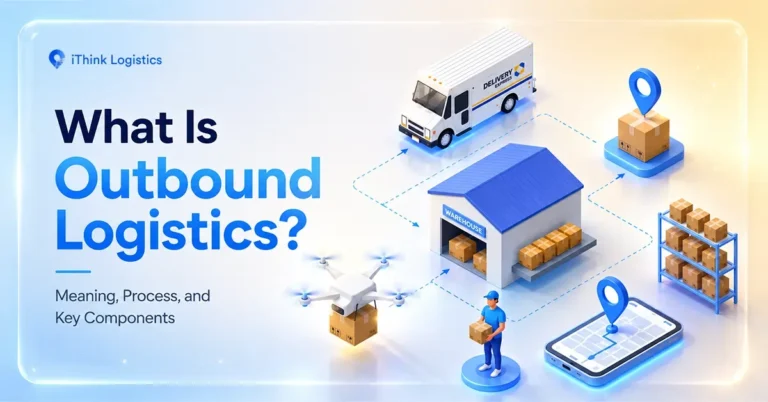
Outbound logistics is the process of storing, preparing, and delivering finished goods from a seller or warehouse to the end customer.
It starts when an order comes in and ends when the buyer gets their package, including order processing, picking, packing, shipping, last-mile delivery, and returns management.
That’s the outbound logistics meaning at its simplest: inbound is what comes into your warehouse, and outbound is what goes out.
If you ship kurtas from your Bhiwandi warehouse to a customer in Bhopal, every step from order notification to delivery confirmation is part of outbound logistics.
For Indian eCommerce sellers, outbound logistics in supply chain management means more than a textbook idea. It’s what your 1-star and 5-star reviews are built on.
Inbound vs Outbound Logistics: Key Differences
Most guides treat these as two separate things you need to “understand.” The real distinction is simpler than that.
Inbound logistics is about getting products ready to sell. Outbound logistics is about actually selling them, meaning getting them to the buyer.
They’re both part of your supply chain, but they fail in completely different ways.
| Factor | Inbound Logistics | Outbound Logistics |
| Direction | Supplier to your warehouse | Your warehouse to the customer |
| Focus | Procurement and receiving | Fulfilment and delivery |
| Goal | Stock replenishment | Order completion |
| Example | Restocking cotton fabric from a supplier in Tirupur | Shipping a kurta to a customer in Pune via Delhivery |
When inbound breaks down, you run out of stock. When outbound breaks down, your customers notice immediately.
For most D2C sellers, outbound is where margin quietly disappears: through RTOs, wrong shipments, delayed deliveries, and re-attempts that never convert.
How Does the Outbound Logistics Process Work?
Every order you ship goes through five stages of the outbound process. Most sellers have a rough sense of these.
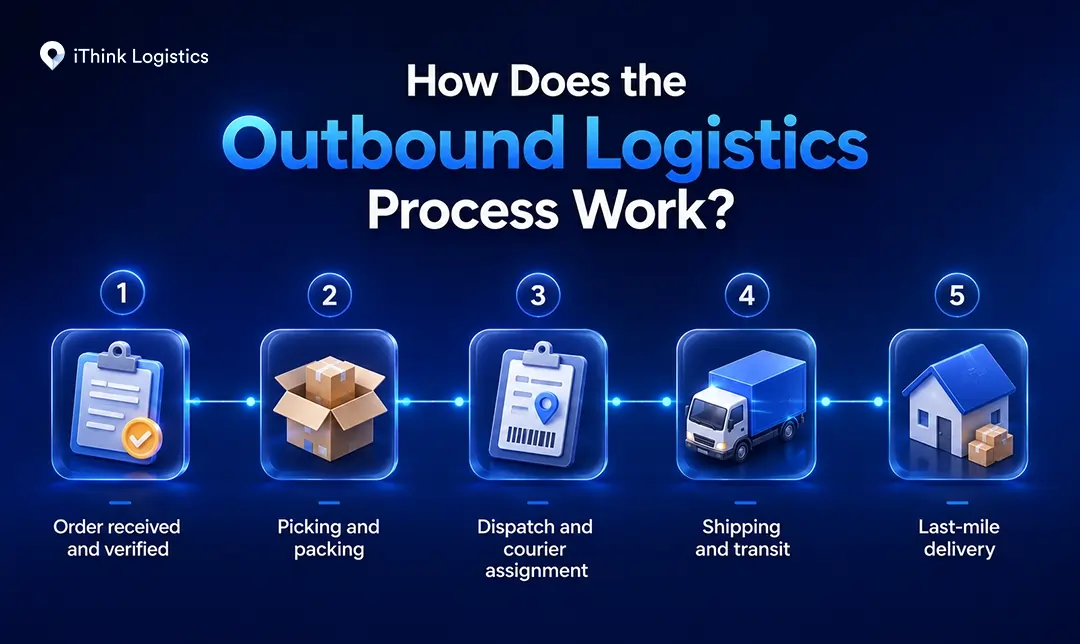
The ones with low RTO rates understand exactly where each stage can fail and have fixed it before it becomes a pattern.
1. Order received and verified
The order enters your system, whether from your website, a marketplace like Meesho or Amazon, or a wholesale buyer.
Before anything physical moves, the system checks whether the item is in stock, the address is complete, and the order is not a duplicate.
This order verification is done in the WMS, and any mistake here can cause issues in later stages.
2. Picking and packing
This is where the outbound process in your warehouse actually begins. Staff pick the items, bring them to packing, and box them with a label and tracking number.
It sounds simple. It isn’t.
The wrong size, product descriptions that don’t match, and damaged products are among the causes of returns in Indian eCommerce. The mistake usually happens right here, at the packing table.
3. Dispatch and courier assignment
Most sellers treat this as a checkbox. Pack the order, assign a courier, move on. It is the step that gets the least attention in most D2C operations and is usually where the most money leaks out.
The decision matters more than most sellers realize. Do you send it with Bluedart for speed? Ekart for the tier-2 pin code reach? Shadowfax for hyper-local? Each choice carries a different cost and RTO risk depending on where the order is going.
At 50 orders a day, you can make those calls yourself. At 500, you are either guessing or spending hours on it.
A courier aggregator like iThink Logistics removes that problem. It automatically picks the right courier for each shipment based on pin code serviceability, past performance, and cost.
Once the assignment is done, the order moves to transit.
4. Shipping and transit
Once the courier picks up the shipment, it moves through sorting hubs toward the delivery location. You have less control here than in any other step. What you do have is tracking visibility.
In India, watching for delays at this stage is the difference between catching a problem early and dealing with an NDR later.
5. Last-mile delivery
This is the final leg of outbound delivery, from the nearest delivery hub to your customer’s address. It is also where most outbound logistics failures in India actually happen.
Not in your warehouse, not in transit, but in this last stretch.
A buyer who is unavailable, an incomplete address, an unanswered phone call, or a COD collection issue: any of these raises an NDR. Once that happens, the clock starts ticking.
Every hour of delay in resolving it reduces the chance the order will ever convert.
Key Components of Outbound Logistics
Outbound logistics runs on six core outbound logistics activities. If any one of them breaks down, it shows up two steps later as a delivery failure.
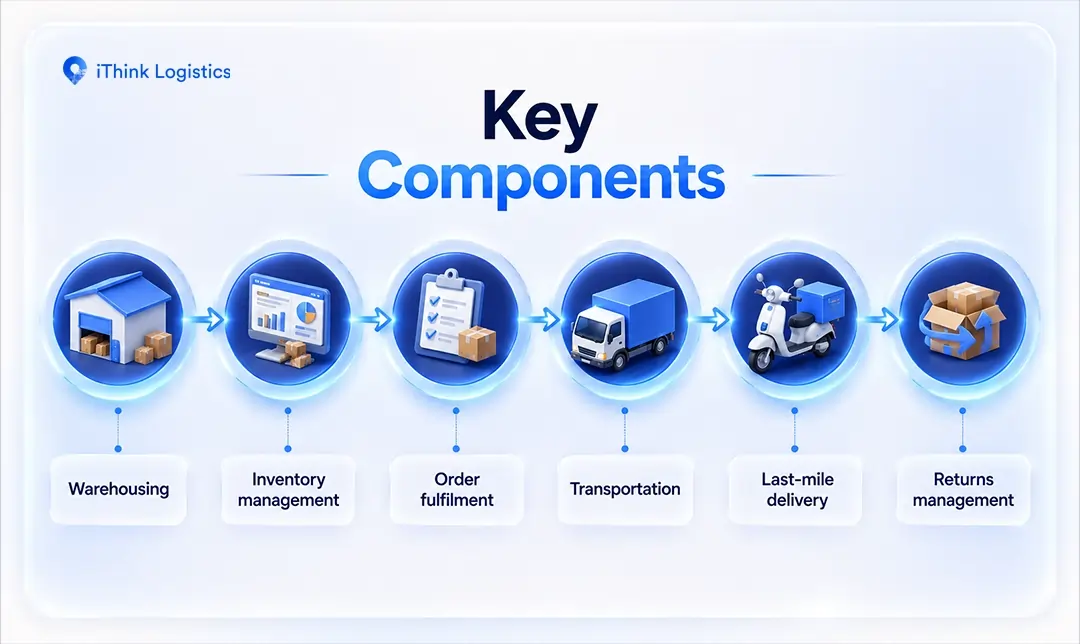
Warehousing
Where you store products inside your warehouse determines how fast they leave it. Fast-moving SKUs far from the packing station slow down every dispatch, every time.
Most sellers realize this late, usually after the operation has already scaled and the layout feels too embedded to change.
Whether you run your own warehouse or work with a 3PL, storage layout and outbound dock management are worth auditing before it quietly costs you on dispatch speed and picking accuracy.
Inventory management
You cannot ship what you do not know you have. Your WMS needs to reflect real stock levels across every sales channel in real time: not just your website, but Flipkart, Meesho, Amazon, and all of them simultaneously.
A single oversell because Shopify stock did not sync fast enough means a cancellation, a bad review, and a customer who ordered from someone else next time.
Order fulfillment
Order fulfillment is what connects a customer clicking “buy” to a package actually leaving your warehouse. It is not a single action.
It is the process design behind all of them: which orders go to which location, how your team prioritizes a backlog, and what happens when something goes wrong mid-route.
Get this right, and the rest of your operation runs on its own. Get it wrong, and every order becomes a problem you have to manually solve.
Transportation
For Indian sellers, carrier selection is not a global logistics problem. It is a pin code problem. Which courier reliably delivers to Muzaffarpur? Which one actually reaches Rajkot without an NDR? The answer changes by month, by courier capacity, and by order value.
Choosing the wrong courier partner slows delivery and increases the risk of RTO.
Last-mile delivery
Last-mile delivery is average. COD RTO rates are between 40 and 49% and occur for D2C brands shipping to tier-2 and tier-3 cities. This is not a courier reliability problem.
It comes down to serviceability coverage, reattempt policies, and how quickly your team responds to an NDR notification and acts on it.
Returns management (reverse logistics)
What supply chain professionals call reverse logistics, D2C sellers call returns management. An order coming back from Nagpur needs to reach your warehouse, get inspected, and re-enter inventory. That process has a cost every time.
In Indian fashion eCommerce, return rates run between 25–40%, which means that for every 10 orders you ship, up to 2-4 come back.
Outbound Logistics Challenges for D2C Sellers in India
Most outbound logistics guides talk about global supply chains, shipping containers, and customs. That’s not your reality at 8 AM when orders start coming in.
Here are the four challenges you actually face in Indian eCommerce.
Pin code serviceability gap
When you get an order for an address that none of your courier partners service, you get stuck. Either the order sits unshipped, or you search for a partner, even with poor coverage in that area.
Sellers shipping regularly to tier-2 and tier-3 cities often face this problem more than they expect. The order exists, the customer is waiting, but no reliable delivery option is available for that pin code.
High RTO rates from poor courier-order matching.
A premium courier on a low-value COD order going to a remote pin code is bad maths. You pay more for the shipment, the delivery probability is lower, and when it returns, the economics fall apart entirely.
Manual courier assignment at scale makes this nearly impossible to avoid.
NDR friction and re-attempt failure
A delivery attempt fails: buyer unavailable, address issue, phone not answered. An NDR gets raised. What happens in the next 24 hours determines whether that order converts or comes back.
If your team does not act on it quickly, the courier’s re-attempt window closes and the shipment returns automatically. You lose the sale and pay both-way shipping.
COD reconciliation delays
Based on iThink Logistics shipping data, COD remittance timelines commonly range from 2–7 days after delivery, depending on the courier partner. For sellers managing large COD volumes, these settlement cycles can directly affect working-capital availability.
It is not just a logistics problem. It is a cash-flow problem that lives within your logistics.
Key Metrics to Track Outbound Logistics Performance
Effective outbound logistics management starts with tracking the right numbers. These seven metrics tell you exactly where your operation is healthy and where it is losing money and customers.
| Metric | What It Measures | Target Benchmark |
| Delivery success rate | % of shipments delivered on the first attempt | 95%+ for metro and tier-1 cities |
| RTO rate | % of orders returned to origin | Lower is better; fashion categories run significantly higher than general merchandise |
| Order accuracy rate | % of orders shipped with the correct item | 96-98% |
| Order dispatch TAT | Time from order placed to courier pickup | Same business day for orders before cutoff |
| On-time delivery % | Orders delivered within the promised window | 95-98% consider strong to world-class OTD |
| NDR resolution rate | % of failed deliveries resolved within 48 hours | 70%+ |
If orders are coming back more often than they are being delivered, or if your first-attempt delivery rate is falling consistently, the cause is almost always courier selection, NDR handling, or both. Pull these numbers today. If you do not have visibility into all six, that is the first thing to fix.
How to Improve Your Outbound Logistics Operations
Most outbound logistics improvements do not require new infrastructure. They require fixing the decisions that are already happening badly.
Use a courier aggregator for automatic courier assignment.
Manual courier selection does not scale past 100 orders a day without errors creeping in. A courier aggregator like iThink Logistics selects the best courier per shipment automatically based on PIN code serviceability, delivery performance history, and cost.
This one change reduces RTO rates and lowers per-shipment cost without adding a person to manage it.
Set up NDR automation.
An unresolved NDR after 24-48 hours has a significantly lower chance of converting on re-attempt. Automating your NDR follow-up via WhatsApp, SMS, or IVR means your team does not have to manually chase every failed delivery.
The system handles it, and your re-attempt conversion rate improves.
Reorganize your warehouse around pick frequency.
Your top 20% of SKUs likely account for 80% of orders. If those SKUs are not closest to the packing station, every picker walks further than necessary on every single order.
Reorganizing storage around actual order frequency reduces average pick time and directly shortens dispatch TAT.
Track RTO reasons at the SKU level.
Not every return comes from the same problem. Some products are returned due to quality issues. Others, because of sizing confusion or a listing that did not set the right expectation.
Tracking return reasons by SKU tells you whether the fix lives in your outbound logistics or further upstream in your product or listing.
FAQs
Q.1: What is outbound logistics?
A: Outbound logistics is the process of storing, preparing, and delivering finished goods from a warehouse or seller to the end customer. It includes order processing, picking and packing, shipping, last-mile delivery, and managing returns.
Q.2: What is the difference between inbound and outbound logistics?
A: Inbound logistics covers the movement of raw materials or inventory from suppliers into your warehouse. Outbound logistics covers the movement of finished goods from your warehouse to the customer. Inbound focuses on procurement and receiving. Outbound focuses on order fulfillment and delivery.
Q.3: What is another name for outbound logistics?
A: Under the broader outbound logistics definition, it’s also called distribution logistics or forward logistics. In supply chain management, it refers to the downstream flow of goods from seller to buyer, as opposed to reverse logistics, which handles returns.
Q.4: What does the outbound logistics process include? (Outbound process meaning)
A: The outbound logistics process includes five stages: order receipt and verification, picking and packing, courier assignment and dispatch, shipping and transit, and last-mile delivery. It ends when the order reaches the customer or, in the case of a return, when the item comes back to the warehouse.
Q.5: What is a good RTO rate in outbound logistics for Indian eCommerce?
A: An RTO rate below 10% is considered healthy for general merchandise categories. For fashion and apparel, where size and fit returns are common, a benchmark below 20% is reasonable. RTO rates above 25% typically indicate problems with courier selection, address verification, or NDR follow-up.
Conclusion
The sellers who keep RTO under 10% and delivery success above 85% are not operating with better products or bigger teams. They have figured out where outbound logistics actually breaks and fixed those points before they became daily fires.
Pin code coverage, courier assignment, NDR response time, warehouse layout, and SKU-level return data: none of these are complicated problems. They are operational decisions that compound, positively or negatively, with every order you ship.
Your outbound logistics is your brand’s last touchpoint with every customer. A wrong item, a delayed delivery, an unanswered NDR: these do not stay internal. They show up in reviews, in refund requests, and in customers who quietly stop reordering.
The seven metrics in this blog tell you exactly where your operation stands. Start there.




Leave a Reply