Running out of a bestseller costs you the sale. Sitting on excess stock costs you the cash to reorder other items. Inventory management is the process that keeps ecommerce sellers out of both traps, ordering, tracking, and selling stock so the right products stay available without tying up your money.
What Is Inventory Management?
Inventory management is the process of ordering, storing, tracking, and selling a company’s stock, from raw materials to finished products, so the right amount is on hand at the right time.
It covers everything between placing a purchase order and shipping the completed sale.
Done well, it keeps two things in balance: you never run out of what’s selling, and you never tie up cash in what isn’t.
For sellers with multiple channels, it also means one accurate stock count that holds whether the sale happened on Amazon, Flipkart, or your own site.
Why Inventory Management Matters for Ecommerce Sellers
Overstock and understock both cost you money, just in different ways. Too much stock ties up cash you could use for your next order or ads.
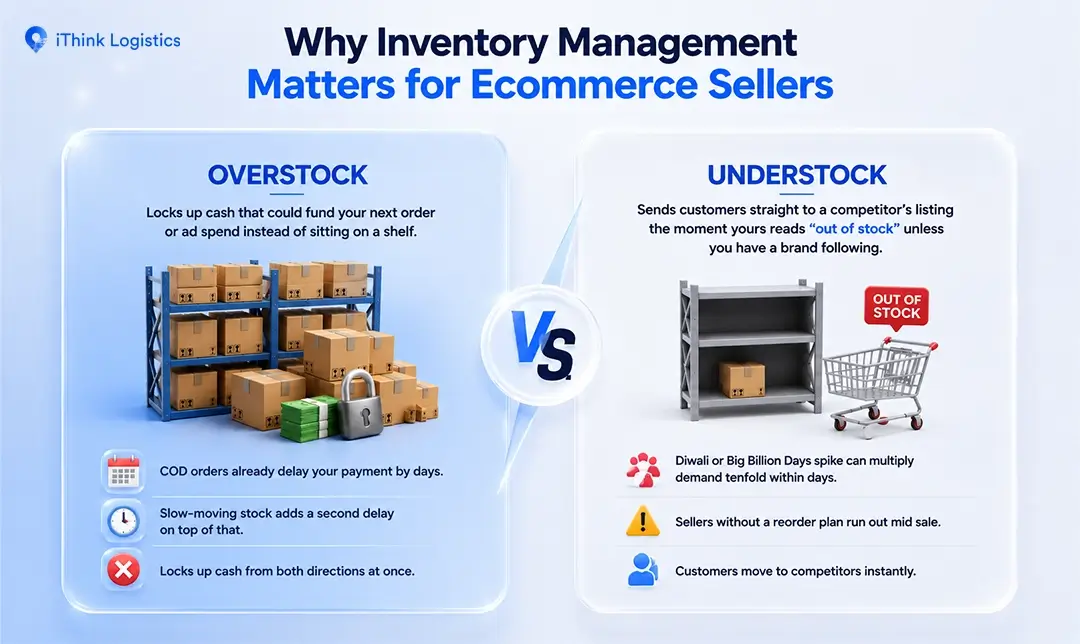
Too little, and customers leave for a competitor the moment your listing says ‘out of stock’ unless you have a loyal brand following.
For Indian D2C and SME sellers, this hurts even more. COD orders already delay your payment. Slow-moving stock adds another cash crunch. Both hit your working capital at the same time.
If you sell on Amazon, Flipkart, Meesho, and your own site, your stock counts can go out of sync fast unless your systems talk to each other.
A Diwali or Big Billion Days spike can multiply demand for one product tenfold within days, and sellers without a reorder plan run out mid-sale.
Good inventory management solves five operational problems: stockouts, overstock, wrong stock counts, waste from expired or damaged goods, and slow manual work.
For you, that means cash keeps moving, bestsellers stay in stock during busy weeks, and your numbers stay accurate across every channel.
None of this works without first knowing what you’re actually managing.
4 Major Types of Inventory
Inventory comes in different forms, depending on where your product is in its journey. Most ecommerce sellers deal with four types.
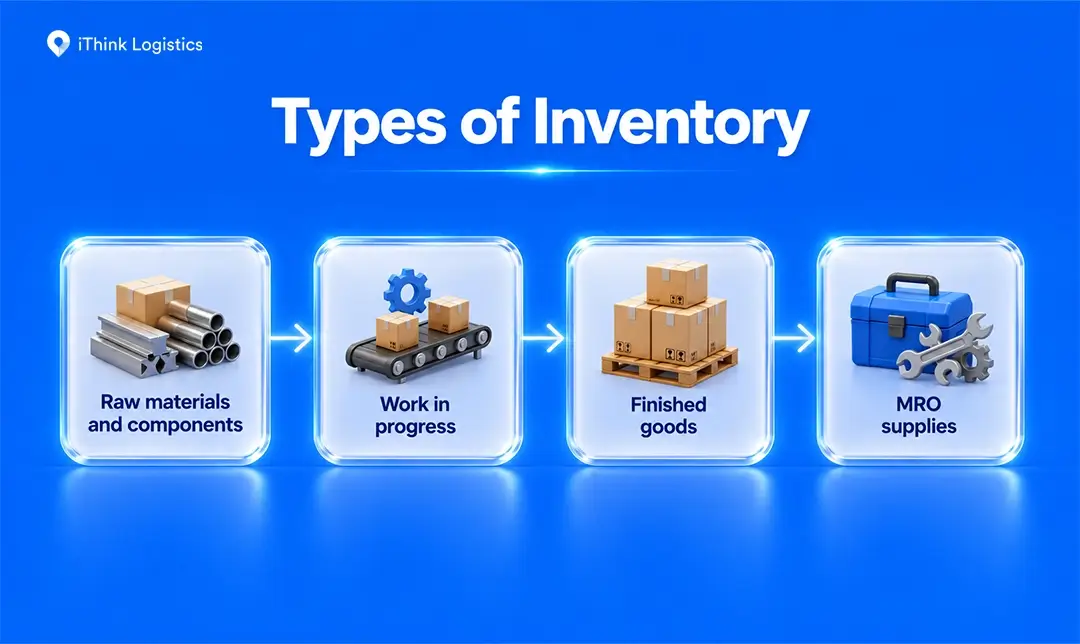
Raw materials and components
These are the inputs you or your supplier use to make your product. Think fabric for a clothing brand or packaging film for a snack brand.
Work in progress
This is stock that’s still being made or assembled, not ready to sell yet. If you’re a private label seller waiting for your manufacturer to finish a batch, that’s work-in-progress inventory.
Finished goods
Completed products sitting in your warehouse or fulfillment center, ready to ship the moment an order comes in.
MRO supplies
Maintenance, repair, and operating supplies like packaging tape, barcode labels, and warehouse equipment. You need them to run your business, but you don’t sell them.
Most ecommerce sellers only manage finished goods. If you manufacture or private label, you deal with all four types.
Once you know what you’re tracking, figure out how that stock moves through your business.
How Inventory Management Works (The Process)
Inventory management follows a repeatable cycle from ordering to reporting. Here’s how it works in six steps.
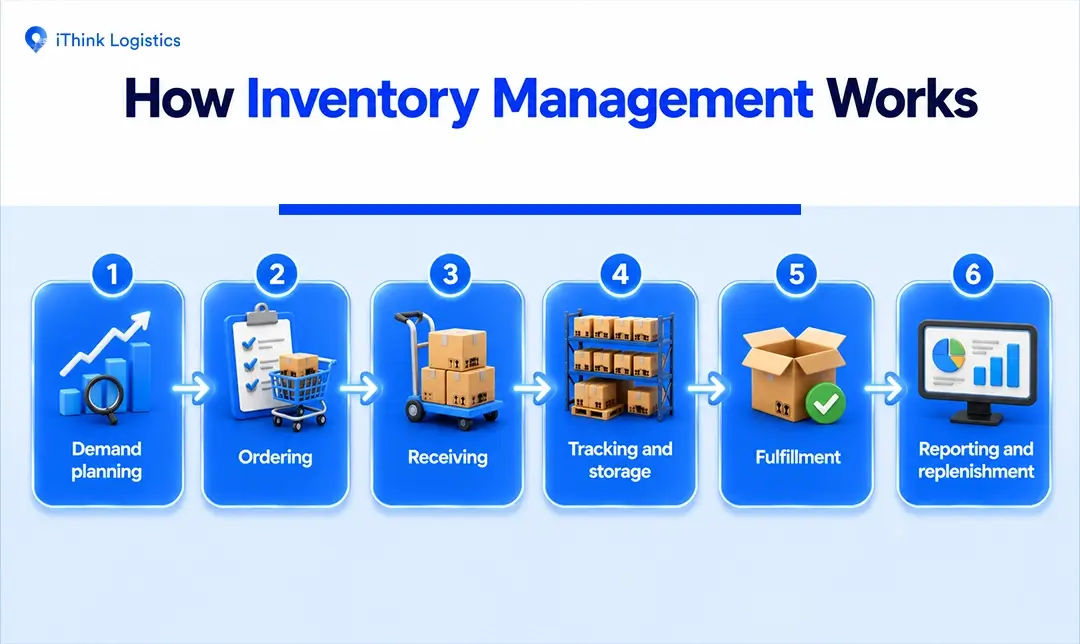
- Demand planning. You review past sales, seasonal trends, and upcoming promotions to estimate how much stock you’ll need.
- Ordering. Based on that forecast, you place purchase orders with suppliers, accounting for lead time and minimum order quantities.
- Receiving. When stock arrives, your team checks it against the invoice, inspects for damage, and logs it into your system.
- Tracking and storage. Your team records each item by SKU and puts it in the right warehouse spot, ready to pick when an order comes in.
- Fulfillment. As orders come in, your team picks, packs, and ships products, and your stock count updates automatically.
- Reporting and replenishment. You review turnover, stockout rates, and dead stock regularly, then trigger reorders before you run out.
This cycle repeats continuously, and the accuracy of each step affects every step after it.
A missed count during receiving throws off your reorder point calculations weeks later. A skipped demand planning review leaves you unprepared for a sales spike.
How well you run this process depends on the method you use to manage stock.
4 Inventory Management Methods and Techniques
No single method fits every business. Most sellers use a mix of three or four, depending on what they sell and how their supply chain works.
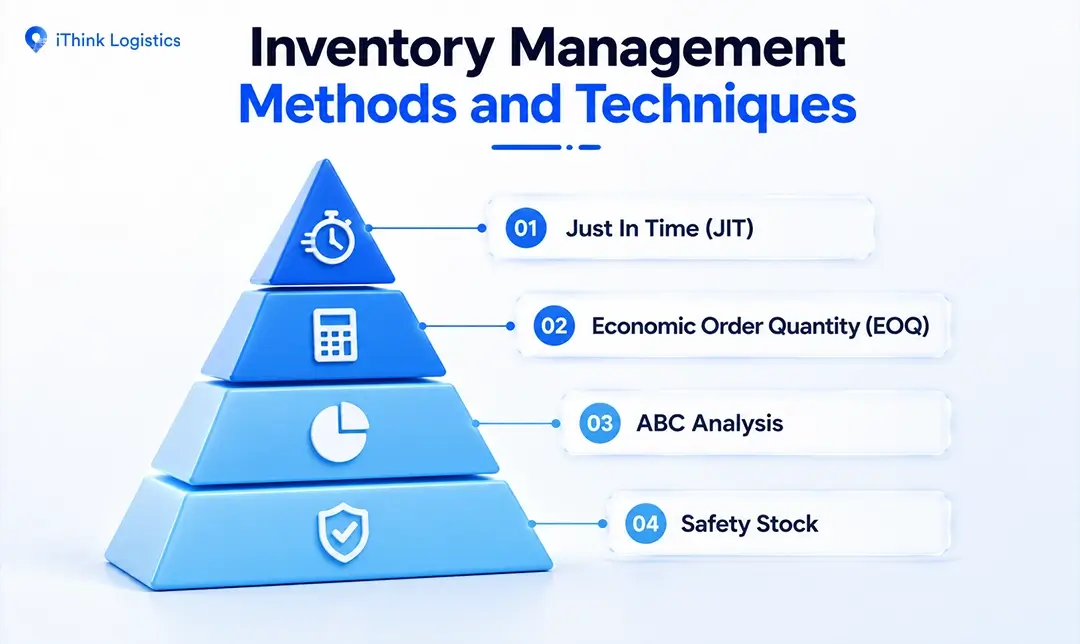
Here’s how JIT, EOQ, ABC analysis, and safety stock work. FIFO and LIFO get their own section below.
Just In Time (JIT)
Just-in-time inventory means ordering stock to arrive right before you need it, rather than holding large reserves. This keeps holding costs low and reduces waste from unsold stock.
It works best when you have reliable suppliers and predictable demand, since a late shipment leaves you with nothing to sell.
Economic Order Quantity (EOQ)
EOQ is a formula that tells you the exact number of units to order at one time, balancing two costs that pull in opposite directions: storage costs, which rise the more you order at once, and ordering costs, which rise the more often you place small orders.
Order too little too often, and you pay extra in repeated supplier and shipping fees. EOQ calculates the batch size where both costs are as low as possible.
ABC Analysis
ABC analysis sorts your inventory into three tiers based on value:
- A items are high-value products that need close, frequent tracking.
- B items sit in the middle.
- C items are low-value, high-volume products that need only basic oversight.
This lets you focus attention where it actually matters instead of tracking every SKU the same way.
Safety Stock
Safety stock is extra inventory you hold as a buffer against demand spikes or supplier delays.
Most sellers keep it year-round for their fastest-moving, highest-demand SKUs, the “A” items from ABC analysis, rather than across their entire catalog, since it costs more to carry than a lean JIT approach.
It becomes especially common practice ahead of predictable demand spikes: festival sales like Diwali or Big Billion Days, a new product launch, or a marketing push that’s expected to drive a sudden jump in orders.
Outside of these periods, sellers with steady, predictable demand often carry little to no safety stock and lean on tighter reorder points instead.
These methods tell you how much stock to keep. But how you value that stock on your books matters just as much.
FIFO vs. LIFO: Inventory Valuation Methods
FIFO (first in, first out) means you sell your oldest inventory first. Your cost of goods sold matches your earliest purchase prices.
LIFO (last in, first out) means you sell your newest inventory first. Your cost of goods sold matches your latest, often higher, purchase prices.
Here’s how the two compare directly:
| Aspect | FIFO (First In, First Out) | LIFO (Last In, First Out) |
| Which stock sells first | Oldest inventory | Newest inventory |
| Cost of goods sold reflects | Earlier, usually lower purchase prices | Recent, often higher purchase prices |
| Effect on profit during inflation | Higher reported profit, since older, cheaper stock counts as the cost | Lower reported profit, since newer, costlier stock counts as the cost |
| Effect on taxable income | Higher, since profit is reported higher | Lower, since profit is reported lower, a reason some countries allow it as a tax strategy |
| Ending inventory value on the balance sheet | Closer to current market prices | Often understated, based on older, lower purchase prices |
| Recordkeeping | Simpler, matches natural stock rotation | More complex, requires tracking purchase batches separately from what physically ships first |
| Global usage | Allowed under both US GAAP and IFRS/Ind AS | Allowed under US GAAP, not permitted under IFRS or Ind AS |
| Best suited for | Perishables, cosmetics, anything with an expiry date | Non-perishable goods in inflationary markets (where permitted) |
| Allowed under Indian accounting standards (Ind AS) | Yes, the standard method | Not permitted |
FIFO naturally rotates older stock out before it spoils, which is why perishable goods and cosmetics sellers default to it.
If you’re comparing global guides that mention LIFO as an option, that option doesn’t apply to your books in India. Nearly every Indian business reports inventory using FIFO or weighted average cost instead.
Valuation tells you what your stock is worth. Reorder points tell you when to buy more.
How to Calculate Your Reorder Point
Your reorder point is the stock level where you need to place a new order so you don’t run out before the next shipment arrives. The formula is simple.
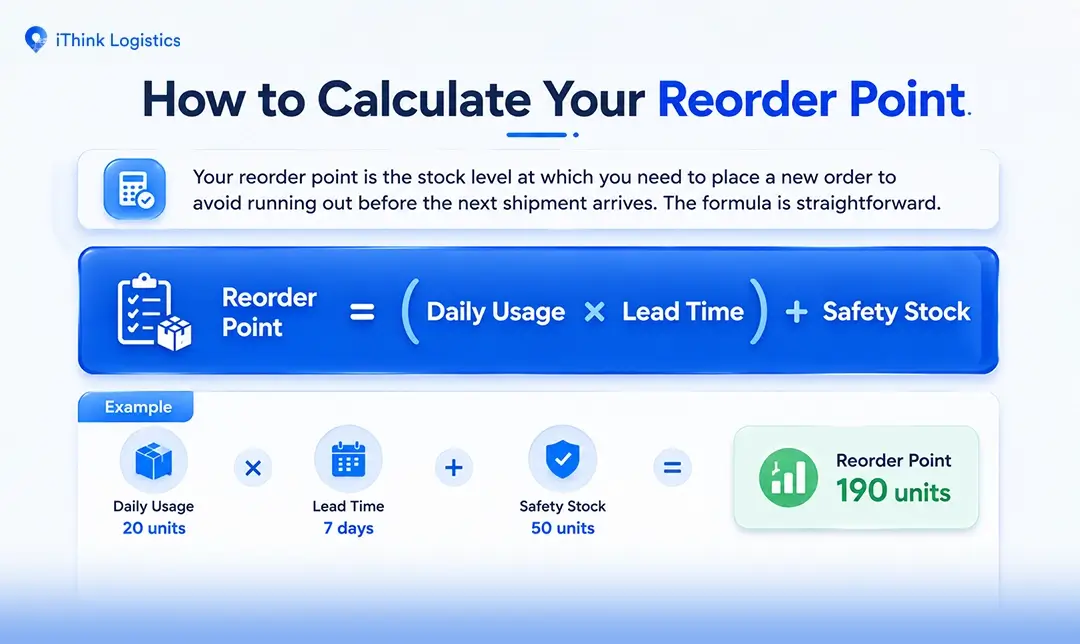
Reorder Point = (Daily Usage × Lead Time) + Safety Stock
Say you sell 20 units a day, your supplier takes 7 days to deliver, and you keep 50 units of safety stock as a buffer. Your reorder point is (20 × 7) + 50, or 190 units. Once your stock drops to 190 units, you place your next order.
This number changes as your sales volume or supplier lead times change, so revisit it every few months rather than setting it once and forgetting it. Most inventory software calculates this automatically once you input your usage and lead time data.
Try it with your own numbers. Take your daily sales, your supplier’s lead time (product delivery time to you), and your safety stock buffer, run them through the formula above, and drop your reorder point in the comments.
Let us know if you keep safety stock or manage without it, we’re curious how different sellers handle this.
Reorder point is a tactic inside inventory management, not the whole discipline. Here’s how it fits alongside terms like inventory control and supply chain management, which get used interchangeably far too often.
Inventory Management vs. Related Terms
People mix up inventory management, inventory control, warehouse management, and supply chain management. Each one covers something different.
| Term | What It Actually Means |
| Inventory management | Broad oversight of stock, from ordering to selling, across your entire business |
| Inventory control | Precise, day to day tracking of stock accuracy within inventory management |
| Warehouse management | Organizing and moving stock within one physical location |
| Supply chain management | Everything from supplier relationships to final delivery, with inventory as one piece |
| Order management | Tracking and fulfilling customer orders, separate from tracking the stock itself |
Inventory control is part of inventory management. It’s about accuracy, cycle counts, and audits to make sure your system matches what’s actually on the shelf.
Warehouse management is even narrower. It focuses on one facility, not your stock across all locations and channels.
Supply chain management is the widest term of the five, covering supplier relationships and logistics that sit outside inventory itself.
Managing all this by hand only works for so long. Once your SKU count grows, you need dedicated software.
What Is an Inventory Management System?
An inventory management system is software that tracks, updates, and reports on your stock levels automatically, replacing manual counts and spreadsheets.
Most systems fall into two categories:
- Periodic systems count stock at set intervals, like the end of each week or month.
- Perpetual systems update your stock count in real time the moment an item is picked, packed, received, or returned.
Across leading inventory management systems like Unicommerce, Zoho Inventory, and Odoo Inventory, you’ll commonly find features such as:
- Real-time inventory tracking across warehouses and sales channels
- Barcode, SKU, batch, or serial number tracking
- Automated reorder points and low-stock alerts
- Multi-warehouse inventory management
- Purchase and sales order management
- Inventory reports covering stock movement, turnover, and inventory value
Small sellers with under 100 SKUs can often manage inventory using a spreadsheet and manual reorder checks.
Once you’re selling across multiple marketplaces, managing several hundred SKUs, or scaling rapidly, keeping stock accurate by hand becomes slower and more error-prone.
Software solves the tracking problem. It doesn’t solve every inventory challenge Indian ecommerce sellers deal with every day.
Common Inventory Management Challenges for Indian Ecommerce Sellers
Indian ecommerce sellers deal with a few challenges that generic inventory advice rarely addresses.
Festival season demand spikes. Diwali and Big Billion Days-style sales can multiply demand for a single product within days. Sellers without a pre-built safety stock plan run out mid-sale, losing both revenue and ranking on marketplace search.
Multi-channel stock syncing. If you sell on Amazon, Flipkart, Meesho, and your own site, your stock counts need to match everywhere. If one channel doesn’t update fast enough, you risk overselling.
Tier 2 and Tier 3 fulfillment. Sellers expanding beyond metro cities often need multiple warehouses to keep delivery times reasonable, which multiplies the complexity of tracking stock across locations.
Cash on delivery lock-up. With COD orders, the customer pays the delivery partner at the doorstep, not you. The courier holds that cash and remits it to you only after their settlement cycle completes, typically 3 to 10 days depending on the courier.
Until that remittance lands, you’ve already paid for the stock, shipped it, and delivered it, but you still don’t have the money in hand.
If capital is also tied up in unsold inventory at the same time, both are pulling on your cash at once.
Solving the stock accuracy side of these problems is only half the job. Once your inventory data is accurate, the next challenge is getting those SKUs to customers reliably.
A multi-courier shipping aggregator like iThink Logistics keeps fulfillment moving as fast as your stock does, so accurate inventory actually translates into orders delivered on time.
Which of these four hits you hardest right now? Tell us in the comments: festival spikes, multi-channel syncing, Tier 2/3 fulfillment, or COD lock-up. It helps us know which of these to cover in more depth next.
FAQs
Q.1: What are the objectives of inventory management?
A: The main objective of inventory management is to keep enough stock on hand to meet customer demand while spending as little as possible on holding that stock. A second objective is accuracy, making sure your recorded stock counts match what’s actually in your warehouse, since inaccurate counts undermine every reorder decision you make.
Q.2: What is the difference between inventory and stock?
A: Stock usually refers only to finished goods ready for sale, while inventory is the broader term covering raw materials, work in progress, and finished goods together. Every stock item is inventory, but not every inventory item counts as stock.
Q.3: What is ABC analysis in inventory management?
A: ABC analysis sorts inventory into three tiers based on value. A items are high value and need frequent tracking, B items sit in the middle, and C items are low value, high volume products that need only basic oversight.
Q.4: What is the 80/20 rule in inventory management?
A: The 80/20 rule, also called the Pareto principle, holds that roughly 80 percent of your sales value typically comes from about 20 percent of your products. This is the same logic behind ABC analysis, and it helps sellers decide where to focus reorder attention and safety stock.
Q.5: Is inventory management the same as inventory control?
A: No. Inventory management is the broader process covering ordering, storing, tracking, and selling stock. Inventory control is one part of that process, the specific practice of counting and verifying that your recorded stock matches your physical stock.
Your Next Step
One number is all it takes to start. Run your best-selling SKU through the reorder point formula above and you’ve got a working system for the product that matters most. Drop that number in the comments along with the others we’ve asked about, we’re building a real picture of how different sellers actually manage this.
Author