
Introduction
When a customer clicks buy, they see a confirmation and a delivery date. What they don’t know is the chain of sourcing, inventory, fulfillment, and logistics working together to get that order out the door.
That network is the supply chain, and managing it well is what separates ecommerce businesses that deliver consistently from those that don’t. Supply chain management in ecommerce isn’t a back-office concern.
It’s the operational foundation every online business runs on, whether they’ve built it deliberately or not.
What Is Supply Chain Management in Ecommerce?
Supply chain management (SCM) in ecommerce is the end-to-end coordination of sourcing, inventory, order fulfillment, logistics, and returns, everything that moves a product from a supplier to a customer’s doorstep and back again when needed.
SCM stands for Supply Chain Management, and in ecommerce it covers far more than shipping. Between your supplier sending goods and your customer receiving them, you have to source, store, track, process, pack, assign a courier, and handle returns.
If you manage each step, customers never notice a problem. If you don’t, they will. Managing multiple couriers, warehouses, and daily demand is already supply chain work. The brands that grow are the ones that do this deliberately, not reactively.
What Is the E-Commerce Supply Chain?
Traditional retail moves bulk goods on fixed schedules. Ecommerce is different. You serve individual customers, each expecting a different product at a different address, and they want it fast.
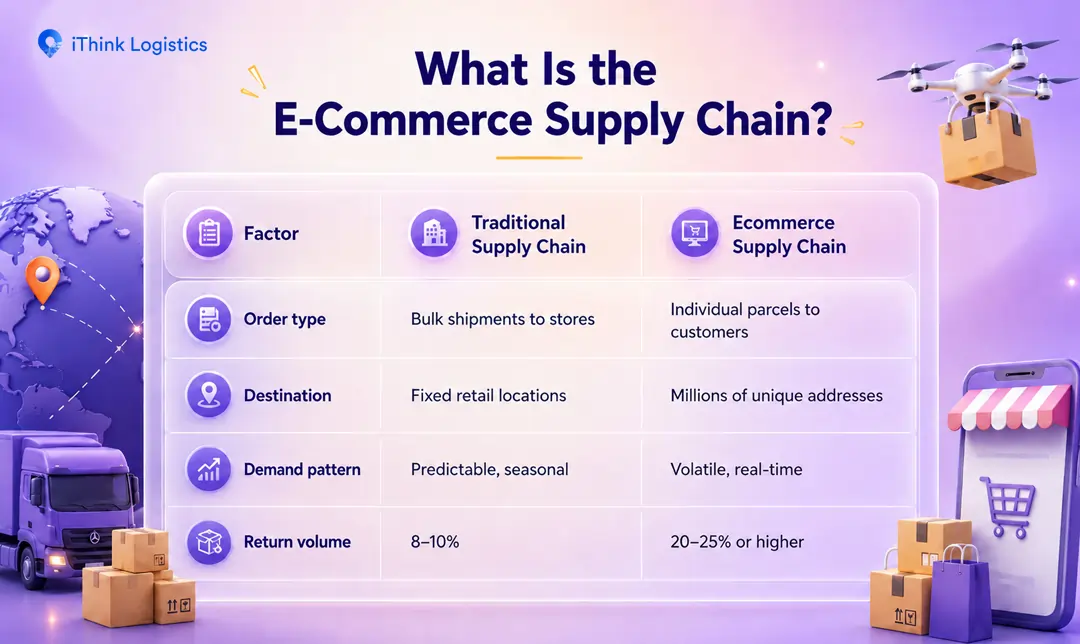
| Factor | Traditional Supply Chain | Ecommerce Supply Chain |
| Order type | Bulk shipments to stores | Individual parcels to customers |
| Destination | Fixed retail locations | Millions of unique addresses |
| Demand pattern | Predictable, seasonal | Volatile, real-time |
| Return volume | 8–10% | 20–25% |
Returns and RTOs in Indian ecommerce are not rare. They’re daily reality. Knowing each part of your supply chain is what makes it manageable.
Key Components of an E-Commerce Supply Chain
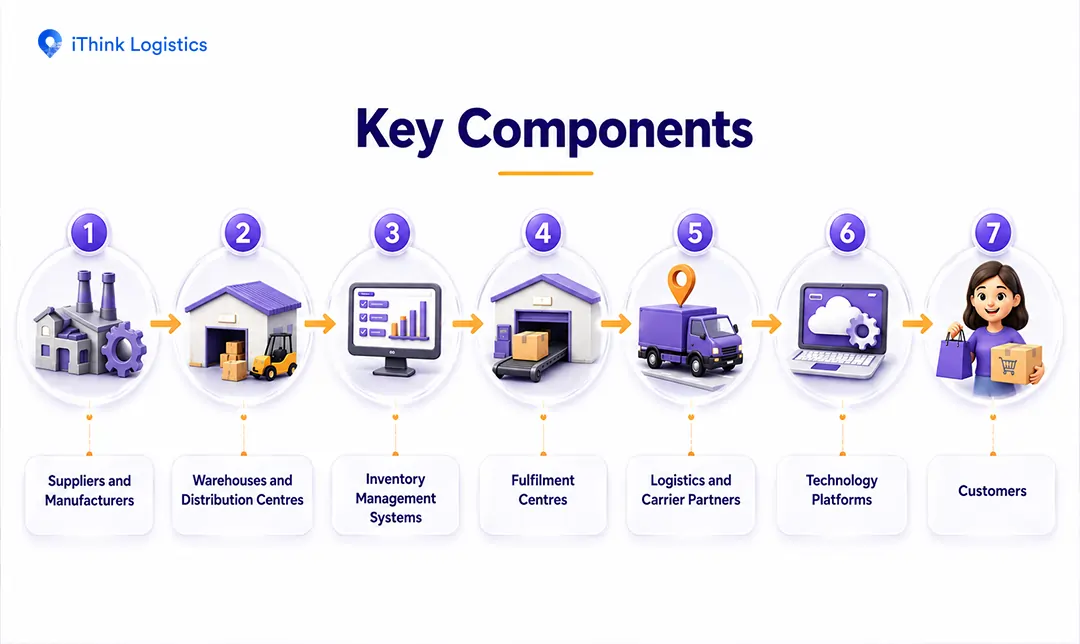
Your supply chain is not one system. It’s a set of connected parts, each handling a stage from supplier to customer. When it works, no one notices. When it breaks, everyone feels it.
Suppliers and Manufacturers
where the product begins, whether that’s raw materials sourced from a vendor or finished goods procured from a manufacturer.
Warehouses and Distribution Centers
where inventory is stored, organized, and made ready for dispatch.
Inventory Management Systems
the tools and processes that track exactly what’s in stock, where it is, and when it needs replenishing across every location.
Fulfilment Centres
Where orders are picked, packed, and labeled for shipping the moment a customer places an order.
Logistics and Carrier Partners
The courier companies that physically move packages through the last mile to the customer’s address.
Technology Platforms
The order management systems, WMS tools, and aggregator platforms that connect and automate everything above.
Customers are the final link, and their experience reflects how well every component before them performed.
Each part depends on the one before it. A supplier delay doesn’t just affect sourcing; it ripples through inventory, fulfillment, and delivery. That chain reaction is exactly why the step-by-step process matters.
How Supply Chain Management Works in Ecommerce: Step by Step
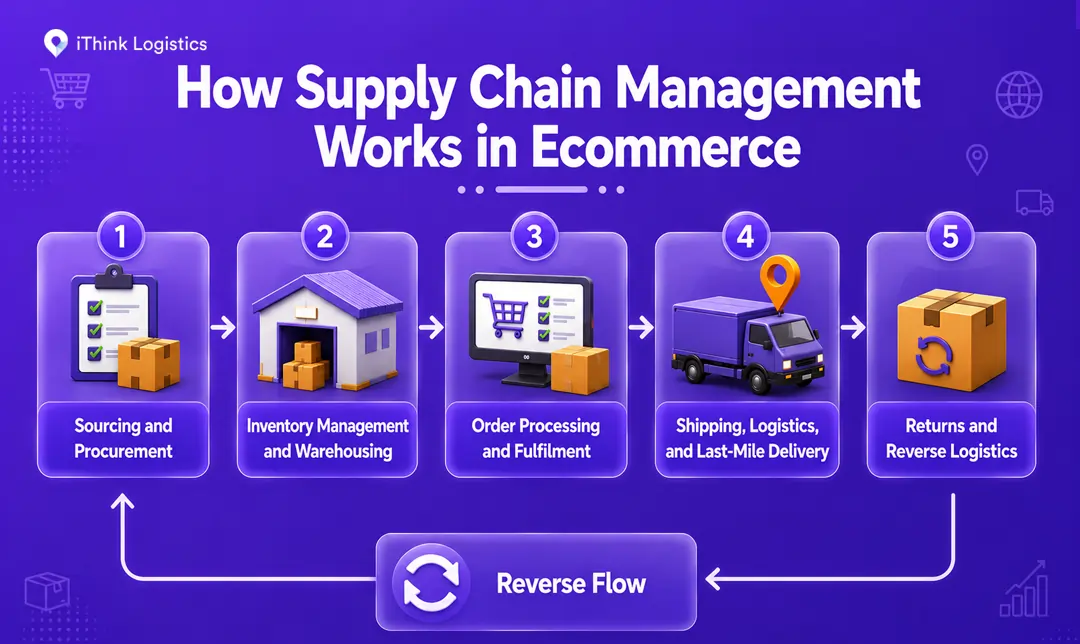
The ecommerce supply chain has five stages. Each one builds on the last.
Sourcing and Procurement
Sourcing and procurement is the process of identifying suppliers, negotiating terms, and securing the products or raw materials an ecommerce business sells.
This is where everything starts. A seller sources either finished goods from a vendor or raw materials from a manufacturer, and decides which suppliers to work with, what lead times to agree to, and sets a quality standard for the product.
If a supplier delays a shipment by two weeks, then it creates a procurement problem.
That delay can lead to a stockout or a canceled order, resulting in a bad customer experience and a customer who doesn’t come back.
Inventory Management and Warehousing
Inventory management in ecommerce is the process of tracking, storing, and controlling stock levels to ensure the right products are available in the right quantities at the right time.
Once goods arrive, they need to be stored and tracked. Real-time visibility across warehouse locations prevents two of the most expensive problems in ecommerce:
- stockouts (which lose sales) and
- overstocking (which ties up capital and increases storage costs).
Demand forecasting tools help sellers anticipate what to restock before they run out, not after.
Order Processing and Fulfillment
Order processing is the sequence of picking, packing, verifying, and labeling a customer’s order from the moment it is placed until it leaves the warehouse.
When a customer hits “buy,” the clock starts. You need to locate inventory, pick the product from the shelf, pack it correctly, label it for the right courier, and hand it over for dispatch.
Making mistakes like packing the wrong item means a return, a refund, and a bad customer experience that’s hard to recover from and is an expensive mistake.
As product returns are sometimes not cost-effective, the product cost is gone, and customer experience is a plus.
That’s why fulfillment centers built for accuracy and speed to reduce both processing time and error rates significantly; that difference compounds quickly at scale.
Shipping, Logistics, and Last-Mile Delivery
Last-mile delivery is the final stage of the logistics process, where a packaged order moves from the nearest fulfillment point to the customer’s address.
The last mile is where most failures show up to your customer. It’s also the most expensive part, often over half your shipping cost.
Carrier performance, route planning, and pin code coverage decide if your order arrives on time.
For Indian sellers, managing carriers is not a one-time job. No single courier covers every area or product type. You need to stay on top of it.
Returns and Reverse Logistics
Reverse logistics is the process of managing returned products from customer pickup through inspection, restocking, refurbishment, or disposal back through the supply chain.
Ecommerce returns run at 20–25% in most categories, compared to 8–10% in offline retail. In fashion, the number goes higher.
Every return that isn’t processed quickly is cash sitting idle and a customer waiting on a refund.
An efficient reverse logistics process gets sellable products back to available inventory fast, flags quality issues for supplier escalation, and handles refunds without adding to the customer’s frustration.
Returns aren’t just a fulfillment cost. They’re a loyalty decision; if handled well, they bring customers back; handled badly, they don’t.
How well all five stages perform determines the health of the supply chain. In India, that performance is shaped by conditions that most global playbooks never mention.
Role of SCM in Ecommerce: Why It Matters for Indian D2C Sellers
The role of supply chain management in ecommerce is to ensure products reach customers on time, at the lowest viable cost, with the fewest errors, and that when failures happen, they’re caught and corrected before they cost the business a customer.
For Indian D2C sellers, this plays out against a set of conditions that make supply chain management both harder and more consequential than global benchmarks suggest. RTO rates in Indian ecommerce range from 20% to 40%, depending on the category, channel, and courier performance.
COD orders account for the majority of transactions in Tier 2 and Tier 3 cities, adding reconciliation delays and increasing RTO risk to every logistics decision.
Managing five or six courier partners simultaneously, each with different serviceability maps, SLAs, and pricing, is itself a supply chain job that many sellers are still doing manually when they should automate it.
Revenue demand forecasting helps sellers predict inventory needs before stockouts occur, rather than scrambling afterward.
Courier aggregator platforms are centralizing multi-carrier management, automating courier selection based on performance and pin code data, and surfacing RTO patterns early enough to act on them.
For sellers managing multiple carriers and trying to reduce RTO while keeping delivery costs in check, iThink Logistics brings courier selection, performance tracking, and RTO management into one place.
Benefits of Supply Chain Management in Ecommerce
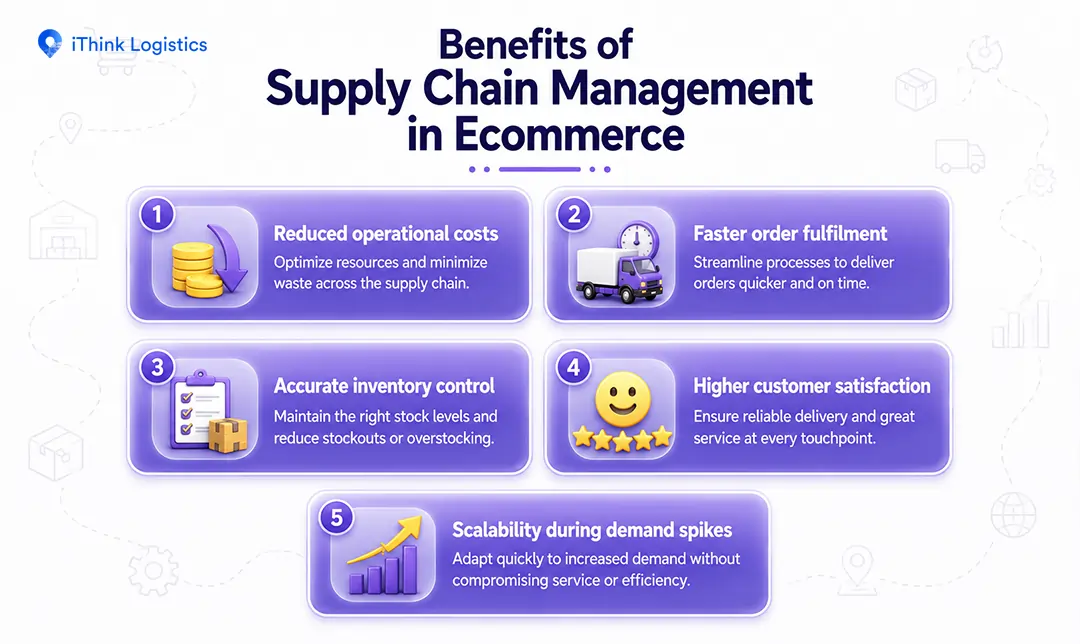
Effective supply chain management in ecommerce reduces costs, accelerates fulfillment, and improves the customer experience.
Here is what each of those actually means in practice.
Reduced operational costs
When inventory is managed well, less capital sits in slow-moving stock. Selecting couriers based on performance data reduces shipping costs. Packing errors cost twice, once on the return, once on the re-delivery.
Faster order fulfillment
A streamlined dispatch process cuts the gap between order placement and courier handover. Customers get their orders sooner, and late-package NDRs stop piling up before they become a pattern.
Accurate inventory control
Real-time stock visibility means sellers know what’s available before a customer orders it, not after the order is already in the system. Overselling stops. Dead stock reduces.
Higher customer satisfaction
Customers who receive orders on time come back. Customers who don’t, often don’t. Retaining customers through logistics performance costs far less than reacquiring them.
Scalability during demand spikes
A supply chain built for today’s volume creates headroom for the festive season and flash sales. Growth doesn’t have to mean proportional chaos.
None of this happens on its own. It comes from actively managing the supply chain, which means knowing where it breaks first.
Common Challenges in Ecommerce Supply Chain Management
Supply chain challenges in ecommerce are predictable. Knowing them early means you’re solving problems before they become patterns.
High return rates and RTO
In Indian ecommerce, RTO isn’t just a logistics metric; it’s a direct margin drain. Every undelivered order costs twice: outbound shipping and the return. Proactive NDR management and courier performance tracking are what keep it in check.
Inventory inaccuracies
Stock data inaccuracies lead to overselling or deadstock. Manual tracking is usually the issue, and the fix requires both better systems and the discipline to update them consistently.
Demand fluctuations
Festive spikes, viral products, and flash sales outpace supply planning fast. Without forecasting built into the process, sellers are always restocking in reaction mode.
Shipping delays
A single courier dependency means every disruption that the partner faces becomes your problem. Multi-carrier strategies distribute risk but require centralized management to work. using
Multiple sales channels
Selling across a D2C site, Amazon, Flipkart, and Meesho simultaneously creates inventory sync problems that a manual approach can’t keep up with.
FAQs
Q.1: What Is the Full Form of SCM in Ecommerce?
A: SCM stands for Supply Chain Management. In ecommerce, it refers to the coordinated management of sourcing, inventory, order fulfilment, logistics, and returns to ensure products reach customers efficiently and cost-effectively.
Q.2: What Is the Role of SCM in Ecommerce?
A: SCM coordinates every stage of the product journey from supplier to customer doorstep. Its role is to reduce costs, maintain product availability, ensure timely delivery, and manage returns in a way that protects margins and customer satisfaction.
Q.3: What Are the Main Stages of an Ecommerce Supply Chain?
A: The five core stages are sourcing and procurement, inventory management and warehousing, order processing and fulfilment, shipping and last-mile delivery, and returns and reverse logistics.
Q.4: How Is an Ecommerce Supply Chain Different from Traditional Retail?
A: Traditional retail moves bulk shipments to fixed store locations on predictable schedules. Ecommerce delivers individual parcels to millions of unique addresses with volatile, real-time demand and significantly higher return rates.
Q.5: Why Is Supply Chain Management Important for Online Businesses?
A: Poor SCM leads directly to stockouts, late deliveries, high return rates, and customer churn. Strong SCM lowers per-order cost, speeds fulfillment, and builds the operational foundation that makes scaling possible without proportional cost increases.
Q.6: What Is Reverse Logistics in Ecommerce?
A: Reverse logistics is the process of handling products returned by customers covering pickup, inspection, restocking, refurbishment, or disposal. In ecommerce, where return rates run significantly higher than offline retail, efficient reverse logistics is a margin-protection function, not just a customer service one.
Conclusion
Supply chain management in ecommerce isn’t a back-office function. It’s the operational layer that determines whether customers come back or complain. For Indian sellers, getting SCM right means addressing the specific challenges of RTO, COD reconciliation, and multi-carrier complexity that global playbooks don’t cover. The sellers who build this foundation early scale with far less friction than those who patch it together later.
Author




Leave a Reply