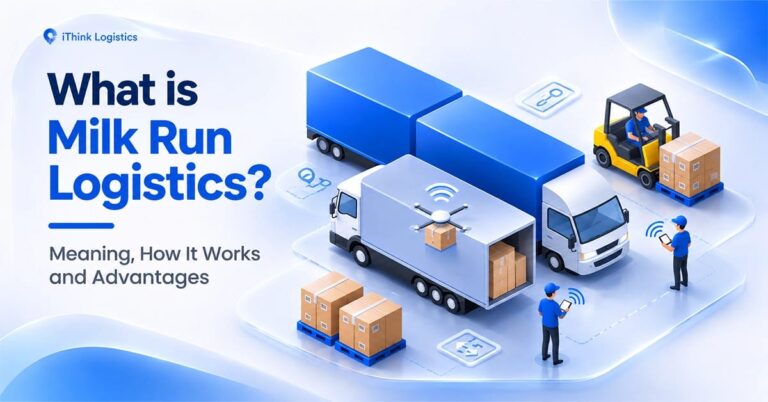
Milk run logistics is a transport model where one vehicle follows a fixed route to serve many stops. It replaces a separate truck for every supplier or customer. Picture five suppliers in one industrial belt, all feeding one plant.
A milk run sends one truck around all five instead of five trucks to your gate. The name comes from milkmen, who left full bottles and collected empties on one route. Manufacturers, retailers and ecommerce teams all use the same idea.
Milk Run Meaning in Logistics
A milk run is a planned round trip where one vehicle visits several stops on a fixed schedule. It consolidates trips that would otherwise run separately for each stop. The defining feature is one route serving many stops, not one origin serving one destination.
Airlines also call a multi-stop flight a milk run. In milk run logistics, though, the phrase always means a shared route. To see why that saves money, follow one run from start to finish.
How Does the Milk Run System in Logistics Work?
A milk run system is a repeating, scheduled route on which a vehicle collects or delivers goods at fixed stops. Planners set the stop order, timing and vehicle size in advance. The same loop then repeats daily or weekly, so every stop knows when the vehicle will arrive.
Take a plant that buys parts from five suppliers in one industrial area. One run looks like this:
- Fix the route and slot. List the suppliers, order them sensibly and agree a pickup time with each.
- Leave the plant. The truck departs at the set hour with the empty crates from the last run.
- Stop at each supplier. Each one loads only its own small batch.
- Carry the combined load. By the fifth stop, the truck holds parts from all five.
- Return to the plant. Goods unload, the truck takes on empties, and the cycle repeats.
The empties are the milkman’s logic at work: the truck drops off the empty crates each supplier needs for its next batch. Small, frequent runs also make milk run logistics a core part of just-in-time (JIT) supply chains.
Types of Milk Run Systems
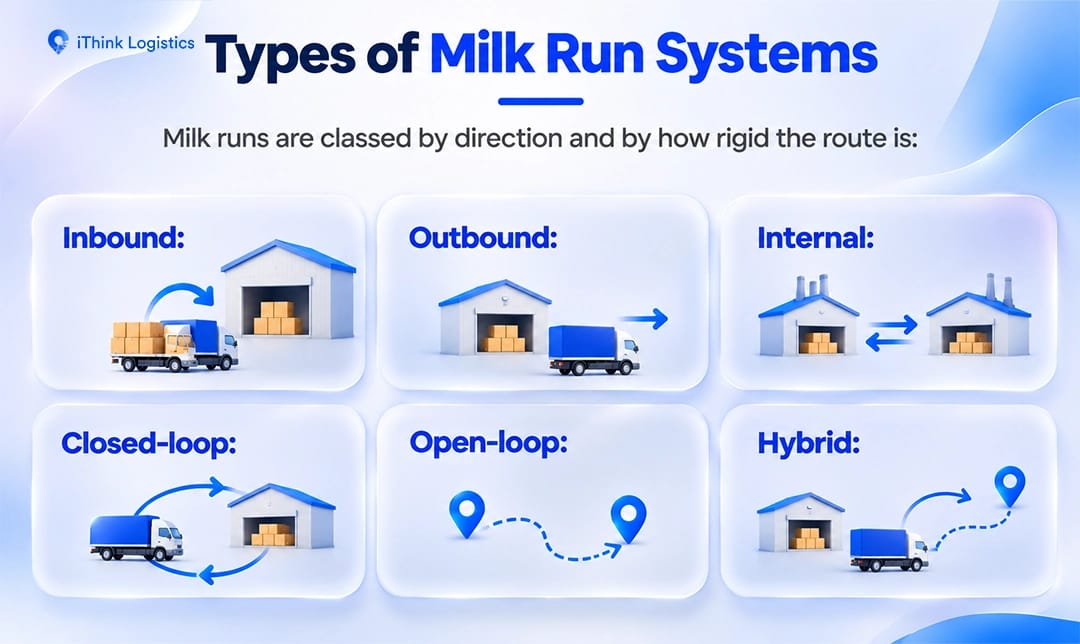
Milk runs are classed by direction and by how rigid the route is:
- Inbound: one vehicle collects from several suppliers for one plant or warehouse.
- Outbound: one vehicle serves several stores, dealers or customers from one hub.
- Internal: a cart or tugger train restocks workstations on a loop inside a factory.
- Closed-loop: fixed stops and timings, efficient but rigid.
- Open-loop: stops change with demand, flexible but harder to plan.
- Hybrid: a closed loop where planners can add or drop some stops.
Some networks add cross-docking: goods are unloaded and sorted at a hub with little storage time. That raises a practical question: why not send a truck to each stop?
Milk Run vs Traditional Point-to-Point Delivery
Milk run logistics joins many stops into one route, while point-to-point delivery gives every stop its own trip. The table adds full truckload (FTL) and less-than-truckload (LTL) shipping, because buyers often weigh all three:
| Parameter | Milk run | Point-to-point (FTL) | LTL |
|---|---|---|---|
| Number of trips | One trip serves several stops | One dedicated trip for each origin and destination pair | Separate pickups feed shared carrier terminals |
| Route | Fixed multi-stop loop on a set schedule | Direct route from one origin to one destination | Set by the carrier’s network, not by the shipper |
| Vehicle utilisation | Several partial loads fill one vehicle | High only when one shipper fills the whole truck | Space is shared with other shippers’ freight |
| Cost | Trip cost is shared across the stops on the route | One shipper pays for the full truck | Shipper pays for the space and weight used |
| Best suited for | Clustered stops with small, regular volumes | Large loads moving between two points | Irregular, small shipments to scattered locations |
| Inventory impact | Frequent small deliveries support lean stock | Large, infrequent deliveries tend to need more stock on hand | Variable transit times can call for buffer stock |
A quick test: if your stops sit close together and need small, regular volumes, price a milk run first. Supply chains built on frequent, small deliveries show where that test pays off.
Milk Run in the Supply Chain: Where It Fits
In a supply chain, a milk run is a scheduled cycle that moves stock in small, frequent batches. Plants and stores receive what they have used, not what they might need. That keeps inventory low without paying for many separate trips.
Suppose those five suppliers sit in one industrial estate, about 20 km from the plant. Five separate round trips cover about 200 km. A milk run covers the 40 km round trip plus roughly 10 km inside the estate.
On these illustrative distances, that is about 50 km with one truck instead of 200 km with five.
Milk run logistics appears wherever suppliers cluster, such as the auto-component belts around Pune and Chennai. Outbound runs restock stores and dealers, a pattern common in B2B shipping. Courier pickup rounds follow the same logic, with one rider or van collecting from many seller addresses.
Whatever the sector, the payoff comes from the same few advantages.
Advantages of Milk Run Logistics
Milk run logistics offers six advantages, each tied to how a shared route behaves:
- Lower transport cost: five stops share one vehicle’s fuel, driver time and wear.
- Better vehicle fill: small loads add up, so the truck runs less empty.
- Leaner inventory: small batches arrive often, so less safety stock sits on the floor.
- Fewer vehicles on the road: fewer trips cut congestion and fuel burn.
- Predictable timing: every stop knows its slot, so docks and labour can plan around it.
- Easier supplier coordination: one rhythm for all suppliers, and the same truck can bring back empties or returns.
None of this is free, though. A milk run asks more of your planning than a single dispatch does.
Challenges and When Milk Runs Don’t Work
Milk run logistics fails in predictable ways. Five limits decide whether it suits you:
- Accurate route planning: stop order, time windows and vehicle capacity interact, and a poor sequence erases the saving. Test it on paper first.
- Clustered stops: stops spread across a city or state add distance faster than load. Keep each stop within a short loop of the next.
- Cascading delays: a late pickup at stop two pushes back stops three to five. Build in slack and plan for a skipped stop.
- Steady volumes and shared costs: a truck running half empty on a fixed loop loses the benefit. If shippers share a route, agree cost-sharing in writing first.
- Very large single loads: when one shipper fills a whole truck for one destination, a full truckload (FTL) is simpler.
If those limits do not rule you out, the next job is setting the run up properly.
How to Implement Milk Run Logistics Effectively
Five steps help milk run logistics hold its savings:
- Cluster stops by pin code or area. Close stops keep the loop short.
- Fix routes and time windows. Agree a slot with every stop before the first run.
- Size the vehicle to the combined load. Add up every stop’s volume, then allow a small buffer.
- Track every run. GPS and stop-level updates show which stop is slipping. A proof of delivery (POD) at each stop closes the loop.
- Review the run regularly. Compare planned and actual timings, then adjust the stops.
Once milk run logistics is planned, the freight still needs booking, pickup and tracking.
Moving Bulk Freight with iThink Logistics
A milk run solves the route. Booking the freight, getting it collected and tracking it still needs a system.
iThink Logistics built its bulk shipping solution for businesses that move goods in tons, not parcels. You can book, manage and track bulk shipments from one interface, with a network of logistics partners behind it. It is built around simple booking, faster supplier pickup and shorter lead times.
If your freight starts at several pickup points, share the locations and weekly volumes with the iThink team. They can tell you how bulk shipping fits your pickup setup.
FAQs
What is milk run logistics in simple terms?
Milk run logistics means one vehicle covers several stops on a fixed route instead of a separate truck for each. The vehicle collects or delivers on a repeating schedule, so trips drop and supply stays regular. It works best when stops sit close together.
What does milk run mean in logistics?
In logistics, a milk run is a repeating, fixed route that serves several pickup or delivery points. The term comes from milkmen, who delivered full bottles and collected empties on one round. Today it describes any consolidated multi-stop run, from supplier collection to store restocking.
What is the difference between a milk run and point-to-point delivery?
A milk run serves many stops on one route, while point-to-point delivery sends one trip between two places. Milk runs suit clustered stops with small, regular volumes. Point-to-point works better for large single loads and urgent shipments, where waiting for a loop costs more.
What are the main advantages of milk run logistics?
The main advantages of milk run logistics are lower transport cost, fuller vehicles and leaner inventory. Fewer trips also mean less congestion and lower fuel use on the road. Fixed schedules make arrivals predictable, and regular visits make coordination with suppliers easier.
Where is the milk run system used in the supply chain?
Milk runs are used for inbound collection, outbound distribution and movement inside plants and warehouses. Inbound runs gather parts from nearby suppliers for one plant. Outbound runs restock stores or dealers, and internal runs feed workstations on a fixed loop.
Is milk run the same as just-in-time (JIT) delivery?
No, a milk run is not the same as just-in-time (JIT) delivery. JIT is an inventory approach that brings materials only when needed. A milk run is the transport method that makes frequent, small deliveries practical, so the two often work together.
Can you give an example of a milk run in logistics?
A warehouse truck that restocks three retail stores on one loop is a simple example. It drops goods at each store in turn and collects empty crates on the way back. Without a milk run, each store would need its own delivery trip.
Can ecommerce sellers in India use milk run logistics?
Yes, though many sellers use it indirectly. A courier pickup round collects from many seller addresses in one trip, which follows the same logic. Sellers with several stock points can also cluster pickups by pin code to cut trips and keep pickup times predictable.
Author