


Introduction
You ship goods to a store. Either they buy and own them from day one, or they just hold and try to sell them, paying you only for what actually moves. The first is a sale. The second is consignment.
The difference between Consignment and sale is about three things: who owns the goods, who takes the risk, and when you get paid. Get this wrong, and you’ll end up with dead stock or chasing money that was never yours.
Let’s break down how both work and which one actually fits your business.
What Is the Meaning of Consignment? Definition Explained
Consignment is a commercial arrangement where the owner of goods, called the consignor, sends those goods to an agent, called the consignee, to sell on their behalf. Ownership stays with the consignor until the goods are sold to the end customer.
In Simple terms, Consignment means you (the owner) send goods to someone else to sell for you. You keep ownership until the goods are sold to the final customer.
It’s a trust setup. You hand over the goods, but not ownership. The agent just holds and sells them, earning a commission only when something sells.
They never own the goods. That one fact changes everything. The consignor generally bears the loss because ownership remains with them, unless the consignee is negligent or the agreement provides otherwise.
That’s why consignment is common when you’re entering new retail markets. Retailers who won’t buy unknown stock up front will still put it on their shelves if the risk is zero.
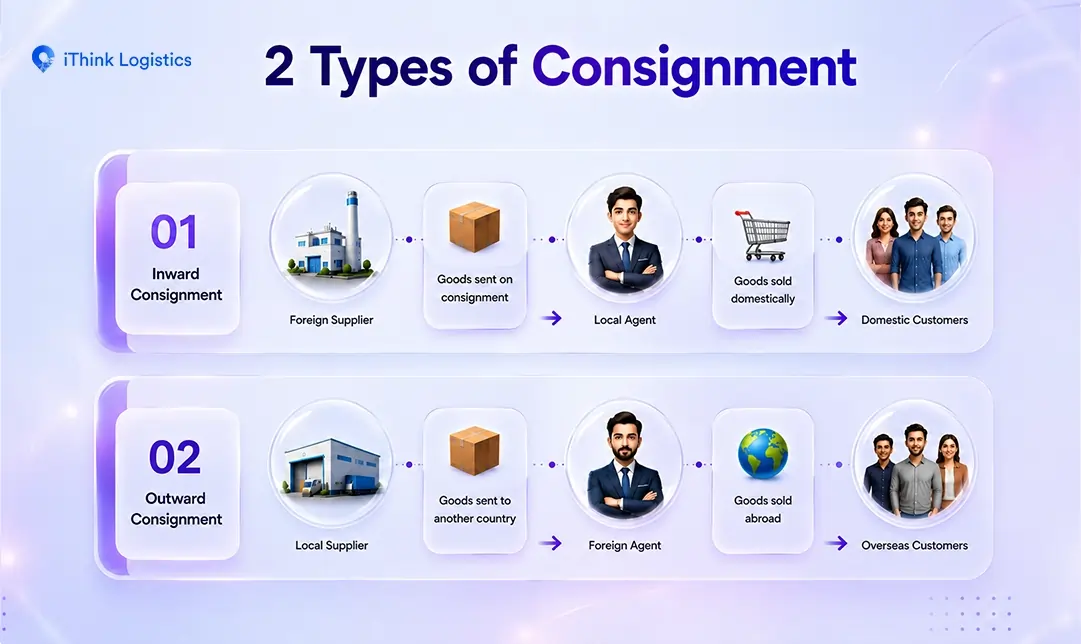
There are 2 types of consignment:
- Outward consignment is when a consignor sends goods to an agent in another country for international sale.
- Inward consignment is when a local agent receives goods from a foreign supplier to sell domestically.
Still not clear how this is different from a regular sale? Read on for a quick definition and a side-by-side comparison.
What Is a Sale? Definition and Meaning Explained
A sale is a transaction in which the seller transfers ownership of goods to the buyer immediately in exchange for an agreed-upon price. Once the transaction closes, the buyer owns the goods in full and bears all risk from that point forward.
In a simple way, A sale is simple. You transfer ownership to the buyer as soon as the deal is done. They own the goods and take all the risk from that moment.
No agent, no commission, no returns for unsold stock. You get paid, the buyer gets the goods, and that’s it.
This is the big split. In a sale, everything is final at the time of the transaction. In consignment, it’s only final when the end customer buys.
The gap between when goods move and when ownership moves is what every difference in this guide comes back to.
Consignment vs Sale: Key Differences, Quick Comparison and Detailed Breakdown
Both models move goods from you to someone else. But ownership, risk, and payment work differently. Here’s the full comparison.
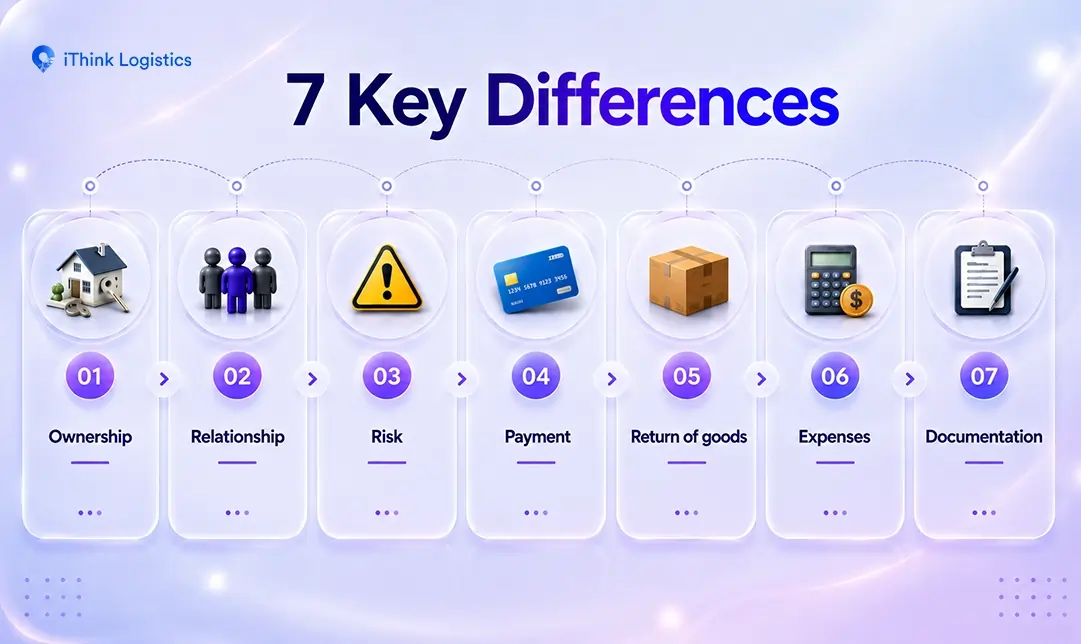
| Basis of Difference | Consignment | Sale |
| Ownership | Stays with the owner until sold to end customer | Passes to the buyer immediately |
| Relationship | Owner (Manufacturer/ Brand) and selling agent/ retailer/ store owner/ 3rd party | Buyer and seller (debtor-creditor) |
| Risk | The owner pays if goods are lost, damaged, or unsold | Buyer takes on all risk after delivery |
| Payment | After goods are sold, minus commission | At purchase or on agreed credit terms |
| Return of goods | Unsold stock returned to owner as standard | No return unless seller agrees upfront |
| Expenses | Owner covers all costs | Buyer covers all costs after delivery |
| Documentation | Delivery challan, account sales statement, and other consignment-related documents | Tax invoice and sale-related documents |
| Commission | Consignee earns commission (ordinary or del credere) | No commission — buyer earns profit margin |
| Unsold Stock Valuation | Valued at cost + proportionate expenses (in consignor’s books) | N/A — buyer owns stock |
| Nature of Transaction | Not a sale until end customer buys | Complete and final at the point of transaction |
| Applicable Law | Agency principles under Indian Contract Act, 1872 (Sec. 182) | Sale of Goods Act, 1930 |
| Accounting Treatment | Goods remain in consignor’s books as inventory until sold | Goods removed from seller’s books on sale |
Each row is a real legal and financial difference. Here’s what it means for your business.
Ownership of Goods
This is where the consignment and sale split. In consignment, you keep legal ownership even while your goods sit in someone else’s store. Ownership only passes to the end customer when they buy.
In a sale, ownership moves the moment the deal closes. The buyer owns the goods from day one. Any loss or damage after delivery is their problem, not yours.
Relationship Between the Parties
In consignment, you call the shots. The agent sells on your instructions, not as a buyer. You decide, and the agent acts accordingly.
A sale is direct: buyer and seller, no middleman. Once payment is made and goods are delivered, you’re done. If it’s a credit sale, you wait for payment, but otherwise, there are no strings attached.
Transfer of Risk
In consignment, you hold all the risk. If goods get damaged, stolen, or don’t sell after 60 days, it’s your problem.
Even if the agent takes care and something still goes wrong, you take the loss unless your contract says otherwise. The agent is only required to take reasonable care, not guarantee outcomes.
In a sale, risk moves at delivery. If a retailer buys 500 units and 200 don’t sell, that’s their loss.
Payment, Consideration, and Settlement Terms
In a sale, you get paid upfront or on credit. What happens to the goods after delivery doesn’t affect your payment.
In consignment, you get paid only after the item sells to the end customer. The agent deducts their commission and expenses, then sends you the rest. Depending on how fast things move, this can take 30 to 90 days (depends on owner and store agreement).
Return of Unsold Goods
Under consignment, unsold stock automatically comes back to you. No negotiation needed as the agent never owned it.
In a sale, the buyer owns the goods from day one. Returns only happen if you agreed to them upfront, the goods are defective, or your return policy allows them.
Expenses and Charges
In a consignment arrangement, the owner covers transportation, insurance, loading, and storage costs. These are either paid directly or reimbursed to the agent through the account sales settlement.
In a sale, the buyer pays all costs after delivery. Storage, insurance, and distribution are their responsibility once they have the goods.
Documentation Required
Consignment uses two documents. You send a pro forma invoice showing quantity and estimated value.
After the sale, the agent sends you an account sales statement showing sales, expenses, commission, and the net amount due.
A sale just needs one document: a standard tax invoice at the time of the transaction.
Key Features of Consignment and Sale
Know the key features before you sign any agreement. It’s the only way to be sure which model you’re in.
Key features of consignment:
- Consignor retains ownership until goods reach the end customer.
- Consignee acts as an agent, not a buyer.
- The retailer earns a commission, not profit, on the goods.
- You pay all costs, take all the risk, and absorb any losses on unsold stock.
- Unsold goods come back to you as standard.
Key features of a sale:
- Ownership moves to the buyer as soon as the deal is done.
- Buyer bears all risk and expenses after delivery.
- The seller earns direct profit from the transaction.
- Goods cannot be returned unless the seller agrees up front.
On paper, both look similar. The real differences show up when things go wrong.
Stock doesn’t sell, goods get damaged, or payment is late. The next section breaks down what happens in each case.
Important Terms in Consignment: Consignor, Consignee, and Del Credere Commission
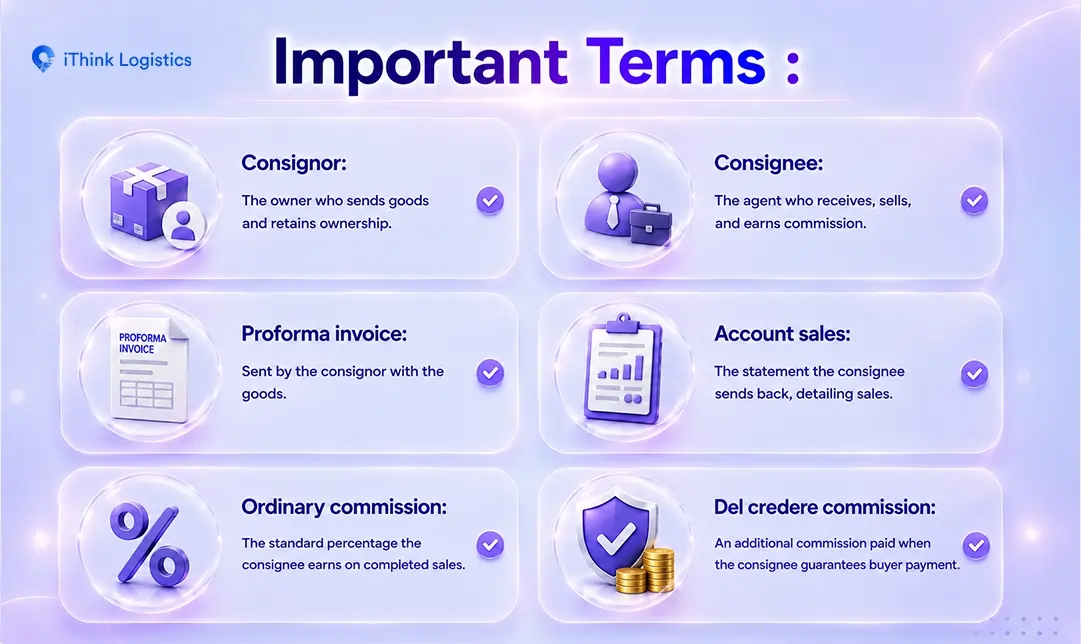
These terms appear in every consignment contract. Knowing them prevents costly misreads.
Consignor: The owner who sends goods and retains legal ownership throughout the consignment period.
Consignee: The agent or store that receives, displays, and sells your goods. They never own the goods. They only earn commission on what they sell.
Proforma invoice: You send this when goods are dispatched. It shows quantity and estimated value. It’s not a payment demand as no money is owed yet.
Account sales: The agent sends this after selling. It lists gross sales, expenses, commission, and the net amount you get.
Ordinary commission: The standard cut the agent earns on each sale.
Del credere commission: Extra commission you pay the agent if they guarantee payment from the end customer. If the customer doesn’t pay, the agent covers the loss. You get protection from bad debt, but pay a higher commission.
This is more common in wholesale and B2B consignment arrangements where buyers purchase on credit terms, not in standard retail.
When Should a Business Choose Consignment Over an Outright Sale?
Choosing between consignment and sale depends on your market position, cash flow, and the level of inventory risk you can handle. Here’s a practical way to decide.
| Choose consignment when | Choose a direct sale when |
| You’re entering a new market and buyers are hesitant to commit | Demand is established and buyers can commit upfront |
| You want to test a new product without forcing inventory risk on a retailer | You need immediate cash flow |
| Your buyer lacks working capital to purchase stock upfront | You want a clean, final transaction with no returns |
| You’re expanding through local agents in distant or unfamiliar markets | The buyer has capacity to manage their own stock |
2 real scenarios where the choice plays out:
Scenario 1: You’re a new skincare brand entering modern trade. Most retailers won’t buy unknown SKUs upfront as they don’t want the risk. But, going with Consignment gets your products on shelves without asking the retailer to take a chance, since they don’t have to pay. You carry the inventory risk, but you get market access.
Scenario 2: You’re an established apparel brand selling to a retail chain. Demand is proven, the buyer has cash, and both sides want a clean deal. Direct sale is better. You get paid faster and don’t worry about unsold stock at the retailer’s end.
For D2C brands, reliable multi-courier shipping keeps both models running smoothly. iThink Logistics connects you to 25+ courier partners so your consignments and direct orders move on time.
Conclusion: How to Distinguish Between Consignment and Sale for Your Business
The core difference is ownership. In a sale, it moves to the buyer the moment the deal closes. In consignment, it stays with you until the end customer buys.
Before you sign any supply or distribution agreement, know which model you’re in. That single fact determines your risk, your payment timeline, and your rights over unsold stock.
Choose consignment when you need market reach without asking buyers to carry your inventory. Choose a direct sale when you need cash now, and your buyer is ready to commit.
FAQs
Q.1: Is Consignment the Same as a Sale?
A: No. In consignment, the owner retains ownership and the agent earns commission on what they sell. In a sale, ownership transfers immediately to the buyer at the point of transaction. They are distinct legal and commercial arrangements with different risk, payment, and return structures.
Q.2: Who Bears the Risk in a Consignment Arrangement?
A: The owner bears all risk throughout the consignment period. Damage in transit, theft from the agent’s premises, or stock that fails to sell all fall on the owner. The agent is only required to take reasonable care of the goods.
Q.3: What Is the Relationship Between Consignor and Consignee?
A: The relationship between consignor and consignee is that of a principal and agent. The consignor is the principal who owns the goods and sets the terms. The consignee is the agent who sells on their behalf and earns a commission on completed sales only.
Q.4: Can Consigned Goods Be Returned to the Consignor?
A: Yes. Since the consignee never owned the goods, returning unsold stock is a standard part of every consignment arrangement. No special agreement is needed. In a completed sale, the buyer cannot return goods without prior written agreement from the seller.
Q.5: What Is the Difference Between Consignment and Joint Venture?
A: Consignment is a principal-agent arrangement where one party sells goods on behalf of another for commission. A joint venture is a partnership where 2 or more parties pool resources, share ownership, and split both profits and losses on a specific project. Ownership and risk work differently in each.
Q.6: What Does 60/40 Consignment Mean?
A: In a 60/40 consignment arrangement, the sale proceeds are split between the consignor and the consignee. The consignor receives 60%, and the consignee keeps 40% as their commission. The exact split depends on what both parties agree upfront; like 60/40, 70/30, and 80/20 are all common depending on the product category and how much selling effort the agent puts in.
Q.7: What Is the Difference Between Consignment and Ordinary Sale?
A: In an ordinary sale, ownership transfers to the buyer immediately when the transaction is complete. In consignment, ownership stays with the original owner and only transfers when the end customer buys from the agent. The term “ordinary sale” is used in commerce textbooks specifically to contrast with consignment; the word “ordinary” just means a standard direct sale, not a special arrangement.
Q.8: Which law governs consignment and sale in India?
A: Consignment is based on agency principles under the Indian Contract Act, 1872. Section 182 defines an agent as a person who acts on behalf of another person (the principal), which reflects the relationship between a consignee and consignor. A sale, on the other hand, is governed by the Sale of Goods Act, 1930, which regulates the transfer of ownership, risk, and the rights and obligations of buyers and sellers.
Q.9: Is GST applicable on consignment transactions in India?
A: GST implications can arise in consignment transactions depending on the nature of the principal-agent relationship. Under Schedule I of the CGST Act, 2017, certain transactions between a principal and an agent may be treated as a supply even when made without consideration. This includes situations where an agent undertakes to supply goods on behalf of the principal or receives goods on the principal’s behalf. Businesses operating on a consignment model should evaluate the applicable GST provisions before dispatching goods or determining tax liability.
Q.10: Is an e-way bill required when goods are sent on consignment?
A: An e-way bill is generally required for the movement of goods when the consignment value exceeds ₹50,000, subject to applicable GST rules and exemptions. Businesses operating on a consignment model should verify the applicable e-way bill requirements before transporting goods.
Sources:
- Sale of Goods Act, 1930
- CBIC Circular No. 57/31/2018-GST (Principal-Agent Transactions)
- GST Council E-Way Bill Recommendations (March 2018)



Leave a Reply