


Air transport accounts for 35% of global trade by value. That sounds impressive until you realize it accounts for less than 1% of the total freight volume. The math tells you everything: air transport is fast, secure, and expensive, built for shipments where time matters more than cost.
For businesses deciding between air, sea, and road, the choice is rarely obvious. This guide breaks down the real advantages and disadvantages of air transport so you can make that call with confidence.
What Is Air Transport?
Air transport is the movement of people and goods using aircraft. This includes commercial passenger planes, dedicated cargo aircraft, and helicopters. It operates through a global network of airports and air corridors that connect virtually every country.
In India, major air cargo hubs in Mumbai, Delhi, Bengaluru, Chennai, and Hyderabad handle domestic courier shipments and international freight. For sellers, this typically means either domestic air express or international air freight.
Advantages of Air Transport
The advantages of airways and air freight go beyond just speed. Here are the five that matter most for businesses and sellers.
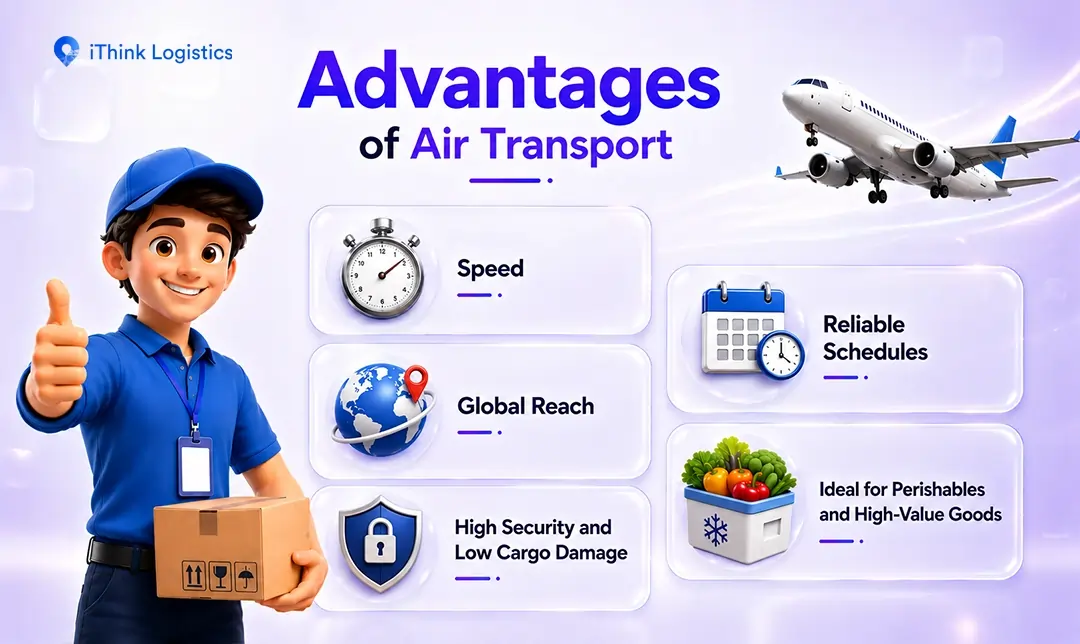
1. Speed
Air is the fastest way to move goods over long distances. International shipments arrive in 1 to 3 days by air, compared to 2 to 6 weeks by sea.
On domestic routes in India, air express cuts transit from 3 to 5 days by surface down to next-day or two-day delivery across most major cities. When a shipment is time-sensitive, no other mode comes close.
2. Global Reach
Aircraft cross oceans, mountains, and remote terrain that road transport cannot handle. Air transport connects virtually every country in the world through an extensive global network of airports and air routes.
For Indian sellers shipping internationally, this opens markets that surface or sea routes make impractical.
3. High Security and Low Cargo Damage
Airports run strict screening and limit cargo access. Air freight typically involves fewer handling points and shorter transit times, which can help reduce the risk of damage and cargo loss.
4. Reliable Schedules
One of the core advantages of air travel is schedule reliability. Airlines operate on fixed departure windows, and even when a flight is missed, the next departure is usually a few hours away.
This predictability matters for businesses running lean inventory. You can plan restocking without large buffers for transit uncertainty.
5. Ideal for Perishables and High-Value Goods
Fresh produce, flowers, pharmaceuticals, and temperature-sensitive products need to move fast. Air gets them to the destination before quality degrades. For high-value products, the faster transit also means lower inventory holding costs. Less stock sits idle in the supply chain.
Speed is the strongest card here. But that advantage comes with real trade-offs on the other side.
Disadvantages of Air Transport
Every mode of transport has limits. The disadvantages of airways are consistent across cargo types and worth understanding before you commit.
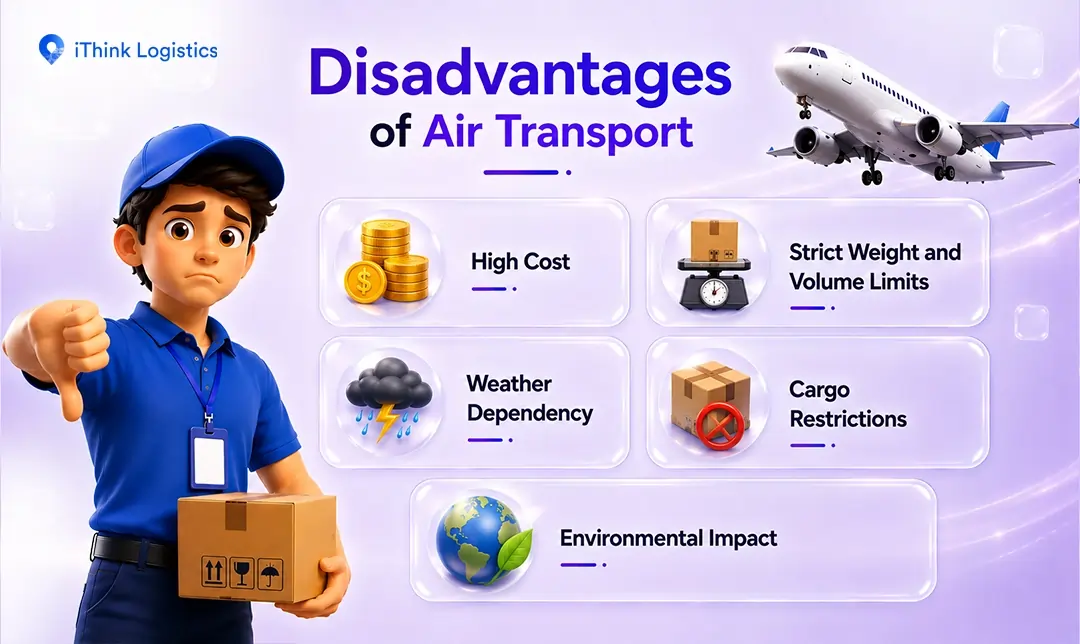
1. High Cost
Air freight is significantly more expensive than ocean freight, making it best suited for urgent or high-value shipments.
For domestic air express in India, the premium over surface courier runs 2 to 3 times higher for similar weights. Low-margin products, heavy goods, and bulk shipments rarely justify it.
2. Strict Weight and Volume Limits
Aircraft hold a fixed amount of cargo by weight and dimension. Oversized items, heavy machinery, and large quantities of raw materials cannot be moved economically by air. Air freight is generally most cost-effective for lighter, higher-value shipments.
3. Weather Dependency
Fog, storms, and severe weather can ground entire fleets. Disruptions at major airport hubs can affect flight schedules and connected routes across wider airline networks.
Air networks are more vulnerable to cascading failures than road or sea when conditions hit a single hub.
4. Cargo Restrictions
This catches many sellers off guard. The IATA Dangerous Goods Regulations ban or heavily restrict a long list of goods from being flown. Lithium batteries shipped separately, aerosols, flammable liquids, certain chemicals, and petroleum-based products face strict limits or outright bans.
Sellers in beauty, personal care, and electronics regularly hit these restrictions. Always verify compliance with the IATA DGR before booking air freight for a new product category.
5. Environmental Impact
Aircraft burn significant fuel and release CO₂ at high altitudes, where their warming effect is greater than the same emissions at ground level. According to the International Energy Agency (IEA), aviation accounts for around 2.5% of global energy-related CO₂ emissions.
For businesses with sustainability commitments or ESG reporting requirements, aviation’s carbon footprint is a real operational consideration. Understanding these limits helps you choose at the right moment, not by default. A quick side-by-side comparison makes that decision easier.
Air Transport vs Road vs Sea: At a Glance
No mode of transport wins across every situation. The table below shows where each one fits.
| Factor | Air | Sea | Road |
| Speed | 1 to 3 days | 2 to 6 weeks | 3 to 10 days |
| Cost | Highest | Lowest | Moderate |
| Cargo capacity | Limited | Massive | Moderate |
| Weather risk | High | Moderate | Low |
| Best for | Urgent, high-value, low-weight | Bulk, non-urgent | Regional, domestic |
| Environmental impact | Highest | High | Moderate |
For most Indian ecommerce sellers, the choice comes down to air versus surface for domestic shipments, and air versus sea for international shipments. The table makes the trade-offs clear at a glance.
Conclusion
The importance of air transport becomes clear when speed and security matter more than cost. It works best for time-sensitive shipments, high-value products, and routes where no practical ground or sea alternative exists.
For bulk goods, low-margin products, or restricted categories, other modes make more financial sense.For Indian ecommerce brands shipping internationally, the right freight partner matters as much as the right shipping mode.
iThink Logistics offers shipping across 180+ countries, built for D2C sellers who need reliable cross-border delivery.
FAQ
These are the questions sellers and students ask most.
Q.1: What are the advantages of air transport?
A: Speed, global reach, schedule reliability, high cargo security, and suitability for perishable and high-value goods. It is the fastest mode of freight movement over long distances, making it the right choice when delivery timelines are non-negotiable.
Q.2: What are the disadvantages of air transport?
A: High cost, strict weight and volume limits, weather-related disruptions, cargo restrictions on hazardous goods, and a significant environmental footprint. It also depends on ground transport at both ends, which adds time and cost to the total door-to-door journey.
Q.3: What is the main disadvantage of an air journey?
A: Cost is the primary disadvantage. Air freight is considerably more expensive per kilogram than ocean freight. Cargo restrictions are a close second. Goods like lithium batteries, aerosols, and flammable liquids face IATA bans or heavy restrictions, creating compliance challenges for sellers in electronics, beauty, and personal care.






Leave a Reply