Introduction
You found a product that sells. Customers want it, margins look good, and orders are picking up. But then your supplier delivers late. The next batch has quality issues. Suddenly, your bestseller has 3-star reviews and a stockout warning.
That’s a sourcing problem.
Sourcing means finding and picking the right suppliers. When you get it right, your costs, quality, and delivery timelines work in your favor. Get it wrong, and the rest of your business pays the price.
Here’s what sourcing really means, the main types, how the process works, how it’s different from procurement, and what it looks like for Indian ecommerce sellers.
What Is Sourcing?
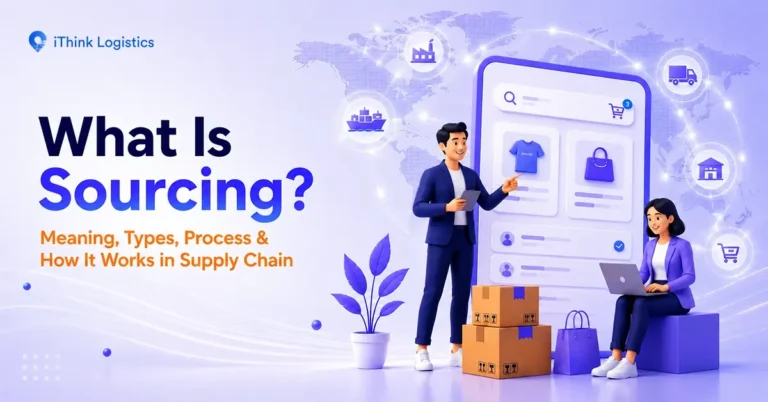
Sourcing is the process of identifying, evaluating, and selecting suppliers to provide the goods and services a business needs to operate. It serves as the foundational phase of supply chain management (SCM), occurring before any purchasing.
That’s the sourcing meaning at its simplest. But in practice, it covers a lot of ground.
Day to day, sourcing involves researching the market for potential suppliers, comparing their capabilities and pricing, negotiating contract terms, and checking whether they can consistently meet your quality standards.
It is the groundwork that decides who you buy from, at what price, and under what conditions.
The term applies to two main contexts. In business and supply chain management, sourcing means finding vendors for products, raw materials, or services.
In HR and recruitment, it means proactively finding job candidates for open roles. Both share the same core idea: identifying the best resource before committing.
This guide focuses on business sourcing, specifically for sellers and business owners who source products to sell or materials to manufacture.
Before going further, one confusion needs to be cleared up. Sourcing and procurement are not the same thing.
Sourcing vs Procurement: What’s the Difference?
These two terms get used interchangeably, but they refer to different stages of the supply chain.
Sourcing is the “who.” It is the research and strategy phase where you find and evaluate vendors and negotiate terms. Procurement is the “what.”
It is the transactional phase where you place orders, receive goods, process invoices, and make payments. Sourcing decides where to buy from. Procurement handles the actual buying.
Here’s how they compare:
| Factor | Sourcing | Procurement |
| Focus | Finding and selecting suppliers | Buying goods and services |
| Timing | Before purchase | During and after purchase |
| Activities | Market research, supplier evaluation, contract negotiation | Purchase orders, invoicing, delivery, payment |
| Goal | Build a reliable supplier network | Acquire goods at the right price and time |
| Scope | Strategic and research-driven | Transactional and operational |
Once you understand that sourcing is the selection phase, the next question is, what types of sourcing can a business use?
6 Types of Sourcing
Businesses choose their sourcing approach based on what they sell, where their suppliers are, and how much control they need over quality and cost.
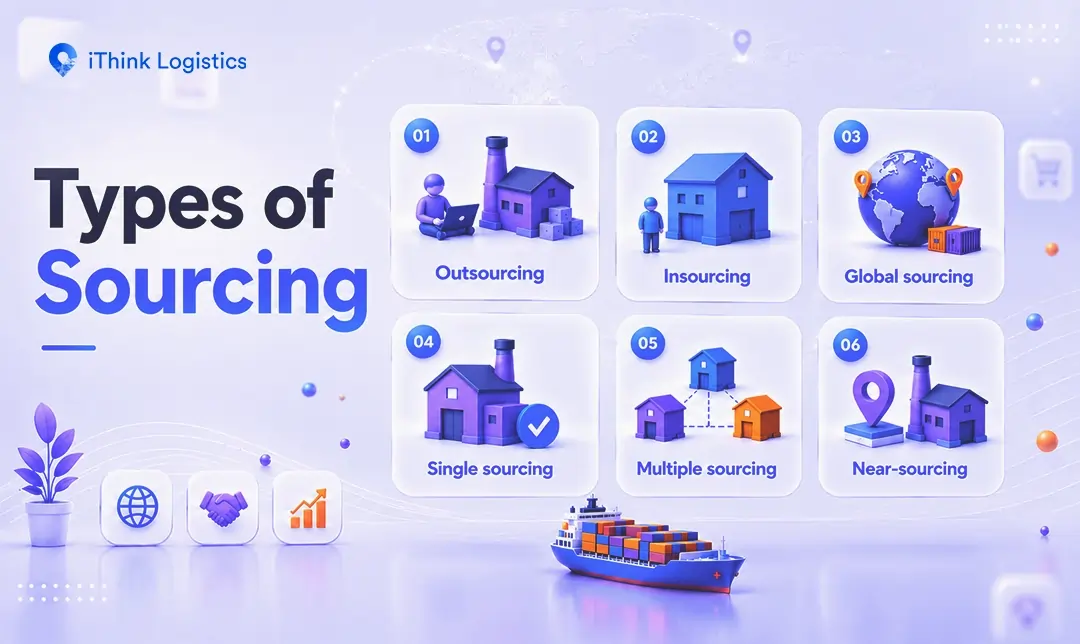
Here are the six most common types of sourcing in supply chain management.
1. Outsourcing
Hiring a third party to handle tasks your business doesn’t do in-house. For online sellers, this often means outsourcing manufacturing while you focus on branding, marketing, and sales.
It frees up time but gives you less direct control over production quality.
2. Insourcing
Handling production or operations internally instead of hiring an external vendor.
If a clothing brand buys its own screen printing equipment instead of paying a vendor, that’s insourcing. You control quality and output, but you’ll need to invest more upfront in equipment and staff.
3. Global sourcing
Buying products or raw materials from other countries to get better prices or expertise. Material sourcing from overseas is common among Indian D2C brands, whether it’s electronics from Shenzhen or fabrics from Bangladesh.
The catch: longer lead times, customs paperwork, and currency fluctuation risks.
4. Single sourcing
Relying on one supplier for a product or material. You build a strong relationship, simplify operations, and often get better pricing for your loyalty.
The risk is obvious: if that one supplier fails, your entire supply chain grinds to a halt.
5. Multiple sourcing
Working with several suppliers for the same product or material. This spreads your risk and gives you more leverage, as no single supplier can call the shots.
The downside: more coordination, more quality checks, and more relationships to manage.
6. Near-sourcing
Sourcing from suppliers in your region or nearby. You cut transport costs, get faster deliveries, and can actually visit the factory if needed.
For an Indian seller based in Mumbai, sourcing garments from Surat rather than importing from China is a near-sourcing option.
Most businesses don’t pick one model. A D2C skincare brand might source ingredients globally, have printing and labeling done by a local vendor, and outsource manufacturing to a contract facility.
The right mix depends on your product, margins, and how much risk you can absorb.
Knowing the types helps you pick a model. But the actual sourcing work follows a structured process.
The Sourcing Process: 7 Key Steps
Whether you’re sourcing for the first time or switching suppliers, the steps are the same.
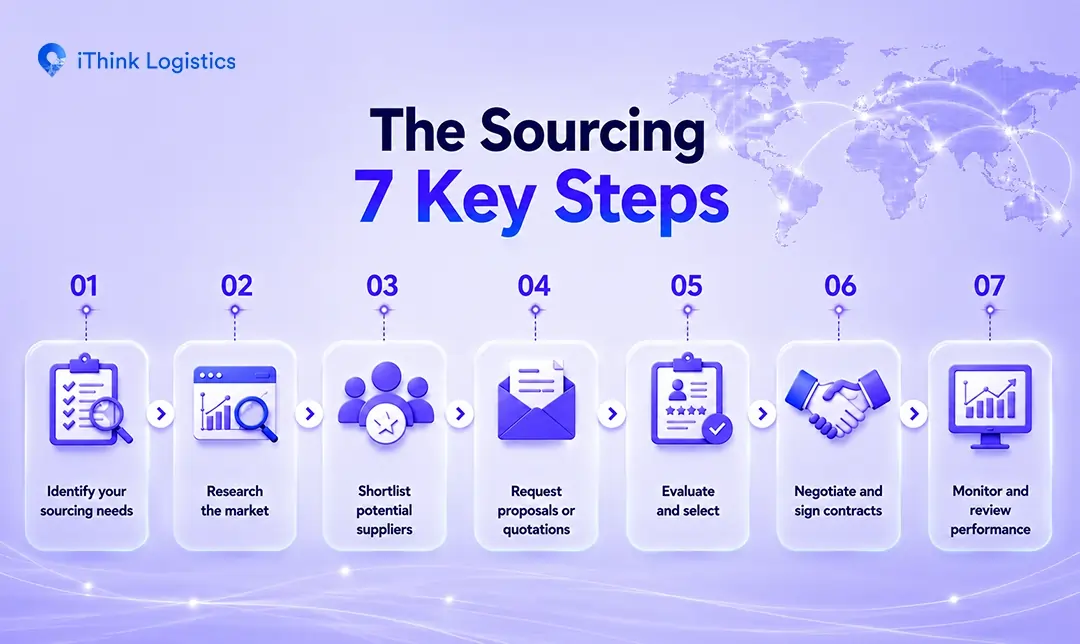
1. Identify your sourcing needs
List exactly what you need, like products, materials, quantities, quality standards, and lead times. This sets the scope for everything else.
2. Research the market
Find suppliers who fit your needs. For product sourcing, this means checking IndiaMART or Alibaba, talking to industry contacts, visiting trade shows like the Canton Fair, or searching manufacturer directories.
3. Shortlist potential suppliers
Filter by capacity, price, location, reputation, and minimum order size. Always ask for samples before you commit.
4. Request proposals or quotations
Send RFQs (Request for Quotation) or RFPs (Request for Proposal) to your shortlisted suppliers. This way, you compare everyone on the same terms.
5. Evaluate and select
Compare proposals for price, quality, delivery, payment terms, and reliability. Cheapest isn’t always best. Pick the supplier who gives you the most value overall.
6. Negotiate and sign contracts
Lock in pricing, minimum order quantities, delivery schedules, payment terms, quality benchmarks, and penalties for non-compliance. Get everything in writing before your first order.
7. Monitor and review performance
Track delivery, quality, and your supplier’s responsiveness. Review regularly. If a supplier keeps missing the mark, start looking for a backup before you’re in urgent need of a material or product.
Good sourcing is not a one-time exercise. It means continuously evaluating your suppliers and the market, especially as your order volumes grow and your quality standards tighten.
That’s the process for tactical, day-to-day sourcing. Strategic sourcing takes it a level deeper.
What Is Strategic Sourcing?
Strategic sourcing is a long-term, data-driven approach to supplier selection that looks beyond the lowest price.
Instead of picking the supplier with the cheapest quote, this approach evaluates total value: can this supplier deliver consistently as your business scales from 100 orders a month to 10,000? Will they hold quality, meet deadlines, and adjust pricing as your volumes grow?
That’s the difference from tactical sourcing. Tactical is short-term. You need raw materials this month, so you need to find the fastest available option.
Strategic sourcing is the opposite. You evaluate the full market, test multiple vendors, lock in long-term contracts, and regularly review performance.
For e-commerce sellers, this shift usually happens once your first supplier relationship is stable and you start thinking about growth, backup options, and better terms.
Strategy is one part of good sourcing. But where you source from also carries responsibilities around ethics and sustainability.
Responsible and Ethical Sourcing
Where you source from says as much about your brand as what you sell.
Responsible sourcing means choosing suppliers who follow fair labor practices, maintain environmentally sustainable production, and conduct business transparently.
It is not just a corporate buzzword. Customers, marketplace platforms, and regulators are all paying closer attention to how products are made.
For Indian e-commerce sellers, this is becoming harder to ignore. Platforms like Amazon and Flipkart have compliance and quality documentation requirements for sellers.
D2C brands that can trace their supply chain and prove ethical sourcing practices have an edge in customer trust, especially in categories like food, personal care, and apparel.
A related concept worth knowing is impact sourcing. This involves intentionally employing people from underserved or disadvantaged communities as part of your supply chain operations.
It is more common in BPO and services, but the principle applies wherever sourcing includes hiring decisions.
Ethics aside, sourcing also has very practical challenges every business faces.
Top 5 Common Sourcing Challenges
Even with the right vendor in place, sourcing comes with its own set of problems.
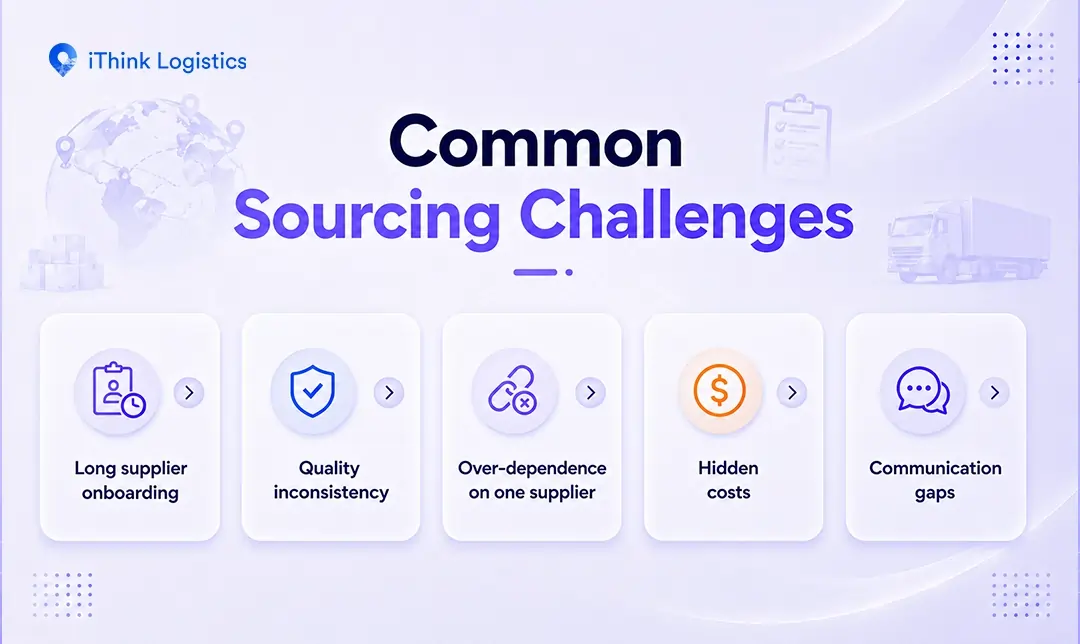
1. Long supplier onboarding
Vetting, sampling, negotiations, and approvals can stretch across weeks or months before your first order ships. For a business owner launching a new product, this delay can mean missing an entire sales season.
2. Quality inconsistency
A vendor sends perfect samples, then drops standards on bulk orders. The risk increases when your vendor is overseas, and you cannot inspect production in person.
3. Over-dependence on one supplier
If your only supplier faces a production halt, floods, a factory shutdown, or a raw material shortage, your entire business stops with them.
4. Hidden costs
The quoted price per unit rarely tells the full story. Customs duties, shipping charges, packaging, defect replacements, and minimum order quantity (MOQ) requirements can significantly increase your actual landed cost, sometimes by 15-30% over the original quote, depending on the product category and country of origin.
5. Communication gaps
Timezone differences, language barriers, and slow response times create delays that ripple through your restocking schedule. One missed email from a supplier can push your next shipment back by a week.
These challenges are exactly why sourcing matters more than most sellers realize. Here’s what good sourcing actually does for your business.
4 Benefits of Effective Sourcing
When sourcing is done right, it affects everything from your product margins to your customer reviews.
1. Lower costs
Strategic supplier selection and negotiation directly reduce your unit cost. Even a small improvement in sourcing terms compounds across hundreds or thousands of orders every month.
2. Better product quality
The right vendor delivers consistent output that matches your brand expectations. Fewer defects mean fewer returns, fewer refunds, and better ratings on your product listings.
3. Supply chain reliability
Strong supplier relationships mean predictable delivery schedules. You restock on time, avoid stockouts, and keep your listings active, rather than losing ranking to an “out of stock” tag.
4. Reduced risk
Working with multiple vetted suppliers means one disruption does not shut down your entire operation. If Supplier A faces a delay, Supplier B keeps your orders moving.
Competitive advantage
Better sourcing gives you better products at better prices. That shows up on your product page, in your reviews, and in your repeat purchase rate.
All of this matters most when you’re sourcing products to sell online. Here’s what that looks like in practice.
Sourcing for Ecommerce Sellers: What It Looks Like in Practice
Most sourcing guides are written for procurement teams at large companies. If you run an ecommerce business or a D2C brand, the reality looks different.
What does supplier sourcing mean for most Indian sellers? It starts with finding a manufacturer or supplier for the product they want to sell.
That could mean browsing IndiaMART for a private-label skincare manufacturer, visiting a trade fair in Delhi for textile suppliers, or negotiating directly with a factory in Surat for custom apparel.
Some sellers source finished goods from wholesalers on platforms like Alibaba. Others source raw materials and get them assembled by a contract manufacturer.
The model varies, but the sourcing fundamentals stay the same: find a reliable supplier, negotiate fair terms, and verify quality before committing.
What most guides miss is that sourcing does not end when you pick a supplier. Where your supplier is located, how they package products, and how quickly they can produce and dispatch directly affect your shipping costs and lead times.
A supplier in Jaipur shipping to a customer in Kochi has very different logistics math than a supplier based in the same city as your warehouse.
Once your products are sourced and ready to ship, logistics platforms like iThink Logistics help you compare courier rates, automate tracking, and manage delivery exceptions from a single dashboard.
Conclusion
Sourcing is one of those things that quietly shapes every part of your business. The product your customer holds, the price they paid, and whether it arrived on time all trace back to the supplier you chose.
How do you source your products? Found a reliable supplier or still figuring it out? Tell us in the comments.
If you’re an ecommerce seller looking to streamline shipping after sourcing, iThink Logistics helps you compare multi-carrier rates, automate tracking, and manage NDRs from a single dashboard.
Have more questions about sourcing? Here are the ones people ask about most.
FAQs
Q.1: How do I find reliable suppliers in India as a first-time seller?
A: Start with IndiaMART for domestic manufacturers and Alibaba for international ones. Attend trade shows like the India International Trade Fair (Delhi) or the Canton Fair (China) for face-to-face vetting. Always request product samples before placing a bulk order, and check the vendor’s GST registration, business age, and client references before signing anything.
Q.2: What legal or compliance checks should I do before finalizing a supplier?
A: Verify GST registration, business registration documents (like the Udyam certificate for MSMEs), and any category-specific licenses (FSSAI for food, BIS for electronics). If you sell on Amazon or Flipkart, check their seller compliance requirements as well, since both platforms can suspend listings that lack proper documentation.
Q.3: What negotiation tactics work best with Indian suppliers?
A: Get quotes from at least 3-4 vendors before negotiating. Use competing quotes as bargaining chips. Negotiate not just unit price but also payment terms (net-30 vs advance), MOQ flexibility, defect replacement policies, and delivery penalties. Longer commitments often unlock better rates, so offering a 6-month or 12-month volume projection can help.
Q.4: How do I handle supplier quality drops after the first few orders?
A: Set clear benchmarks in your contract: acceptable defect rates, material specifications, and packaging standards. Inspect a random sample from every bulk order before accepting it. If a vendor consistently misses benchmarks after 2-3 orders, start sourcing a backup before you’re stuck.
Q.5: Are there sourcing platforms beyond IndiaMART and Alibaba for Indian sellers?
A: Yes. TradeIndia and ExportersIndia are domestic alternatives. For global sourcing, Global Sources and Made-in-China are widely used. For niche categories, industry-specific directories and local manufacturer associations often feature vendor listings that don’t appear on the big platforms.
Q.6: What is the difference between direct and indirect sourcing?
A: Direct sourcing means buying materials or products used in your final product, like fabric for a clothing brand. Indirect sourcing means buying items your business needs to operate but does not sell, such as office supplies, software subscriptions, or logistics services.
Q.7: What does sourcing mean in supply chain management?
A: In supply chain management, sourcing is the first step where businesses find and select vendors for raw materials, components, or finished goods. It sets the foundation for procurement, manufacturing, and distribution. Everything that happens downstream in the supply chain depends on who you choose to source from.
Author