


Introduction: Why Shipping Courier Strategy Can Make or Break E-commerce
Most Indian e-commerce sellers treat shipping as a backend task. It’s usually that “set it and forget it” task you handle once the site goes live.
But that mindset? It’s quietly killing your growth.
In reality, the shipping and courier strategy needs the same attention as your product pricing strategy, marketing and brand positioning, and customer experience. Every time your product doesn’t arrive on time, there are failed attempts, or customers’ courier interactions are poor, it directly impacts conversions, RTO, repeat purchases, and long-term brand trust.
Industry data from RedSeer Consulting shows that nearly 35–40% of Indian online shoppers don’t return after a single poor delivery experience, which can occur for any reason. That’s not a logistics issue, it’s a revenue problem since customer acquisition costs the company, while repeat customers become the main revenue source.
Today, shipping is no longer just about moving parcels. It’s a growth lever:
- Faster delivery improves conversion rates.
- Better courier allocation reduces RTO
- Real-time tracking cuts WISMO (“Where Is My Order?”) queries
- Smarter returns management protects margins.
This ecommerce shipping guide breaks down how ecommerce shipping works in India, from courier selection to delivery returns and scalability.
1. Shipping Basics: Understanding Courier & Postal Systems
Before choosing the fastest courier or negotiating rates with them, you must understand how courier and postal systems actually function. Most product delivery failures because the courier partner lacks the basic process gaps and integration issues across multiple systems.
1.1 How To Write an Address on an Envelope in India Post
You must know which address to place in which section of the envelope, as incorrect placement can delay delivery.
For India Post, follow these basics:
- Write the recipient’s address centrally on the envelope.
- Keep the address block at least 40 mm from the top and 15 mm away from all edges.
- Place the sender’s address (your address from where you are sending this parcel/ courier) in the top-left corner. If you use a logo, keep it small and unobtrusive.
- Postage stamps in the top-right corner, leaving clear space around the recipient’s address.
- Leave a 15 mm clear area at the bottom for barcode printing.
Any mistakes made here often push shipments into manual sorting, which takes time and delays delivery.
1.2 What Is a Consignment Number & Why Does It Matter?
A consignment number is a tracking ID for your parcel/ courier, issued by postal or courier partners, that serves as a digital identity for your shipment.
It connects:
- Pickup scans
- Transit updates
- Delivery attempts
- COD reconciliation
With consignment number tracking, sellers can check their status, as ecommerce shipping strategies depend on real-time consignment data to:
- Predict delays
- Trigger proactive communication
- Reduce “Where Is My Order?” queries.
The consignment number keep seller in check on the courier status.
How Ecommerce Shipping Works: Step-by-Step Process
Ecommerce shipping is the operational journey that begins when a customer places an order online and ends with the product delivered or returned. Here we will go through each process one by one to explain how each step works:
Step 1: Order Placement & Confirmation
The process begins when a customer completes checkout. The system captures order details, payment status (prepaid or COD), delivery address, and shipping preferences. At this stage 1, address accuracy and pincode serviceability checks to confirm delivery possibility.
Step 2: Order Processing & Inventory Allocation
Once confirmed, the inventory is allocated, invoices are generated, and the order is prepared for dispatch. Delays here often impact same-day or next-day deliveries.
Step 3: Courier Selection & Shipping Label Generation
A courier partner is selected based on factors like delivery speed, cost, destination pincode, COD capability, and past performance. Shipping labels with tracking IDs are generated after the package is packed based on size, weight, fragility, and courier guidelines and attached to the package.
Step 4: Pick Up
In the Pick Up stage, the courier agent collects the packed shipments and scans their barcodes to trigger a real-time tracking update for the customer. In this stage parcel starts moving from the seller to the customer.
Step 5: In-Transit Movement
The shipment moves through the courier’s network of hubs and sorting centres. Real-time tracking updates are shared with customers via SMS and WhatsApp.
Step 6: Last-Mile Delivery
The courier attempts delivery at the customer’s address. Successful last-mile delivery depends on address accuracy, customer availability, COD readiness (sometimes at the time of delivery, customers don’t have money to pay for the package, so it goes back for later reattempts), and courier performance.
Step 7: Delivery Confirmation
If delivered successfully, the order is closed, and payment is settled. If delivery fails or the customer initiates a return, the shipment enters reverse logistics, changing costs and cash flow.
2. Courier Services in India: Options, Speed & Cost
Choosing a courier partner is not about picking the biggest name; it’s about matching courier capability to your business model.
2.1 Fastest Courier Services in India
Speed matters, but not everywhere.
Same-day or next-day delivery improves conversions in metros, but in remote zones, reliability matters more than speed. Products with a decent price tag and a 3-7 day shipment time in rural areas are preferred over 1-day delivery at a higher price.
2.2 Top Courier Companies for Ecommerce Brands
These are some top courier companies for ecommerce brands in 2026:
- Blue Dart: The industry leader for premium speed and reliability in metro cities.
- Delhivery: Best for technological integration and massive reach across 18,700+ pin codes.
- India Post: Provides the most extensive rural connectivity for remote Tier-3 locations.
- Ekart Logistics: Highly efficient in managing reverse logistics (returns) and marketplace pickups.
2.3 DTDC Courier Charges Explained
DTDC is a powerhouse in India, especially for Tier 2 and Tier 3 connectivity, but their pricing is often misunderstood. For a seller, the “rate list” you see at a local franchise is almost never what you end up paying. Your total cost is a combination of the Service Tier and Zonal Distance.
There are 4 service tiers in DTDC:
- DTDC Lite: The economy choice. It moves by road (surface), takes 5–7 days, weighs 500g, costs ₹40-₹100, and is the cheapest service available.
- DTDC Plus: The “standard” e-commerce choice. It gets delivery next business day in the major cities, and for approx 500g of courier costs ₹60-150.
- DTDC Blue: This tier position is between Prime and Plus. It takes ₹70 – ₹200 for a 500g package, approx. and could take 2 business days for zonal delivery.
- DTDC Prime: Priority handling with a delivery guarantee. It takes ₹80 – ₹250 for a 500g package, approx. and falls under priority, high-value, or time-sensitive orders.
Never walk into a retail DTDC shop to book. Retail rates are “Premium.” Instead, sign up for a DTDC Corporate Account or use an aggregator like iThink Logistics to get good rates to have your packages deliver cost effectively.
3. Shipping Costs, Pricing & Weight Calculations
Many sellers think shipping cost = courier rate.
That’s only half the story.
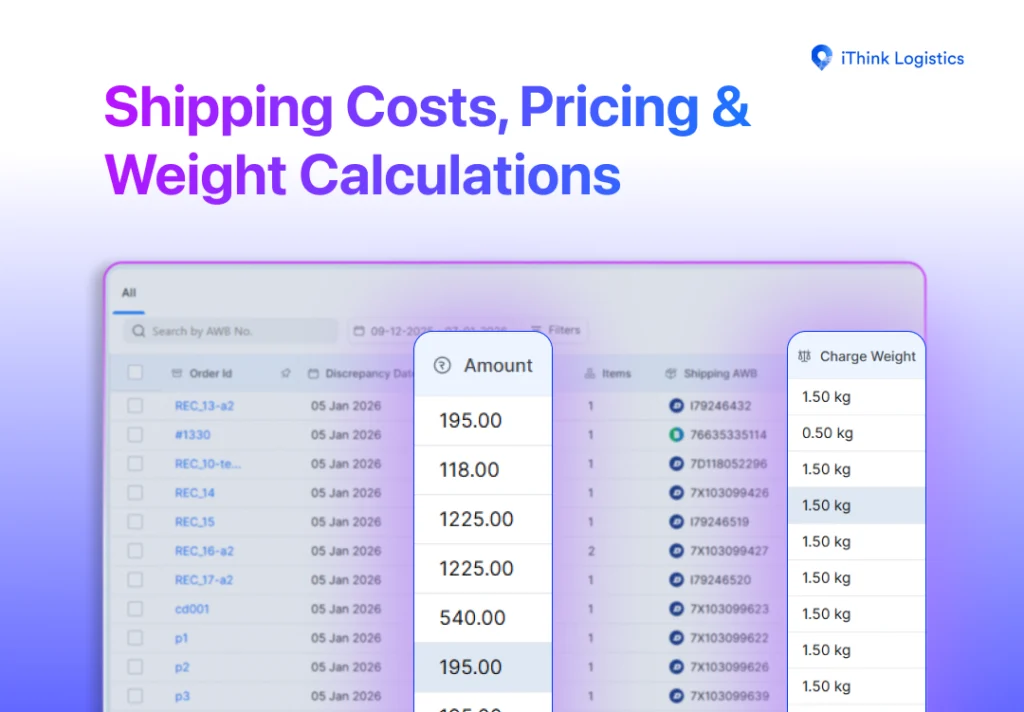
3.1 How Is E-commerce Logistics Pricing Determined?
Actual logistics pricing depends on:
- Dead weight (Actual Weight) vs volumetric weight
- Delivery zone
- Fuel & Vehicle
- Labour
- Transportation
- Warehousing
- Return probability
- Taxes & Duties
Lack of transparency here leads to margin leakage.
3.2 How to Calculate Volumetric Weight in Ecommerce Logistics
Bulky products often cost more to ship, even if they’re light.
Courier companies bill on whichever is higher:
- Dead weight (Actual Physical weight)
- Volumetric weight
Ignoring this leads to unexpected invoices.
Companies charge 2 higher prices. If a product is large but light, it will be charged based on volumetric weight, while a heavy product of small size will be charged based on dead weight (Actual weight), ensuring a fair price for the space/weight used in logistics.
3.3 Shipping Zones Explained
Shipping zones decide:
- Cost
- Delivery timelines
- Courier availability
Understanding zones allows sellers to design smarter pricing and delivery promises. Zones that include Jammu and Kashmir usually take longer than the central and southern zones.
3.4 Cheapest Ways to Ship Large Packages
Large packages don’t have to mean large losses.
Factors to consider when delivering them:
- Packaging dimensions
- Courier allocation
- Zone-based pricing
- Different logistics
4. Speed Post & Postal Shipping in India
India Post still plays a crucial role in ecommerce in India, especially for:
- Remote areas
- Documents delivery
- Low-cost shipping
4.1 Speed Post Charges 2026
Most people assume India Post is unreliable and expensive for speed post, while it isn’t. If you want to send 500g documents to Chennai, it costs ₹70, but people assume it is costly and go directly to a private courier partner, paying ₹160 or more for the same delivery.
To learn more about Speed Post charges, please refer to the detailed price breakdown.
5. Cash on Delivery (COD): Operations & Impact
Even with UPI, wallets, and BNPL (Buy Now Pay Later) becoming mainstream, Cash on Delivery (COD) continues to dominate Indian ecommerce.
According to data shared by 1checkout.ai, over 62% of new ecommerce orders in India are still placed using COD, which can be reduced and converted through the Connect+ product, which helps ecommerce stores convert COD customers into Prepaid customers after they place an order.
COD payment is the reality, and to reduce it, businesses are using services which help them convert their customers to prepaid.
COD directly influences:
- Courier risk appetite
- RTO (Return to Origin) rates
- Delivery attempt behaviour
- Seller cash flow cycles
When a customer pays the amount at the time of placing an order, RTO is reduced compared to COD orders.
5.1 How Cash on Delivery Works
At a surface level, cash on delivery sounds simple: the customer pays cash at delivery. Operationally, it gets layers in operation.
Here’s how the COD lifecycle works in real ecommerce operations:
Order Placement
The customer selects COD at checkout. This marks the order as COD.
Courier Allocation & Pickup
Some companies limit COD shipments by:
- Pincode
- Order value
- Seller history
Certain pincode regions tend to see higher COD orders and returns.
Out for Delivery & Payment Collection
- The delivery agent collects cash (or sometimes UPI on delivery).
- Failed payment, unavailability, or refusal at this stage increases RTO probability.
Cash Remittance to Courier
Cash is collected through the courier’s internal system, hub by hub. The paperwork has been processed, and the cash transfer to the Aggregator (us) begins. We verify the remittance, then transfer the amount to the respective sellers.
Different logistics companies have different remittance cycles, and then each aggregator gets its own cycle, like week 2 of the month, week 4 of the month and so on.
From our operational experience at iThink Logistics, if a seller gets many COD orders, it hampers their cash flow, as when the COD remittance cycle comes, they are paid for those orders.
Understanding this lifecycle helps sellers:
- Set realistic delivery expectations.
- Plan working capital better.
- Reduce disputes with couriers.
- Act early on risky COD shipments.
This is important for the seller to understand the remittance cycle so they are prepared with cash to run the business’s daily activities and aren’t hampered by it.
5.2 Advantages and Disadvantages of COD
COD exists because it addresses a trust gap with new sellers in the market and helps customers get the money before they place an order, which is helpful, but it also creates logistical friction.
| Advantages of COD | Disadvantages of COD |
| Higher conversion rates from first-time and hesitant buyers | Significantly higher RTO (Return to Origin) rates |
| Builds trust where online payment confidence is low | Cash flow delays due to fixed COD remittance cycles |
| Strong demand driver in Tier 2, Tier 3, and rural locations | Additional COD fees and courier risk surcharges |
| Enables access to customers without UPI/cards at checkout | Higher reverse logistics and return shipping costs |
| Useful for new brands without strong brand recall | Increased delivery refusal at doorstep |
| Helps sellers test new geographies and products | More operational effort in reconciliation and settlements |
| Improves order volumes during sales and promotions | Higher dependency on courier delivery agent behaviour |
There are probably more, but these are the ones that’ll hit your bottom line.
Sellers who actively manage COD through pincode restrictions, order value caps, prepaid offers, and smart courier allocation can retain reach.
6. Delivery Tracking & Shipment Visibility
Once an order is shipped, the customer’s biggest question is simple:
“Where is my order right now?”
This is where delivery tracking stops being a backend system and becomes a customer experience layer. It’s even better if you have a customizable tracking page from a logistics company or an aggregator that provides a Branded Tracking page where you can place your other products below the tracking to upsell more products while customers check their product delivery status.
In Indian eCommerce, poor tracking is one of the top reasons behind:
- WISMO queries (“Where Is My Order?”)
- Support overload
- COD refusals
- Negative reviews
A strong ecommerce delivery strategy treats tracking as a communication tool, not just a courier feature.
6.1 How the Courier & Package Tracking System Works
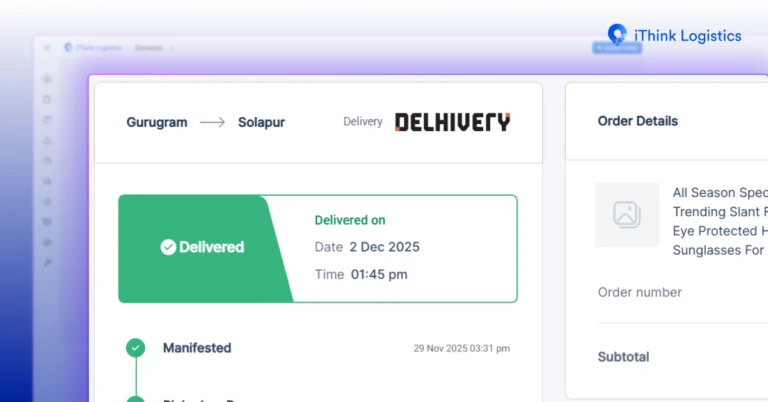
Every courier tracking system works on scan-based milestones:
- Manifest
- Pickup scanned
- In-transit
- Arrived at the destination city
- Out for delivery
- Delivered / Undelivered
Behind the scenes, this data flows from:
- Courier handheld devices
- Hub management systems
- Central tracking APIs
For sellers, the real value lies in correctly interpreting tracking events, not just displaying them.
6.2 Importance of a Delivery Tracking System
A strong delivery tracking system impacts both customers and operations.
From a customer’s perspective:
- Reduces anxiety
- Builds confidence in prepaid orders
- Improves brand trust
From a seller’s perspective:
- Cuts support tickets
- Helps identify courier performance issues
- Enables proactive delay management
6.3 E-commerce Order Tracking Explained
Ecommerce order tracking is not just courier tracking.
It connects:
Checkout → Order confirmation → Pickup → Transit → Delivery → Returns
When these stages are visible in one flow, sellers can:
- Set accurate delivery expectations.
- Trigger automated customer communication.
- Reduce failed delivery attempts.
This end-to-end visibility is now a baseline expectation, especially for D2C brands.
6.4 What Do You Mean by Delivery Exceptions?
A delivery exception means something didn’t go as planned.
Common exceptions include:
- Customer unavailable
- Address issues
- Delivery refused
- Payment not ready (COD)
7. Shipping Delays, Pickup Issues & Problem Resolution
No logistics system is delay-proof, but unmanaged delays cost sellers heavily.
7.1 Most Common Reasons for Shipment Delivery Delays
Delivery delays usually fall into three buckets:
- Courier-side issues (hub congestion, manpower)
- Seller-side issues (late handovers, wrong labels)
- Customer-side issues (unavailability, wrong address)
Understanding the root cause helps sellers fix the right problem instead of blindly blaming the courier.
8. Same-Day & Next-Day Delivery Evolution
Since the rise of quick commerce, Indian consumers now expect same-day delivery within 10 – 30 minutes for daily-use items, as well as electronic devices like earbuds, power banks, and other essentials.
8.1 The Rise of Same-Day and Next-Day Delivery
According to RedSeer’s industry reports, fast delivery options can increase conversion rates by 15–20% in high-intent categories such as fashion and electronics. Nowadays, convenience is top of the list for Indian Tier 1 customers; delivery speed is no longer an added service but an essential part of the brand, enabling you to get the product quickly and cost-effectively.
8.2 Same Day Courier Service for Ecommerce Sellers
Same-day delivery works when the inventory and the delivery destination are both in the same city.
- Inventory is city-based
- Order volumes are predictable.
- Courier partners are localised.
It’s not for everyone, but when done right, it becomes a strong competitive differentiator.
9. Courier Performance & Partner Evaluation
Courier relationships should be reviewed using metrics such as RTO percentage, delivery success, pickup reliability, and more.
9.1 Measuring Courier Performance Effectively
Key courier metrics include:
- First attempt delivery success
- RTO percentage
- Average delivery time
- Pickup reliability
Tracking these metrics helps sellers allocate shipments effectively based on courier company performance.
9.2 How Multiple Courier Partners Improve Shipping Efficiency
Depending on a single courier is risky as their service may go down for some time, technical issues or any number of problems can occur to them, that’s why using multiple courier partners is helpful or logistics aggregators like we get you the option to choose multiple courier partners so if your parcel can’t be deliver by 1 courier partner it does with another courier.
10. Reducing RTO, Returns & Reverse Logistics Complexity
Returns are inevitable — losses are not.
10.1 Best Courier Aggregator to Reduce RTO
Several courier aggregators help businesses in India with their shipping and logistics for ecommerce:
- iThink Logistic: – AI-powered courier selection and automated NDR management.
- Shiprocket: Wide courier network and COD fraud detection.
- Pickrr: Smart order allocation and return management.
- NimbusPost: Real-time tracking and discounted shipping rates.
And many more aggregators are out there, but choosing the right fit for you will improve your customer delivery experience, reduce RTO and build your Brand reputation for reliable delivery services.
10.2 Simplify Reverse Logistics with the Right Courier Partner
Reverse logistics fails when these 3 things happen:
- Pickups are delayed
- Tracking is poor
- Refunds are slow
So the right courier setup simplifies this entire flow, which helps you focus on scaling, not on logistics, and delivery when your competitors are doing the same.
10.3 Streamlining Ecommerce Returns & Shipping
Returns should not be treated as exceptions, while they are a core part of the ecommerce shipping lifecycle. Streamlining returns and forward shipping through a single system helps sellers reduce delays, control costs, and deliver refunds faster. When courier selection, pickup scheduling, tracking, and customer communication are aligned, returns become predictable and manageable instead of chaotic.
This end-to-end approach improves customer trust while preventing reverse logistics from quietly eroding margins.
Also Read: Ecommerce Returns & Shipping
11. Ecommerce Shipping Strategy & Common Mistakes
Most sellers don’t “design” a shipping strategy. They inherit one.
Whatever courier worked in month one becomes the default. Whatever rates they were quoted early on are treated as fixed. And slowly, shipping shifts from a growth enabler to a silent bottleneck.
A real ecommerce shipping strategy is about removing friction before it shows up in numbers like RTO, delivery delays, support tickets, and shrinking margins.
11.1 Best Ecommerce Shipping Strategy for Startups
In the early stages, the goal isn’t speed. It’s control.
Startups that survive the first year usually do three things right without realising it:
- They keep shipping costs predictable, even if delivery isn’t always the fastest.
- They choose reliability over promises they can’t keep
- They leave room to change couriers as volumes grow.
Instead of locking themselves into a single courier or pricing structure, smart sellers keep their setup light and flexible. This makes it easier to experiment with new pincodes, manage COD risk, and fix issues without tearing the system apart.
Shipping doesn’t need to be perfect early on. It just needs to be forgiving.
Also Read: Ecommerce Shipping Strategy for Startups
11.2 Top Ecommerce Shipping Mistakes Sellers Make
Most shipping mistakes don’t look like mistakes at first.
They look convenient.
Relying on one courier feels simple until deliveries slow down. Ignoring volumetric weight seems harmless until invoices spike. Offering COD everywhere boosts orders until RTO eats the margin.
The most common mistakes sellers make:
- Sticking to a single courier for too long
- Discovering volumetric weight only after billing disputes
- Treating COD as demand, not risk
- Over-promising delivery timelines to match competitors
These issues rarely break a business overnight. They quietly weaken it order by order.
11.3 Complete Ecommerce Shipping Solution Guide
A complete shipping solution is a system.
Pricing, courier selection, tracking, COD handling, and returns can’t live in isolation. When they do, sellers spend more time fixing problems than scaling.
When everything works together, shipping becomes boring, and that’s a good thing. Orders move, customers stay informed, returns don’t spiral, and margins stay visible.
That’s when logistics stops being something you “manage” and starts becoming something you trust.
12. Advanced Logistics for D2C & Scaling Brands

As D2C brands scale, logistics stops being a cost centre and starts deciding profitability. At this stage, efficiency matters more than speed alone.
12.1 Smart Logistics for Stronger Profits in D2C
At scale, profitability is decided less by demand and more by how efficiently orders move.
Strong D2C brands rely on:
- Automation to reduce manual errors and processing delays
- Data-driven courier allocation instead of fixed courier rules
- Predictive delivery planning to prevent delays before they happen
The shift is simple: logistics moves from being reactive to quietly optimised in the background, and profits improve as a result.
13. International Shipping & Exports
Global expansion is exciting, but international shipping is heavily influenced by costs, compliance, and timelines that change significantly once orders leave the country. International shipping is not the same as domestic logistics, and neither should be treated as an extension of domestic.
13.1 How to Choose the Right Shipping Partner for International Exports
The right international shipping partner reduces the friction and makes exporting easy for you.
What matters most:
- Compliance clarity across documentation and customs rules
- Cost transparency with no surprise surcharges
- Delivery reliability across regions, not just major countries
Choosing the wrong partner can not only delay your product delivery and create paperwork and compliance issues, but also delay global growth.
13.2 What Are CSB 4 and CSB 5 in International Shipping?
CSB 4 is an Indian customs shipping bill used for non-commercial exports where the seller is claiming duty-related benefits or refunds from the government.
CSB 5 is an Indian customs shipping bill used for commercial exports via courier, in which no duty benefits or incentives are claimed, enabling faster, simpler customs clearance.
Also Read: What Are CSB 4 And CSB 5 In International Shipping?
Conclusion
Shipping is shaping how customers experience your brand after checkout.
As this guide shows, profitable ecommerce brands in India don’t optimise shipping in parts. They align courier selection, pricing, COD control, tracking, delivery speed, and returns into one system. When these pieces work together, RTO drops, cash flow improves, and growth becomes predictable.
Shipping doesn’t need to be complicated. It needs to be intentional. And when done right, it becomes a quiet advantage that scales with your business.



Leave a Reply