


Introduction: Why E-commerce Marketing Is No Longer Optional
Let’s start with a hard truth most sellers learn too late: Traffic doesn’t build e-commerce brands. Experiences do.
Over the last few years, iThink Logistics has analysed millions of shipments, failed deliveries, repeat orders, and customer interactions across Indian e-commerce businesses ranging from early-stage D2C sellers to scaled marketplace-first brands. One pattern shows up consistently:
What we consistently see on-ground:
• Sellers who depend only on ads often see quick spikes in orders, followed by higher returns, rising support load, and margin pressure.
• Sellers with marketing, delivery experience, and a post-purchase communication system grow more slowly but build repeat demand and long-term stability.
This difference matters today. As India’s e-commerce market approaches $325 billion by 2030 (IBEF), customers evaluate more than just price. Delivery timelines, return experience, communication, and brand trust now influence both purchases and repeat orders.
In other words, e-commerce marketing is no longer about driving clicks to a website. It’s about guiding customers from discovery and consideration to purchase, delivery, and post-purchase confidence.
What this blog will help you with,
By the time you reach the end, you’ll clearly understand:
- What is e-commerce marketing in today’s India?
- How modern ecommerce and marketing strategies actually work on the ground, not just in theory
- Which ecommerce marketing tactics drive growth without killing margins?
- How successful are ecommerce brands in building loyalty with their branding and marketing?
- How to design an ecommerce marketing strategy that scales year after year
This isn’t a theory. This is built on data backed by real life seller behaviour, logistics data, and conversion patterns we see every single day.
1. E-Commerce Growth Foundations
Before traffic, before ads, this is where growth actually begins.
Most sellers jump straight to promotions. That’s a mistake. Sustainable ecommerce growth always starts with foundations.
1.1 What Is E-commerce Marketing?
In the digital marketplace, e-commerce marketing is no longer a top-of-funnel activity; it is an end-to-end strategy that governs the entire customer lifecycle. It encompasses every touchpoint where a brand interacts with a consumer from the first moment of discovery to the post-delivery experience.
- Discoverability
- Conversion
- Trust
- Repeat purchases
More importantly, e-commerce marketing is about guiding customers through a complete sales funnel from awareness and consideration to purchase and post-purchase loyalty using a mix of SEO, content, social media, email, ads, and lifecycle communication.
Unlike traditional digital marketing, e-commerce marketing is:
- Transaction-aware (every click has a measurable revenue impact)
- Experience-driven ( Operation – delivery, returns, tracking, and support directly affect business)
- Data-heavy (decisions are based on behaviour, stats, not assumptions)
From iThink Logistics’ internal analytics, we’ve observed:
- Sellers with clear delivery timelines on product pages see up to 18–22% higher checkout completion.
- Brands that communicate proactively post-purchase reduce WISMO (“Where is my order?”) queries by over 30%
This is why marketing doesn’t stop at checkout. That’s where it proves itself as in e-commerce, marketing cannot be separated from structure, operations, or experience.
1.2 E-commerce Growth Hacking: What Actually Works (and What Doesn’t)
Let’s clear a myth.
There is no growth hack in Ecommerce. But you can explain growth hacking as:
- It is about identifying high-leverage opportunities in customer acquisition, conversion, and retention.
- Growth experiments only work when they can be supported by inventory, delivery capacity, customer support, and unit economics.
- Strategic alignment and experimentation create repeatable, scalable wins.
The key takeaway: There is no Growth hacking, but these work only when paired with long-term marketing discipline, thoughtful resource allocation, and a focus on meaningful metrics, not just vanity (paper) growth.
(Read more: E-commerce growth hacking tips from the experts.)
2. Driving High-Quality Traffic to Your E-commerce Store
Here is a hard truth we see in the data every single day: 10,000 “wrong” visitors will cost you significantly more than 1,000 “right” ones.
In the race for sustainable ecommerce growth, the goal isn’t just to watch a Google Analytics graph go up and right. It’s about attracting visitors who are actually aligned with your brand at specific stages of their buying journey while growing sustainably. When you align your traffic sources with user intent, your marketing spend becomes an investment rather than an expense.
The Intent-First Funnel
To scale, you have to stop treating traffic as a monolith. Instead, think of it in layers of intent:
- Awareness (Top of Funnel): These are people discovering you through an educational blog post or a viral reel. They aren’t ready to buy yet, but they are forming their first impression of your brand.
- Consideration (Middle of the Funnel): These users are actively comparing options. They’re looking at your reviews, reading “How-to” guides, or signing up for a discount code. This is where you build authority.
- Conversion (Bottom of Funnel): These are your “hot” leads. They’re searching for specific product names or clicking through from a cart-abandonment email. Optimising for these users yields the fastest ROI.
2.1 Proven Ways to Drive Traffic That Converts
Most brands fail because they try to be everywhere at once. A more human, data-driven approach is to prioritise channels based on their long-term compounding value relative to their immediate cost.

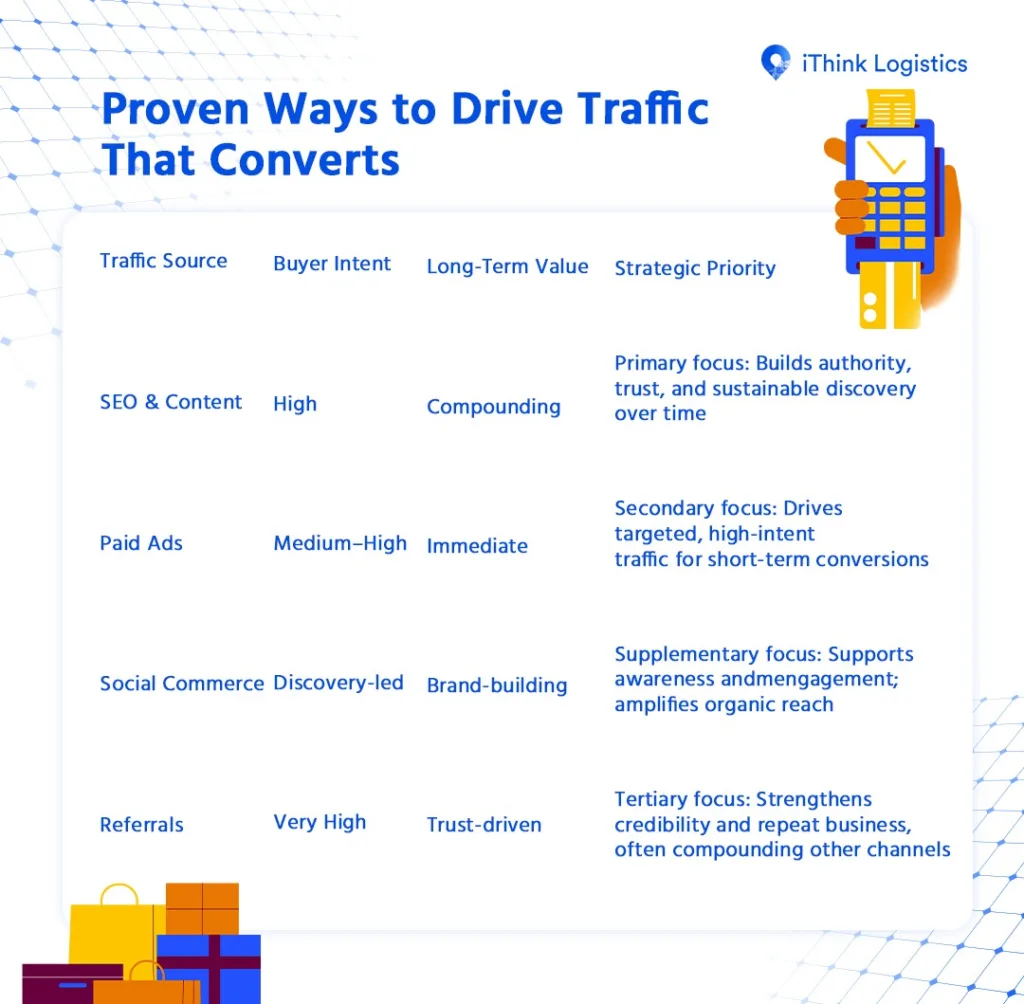
While paid ads stop the moment you stop paying, organic content (like a well-written product guide) continues to bring in customers for years. In fact, research shows that over 50% of shoppers perform extensive research before ever hitting a “Buy” button. If you aren’t providing the content for that research, your competitors will.
(Read: Drive Traffic To Your Ecommerce Store With These Tips.)
2.2 Turning Instagram into a Revenue Engine
Instagram has evolved far beyond a digital mood board. If you’re only using it for “branding,” you’re leaving money on the table. We’ve analysed the shift in social shopping, and the results are clear:
- Reels are the New Storefront: Video content currently outperforms static images by over 2x in click-through rates (CTR). And the best part, you don’t need to create a reel from scratch; you can repurpose your long-form blog content and long-form video content into multiple reels.
- The “Trust Transfer”: When a trusted influencer features your product, their credibility transfers to you. This converts best when you clearly communicate “friction-removers” like Fast Delivery or Cash on Delivery (COD) options immediately in the caption or bio.
How Winning Brands Scale on Social:
- Influencers for Credibility: They use creators to demonstrate the product in real-life settings.
- Frictionless Checkout: They utilise Instagram Shopping tags so a user can go from “discovery” to “bought” in three taps.
- Strategic Retargeting: They don’t just show the product again; they retarget viewers with “delivery-first” messaging (e.g., “Get it by Friday”) to close the sale.
Explore more in our guides on Instagram Influencer Marketing and Instagram Shopping Mastery.
3. Content Marketing & Blogging for E-commerce Growth
In the modern ecommerce landscape, content is far more than just “filler” for your brand. It is the core that drives discovery, builds trust, and ultimately lowers your customer acquisition costs (CAC).
Think of content as your 24/7 sales team. While ads stop working the second you stop paying, high-quality content continues to educate and convert while you sleep.
To scale, your content must serve a specific purpose at every touchpoint:
- Awareness / TOFU: These are Educational blogs, articles, infographics, podcasts, Digital Magazines, and how-to guides explaining products, social media reels, carousel posts that attract users, customers, and learners interested in the topic, products, and tools.
- Consideration / MOFU: Product explainers, comparison articles, surveys, downloads, webinars, testimonials, and reviews guide buyers toward confident decisions. This stage reinforces users before buying products, services, tools, and solutions.
- Conversion / BOFU: Persuasive, benefit-focused content on product pages, checkout messaging, and follow-up emails closes the sale and encourages repeat visits.
Companies which align their content marketing in funnel stages see significant growth in their businesses. It’s not about how much you do but how you do it.
3.1 Why Blogging Is a Growth Asset (Not a Content Task)
Blogs are business assets that help you gain more reach, reach new audiences first, help users with their queries, and get more people sent to the next stage of the journey until landing pages where users convert.
In terms of SEO, reach, blogs actually do:
- Build topical authority in Google.
- Help the brand become an industry authority.
- Reduce dependence on paid traffic.
HubSpot reports businesses that blog generate 67% more leads
(Read: 9 reasons why your e-commerce store needs a blog).
3.2 The Perfect E-commerce Content Marketing Strategy (Indian Context)
The Indian market is unique—shoppers are research-heavy and value-conscious. A “one-size-fits-all” approach won’t work. To win, your content must be mapped to the journey:

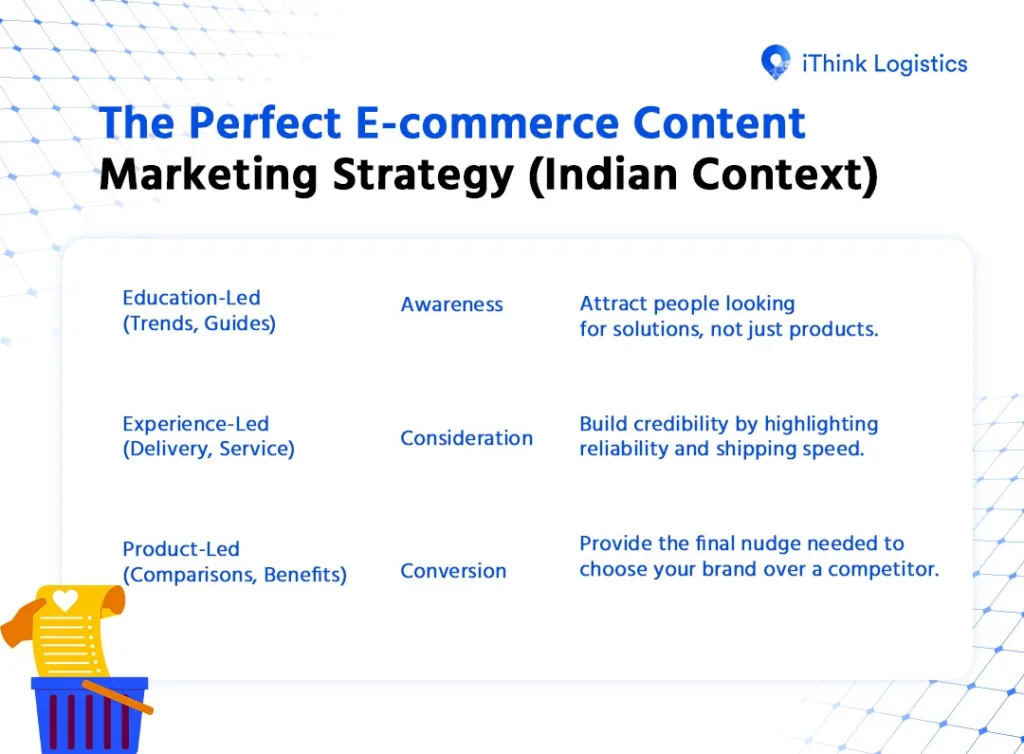
The Strategy in Action:
By mapping content this way, you move a visitor from Awareness (learning about a problem) to Assurance (knowing your brand is the right choice). This structure ensures your efforts aren’t random—they are focused on driving measurable business impact and long-term loyalty.
(Read: The perfect e-commerce content marketing strategy)
4. Product Page Optimisation & Conversion Growth
Most online sellers spend a fortune on ads, only to lose potential customers at the finish line. In the Indian market, conversion is often where the battle is won or lost. Even a tiny bit of friction, like hidden shipping costs or a confusing layout, can cause a shopper to vanish in seconds.
Conversion Rate Optimisation (CRO) isn’t just about changing button colours. It’s about understanding the “why” behind a shopper’s hesitation. When you optimise a product page, you are essentially turning it into a high-performance salesperson that works 24/7.
The Conversion Journey
Think of your product page as a mini-ecosystem designed to move people through three specific shifts:
- From “Just Looking” to Interested: Your page needs to quickly explain how the product solves a problem or improves the buyer’s life.
- From Interested to Confident: This is where you remove doubt. Clear pricing, customer reviews, and “Trust Signals” (such as secure payment icons) help shoppers feel safe.
- From Confident to Buyer: A smooth, fast checkout process ensures the customer doesn’t have time to second-guess their decision.
4.1 CRO for E-commerce (No Jargon, Just Results)
Conversion Rate Optimisation (CRO) is essentially the art of getting out of your customer’s way. It is a data-driven process that ensures every visitor has a smooth, intuitive path from your landing page to the checkout “Thank You” screen.
Think of it like a physical store: if the aisles are cluttered and the price tags are missing, people leave. Online, those “cluttered aisles” are slow loading speeds, confusing navigation, and are unable to guide users from their pain to solutions – your products.
The Real Impact of Friction:
- Vague Delivery Dates: If a shopper doesn’t know when their package will arrive, they are significantly more likely to abandon their cart.
- Hidden Return Policies: Uncertainty about returns often prevents people from choosing prepaid options, increasing RTO (Return to Origin) risk.
- Unclear Messaging: The Messaging you are conveying must be crystal clear, or people won’t buy anything from you.
Read: What is Conversion Rate Optimisation (CRO) for E-Commerce
4.2 Product Pages That Actually Sell
(Product optimisation, descriptions, sold-out strategies)
A great product page is more than just a gallery of images; it’s a conversion hub where user experience, trust, and clarity meet. When a visitor lands here, they are looking for a reason to say “yes.” Your job is to remove every reason for them to say “no.”
To build confidence and reduce hesitation, focus on these core areas:
- UX Flow: Ensure intuitive navigation, proper CTAs, and clear pricing. A simple, frictionless layout reduces drop-offs. Most users are on mobile, so the UX must be flawless for them, or you will lose potential customers.
- Trust & Credibility: Use verified reviews and “Safe Payment” badges. In a market where trust is the primary currency, these small signals act as a digital handshake.
- Information Clarity: Highlight availability, return policies, and shipping timelines upfront to prevent cart abandonment.
- Mobile-First Design: With increasing mobile shoppers in India, pages must load quickly and render seamlessly, with a design that converts users on mobile devices.
- Smart Upselling: Suggesting a matching accessory is great, but keep the focus on the main product. If too many products overwhelm shoppers, they may end up choosing nothing.
These conceptual improvements strengthen conversion intent, reinforce brand reliability, and support long-term revenue, without duplicating cluster content on descriptions, sold-out pages, or must-have features.
(Links: Product Description Writing, Sold-Out Page Conversion, Must-Have Website Features)
5. Promotional Strategies & Smart Sales Boosters
How to create urgency without destroying long-term brand value when discounts are easy to offer, while profitable promotions are not.
Brands that rely heavily on blanket discounts see higher order volumes but lower repeat rates and higher return ratios. When customers start looking at a brand not for its service quality but for discounts, they tend to purchase products only when discounts are offered.
You should focus on strategic promotion to consider:
- Segmentation: Target offers to the right customer group rather than blanket discounts
- Timing & Seasonality: Align campaigns with peak purchase periods and lifecycle stages
- Perceived Value: Provide added benefits, such as free shipping or exclusive early access to selected products, to encourage sales or clear space.
- Cross-Sell & Upsell Integration: Encourage buyers to add complementary small add-ons to their purchases to increase average order value without eroding margins, such as offering a protective case with wireless earbuds.
- Testing & Measurement: Track promotion ROI, repeat purchases, and impact on retention to refine strategy
Focus on these smart ecommerce marketing tactics for sustainable growth, ensuring urgency drives conversions while building loyalty and long-term brand equity.
5.1 Smart Use of E-commerce Offers
Instead of discounting everyone and asking how much discount should I give?”, ask: “Who should see this offer, and why?” A specific group of people should see only some, not all.
High-performing e-commerce brands use offers to push first-time buyers to try our products while the offer is on, and to encourage them to use Prepaid to qualify for that discount.
Now, in many cases, you can take many steps, which is better than flat discounts:
- Free shipping (especially in Tier 2/3 cities)
- Prepaid-only incentives/ offers
- Limited-time offer on selected products instead of price cuts
- Loyalty-based offers (repeat buyers get more value, not more discounts)
Read: 5 Smart Ways of Using eCommerce Offers To Generate Sales
5.2 Guerrilla Marketing for E-commerce Brands
Guerrilla marketing sounds exciting—low budget, high impact, viral potential. But it only works when your fundamentals are already strong.
You can’t guerrilla-market your way out of unreliable delivery or poor product quality. What you can do is use unconventional tactics to amplify a brand that already has clarity and operational consistency.
Guerrilla marketing works when results are delivered:
- Your brand has a clear identity. People need to immediately understand what you stand for.
- The message is very clear: You have seconds to make an impression, not minutes, so keep your messages very clear and consistent across the marketing.
- The execution feels authentic, not forced. Customers sense when creativity is manufactured.
6. Email Marketing & Lifecycle Communication
Because renting attention is expensive—owning it is powerful.
Every mature e-commerce marketing strategy eventually shifts focus from acquisition to retention. Getting new customers every time is costly, but retaining them is where the brand grows. And in this shift, email remains one of the most reliable and measurable channels. A structured email marketing strategy nurtures leads, converts hesitant buyers, and drives repeat purchases, creating compounding value over time. And still 1 of the most important channels used in marketing.
Start sending emails and align them with the customer lifecycle:
- Welcome Email Series: Introduce your brand, set expectations, build trust, and share your brand story.
- Abandoned Cart Flows: Recovers potential revenue by reminding users at the right time. These users are already interested, but for many reasons, they abandoned their cart.
- Post-Purchase Communication: Confirms order status, encourages reviews, and reinforces brand reliability
- Retention & Re-engagement: Offers loyalty incentives, new arrivals, and personalised recommendations
At iThink Logistics, we see that brands investing in segmented, automated, and personalised email flows not only improve repeat purchase rates but also reduce customer churn, increasing lifetime value and strengthening the overall ecommerce marketing ecosystem.
6.1 Email Marketing That Actually Boosts E-commerce Sales
Email isn’t about newsletters. It’s about timing, relevance, and intent at the right moment in the customer journey.
From real seller behaviour, we see clear patterns:
- Welcome emails set brand expectations. First impressions matter—use them to establish trust and clarify what makes you different.
- Abandoned cart emails recover lost revenue. These customers were already interested. A timely reminder with delivery reassurance often closes the sale.
- Post-purchase emails reduce anxiety and increase trust. Order confirmations, shipping updates, and delivery notifications keep customers informed and reduce support queries.
The bottom line? You don’t need a massive team or complex newsletters to see results. By setting up these three (3) automated flows, you create a system that works in the background while you sleep.
When your emails provide real value, like a clear shipping update or a product tip, then you aren’t just “marketing.” You are building a reliable brand that people feel safe shopping with again and again. It’s the simplest way to turn a one-time browser into a loyal customer without spending an extra rupee on ads.
7. Customer Experience, Service & Logistics
Where marketing promises are either kept or broken
Here’s something most guides won’t tell you: in e-commerce, logistics is marketing—just delayed. The way customers experience delivery, returns, and communication directly affects brand perception, repeat purchases, and referrals.
7.1 Improving Customer Service in the Logistics Industry
Customer service in logistics isn’t just about resolving complaints—it’s about preventing them. Strategic depth matters here:
Anticipate common issues: Identify high-risk orders and communicate early. A simple “Your delivery might be delayed by a day” message prevents frustration before it starts. Like WISMO, which sends the status of your product throughout the journey until it reaches your customer’s hand.
Empower agents with contextual data: When a customer calls, the support team should already have the order status, delivery partner details, and the most recent update visible, so they can resolve the query quickly and maintain the customer’s trust.
Great customer service doesn’t mean fewer issues; it means faster clarity, reduced anxiety, and stronger brand loyalty.
Read: How to Improve Customer Service in the Logistics Industry?
7.2 Customer Happiness: Small Ideas, Big Impact
Customer happiness is rarely about big gestures. It’s built through predictability, transparency, and respect for the customer’s time.
Read: 10 ideas worth trying for customer happiness!
Small Touches That Work
Thank-you notes in packaging – A handwritten note or personalised insert makes the unboxing feel special rather than transactional.
Honest delivery expectations – Don’t promise 2-day delivery if you can’t consistently deliver it. Under-promise and over-deliver works better than the reverse.
Simple, human communication during issues – Skip the corporate jargon. “We’re sorry your order is delayed. Here’s what happened and when you’ll receive it” builds more trust than a templated apology.
Read: Benefits Of Having A Branded Tracking Page For Your eCommerce Business
8. Customer Feedback, Loyalty & Retention
Getting a new customer is exciting, but keeping them and generating repeat sales from them are what actually keep your business alive. Most sellers spend all their energy on “the chase” (acquisition), but the most successful brands focus on “the relationship” (retention).
Why? Because a repeat buyer is cheaper to convert, spends more time with the brand, and acts as a free marketing team by telling their friends about you through word of mouth and on their social media.
8.1 How Customer Feedback Improves E-commerce Sales
Think of reviews as your brand’s digital word-of-mouth. They aren’t just “vanity metrics” to make you feel good. They are real-time signals that tell other customers it’s safe to buy from you.
From what we’ve seen on the ground:
- Reply to the good and the bad: When you respond to a review, you’re showing the next customer that there’s a real human behind the screen who cares.
- Fix the leaks: If three people complain about a delivery delay or a confusing size chart, that’s not a “complaint”, it’s a free tip on how to fix your store and stop losing sales.
- Build the “Trust Loop”: Brands that actively ask for and show reviews see much higher average order values. People are willing to spend more when they know others have had a great experience.
Read: How customer feedback can improve your e-commerce sales
8.2 Turning One-Time Shoppers into Lifetime Customers
The hardest sale you will ever make is the first one. Once someone has trusted you with their credit card or address, the “trust wall” is down.
A repeat customer is a goldmine because they:
- It doesn’t cost you extra ad money to reach.
- Buy more frequently because they already know your quality.
- Trust your brand to deliver on its promises.
To build this loyalty, focus on the consistent experience. If the checkout was easy but the delivery was slow or had a problem, they wouldn’t come back. But if you provide a smooth journey from the “Order Confirmed” email to the moment the courier hits their doorstep.
Read: How to turn one-time shoppers into lifetime customers
8.3 Personalisation Without Crossing the Line
Personalisation works best when it feels like a helpful shop assistant, not a stalker. The goal is to make the shopping experience feel like it was built just for that one person. Customer loyalty is a key driver of long-term growth in eCommerce, reducing acquisition costs while increasing lifetime value.
Effective personalisation is simple:
- Smart Suggestions: “Since you bought a camera, you might need these batteries.”
- Right Place, Right Time: Sending a restock reminder just as their previous order is likely running out.
- Knowing the Shopper: Remembering their delivery preferences so they don’t have to type them in every single time. Use 1-click checkout products to streamline the process.
When you use data to make things easier for your customer, you’re providing a service. That’s the foundation of a brand people actually love.
9. E-commerce Branding & Trust Building
In a crowded market, your brand is the reason a shopper chooses you over a cheaper alternative. It’s the trust you build by being consistent from the first ad they click to the moment your package arrives at their door.
9.1 E-commerce Branding Guidelines That Drive Recognition
You don’t need a massive agency to build a recognisable brand. You just need to be consistent with your ecommerce branding guidelines. If your Instagram is fun and casual, but your checkout emails are cold and robotic, you break the “trust loop.”
How to stay consistent:
- One Voice: Use the same tone in your product descriptions, WhatsApp updates, and customer support.
- The Delivery Promise: If your brand is about “speed,” your logistics must back that up. If it’s about “luxury,” your packaging needs to feel premium.
- Storytelling: Share the “why” behind your products. Indian shoppers love a good story, especially when it feels authentic.
By aligning how you look, how you talk, and how you deliver, you create a brand that people don’t just remember—they recommend.
10. Bringing It All Together: Your E-commerce Marketing Blueprint
Here is the big secret most sellers miss: E-commerce marketing is a chain. If one link breaks, the whole thing fails.
- Traffic without Trust is just a waste of your ad budget.
- Conversion without Experience leads to one-time buyers who never come back.
- Delivery without Communication leads to “Where is my order?” (WISMO) calls and high return rates.
Success happens when you stop treating these as separate tasks and start treating them as one unified blueprint.
The 4-Pillar Checklist for Growth:
- Education: Help people understand their problem and your solution.
- Execution: Drive high-intent traffic and make the purchase path invisible.
- Experience: Deliver on time and keep the customer in the loop.
- Expansion: Use feedback and loyalty programs to turn buyers into fans.
By following this blueprint, you aren’t just chasing the next sale; you are building a sustainable business that grows year after year.
Conclusion: Building an E-commerce Brand That Scales in India
The most successful e-commerce brands in India don’t just shout the loudest—they deliver the most consistently. They obsess over the customer journey from the first click to the final unboxing.
E-commerce marketing isn’t about “tricking” people into buying. It’s about being there with the right message at the right time. Focus on building trust, fixing friction, and keeping your promises, and the growth will follow.

