Simplify your logistics with scalable, tech-driven solutions tailored for Indian businesses. From warehousing to last-mile delivery—grow faster, ship smarter.
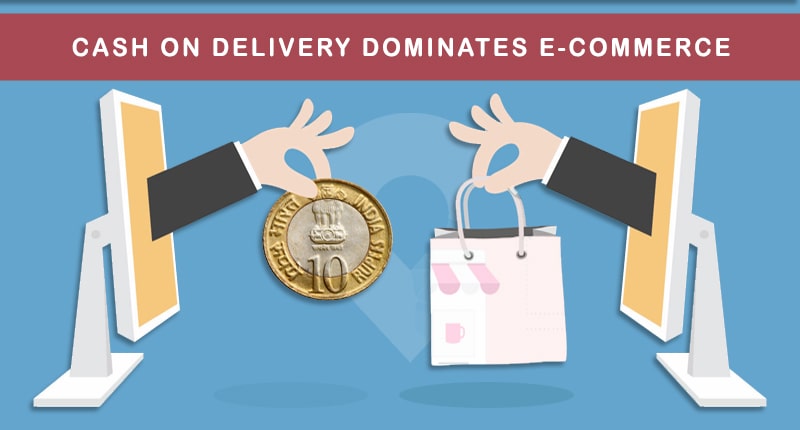
Remember when the rise of E-Commerce in India that gave the early anxiety of making payments over the internet? Despite the fact that there has been a huge ascent in online transactions in the last few years but Cash on Delivery (COD) still remains one of the most favored methods of payments among shoppers in India.
As per Nielsen’s Global Connected Commerce Survey (Business Insider), about 83% of shoppers in India favored utilizing cash for all their online purchases. Customers still hesitate to input card information because of different online extortion dangers. A report features that larger part of the payment made by buyers for online stores like Flipkart, amazon, Shopclues was COD, where 72% were from significant urban communities and 90% from small towns.
Flipkart, which was propelled in 2007, was the primary E-Commerce player after Indiaplaza to offer COD facility in 2010. In fact, it was the Cash on Delivery that made Flipkart a particularly well known web-based shopping platform among the majority.
Why COD is a convenient mode for payment?
Even though versatile wallets and net banking exchanges are on the ascent, still a large portion of the purchasers are still inclined toward the Cash-on-Delivery payment model. Payment choices like Net-Banking, Credit and Debit Cards and e-wallets cater to just 30% of online purchases when compared with Cash On Delivery (CoD).
As per the latest survey it has been seen that despite the low utilization of the Internet in various underdeveloped areas, the E-Commerce sector has significantly increased its turnover from $4.4 billion (Rs 20,020 crore) in 2010 to $24 billion (Rs.240 crore) in 2017.
The online retail segment in India is also expected to reach $1 trillion (Rs 660,000 crore) showcase by 2020, as per an ongoing report by the Confederation of Indian Industry (CII) and Deloitte.
There’s no reason to disagree that COD holds a lot of advantages for the buyers. It has gained trust from the individuals who were skeptical about buying things online.
The dread of online trick
Whether it’s the charm of not having to make an immediate payment while buying something, or be it the lack of enough trust for the buyer, the cash on the delivery concept in e-commerce has gained great popularity among the middle-class Indian individuals, in the past few years. Not only did the concept increased the percentage of people buying things online, but has also contributed to the substantial economic growth of the country.
Advantage of Cash On Delivery over other payment options
The familiarity and Trust
Being a developing country, there are a lot of places in India which has not digitized enough yet. Most people living in the outskirts are unfamiliar with even if they have a bank account or an internet connection. Hence they prefer the familiar and trustworthy way of buying things online. Cash on Delivery in such cases provides reliability and an easy way of making payments.
The Security
One of the major advantages of Cash on Delivery in e-commerce is the maintenance of security. No financial information is given out and hence the customer can stay free of any kind of fraud. It also staves off the tension of refund in case of non-delivery of the product. The customer can pay only after they get the product in hand. In that way, there is no risk of any kind of money loss.
Product Quality issues
Paying via COD, allows the customer to check the quality of the product before payment. In case the product is defective or different he/she can always return it without paying.
The company that pioneered cash on delivery in India
At the point when Flipkart propelled in 2007, the Indian internet business segment was in its early stages. After 10 years, India’s e-commerce business is flooding, on account of the rise of internet users and smartphones. Nonetheless, the audience in India still remains vigorously reliant on the cash on Delivery.
Cash on delivery is the procedure of customers paying for an item face to face on its conveyance. In the event that the COD purchaser refuses to accept the item, the product returns to the vendor. In India, the framework was intended to draw the attention of the purchasers who were skeptical about making payments online. Cash On Delivery has encouraged a significant part of the development of Indian web-based business.
Many years back, lots of on-demand startups started showing up in the industry. However, all of them were considered an epic failure that would not survive the market. Nevertheless, many startups came out as successful companies that are now ranked among the top companies in the world. So, have you built an excellent mobile application recently? Do you think that this app is going to be the answer to numerous problems? Then you might be feeling great about it and you might be thinking that your idea is unique. However, that is not reality.
With the advancement of technology, thousands of startups are barging the industry every day. They are increasing in number every day. Owners are proliferating with more and more ideas. The internet has helped us and transformed us into the proper tech users. It has enabled us to learn and access to information very easily. Thus, people are coming out with newer ideas every single day. App-based services like online food ordering, online car booking, online grocery shopping, navigating apps, etc. have become the global hits of the market. As on one hand, many startups experienced the success of the industry, on the other hand, many startups failed miserably.
The Era of Automation
In this era of automation, technology and innovation play a significant job in expanding the proficiency of an association. Automation has an indispensable job in the business procedure streamlining. There is significant programming software that can be sent in the logistics framework. This saves a lot of time because manual dependence for the management is not considered relevant anymore. Additionally, precise tracking helps in improving the executives of process management. The worker subtleties and record subtleties can be overlooked by utilizing explicit programming framed for these particular assignments. Subsequently, thelogistics firm should grasp the newer technological evolutions for expanding its efficiency and credibility.
When the whole world is big on digitization, a single click on your phone can do wonders. Many years back people never thought they could do everything on their phone. Starting from shopping to bank transactions to even booking a doctor’s appointment. Amazon’s one-day delivery shipping has shown people how a particular item can reach them in no time. If you are running or planning for an e-commerce start-up, then you should be very particular about the logistics. This aspect of your business can be the reason for your success and if not properly dealt with it can be the reason for your downfall. If you are failing to ship the products according to your customer’s desires or if you are, spending an excessive amount on shipping, then your business is bound to failure. Maybe you are selling items that are very sustainable like apparel, environment-friendly décor items for the home, or non-toxic toys, etc. whatever may be the product mix, and you should always be ready to deal with the present e-commerce situations. Your company should be able to outgrow its current e-commerce levels. All your dreams related to your business can become your worst nightmare because when it comes to logistics everything is unpredictable. You may be an expert in your industry; logistics can still ruin your business, as it is a science on its own. It is always very tricky to master all the logistical tactics.
The best advantage of a native digital brand start-up is that your company is not bound by procedures and legacy systems. You can apply best practices for your business from the beginning itself rather than just discovering later along the way. You can start with the best and proved practices that can help your business grow and flourish from the beginning itself. You can incorporate new technology and better analytics for your business which will help you in cost control and will help you deliver your brand promises. After all, any inventory that is stacked up on your shelf represents the investments that you have done for your business. You should always track your inventory so that you can look after your cash flows. This will open a broad way of complex analysis of inventory which guides you to your strategic business planning.
Major challenges faced by the on-demand startups
There are several challenges a company faces when it first enters the industry starting from thriving for visibility to dealing with a highly competitive market. Let us discuss some major problems:
Very competitive market
As the demand for the hyperlocal on-demand services increases, thousands of new startup companies are opening up that are catering to every need of the customers. Many entrepreneurs are jumping on the process of opening up a startup without planning for it properly. You first need to have a clear vision of what you expect your future to look like before jumping to conclusions. To co-up with their competitors, they are offering their services at a minimal amount. As the competition in the market is massive, the startup needs to compromise in some aspects to stay valid and evident in the market. They spend a lot of money on delivery aspects like transportation, infrastructure development, and labor. Due to insufficient funds, the budgetary constraints act as a huge roadblock for the new entrants. Due to the lack of knowledge and experience of the entrepreneurs, they fail to create a strong impact in the market and end up shutting down completely. After spending a lot of money on the workforce and the marketing ventures, they are facing a serious crunch in their financial states and this ultimately leading to the demise.
Investment difficulties due to reluctance by the venture capitalists
The failure stories of startups keep hogging the popular headlines and newspapers every day. This has made the investors very skeptical. The honeymoon phase between the startups and the VCs is final over, and the investors are mainly interested in the numbers. They have slowly backed off and started analyzing the actual credibility of the on-demand businesses. The VCs have become very particular about these startups and have started demanding them to prove their relevance to their business model. However, the financial draft or the funding of the startups has not dried up yet. The companies that have a calibrated financial model are most likely to hit the jackpot. The VCs have the vision that the startups that have a long-term objective plan are more likely to excel in the market and thus these companies have become the focal point of the investments for almost all the investors.
Understanding logistic management
A logistics firm is an inventory network process that executes, plans, and controls the proficiency, viability, and capacity of the products, its benefits, and data related to it from the purpose of origin to the point of utilization to meet client prerequisites. Strategic assets, for example, tanks, pipelines, and boats, have the fundamental goal of making items, gear, and crude material, stream simpler all through the process to amplify benefits. The calculated assets arrangement generally is applied to frameworks for its reliance and related requests and supply of items. Overall, in the calculated model appraisal, hardware with unwavering quality, which profoundly influences benefits, is not considered. Much of the time, logistics is additionally not considered in the RAM examination. The primary conversation right now is the significance of including plant dependability issues and calculated assets, which together have a perplexing model. The fundamental strategic assets in a treatment facility are tanks, which give oil to refining plants. Such tanks diminish framework inaccessibility at whatever point siphons or other hardware that supply oil to the tanks shut down.
Logistics managements organize streamlining that is deficient without incorporating estimation, examination, and inputs. You have to quantify the amount of yield when you introduce new processes in the system. This is significant as it suggests the achievement or disappointment of the procedure. Estimation devices and programming ought to be incorporated that effectively decides and arranges the data according to the prerequisite. Your future arranging is intensely reliant on the deliberate data. The measurements identified with various tasks.
Slender profit margin
In the United States, there are several new entrants in the on-demand market and for this reason, the prices are optimized in a lucrative way for the customers. High prices can harm the growth of revenue generation and sales of the business, as the high prices can drive away existing and new customers. The market rules state that the quality of your product or services you are offering to your customers should match the pricing you set for the same. Your price should not linger around the higher ends or even the lowers end concerning the quality of your customers. As you should not charge more, in the same way you should not charge less. This can have a great impact on the profit margins of your business. Regarding the persistent competition of the market, startup companies cut down on their prices of the product to stay visible and evident in the industry. Most of the startup fails to optimize the cash flow of their business and thus they fail to reach the break-even point. If you want your service to become scalable, you need to stand out in the market by fighting out all the odds. This can happen only when you understand that you need to burn some cash to standout. You need to present something better than what other products in the market is already providing the customers. If you start losing your orders, it will be very difficult for you to make money at such a point. Therefore, you need to price your products very carefully and reasonably so that you can constant counts of orders. However, whatever may be the case the startups end up losing either their customers or they end up losing money.
The incompetence of product in the marketplace
Your entire startup idea will be a major failure if the product you are planning to bring in the market is not of superior quality. The customers will go for your product only if your product and edge out the quality of the other existing products or services of the market. Many hyperlocal startup fail in improving the quality of their products over the years. This happens because they focus more on monetizing their business by creating a strong customer base. However, they fail to realize that this would work only if their product is up to the mark. If you want to create a strong customer base, you first need to know how to keep them satisfied with your product and services. According to an analyst, the market size for such businesses is growing every day.
The on-demand business is growing every day and it is adding more and more value to the U.S markets. To maximize their customer engagement, they offering their new and existing customers with some exciting offers and discounts. However, they fail to understand that this is not a permanent solution to increase customer engagement. They need to think of some better to gain the trust of their consumers and learn to enhance brand loyalty. Such particular bizarre tactics of customer engagement depreciate the value of these startup companies, as the investors are very skeptical about the discount model of marketing.
Supply-chain management
Supply chain visibility is table stakes today. It wasn’t too long ago that visibility was a “nice to have”. Now it is “a must-have”. It is important to know what is going on inside the supply chain at all times. At times, there are potential disruptions in the supply chain; there are market opportunities, and things keep on changing with time. Therefore, it is very important to have visibility on both the upstream and down streams. This gives you the feeling of comfort to see all those processes taking place and you have full control over everything. This helps you to respond to potential disruptions or opportunities that might arise when a shipment is in transit. Every company whether it is a big or small company, supply chain visibility is important for every business or company. If you are an importer or exporter or even have a multi-national shop, you still have all the same fundamental components involved in your supply chain.
You got a lot of things that can happen and go wrong when a shipment is in transit. The smaller companies are a lot easier to communicate internally. They have fewer people involved in the supply chain in servicing your customers. Bigger companies have more stakeholders and more finance groups. They also have many buyers and several logistics people are involved. Overall, it is a big crowd. Therefore, internal communication becomes difficult. This is the reason why a good visibility tool is required to not only manage shipments and supply chains effectively but also it gives all those stakeholders insides the visibility of your company. This latter part is important too as it makes the internal flow of communication much easier to manage. When supply chain visibility is concerned, there are certain things you need to focus on.
Inefficient resources
If you are lacking in expertise in the operations that is related to the major domain part, then this might result in the downfall of your business. The situation is very similar in the case of startups that are operating under the on-demand business domain. If a suitable workforce is not employed for the job, then the development of the startup can be at stake. Moreover, if the workers are not efficient enough to co-ordinate in the team or they are unwilling to perform with the associated team, then your startup will be dysfunctional. This will ultimately lead to a complete shutdown of the company. Most of the company that has experienced the downfall is mostly because of the lack of a skilled workforce. Before appointing the employees for their particular job segments, they should get trained first.
You need to provide them with proper training before you let them handle your company’s whereabouts. Funds can dry up very easily for the startup companies and if the high profile executive exits the company, then this can have a jolting effect on the overall growth of the company. Often startup companies end up hiring employees without assessing them properly on their skill sets. A startup needs to have a proper set of employees to develop and grow. In most cases, startups fail to recruit professionals due to a lack of capital. They fail to motivate their employees as they fail to provide them with raise benefits. As the on-demand startups are a niche domain, you must hire people that have some experience in the same filed.
Conclusion
There are thousands of Startup Companies opening up every day. In this rush, how will you manage your company to stay on the highlighted spot of the industry? All you need is to keep all the above aspects in check, and then you are all set. The most important aspect of success for an on-demand startup is to stay goal-oriented and to have a proper plan. You need proper demand planning before you get started with your startup company.
Recently there have been many reports about how on-demand warehousing has been benefiting several companies and helping them grow. This topic has been the highlight of discussion hand has been featured in many popular journals like the wall street journal, Bloomberg, and Geek wire. On-demand warehousing is a pivotal player in the game of shared economy and its impact on the logistics. However, the question is what exactly is on-demand warehousing and how it plays a significant role in the economy and how brands and retailers are approaching it for their benefit.
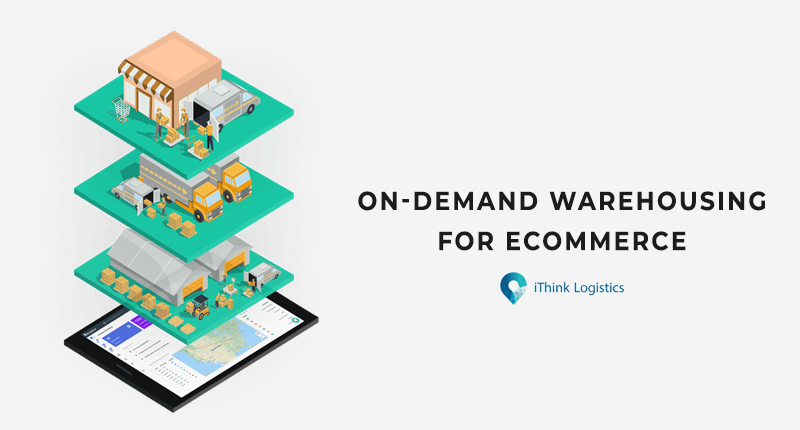
As the eCommerce came into force, it was clear enough that the traditional methods for fulfillment and warehouse management are not going to work and it is not going to be enough to support the rising industry. Thus, a completely new system was established for managing storage, retail distribution, and fulfillment, known as the on-demand warehousing. On-demand warehousing provides the retailers with a flexible and scalable warehousing solution. It depends upon the transactional pricing and marketplace model so that the brands and the retailers can contract and expand their connections as needed.
On-demand warehousing connects warehouse service providers who keep excess services and capacity with brands and retailers that require a flexible solution. The on-demand warehousing provides the pay-as-you-go model which helps the brands and the retailers to secure fulfillment and warehousing solutions at an ease and with no costly fee or long-term commitment.
How does it function?
On-demand warehousing allows the logistic centers and marketers to expand the network chain without thinking about the buying and building the space in the warehouse. This way they can easily get access to any warehouse space that is being given up by any company or owner in specific countries due to demand. Usually, companies tend to use the space only which is required for a specific period and do not stock up the extra space.
Om-demand warehousing also enables the marketer to expand their business over the course of time and that too at an affordable rate.
Demand for the on-demand warehousing
As the onset of the internet took a huge step, the way we shopped changed accordingly. However, the logistics that supported have not been able to catch up. The supply chain that was built was framed for the pre-internet era when products or goods sold in a traditional marketplace that was mostly centralized. The logistic network that was built was made for delivering the goods or products to the respective store shelves and not at the customer’s doorsteps.
Therefore, when the Omni channel and the eCommerce retail came into force and entirely changed our ways of shopping, it not only changed the old traditional ways of product distribution to customers but also increased the demands of the brand and the retailers on a large scale. This completely shut down the old ways of product distribution as it became inefficient and outmoded with time.
On-demand warehousing can help the brands and retailers to build a logistic system that can significantly support the myriad of the new preferred ways of shopping of the customers. When it is online, pop-up stores, Omnichannel, BOPIS, or any other method that doesn’t exist yet, on-demand warehousing can be a h=great help as it will help the business to adopt the new ways of satisfying their customer’s needs.
Why on-demand warehousing over Traditional warehousing solution?
On-demand warehousing is a new and improved solution to all the traditional solutions that were used. Let us see what traditional options do the brands and the retailers had back in the day for warehouse management.
Traditional-warehouse solution:
You can create an in-network. You can own, operate, and outfit this facility in your suitable ways.
ou can bring out your very own facility, then outfit it in your suitable way, and then operate it accordingly.
You can bring out services and space from a specific third-party logistics provider, and make them work for a multi-year basis for a long time.
Some combination of these traditional solutions can benefit your business, but there will be some major drawback to it:
Expensive
Traditional solutions always come with a steep upfront on capital investments and very expensive setup fees. On the other hand, on-demand warehousing can be accessible at a much cheaper rate.
Limited
With the typical system of partner with specific warehouse partners, your business growth is limited as they fall quite short on capabilities compared to the on-demand warehousing systems and also because of the faraway network locations.
Slow
The changes cannot be applied in an instant to your owned network and bringing out space from the traditional sources takes a long time to commence. On the other hand, on-demand warehousing is a rapid process and not every procedure under it takes a longer time to commence.
How is the on-demand warehousing process different?
The on-demand warehousing system allows you to create dynamic distribution network strategies that are as competent as your business. Using this you can scale the capabilities and size of the fulfillment and warehouse networks to match up to various demands and unexpected situation that arises throughout the year. Instead of creating a business only along with the infrastructure that you already have, on-demand warehousing allows you to keep up with customer’s rising needs and test out newer strategies. The model of variable cost negates the requirement of a fixed, short-term, or long-term contract with high premiums.
What on-demand warehousing is capable of?
On-demand warehousing allows you to support a large number of use cases. However, it has three major solutions that are eCommerce fulfillment, inventory overflow, and lastly retail distribution.
eCommerce fulfillment
The on-demand warehousing system for eCommerce fulfillment provides you the brands and the retailers the compatibility to scale the fulfillment networks or connections, as much as it is suitable to enhance the direct-to-consumer strategies. Brands and retailers can bring up fulfillment and warehousing networks to improvise their promises related to deliveries, testing new market places, and creating short-term promotions for the products.
Inventory overflow
On-demand warehousing enables brands and retailers to add extra capacity according to the requirement as quickly as possible, in case of an unexpected inventory situation or planned occasional peaks. This solution is a turning key for recurring problems related to warehouse storage.
Retail distribution
On-demand warehousing helps the brands to supply to their retail partners by offsetting inventory holding fees and by shortening transportation. This is done by storing products or goods closer to the location of the intake centers.
Logistic Parameter of India and the challenges it faced
The Indian logistic industry has been growing substantially within the years. The demand for it has been increased too. Here is an overview of the industry through the year 2016:
Parameter logistics India parameter index (LPI):
Score- 3.08 (where the rank was 54 globally)
Logistics cost (as a percentage of GDP) – 13%
Logistics cost-share for Transport- 8%
Warehousing -29%
Others — 63%
Major industries that are running the logistics sectors like pharmaceuticals, textiles, automobiles, cement industry, etc. the major problems that were faced during the setting up of the sector in India are Inadequate road and inadequate and bad transportation structures.
Storage and warehousing is the second pivotal element in the India logistic industry. As the supply chain developed and evolved, warehousing has become a major function for the economic development of the country. In recent times, the warehouse not only provides a secure place for the goods to be stored but also provides value-added services like packing, sorting, processing, blending, and transporting.
Depending upon the type of goods that is stored, warehouses can be differentiated into five major areas: retailor industry warehousing, warehousing for storage of liquids, warehousing for storing agricultural goods, warehousing for storing cold items, and warehousing fir storing the container items.
Advantages of on-demand warehousing
On-demand warehousing enables the companies to increase their profit margins by using the unused space and helps in building strong connections in the industry.
On-demand warehousing enables you to use the unused space to your benefit instead of bearing its expenses. It turns the non-used space into a revenue collecting asset.
As you will own the space, you can keep it available for your benefit as long as you want.
As a manager of a warehouse, you can form great on-demand warehousing trends in a specific city or country, which will, in turn, fetch your higher margins of profit.
Many retailers and whole sellers are gradually realizing the need for expanding their business and for that, they will require the on-demand warehousing system. This will not only help you expand your business but also fetch some newer customers for your brand.
Due to –on-demand warehousing, the brands and the retailers can locate and store their products closer to their customers. This will also enable you to compete with your rivals, and which in turn will help you create a strong and reliable Omnichannel strategy for your business operations.
This huge change with the on-demand warehousing systems being approaches and applied, the economy is being expanded and new warehousing connections or networks have been established.
Whenever you are thinking about on-demand warehousing, you must look for cities with a better utility like better port, great transportation options, and large warehouse properties. Metro cities like Mumbai, Bangalore, Delhi NCR, Chennai, Pune, Kolkata, etc. are the best countries as they have the largest hubs for shipping.
However, reaching larger cities can raise the profit volumes in terms of greater reach, but it also important to have centers in the rural and remote areas. Maybe you won’t be profit well in terms of travel but then your warehouse will the center of attraction of the whole area. You can raise your profit volumes by being the only warehouse in the area.
The growth of Indian warehousing sectors and on-demand warehousing
According to the recent market reports, the top eight metro cities that are Bangalore, Ahmedabad, Chennai, Hyderabad, Delhi NCR, Pune, and Mumbai altogether contribute to at least 42 percent of India’s total GDP. Therefore, they are also considered the country’s major warehousing hubs. The logistics sector of India is having a gradual shift from being an unorganized sector to being an organized one. It is now evolved well and is dealing with the higher quality warehouse that is being considered to be as A and B grade warehouses. They require automation and security in the operations. All these are ornamented with load trucks, vertical racking, automated conveyors, hydrant systems, fire sprinkler, and many more.
In recent times, the substantial growth of the Indian logistics and warehousing sectors have lured the equity firms (private) and foreign investors. Furthermore, the conducive policies such as the allowance of complete 100 percent “foreign direct investments” (FDI) in the food storage and warehouses, have lured them more into the Indian industry. The on-demand warehousing system is coming to force gradually and its substantial growth is consecutively teaming up with the evolved internet technologies.
In the time, where online facilities and online mobile apps rule the economy, the cashless benefit is that trump cards that everyone is looking for hassle-free and smooth transactions.
On-demand warehousing has been playing a major role in benefiting the younger entrepreneurs and SMEs so that the business can be proceeded cost-effectively, which in turn is going to lead the growth and development of money savings and business connections. Due to the introduction of immense advancement of technology and smarter marketing techniques, India has bloomed within the years in supply chain and logistics industry.
Conclusion
As everything is now digital, everything is moving faster than anything is. This technological era has evolved and thus it is very important to stay updated when running a business through the year. On-demand warehousing is one of the most highlighted section of the eCommerce.it enables you to expand your business territory and gain more and more loyal customers on the journey. If you own a business, it is necessary to go for on-demand warehousing.
The best way to describe the hyperlocal market is that it helps in connecting the consumers with the local retailers of a certain specific area. Communities and localities have a desperate need for on-demand delivery services. These deliveries are mainly hyperlocal by nature and thus they can be catered to during immediate needs. The transaction process is also very compatible and easily accessible in these deliveries. A single transaction can be completed with just an hour in on-demand hyperlocal businesses. The other primary reason for trusting the hyperlocal on-demand delivery services than the non-hyperlocal ones is its actual physical presence. The physical attire of the stores makes it quite easier to attend to the customer’s grievances.
It is a new and revolutionary way of doing business and the industry is craving for it. It is bringing new ideas and opportunities to the surface. This pandemic has changed the entire economic system. It has shaken the entire operative structures and retailers have finally changed their perception of the on-demand delivery system. In these difficult times, it is very important to grab on to any opportunity that opens up the door to any sort of growth or development. Logistics and deliveries do not mean the same thing for non-hyperlocal and hyperlocal businesses. Hyperlocal businesses don’t worry about things like long-distance transportation, warehousing, or logistics fragments. The only logistics that affects the hyperlocal businesses is the last-mile delivery.
Around the locality, their businesses ride on the retailers. The reverse logistics is not that of a big deal for the hyperlocal on-demand business as they only operate within limited areas. Retailers are not adopting the on-demand delivery system, they are suffering are a huge loss in their businesses. They are desperately looking for alternative ways to stabilize their business and the best option that seems so far is the option of on-demand hyperlocal deliveries.
Hyperlocal delivery is a delivery process where packages are delivered directly from the seller to the consumer. In these delivery processes, a particular courier agent picks up the specific product from the accurate seller and then delivers the package directly at the consumer’s doorstep. The whole delivery process is limited to a specific geographical area and the deliveries are usually completed within a few hours. There is some product category in these deliveries. Any item that weighs more than ten to twelve KG cannot be delivered. You have to maintain a weight restriction in this type of delivery.
Moreover, in this mad technology era, there is a lot of engagement in the eCommerce business that can provide you with online access to their items. Customers expect their items to be delivered as quickly as possible. You can call it a revolution or a diversion of time but technology has taken a huge leap. Therefore, people have adopted all the latest ways of lifestyle. Now customers prefer to purchase their item online rather than visiting the traditional stores and that is why both hyperlocal and last-mile delivery process holds a lot of relevance in recent times. Even though there are few challenges in Hyperlocal delivery, but it still holds a lot of importance. Find out.
Importance of hyperlocal marketplace model in recent times
The relevance of this particular market is huge in recent times. The industry is changing gradually, it is adapting to newer ideas and approaches, and the hyperlocal delivery system is one among them. If we look at the present situation, when the entire country is under the commencement of lockdown hyperlocal delivery has a pivotal role to play. Due to this outbreak, the entire buying pattern has changed. As the eCommerce industry is facing a major halt, only essential items like medicines, grocery items, healthcare equipment, food items, pet supplies, and many as such are made available for the people. In some areas are entirely shut down and people are strictly not allowed to step out from their houses. These are the areas where eCommerce is very essential.
Some of the courier companies have recently started delivery essentials across the nation. Therefore, in this case, the courier company’s delivery process should be very good and should be top-notch to ensure that the delivery agent as well as the customer is completely safe. Protective equipment like surgical masks, surgical gloves, sanitizers, and other essential safety items should be provided and made available. After keeping everything in mind, the timing should also be maintained. The delivery should be conducted within time so that the customers do not have to wait for their items.
Some people are buying essential stuff from nearby local shops. In this situation, the hyperlocal delivery can also be a game-changer. After the commencement of complete lockdown, people are not allowed to go to shops or places where there is a possibility of social gathering. Looking at the present state of the country, we are running at a high risk of getting affected by the virus. In these times, it is better to stay completely quarantined. Thus, it has become impossible for individuals to purchase essential items like grocery or food items, healthcare, and medicinal requirements, etc. Sellers can adopt the hyperlocal delivery system for delivering essential items to their customer’s doorstep. As the hyperlocal delivery system, is not that popular in India, a fast track method can be adopted.
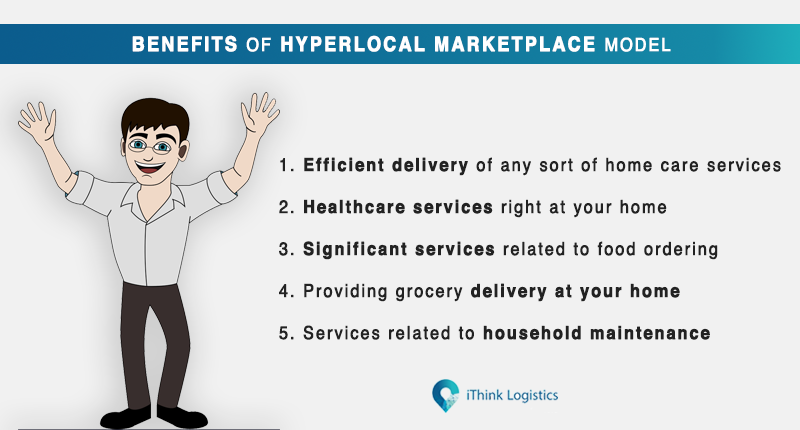
Benefits of Hyperlocal Marketplace Market place model
Providing with efficient delivery
Any sort of personal household or any sort of other home care services
The services include salon services, beauty regiments, spa services, etc. May be these services do not fall under the absolute necessary list, but it is very crucial especially during these times when people are going through a lot. These services can provide the common masses with some sort of comfort.
Providing Healthcare services right at your home
These services include baby care, caregiving, senior care, etc. During this time, it could be both difficult and overwhelming to take care of kids as well as senior members along with all the household work at hand. People will find it crucial to hire some sort of assistance during this time. Therefore, if they can hire personnel at the comfort of their home, it will not only be helpful for them but also be very beneficial for your business. Even if you charge some extra money on the services during this time, people won’t hesitate much before taking it as they can hardly manage to find some other better service during the pandemic.
Provide significant food ordering related services
This is one of the most needed and crucial services provided by the business. People tend to order food almost daily. During this pandemic, this service is more relevant and crucial than ever, as people cannot physically go around to stores and restaurants for grabbing food.
Working efficiently towards providing grocery delivery at home
Due to the commencement of social distancing, the common masses are avoiding the crowded traditional market places. As the stocks at their home are not lasting for long, they are ordering groceries online. This is one of the primary reasons that the online grocery delivery business is seeing immense growth in their profit margins. It is the best time to take your grocery business to an online platform.
Providing services related to household maintenance
These services include carpentry, plumbing, gardening, electrician, etc. These services can be beneficial both ways. Both the customer and the provider will be benefited. The customer will get its services and the person providing it can earn some money during these difficult times. During this pandemic, people cannot reach put to local service providers if they need any sort of handyman services. Therefore, it will be a great help for the customers if they can get a hand on plumbers or electricians at their fingertips.
Conclusion
This whole pandemic situation has been very hard not only on the common masses but also on the local industry. The entire economy has been brought down. In these difficult times, it is very necessary to come up with newer systems and ideas so that the industry can amidst the Covid-19 crisis. The success in logistic business lies in fulfilling customer needs and desires. The hyperlocal business industry is facing difficulty in fulfilling customer’s expectations of rapid delivery at their doorsteps. Without technology, it is difficult for logistic companies to cope up with these on-demand deliveries and that is why they need a proper business model for it. The hyperlocal market model is very much essential in India not only for the consumers but also for the industry to get stabilized. Moreover, this delivery model can be a great help for common masses. The common people are stuck at their houses. They are finding it very difficult to carry out with their day to day shopping. Thus, a retail shop that is providing hyperlocal delivery service can work wonders for the common masses.
If you are fulfilling order requests for a retail store or a single end customer, the B2B and the B2C will seem a very similar concept for you. It may seem to you that is not much of a difference between the two concepts. However, many key differences don’t seem to be on the surface. B2B refers to business to business order fulfilment and B2C refers to business to consumer order fulfilment. Both the category of order deliveries is very different and requires different operation and processes to be conducted. Each delivery that your business does whether to a single customer or an entire business, is required to reflect your brand name, otherwise, you might end up losing potential customers.
If you work with a suitable third-party logistics provider that perfectly aligns with your business ventures, then you might be able to navigate the key differences between the supply chain logistic, fulfilment services, inventory management, and warehouse management for the B2B and B2C orders and its respective complexities.
What do you mean by business-to-business fulfilment?
B2B is also referred to as B2R. Here the products are directly shipped to a business or a retail store. Here the average volume of the orders is much higher than the B2C so that the business receiving the orders can have enough inventory to sell from it. When the businesses place orders, they do it in advance and they do it in bulk so that they don’t have orders frequently.
Accuracy is one of the major elements in B2B order fulfilment. Businesses will have certain compliance needs like SKU codes, product restrictions, tax rules, parcel labels, particular invoicing structures, and barcodes. As the order volume is large and is much bigger than B2C, it takes a lot more money and time to get delivered. You need to get more familiar with certain carrier information like air freight, sea freight, along with some international trade barriers such as tariffs, taxes, and subsidies, as you will need to ship the orders far and wide.
If you are choosing a third-party logistics provider for your B2B order fulfilment, then you need to make sure that the third-party logistics provider you chose is providing reliable and fast deliveries. As the businesses, also deal with many other companies, they highly expect that these order fulfilments be done with utmost accuracy and efficiency along with cost-effectiveness. Third-party logistics also plays a pivotal role in meeting orders in time. Mismanagement and delay by the third-party logistics providers can affect the reputation of the organization and this may incur certain penalties and losses that they have to provide.
What do you mean by business-to-consumer fulfilment?
As the term suggests, the B2C orders are directly delivered to the end customers. As the order comes from a single customer, automatically the average order values of B2c orders are much lower than that of the B2Borders. The B2C order deliveries are also much simpler than the B2B, as there are not many rules and regulations that need to be followed while fulfilling a single order. These types of orders always have a pre-set price that appears and will display the same to every customer. The only exception to this is certain promotional or seasonal activities due to changes in demand or pricing. The payment process of the B2C orders is also very streamlined, as online transactions are very advanced and accessible these days.
Generally, you are fulfilling one single purchase from an individual user with B2C order fulfilment. This type of order does not face that much of an entry barrier, as the customers are buying directly from your website. Moreover, in this time and age, everyone seems to be very comfortable with online shopping and even many customers find it more preferable than store shopping.
If you are working with a third-party logistics provider to complete your B2C orders, then they will make sure that your orders are delivered damaged-free to their suitable customer at its suitable location. Some third-party logistics providers also handle refunds and returns of the products.
The primary differentiators B2B and B2C order fulfilment
There mainly three stages that occur in every order fulfilment:
Pre-purchase
Purchase
Post-purchase
In each of these stages, there is some key difference in B2B and B2C order fulfilment. Let us discuss in brief:
Pre-purchase
Product price
The pricing of the B2B orders is set based on the requirements and needs of the end business. However, the pricing can vary depending upon the recurring orders, size of the orders, the duration of the contract, and payment terms. On the other hand, a B2C order is much more straightforward and does not deal with much complexity like the B2B orders. The pricing set for these orders is pre-set by the company and there is rarely any variation in that.
Revenue received off of every customer
B2B orders mostly include the bulk of raw materials and a large volume of orders, whereas the B2C order fulfillments usually consist of a smaller volume of orders like electronic items or personal appliances, etc. Therefore, B2B orders can be as high as a million dollars and can still be recurring, whereas the B2C orders will be usually in hundreds and will one-off purchase.
Sales assistance
Often there is some sort of sales coordinator or account manager who helps in facilitating the exchange of goods for B2B order fulfilment. This lends a lot of help and support around the B2B order fulfilment process and more people are engaging in this interaction. On the other hand, in B2C order fulfilment, there is no need for any extra sales assistance, as the orders that are placed are directly placed by the end customers through an e-commerce business site.
Purchase
Selling/buying process
The selling process in B2B order fulfillments requires more time that a B2C order fulfilment, as they need to go through department approval, requests for quotes, negotiation, etc. on the other hand, in B2C order the customers can shop around different websites, or they can just place an order right away. This takes way less time than the B2B order fulfilment.
Order size
B2B shipments usually consist of large volumes of products, which is purchased in fewer orders. These products will be sold directly by the retailer through their physical or online store. Therefore, the retailer will place the order only when he has to restock their fulfilment inventory centre. On the other hand, B2C purchases are single hand purchases and often come in smaller volumes. These purchases are completed in a single transaction.
Payments
B2B payments are usually made within the contracted time duration using traditional methods like cash on delivery, credit, or purchase order method. In B2C orders, the payment is made immediately via debit card, credit card, cash, or cheque.
Post-purchase
Shipping and order fulfilment
As the B2B orders come in larger volumes, the shipment of these orders takes longer, requires sophisticated equipment handling, needs more money to complete, and professional unloading and loading of product pallets. On the other hand, B2C orders are low-cost as the packages are lightweight and sometimes have free shipping to them. Therefore, a single order can be shipped within a few days.
Customer relations
It is very important that you have proper personal relationships with the retailers that are willing to sell your product. Often B2B contracts come with large volumes, recurring shipments, and personal partnerships. This contract is mostly a negotiation over a period and requires constant monitoring and follow up. These relationships should not be confused with the customer satisfaction required for B2C order fulfilment. Customer satisfaction includes customer service, marketing, display of accurate products along with its details, on-time delivery, and proper order fulfilment that gives the ultimate customer experience.
Return
Every business should have a suitable system for managing the returns whether they are dealing with B2B or B2C order fulfilment. The B2C process of return is very simple and straightforward. The B2C orders have direct return policies along with a full refund if the customers are not satisfied with the product and they end up returning it. If the returned item is not damaged and has all its tags intact, then the customer will get a direct return within a few days of returning it. On the other hand, the B2B refunds and returns are very complicated.
The reverse logistic process gets way too complicated as they contain a large volume of products and order size, the contract that they are bonded to, and certain obligations that need to be negotiated. All these aspects have to be taken care of, then only a return process in B2B order fulfilment can be concluded.
Conclusion
Depending upon the kind of business you are running, you may opt for B2B order fulfilment or B2C order fulfilment, or maybe even both. Identifying the difference between each can be very difficult and challenging, but now that we have discussed each of its differentiators, you are better equipped to deal with it and make the right choice for your business.
If you run any sort of eCommerce business, you must have come across a similar term ‘Shipping Barcode’. It is one of the major elements for any business selling physical goods or products. This is used in the physical stores for purchase and return purposes. In warehouses and fulfillment centers it is used to track packages and inventories. Courier companies use barcodes to track and locate shipments and sometimes barcodes are used on the invoices for accounting purposes.
Barcodes have become an absolute necessity in the order fulfillment processes. It is so essential that logistics and moderns shipping is entirely incomplete without it. They are more prone to defaults without the barcodes embedded in the products. Many 3PL companies completely rely on barcodes while running their warehouse operations efficiently. This helps them to serve their customers better for whom they tend to perform the fulfillment services.
Let us discuss what shipping barcodes are and how it can help for enhancing e-commerce fulfilments.
What are shipping barcodes?
Shipping barcodes are certain patterns of different widths that are parallel. These patterns are printed on products or goods so that they can be read by a machine. These keep the stocks in check. A barcode is often embedded in the shipping labels of a shipment. These barcodes that are printed at the back of the product is very essential and is scanned by a machine from the point of pickup to the point where the product is delivered to the end customer. Barcodes on shipping packages are very informational and with one scan, it can identify the particular order. It can access its details like the kind and category of the product in the package, the particular delivery address where the product has to be delivered, the customer’s details, and even the mode of shipping and the mode of payment of the product.
Barcodes printed on documents like return documents or purchase order documents, can be a great help in retrieving any sort of information and record related to the purchase or return directly from the server.
When the shipping barcodes are exactly used?
Any business that is planning and arranging on shipping online orders or preparing their eCommerce inventory, make use of the shipping barcodes for advanced eCommerce fulfillment and tracking. Let us discuss at what instances the shipping barcodes are used:
While receiving the inventory in the fulfillment centers
When they are receiving the inventory items at the fulfillment centers, experts need to make sure that they have received the right items. They also need to make sure that the inventory they received is from the freight shipments or parcel shipments. For this, they need to scan the barcode that is embedded in the package or the inventory to make sure that the above facts are clear.
While handing out your orders to the courier companies
Once the order that is been placed is completely ready to be shipped after it is picked and packed properly, a shipping barcode will be imprinted on the label pasted on the package. The retail or the eCommerce company will hand out the shipment package to the courier company. Here the carrier will scan the barcode that is imprinted on the label pasted on the package before he leaves the fulfillment center. This is very necessary to keep proper records of the shipments that are being handed over on a day-to-day basis.
While receiving the returned orders from the particular end customers
Different categories of returns are made. However, the returns that involve customers directly shipping the returned item back to third-party logistics need to be scanned by the third-party logistics provider. They thoroughly scan the shipping barcode imprinted on the shipping label before they accept the order. This has to be done to make sure that they have received the right item and this is important because the refund will be initiated accordingly after they received the item.
How shipping barcodes can help in improvising your fulfillment operations?
Barcodes are a major element in the entire process of warehouse management. The barcode technology has become an absolute necessity in the warehouse management systems. It helps to maximize the benefits of the systems. Let us see some of the benefits that the shipping barcodes provide to increase the operational efficiency of your business:
It helps in increasing the speed of the order processing
It is impossible to process a large volume of orders without using any scanning technology. You will be highly prone to mistakes and you cannot avoid the situation. Without the proper technology, it is impossible to jot down the exact number of items that are in every single package, every single product details, and every single customer details who have placed the particular order. Shipping a large number of products daily is next to impossible without proper barcode scanning of the inventories, especially if the business is on the verge of growing every day. Barcodes help in increasing the speed of this large number of order processing and decrease the chance of errors.
It helps in reducing errors
Keying in important inventory data can lead to many errors. After proper integration with the warehouse management system, it was found that barcode technology could reduce manual data entry and bring it down to zero. It can increase the data collection speed during the processes of receiving the orders, picking the orders, the shipment of the orders, and during other inventory management operations. Barcodes provide us information with an utmost accuracy of 99.9 percent.
Helps in increasing efficiency and mobility of the systems
As technological advancement has taken place, scanners don’t necessarily need to be fixed at a single point. This means the warehouse merchants don’t have to stand at a fixed point to scan the orders. Now you can have access to wireless barcode scanners and these increase the efficiency of the warehouse as it cuts down unnecessary walking time. However, this might not be an absolute necessity for the smaller companies, but bigger companies that have more number of order processing per day can benefit from it greatly.
It helps in improving dashboards and inventory management
There is an extreme amount of data that is available in the fulfillment centers. However, most of the data is pen-paper based which makes it difficult to assess. Shipping barcodes does wonders in these cases when integrated with suitable warehouse management systems. Shipping barcodes can provide you with real-time data and information about major functions that take place within the warehouse. This allows the fulfillment directors and line managers to focus on other major facets of their business. Shipping barcodes are very efficient in inventory and warehouse management. They reduce the manual works and this in turn reduces the chances of errors that can occur while dealing with large volumes of orders.
Conclusion
Barcode technology is a new form of business now. Without it, you cannot run your business properly. It is the new form of growth and development of your business. This technology has evolved within the years and now has become an absolute necessity, especially for businesses that are growing every single day.
The novel coronavirus disease – better known as the COVID-19 is causing great fear, panic, and inconvenience to many people worldwide. In fact, the global focus has shifted priorities for most businesses, one of which includes the logistics and supply chain industry. And as the number of cases continues to rise every day, it impacts and has indeed taken a toll on the global economy that causes constant changes in stock prices, demands, and many more.
Also, because of the coronavirus threat, many people from different countries are forced to stay indoors and practice isolation for a couple of weeks. This is to help contain and combat the virus as much as possible. Meanwhile, warehousing facilities and workers are on the frontlines, observing business as usual. Along with the rising number of people staying indoors is also the increasing need for supply chain industries to keep their systems and operations up and running. A lot of consumers now turn to online shopping with the hopes of getting their basic needs and other essentials delivered in an instant and right at their doorstep.
But frankly, the supply chain and logistics industry are having a hard time coping with the latest global changes brought about by the pandemic. The current situation has indeed taken a toll on most businesses, if not all. So, to know more about this, here’s how the coronavirus has affected the supply chain industry:
End-To-End Global Supply Chain Disruption
The current situation of the world has definitely changed, disrupted, and posed a significant threat to the end-to-end [global] supply chain system. This concerns the products consumers use almost every day. Each of these products entails a couple of elements before the finished product is taken to a consumer. It takes a journey through oceans, rails, air, and roads before delivered to a boutique. Each of these complex supply chain systems is highly important, and if one is taken out of the equation, then it will most likely impact and disrupt the entire supply chain. With COVID-19 still around, it continues to affect all channels and nodes connected to the China-centric network.
Lately, demands concerning toilet papers and alcohol have skyrocketed. But grocery store shelves are all empty because of problems with a production capacity that may also lead to time and lead constraints. The raw materials used to make and formulate tissue paper or alcohol are probably linked by a specific network. The facility where this is made might not have enough workers or truck drivers to deliver these raw materials on time into warehouses, from there, then onto the shelves. And this is what it means to actually experience an end-to-end global supply chain disruption.
Fast-Paced System And Transaction
With all the basic needs and other essential goods rising in demand, warehouses and distribution centers worldwide, like LSCR’s, are working on a fast-paced system and operations. As previously mentioned, demands keep rising, yet stocks are running low each waking day. With that, the supply chain industry is forced to scale up on operations and production to meet consumer demands on time.
Reduction In Number Of SKUs
In order to make supply chain markets more manageable these days, many retailers have already started reducing product variety. This allows both supplies and the entire supply chain ecosystem to focus and make storage space for items that are currently high in demand.
The full extent and impact of the COVID-19 are still unknown, especially for the supply chain and logistics industry. But if there is one thing certain, it’s that now is the best time to adjust and prepare for all the potential economic downpours and disruption throughout the entire supply chain ecosystem.
Crucial factors to consider during this crisis
Despite all the ongoing operations and reassurance from suppliers and manufacturers, businesses should not ignore the fact that there will definitely be supply chain disruptions, one way or another. Therefore, it is only critical that large asset and business owners take a huge step towards responding to the current situation. How do you ask? Here are some crucial factors to consider when planning for and mitigating the impacts of the pandemic, so that startups can revamp during the corona pandemic.
Implement A Clear Forecast Of Business Requirements
You can’t afford to go all out or nothing at all these days. The current status of the world calls all businesses, especially those in the supply chain industry, to be as precise as possible. Forget about over or understocking your products, supplies, or other materials. What you should be establishing now is a clear plan and forecast of all your business needs. Make sure you always keep in check with your supplies or warehouse managers so that you are updated and notified with stock replenishment (especially for essential goods), manufacturing, backlogs, maintenance, and many more.
Enumerate Your Vulnerabilities
Being aware of all your vulnerabilities can significantly help you stay in control despite the current situation. And, two of the greatest vulnerabilities supply chain markets face today include production location and consumer match.
The location of your production strongly correlates with the availability of your workforce. Say, your warehouse is located in a place full of COVID-19 cases, then you might be having a hard time running operations. The best way to get through this dilemma? Incorporate warehouse robotics into the system. Warehouse management systems and software and other robotics greatly help keep distribution centers and manufacturing facilities up and running despite the threat of the virus because there is less to no physical contact among workers; hence, preventing contamination.
On the other hand, you could also be operating with the help of a third party manufacturer. But in the event that this manufacturer is overseas, then you might be having a problem. You see, the supply chain ecosystem is scattered all over the world. You could be selling products in one country but manufacturing them in a totally different state on the opposite side of the world. With the lockdowns and quarantine in place, businesses will be having a hard time coping and meeting production capacity and requirements. Which leads us back to square one: implement a clear forecast of business requirements—also, robotics.
Keep Your Communication Channels Open
Now more than ever, maintaining your supply chain’s flexibility is essential if you really want to lessen disruption. This is why it’s still vital that you keep your communication channels open with all your key suppliers. This will help both parties adjust to one another’s needs and requests. In turn, allowing you still to make transactions or manufacture amidst the on-going pandemic. Keeping all your communication channels open also significantly helps you make both ends meet, and who wouldn’t want that at such a time like this?
Have A Response Plan In Place
Consider making an entire response or resilience plan. Categorize each risk or problem according to severity or priority, then identify how you can mitigate each one. It helps to have your team have a say in this as they are the ones more exposed to systems and everyday operations. Some risks and problems may include but are not limited to:
Advance orders
Stock holdings
Changing of demand profiles
Building inventories
Stock replenishments
Getting an alternative or temporary supplier
Building inhouse
Continue Monitoring Activities And Adjust
We all know that the system is rapidly changing, along with the situation. Therefore, it’s best if you continue to actively monitor all activities under your watch and adjust accordingly. As new trends and information come to light, be ready to adapt while still having a risk response and recovery in line.
The pandemic is forcing businesses to consider how [global] supply chain behaviors are bound to change in unexpected ways. Alongside containing the virus’s impact is seeing to it that the supply chain ecosystem stays intact while depending more on innovations that could help with recovery. It’s not a matter of “how do we survive amidst the situation?” but rather, “how do we stay effective within the same industry?”
Here are some other things you can do to try and keep the supply chain ecosystem running and intact:
Look for alternative supply and transportation routes
Use digital technology
Reassess travel plans and package routes
Build inventory around stores and boutiques to reduce the impact of port delays
Calculate stock tolerance
Wrapping Up
Above all, one of the greatest challenges during the time of pandemic is keeping your workforce healthy. One staff who tests positive for the virus will only mean the entire facility has to go on quarantine and halt operations. This is why warehouse robotics is also an integral part of distribution centers these days as it helps reduce physical contact and contamination. Moving forward, we’d like to think that the supply chain and logistics industry will thrive even amidst the pandemic, and definitely once this is all over.
Communities and localities have a desperate need for on-demand delivery services. These deliveries are mainly hyperlocal by nature and thus they can be catered to during immediate needs. The transaction process is also very compatible and easily accessible in these deliveries. A single transaction can be completed in just an hour in on-demand hyperlocal businesses. The other primary reason for trusting the hyperlocal on-demand delivery services more than the non-hyperlocal ones is their actual physical presence. The physical attire of the stores makes it quite easier to attend to the customer’s grievances.
Logistics and deliveries do not mean the same thing for non-hyperlocal and hyperlocal businesses. Hyperlocal businesses don’t worry about things like long-distance transportation, warehousing, or logistics fragments. The only logistics that affect the hyperlocal businesses is the last-mile delivery. Around the locality, their businesses ride on the retailers. The reverse logistics is not that of a big deal for the hyperlocal on-demand business as they only operate within limited areas.
What is hyperlocal delivery?
Hyperlocal delivery is a delivery process where packages are delivered directly from the seller to the consumer. In this delivery process, a particular courier agent picks up the specific product from the accurate seller and then delivers the package directly to the consumer’s doorstep. The whole delivery process is limited to a specific geographical area and the deliveries are usually completed within a few hours. There is some product category in these deliveries. Any item that weighs more than ten to twelve KG cannot be delivered. You have to maintain a weight restriction in this type of delivery. Some of its benefits are:
Countering the traffic congestion
Customers from various localities have various needs. Urban traffic makes it very complex for conducting hyperlocal deliveries. If you can make proper use of technology, then you can plan better routes that are efficient and time conserving.
Bearing the costs of free delivery
The hyperlocal businesses get their revenue from two primary sources: one is from the commission that is earned from the merchants and the second is from the delivery charges received from the consumers. However, customers nowadays are very sensitive to additional delivery charges and expect free delivery on purchase. Along with that customer also expects flexible delivery. Catering to such demands can take up costs in the last-mile delivery. Therefore, automation is the only remaining option that can help you sustain the costs related to free shipping.
Easy access to allocating delivery zones
Automation helps your business to find suitable and sustainable delivery zones. It can help you find suitable routes that do not incur the last mile delivery charges. Moreover, it is very difficult to assign each delivery zones when there are thousands of orders from various localities.
Maintaining the efficiency of the fleet
For any hyperlocal logistical business, it is very important to maintain the productivity and efficiency of the fleet. In this mad technological era, suitable technology is the only significant option for marinating the efficiency of the fleet. The optimization of the delivery routes can help in the reduction of extra costs.
7 primary Challenges faced in hyperlocal delivery
The popularity of hyperlocal delivery has grown at an exponential rate. According to the study, almost 80 per cent of the start-up company has emerged for hyperlocal delivery since the year 2014. The difference between hyperlocal and last-mile delivery is that the hyperlocal market beholds great opportunities that can be a great boost to your business. However, as every opportunity has some sort of challenge to it, so does for the hyperlocal delivery industry too. Many challenges are faced in this business. Some of the primary challenges are:
Increasing competition
The eCommerce shipping industry itself has been a very busy place where competitors are at a leap. The hyperlocal segment also falls under the same category when it comes to competition. As time has passed, the hyperlocal delivery has evolved into something great. It is no more just an added benefit. It holds relevance as an entire marketplace. The competition is extreme in this industry. Players like Dunzo, Shadow fax local, Grab, etc. hyperlocal businesses are coming into the picture establishing the immense competition the hyperlocal industry holds. As most of the sellers are grabbing their opportunities to get these services, you should build access so that you can reach all these delivery partners for getting these services. You need to get a good hyperlocal service provider so that you can overcome the increasing threat of competitors.
Fleet management
The sellers in the hyperlocal industry that sell items related to grocery, healthcare, medicinal, raw meat or any sort of stationery item often hire their fleet. This can be a real challenge because managing the entire workforce can be costly as well as risky. Managing an entire fleet needs a lot of resources which can be very challenging at times. Another factor that can affect the feasibility of this process is that not all the orders that are placed have a fixed time interval. Thus, managing the entire fleet can be very cumbersome. Therefore, fleet management can be very challenging when it comes to hyperlocal delivery.
Irregular operations
The hyperlocal deliveries are very scattered and all over the place. Thus, even if your customers tend to stay loyal to you, the orders they place are very irregular. There are many instances that the orders somehow get spiked somehow, and this becomes very problematic. For example, during festive times, customers tend to order more and thus increase the frequency of the orders at an immense rate. During these times, customer engagement increases a lot and thus some of the orders get spiked. Other than that rest of the year, the order frequency remains normal. Therefore, such irregular operations become a significant problem or challenge for hyperlocal deliveries.
Additional fees charged by the hyperlocal marketplaces
Hyperlocal deliveries have been a popular form of delivery for a long time now and customers are more and more interested in these door to door deliveries. Customers have mostly become fond of this delivery type, as it is much more convenient for them than picking up their essential items at stores. They find quite a significant form of delivery where they can get their essentials at their doorstep and return if not satisfied. However, this is not that beneficial for sellers. The sellers had to put on additional amounts for listing their products on the market even though they provide proper visibility to the stores. Sellers had to put in extra effort and money for the entire listing process because without getting their products listed they cannot start the marketing process of the product. This can be very challenging and difficult for the ones that are new to this hyperlocal industry and do not have the required margins to pull this off.
The rush for the exclusivity
In the online marketplace of the hyperlocal industry, many brands have found their exclusive stores. They have successfully registered themselves in those stores. The stores that are chosen are mostly the ones that can shed those extra amounts for providing extra visibility and reach for the brands. In this rush for visibility, mostly the smaller stores fall behind and couldn’t fix the deal. On top of that, now the marketplaces have also started manufacturing their products. This supposedly poses a great threat to the already available sellers and shops. Therefore, selling any product in the marketplace is not as easy as it seems to be. The fight for exclusivity is real and very challenging.
Additional charges of marketing costs
Having the hyperlocal delivery for your brand is a great aspect of your business, however, making the customers aware of the same is a whole different challenge. It is a known fact that the hyperlocal sellers do not have huge profit margins on the sales and so investing in monotonous offline marketing can be a bit of a challenge. Informing your regular customers about any new service is very easy, but acquiring new ones can be very challenging. Sellers who have put the effort into building their online store along with their regular store can promote their brand on different social media platforms. However, if you are trying to target customers within a specific small area, it can be very challenging.
Difficult expansion
Every shop under this system operates at a micro-level. Therefore, it is very difficult to expand delivery services at a far distance. Here you can only engage buyers at a certain specific geographical area from the location where your market saturates. Therefore, for expanding or growing your business you have very few options like opening various branches in different regions.
One solution for all
The only solution for any above-mentioned challenges you are facing in your business is to get a suitable hyperlocal service provider that provides the following benefits:
Personal residential and home care services
The services include salon services, beauty regiments, spa services, etc. Maybe these services do not fall under the absolute necessary list, but it is very crucial, especially during these times when people are going through a lot. These services can provide the common masses with some sort of comfort.
Services related to food ordering
This is one of the most needed and crucial services provided by the business. People tend to order food almost daily. During this pandemic, this service is more relevant and crucial than ever, as people cannot physically go around to stores and restaurants for grabbing food.
Handyman services
These services include carpentry, plumbing, gardening, electrician, etc. These services can be beneficial both ways. Both the customer and the provider will be benefited. The customer will get its services and the person providing it can earn some money during these difficult times. During this pandemic, people cannot reach out to local service providers if they need any sort of handyman service. Therefore, it will help the customers if they can get a hand on plumbers or electricians at their fingertips.
Healthcare services at home
These services include baby care, caregiving, senior care, etc. During this time, it could be both difficult and overwhelming to take care of kids as well as senior members along with all the household work at hand. People will find it crucial to hire some sort of assistance during this time. Therefore, if they can hire personnel at the comfort of their home, it will not only be helpful for them but also be very beneficial for your business. Even if you charge some extra money on the services during this time, people won’t hesitate much before taking it as they can hardly manage to find some other better service during the pandemic.
Services related to grocery delivery
Due to the commencement of social distancing, the common masses are avoiding the crowded traditional market places. As the stocks at their home are not lasting for long, they are ordering groceries online. This is one of the primary reasons that the online grocery delivery business is seeing immense growth in its profit margins. It is the best time to take your grocery business to an online platform.
Conclusion
In this mad technology era, there is a lot of engagement in the eCommerce business that can provide you with online access to their items. Customers expect their items to be delivered as quickly as possible. You can call it a revolution or a diversion of time but technology has taken a huge leap. Therefore, people have adopted all the latest ways of lifestyle. Now customers prefer to purchase their items online rather than visiting the traditional stores and that is why the hyperlocal and delivery process holds a lot of relevance in recent times.
Both the delivery systems are quite relevant and very essential in this difficult time. If you adopt the delivery systems, you are bound to see the success of your business. These delivery processes are not relevant in this pandemic but also after this ends. Our eCommerce industry has seen a lot of development since the “delivery at the doorstep” is made viable. Therefore, you must give equal importance to both the delivery systems. If you plan to adopt the hyperlocal delivery process, you need to have an excellent last-mile network.
The success in logistic business lies in fulfilling customer needs and desires. The hyperlocal business industry is facing difficulty in fulfilling customers’ expectations of rapid delivery at their doorsteps. Without technology, it is difficult for logistic companies to cope with these on-demand deliveries and that is why they need a proper business model for it.
Ecommerce business, also known as electronic trade or web business alludes to the selling of products, purchasing, and administrations utilizing the internet along with the exchange of cash and information to execute these business procedures. However, it also portrays any sort of business exchange that is made or encouraged through the web. While e-business refers to all parts of working, an internet business or online business refers to the exchange of enterprises and merchandise. The mobile e-commerce business is a quickly developing new road of e-commerce that is for the most part determined by the growing e-commerce shipping sector business sector and impact of cell phones and recent smart devices associated with shopping on the web.
Ecommerce business has developed to make items simpler to find and buy through online retailers and commercial centers. Autonomous specialists, private ventures, and enormous partnerships have all profited by e-commerce business, which empowers them to sell their products and enterprises at a scale that was unrealistic with conventional disconnected retail.
To date, eCommerce has been entitled to great success by outsourcing fulfillment. If you are good at outsourcing fulfillment, then you can help your business grow at a faster pace. However, there is a silver lining in discussing and choosing a fulfillment company. Not every fulfillment company is made similarly. Every fulfillment providers offer different services on the fulfillment of orders. There are many factors that you need to consider before getting on with the process that is the monthly volumes of the order, the locations of your targeted customers, and last the category of product that you sell.
If you are into an online business, then it can be difficult to determine accurate ways of charging the e-commerce shipping costs from your clients. This can be tricky because of the ample amount of eCommerce stores that are available does not provide that element of consistency. Some questions are bound to cross your paths i.e. whether you should offer free shipping to your customers or whether you should charge the shipping prices based on the weight of the items and lastly will you be capable enough to maintain the profit margins.
These are the most common questions that bother all the online business holders. In this content, we will highlight the common problems faced by online retailers and their consecutive solutions. The shipping rates that you offer will depend on the type of industry you are working in, the type of items you are delivering, and the estimated sales value of this item.
Before getting into the problems, we need to highlight how you should determine your shipping cost.
Benefits of an e-commerce business
There is a motivation behind why e-commerce has shown such significant development in recent years. Surely, with the web turning into a basic prerequisite of regular daily existence, organizations are figuring out how to exploit the various advantages of e-commerce, the most eminent of which include:
Global market
A physical store will consistently be restricted by a geological region it can serve. An online store or some other kind of e-commerce business has the entire world as its market. Going from a neighborhood client base to a worldwide market at no extra expense is probably the best favorable position of exchanging on the web. In 2018, 11.9% of worldwide retail deals originated from online buys and this is just set to build year on year.
Availability
Another incredible advantage of maintaining an online business is that it is constantly open. For a trader, it is an emotional increment in deal openings and an accessible choice for the clients. Unlimited by the working hours, e-commerce organizations can serve clients all day, every day/365.
Reduced cost
Online business organizations profit by fundamentally lower running expenses. As there is no compelling reason to enlist deals staff or keep up a physical retail facade, the major e-commerce costs go to warehousing and item stockpiling. Moreover, those who are maintaining an outsourcing business value even degraded forthright venture requirements. Vendors can offer better limits to their clients and arrangements as they can save considerable amounts on operational costs, they Inventory management: E-commerce shipping business organizations can automate their stock administration by utilizing electronic devices to quicken requesting, conveyance and installment methodology. It is sparing the organization billions in operational and stock expenses.
Targeted marketing
With access to such an abundance of client information and a chance to watch out for client purchasing propensities just as the developing business patterns, e-commerce organizations can remain light-footed and shape their promoting endeavors to give a superior customized understanding and discover all the more new clients. Just consider that you get an opportunity to address all your clients by their specific first names; that is something as of now.
Niche markets
Running a special e-commerce business can be extremely challenging. Scaling a specialty item to get well known is effortful. By taking advantage of a worldwide market, then again, e-commerce retailers can fabricate an exceptionally productive specialty business with no further speculation. Utilizing the web search abilities, clients from any side of the world can discover and buy your items.
Working suitability
Maintaining an e-commerce business implies that you don’t have to sit in an office from 9 to 5 or endure a drive throughout every day. A PC and a proper internet connection are all you need to deal with your business ventures from anywhere on the planet.
How to start an e-commerce business?
There is a consistent question on how you should approach constructing an e-commerce online store. Even though a real online store cannot be constructed in a single day, people try to approach the procedure without proper knowledge. Investigating, building, propelling, and growing a gainful e-commerce business is a multi-layered procedure including various advances and choices. Some pointers are discussed below:
Selecting and sourcing the right product
The initial step to begin an e-commerce business is choosing what items you’re going to sell. Finding a productive thought can be difficult work, so you need to set up to do some genuine burrowing and thinking. Fundamentally, you pick items with sound edges that will permit you to turn a benefit and scale the business later on. When you comprehend what you need to sell, you will have to choose how and where you are going to source the items. The four principle strategies for sourcing items and stock are making, assembling, discount, and outsourcing.
Planning and conducting research
Your product planning will direct which parts of the market you have to inquire about, however probably the most significant territories to investigate will be your opposition, estimating methodology, and your remarkable incentive. Now, it is likewise a smart thought to draft a field-tested strategy that will assist you with envisioning your development procedure and distinguish any potential dangers or obstructions.
Frame your brand identity right
Since you have a promising item thought and a way for the market, it’s an ideal opportunity to begin considering the key components of your store, for instance, area name, your image identity, brand regulations, and your unique logo. Getting your image directly from the beginning can help quicken the development and vanquish the hearts of potential clients. Before directing your concentration toward building the store, you ought to invest some energy examining the essentials of SEO, with the goal that your business gets looking great so far.
Setting e-commerce shipping rates for your online store
DETERMINING FOR SHIPPING COSTS
You must estimate and calculate your shipping cost before you set the shipping prices that you will be charging from your customers. This is how you can determine the shipping costs:
Handling
The first and the foremost thing that you need to assess is the average time needed for you to pack an item that you want to sell. This process will be easier if you calculate considering less number of items. You need to identify the exact number that is required for packing a single item and then divide those numbers by 60. As you get the number, multiply it with the hourly rate that you might consider paying your employees. If you do not have employees for measuring the same, you can consider the minimum rate that you will consider paying.
Packaging
After handling, you need to identify the average amount required for arranging the materials needed for packaging like the tapes, boxes, cushioning items, and many more. You should always have the exact numbers while determining the amount you need for packing a single item. Nevertheless, if you are selling fewer items you can precisely consider $1 for your packaging.
Postage
After the packaging requirements are fulfilled, you need to move on to the postage requirements.Here you need to calculate the average package weights and dynamics. Then place the same numbers in a shipping calculator for assessing various locations where you might carry out your shipments. If most of your clients will be in India, then test out different locations in India to identify the average cost required.
After you get all three of your numbers and then add them up to determine your final cost excluding the fees and taxes. You will have the average shipping cost according to each order and then you can finally set the shipping rates for your online business.
SOLUTIONS FOR SHIPPING
There are mainly are several ways in which you can manage the shipping rates of your company. However, we’ll be discussing the foremost common solutions:
Free shipping
In this shipping, you deliberately get hold of the shipping and don’t truly charge your customers for the delivery.
Flat-rate shipping
In this shipping method, you set one rate for each order no matter the load, quantity, or size.
Price-based shipping
In this method, you set the shipping rates in line with the full cart price. This shipping system is typically framed into a tired system. Here the shipping worth ought to be supported by the full cart price of the things purchased. The price will fluctuate concerning items that are being added. However, the tiers can continuously be outlined by the worth of the item.
Weight-based shipping
In this shipping process, you set the shipping price of a particular item ordered according to its weight and dimensions.
Real-time rate calculators for shipping
The shipping cost is calculated in real-time via specific shipping carriers like UPS, FedEx, etc.
Sometimes you can consider combining any of the options mentioned above. For example, you might offer free shipping on items that are above $100 but charge an extra weight-based amount for orders that are less than that.
Calculating the average e-commerce shipping value for your products
The initial step is to work out a variety which will be a possible shipping rate for every one of your products. You need to choose an appropriate carrier and you need to set the dynamics of the product that you are going to be shipping across. This may appear tiresome work, but you cannot avoid it in any doable manner. You have to do this when you ship a product.
After you are done figuring out the weight and size of your product, go to your carrier’s website and log the destination zip code of the areas. Be sure to select both the rural and urban locations. Your carrier might charge more for the rural areas even though they geographically much closer. After getting into the Nitti gritty of it, you will understand the trend. Then it will be easier for you to determine what your average shipping cost will be for each product.
Calculated v/s Flat rate
Flat rate means charging the shipping rate that has been pre-set whether it is free shipping that is being offered or the shipping rate that is charged for all the orders that are placed. Calculate shipping is different from the flat rate. It is not decided or set for beforehand. It is set considering different variables such as the weight and dimensions of the item, the total price of the item, and the destination where the item is to be delivered.
There are advantages and limitations to both the rates. There have been several types of research and assessment on which of the rates are better when it comes to the whole profit margins of the company. It has been found that the calculated shipping rate is better when it comes to increasing the cart abandonment.
When the customers are shopping on your online site they tend to make two consecutive decisions- on whether they want the products or items that you are selling on your site, two whether they are willing to pay the price that you are offering on that particular product. These are the two major decisions that you need to go through. You have to be very tricky in such a situation because for every extra decision you ask your customers to make; you will lose one significant amount of them. For instance, while your customers are checking out and they see a shipping rate that is been charged for the item, they will tend to think again whether they are willing to pay the shipping charges and whether the other stores will charge them with the same or less amount. These last-minute decisions can make you lose customers.
Mostly big retail companies do not charge the exact amount that is required for the shipping, so the customers never have the actual idea of the shipping rates. Many retailers tend to offer free and discounted shipping rates and therefore customers always expect to get some kind of discount every time they shop. This is a great strategy because the retailers that are offering such discounts are not losing the money instead they are recouping the amount from elsewhere. Maybe they are increasing their profit margins by increasing the sales price of the product or they have realized that offering free shipping has increased their sales and they are making huge profits in the sales volume.
If you are not significantly aware of the common e-commerce shipping terms that are used in the shipping industry, then most definitely you will be unfamiliar with the various trading practices that are conducted in respective countries all-round the world. It is very important to know all the shipping terms exactly, otherwise, any default, in this case, can lead to great disputes regarding payments of freights, shipment prices, or cost-related to any kind of insurance or security. The trade rules of the shipping processes are termed as the “International Commercial Terms or Incoterms”. This is a series of rules regarding the shipment processes laid down by the International Chamber of Commerce or ICC.
EXW (EX works) – Related to (named place for delivery)
The sellers are responsible for making the goods available at the said address or at any other named place. Here the maximum obligations lie on the buyers and minimum obligations lie on the sellers. The Ex-works is used to refer to any particular sale of items without including the cost. EXW means that there is risk associated with the process of shipment and the risk is incurred by the buyers while completing the delivery of the administrations
FCA (Free Carrier) – (Related to named place for delivery)
The sellers deliver the items that are cleared for exports at a particular place including their premise. The goods or administrations can also be delivered by a carrier who is nominated by the buyer itself. In modern usage, the incoterms have replaced the wide usage of the FOB. However, the probability of risk is always there from loading up the vehicle for abroad ventures to the determined places.
CPT (Carriage paid to)- (Related to the named place of the location)
CPT takes place of the CFR terms associated with every shipping mode that is beyond the non-packed sea freight along with the C&F. the seller is bound to pay for the transportation of goods up to the said location. However, the goods are already considered as delivered when the items are handed over to the primary or main carrier. Henceforth, the risk passes on to the buyer who has assigned the primary carrier at the said location in the exporting country.
Airway bill number (AWB number)
This number is a –digit tracking code used for tracking shipments. This number can be used to check the real-time status of the delivery and its exact positions. If your delivery is late, then you can use the AWB number to register you to complain to the logistics and the shipping company.
Shipping invoice
This document contains standard information that includes the address and the name of the receiver and the sender. It also reflects information about the ordered items, which includes the number of items, their price, any applicable taxes, any discounts that are been applied, and the final amount that is being paid.
Conclusion
Ecommerce business has developed to make items simpler to find and buy through online retailers and commercial centers. Autonomous specialists, private ventures, and enormous partnerships have all profited by e-commerce business, which empowers them to sell their products and enterprises at a scale that was unrealistic with conventional disconnected retail.
Worldwide retail internet business deals are anticipated to reach $27 trillion by 2020.
Logistics management is an inventory network of the supply chain that is utilized to satisfy client needs through the planning, control, and usage of the viable development and capacity of related data, products, and enterprises from starting point to the goal. Logistics management helps the organization to reduce costs and upgrade the client services. The logistics management procedure starts with crude material amassing to the last phase of conveying merchandise to the goal. By holding fast to client needs and industry gauges, logistics management encourages process technique, arranging, and usage.
There are some particular important elements of logistics management. The elements are:
Choosing the aptest vendors that will enable you with transportation facilities.
Selecting the most suited routes for transportation facilities.
Choosing the proper delivery way
It uses certain programming software for handling any related issue
In logistics management, hasty choices make various issues. For instance, conveyances that are canceled or delayed lead to customers’ disappointment. Another potential issue is thoughtless transportation. Poor logistics planning steadily build costs, and issues may emerge from the execution of inadequate logistics programming. A large portion of these issues happens because of ill-advised choices identified with redistributing, for example, choosing an inappropriate merchant or completing conveyance undertakings without adequate assets.
To determine these issues, associations should actualize the best administration rehearses. Organizations should concentrate on coordinated effort instead of rivalry. A great coordinated effort among transportation suppliers, purchasers and sellers decreases costs. An effective and safe transportation supplier is additionally indispensable to business achievement.
Tips to maintain effective system logistics management.
Effective administration is the way to progress, particularly when it comes to supply chain management. There are different components associated with compelling logistics management, for instance, computerization and impeccable coordination. However, there is always scope for improvement in the process. At the point when your business observes development, you should discover newer approaches for logistics planning. This will substantially help in arranging forms for improving yield.
Proper planning
The initial step to achieving an errand is planning. Presently, planning exemplifies different components. It includes obtaining the merchandise, storerooms, and conveyance of items to the specific area. Other than these, parameters that are considered is– transportation, time and expenses. An inventory network usable ought to have the option to devise the stream diagram for the entire activity. The reason for planning is to accomplish the most extreme work at all conceivable time. Simultaneously, arranging should target expanding the benefits. Appropriate planning is a shrewd arrangement, yet an accomplished administrator will have the option to get ready for the unexpected conditions too. These circumstances can be identified with:
Products
Problems of transportation
Choose accurate freight class
Research
For this, a contingency plan should be formulated for avoiding further problems or failures related to logistics. The process of logistics planning is incomplete if an emergency plan is not formulated along with it.
Adopt automation
In this era of automation, technology and innovation play a significant job in expanding the proficiency of an association. Automation has an indispensable job in the business procedure streamlining. There is significant programming software that can be sent in the logistics framework. This saves a lot of time because manual dependence for the management is not considered relevant anymore. Additionally, precise tracking helps in improving the executives of process management. The worker subtleties and record subtleties can be overlooked by utilizing explicit programming framed for these particular assignments. Subsequently, the logistics firm should grasp the newer technological evolutions for expanding its efficiency and credibility.
Value relations
The team is a basic part of an association that is answerable for the development. Regardless of whether it is the warehouse supervisor or the delivery person, everybody ought to be flawless in his or her particular field of work. For this, you have to put resources into the appropriate training of the workers. Workshops conducting regular training keeps the employees completely updated with the ongoing trends prevailing in the logistics associations. These aides in expanded productivity and fulfillment of the customers. Logistics manager with perfect relational aptitudes is critical for the association. There are times when things do not work as per the planning. You will need a dependable individual who can handle such issues with extreme effectiveness. In addition, the supervisor should have definitive contacts in the business. This can be advantageous in tapping the business openings.
Warehouse management
Proper Logistics management is deficient without the proper functioning of the warehouse management. Warehouse management form the backbone of the logistics industry. It looks after every little inconvenience that can lead to huge losses. The warehouse activities are significantly subjected to the kind of products being manufactured. For instance, short-lived merchandise, for example, dairy items, needs refrigeration systems. Grains should be stored in a place that is particularly free of any kind of dampness or moisture. Correspondingly, the specifications fluctuate according to the items being stored. The logistics firm should target building up a proper warehouse inventory so that there is the least wastage of merchandise. In addition, expand the capacity limit of the distribution center. The utilization of vertical stockpiling sections is suggested. Moreover, proper software should be installed. This helps in the execution of the product for sequencing the items so that there is no delay while finding the particular items while the order is already been placed. The staff working in the warehouse should be efficient enough to perform the warehouse activities whenever called for.
Efficient transportation
The transportation system can be broken down into two aspects that are the costs of the logistics firm and the quicker conveyance of the items. Following components ought to be considered for effective transportation:
Deciding the best conveyance course. A logistics firm ought to settle on the briefest yet most secure course. This is helpful for setting aside cash just as time.
Well-informed packaging guarantees low venture and wellbeing of merchandise too. Streamline the packaging with the goal that it possesses less volume and it does not expand the heaviness of the bundle.
Improvise and measure
Logistics managements organize streamlining that is deficient without incorporating estimation, examination, and inputs. You have to quantify the amount of yield when you introduce new processes in the system. This is significant as it suggests the achievement or disappointment of the procedure. Estimation devices and programming ought to be incorporated that effectively decides and arranges the data according to the prerequisite. Your future arranging is intensely reliant on the deliberate data. The measurements identified with various tasks. This includes:
Cost metrics
Cycle-time metrics
Service metrics
Liberal criticisms help in extemporizing. The thoughts and recommendations of the representatives ought to be recorded occasionally. This guarantees you produce a pool of thoughts and simultaneously, it uncovers any imperfections in the framework.
Logistics resources
A logistics firm is an inventory network process that executes, plans, and controls the proficiency, viability, and capacity of the products, its benefits, and data related to it from the purpose of origin to the point of utilization to meet client prerequisites. Strategic assets, for example, tanks, pipelines, and boats, have the fundamental goal of making items, gear, and crude material, stream simpler all through the process to amplify benefits.
The calculated assets arrangement generally is applied to frameworks for its reliance and related requests and supply of items. Overall, in the calculated model appraisal, hardware with unwavering quality, which profoundly influences benefits, is not considered. Much of the time, logistics is additionally not considered in the RAM examination. The primary conversation right now is the significance of including plant dependability issues and calculated assets, which together have a perplexing model.
The fundamental strategic assets in a treatment facility are tanks, which give oil to refining plants. Such tanks diminish framework inaccessibility at whatever point siphons or other hardware that supply oil to the tanks shut down.
Structure of logistics management
The logistics firm characterizes the jobs inside the asset organization that are liable for planning the development of gear and workforce comparable to the good test activity. This data might be exhibited utilizing an organogram. A common arrangement characterizes a lead logistics director based at the asset organization central station or supply base and a second logistics facilitator based at the well site in the department. This staff speaks to the central focuses inside the asset organization association through which all material and workforce developments are approved and facilitated. These jobs, for the most part, sort out all transportation.
Workforce developments are commonly overseen through the well site logistics’ facilitator who orchestrates flights and settlement for staff heading out to and from the well site.
This area of the arrangement records the names and contact subtleties of the logistics. The central logistics department focuses on all hardware and material conveyances. Area maps for land-based locales, especially guides specifying fitting waypoints if the well site is in a remote area, are significant for staff who have an event to make a trip to the well site by the street.
The role played by logistics management in the supply chain
Logistics resembles the oxygen, which makes the store network inhale and live because, without appropriate calculated help, the development of products over a chain would not be smooth. Let us investigate how logistics turns into the unshakable establishment on which any production network stands:
Following the order
The buying request is integral to any exchange between the gatherings in an inventory network. This archive contains all the vital subtleties, for example, the details of the item and business terms. Appropriate logistic guarantees that this archive is handled in time in order to guarantee a successful execution cycle and to get out any uncertainty about the accessibility of materials and installment terms.
Inventive inventory
A perfect stock is one that has compelling capacity abilities to guarantee smooth stockpile yet can likewise chop down cuts. Logistics guarantees this moment balance between advertising openings and planning. An inadequately overseen stock can consume a significant lump of the benefit in an inventory network since it incorporates costs for pilferage and protection.
Warehouse war
The distribution center is the focal sensory system in a store network and goes about as the control space for everything strategic. An association’s legitimacy is controlled by its powerful warehousing choices. Variables like area, number, size, format, and configuration assumes an enormous job in how the logistics fairs of an inventory network will work out.
The tricky nature of transport
Transport is the thing that keeps the production network moving truly and metaphorically and it is the absolute most significant segment in the calculated side of supply chain management. The physical exchange of merchandise is the real providing procedure and it cannot vacillate using all means. The transportation foundation has to be considered in order to guarantee a quick conveyance, which is not excessively costly. Deciding the earnestness of a stock is additionally significant.
Material handling
Material handling is a frequently disregarded viewpoint with respect to the job of logistics in supply chain management. Since no appropriate measures are taken for regular hazards, delays, and accidental expenses. The mechanization in the material handling process has resulted in much-calculated profitability. The volume, speed and the degree of administration all must be thought-about to guarantee that the material handling procedure goes easily.
Packaging
Strategic or modern packaging is vital to guarantee the viability of the real physical appropriation of an item. This influences the strategic side of a supply chain instead of item packaging, which is represented by what the market needs. Strategic packaging can guarantee insignificant harm during material dealing with and save money on a significant extra room. The packaging cost frequently relies upon the use of the heap.
Information
Logistics helps in moving data over a supply chain and hence a data framework assumes a significant job in guaranteeing better assistance. Data innovation devices are continually used to store, break down, and recover significant information, which can enable a firm to reinforce the capacity of logistics in their inventory network.
International logistics management
Universal advertising is getting increasingly critical to organizations as the world shifts from unmistakable national markets to connected worldwide markets. Globalization brings homogenization of customer needs, the progression of exchange, and serious favorable circumstances of working in worldwide markets.
Organizations are compelled to think and act all around to get by in such a unique situation. Every one of these components has a profound effect on the advancement and the situating of organizations on universal commercial centers where rivalry is pitiless. Besides, another critical change concerns those clients’ worries about significant issues like, lead-time what’s more.
Right now, it must be increasingly adaptable and receptive to foresee and to adjust to such changes. This mission for adaptability and reactivity influences the origination and the administration of firms. This the part that their strategic frameworks add to the advancement of organization relations, to the development of mergers or key coalitions between organizations.
Subsequently, a firm can never again be considered as a secluded element yet as a segment of a more extensive supply organize. Universal Firms have started to actualize different methodologies to remain serious in the world market.
Logistics is one of the key zones during the time spent in universal advertising as the conveyance of products to the purchaser is as significant as any other movement in business and advertising. Frequently, the most pivotal part of Universal exchange is the convenient conveyance of products at a sensible expense by the exporter to the merchant.
Truth be told, the imminent purchaser might be happy to pay the expense that is even more significant for auspicious supplies. The development of logistics as an integrative action, with the development of crude materials from their wellsprings of supply to the creation line and closure with the development of completed products to the client, has increased extraordinary significance.
Prior on, not all the capacities containing logistics were seen as segments of a solitary framework. Nevertheless, with the rise of calculated as a significant piece of the corporate system because of specific advancements in the field of global displaying has increased unique importance.
Relevance and concept of international logistics in marketing
Word, ‟Logistics‟ is gotten from the French word ‘longer’, which implies the specialty of war relating to the development and supply of armed forces. Fundamentally a military idea is currently normally applied to promoting the board. Battling a war requires the setting of an item, and to accomplish this goal careful arranging is required with the goal that the soldiers are appropriately conveyed and the stockpile line comprising, weaponry, nourishment, clinical help, and so forth is kept up.
So also, the arrangement ought to be perfect so that there is a base loss of men and material while, simultaneously, it is fit for being changed if the need emerges. The showcasing supervisors likewise need a reasonable logistics plan that is equipped for fulfilling the organization’s goal of satisfying the need of the potential and valued clients.
From the perspective of the executives, advertising logistics or physical dissemination has been depicted as „planning, actualizing and controlling the procedure of physical progressions of materials for the purpose of utilization so as to address customer’s issues at a benefit. As an idea, it implies the craft of dealing with the progression of crude materials and completed merchandise from the wellspring of supply to their clients.
At the end of the day, essentially it includes proficient administration of merchandise from the finish of product offering to the customers and now and again, incorporate the development of crude materials from the wellspring of supply to the start of the creation line. These exercises incorporate transportation warehousing, stock control, request preparing and data checking.
These exercises are viewed as essential to the successful administration of logistics since either they contribute most to the all-out expense of logistics or they are fundamental to the powerful fruition of the logistics task. Notwithstanding, the organizations must complete these exercises as a basic piece of giving the client the merchandise and ventures they want.
Its significance
The significance of logistics frameworks lies in the way that it prompts extreme culmination of the deal. The purchaser is not keen on the guarantees of the vender that he can supply products at serious cost however that he really does as such. Conveyance, as indicated by the agreement, is basic to satisfying the business and lawful prerequisites. In case of inability to conform to the stipulated supply of period, the dealer may recover his deal sum, however, may likewise be lawfully punished, if the deal so determines.
There is no uncertainty that a better conveyance plan is a decent limited time technique when purchasers are hesitant to put resources into warehousing and keeping a more significant level of inventories. Additionally, better as well as opportune conveyance helps in getting rehash arranges through the formation of generosity for the provider.
Accordingly, as successful logistics framework contributes massively to the accomplishments of the business and promoting destinations of a firm. It makes time and spot utilities in the items and in this manner helps in amplifying the worth fulfillment to buyers.
By guaranteeing brisk conveyances in the least time and cost, it assuages the clients of holding overabundance inventories. It likewise cuts down the expense of conveying stock, material taking care of, transportation and other related exercises of dispersion. In nutshell, an effective arrangement of physical circulation/coordination has an incredible potential for improving client care and decreasing expenses.
Conclusions
If you wish to best over your rivals, you ought to adjust the most recent innovation and creative methodology. The point of powerful logistics management is to improve the proficiency of the tasks, guaranteeing consumer loyalty, and increment efficiency. These tips and procedures are fundamental for process enhancement. Each logistics firm that is battling to help their tasks, they can consolidate these proposals for logistics network enhancement. Logistics management is one of the important aspects of the whole logistics industry as it contributes to the economic benefits of the country. The logistics industry is so huge that it significantly influences the country’s economic states.