iThink Logistics | Blogs

Categories
E-commerce Logistics

5 Steps to Build a Successful Online Dropshipping Business

To start your own e-commerce business, you need to manufacture/buy original products, store them in your warehouse, list them on your website, host your website, integrate a payment gateway, manage customer care, handle the marketing to ensure traffic, and provide shipping. 

Seems like a lot to handle? We can understand. 

But what if you can simply manage the hosting, marketing, and payments and still reap all the benefits of an e-commerce website?  

Indeed you can with the dropshipping business model! 

Dropshipping is an e-commerce business model that has gained massive popularity over the years. It basically involves hosting a website with products listed on it and not worrying about the rest. All it requires you to do is to make a platform that the customers can visit – similar to a display tile. Once a customer places an order, a dropshipper simply processes it and sends the request to the third-party manufacturer. Then it becomes the manufacturer’s responsibility to ship the product safely to the customer. 

And the best part is that the dropshipping business model doesn’t require you to have a large warehouse. All you need is a tie-up with a seller/manufacturer and they will deal with the shipping. 

Some other benefits of starting your online dropshipping business in India include investing minimal capital, the freedom to run it from anywhere in the world, the freedom from maintaining an inventory or renting a warehouse, no shipping hassle, the flexibility of adding/removing products based on performance, and the ease of starting a dropshipping business in the first place.  

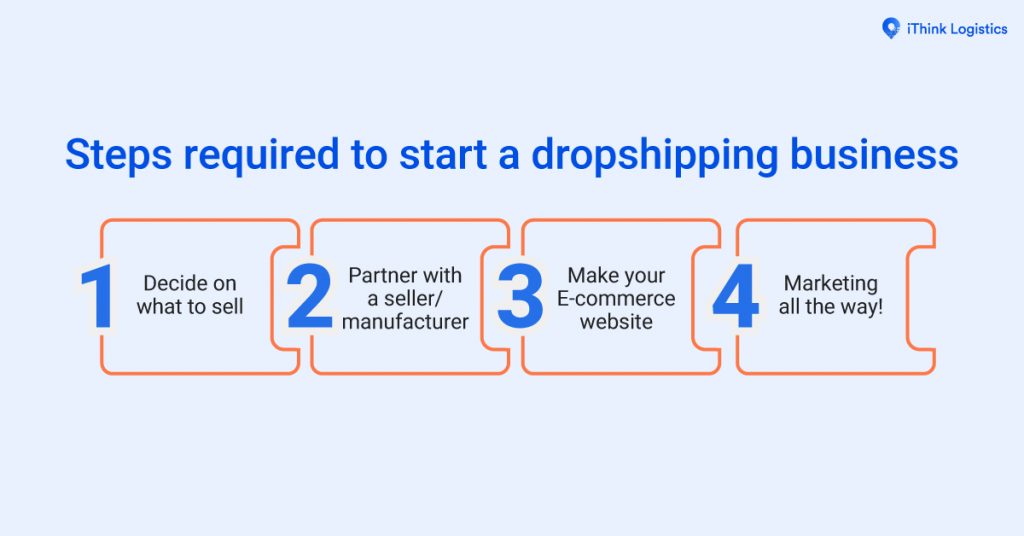
Steps required to start a Dropshipping business

Decide on what to sell 

In a competitive world, finding your niche can get tough. Especially after the pandemic, people’s love for online shopping has made e-commerce skyrocket. What started off as books being sold by Indian player Flipkart, grew into a multi-million dollar business of selling everything under the sun.

Not only marketplaces like Amazon and Flipkart, but businesses have also started making their own e-commerce websites. Therefore, before you decide to make a website, do your research and due diligence to search for unique products that will set you apart. 

Partner with a seller/manufacturer 

To get your website running, you need good products in the first place. And to do so, you need to secure your supplier after careful consideration. Check proposals from multiple manufacturers/sellers. Calculate the cost of their products, estimated shipping charges, packing charges, etc. before finalizing one because it will affect your profit margins. Remember that in a dropshipping business, the profits are split two ways. The first part is for you and the second for the manufacturer/seller. 

Nowadays with the popularity of e-commerce, many businesses are wishing to go online but can’t handle the hassle of operating an e-commerce website. In such cases, it is advised to bring your inclination of running a website and their desire to get their own platform together. It is best to partner with them and become the owner of a successful dropshipping business. 

Make your E-commerce website 

After securing your product supplier, get your e-commerce website up and running. Choose between open-source codes, headless e-commerce, and ready-to-use SaaS (software as a service) to make your website. A low-budget and hassle-free option is Shopify – a SaaS provider that enables you to make, host, and operate your e-commerce website with pre-integrated plug-ins. It’s like a plug and play system where you can make your website within minutes. 

Marketing all the way

This is where your salesman of the year skills need to come out and shine to make your dropshipping business a super success! But don’t worry, you won’t have to go door to door. The internet has much more than e-commerce websites. With search engines and social media, you have easy and effective access to not just a local but national and international pool of customers.

Opt for search engine optimization services to get your website ranking on Google’s first page where users are most likely to click and convert. Define your target audience and run ads on social media platforms like Facebook and Instagram to increase visibility and encourage buying. To put it simply, it’s like having your shop window displays but online. While this is just the tip of the iceberg, there is a lot to explore in the realm of digital marketing. 

Tips for successful dropshipping business

Find unique products

Dropshipping has been around for a while now. It’s an overused business model but definitely very profitable when done right. To give you an example, take a look at some of the well-known skincare brands. They started off by listing their products on e-commerce giant Nykaa. Then they started making their own online stores too.

So for you to decide to sell those same skincare brands will be a rookie mistake since you will be competing with the brand within itself as well as its competitors. It is recommended that you partner with a business that is original, authentic, or at least brand new. 

Find hassle-free products

While finding unique products, don’t chase something that is going to be a logistical problem. Something too big, too fragile, or too easily perishable will not only limit your delivery radius and customer base but also not be very profitable. Also, it involves high-risk as its chances of getting damaged are high. Go for products that can be stored for quite some time since initially, your website will take time to pick up. You can always go for food items also provided your manufacturer/supplier has adequate cold storage solutions in place. It is ideal if your products involve minimal packaging, and fewer shipping costs to increase your profit margins. 

Find reliable suppliers

Dropshipping is based on trust. Since you are not manufacturing the products or let alone storing them, you need a supplier that is dependable. A delay in their production will be seen by your customers as of late delivery or bad customer service. Make sure your suppliers provide quality products at all times to avoid unnecessary returns from your customers. 

Starting a dropshipping business in India is easier than it looks. Take a good look at our tips and get started with your own venture today! 

FAQs

Is dropshipping a profitable business in 2021?

Yes. Dropshipping business model is most certainly profitable provided you make a user-friendly e-commerce website, find a reliable supplier/manufacturer, and have a good marketing strategy. 

Can dropshipping start with no money?

No, but you can still consider it. While every business involves some capital, dropshipping business model relatively requires minimal investment. With SaaS solutions like Shopify, making your e-commerce website is easier than ever. Even your marketing budget can be low since you can clearly define your audience and target only them on social media. More so, creating a social media page is free. There is no manufacturing and shipping cost. So the capital required isn’t that high. 

Is dropshipping an online business?

Yes. Dropshipping is an online business model. The very basics of dropshipping involve you making your own e-commerce website which is the online version of a brick-and-mortar retail store. Even your customers are acquired online, and in most cases so is the payment processing as well. 

Which is the most successful product for dropshipping?

Hassle-free, nuisance-free, and easy to ship products are hot sellers among dropshipping platforms. Anything in the lifestyle and beautiful space that has a longer shelf life and easy storage solutions is ideal to sell. For eg: Books, clothes, bags, stationery, etc. 

Categories
E-commerce Logistics

How to Calculate Volumetric Weight in E-commerce logistics

If you own an ecommerce company, then you must have probably heard shipping companies talk mostly about packaging and its volumetric weight. But what exactly is volumetric weight? It’s not the weight in kilograms? Having an ecommerce store make this calculation essential?

There are a few hacks mentioned for you in order to reduce the dimensions of your goods. So, in a way, you can avoid paying too much money in shipping your goods and it helps you in curtailing extra expenses for logistics in your ecommerce company.

What is volumetric weight?

The quantity and capacity of goods are measured according to volumetric weight by the shipping company. Thus, the physical weight of the package is then calculated and compared to volumetric weight.

How is volumetric weight calculated?

Volumetric weight is calculated by two methods.

  • Using formula calculation from a guidebook.
  • Free use of a volumetric calculator.

The formula for calculation is:

length* height*width/ conversion factor = volumetric weight

Measurements to remember for length, height and weight should be in centimetres. The factor of conversion may differ from one shipping company to another, so always choose your provider wisely. There are wide exceptions in other countries in their standard conversion rate. FedEx carrier company uses a conversion rate of 5,000 to calculate it. Always recommend checking the volumetric weight of your package before dispatch. The prices are different, and it varies according to the shipping company you choose.

Why calculate the volumetric weight?

Thus, the carrier takes a lot of space in your transport can cause delays in the delivery of the product due to poor packaging practices. The products are packaged in an economical manner using volumetric weight. This can help you in maintaining the shipping costs as well as help you in getting your product safely. Many shipping carriers have the practice of weighing products applying dimensional weight, as this helps in saving time and shipping the goods in quick time.

How can you maintain the volumetric weight?

An improper package can lead to a wrong volumetric weight. Overdoing the packaging or wrong material packaging is also one of the reasons where volumetric weight can go wrong. This practice leads to the wrong dimensions of your product. This can lead to high shipping costs due to an increase in volumetric weight. Follow the best quality packaging practices to avoid such issues and to provide good value to the buyer.

Few shipping companies follow some guidelines before packaging products in order to avoid logistics issues regarding your shipment. Moreover, we investigate suit carrier partners interests and maintain the package with proper dimensional weight.

Tricks to reduce shipping costs

Software for shipping

Major shipping companies have shipping software that maintains the process of shipping like printing labels in bulk, reducing return orders and auto-import orders. They are assigned to ship with multiple courier partners at affordable prices.

Shipping rate calculators

The budget and the variety of packaging you choose for your shipment depends entirely on your shipping rate calculator.

 Conclusion

Each courier company uses different criteria of volumetric weight for the delivery of the product. If you get an idea about how the volumetric weight helps in calculating, then you can maximize the shipping costs. This concept is very easy to follow and can also help you in increasing the number of shipments by coordinating with the courier partners by delivering maximum products on time.

Use simple strategies and make your shipping company work effortlessly by delivering to more countries in a quick time. Tell us how you would like to work on your shipments after reading this.

Categories
E-commerce Logistics

A Detailed Guide on E-commerce Revenue Model

The e-Commerce space has never been so elastic and broader before. Addressing the recent upsurge in global business, technological advancement and the people following online shopping, the digital space has opened flexible ways to put up your e-commerce revenue model in the array and reach out to your audience much more easily. 

It has been just 25 years that the internet has brought the entire marketplace to your fingertips. This has forged a branched path for eCommerce allowing people to come up with different businesses over the internet that are categorized into wider aspects. But before we jump into our classification of eCommerce business models, let’s refurbish our definition of eCommerce business.

What is an eCommerce business?

In simple terms, eCommerce or electronic commerce business refers to selling, buying or making a transaction over the internet in the digital marketplace. The products or services are showcased through a website or mobile application through digital signage systems that are integrated with a secured payment gateway facilitating product purchase and financial transactions. 

Understanding e-commerce revenue streams is essential, as they provide the foundation for any e-commerce revenue model by outlining how income is generated. A well-designed e-commerce revenue model leverages various e-commerce revenue streams like direct sales, subscriptions, and advertising to ensure sustainable growth.

In the competitive world of online business, focusing on diverse e-commerce revenue streams can enhance a company’s resilience. Each e-commerce revenue model can benefit from exploring different e-commerce revenue streams to optimize profitability and meet market demands.

Now let’s move ahead with segregating the eCommerce business models based on their revenue model. 

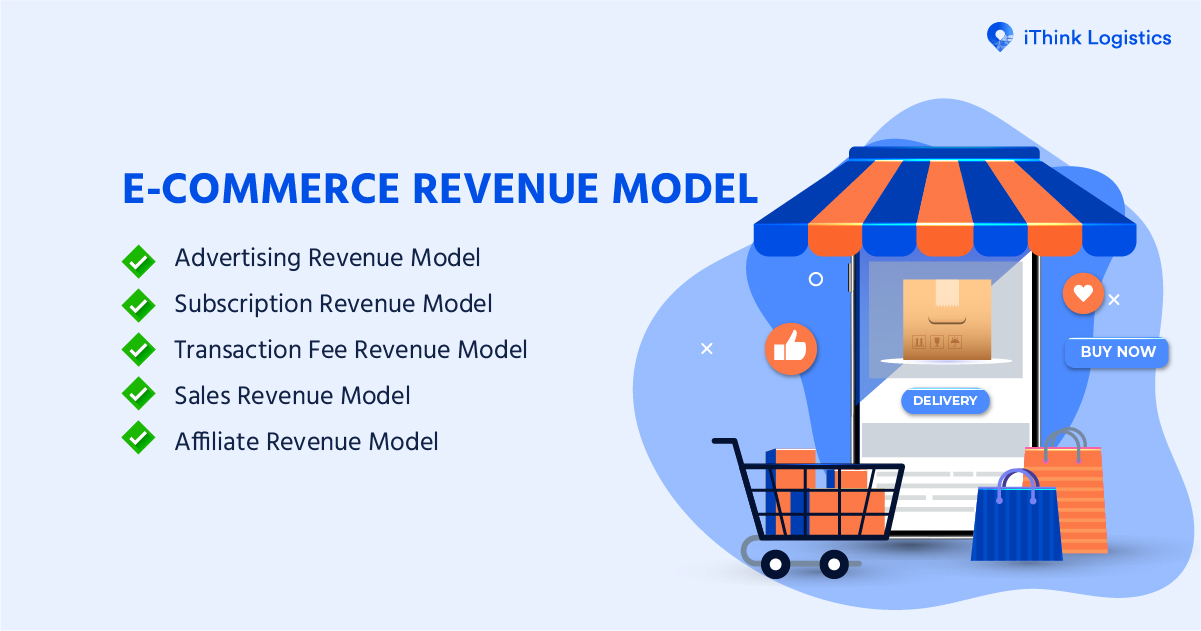
The revenue models in e-commerce are usually considered in classifying an eCommerce business as revenues denote the total amount of money that is being received by the company after trading its products or service with its customers. Understanding the various revenue models in e commerce is crucial for success. There is a range of options from which revenues can be generated including advertising, affiliate marketing, subscription and a lot more. 

The industry never restricts the upcoming of any new way of generating revenue. Though we will stick to explaining the basic five revenue models in e commerce with possible variations to the approach.

The choice of examples of e commerce business models depends on various factors, including the target market, product or service offerings, and business goals.

Also read: The Concept of E-commerce Business Model

Advertising Revenue Model

Generally, there is always a commission charged to advertisers to put up their advertisements in a well known online marketing platform. This is the classic principle that is being followed for the business categorized for the Advertising Revenue model. They take advantage of the huge traffic who regularly visit the chosen platform to shop around, see the ad and get redirected to the actual site. 

This can be related to a way of increasing leads to the business. The payments are made to the hosting platform based on a fixed commission or decided upon the traffic density that is driven to the business.

Business following the Advertising Revenue Model presents an indirect way of earning revenue through a digital platform and the conventional ways of putting up ads generally include display marketing that includes a super banner, wallpaper, skyscraper or rectangular ads. These are paid according to the traffic that is driven from the platform through the ads. The general income structure is based on the invoices raised against Cost per Click (CPC) or Cost per Action (CPA). Apart from the regular display marketing strategies that are aimed to redirect the traffic coming onto the eCommerce platform into the address where the ads are linked, affiliate marketing and search engine marketing are other famous ways.

Google Adwords and Adsense are among the most trending and reliable options that allow you to place your ads through the Google Search engine allowing you to bring your business website to the top of the search results when searched with the related keywords. Similar platforms are Facebook and the New York Times that allows you to display ads based on a Cost Per Mile (CPM) basis.

Subscription Revenue Model

You must have heard of Netflix, Amazon Prime, YouTube Premium, etc who will let you enjoy their unlimited services. These eCommerce business models charge their users or rathers subscribers based on a certain interval of time (daily, monthly or annual) to avail their services.

The service offerings of these companies generally include music, videos, TV channels, magazines, special services, etc. which is offered to the subscribers for a price to watch/listen or get the latest edition. Now, let me guide you through some examples of basic subscription business models.

  • Premium membership:  Many social media and business platforms like Xing, Linkedin, stayfriends, etc. offers subscriptions to avail of additional services that get the subscribers to access to daily updates, newsletters, short notices, etc. These information and quick updates are delivered to them directly to their account.
  • Internet service providers: We all are familiar with the monthly and annual subscription of internet service providers or rather a broadband connection enabling the subscribers to enjoy unlimited internet service. 

Publishers and content services: You are well acquainted with Netflix, New York Times, Spiegel Online, etc. These eCommerce business models ask for subscription fees based on monthly or annually to get access to their content.

We all know that every eCommerce business has one thing in common and that is their payment gateway. These are companies like Paypal, VeriSign whose subscription fee depends upon the SSL certification and the period of service. 

Transaction Fee Revenue Model

Following the transaction fee revenue model, the eCommerce business charges a fee to a seller for every transaction made through them. They are the payment companies that provide the payment gateway service to other eCommerce business platforms. Generally, the profit is derived through enabling or executing transactions. 

The operator provides a platform for the eCommerce marketplace through which the transaction can be completed. Now, the necessary steps include registering of the vendor and the operator so that the identities are kept intact that may later be required for a business. The model has proximity to the affiliate market but is somewhat different. The core principle of a Transaction Revenue Model is to facilitate transactions and earn a commission or fee on each one.

To explain it in a better way, let’s take the example of PayPal. The company charges a transaction fee to the sellers of the product once the transaction is completed. Similarly, eTrade gains a transaction fee whenever a stock transaction is made with a customer. The amount to be paid to the operator is either decided upon based on a percentage or a fixed amount with the vendor. Amazon is another example of a transaction fee revenue business model.

Sales Revenue Model

This is one of the most commonly followed eCommerce business models where wholesalers and retailers sell their products over the internet intending to reach out to a larger target audience. Also, more importantly, this sales revenue model in e-commerce brings inconvenience for the customer as well as saves them time. And the hassle to walk up to their physical store. There is an extra cost. 

The prices are often competitive in comparison to the actual store price.  The business following the online sales revenue model often comes with marketplaces as common entry points that allow them to deal with various product vendors allowing them to grow the marketplace and therefore earn more.

In certain cases, the sales are directly injected into the business where the profit is shared with none. Based on the size of the business and the point of sales traffic, certain functionalities of the business are transferred to third party vendors, generally done for the logistics and supply chain. 

Examples can be sited in terms of all the single shop companies selling their brand products over the internet through their online platforms. This forms a dedicated way of doing sales and reaching out to a vast number of customers. Amazon, Otto, etc are examples of businesses following such a model for their web catalogue-based business over the internet. Also, Buy.com and Etsy are examples of such marketplaces while blood, woot! guut.de are examples of live shopping marketplaces.

Affiliate Revenue Model

Next, on the list, we have an affiliate revenue model that deals with a business that follows the principle of commission. Merchants and vendors partner up with well-known eCommerce platforms to advertise and sell their products giving them a percentage of the profit as a commission. 

Affiliate marketing is a well-known way of inviting as well as driving quality leads into their business. The process basically works as a link that is hyperlinked to the affiliate and is archived on a host platform that gets regular traffic. Any user who clicks to the affiliate link is redirected to their website where the product or service is catalogued. The affiliate or the merchant thus pays an agreed commission to the host operator who’s carrying the link for every traffic driven.

Also Read: Everything You Need to Know About B2B Business Models

Amazon and affiliate are well-known examples of Affiliate Revenue Models that let you affiliate your product links and drive traffic. For each lead driven to your website, you need to pay a certain percentage to Amazon or affilinet as their commission. Interestingly, the Affiliate Revenue Model brings a win-win situation for both the merchant, who sells his product and the affiliate who advertised or marketed their product. Such eCommerce business models utilizes different variations such as pay-per-click, banner exchange and also, revenue sharing programs that aim at driving the audience from one platform to another.

There are a lot of other business models that are being used today to gain profit from the online marketplace. However, it’s natural that eCommerce business and digital marketing go hand in hand while delivering the business objective. Today there is an estimated rise of 17% in the eCommerce business since last year and has the potential to grow sky high in the coming years. 

Conclusion

Though shopping around physically hasn’t yet gone out of trend, most businesses today find a way to rule both the physical and online marketplace. So, there is always a scope for defining a new way of doing business over the internet. This means, more business models are yet to be known for the online eCommerce market.


Categories
E-commerce Logistics

What Are The Cheapest Way to Ship Large Packages?

As an eCommerce company owner, you probably feel like you pay too much for shipping, right? Whether you’re delivering across India or engaging in cross-border shipping, finding the cheapest way to ship large packages is a crucial aspect of running a business.

Shipping can be one of the biggest costs for an eCommerce store. Many shipping options exist, but not all are budget-friendly. Heavy parcel delivery can be a challenge, but the good news is that sending large items by courier service doesn’t always mean paying high fees.

This blog will guide you through the best courier for heavy items and the steps you can take to reduce your shipping expenses. Let’s dive in!

How to Ship Large Packages at the Lowest Cost

1. Pack Your Items Properly

The first step to cost-effective shipping is ensuring your large item courier package is securely packed. Cushion oversized items well to prevent damage during transit.

2. Consider Package Dimensions

If you manufacture products, design them with shipping efficiency in mind. Always measure the length, breadth, height, and weight of your package to get an accurate shipping price. Most carriers, including USPS, FedEx, DHL, and Blue Dart, have specific dimension requirements.

3. Calculate the Shipping Rate

Use online rate calculators from major shipping companies to enter your package details and compare costs. This ensures you pick the cheapest way to ship large packages.

4. Pay and Process the Order

Once you have found the most affordable rate, proceed with payment and confirm your shipment.

5. Print and Attach Shipping Labels

All packages require shipping labels. After payment, print and securely attach the label to your package.

6. Ship the Package

Your item is now ready for shipment. You can schedule a pickup or drop it off at the courier company’s nearest facility.

Also Read: Proper E-Commerce Packaging Which Will Save Your Cost

Best Courier Services for Large or Heavy Item Courier in India

1. Blue Dart

Blue Dart is a well-known logistics provider in India, covering over 35,000 locations. They specialize in heavy parcel delivery and can handle large shipments efficiently. While their pricing might seem high, negotiating rates can help you get the best deal.

Features:

  • Easy account creation
  • Guaranteed on-time delivery
  • Rush delivery option
  • Scheduled delivery times

2. DHL

DHL is a top choice for both domestic and international shipping. Their large items courier service ensures seamless delivery with customs clearance and tracking.

Features:

  • International express shipping
  • Warehousing solutions
  • Handles packages up to 70 kg
  • eCommerce-specific services

3. Ecom Express

Ecom Express is a rising player in India’s eCommerce shipping sector. Their delivery service for large items includes express delivery and return logistics at competitive rates.

Features:

  • Nationwide express delivery
  • Pickup facility
  • Try and Buy option
  • Ground services for bulky shipments

4. Delhivery

Delhivery is India’s largest express parcel network. Their services cater to cheap courier for large items, making them ideal for startups and growing businesses.

Features:

  • Real-time tracking
  • Simple return management
  • Special services for oversized orders
  • WhatsApp customer support

5. FedEx

FedEx is a well-established logistics brand offering heavy item courier services. While they don’t cover all regions in India, they are great for international shipments.

Features:

  • Package insurance included
  • Competitive pricing
  • Weekend deliveries available
  • Ships up to 68 kg

6. XpressBees

XpressBees is a cost-effective option for businesses looking for cheap courier for large items. Their flexible shipping options and vast network make them a great choice.

Features:

  • Same-day and next-day shipping
  • Bulk storage and transportation
  • Affordable pricing

Finding the Best and cheapest way to ship large packages

Choosing the right large items courier service depends on your shipping needs. Here are some tips:

  • Compare rates and customer reviews.
  • Negotiate bulk shipping discounts.
  • Choose a courier that aligns with your delivery timeline.

Conclusion

Shipping heavy parcel delivery requires strategic planning to keep costs low while ensuring reliable service. By selecting the best courier for heavy items, packing efficiently, and comparing rates, you can significantly reduce your shipping expenses.

Sign up with a delivery service for large items today and optimize your shipping costs for a more profitable eCommerce business!

Also Read: Types of Packaging Materials for Export and Their Benefits

FAQs On Shipping Large And Heavy Packages

1. What Is The Best Courier For Heavy Items?

The best courier for heavy items depends on factors like pricing, delivery speed, and service coverage. Popular choices include FedEx, Blue Dart, and DHL, which specialize in heavy parcel delivery and offer reliable services for businesses. Compare their rates to find the cheapest way to ship large packages without compromising on quality.

2. How Do I Choose A Reliable Heavy Item Courier?

When selecting a heavy item courier, check for features like tracking, delivery timelines, and package handling. Look for companies offering a specialized delivery service for large items to ensure safety during transit. Comparing multiple options helps you find a cheap courier for large items that meets your needs.

3. What Is The Cheapest Way To Ship Large Packages?

The cheapest way to ship large packages involves using bulk shipping discounts, negotiating rates, and choosing economy shipping options. Companies like Delhivery and Ecom Express are known for their affordability and are great choices for a large item courier service.

4. Which Courier Offers The Best Large Items Courier Service In India?

Several couriers provide excellent large items courier service, including FedEx, DHL, and Blue Dart. For cost-effective shipping, startups like Delhivery and Ecom Express offer a cheap courier for large items while maintaining delivery efficiency.

5. How Can I Reduce Costs For Heavy Parcel Delivery?

To lower costs on heavy parcel delivery, use efficient packaging to reduce dimensional weight, compare shipping rates, and choose a cheap courier for large items that offers volume discounts. Opting for ground shipping instead of air freight also helps reduce expenses.

6. What Factors Affect The Pricing Of Large Item Courier Services?

The cost of a large item courier depends on package weight, dimensions, shipping distance, and urgency. Choosing a delivery service for large items that offers bulk discounts can significantly cut down shipping expenses.

7. Can I Get Insurance For Heavy Parcel Delivery?

Yes, most heavy item courier companies offer insurance to protect against damage or loss. If you’re using a large items courier service, check their insurance policies to ensure your shipments are covered in case of transit issues.


Categories
E-commerce Logistics

How Can You Make Shipping For Ecommerce Sites Easier?

To grow your business online the most impressive steps that you can take is an ecommerce shipping strategy. Brand differentiation can also be one of the efficient points of shipping.

Ecommerce business is dependent more on logistics for undamaged and time to time delivery of products to the customer. Operating with a third party courier partner can help make shipping easier. For improved ecommerce customer satisfaction, shipping should be the key point to unanimity. Ecommerce shipping can be affordable and easy to manage with the right assistance. There should be a perfect list of doing and don’ts for ecommerce shipping solutions in India.

Ecommerce Shipping Best Practices

Free shipping discounts

Free shipping does not mean entirely free but waves off some amount as a discount. Thanks to companies like Amazon that offer free shipping to their consumers, but they have matured statistics to back it up also. Online shopping is abandoned because of high-cost shipping rates. So in order to meet the profitability of the retailer, companies like Amazon have adopted free shipping orders to customers who shop for more than one product. So this encourages the customer to shop more and spend more time on your website. In fact, the free shipping option can boost order quantity to 30%.

Shipping costs to be cleared before checkout.

It’s always a compulsion to make your shipping cost obvious at checkout. Shipping fees are added as subtotal after the customer enters their Pin Code. Customers enjoy shopping but unnecessary expenditure at the end of checkout makes them abandon their cart. Some abandoned carts are due to High Shipping Costs at the checkout.

Confirm customers with an Estimate Delivery date

While completing the checkout we provide the customer estimated delivery date. A large number of people say that shipping time is an important factor while purchasing. A general estimation of delivery should be given not necessarily by a perfect date but this can make the customer less likely to abandon their cart.

Always keep your customers updated during the shipping

 So when your customer is satisfied with the order they received by taking advantage of free shipping. Keeping a connection of communication with your consumer is always a good idea. This can help you gain a positive review about their experience of shopping with your company. Always try to keep them updated and track of their order to shipment till their final destination. This will build trust in your customer and would also help them in shopping with your company.

Take immediate action and act responsibly if a shipping problem is reported.

Always remember loss and damage of a shipment could be a  problem at times due to a third party courier, but take immediate action responsibly to solve the issue of your customer. This means you are the prime person to help your customer.

Firstly check on the shipment details and information that is correctly entered. Contact the third party carrier and try to track the details and resolve the issue by giving an immediate replacement to the customer as soon as possible. Customer satisfaction is your first priority by a replacement and then get compensation for your lost shipment from your package carrier.

Ecommerce Shipping Strategy Goals

Ecommerce shipping is dominant discrimination for your brand. This requires support and coordination from the entire team. There are few strategy goals to keep in mind before you proceed with it furthermore.

  • Boost conversions.
  • Hike the average value of the order.
  • widen the market or spot your audience.
  • Decline the costs.
  • revamp operational skills.

Important steps to consider before Ecommerce Shipping 

Be Clear with Your Order Fulfillment and Return Policies

Customer satisfaction is on three steps: receiving, processing and shipping. An order is only cleared when a customer receives it according to their specifications.

Flat Rate Shipping

There are different categories of shipping, but flat rate shipping is based on the size of the box. Different courier companies have a variety of flat-rate shipping programs.

Table Rate Shipping

In this concept, the shop manager amends shipping and shipment fees is calculated according to rule-based methods.

Live Shipping Rates from a Carrier

The rates are calculated on a basis of real-time rates and few shipping carriers use different apps to calculate these rates.

Utilize Shipping Tools

Shipping products are protected by packing them in a heavy box to bubble wrapping for having a flawless delivery.

Packaging

Packaging before shipment constitutes various processes like enclosing and protecting a product from damage to labelling it and ends with transporting it safely.

International Shipping

International shipping is basically shipping from India that actually works on the time of delivery on location.

Top Ecommerce Shipping features

Shipping is one such factor in ecommerce platforms that can bring a hole in your pocket. Choose smartly and rightly the opportunities that you have to identify your needs for shipping. To save money and to help your customers with their needs try choosing a perfect shipping company for your ecommerce and there are few requirements that you need to keep in mind while doing it.

Prioritize customer satisfaction

Always try to prioritize time in making a checklist according to customers requirements. Look for shipping instructions that can also make your audit work go easy. A robust reporting tool can help you lessen your burden of audit needs by tracking a correct record and by solving issues.

Merging of load

Merging of load can help you by providing cost-cutting to shipping your orders in ships or trucks. Timeframes and locations are managed in a full truck and a single ship to secure the low cost on each package from your carriers. You can support inventory to different satellite locations also by merging loads. Some 3D trailers can also extend support by maximizing space in rigs to bring more sense to your business.

Endless cost trackers

The best carrier can be chosen by making endless cost tracking and by making a note of its delivery speed. Choose the best factors that can sort issues on weight, delivery destinations and the volume of the product. These trackers can help you find solutions for saving new opportunities on carrier performances and on its measures.

Cross-docking

Cross-docking can help you store goods according to inventory locations. This can also help you in saving time and energy when you have ample orders. This method helps you in supplying goods more fastly and quickly to their final destinations.

Smart trademark and innovation

Make a vast note of goods that you receive from manufacturers and that’s not the end of data that your customer would be needing. There would be a lot more on your customers’ expectations. Manufacturer inventory should have all the track details of labels and barcodes of your goods. This can enable you to break down goods into smaller portions and can also help in filling the information of your customer in your system. So that it can help you in future endeavours with your customer requirements for operational or regulatory meet.

Rationalized dashboards

The best innovative way to progress with your shipping strategies is to present them in a proper way. Rationalized dashboards can help you in presenting it in a better way by being precise and right to content with adequate knowledge about it. Be part of the selection process and present it in an innovative way by being a successful leader giving a guarantee over things.

Multiple cheapest shipping partners in India

Most ecommerce companies in India consider FedEx as the best courier service for ecommerce platforms. The only problem with FedEx is that it does not cover every nook and corner of the world for ecommerce delivery. Other than that the company has positive reviews for its pick up and delivery services and also has a collection of international shipping options for its sellers to select.

DTDC has a broad network of shipping business in the time past of 1990 in all over India and has spread across the world over 220 countries. The small-term ecommerce business cannot fit in with DTDC due to its pricey features.

Ecom Express is a beginner in this shipping market but is considered for both shipping and logistics services. They have really good policies in terms of delivery and returns. As the service quality and response time is standard, the rates are also at low cost with efficiency.

Blue Dart is also popularly known for its services like shipping and logistics within the country that gives an option of the bargain to the high prices that is offered. The customer satisfaction rate is also highly commendable with this courier service.

Delhivery is another company on the list that is quite new to meet the shipping requirements of the ecommerce shipping platforms. The delivery services offered are reliable and are growing rapidly these days.

DHL is one such courier service in the list that is growing steadily nationwide to accept any needs of an ecommerce platform. DHL has a branch that is completely known for its ecommerce platform. This courier service helps in issues related to clearing customs. As compared with other courier companies DHL has high courier charges in India.

India Post Service is the most generous amongst every other courier company on the list. They are best when it comes to rates and for sending the delivery to the remotest location.

First Flight is slightly progressing its rank in the list and has become the best competitor also by spreading everywhere in the nation with affordable ecommerce shipping rates. They have tried to expand over 220 countries and have 10 offices across the world.

Not so old but not new, GoJavas is also one of the courier companies that provides ecommerce shipping. Earlier GoJavas used to provide their limited services to Jabong but now they even help to reach different ecommerce platforms also. The shipping rates and their services are dependable on delivery and as well as on pickup points.

Conclusion

Different challenges are the rare concern of business nature. Ecommerce business sellers undeniably have a greater challenge in terms of shipping. Shipping has a division of inventory across their destinations and costs and time in transit.

Building and working according to customer satisfaction can ultimately pay off many of your business shipping strategies. Patience is one such approach that can bring prosperity to your ecommerce shipping company. 

Hope you’re happy to have more profound information about ecommerce shipping sites in India. For improved sales on your store approach for a quick and easy shipping courier partner at your convenience.


Categories
E-commerce Logistics E-commerce Marketing Ecommerce

Types of E-commerce platforms

Walking into a mall, browsing through shop windows, and coming home with big bags of goodies and happiness is a customer’s ideal day. 
Now imagine being on the seller’s side. 

Having customers walk into your stores, love the selection, and shop more than you expect! What a day! 

But when the pandemic struck, buyers and sellers got the biggest wake-up call of their lives. No more shopping malls and no more walking into stores!

And at that moment, e-commerce emerged like a true hero saving millions of businesses and keeping the economy afloat. 

While e-commerce has been there for quite a while now, it has gained massive momentum in the recent past. To know what exactly ecommerce platforms are, read on. 

What is an ecommerce platform?

From the best ecommerce platform to the smallest one with a minimal selection, an ecommerce platform is essentially a website that operates as a shop. 

Businesses can list their products on it, customers can browse the selection, pay for them, and get them delivered to their doorstep. 

It’s nothing but a retail store where the brick and mortar have been replaced by a webpage (or webpages) and there is no physical interaction between the buyer and seller.  

Why Use an Ecommerce Platform?

As a customer, it’s like walking into dreamland! Sitting at home (or practically anywhere), browsing through a catalogue rich with products simply via an internet connection, placing an order, and receiving the order at their doorstep. 
It is said that the customer is king. Well, ecommerce truly treats customers like kings and queens. 
And as a seller? It’s better than dreamland! 

  • Not having to maintain a physical store – no rent! 
  • Relatively lesser ‘maintenance’ costs
  • Enjoying the benefit of staying open 24×7 (After all, customers love coming home from work, lying on the bed, and shopping online!) 
  • Better returns on marketing costs due to audience targeting. 
  • Being able to run your website from anywhere. 
  • Not keeping a huge stock on display.
  • Growing your business easily.

The list goes on… but we believe that you’re convinced about why you should join the e-commerce market. 
Different types of  Ecommerce platforms?

While owning an ecommerce business sounds rewarding, making it and maintaining it requires some more time, dedication, and research. 

Here are the three options you can choose from: 

Open Source

Open source platforms are essentially code that can be accessed and customized completely according to your needs and desires. It is where your developers will favour you because they will have complete control of even the smallest nuances of your ecommerce website, which means that things can be altered whenever required without much hassle.

You can host an open-source website on the cloud or on-premise. However, when we say in complete control, we also mean completely responsible for security certifications, firewalls, updates, CRM, CMS, payment gateway, marketing tools, design customizations, running promotions, etc. 

While open source solutions offer massive room for uniqueness and control, they’re also often very expensive to make and maintain. 

SaaS

Software as a Service solution is a relatively easier-to-use code that takes away all the ‘complicatedness of running an ecommerce website. It is as simple as renting a platform already coded with the required features for an ecommerce website. Due to the fact that it eliminates the need to build or develop a website from scratch, it is relatively cheaper and a favourite of the marketing team because it saves a ton of money that can be used to run offers and advertisements instead.

Unlike an open-source solution, security, hosting, compliance, etc. are managed by the SaaS provider and not the ecommerce website owner. 

However, you must note that using SaaS solutions limits the room for customization since a portion of the code is completely closed-off to your own IT team. Not to forget that SaaS solutions can only be hosted on the cloud. 

Headless Commerce

Headless ecommerce is basically running an ecommerce website without worrying about how the customer will check out and the payment will be processed. In technical terms, it is a decoupling of the shopping cart from the customer management system (CMS). Brands and businesses tend to use individual design platforms and a content management system to make their website. Once that is done, they plug in a decoupled shopping cart solution. 

While a decoupled shopping cart is one option, a headless commerce provider can also offer a bunch of other services like email service provides, enterprise resource planning, order management system, etc. Headless commerce allows you to enjoy the benefit of assembling the best technologies without having to host them all on your own. 

To put it simply, think of it as a car. Car companies often take multiple pieces of a car and assemble them together to create a great product. Similarly, choosing a headless commerce solution allows you to simply host a page with your product on it and buy other services that can be automatically plugged into your page from expert providers. 

Self-Hosted vs Cloud-Hosted Platforms

Self-hosted

A self-hosted platform means literally hosting the server of your ecommerce website in a room with your own IT and development team. Some of its advantages are that you never have to depend on other companies for your hosting and can immediately resolve problems in-house. However, it all comes at the cost of maintaining a server room, installing machines, performing updates manually, and employing your own IT team.

There is the option of hosting your website on-premise but via a third-party provider’s warehouse/server room. However, while this option is cost-effective, any maintenance issues and malware problems in your provider’s server will directly affect your business. It may so happen that your website will be down and you will simply have to wait for the provider to solve the problem. 

To give you an overview, hosting on-premise provides better visibility of your data, a deeper knowledge of data security, and more control over your ecommerce website. 

Cloud-hosted

Cloud-hosting means hosting your website off-site on a network of virtual and physical cloud servers. One of the biggest advantages of cloud hosting is that there is no hassle and cost of setting up server rooms, maintaining them, and deploying your own in-house IT team. You simply have to choose a provider. For eg: Amazon Web Services. While it seems like the best option for new players, it has a few disadvantages.

There is a fixed licensing fee involved. More so, you might have to incur the cost of adding more security layers to your website since not all cloud servers provide the best protection. There is little room for customization and you’re always dependent on the efficient functioning of the cloud server. Additionally, installation of patches, updates, and more is not done automatically in all cloud servers. 

Things to Consider When Choosing Your Ecommerce Platform

Building an ecommerce website is now easier than ever. However, choosing a service provider without much thought is a rookie mistake that you don’t want to make. Here are the things to consider before choosing a platform: 

Cost

Open source solutions are usually the most costly because they require you to build everything from scratch, host it, troubleshoot it, and upgrade it from time to time. However, even SaaS platforms like Shopify aren’t always the best options. It may be cheaper to host your website on their platform, the add-ons for various services may run up the bill. Also, even while choosing headless commerce, the type of services you take and the service providers you choose can determine how expensive will it truly be to host our ecommerce website. More so, your budget will depend on various nuances like security, licensing, web design, maintenance, programming, etc. Choose a platform after detailing down all the costs and reaching the best conclusion. 

Product/Service Catalogue

On one hand, there are websites like Amazon that list lakhs of products on their website, and on the other hand, there are websites owned by a single business that host only their products/services. For eg: You have a business selling athletic/gym wear. Supposedly your collection includes 50 items of clothing, you will only need a website with a few pages. The more extensive the product/service offering, the more pages your website will have. Take this into account especially when choosing a SaaS solution. SaaS may offer solutions that allow you to list only a limited number of products/SKUs. Therefore, choose a solution where all your products can be listed clearly. 

Marketing

One of the biggest reasons that ecommerce has grown exponentially is because of the popularity of social media. For users, they’re platforms to unwind, but for marketers, they’re the best places to advertise and get people redirected to marketplaces. In fact, with the advent of Instagram and Facebook Shopping, users aren’t even required to leave the social media platform. Only once they intend to buy the product will they be redirected to the ecommerce platform for checkout. So make sure that you use built-in integrations with social media platforms to make the users’ shopping experience on your website smoother. 

Scalability

Back in the day when Amazon started in a garage, all it had was a few pages and a few plug-ins. But as the company saw growth, so did their website. Similarly, you may be okay starting small. However, once your products become popular, you run more ad campaigns and you host promotions and sales, the website traffic significantly increases. While with an open-source platform you can easily upscale since you are under total control, it is not always the case with SaaS and headless commerce.  You need to purchase relevant add-ons and plug-ins to upscale your website. 

Customer service

One of the biggest disadvantages of the ecommerce industry is the lack of one-on-one human conversation. While it works well when the buying and checkout are smooth, more often than not customers need to talk to a real person to solve their problems. From late deliveries to in-app/website glitches to payment gateway problems to questions about returns, the best way to take a customer from disgruntled to loyal is by a human voice answering their questions. So make sure that the provider you choose comes with a great customer service centre. Because at the end of the day great customer service goes a long way in creating loyal customers. 

Best Ecommerce Platform

Making an ecommerce platform is difficult when you are doing it from scratch, but getting one made with the help of providers makes the job much faster, better, and easier. 

Shopify

One of the most popular platforms these days is Shopify. By far, one of the user-friendly SaaS platforms, Shopify is a great choice among home-based entrepreneurs, small business owners, newbies, and people who want to expand their hobby into a profession. With a simple plug and play-based tool, you can make your website within a few hours. With Shopify, there is no need to develop your own servers, arrange for payment gateways and other hassles.

You can choose a design, list your products, and use ready-to-use pre-integrated payment gateway options that allow you to get started in no time. Since it’s a SaaS-based platform it hosts your store online. 

Shift4Shop

While we’re on the topic of SaaS solutions, you can also consider smaller platforms like Shift4Shop that are ideal for multilingual support and don’t require any APIs.  

Wix

Another great platform that is gaining momentum is Wix. By far one of the easiest ways to make a website, Wix is the ideal drag-and-drop solution you’re looking for. It offers free themes to customize your website, market-friendly pricing and is ideal for beginners as well as big businesses. 

Magento

A great provider of headless commerce is Magento. Not only is it great for businesses who are hosting their stores on-premise and using an open-source code, but it is also a much easier way to expand and scale up your website when you have a big IT and development team. Magento is SEO-friendly, provides faster loading time, flexible content management, customization opportunities, and more to businesses. 

OpenCart

An open-source solution that you can explore is OpenCart. It is ideal for businesses and freelancers looking to set up more than one store and payment options. 

You can also check out the likes of Episerver, Ecwid, Big Cartel, Squarespace, etc. 


Categories
Ecommerce Logistics

Things To Avoid If You Want to Convert a Lead into a Sale

Our ultimate goal remains to get SALES from the moment we begin the business till wherever it goes! Until now, you must have been following a lead strategy to get more leads for your business and convert them into a customer eventually.

We’ve always noticed that our sellers focus on getting traffic on their website and receiving inquiries as leads start pouring in! That’s really great, but what next? If you have the same question in your head, then this blog is all for you.

The journey from a lead to sales passes through a funnel, which in marketing terms is known as sales funnel. As we begin, let’s first understand what does a sales funnel looks like:

Sales Funnel:

Every customer goes through different stages before deciding to purchase your product. And this is called a sales funnel. In a Lehman language, you pour a large quantity of something into the funnel to filter and receive the end goal. Similarly, in marketing, we create a sales funnel of different stages where a large set of audiences go through different stages, and only a certain percentage of your leads will buy the product from you.
We continuously focused on stages of the sales funnel; now, let’s dive deeper to cover these stages:

A sales funnel comprised of four stages:

a) Awareness
b) Interest
c) Decision
d) Action

To make your sales funnel do wonders, we take you through 5 steps to create your funnel strategy:

1) Research Your Target Audience:

It all begins with understanding what you sell and to whom you want to sell your products. At times, you might be overwhelmed on how to figure out the ideal audience that may convert for you. To give you answers, we have got a list of questions you need to ask yourself while selecting your ideal audience:

  • What are the pain points?
  • Where do their interests lie
  • What and how much are their expectations
  • Which social media platforms do they use?

After you’ve thoroughly understood your ideal audience for your product, the second stage is to create the buyer’s persona.

2) Create buyer personas

Before we talk about how to create a buyer’s persona, let’s begin by understanding a buyer persona.
A buyer’s persona is known as a detailed description of someone who represents your audience. They are not your customers yet, but you create a representation of your potential customers. Like you give the name, demographic details, their behaviour and interests.

This will help you understand their goals, pain points and buying patterns. There is also another way to do it by asking questions to yourself, and they are:

  • Why do they prefer to buy the product
  • Different possibilities of using your product
  • What can inspire them to purchase your product

3) Plan A Lead Generation Strategy

Once you’ve defined your audience and research is in place, the next step leads us to focus on traffic to your website, which gets you leads. To increase the traffic to your website, which eventually boosts the leads are through the following methods:

  • Pay per click campaigns
  • Social media marketing and advertising
  • Influencer marketing
  • Landing page optimization
  • SEO (Search engine optimization)
  • Guest posting

4) Create a strategy to engage leads

After creating the leads, it is vital to engage the leads received and to go about it, you can:

  • Create engaging content
  • Create infographics – informational content
  • Use social mediums to share posts with your audience
  • Share your products with the influencers for reviews and tutorials about your products.
  • Utilize an email marketing strategy to promote your content

5) Convert leads to your loyal customers

This brings us to the final step, which is to convert leads into customers. To the final leg of the sales funnel, note it to make your lead your ideal customers. You can do it by:

  • Offer one-click signup and sign in options
  • Minimize the form fields
  • Simply the checkouts on your website

We’ve understood how to convert leads into sales, but how to make the calculations? Here’s where we talk about calculating the lead conversion:

To calculate the lead conversion rate:

  • Take the total number of conversions made.
  • Divide the same by the total number of leads.
  • Multiply by 100.
  • The final number that you receive is your lead conversion rate.

For example, let’s consider that you’ve received 100 qualified leads for a month. From those qualified leads, 20 became your customers so that the formula will look like 20/100*100. This means the lead conversion rate for that particular month will be 20%.

Average Lead conversion rates:
Considering one ratio will not provide optimum results, so opt for various touchpoints that can be used across the industries.
Your brand/ company will benefit if you use the conversion rates by every channel like email conversion versus landing page and other conversion factors too.

Lead Conversion Strategies:

There are different conversion strategies for your prospective clients; let’s begin:

Behaviour Automation

Automation is a great way to save time and scale up your sales. For example, let’s consider that your lead, after reading a testimonial, moves to your website and shows some interest in your product. Keeping this in mind, automate your follow up email for your lead to take them closer to make a purchase. You can decide whether it could be a demo, freebie or trial offer.

According to research, behaviour based emails perform better than any other type of automated email. Views/impressions on the pricing page don’t require an automated follow-up email; even the views on customer stories can be a part of your strategy.


Let’s look at the list of behaviours that help you convert into a sale through automation.

  • Sign up for a free trial
  • A product demo
  • Stays tuned with your email marketing campaign
  • Pricing page reviews
  • Product inquiry through any channel
  • Make a download of any high intent content

Work with your marketing/ sales team to trace the key behaviours which can be automated for easy follow-ups.

Engage your leads through email

Nurturing your leads through email marketing to make them your customers. When creating a strategy to nurture your leads to email, make sure to offer them valuable content to convert as your customer. Here’s where the data comes into action. Use the information you’ve collected about your leads so far and deliver the content that generates their interest and solves the problem.

We’ve compiled a few tips for your email to do wonders, and they are:

  • Add personalization to your email. Like adding a name.
  • Automate your trigger actions based on engagement
  • Make segments of your email list.

Leads hear what your customers are talking about

Before your leads decide to turn into your customer, they look for social proof that includes reviews and customer testimonials to help them make an easy purchase decision. Testimonials are best used when leads are close to making the purchase decision. And this is why you often see reviews on pricing or landing pages.

Opt for Retargeting Through Google Adwords

Reaching to your leads through retargeting is a great way to remind them about the purchase. While retargeting your ads, you make them reintroduce your order to them, making their purchase decision stronger.

Conclusion

Getting customers to pay will be easy if you’ve followed every sale funnel step with an effective strategy.

Using the simple strategies mentioned above will help you find your ideal target audience, get more customers, and stand out from our competitors.

If you’d like more information on how to get started, reach out to us.
Before we end the blog here, tell us which effective strategy you will try using today?

Categories
E-commerce Logistics Ecommerce Website

Everything to Know About Ecommerce Security (Updated 2021)

Where there’s money, there are two kinds of people – businessmen and…thieves. 

Just like a brick and mortar store, criminals have found creative ways to attack e-commerce websites as well. And while cybercriminals have gained popularity, the internet has also come up with better, stronger, and more secure ways to protect your business from their nasty hands. 

But before we delve into how to keep hackers at bay, let’s learn the nuances of e-commerce security issues from the perspective of a buyer and seller. 

4 Reasons You Need e-Commerce Security

Privacy of Data

One of the biggest reasons that people are worried about online payments is the fact that they have to give away their bank account details and phone numbers to the website. And more often than not, this data gets sold to third-party vendors who target them for various promotions, schemes, and even frauds. Even if the online retailer doesn’t sell this data exclusively, in the absence of proper encryption, firewall, and anti-virus software, hackers can easily access user data.  

Trust

Customers already face hesitation when they have to pay before for a product and wait for a few days for the delivery to arrive. Add to that the stress of declaring their credit card and bank details can often be a dealbreaker. Customer has to feel secure that their data is secure and will remain unchanged. Customer has to be assured that their data will not be altered in any way for any malicious use. 

Authentication

A big challenge for e-commerce sellers and shoppers is knowing that they are transacting with an actual/real business/person and getting genuine items/services. Since e-commerce websites lack human interaction, customers may not feel safe by simply trusting a bot/website. Similarly, even e-commerce websites need to know that they are not being fooled. One way to authenticate the user is by asking them to register and log in. Since a login requires an email id, it becomes easier to identify and authenticate them. A great way to ensure security and authentication of transactions is by asking the customer to enter their credit card PIN number and an immediate auto-generated password. 

Confirmation

A simpler term for non-repudiation. A principle that e-commerce website owners follow as a thumb rule is to establish trust behind the buyer’s decision to purchase. The business and the buyer, both parties shouldn’t backtrack on the transaction, which is why it has to be confirmed. In order to do so, after every purchase, a message, mail, and now even a Whatsapp message is sent to the buyer along with a detailed invoice for proof of transaction. 

Now that we have some idea about why one needs to ensure ecommerce security, let’s take a look at some of the ways you can do so. 

4 Ways to Ensure Ecommerce Security 

Install a super-strong Firewall

A firewall is essentially a filter. Just like a water filter lets pure water droplets pass and keeps impurities away, similarly, a firewall identifies genuine traffic from bad traffic like Spam, malware, XXS, etc. and blocks fraudsters/hackers from accessing your website and user data. 

Say yes to Anti-Malware Software

It’s not the internet from where many viruses and malware can hack into your account/website. It is also the electronic devices that we use. It is important to install antivirus software to detect all easily detectable as well hidden malware from the system. This software regularly scans the entire system to ensure complete safety. While e-commerce security issues cannot be solely handled by anti-malware software, it is definitely a good start. 

Strengthen your ecommerce security with layers

Just like adding more locks and double doors to your entrance, you also need multiple layers to keep malicious and fraudulent individuals away. More often than not, their people try to access user data with their username and password (often obtained illegally). By adding two-step authentication that asks users to enter a code they received via email/SMS, wrongful users can be identified and blocked. Also, consider installing a Content Delivery Network to block unwanted and corrupt traffic.   

Secure your website with an SSL Certificate

While the internet makes it possible for an ecommerce business owner and a buyer to transact with each other even from miles away, it also runs the risk of the user’s private information reaching the wrong hands. Since the internet is operated via servers, user data bounces off multiple servers before reaching the destination of the intended person. In order to ensure that no data gets leaked while reaching this destination, you need an SSL Certificate – Secure Server Layer. A safe and secure way to encrypt sensitive user data. 

Conclusion

Humans evolved from locks to lockers. Similarly, it’s time we move on from simply being happy with a pre-installed anti-malware to fortifying our security with modern-day solutions. Because in an age where the internet is making work-from-home and shop-from-home possible, even hackers have evolved and found more and more complicated ways to breach our privacy. However, with the right security instalments on your e-commerce store, you can rest assured that the sensitive data of your users will always be safely encrypted. 

And always remember, when a user feels safe, they will not hesitate to shop from you again. Gain trust, build confidence and become a reliable e-commerce business owner by securing your website today. 

Categories
E-commerce Logistics E-commerce Marketing

Shipping guide when you sell from home

Imagine getting a call from the client that you always wanted to work with. Imagine all the details going well. And the best part? Imagine that they have no issues in paying you. 

But here comes the twist….
You ask for a deadline and the response is, “The deadline was yesterday.” 

This is no longer just a phrase you will hear in a corporate office. In the era of express shipping and next-day delivery, customers expect their orders to reach them faster than ever. 

If it were up to you, you would teleport to the place personally. And if it were up to them, at a snap of their fingers, their orders would come to them from the screen to their homes. How we wish it was that easy to ship from home!

However, since both these scenarios are nothing but silly daydreams, there is a little something called shipping that is here to save the day. 

And for your small business that wishes to ship from your home, we have the perfect guide for you. 

 Perfect guide for you  to ship from Home

Calculate your shipping cost

In order to know how to ship your own products from home, first, you need to determine the total cost of shipping. Your shipping cost is essentially based on 4 crucial elements – the weight and size of your product, the delivery radius, the shipment volume, and the speed of the delivery.

It kind of goes without saying that the larger and heavier a product, the more elaborate and expensive packaging and shipping will be. However, often for smaller and fragile products, the shipping cost may be extra owing to the packaging and delicate care in transit. Secondly, the farther you offer delivery, the more money shipping will cost you.

Thirdly, economies of scale often let shipping companies make a better profit as well as charge you less if you ship a consignment in bulk. However, there are options for individual package shipping as well. Lastly, and most importantly, it all comes down to speed. Anything ‘express’, ‘expedited’, and ‘super fast’ is going to cost you more than standardized shipping. 

Pro tip: When you start to ship from your home experiment by going for not one but multiple shipping carriers to gauge who delivers the fastest, has the best customer service, and the most cost-effective shipping rates. 

Save on packaging

When you are learning how to ship your own products from home, your fulfilment centre is your own personal space. And in most cases, instead of trained personnel, it’s up to you to package the order in the best way possible. With the whole ‘unboxing’ trend viral on social media, users are looking for not just good products but products that are packaged well.

So ideally, there are two steps to pack. The first one is the packing of the product. The second one is the packaging of the product in the shipment bag/box. Based on the nature of the product and the weather conditions, you will have to choose from paper-based or plastic-based packaging. While there are many options available from corrugated paper to plastic wraps to cardboard boxes, choose your packaging based on the transit speed, time, and fragility of the product. Prefer mass-produced boxes over personalized packaging to save cost.

In order to avoid in-transit damage, products often need to be wrapped with bubble wrap, airbags, and extra stuffing, all of which has to be carefully packaged by you. Make sure that you don’t skimp on the tape. The better packaged a product is, the more valuable a customer feels. 

Define your shipping charges

Partnering with a shipping courier is one thing, charging your customers for shipping is another. ‘Free shipping is a definite way to lure in customers. However, there are times when you need to charge a shipping rate as well. Giants like Amazon have gotten people used to free shipping, which is the reason why people often ‘add to cart’ and disappear when they see a shipping charge.

And while there are customers who are ready to pay an expedited shipping cost, more often than not, customers choose free shipping even if the delivery date is farther than expected. To reach a middle ground, you can also do what Amazon offers to its non-prime customers. In order to reduce costs, customers are obliged to fill their cart up to a minimum value to get the benefit of free shipping. If they don’t do so, Amazon charges a shipping fee based on the 4 elements of shipping costs stated above.  

Manage your insurance and return policy

Online shipping is a gamble for most customers since they are not physically in contact with the product. Therefore, even the most popular products are often subject to returns. As a matter of fact, many customers judge the credibility of the business based on the return policy. While returns are still manageable, damages are tough to navigate. No matter how small your home business is, it is always at risk from unforeseen circumstances and natural calamities. Many shipping partners often provide insurance cover. In case they don’t, make sure to get one before going into business. 

Opt for multiple channels and carriers

Widespread reach and visibility is the long-term key to converting viewers into customers. It is a proven fact that the more places you list your products on, the more they sell. While many companies have their own e-commerce websites, they also choose to list on Amazon, knowing very well about profit sharing. However, it is a win-win deal for both parties because Amazon’s reach inevitably gets the business more and more orders.

Also, one of the biggest bonuses’ of listing on established marketplaces is the convenience of shipping. A majority of marketplaces have their own fulfilment centres and their own shipping policy which saves you the trouble of setting up your own packaging and shipping process. Speaking of shipping, never settle for simply one shipping carrier. Each shipping company brings its own set of benefits to the table. While some offer a wide reach, some offer delivery to less connected areas.

Some are the best at express shipping while some are the most cost-effective for regular shipping. Diversification in terms of selling channels and shipping carriers is a must to get a steady grip on your shipping.  

Consider outsourcing

If you simply don’t want to go through the issue of shipping, try outsourcing it. Here you have two options – dropshipping and third-party logistic players. Dropshipping simply means passing on the order on your website directly to the manufacturer. Then the manufacturer deals with the packing, packaging, and shipping of the order.

Third-party logistics are simply shipping companies that have their own fulfilment centres and their own fleet of vehicles. All you have to do is pay them a fee to store, pick, pack, and ship your orders to the customers. They also offer you the service of order tracking which makes the whole process stress-free. 

Conclusion

Starting a home business is no doubt a challenging venture. And going wrong with shipping can often be a deal-breaker. Therefore, research on multiple shipping carriers before launching the business. From dropshipping to third-party logistics, choose what works best for you. And always remember that a happy customer is one who gets their order on time and in top condition. Two things you must keep as your top priority before finalizing your shipping policy. 

Categories
E-commerce Logistics

Difference Between Shipping and Delivery

Order – Shipping – Deliver

We can broadly categorize the journey of a product in this 3-step e-commerce chain that starts from the consumer placing an order to finally receiving it. While modern e-commerce sites have made it so easy and rather tempting for the users to place an order, shipping and delivery to have come a long way.  

With the rise of e-commerce, not just customers, even business owners are often using the words ‘shipping’ and ‘delivery’ as if they mean the same thing. And even though they’re pretty easy to confuse, they mean two distinct things. Now let’s take a look at both. 

Shipping

What does the internet say about shipping? 

Shipping has two definitions with a hairline difference. Firstly, it means the ‘date’ on which the product is going to be dispatched (sent out) from the warehouse/fulfilment centre. Its second meaning includes the processing, packaging, and dispatching of small items that can be sent to the customer quickly, and fairly easily via local postal service. 

Now, what do we say about it? 

Shipping is something that makes business owners happy because their product is finally out of the warehouse and on the way to the customer. 

Delivery

What does the internet say about delivery? 

Just like shipping, the delivery has two meanings with a minor difference. Delivery means the ‘date’ on which the product arrives at the customer’s address or is rather expected to arrive at the customer’s address. To put it simply, it means the successful distribution of the orders to the customers’ addresses. 

Its second meaning includes the arrival of fairly larger items that are transported from the warehouse/fulfilment centre to the customer’s address. A lot of the time it includes large electronic appliances and furniture that require proper installation. 

Now, what do we say about it? 

Delivery is something that makes the customers happy because who doesn’t love getting parcels delivered right at their doorsteps! 

What is the difference between the two? 

The next time you shop on an e-commerce website, take a closer look at the shipment instructions. It will say something like ‘dispatched within 4-5 business days. This means that the ordered product will leave the warehouse/fulfilment centre of the brand within 4-5 working days. In those 4-5 working days the product will be processed, packaged, labelled, and will be kept ready for pick-up that is an essential stage of shipping. Post pick up, the order is then declared to be ‘in transit, which means that it is being transported to the customer’s address.  

Now the focus shifts on how long the transit takes. Thanks to shipping companies offering customers the convenience of ‘order tracking’, it is easier to give the customer an estimated date of delivery. If all goes well, the product reaches the customer’s address on the estimated date, exactly on time. However, natural calamities, unforeseen events, government restrictions like Covid-19 lockdowns, weather changes, etc may push the delivery date. 

Conclusion

Now that you have a clear understanding of the difference between shipping and delivery, make a wise decision before choosing the right logistics partner. This decision can be a deal-breaker in terms of business. Check for quick delivery, large distribution radius, staff size, fleet variety, customer service, and most importantly the shipping costs before making the final call on a logistics partner. 

—-

Exit mobile version