iThink Logistics | Blogs

Categories
E-commerce Logistics

Leveraging New-Age Technology in E-Commerce

E-commerce is a growing platform that lets businesses display products online. But how does that happen? Is it online website creation and small warehouses that help businesses to increase their sales?

Did you like the shoes you bought from that website last week? Of course, you are glad that you can buy products online without much hassle but you don’t understand how it is rising so fast? Worry not! We are here to break it down for you.

Oops, we ended up asking you questions instead of answering yours, didn’t we.

But it’s given that these questions would have crossed your mind multiple times, one way or the other. We are here to provide you answers to these everyday questions you have, which you are often afraid to ask others often. 

What is eCommerce and how vast is it?

You would be thinking “Really? Are we talking about this?”

Well, we are. You would already know that e-commerce encompasses all the transactions which are conducted electronically. There is very little possibility that a business doesn’t have any presence on the internet these days.

Startups, big enterprises, and everything in between have an e-commerce presence. The rise in e-commerce is happening at an exponential rate.

The global market was valued at $ 9.09 trillion in 2019. Blown away? Not only this, but it is also expected to grow at a compound annual growth rate of 14.7% between 2020-2027. 

We don’t need to go into the details about what constitutes e-commerce, but you definitely would have heard of terms such as B2C or B2B. Uhm, Shark Tank says hello!

Transactions take place not only between consumers and businesses but also between consumers and customers as well as between businesses.

The rise of e-commerce has been swift, to an extent that you wouldn’t find a single large retailer who doesn’t have an online presence.

More than that, many new businesses have come up that connect the seller directly to the customers, which in today’s world is called D2C.

So where does new-age technology come in? Yes, you are right. It comes everywhere. Technology is nearly inseparable when we talk about e-commerce as it helps the business with various tools such as marketing insights, analytics, e-commerce logistics, etc.

How did it rise in demand and supply?

Let’s say you want to buy a few vegetables. You can go to that store which is over 4 km away from your house or you can order it online from your phone. With the likes of Blinkit and Zepto it has become easier.

What will you choose? That’s right, You’ll order it online. e-Commerce has made daily transactions in life very easy and manageable. 

We can understand the rise in a better way if we break down the demand and supply aspect of it.

  • Consumer Demand
  • Producer Supply

If we look at the demand side of this whole scenario, the customers know what they want and where they can get it. Why would you want to buy stuff online?

  • Increase in your utility. 
  • Reduced transportation costs for you, along with discounts and offers reducing your total bill.
  • Reduced time spent shopping for your desired item.
  • Gives you an incentive to use that time elsewhere. 
  • Increase in knowledge about products with detailed explanations. 
  • Varied choices suiting varied expectations.

Understanding the demand aspect sort of begins with understanding the reason why there is a rapid rise in e-commerce demand. This can be attributed to the following aspects:

  • Marketing strategies are devised by the business to suit consumer preferences almost perfectly.
  • Affordable prices and an increase in consumer engagement.
  • Increase in the accessibility of electronic devices and an increase in internet penetration.
  • Easy to use and quick results.

Easy? Absolutely. With one click, you can make the payment and buy the product without stressing out about how you will bring that product back home. 

Similarly, when we see the supply side of this scenario, the increase in supply can be mostly attributed to the rise in demand for e-commerce.

It has become increasingly necessary for a business to be aware of the rush they might face due to increased customer demand. 

Good quality products, timely delivery, product customization, hassle-free search options, etc. help a lot to maintain customer loyalty.

Not to mention, with improved resources for businesses, they have become more capable to meet the increasing demands of consumers. 

Yes, it works like a loop.

Businesses have started looking to expand their distribution chain and warehouses to accommodate the rise in demand.

E-commerce logistic models have made this work easier, to say the least. So “let’s dive deeper into this. Why has the supply increased?”

  • Better e-commerce logistics are used by businesses which has made procurement of raw materials and delivery to customers easier. 
  • Having a country wise presence, moving forward to a global presence.
  • FinTech companies enable faster and more secure payment methods.
  • E-commerce solutions for businesses to help maintain an online storefront.

Demand and supply forces have strengthened the presence of e-commerce widely. 

What will be in the future?

Oh no, you don’t have to worry about e-commerce platforms shutting down. You will still be able to buy your favorite stuff online, and maybe do more than that, in upcoming times. 

In the next four years, e-Commerce platforms are expected to have growth in trillions of dollars. Can you believe that? 

Let’s find out why will this happen:

  1. Long term relationships with customers

With rising acquisition costs on the part of businesses, long-term relationships are encouraged with customers. By keeping the brand identity at the forefront, consumer trust is built, which leads to better relations between the business and its customers.

2. Increase in online retailers

There are very few barriers to enter in e-commerce. This has generated a large influx of online retailers, from small businesses to large enterprises. By following the pattern in consumer demand, it isn’t much difficult for businesses to deliver exactly what the customers want. 

3. The rise in e-commerce marketplaces

Apart from personal websites, e-commerce marketplaces such as Amazon, Flipkart, etc. have increased the basket of selection, along with customer ease. They have managed to get on-board many brands that enable purchases to be hassle-free for the consumers. 

4. New marketing strategies 

Oh, this should be very interesting. While the paid advertisement has been increasing in cost, attributed to the rise in online retailers, social media has come in to fill in this void. Businesses create their online presence and directly connect with customers. With trendy posts, reels, and celebrities on board for promotion, maintaining a good brand image has become very easy. 

5. User-friendly experiences

E-commerce ensures that consumers don’t have to worry about physically going to the store while purchasing online. Newer technologies such as voice and image search further make it easier for customers to make hands-free payments. 

While it may seem unbelievable, the rise in e-commerce is so swift and engaging that it will be very difficult to go back to a model which doesn’t have an online presence involved. 

Do you have a business model you want to start with but are not sure how to go about it? This is where e-commerce logistics comes in. 

How do we leverage e-commerce technologies?

At present, it isn’t uncommon to see new-age technologies leading digital transformation. Remember the chatbot you saw on the Xyz website? Most of the new companies are integrating this tech assistance to have improved revenue and profit. 

Here are a few technology trends that are in circulation at present which will make your brand reach even better than before:

  1. eWallet technology 
  • It helps in storing money for future online transactions.
  • It eliminates the need to carry a physical wallet around to make payments.
  • They are a fast mode of payment.
  • They are easier to keep a track of. 

You don’t have to worry about COD or the blockages which come with that. eWallet technology will ensure that your e-commerce business reaches people everywhere and payments are never a hindrance for them. 

2. Voice and Image search 

  • Helps with a better comprehension of the search query.
  • Gets results quicker.
  • It’s easier for your customers to make search queries without placing restrictions.

With voice and image search, your customers will be happy to place orders anytime, anywhere. 

3. AI Chatbots – Enhancing Customer Communications

·   Boosts the brand image and helps in improvised results for online shopping.

·   Helps the customer to match their interest.

·   They ensure security which helps in the enhancement of customer communications.

You don’t have enough funds to have large customer care to answer all the small questions that your consumers have? AI chatbots will effectively solve this problem for you!

4. Augmented Reality (AR) and Virtual Reality (VR)

  • AR helps customers to visualize products from online stores.
  • VR will help to provide exact and up-to-date details for consumers to make good buying decisions. 
  • Your customers will be more inclined to buy a product if they are allowed to try it out virtually.

With technologies of AR and VR, your brand will not only become more visible but will also increase your customer’s inclination to buy a product. 

5. Product Customization

·   It makes purchases more convenient for your customers.

·   With product customization, a consumer’s choices are well matched.

·   It will increase customer loyalty and bring up sales. 

·   Your customers are likely to visit your site again if you offer product customization. 

Your customers will be glad to be on your websites if you show them personalized products. It will save their valuable time and make the purchases swift!

Artificial Intelligence along with extensive data analysis is helping companies to meet consumer demands as well as delivery deadlines. With this, it isn’t difficult to see the rise in e-commerce logistics companies. 

The rise of e-commerce has led logistic companies to provide high-end solutions. They even provide the analysis of the risk percentage of orders in case the consumer “returns” the product. Resolving COD defaults by using cashless payments is also another way through which e-commerce brands are moving forward. 

Why is this important though? What’s the big deal about it?

1. Increase in Customer Loyalty 

Placing customers first is the most important thing. By adopting new-age technologies, companies can be assured that most of the consumers will get their products. Real-time updates about shipments will further enhance the trust of the customer in the brand. 

2. Maintaining a balance between sales and return orders

These days, customers prefer to have a choice to return their online packages if they do not like the product. But what if the chances of return are so high that you end up making huge losses? Analytics for the same need to be used so that you can make the best out of consumer demands.

3. Resolving to ship of products

Cost reduction is very important to make good sales. AI logistics which help in assigning cheapest as well as fastest couriers that will reduce your shipping costs and increase your profits. 

4. Handling all different aspects of logistics 

We understand how overwhelming taking care of everything is. By outsourcing your needs from different channels, platform integration fees are charged. Hence to make the best use of logistics, combining them all into one global shipping platform is essential. 

iThink logistics provides you with this and more! We understand that keeping up with the rise of e-commerce is not easy, especially when you have to deal with other challenges apart from shipping. 

By having a good logistics team by your side, you can ensure that your company and the future of e-commerce are highly aligned.

Evaluating services, distribution techniques, consumer demand, etc. will help you to conduct your business more efficiently. 

iThink offers the following latest technologies which will help your brand keep up with the rise of e-commerce:

  • AI-driven recommendation engine
  • Patented 6 Step NDR 
  • Real Time Tracking updates
  • White label tracking page 

Amongst these broad categories, many tools are being offered to our dear businesses such as delivery tracking, 4-step verification, automated reattempt, multifunctional dashboards, and auto-generated reports. 

We understand how important it is to keep up with the latest technology to ensure that you are one of the best players in the market, to whom consumers refer.

With improved e-commerce logistics by your side, you’ll find out that you don’t have to spend too much time on solving short problems. You can put your complete focus to business expansion and customer satisfaction, with better results. 

All in all, it is truly important to engage with new-age technologies if you want to keep up with the rise of e-commerce. Getting together with e-commerce logistics companies is one step in this direction. 

Categories
E-commerce Logistics

6 Most Common Reasons for Shipment Delivery Delays

In this quick-paced world of instant gratification, hardly anyone likes to receive a scary email that notifies them about shipment delays.

We love everything about online shopping – the convenience, the countless options, the doorstep delivery.

After having excitedly placed an order online, most find themselves glued to the window or sitting by the door waiting for a “quick delivery.”

On the business side of things, seamless deliveries are an important part of the brand experience.

It would not be an exaggeration to claim that everything in the shipping and logistics department affects a business’s bottom line regardless of how big or small the business is.

Unfortunately, however, logistics delays are common and sometimes may even be unavoidable.

What Causes Shipment Delays?

A shipment delay can occur due to various factors, leaving customers wondering about the shipment delay reason. Common reasons for a delay in shipping include weather disruptions, unexpected demand, or logistical challenges. Knowing the shipment delay reason can help customers prepare for potential delays in their orders. While a delay in shipping may sometimes be unavoidable, companies strive to minimize shipment delay by optimizing their processes. Staying informed about a shipment delay reason enables better communication and expectation management.

According to a study (Source), as many as 69% of consumers are much less likely to shop from a retailer in the future if their order does not arrive within two days of the promised date.

Considering this, businesses must understand what is causing shipping delays to avoid these to the best of their capabilities for a great customer experience.

Experiencing a delivery delay can be frustrating for both businesses and customers. When a delivery is late, it impacts customer satisfaction and business reputation, and understanding the reason for delay in delivery of goods becomes essential. Businesses must understand the primary causes of late delivery—from traffic congestion to weather conditions. To minimize delay in delivery, companies should implement proactive measures, such as route optimization and improved communication with customers. Ensuring minimal delivery delay builds trust, as customers value transparency. By managing each late delivery effectively, businesses can reduce the likelihood of delay in delivery and enhance the overall shopping experience.

Not mastering the last mile delivery not only affects customer retention but will also compel online shoppers to switch to the competitor’s side.

Without further ado, here are the top seven reasons for late shipment that brands and businesses must strive to iron out: –

Shipment Delays Due to Traffic

The creased foreheads that repeatedly stare at their clocks, annoyed individuals tapping their feet and anxiously peeking through the sea of cars and bikes to find an opening to cut through the traffic is a common sight for people travelling on busy roads.

Heavy traffic is often the cause of a delayed order.

As unbearable as these “rush hour” experiences may be, oftentimes, they are unavoidable. And just as for people, traffic jams are a hassle for manufacturers and shippers as well.

These costs of travel delays are passed on to the customers who then sit wondering why their order is delayed.

While little can be done to overcome the traffic hurdle, businesses can try using route optimization software to avoid busy roads during peak traffic hours.

Additionally, to play safe, road congestion should be anticipated to give an accurate “expected date of delivery” commitment to the receiver.  

Also read: Understanding Shipping Terms

Shipment Delays Due to Unfavourable Weather Conditions

The details of the climate change debate are best left to environmental experts (and politicians) but it is almost impossible to deny the weather fluctuations that we experience particularly during seasonal changes.

And when it comes to bad weather and road closures nature has a way to spice things up with its own plans. When this happens, there is little to do aside from waiting it out to ensure the safety of the delivery partners and the package. Severe weather can result in a delayed order to ensure safety.

Thankfully, when such conditions occur, customers are often understanding and would not mind a late shipment considering that they have been informed about the reasons behind the delay.

Holidays

Holidays are amazing for a lot of reasons, be it decorated houses, happier people, or office and school holidays, but the thing that excites everyone without exception is the shopping spree and so many gifts! That is why they say: when the holiday season strikes, online orders spike.

This is because rightly capitalising on the holiday opportunity, ecommerce businesses create excitement by including promotions and major sales for online orders subsequently increasing online purchases by a lot.

However, this prime time for gift buying leads to an increase in shipment volumes which can overwhelm shipping capacities.

To prevent shipping delays in this scenario, businesses must pre-plan and establish an efficient logistics system by working with efficient delivery partners, ensuring there is enough staff to manage orders, and strategically spreading out promotional offers over several days.

Loss or Damage of Goods

Although most e-commerce businesses will try their best to not let this happen, loss or damage of goods can lead to logistics delays. 

Damages during transportation are not very common especially as logistics businesses have started to expand their network and refine their transportation but unexpected situations might arise and cause damage to the package.

In such a situation, the package will either have to be returned by the customer or by the transportation unit itself before the package reaches its delivery location.

Loss of goods on the other hand can be highly frustrating especially because the customer cannot know when or if their parcel might arrive.

To avoid such situations, real-time tracking of the order and proof of delivery through photographs and signatures for the order delivered are provided by logistics companies. 

Technology

Technology can make several things easier on one condition – it is updated to manage current expectations. When technology malfunctions or is outdated, it is going to cause shipping delays.

Supply chains are known for sticking with old technology which can be particularly problematic as it becomes a lot more challenging to integrate new software that has the potential to prevent delays in deliveries.

Also read: Difference Between Shipping and Delivery

Customer Errors

It is not always the fault of the delivery partner. Sometimes, what is causing shipping delays is a customer who has either given the wrong delivery address, has accidentally misspelt when adding the delivery information, or has provided inadequate information for delivery.

So, when customers complain and ask customer service professionals “why my order is delayed?” it becomes important to verify whether the delivery information is accurate.

In conclusion, the convenience of online shopping is only a part of a great customer experience and if e-commerce businesses want to stay on top of the game, they need to ensure a seamless delivery.

With iThink Logistics, businesses can be connected with suitable delivery partners that are tailored to assist with specific business requirements and explore a diversified network that stretches across 180 countries.

Categories
E-commerce Logistics

All You Need To Know About B2B Lead Generation

Have you spent most of your time on zoom/meet in these past two years? Do you wonder how zoom manages to get such a big platform in such a short time? You are not the only one!
If you want to know how this process of attracting the perfect customers for a product or service works, you are right! We will explain how the use of B2B is carving a new path to successful marketing.

What is B2B lead generation, and why is it important?

In simple words, B2B is a system that includes the tactics of attracting the right customers for a service or a product. Companies consider this lead generation vital for their businesses, and the sales and marketing teams are fundamentally responsible for performing this.

The lead is usually used for a possible customer and collects their data like their name, company address, email address, etc. This is also commonly known as B2B data. This information can be acquired in a survey or by getting your customers to subscribe through online content like blogs, social media, emails etc. 

The growth of B2B data allows your business to flourish. With the efforts of sales and marketing teams, spreading the correct information you need to attract the customers, they create a line of potential customers. B2B lead generations are significant if you want a successful business. 

(it’s incredible how the right teams can make your business a success, right?)

You Can Also Read Things To Avoid If You Want to Convert a Lead into a Sale

What is B2B leads?

A B2B lead refers to the people whose data you have collected as the possible customers and who are interested in your work and products. 

To attract these customers, there are two leads:

  • Marketing-qualified leads 
  • Sales-qualified leads 

(that’s how we do it, using these, we deliver success, not just your parcels)

Marketing-qualified leads (MQL)


When you don’t know if you’re going to buy a dress, but you keep going back to it and checking it out, that is how marketing-qualified leads work. They consider you as someone who will most likely be a customer of their products. The customers are not yet ready to come in contact or directly engage with your company. 
For example, regularly visit a website’s page, add things to the wishlist, and put things you like in favourites. This sort of engagement ensures that they’re interested in what you have to offer. 
(we certainly have a lot to offer!)

Sales-qualified leads (SQL)

Once a customer has passed through their MQL pipeline and has the full intention to buy your product, they’re considered a sales qualified lead. You’re not just looking at the dress; you intend to buy it this time. 

For example, the customer is interested in filling out a form asking about your product or service or directly talking to a salesperson on your team. 
Using companies like LinkedIn to promote your services or product can be pretty helpful since it is a great way to showcase your work through online content. 

B2B lead generation strategies for your eCommerce business 

Although sales and B2B can be done in an offline, traditional way since the pandemic eCommerce business has taken a huge leap and their online businesses have been growing rapidly. 

How have they been doing so, and what strategies do you need to know to enhance your leads?


Let’s find out by observing the following strategies:

Social media 

Apps like Facebook, Twitter, and LinkedIn are very useful when it comes to generating leads for eCommerce businesses. 
LinkedIn, for example, allows you to collect data and promote your business. People sign up for this app to apply and look for applications and they upload their resumes and their data. Using the relevant information that your potential customers have put out there, you can try to make a connection and promote an advertisement. 


You should optimize your company’s profile and make it seem attractive and interactive. It should be clear and specific about your goals and what your company provides. 

Create a place for open discussions and form a connection with potential customers and audiences. 

To increase your engagement, you should try to join relevant groups so you get the chance of reaching all the members who are likely to be your leads. 

Big eCommerce companies like amazon business marketplace have a B2B process through which they try to advance their company. 

Ecommerce conversion rate optimization

There is a way to find what element on your website is converting most of the visitors into leads. Optimizing your website is very important. Utilizing that space can make your website look more attractive and allow visitors to visit and get more information about your company. 

The right optimization rate can make those visitors even more interested in your products and services. It also tells you the scores and results of how your company is doing in generating leads. 

Using online blogs, emails, and ads to convert your visitors to leads helps increase the average conversion rate optimization. You can improve your average conversion rate optimization by making small changes. Offering coupon codes, discounts, sales, and eye-catching homepages can do wonders for your websites and leads. 

(Small steps do count if you want to deliver success.)

Marketing partnerships 

Finding relevant companies who complement your services where you can enhance your leads without forming a competition is an advanced and strong strategy. It should be followed carefully as you don’t want your audience to have bad experiences.

The correct choice can make all the difference! 

Being involved in these kinds of partnerships gives you a chance to get marketing teams on your side and helps you generate leads for your businesses. The partnership should be smooth sailing, benefitting both of you. Getting in touch with different companies and forming partnerships gives you a headstart and more opportunities to build your leads. 

It adds growth and value to both of your partnerships. 

Email marketing 

Once your audience has already subscribed to your list, you can increase your engagements by emailing and attracting them to offers and business. By forming interesting and attention-seeking headlines and content, you can catch the eye of your potential customer and turn them into a lead.

Since emails can be repetitive and common, remember to make them unique. To indulge your audience in doing business with you, use CTAs. CTA is a call to action. They are buttons or hyperlinks which can direct you to your website. These CTAs can propel your customers to not get distracted and focus on your business. 

For eceCommerceompanies, functioning mostly online, emails are a good way to get your audience to engage with you. You should offer what they want, useful resources and information to make them feel more welcomed.

Hosting webinars

A lot of us have been attending webinars and events online for the past couple of years, little did you know, they are in fact, super useful. 

Instead of just pining in their social media and emails, why don’t we interact with them and get out of the talking stage? The next stage is getting them to become your leads and buy your products. 

Hosting webinars gives you the chance to run a product demonstration and educate your target audience about your services. Webinars conduct questions and answers at the end of the sessions. You can answer their questions and engage your audience. Carefully planning your webinars gives your target audience a clear and clean plan. 

Asking for feedback is a smart option at the end of your webinar so you can see where most of your visitors might be converting into leads. It also shows efforts and dedication Ecommerce companies like zoom used the function of webinars totally to their favour, and so can you.

Pushing notifications 

Getting alerted by pushing notifications has always been very useful. Whether it’s a YouTuber asking you to push the notification button and subscribe. At this point, you are a kind of a YouTuber. You have to ask your audience to engage with you and support your business. 

Receiving alerts can catch the target audience’s eye. Pushing notifications can be more powerful than emails or SMS. This form of notifications can look intriguing especially when you spice them up. If you add different festivities, discounts, fun facts and information that they’re interested in, it’s easier to get them to sign up. That is how they turn into leads. 

Make sure not to overdo it, as too many notifications and unnecessary information can be annoying and drive them away. 

It is advised to keep your push notification in your browser windows, it’s easier and more convenient for the audience to keep it in their mind and reach out to them. Giving them a short deadline for an event that they have very less time for, gives them the motivation to sign up or subscribe. Alerting them at specific times of the day or the week is a smart move and keeps them engaged.

Using cookies 

Cookies help redirect the audience to your website. Have you ever visited a really cute website, and then continued to mind your own business. Next minute, you’re surfing through social media and you see the advertisement for the same product from the same website? That is what we can do to generate more leads. 

Cookies recognize your activities and track your patterns. So when you accept a website’s cookies, it can save your searches or details in browsers. So the company is the cookie and the audience is the milk. (the perfect duo, we must say.) 

When you present them with their interests through their browser search, you get a better chance of appealing to them and turning them into leads.

Become a successful eCommerce seller with iThink Logistics 

As beneficial and fruitful, as these B2B lead generation strategies are, what is the use of it if your products or services are not well taken care of?

Ecommerce businesses need more than just leads and sales. They also require management and shipping of their goods and services. Good partnerships with a logistics company are vital for your relations and profits. A calculated distribution and evaluation of your services are life-saving and help you manage your business with more ease. It will also keep your leads happy. 

iThink Logistics is the key to your door. These are the features you can look forward to enhancing your businesses:

AI-driven NDR tool

With features like 4 step verification, automated reattempt, multifunctional dashboard and auto-generated reports your customers can relax and just have a cup of coffee.
Who isn’t a nerd for an AI-driven tool, right?

AI-driven recommendation engine 

Our features like the same day pickup, NDR updates, RTO, differentiating through demographics and an automated recommendation engine. These provide the customers with a sense of security and the automated systems can save your money!

Save some of that cash and buy yourself something nice 😉

Live NDR updates 

Easy updates, real-time tracking, and early issue detection, with all these features, your customers can play I spy with my eye!

Your customers even get detailed NDR reports for complete transparency. 

Net promotor score 

Your customers can enjoy giving that five-star rating!

White label tracking page 

Re-engage your customers into the magic of your products and give them accurate data calculation. We will provide them with some of our magic by giving them regular updates on whatever platform they’re most comfortable with. 

Automated billing reconciliation system 

Now don’t wait too long for your COD payments, get your detailed transaction and trust our logic!

The billing amount will be according to the weight and freight charges, so don’t worry about us being extra. 

Rate calculator 

Enjoy your budget before shipping your products, it won’t cost a hole in your pocket!

Postpaid payment 

Don’t worry about credit transfer, you deserve it

Easy payments and no manual charges feel like credit too!

And this is not just the end of it, as a bonus, you also get duty-free features of Email and SMS notification, Easy integration, Tailor-made support, easy sync and report and seamless shipping. 

B2B lead generations are the best way to look forward to your company’s future and teaming up with the right logistics company can take you a long way. 
(It can even ship you a long way if you know what we mean. )

Categories
E-commerce Logistics

Here Is How Agile Supply Chain Can Help Your Business

In recent years, the pace of business has risen dramatically.

As a result, companies must be quick to detect and adapt to changes to succeed in a competitive environment. On the other hand, agility isn’t just about reacting faster than your competitors; it’s also about better preparation and execution.

Companies must gain more expertise in managing a supplier base that can match consumers’ needs since supply chains are complicated. Companies must seek ways to ramp up products fast and launch ahead of their competitors when developing agile supply chain strategies. They should be able to redirect things from one location to another and make modifications to them without affecting inventories.

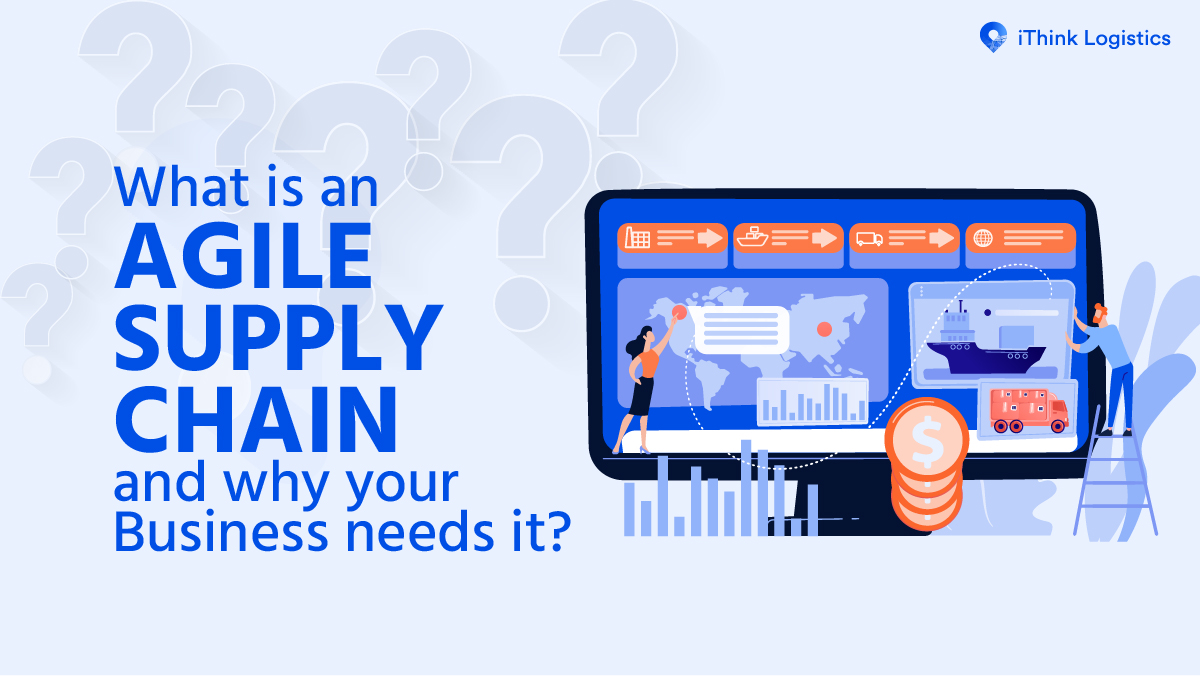
What is an Agile supply chain and why your business needs it?

An agile eCommerce supply chain, by definition, is a product distribution system that prioritizes speed, cost savings, productivity, and market reactivity and adaptability. The goal of supply chain management (SCM) is to boost a company’s long-term success.

Real-time data, as well as expected data in supply forecasts, are used by agile supply chains to make decisions in day-to-day operations. When used together, it produces a more robust process that saves money for businesses and consumers, removes excess inventory waste, predicts potential shortages, and does it swiftly and efficiently. Flexibility is essential in an agile supply chain.

Agile or agility can be defined as the ability to move rapidly and readily, as well as being nimble or lithe. As a result, an agile supply chain is defined as the ability to adjust to ever-changing supply and demand trends in a way that expedites product delivery to customers.

This is a crucial strategy for firms that are always trying to adapt their internal environment to unforeseen developments in the outside world. It also uses real-time data to measure and estimate demand, resulting in increased efficiency and productivity.

  • Accurate Data: Shortening response times, expanding accessible options, and improving the quality of information available to make quick, effective decisions are the first steps toward enhancing agility.
  • Control Across the Board: Agile supply chains attempt to comprehend the entire supply chain, including the critical enablers and inputs required to deliver the best possible customer experience. They invest in new technologies and data-driven processes that allow them to keep a tight grip on the company.
  • Making Quick Decisions: While no one can forecast all disruptions, having processes and technology in place that allow for swift decision-making is critical to establishing an agile supply chain that can adapt quickly to the unexpected and grab new possibilities despite the inherent volatility in the industry.

There are several benefits of an agile supply chain-

With increased flexibility and demand-driven planning, companies with an agile supply chain can respond to changing customer demand. This allows companies to capitalize from brief profit windows and bring items to market faster than their competitors. Agility benefits the supply chain a lot.

Agile supply chains are more responsive and robust to rapid changes because of this greater flexibility. An agile supply chain can swiftly adjust to and overcome difficulties such as the loss of a major manufacturing partner or a substantial logistical bottleneck, which would create considerable delays in a static supply chain.

The virtual integration required to run an agile supply chain provides improved insight across the whole supply chain, allowing companies to anticipate and eliminate problems before they become a problem.

How to make an agile supply chain for your ecommerce business

Look for ways to improve the efficiency of your processes and systems

There are numerous ways to improve the efficiency of your SCM, lower expenses, and improve customer service levels. Sourcing, incoming and outbound transportation, IT services, and many four-walls tasks are all part of a typical eCommerce supply chain (receiving, storage, order fulfilment, value-added services, and reverse logistics). Here are four important cost-cutting strategies for your supply chain.

Distribute conveniently and flexibly

The customer is in control and can see inventory located at the stores nearest them. BOPIS, ship from store, and ship from an FC are all options. The importance of communicating availability and delivery timeframes from each location cannot be overstated.

3PLs function as intermediaries between the shipper and the carrier. As a result, the 3PL serves as a customer service agent, communicating with the carrier on behalf of the customer throughout the shipment’s life cycle.

iThink Logistics, one of the leading eCommerce shipping businesses, is the finest partner for you. iThink Logistics can give your company wings in one fell swoop, thanks to its low prices and superior shipping services. Whether it’s international or domestic eCommerce shipping, iThink Logistics can handle it all.


Categories
E-commerce Logistics

Why Is Pre-Ordering Important For Ecommerce Stores

What is pre ordering?

We book our tickets in advance for a flight. Like we do for hotel bookings when on a trip. Just like that, there are times when ecommerce platform sellers can offer customers the option of booking a product even before it has officially been listed for sale. This is called pre-ordering – a strategy where the customers can buy a product that hasn’t yet been released. 

When it comes to online selling and ecommerce shipping, pre-ordering is a tactic that retailers have followed avidly.

However, before you decide to do so for your upcoming products, it is best to read on about the pros and cons. 

Why offer pre-orders?
 

Besides being a fantastic marketing strategy, preordering has many benefits for retailers on ecommerce platforms


Creating A Hype


Pre-ordering campaigns help the ecommerce dealers create a sense of FOMO – fear of missing out because they work on the scarcity principle. A pre-order campaign usually offers up to a certain number of limited pro-orders only. And the race to be one of the chosen few on the pre-order list adds to the sense of hype. These products often come across as limited edition products that furthermore make people feel special. It’s a human tendency to show off the things they have and others don’t. In the same way, a user with a successful pre-order delivered to him/her is of great help in generating a buzz online and offline. 

Forecast Demand

One of the biggest pros of running a pre-order campaign is the ability to calculate and estimate demand. Depending on the number of pre-orders placed, you can decide to manufacture the actual number of products because by now you will have a fair idea of how coveted the product actually is. For example, if the pre-ordering list is full and enquiries for orders keep coming in, your product is a hit and the production can be more. If the pre-order list has shown a good, not great response, you will know exactly how many products to manufacture/purchase. This automatically cuts costs and best of all, it avoids the pile-up of unsold inventory.  


Reduces Risks

Pre-ordering gives you the advantage of charging the customers for the product while they place an order. So that means you have collected the cost and profit for the order even before it is purchased. This gives you a good financial safety net and greatly reduces the risk for the actual number of products you manufacture/purchase. 

Create a successful pre-ordering strategy with these tips

Contemplating whether you want to run a pre-ordering campaign or not? Check out these tips! 

Pre-launch Marketing

Before the movie, comes the teaser. People see the teaser, get intrigued, show excitement, and book the tickets. This goes to show how important it is to generate buzz on ecommerce platforms even before you launch your pre-ordering campaign. To give you an example, make the most of content marketing, email marketing, and influencer marketing in your phase before you start booking pre-orders. 

For eg, for the release of a book written by a celebrity, the process starts with the publishing house and the celebrity taking to social media to announce the book. Then comes the second step of releasing the cover. Then comes the step of gifting the book to influencers and asking them to post a review. Over and above all throughout the campaign, emailers and messages about the pre-ordering date inching closer add to the hype of the product. 

Prepare in Advance

A pre-launch campaign is great. But in your pre-ordering phase, ensure that you are completely set for the day the actual launch takes place. To do so, get the product descriptions with SEO friendly keywords already embedded in the content, enough reviews posted from paid partnerships, and PR articles ready to be uploaded once the launch is done. The preparation also involves ensuring that the ecommerce platform with your listing is equipped for heavy traffic.


Create a Scarcity

The principle of scarcity has given birth to the ‘limited edition’ concept – a strategy used by all brands when something ‘new’, ‘special’, and ‘innovative’ is about to hit the market. By adding a ‘limited period offer’ and a ‘limited edition’ in your communication, you can create a hype among the customers about how exclusive your product is and only the coveted few can get it. You can also offer your product only for a limited period of time to increase the hype further. 


Fulfilment

As mentioned earlier, staying prepared for doing all the work once the pre-orders have been booked and locked is crucial. And here is where shipping comes into play. Shipping software in India has developed a lot over the years because of which it is considered foolish to try and do the entire fulfilment all by oneself when fast and favourable options are available. One such option is choosing a third party logistics partner. And with ithinklogistics, you’ve found the perfect partner. With our AI-based dashboard and process, we are one of the best fulfilment and shipping software providers in India. From real-time step by step updates to finding out the reasons for non-delivery to attempting delivery again, ithinklogistics covers it all. 

From listing the products online to ecommerce shipping, if you’re in the business of online retail, pre-order is something you definitely try. It is preferable to do so on a product that is backed by a popular brand/celebrity or its predecessors have good brand value in the market. From phones to smart watches to books, every industry has room for a pre-ordering campaign. All you need is the right product and the right shipping partner. Choose your ideal shipping partner by contacting us at ithinklogistics.

Categories
E-commerce Logistics

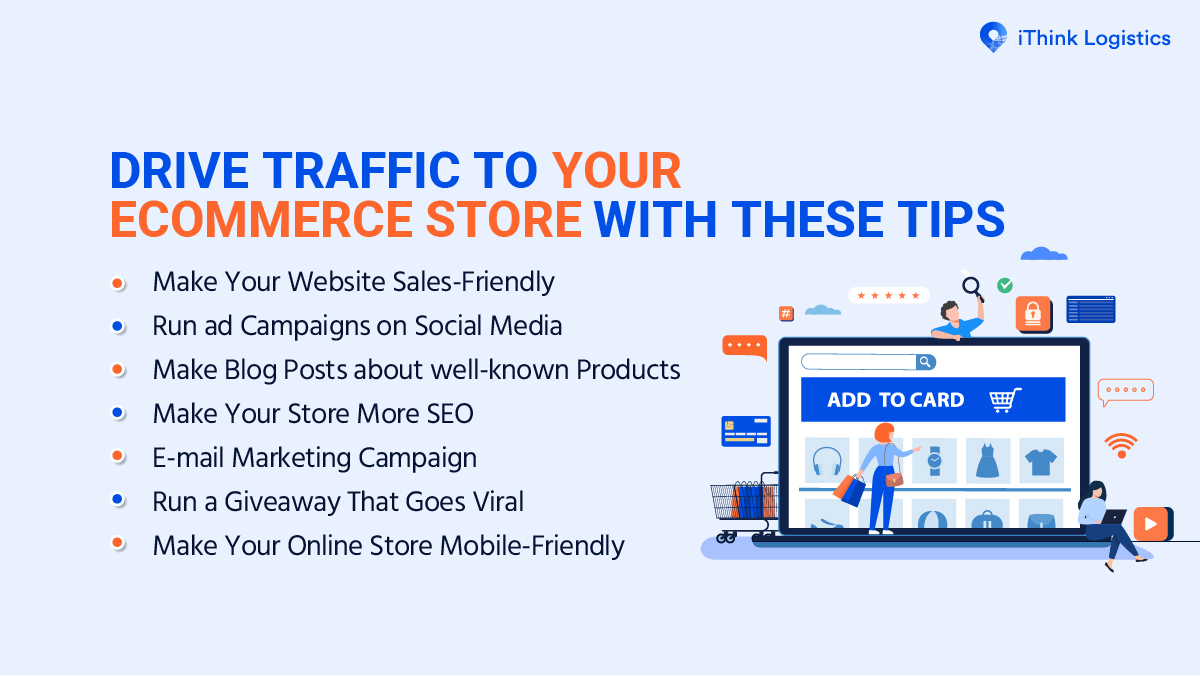
Drive Traffic To Your Ecommerce Store With These Tips

Online sales are expected to increase dramatically ever since the COVID19 pandemic struck us. As a result, new eCommerce enterprises are constantly sprouting up. However, how do you stay ahead of the competition and position your organization for success in this more competitive environment? One of the most crucial things you’ll need to do is work on increasing traffic to your online store along with supreme eCommerce shipping solutions

Getting eCommerce traffic to come and buy from your online store can be difficult, especially if you’re just getting started. Even with great eCommerce packaging and excellent eCommerce shipping you need to make sure more new traffic comes your way. 

We’ve prepared a collection of excellent suggestions for attracting clients to your internet business in this article.

Before we start Reading This Blogs lets us know what is an e-commerce business and How does it works

Here is how you can increase the traffic to your eCommerce store

Make Your Website Sales-Friendly

Everyone is looking for strategies to improve eCommerce traffic and ultimately attract people to buy their products, whether they’ve recently debuted or have been around for a long. However, each potential visitor is different, and there are a variety of ways to contact them. These tried-and-true methods will undoubtedly generate traffic to your online store, from social media to SEO, engaging with influencers, and more.

Run ad campaigns on social media 

You must be able to bring your business in front of your ideal customers to improve internet traffic for your online store. Taking advantage of social media advertisements you can easily create highly targeted campaigns that will show customized ads to interested customers who are more likely to click and buy them. 

Make blog posts about well-known products.

More traffic to your store can be driven by publishing consistent, valuable, and all-around engaging content. The majority of customers are looking for a brand with which they can connect and interact.

Take a look at your most popular products if you’re wondering what themes you should cover on your website. Write blog entries on these products.

Make Your Store More SEO (Search Engine Optimization) Friendly

If you’re going to incorporate content production into your overall marketing strategy to improve eCommerce traffic, it’s critical that you grasp the impact SEO plays in driving visitors to your site.

E-mail marketing campaign

Building an appealing email list is one of the most effective ways to drive visitors to your online store, which should come as no surprise.

It’s a big mistake if you focus all your energy on gaining new customers and overlook your existing customers. 

You can send email campaigns to new customers who have never bought from you before, existing customers who have bought from you previously, and even lost customers who abandoned their cart during the checkout process.

Run a Giveaway That Goes Viral

Viral giveaways are an excellent strategy to get new users to your website. Giveaways can help you gain social media followers, brand exposure, lead generation, and email list growth.

Users will be more likely to frequent your store and engage in competitions if you offer giveaways. Also, if they share your post on social media, ask more people to participate, or provide an email address, you can give them multiple reward points.

Make Your Online Store Mobile-Friendly

Many websites are solely focused on desktop computers, completely ignoring the mobile users. As a result of the terrible user experience on mobile devices, your visitors will abandon your site.

You need to make your online store mobile-friendly if you want more customers to come. 

Google has already switched to the mobile-first index which means the website that works well on mobile devices will automatically be ranked higher than those that don’t 

Grow your eCommerce business with iThink Logistics

Executing all company tasks in-house may not be the ideal formula for success in today’s highly competitive market when specialization is critical for growth. Having a 3PL can provide your business with a competitive advantage while also allowing you to concentrate on its core capabilities.

3PLs act as go-betweens for the shipper and the carrier. As a result, the 3PL acts as a customer service representative, contacting the carrier on the customer’s behalf and maintaining communication throughout the shipment’s life cycle.

Through customer service and TMS software, 3PLs provide you with ongoing visibility of your shipment throughout its life cycle. It’s a headache to lose track of a shipment, but working with a 3PL ensures you’ll have eyes on it from the time it leaves the dock until it arrives.

iThink Logistics is the best partner for you and is counted among the leading eCommerce shipping companies. With affordable pricing and excellent shipping services, iThink Logistics can add wings to your business in one go. Be it eCommerce shipping internationally or locally, iThink Logistics can take care of everything. 


Categories
E-commerce Logistics

Complete Ecommerce Shipping Solution Guide: Its Costs, Returns, Packaging, Carriers, & More

An ecommerce shipping solution is a key to your online store’s success.

Along with thorough market research and perfect advertising your brand online, it is also essential to focus on shipping. 

In recent years, we’ve noticed a massive increase in eCommerce sales. This isn’t just because of the pandemic that the consumers depend on online buying more than before; there are various reasons. Before the pandemic crippled the world, people would buy what they wanted. The market came up with new facilities to cater for the need of people stuck in lockdowns.

Online shopping came along with the convenience of digital transactions and a wide range of selections. Naturally, people were attracted to the better of the two. There is no doubt that the global pandemic has resulted in one of the most significant changes in global commerce.

It has become more convenient for people to order things from the comfort of their own homes and have them delivered to their front doors. That is why developing a clear shipping strategy in eCommerce is critical. We’ve put up a quick guide to everything you’ll need to know to make the best selection for your company because the world of shipping and fulfilment can be confusing to those inexperienced with it.

Learn more about What is an eCommerce Business and How does it Works

Five reasons why people shop online?

A Wide Range of Products

Stock in physical stores is limited, and they only keep the items that are popular and sell mainly. There are a variety of factors that influence the availability of other products. In addition, the local merchant seeks to market their limited inventory.

On the other hand, online shopping displays a wide range of products from multiple businesses. 70% of shoppers shop online because they can choose and explore more according to their needs and trends. You can even purchase second-hand products through online shopping.

The Benefits of Not Having to Go to Stores

Shopping on the internet is straightforward. You don’t have to get dressed and go to the local market, and you go to a lot of stores to find the thing you want. When you shop online, you can do so from anywhere and at any time. You don’t have to be concerned about the working hours of the store anymore. And you can, of course, shop from the comfort of your home and also avail the accessible shipping facility. 

There is no sales pressure when you shop online

When you go to a physical store, the salespeople persuade you to buy more things. Internet buying aims to relieve the customer of this stress and simplify shopping.

No Crowd


Who likes crowds? Shopping becomes a problematic effort in a busy place. During busy hours, car parking may become a challenge. This drives people to turn toward online shopping, and it helps avoid crowds and find the best deals without much hassle. 

Easy Replacement and refund of products 

Product replacement and refunds are simple and require no additional charges or effort. A product that does not match your size or material quality expectations may need to be replaced. Online purchasing products come with a replacement warranty for a short time, for example- 15 days return policy offered by Amazon. You can order your product, and if you are not satisfied with it, you can easily replace it within the 15 days return window without any hassle. 


What are the different types of eCommerce shipping solutions?


Your shipping option will be determined by several things, including your goods, target audience, and budget. Finally, clients desire agility, which should be the primary motivator in the shipping method you use whenever possible.

The delivery times for each shipping method vary, but a crucial element is when the consumer places the initial purchase.

Expedited delivery


Expedited shipping refers to any shipment technique that is faster than regular. It ensures that things are delivered faster than they would be with traditional shipping methods. Products may transfer from warehouse to warehouse or another checkpoint in conventional delivery. In most circumstances, expedited shipments go from pickup to delivery.

Expedited delivery means that the shipment is picked up from the closest inventory to the customer’s delivery address and delivered quickly. Expedited shipment is more expensive than standard delivery. (For example, Amazon Prime)

2-day shipping


Amazon prime, the eCommerce powerhouse, popularised the concept of 2-day shipping, which other competitors quickly replicated. You place an order, and your product is shipped from the warehouse and reaches you within two days. Works like wonder for anything, be it a tiny sewing needle or a complete couch from another state; the 2-day delivery option keeps everything sorted.


Same-day shipping


Same-day shipping is a delivery technique in which things are delivered the same day or within 24 hours of the client placing the order. Grocery and medicines ecommerce provides services with this shipping facility, and Amazon provides same-day shipping facilities for their prime users on select products.

Overnight shipping

When customers choose overnight shipping, they expect their package to arrive the next business day. “Next-day shipment” or “one-day shipping” are terms used to describe this type of delivery.

There is a specific time range within which one must submit an order to have items delivered overnight. It is only at that point that it is eligible for next-day delivery. The goods are then sorted and picked out of inventory based on the order, packed, and loaded onto the carrier. The courier partner then picked up the shipment and delivered it to the customer’s address the next day.

The cutoff time for placing an order is often between 6 and 7 p.m. in most cases. Furthermore, eCommerce such as Amazon has its own logistics system, ensuring that shipments are rapidly packed and placed onto the carrier for delivery.

International Shipping

International shipping refers to delivering a product from one country to another. eCommerce shipping internationally works like a wonder to connect the world! International shipping has been gaining in popularity over the years because it allows sellers to diversify their businesses.

International shipping businesses can usually assist you in navigating the complexities of international shipping, allowing you to expand your business more efficiently. This allows you to reach out to more clients and grow your business internationally. Also, shipping globally is a terrific method to improve your brand’s awareness and presence and reach more individuals.

Freight shipping


The shipment of heavy commodities by air, land, or water is called freight shipping. Freight shipping is typically designated for things that exceed a specific size and weight limit and bulk items. Any shipment over 65KG. is considered freight.

Eco-friendly Shipping

For packaging and delivering items, eco-friendly shipping includes the use of biodegradable materials that can be easily recycled, reused, and require less time to degrade.

It can also apply to combining orders into single shipments, adopting low-emitting modes of transportation, and other strategies for reducing the environmental impact of package delivery.

Omnichannel Shipping

To deliver a smooth shopping experience, omnichannel shipping is one-touch integration between operations and physical product flows across all channels.

To put it another way, omnichannel shipping is a system that allows customers to complete purchases and get products through any channel they choose.

Ecommerce shipping costs and rates

Size, distance, and other characteristics can influence how much it costs for a product to arrive at a specific location.

Determine your product’s dimensions and weight

The amount of space or density that your product occupies has a big impact on transportation costs since it determines how much room or weight a box takes up in a truck or how much weight it adds to an aeroplane, for example.

The DIM (Dimensional Weight) technique of estimating transportation costs is a pricing method. It’s calculated by multiplying the L x W x H (length, width, and height) of the package by a specific rate (generally 5000). The actual weight of the box may also be a factor.

Both volumetric and physical weight are compared, and the higher of the two is used as the product weight.

Consider the final destination

Size and weight are important, but it’s also important to consider where you’re sending from and where you’re shipping to. According to a general rule of thumb, the longer the box must go, the more expensive it will be.

For example, a consumer in San Francisco will pay a different delivery rate than a customer in China at an eCommerce company situated in Dallas, Texas. This is simply because China is further distant, necessitating the use of an aircraft or a ship to get there, all of which incurs additional costs for fuel, the vehicles used, and the handling charges associated with shifting the item from one vehicle to another at docks or airports.

Costs of shipping carriers should be added.

While the shipping cost is affected by package dimensions and the customer’s destination, not all shipping providers charge the same amount.

Company A, for example, may charge $14.40 to collect and deliver a package from Dallas, Texas, to China. On the other hand, Company B may charge $15.90 for the same shipment. It’s worth noting, though, that in some circumstances, such as domestic or local shipment, company B may be a better deal than company A.

Handling fees

Workers in the warehouse move goods around, generate mailing labels and do other tasks associated with a fulfilment centre. A handling fee is the cost of all of these additional stages.

Handling fees, as indicated above, can contribute to the cost of shipping since your shipment is processed at a warehouse, dock, airport, or other similar location.

The charges of handling and administration will be incurred. As a general rule, the greater the distance between the eCommerce company and the consumer, the more likely the shipment will be handled by many people, increasing the shipping charge.

Customers are charged for shipping in various ways by different eCommerce retailers. Here are two commonly used eCommerce shipping rates.


Flat rate shipping

Flat rate shipping refers to charging the same fixed shipping fee for all orders or shipments that fall into a specific weight range, order value, or other categories. The blended average shipping and handling cost across orders in a category should calculate flat rate shipping.

However, some drawbacks businesses face while using flat rate shipping: sometimes some orders’ shipping costs will not be fully covered, while others will be overcharged in contrast.

Real-time carrier rates

At checkout, some eCommerce stores show real-time carrier rates. The exact shipping charges are immediately obtained through automation, from the carriers based on the customer’s location and delivery preferences.

This enables you to bill clients for the precise amount it costs your company to ship their order. This is a feature available in Shopify’s Advanced plan and shipping APIs.

Offering free shipping

Free shipping can help you reduce shopping cart abandonment, boost conversions, and promote customer loyalty. You can offer free shipping while still making a profit in a couple of ways:

  • Incorporating the cost of shipping into the product price
  • Shipping at later dates to get cheaper courier service

In exchange for free shipping, a minimum spend is required.

Accepting a recurring cost as part of a loyalty program in exchange for free shipping on all purchases (e.g., Amazon Prime)


Ecommerce packaging

Good eCommerce packaging is essential. Rather than wrapping the goods, putting them in a box, and delivering them, many e-commerce businesses are increasingly investing in corrugated boxes to improve packing and labelling. The fundamental goal of better packaging and labelling is to ensure safe product delivery and successful brand promotion. 

Additionally, investing in packing materials and labelling improves the company’s reputation significantly. The customer is satisfied when the delivered product is in excellent condition, and this increases the likelihood of the consumer placing additional orders, resulting in higher ROI and business growth. 

Proper packing can drastically reduce a company’s costs. Good packaging guarantees that the product is not damaged during shipment, reducing the likelihood of customers returning it.

Packaging is essential for establishing a link between a company and its customers. If your product is well-packaged, it will make a lasting impression on the customer long after the sale.

Proper packaging aids in giving clients a positive first impression of your product. If a consumer receives a well-packaged product, their view of your company will be positive. Proper packaging also aids in the development of a strong brand identity.


Ecommerce shipping carriers

There are dozens of options to choose from when it comes to carrier services. Shippers require access to an extensive carrier services network to achieve their customers’ delivery expectations, particularly in high-volume international distribution. Businesses can benefit from the most significant features of each carrier’s services.

All carrier options are at the retailers’ fingertips with e-commerce shipping solutions. Advanced platforms, like Amazon, enable users to compare carriers and services in real-time and choose the carrier and service best suited for each shipment based on the retailer’s business guidelines. Retailers can accomplish their delivery objectives at the lowest cost for each shipment by doing so.

While any shipper’s ultimate goal is to deliver products to customers on time, without damage, at the lowest possible cost, and in the most efficient manner possible, the recent surge in e-commerce has increased customers’ ability to customise their shipping options, and businesses must be able to accommodate this personalisation.

E-commerce shipping solutions allow a business to fulfil a customer’s shipping needs within their system. With the help of AI, retailers can choose carrier partners according to their business rules. According to the retailer’s business rules, they can choose the one that can offer the best rates to a specific region. And also ensure that each shipment is labelled and communicated by each carrier’s labelling and communication standards, as well as any applicable trade regulations.


Transform your eCommerce shipping solutions with iThink Logistics

Shipping is unquestionably a complex element of any eCommerce operation. Every company will face its own set of obstacles that must be addressed and conquered to build the best and most effective shipping strategy. It will take time and implementation to figure out what works best, just like so many other parts of your new eCommerce site.

Shipping is unquestionably a barrier for eCommerce merchants. And, given the nature of your firm, these issues are sure to be unique. To overcome these obstacles, you’ll need to put in a lot of effort by implementing new procedures and keeping track of what’s working for your company.

As with many elements of your business, it will take time to construct, modify, and work your way to customer satisfaction through delivery. 

iThink Logistics is a game-changer for your business and can simplify the entire process of shipping for you! We have extensive expertise in shipping technologies and have immense experience to help your business reach the stars in a jiffy. 


Categories
E-commerce Logistics

Top 10 Digital Ecosystem Trends In Supply Chain And Logistics

2020 Was the year when the world shut down. But did it?

The digital revolution brought the world online Because supply chain and logistics saw the most extensive boom, And consequently, ‘Your order has been placed’ became popular.

With people indoors, over the top safety protocols, minimal human interaction, and a long list of things to bring home, the logistics and supply chain management industry witnessed incredible growth.

This growth has given rise to many trends owing to technology, faster delivery requirements, AI intervention, etc. 

As of 2017, the logistic industry was valued at over 8 trillion dollars – a staggering number for the world but now it is going to be double in nearly 2023. Because treating the customer like a king and providing superfast doorstep delivery has made the ecommerce logistics industry the new coveted market for venture capitalists and innovators.

Ecommerce giants like Amazon and Alibaba group are now adopting a new model of business and using artificial intelligence, blockchain and many others to face the challenges.

And with more money and emerging ideas pouring into the industry to make it a better and more profitable avenue come more rising trends. Let’s take a look at them below. 

Before diving into this blog Let’s have a look at 5 Ways for SMEs to Optimize Supply Chain Logistics

10 Logistics and Supply chain management trends fueled by the digital revolution

Considering the Environment

Planet health equals our health. The logistics industry hasn’t been kind to the earth. The ecommerce logistics industry is gearing up for a renewed start, A renewed start that involves eco-friendly packing, fuel-efficient delivery, live tracking of sustainable transport methods and energy sources

The rise of ecommerce + logistics combo

Initially, the trend was for a business to make a website, list products online, and get orders; a logistics partner would take care of the product’s journey from the warehouse to the customer.

However, giants like Amazon and Alibaba have developed their logistics and supply chain management. Thereby not requiring the need to outsource their logistics. You may see the term ‘Fulfilled by Amazon’ on many Amazon product listings, which is code for Amazon being that brand logistics partner. 

The Evolution of blockchain

Blockchain is like digital books of accounts, a ledger that keeps track of the cash flow and every aspect of shipping, from packaging to delivery. A technology that has worked wonders for traditional logistics suppliers like FedEx, UPS and uber freight can now plug in the gaps of tracking fraud more efficiently. This, in turn, has enhanced their efficiency and provided more transparency. Blockchain is like a digital ledger.

Logistics as a Service model/LaaS

The pandemic is that from a scale of 200 business owners, all 200 now want to be online and provide end-to-end services to get to their customers.

The digital boom also needs quick logistics. It’s costly and time-consuming for every business owner to develop logistics and supply chain management why businesses are looking to outsource.

And when it comes to outsourcing, iThinkLogistics serves as an ideal third-party logistics partner. With the power of AI-based technology, it is the go-to partner for quick delivery, tracking, problem-solving, and cost and time optimisation. 

Emerging as unstoppable partners

The pandemic was proof that the world could come to a stop. But it also gave rise to a challenge. A challenge of creating a business model that could survive such an event yet again.

And the current ecommerce logistics industry is proof of the challenges being completed. The world managed to get vaccines delivered from sturdier than ever packaging to faster delivery. 

The AI Takeover

Planes have auto-pilot, and cars have auto-driving modes. In ecommerce logistics, artificial intelligence has started to change the way the industry works. With end-to-end robots in charge of packaging and tracking, the industry’s productivity and pockets are enhanced.

With a workforce of AI-powered devices combined with humans, companies are likely to reduce mistakes and save costs. According to the annual industry reports, AI is used by 12% of warehouse businesses, but it is expected to reach more than 60% in the coming years.

The digital twin initiation

We live in a world where the Metaverse is on its way to becoming a whole actual world of its own, existing with our world, yet separately. What exists, in reality, can be made with accuracy in 3D. 3D models of warehouses can help plugin gaps and act as beta testing centres for future technology in shipping, fulfilment, and logistics as a category. 

Data-driven Optimization

Every avenue for the logistics industry is a step in the right direction. Making the most of predictive logistic insights is like taking a peek into the future. Predictive insights enable one to know the most fuel-efficient mode of transport, what product will be the easiest to ship, etc.

Real-time Supply Chain Visibility


AI (Artificial Intelligence)  and planning are based on predicting close to the most accurate patterns that are likely to occur. However, we live in an uncertain world where the weather and human intervention can change anything at the last minute.

With the help of Supply Chain Visibility firms that provide real-time data and tracking, even these problems can be managed well. From the traffic delay to road closures to weather changes, everything can be mapped, tracked, and alternate solutions can be provided quickly. 

New entrants in the business

Even the world of ecommerce logistics and supply chain management that is already so advanced cannot escape the arrival of new technology and, more importantly, new players in the market. The aforementioned trends are proof of innovation taking this industry from being ‘product shippers’ and ‘delivery agents’ to full-fledged AI-driven end-to-end solution providers.

Therefore, the door for ‘new’ and ‘better’ is always open in an ever-growing industry.


Categories
E-commerce Logistics

Advantages of eCommerce: Why You Should Take Your Business Online

In the fast-changing world, eCommerce is becoming more and more important and has become a vital part of any successful business strategy. With the COVID-19 pandemic taking over the world and disrupting lives on the go, eCommerce has become especially important. People are turning to online shopping and this is opening up horizons for cross country, even continent small trades.

Now you can order a pack of Californian almonds while sitting in Belgium!
Ecommerce has connected the world. Businesses should turn to eCommerce to make their mark in the growing market. It’s time for you to strike the iron while it’s hot!

You also need to ensure perfect foolproof eCommerce shipping solutions with the right eCommerce strategy.  

Having an online store provides clients with convenience in its purest form. Customers can simply access all of your products through your website, where they can compare prices and purchase items from the comfort of their own homes.

The online store is open 24 hours a day, seven days a week, allowing clients to purchase their desired things at any time. Traditional methods of purchasing have become a laborious process and are no longer a favoured manner of shopping as a result of social distance. Shopping, on the other hand, has never been easier thanks to online stores.

Before Reading this blog lets us know the details about what is an Ecommerce business and how does it work.

Advantages of selling online

Reduced costs

When compared to a conventional business, an e-commerce store has lower operational costs, which benefits consumers. One of the most significant advantages of e-commerce is this. Prices on the internet are typically lower than in stores. eCommerce also appeals to customers by dropping in good discount deals and other promo codes.

Scalability

E-commerce websites are extremely effective for understanding which products sell well and raising supply levels for certain products. As a result, you will be able to enhance your company’s revenue, customer base, and profitability. Amazon’s online shopping website has been successful because it continually expands its product selection and assesses what customers want. As a result, they’ve been able to significantly extend their product line across a wide range of industries.

Cost-cutting

Ecommerce attracts businesses because of its brilliant cost-cutting ability. In running a smooth functioning physical store, sellers have to spend a lot of money. They need to pay deposits, rent, repairs store design, and so on. Despite investing in all services and inventory, maintenance and staff, it is not guaranteed they will achieve the expected ROI. While eCommerce platform help cut the cost of all the expenses related to physical stores. 

Measurable Advertising & marketing

Advertising via the internet is also less expensive than conventional forms of advertising. You might utilize a Search Engine Optimization strategy to increase your website’s page rankings in search engines. This would be a monthly investment with a predictable return. There are many measurable tools that can increase the customer footfall to your business. 

Flexibility for customers

The ability for sellers to provide flexibility to customers is a significant benefit of eCommerce for businesses. The goods and services are available 24 x7 which attracts the customers. This also gives flexibility to the sellers who can now sell their products anytime anywhere. 

eCommerce marketplace has an abundance of customers all the time. With the flexibility and advantages that come with it, customers tend to return again and again. Free shipping, expedited order delivery discounts and other advantages are just a few of the benefits that attract customers. 

Comparison of products and prices

In ecommerce, sellers can compare products using tools or on their own. This gives them a good idea of the product possibilities available as well as the standard rates in the event that a product requirement isn’t met.

Online comparison saves time and contains more items – Because all of the information is available on the purchase site, it saves time when doing this comparison. Although merchants in physical stores may not have as much information as internet retailers, they do have a greater understanding of their own products.

Open 24×7

You can keep your store open all the time irrespective of whether you are awake or not. Automation can keep your business on track, running it smoothly all the time. A smooth automation process can keep the sales process on track and enable your customers to buy at any time. 

Several payment methods

Buyers value personalization, which is also true when it comes to paying for their orders. On ecommerce marketplaces, UPI, cash on delivery, card on delivery, net banking, EMIs on credit or debit cards, and pay-later credit are all alternatives.

Ecommerce has a significant edge in terms of cart recovery. When a buyer reaches the checkout page, he or she may decide to leave the purchase. Customers might be notified by phone or email to finish their transactions.

iThink Logistics, a one-stop solution for all your eCommerce shipping needs

Starting an e-commerce firm, whether or not you currently have a brick-and-mortar store, is often fairly simple, low-risk, and low-cost. There’s plenty of potential for passive income and great ROI over the long run if you choose your products correctly and have a sound business plan.

iThink Logistics can help you set up your perfect business online Our ecom shipping solutions can take care of all your shipping-related work!. Deliver your best products to your customers in a jiffy with us. We are a leading eCommerce shipping provider. 


Categories
E-commerce Logistics

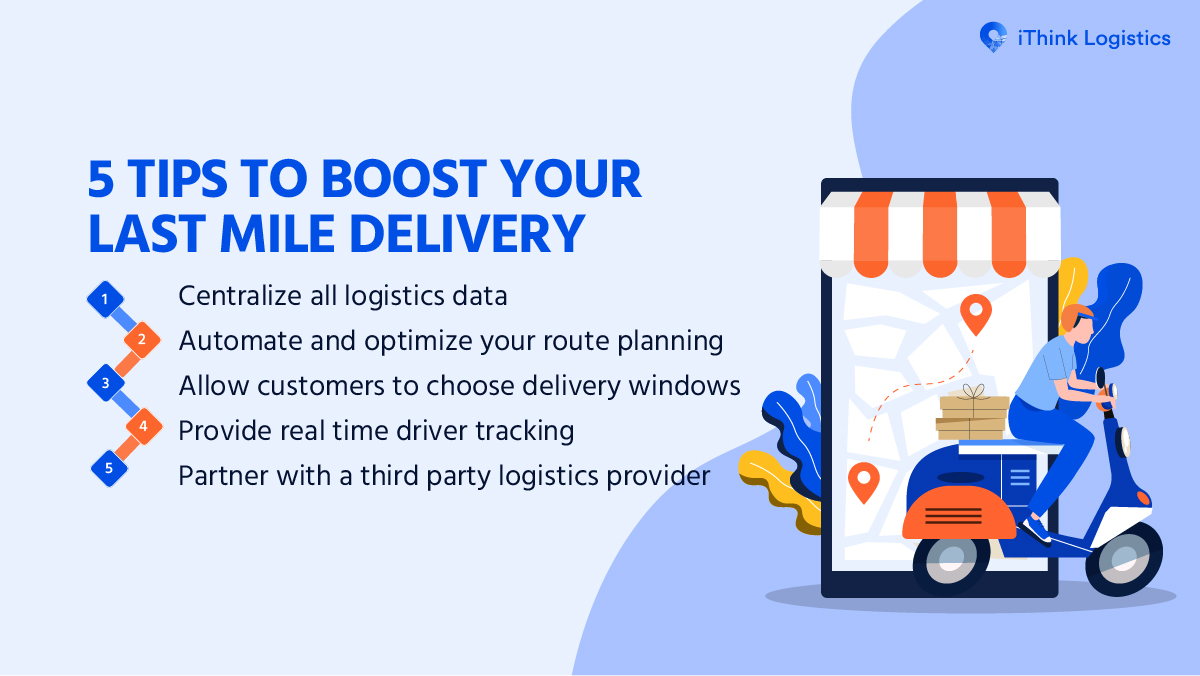
5 Tips To Boost Your Last-Mile Delivery

Last-mile delivery is the last stage in the supply chain, when a product is delivered from a warehouse to the customer’s doorstep safely, efficiently, and cost-effectively, finishing its journey. 

Last-mile logistics, last-mile distribution, and final mile delivery are the other terms used to describe this process. Last-mile delivery is typically the most expensive phase in the supply chain. Corporations generally compare various eCommerce shipping costs to give their clients speedy and sometimes even free eCommerce shipping choices.

Why is Last mile delivery important?

The last mile is the most significant step, regardless of the type of product, the journey, or the number of stops it takes on its route to your door because it is the mile where consumer expectations are met or shattered.

Nothing destroys a customer’s experience like a botched shipment delivery. Last-mile delivery errors are widespread and frustratingly challenging to forecast and avoid. Worse, any last-mile delivery annoyance might elicit a visceral emotional response from the customer, leading to a negative review and a reputation for poor customer care. As a result, achieving client expectations is the primary reason why last-mile delivery is essential in scaling your organisation.

5 Tips to boost your Last mile delivery

Centralize all logistics data

If it’s not organised, there’s only so much you can do with data coming in from your website, aggregator sites, external carriers, and other sources.

By centralising all of this data, organisations can better understand the details of their last-mile delivery process and make adjustments as needed to improve it continuously. Centralised fulfilment solutions aim to simplify the entire e-commerce fulfilment process (from getting the placed order to finally delivering it) while also ensuring that inventory is constantly available across all channels.

This approach allows customers to have a consistent experience across all channels, including last-mile delivery. It also aids returns, often a significant hurdle for online retailers.

Automate and optimize your route planning

The most successful online merchants use a system that constantly optimises transport schedules of the new orders throughout the day. These systems collect new orders, consider the Pincode serviceability available resources, and determine if additional orders can be delivered within the requested time limit.

E-commerce enterprises can improve their operational efficiency and provide consistent, reliable service to their clients by continuously optimising transportation and home delivery service in the same system. Delivery management software can act wonders for last-mile ecommerce. 

Allow customers to choose delivery windows

Allowing consumers to choose their delivery dates is part of a delivery management software strategy that puts the customer in charge of delivery. By providing a variety of delivery time windows on your website, you provide customers with the option of selecting the most convenient time for them, ensuring that someone will be home to accept the item when it arrives.

Provide real time driver tracking

You’ve just discovered a potential problem in your logistics process, i.e. what’s your solution if items are lost or misplaced during last-mile delivery? Before the goods leave the warehouse, set up an effective tracking system. You should be able to follow an order from placement through delivery swiftly and efficiently throughout the supply chain. This will allow you to keep track of how long it takes the package to complete its journey to the customer.

Gathering this information and comparing it to established standard operating procedures provides insight into the supply chain’s performance, particularly in final mile logistics. To ensure customer satisfaction, packages must reach the consumer’s doorstep quickly.

Partner with a third party logistics provider

A third-party logistics vendor, or 3PL, is a company’s order fulfilment partner. The corporation will ship the product in bulk to the vendor, then store it in a warehouse that serves a specific region of clients. 

iThink Logistics is one such 3PL that can help improve your final transportation and last-mile delivery. Working with iThink logistics provider has several advantages like – 

  • Reduced the cost of shipping
  • Lower overhead costs
  • Client satisfaction

With iThink Logistics, you can utilise the inherent last-mile strengths of a 3PL’s nationwide network of carriers, warehouses, and fulfilment centres by outsourcing last-mile delivery to them.

That means you can distribute various inventory volumes to different warehouses across the country and choose the best, most cost-effective delivery method for your consumer, regardless of their location.

Exit mobile version