


Introduction
Every time a shipment moves (whether it’s a courier parcel or a full freight container), three numbers define the weight on paper: tare weight, net weight, and gross weight. Carriers charge you based on gross weight. Customs authorities verify net weight. But the target weight is the number that holds the entire calculation together.
If you have ever noticed a weight printed on the side of a shipping container, or seen the “Tare” button on a weighing scale, or received a weight discrepancy charge on a shipment. Tare weight is at the center of it all.
This guide explains what tare weight means, how to calculate it, and why getting it right directly affects your shipping costs.
Tare Weight Meaning
Tare weight is the weight of an empty container, packaging, or vehicle before any goods are placed inside. It is the baseline weight of the vessel itself. No cargo, no product, nothing added.
In shipping and logistics, tare weight is subtracted from the total loaded weight (gross weight) to calculate the actual weight of the goods being transported (net weight).
The term is also used interchangeably with unladen weight, particularly for vehicles and freight containers.
In Hindi, tare weight is commonly referred to as खाली वजन (khali vajan), meaning the weight of the empty container or packaging only. The same concept appears across regional languages used in Indian logistics operations:
- Tamil: காலி எடை (kaali edai)
- Marathi: रिकामे वजन (rikame vajan)
The Tare Weight Formula
The relationship between tare weight, net weight, and gross weight follows a fixed formula used across every mode of transport and every industry that involves weighing goods:
Gross Weight = Tare Weight + Net Weight
From this, you can derive the following:
Tare Weight = Gross Weight − Net Weight
Net Weight = Gross Weight − Tare Weight
These three variables are always interdependent. Know any two of them, and you can calculate the third.
Tare Weight, Net Weight, and Gross Weight: What Is the Difference?
The difference between net weight and gross weight becomes clearer when you add tare weight into the equation. Here is how all three relate:
| Weight Type | What It Measures | What It Includes |
| Tare Weight | The empty container or packaging | Box, pallet, drum, vehicle, nothing inside |
| Net Weight | The actual goods only | Product alone, no packaging |
| Gross Weight | The total combined weight | Product + all packaging and container |
To see this in practice, take a real example. A D2C skincare brand ships a 500g face serum. The glass bottle and outer box together weigh 200g. The shipment sits on 150g of bubble wrap and a cardboard insert.
- Net weight: 500g (the serum itself)
- Tare weight: 350g (bottle, box, bubble wrap, insert)
- Gross weight: 850g (what the courier actually weighs at pickup)
The courier charges you for 850g. But your product only weighs 500g. Tare weight accounts for the 350g gap between what you sold and what was shipped.
Tare Weight Examples
Shipping containers
Standard intermodal containers have their tare weight stamped on the CSC plate attached to the container doors.
Every container door carries this number permanently, so shippers can reference it directly without needing to weigh the empty container themselves.
Typical tare weights by container type:
| Container Type | Typical Tare Weight |
| 20-foot container | 2,050 kg or 4,520 lbs |
| 40-foot container | 3,750 kg or 8,268.8 lbs |
| 40-foot High Cube container | 3,900 kg or 8,598 lbs. |
These figures vary by manufacturer and container specification. The CSC plate on the container door always shows the official tare weight, payload capacity, and maximum gross weight for that specific container.
Knowing the tare weight of a container is necessary when calculating the Verified Gross Mass (VGM) of a packed container for international ocean freight.
Under SOLAS regulations, shippers must submit a VGM declaration before the container can be loaded onto a vessel.
Ecommerce packaging
For domestic courier shipments, tare weight is the combined weight of your packaging materials: the corrugated box, tape, bubble wrap, dunnage, and any additional protective inserts. This is the weight your courier partner adds to your product weight to arrive at the chargeable gross weight.
Weighing scales
The “Tare” button on a digital weighing scale works on the same principle. You place an empty bowl or container on the scale, press Tare, and the display resets to zero. The scale has now registered the bowl’s tare weight and will only measure whatever is added to it, giving you the net weight of the contents directly.
How to Calculate Tare Weight

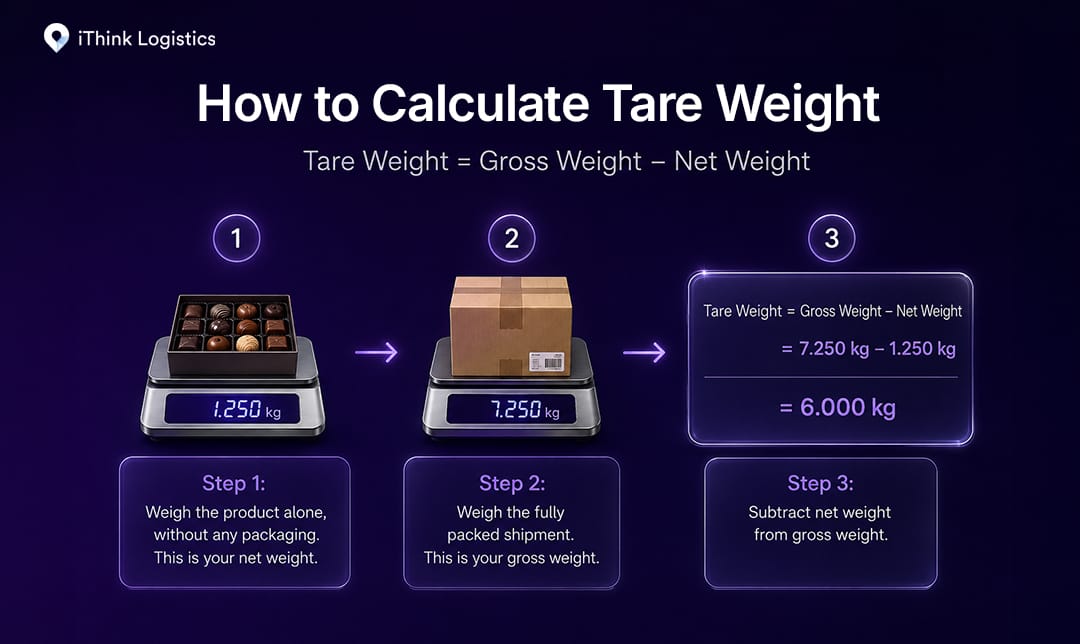
The most direct way to find the tare weight is to weigh the empty container on a calibrated scale. But when that is not possible, you can calculate it using the shipment’s gross and net weights.
Tare Weight = Gross Weight − Net Weight
Step 1: Weigh the product alone, without any packaging. This is your net weight.
Step 2: Weigh the fully packed shipment. This is your gross weight.
Step 3: Subtract net weight from gross weight.
Worked example: A packed carton weighs 4.2 kg. The product inside weighs 3.5 kg. Tare weight of the packaging = 4.2 − 3.5 = 0.7 kg.
For freight containers and heavy vehicles, weighbridges record the loaded and empty weight separately. The tare weight is already stamped on the container door plate and does not need to be calculated.
Why Tare Weight Matters in Shipping and Logistics
Accurate freight charges depend on it. Courier and freight companies charge based on gross weight (or volumetric weight, whichever is higher). Tare weight tells you how much of that gross weight is packaging versus actual product. If your packaging is heavy and you have not accounted for it correctly, you will consistently pay for weight that carries no revenue.
Customs documentation requires it. For cross-border shipments, the declared weight on shipping documents must be accurate. Discrepancies between declared and actual weight can trigger inspections, delays, or penalties. For bulk commodities where duties are calculated per kg, accurate net weight directly affects the duty amount payable.
Road transport has legal weight limits. Trucks operating in India are subject to gross vehicle weight (GVW) regulations under the Motor Vehicles Act. Road transport has legal weight limits. Trucks operating in India are subject to gross vehicle weight (GVW) regulations under Section 113 of the Motor Vehicles Act, 1988. The tare weight of the truck itself counts toward the total, and overloading beyond the permitted gross weight can result in fines of up to Rs. 20,000 for the first tonne and Rs. 2,000 for each additional tonne. Transporters use tare weight to calculate the maximum cargo they can legally carry on a given vehicle.
International ocean freight mandates VGM. Under the SOLAS (Safety of Life at Sea) convention, shippers must submit a Verified Gross Mass for every packed container before it is loaded onto a vessel. VGM is calculated by adding the container’s tare weight to the total weight of the cargo, including all packaging, pallets, and bracing materials inside the container. Submitting an incorrect VGM or missing it entirely means the container will not be loaded.
Tare Weight in Ecommerce: What Sellers Need to Know
When you enter weight on iThink Logistics, the field is labeled Weight (kg) for domestic shipments and Physical Weight (kg) for international shipments. Both fields expect the packed shipment weight. That is the gross weight: your product plus all packaging combined. The platform compares this to your package’s volumetric weight and charges the higher of the two.
Getting this right matters more than most sellers realize. If the gross weight you enter is lower than what the courier measures at their facility, you will incur a weight discrepancy charge for that shipment. Across hundreds of orders, these charges add up fast.
The fix is straightforward. Weigh your product fully packed before entering anything on the platform. That means product, box, bubble wrap, tape, and invoice insert all on the scale together. What the courier weighs at pickup should match what you declared. When it does, the rate you see is the rate you pay.
iThink Logistics lets you compare rates across multiple courier partners based on your shipment weight and destination pincode. Enter an accurate weight, and you get accurate rates.
FAQs
Q.1: What is the difference between tare weight and gross weight?
A: Tare weight is the weight of the empty container or packaging alone. Gross weight is the total weight of the container plus all its contents. Gross weight minus tare weight gives you the net weight of the actual goods inside.
Q.2: Is tare weight the same as unladen weight?
A: Yes. Tare weight and unladen weight refer to the same thing: the weight of a container, vehicle, or vessel when it is empty and carrying no cargo. The term “unladen weight” is more commonly used for vehicles, while “tare weight” is used more broadly across packaging and containers.
Q.3: What is the tare weight of a 20-foot shipping container?
A: A standard 20-foot dry container has a tare weight of approximately 2,200 kg (4,850 lbs). This number is physically stamped on the exterior door panel of every container and can also be verified through container line databases.
Q.4: How is tare weight marked on shipping containers?
A: The tare weight is painted or stamped directly on the door end of the container as part of the CSC (Container Safety Convention) plate. It appears in kilograms and sometimes in pounds. The same plate also shows the maximum gross weight and maximum payload for that specific container, which vary by manufacturer and container specification.
Q.5: What is tare weight on a weighing scale?
A: On a digital weighing scale, the Tare function allows you to zero out the weight of an empty container placed on the scale. Once you press Tare, the scale ignores the container’s weight and measures only the added weight, giving you the net weight of the contents directly.
Wrapping Up
Tare weight is not just a number on the side of a container. For ecommerce sellers, it is the difference between paying for what you shipped and paying for the box it came in.
Every courier partner, every customs form, and every freight invoice works on the same three-number system: tare, net, gross. The sellers who understand this triangle enter accurate weights, avoid discrepancy charges, and pick courier rates that actually match their shipments.
If you ship regularly and want rates that account for accurate shipment weight across courier partners, iThink Logistics gives you that comparison in one place.


