Most sellers think that starting an ecommerce business is about having a product and a website. That’s the setup. But once orders start coming in, six operational systems need to work together behind every sale.
The functions of e-commerce are the core activities that enable online buying and selling. They cover everything from attracting customers to getting paid, shipping orders, and retaining buyers.
Here are the six functions of e-commerce and what each means in practice.
What Are the Functions of E-Commerce?
The functions of e-commerce are the operational systems that enable businesses to sell goods and services online. They include digital marketing, payment processing, order management, supply chain and logistics, customer service, and data analytics.

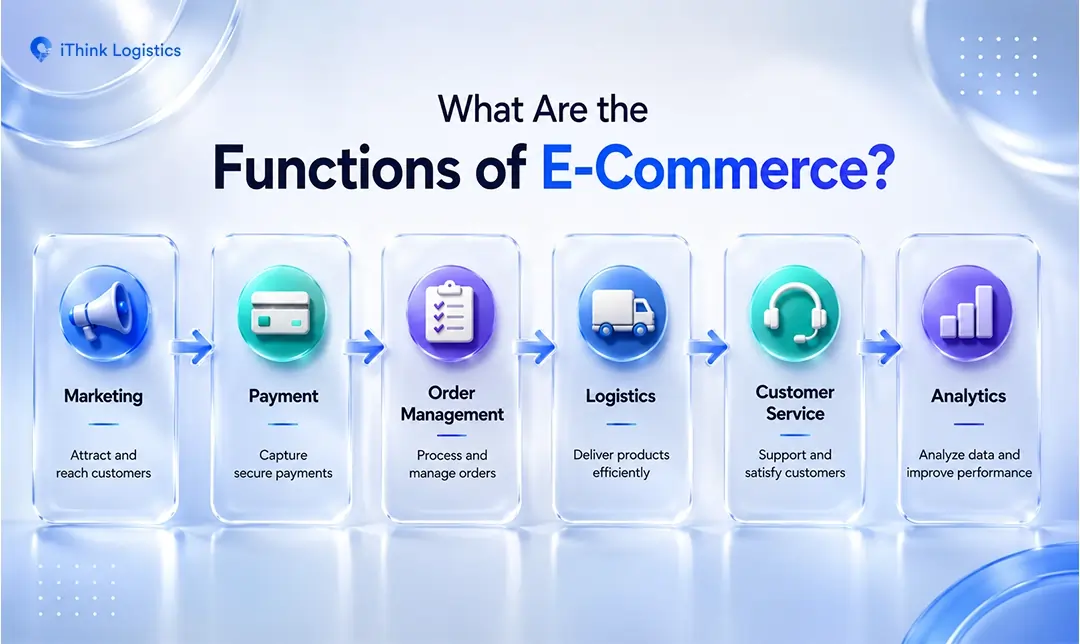
Each function covers a different stage of the buyer journey, from discovery to post-purchase support.
That’s the short answer. What each of the functions of e-commerce actually involves in practice is what shapes how you build and run your store. Start with the one that brings customers in.
1. Digital Marketing and Sales
Every customer who lands on your product page came from somewhere. A Google search, an Instagram ad, a WhatsApp forward, a Meesho listing. Digital marketing is the function of e-commerce that drives that traffic.
For an ecommerce business, the main digital marketing channels are:
- Paid ads on Google and Meta to reach buyers actively searching or browsing
- SEO to rank for queries where buyers already have the intent to purchase
- WhatsApp and email campaigns to bring back customers who’ve bought before
- Social commerce on Instagram, Meesho, and marketplaces for discovery
- Discount engines and referral programs to increase conversion and repeat orders
Here’s what most new sellers miss: it’s not just about getting traffic. It’s about getting the right traffic.
Spending ₹50,000 on ads that bring 10,000 unqualified visitors costs more than ₹10,000 in ads that bring 500 buyers. Targeting, messaging, and channel fit matter as much as budget.
Sellers who treat marketing as a continuous function rather than a seasonal one build steadier, more predictable revenue. And once customers are ready to buy, the next function of e-commerce takes over.
2. Payment Processing and Financial Management
Once a customer decides to buy, the payment function takes over. And in India, this is more complex than most people expect.
Your payment gateway needs to support the payment methods your customers actually use: UPI, credit cards, debit cards, net banking, digital wallets, and cash on delivery (COD).
COD still accounts for a significant share of orders in Tier 2 and Tier 3 cities. That makes COD reconciliation a real operational task, not a footnote.
Payment processing in e-commerce is the system that securely authorizes, captures, and settles transactions between buyers and sellers.
It includes the payment gateway, fraud detection, refund management, and COD reconciliation.
Beyond the gateway, financial management covers GST invoicing, tracking remittance cycles (when your COD money arrives after the courier releases it), and understanding your actual per-order margins.
Most sellers know their revenue number. Fewer know what they keep after shipping costs, returns, and gateway fees come out.
Getting this function right from the start saves significant reconciliation work later. Once payment is confirmed, order management picks it up: one of the functions of e-commerce that most sellers don’t think about until something goes wrong.
3. Order Management
Think of order management as everything that happens in the gap between a customer clicking “place order” and your product leaving the warehouse.
That includes automatic order confirmation, inventory deduction, packing slip generation, and courier assignment.
If you’re selling across Shopify, Flipkart, and direct WhatsApp orders simultaneously, order management means syncing all three so the same unit isn’t sold twice, and no channel shows out of stock when warehouse stock is available.
Order management in e-commerce is the process of tracking, processing, and fulfilling customer orders from purchase confirmation through dispatch.
It covers inventory updates, packing instructions, label generation, and courier handoff.
A gap here becomes visible fast. The customer gets a confirmation email, but the product never ships.
That’s when WISMO calls start. Good order management keeps your warehouse team, inventory system, and courier partner in sync before that happens.
Getting the order out the door is one part. Getting it delivered is the supply chain function.
4. Supply Chain and Logistics
So, here’s what most sellers underestimate: this is the function that most directly determines whether your customer comes back.
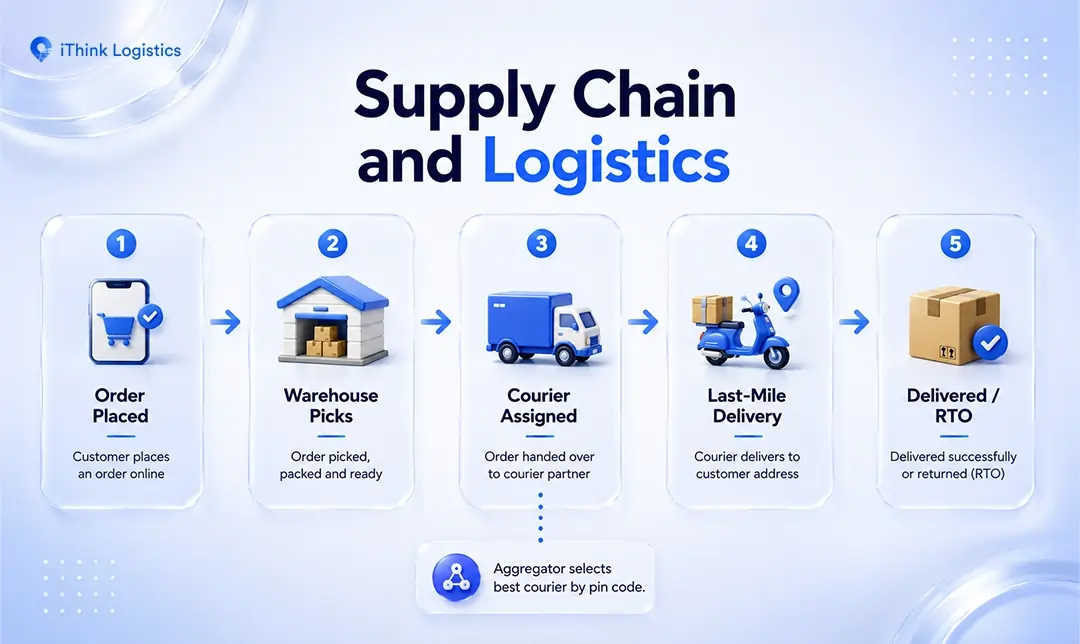
Supply chain and logistics cover warehousing, last-mile delivery, return handling, and everything in between.
For a D2C brand shipping 200 orders a day across India, that means choosing the right courier for the right pin codes, managing non-delivery reports (NDR) when delivery attempts fail, and processing returns (RTO) when customers reject shipments at the door.
Supply chain and logistics in e-commerce are the physical infrastructure and process flow that move products from seller to buyer.
It covers storage, picking and packing, courier dispatch, last-mile delivery, NDR management, and reverse logistics.
India’s logistics landscape has its own set of challenges. RTO rates in fashion and apparel can range from 20% to 40%. Serviceability varies significantly by courier, and delivery times in metros differ from those in Tier 3 towns.
A single courier rarely covers everything well. That’s where a courier aggregator becomes useful.
Instead of managing separate relationships with carriers like Delhivery, Blue Dart, or DHL, you get access to multiple partners, automated courier selection based on pin code performance, and a single dashboard for NDR workflows and tracking.
Ship smarter with iThink Logistics. Access 29,000+ pin codes, 25+ courier partners, and automated NDR management in one platform.
Getting this function right is what separates D2C brands that grow from those that stall. Even after delivery, one of e-commerce’s functions continues to work: customer service.
5. Customer Service and Post-Purchase Support
Once an order ships, your job isn’t over. Your customer’s experience is still unfolding. And among all the functions of e-commerce, this one is the most visible to buyers.
Post-purchase customer service covers shipment notifications, delivery updates, NDR callbacks, return pickups, refund processing, and complaint resolution.
In India, the most common customer service query is WISMO: where is my order. Sellers shipping through iThink Logistics receive automated WISMO notifications at every shipment status update, which significantly reduces inbound queries before they start.
Customer service in e-commerce is the function that supports buyers after purchase, covering ecommerce order tracking, inquiries, returns, refund processing, and complaint resolution. It directly affects repeat purchase rates and brand trust.
Most of this function can be automated:
- Chatbots handle common FAQs at any hour.
- Automated SMS and WhatsApp notifications keep buyers updated without manual effort.
- Live agents handle escalations, disputes, and refund edge cases.
A seller managing 500 daily orders and handling every query manually quickly burns out their support team. Building systems around this function early isn’t optional at scale. Those systems generate data, which feeds the sixth function.
6. Data Analytics and Reporting
Every interaction in your e-commerce business leaves a trail. Analytics is the last of the six functions of e-commerce, and it’s the one that turns that trail into decisions.
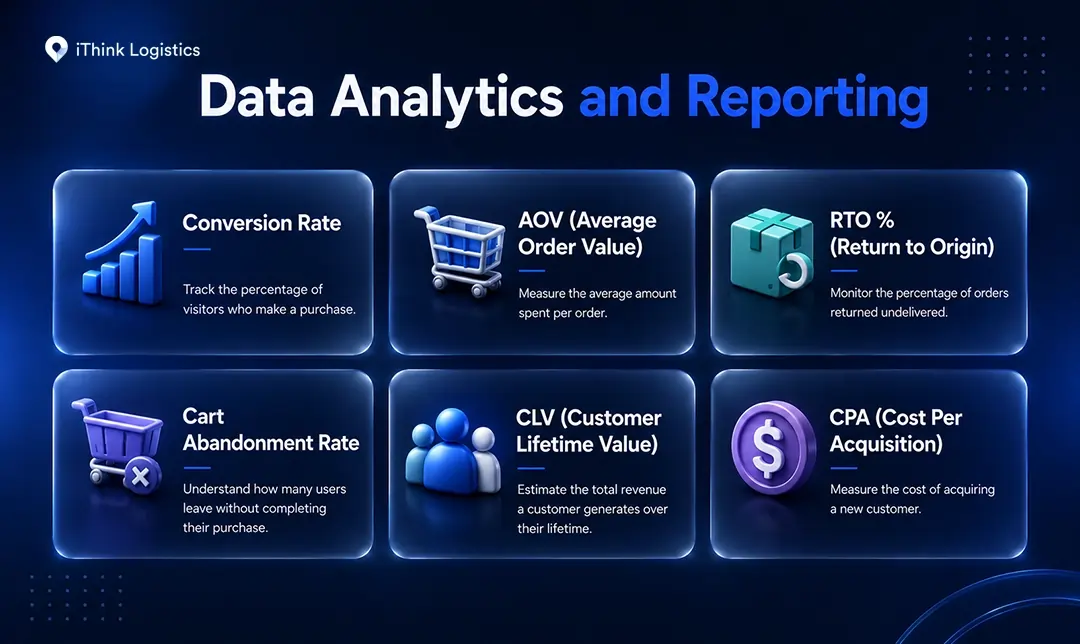
The metrics that actually matter for a seller are:
- Conversion rate: what percentage of visitors actually buy
- Average order value (AOV): how much each transaction is worth
- RTO%: how many orders are returning before delivery
- Cart abandonment rate: where buyers are dropping off before checkout
- Customer lifetime value (CLV): how much a buyer is worth over time
- Cost per acquisition (CPA): what you’re spending to get each customer
Data analytics in e-commerce is the collection and analysis of operational and customer behavior data to improve marketing, inventory, pricing, and fulfillment decisions.
Most ecommerce platforms give you a basic dashboard. The sellers who scale look beyond it. They cross-reference their marketing spend with their RTO rate by channel.
They track which SKUs have the highest return rates and which couriers perform best by pin code.
Analytics doesn’t require a data team. It requires regularly asking the right questions about your own numbers.
And those questions often reveal which platform features are actually supporting the functions of e-commerce you rely on most.
Features of E-Commerce That Enable These Functions
The six functions of e-commerce don’t run on willpower. They run on the capabilities built into your platform.
The key features that support all six functions are the following:
- Product catalog and inventory management: tracks stock across all sales channels in real time
- Secure multi-method checkout: supports UPI, COD, cards, and wallets, with no drop-off.
- Automated order and shipping notifications: reduce WISMO queries without manual effort.
- Shipment tracking integration: lets buyers track their order end-to-end
- Returns and refund management workflow: handles RTO and reverse logistics at scale
- Reporting dashboard: tracks sales performance, traffic sources, and fulfillment metrics in one view
When you evaluate an ecommerce platform, you’re essentially asking: Does this cover all six functions well? A platform that handles marketing and checkout well but leaves logistics as a manual process isn’t the right fit for a growing seller.
FAQs
Q.1: Which is a function of e-commerce?
Marketing, payment processing, order management, supply chain and logistics, customer service, and data analytics are all functions of e-commerce. Each covers a different stage of the transaction, from attracting a buyer to fulfilling and supporting the purchase.
Q.2: What is the role of e-commerce in business?
E-commerce allows businesses to sell products and services online without geographical limits. Its role is to remove the barriers of a physical store: limited reach, fixed hours, and high overhead costs. For Indian D2C brands, ecommerce is often the primary sales channel.
Q.3: What are the aims of e-commerce?
The aims of e-commerce are to make buying and selling faster, cheaper, and more accessible. For sellers, that means reaching customers nationwide, reducing overhead compared to physical retail, and using data to improve decisions. For buyers, it means convenience, price transparency, and real choice.
Q.4: What is the function of supply chain management in e-commerce?
Supply chain management in e-commerce handles the movement of products from storage to the customer’s doorstep. It covers inventory control, picking and packing, courier selection, last-mile delivery, NDR management for failed deliveries, and reverse logistics for returned orders. For Indian D2C sellers, this is the function that most directly affects both profitability and customer satisfaction.
Q.5: What is the difference between features and functions of e-commerce?
Functions are the operational activities an ecommerce business performs, like processing payments or managing logistics. Features are the platform capabilities that enable those activities, such as a payment gateway integration or a shipment-tracking API.
Functions define what needs to happen. Features define how your platform enables it.
Conclusion
An ecommerce business isn’t just a website with a buy button. Understanding all six functions of e-commerce is what lets you build one that lasts.
The functions run in sync: marketing brings customers in, payments capture the transaction, order management triggers fulfillment, logistics gets the product there, customer service resolves issues after delivery, and analytics feeds decisions back into the cycle.
It affects the others. A gap in any one of them shows up in your margins, your return rate, or your reviews.
Understanding how each function works is the first step. Building the right systems behind them is where the real work begins.