



Imagine this: You’ve just shipped a ₹5,000 smartphone case to a customer in Bangalore. Three days later, it arrives—crushed, damaged, and worthless. The customer refuses delivery. Now you’re paying ₹69 for forward shipping, ₹69 for return shipping, ₹4000 product cost, and you’ve lost a customer who might have spent ₹20,000 with you over the next year.
This isn’t rare. It’s happening to thousands of Indian eCommerce sellers right now. The culprit? Not your product. Not your courier. It’s your packaging.
By 2030, India’s eCommerce packaging market is projected to reach USD 7.59 billion, up from USD 3.75 billion in 2025. Yet despite this massive growth, 20-40% of online orders still result in returns—and packaging-related damage contributes to 10-30% of those returns depending on product category.
Here’s the reality: most sellers think packaging is just about finding the cheapest box that fits. But packaging isn’t a cost to minimize—it’s an investment that directly impacts your RTO rates, customer reviews, and bottom line.
Today’s eCommerce packaging serves three critical functions: product protection (preventing damage from impacts, crushing, moisture), cost management (balancing material investment against return rates), and brand identity (creating memorable unboxing experiences).
Research shows 30-40% of customers avoid repurchasing after receiving damaged packaging. Premium unboxing experiences boost brand perception by 28% and increase repeat purchases by 15-20%.
This guide covers everything from daily dispatch workflows to export compliance—helping you build a packaging system that protects profits, reduces returns, and scales with your business.
1. eCommerce Packaging Fundamentals
Product packaging in eCommerce serves three interconnected functions that directly impact your costs and customer retention.
The Three Core Functions
Product Protection
Your packaging must withstand warehouse sorting, courier vehicle stacking, and last-mile delivery—where boxes experience compression forces of 200-500 kg depending on stack height.
Single-wall corrugated boxes (burst strength 4-6 kg/cm²) work for lightweight apparel under 2kg. Electronics and fragile items over 5kg require double-wall construction (10-12 kg/cm²). Single-wall boxes experience 35% crush damage for products over 5kg, while double-wall reduces that to 10-12%.
Cost Management
Packaging affects three cost centers: material expense (₹15-60 per order), dimensional weight charges, and return/replacement costs. Underspending by ₹10 on packaging can trigger ₹200-700 in return costs.
For apparel with a 20-40% baseline return rate where packaging issues contribute to 10-15% of returns, proper packaging could prevent 2-6% of all returns. For 10,000 orders monthly at ₹500 average value, that’s ₹1,00,000 to ₹3,00,000 in prevented losses each month.
Brand Identity
With 25% of customers sharing unboxing experiences online, your packaging is your first physical brand touchpoint. Tamper-evident sealing, clear labeling, and intact delivery signal operational reliability that influences 30-40% of repurchase decisions.
The True Cost of Inadequate Packaging
A seller ships a ₹500 product in a basic single-wall box to save ₹15 on packaging.
Standard Packaging (₹10): Product ₹500 + Forward shipping ₹69 + Packaging ₹10 = ₹579 invested
When It Fails: The box arrives crushed. Customer refuses delivery. Product lost ₹500 + Forward shipping ₹69 + Return shipping ₹69 + Packaging wasted ₹10 + Support time ₹50 = ₹698 total loss
Premium Packaging (₹25): Double-wall box ₹15 + Bubble wrap + foam ₹8 + Quality tape ₹2 = ₹25 total
The ROI: Spending ₹15 extra prevents a ₹698 loss. If better packaging reduces damage from 15% to 5% across 1,000 monthly orders, you save ₹69,800 monthly while investing only ₹15,000 extra—a 4.65x return.
1.1 Importance of Packaging and Labelling in eCommerce
Packaging and labeling function as your silent quality control system. Industry data shows damaged or poorly sealed packages increase return likelihood by 23-29% compared to pristine arrivals.
For apparel (18-22% baseline return rate), packaging issues contribute to 10-15% of returns. For electronics (4-7% baseline rate), poor packaging drives 20-30% of returns due to impact damage.
Packages that arrive crushed, with weak tape, missing labels, or smudged addresses immediately trigger customer doubt—even if contents are undamaged.
Learn more: Importance of Packaging and Labelling in eCommerce
1.2 How Proper Packaging Reduces Returns and Saves Costs
Packaging-related problems are entirely preventable yet contribute to 10-30% of return decisions depending on category.
Five Packaging Failures That Trigger Returns:
- Inadequate Box Strength: Single-wall boxes collapse under stacking for products over 5kg (35% damage rate vs. 10-12% for double-wall)
- Insufficient Cushioning: Products with movement inside experience 25% impact damage. The “shake test” is critical: shake the sealed box—if you hear movement, add more cushioning
- Poor Sealing: Weak tape application causes boxes to open during transit in 15% of cases
- Moisture Penetration: Non-waterproof packaging causes 25% of damage during monsoon (June-September)
- Missing Labels: Incorrect barcode placement or missing “Fragile” indicators cause 10-15% courier delays
Financial Impact: Every prevented return saves ₹120-250 in shipping plus ₹80-150 in refurbishment. Products arriving intact generate 4.2+ star ratings vs. 2.8 stars for damaged arrivals. Customers receiving undamaged packages have 3.2x higher repurchase rates.
Learn more: Proper Packaging That Saves Cost
2. Packaging Process for Daily Order Dispatch

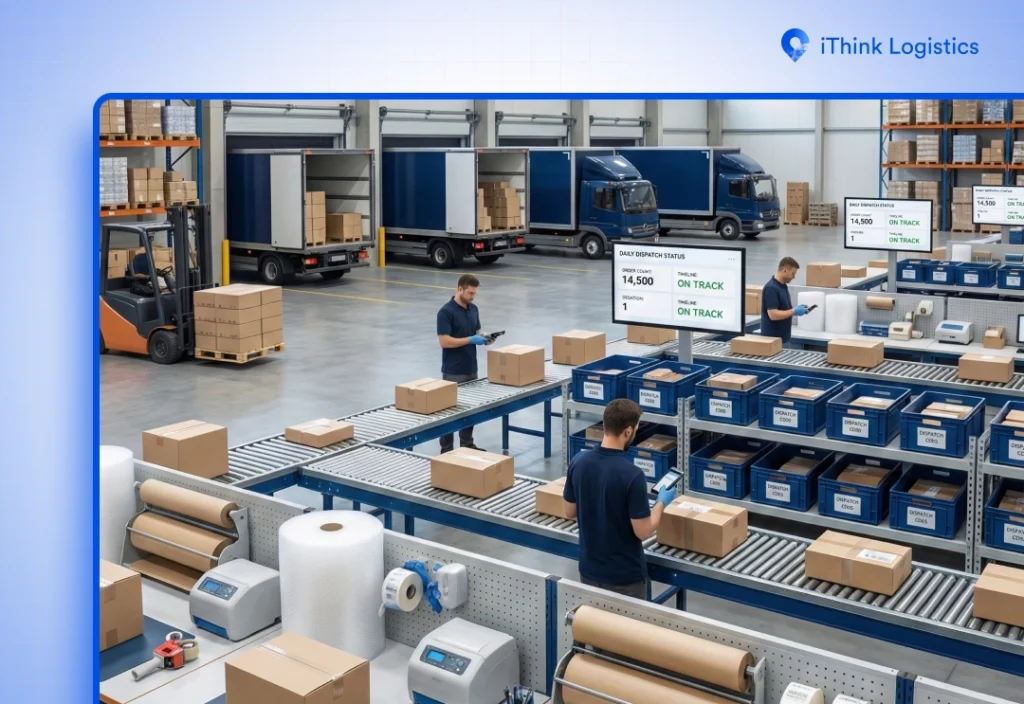
Daily dispatch packaging is a standardized system ensuring every order leaves with consistent protection. Think production line—each step optimized for speed, accuracy, and product safety.
2.1 Tips to Ensure Proper Packaging for Every Order
Different product categories require different priorities:
| Product Category | Primary Need | Key Materials | Cost |
| Apparel | Moisture protection | Poly mailers, tissue wrap | ₹12-16 |
| Electronics | Shock absorption | Double-wall boxes, anti-static wrap, foam | ₹23-30 |
| Liquids/Skincare | Leak-proof sealing | Sealed bags, absorbent wrap, cushioning | ₹18-22 |
| Fragile Items | Multi-layer cushioning | Foam sheets, bubble wrap, dividers | ₹35-42 |
The Universal Test: Gently shake the sealed carton. If you feel or hear movement, cushioning is insufficient. The product should not shift at all.
Learn more: Tips to Ensure Proper Packaging for Every Order
2.2 Ensuring Quality Control in eCommerce Packaging
An effective packaging QC system includes:
– Approved material specifications by SKU category – Standard operating procedures with visual guides – Pre-dispatch inspection checklist (box strength, zero movement, proper sealing, clear labels) – Staff training on box assembly, cushioning selection, sealing methods
Learn more: Ensuring Quality Control in eCommerce Packaging
3. Fragile Items and High-Value Shipments
A ₹500 t-shirt and a ₹50,000 smartphone don’t need the same packaging. Yet most sellers use similar approaches—until an expensive item breaks.
The Real Damage Cost
When a ₹50,000 phone breaks in transit:
Product ₹50,000 + Shipping ₹300 + Support ₹500 + Customer lifetime value ₹20,000+ = ₹70,800+ total loss
Plus the 1-star review and social media complaint reaching 10,000 potential customers.
What Fragile Packaging Needs
Immobilization: Shake the box. Hear movement? Add more cushioning.
Multi-Layer Protection: Bubble wrap inside + rigid box outside + 2-3 inches cushioning gaps on all sides
Stronger Boxes: Double-wall minimum (10-12 kg/cm² burst strength). For items over ₹10,000, use double-boxing.
Double-Boxing: Put the product box inside a larger box with 2-3 inches of cushioning filling the gap. Cost: ₹35-50 vs. potential ₹70,000+ loss.
Learn more: Ultimate Guide to Fragile Items and High-Value Shipments
4. Protective Packaging Materials and Dunnage
Dunnage is filler material that prevents products from shifting during transit. Movement causes damage. Dunnage prevents movement.
Common Dunnage Materials
| Material | Cost | Best For | Limitations |
| Paper Fill | ₹10-15/kg | Lightweight items | Compresses under pressure |
| Air Pillows | ₹0.50-1/piece | Light items, void spaces | Can pop, adds volume |
| Bubble Wrap | ₹2-4/meter | Most products | Multiple layers for heavy items |
| Foam Sheets | ₹5-10/sheet | Fragile items, delicate surfaces | More expensive |
| Corrugated Inserts | ₹3-6/piece | Heavy products, compartments | Needs cushioning support |
The Immobilization Test
Before sealing any box:
- Pack the product with cushioning
- Close the box
- Shake it
Hear movement? Add more dunnage. If the product shifts during your gentle shake, it will shift during transit—and arrive damaged.
Dunnage by Product Type
Apparel: Paper fill or tissue wrap (₹2-4) – provides shape support Electronics: Anti-static bubble wrap + foam corners (₹8-12) – prevents electrostatic discharge, absorbs shock Glass/Ceramics: Foam sheets + bubble wrap + dividers (₹15-25) – surface protection, shock absorption Heavy Items (5kg+): Double-wall box + bubble wrap + foam corners (₹20-30) – prevents weight shifting Liquids: Sealed bag + absorbent wrap + cushioning (₹7-10) – contains leaks, protects from impact
Learn more: Dunnage – All You Need to Know
5. Export Packaging and Global Shipping Readiness
Domestic shipments take 2-7 days. International customs alone takes 5-10 days—if everything goes smoothly. Standard domestic packaging won’t survive international shipping.
Why Export Packaging Is Different
Multiple Handling: Your package gets handled 6-10 times (pickup → warehouse → airport → international sorting → customs → destination warehouse → delivery)
Extended Transit: Packages sit for weeks in warehouses, containers, sorting facilities
Climate Extremes: Mumbai’s humidity (85%, 32°C) → sub-zero cargo holds (-20°C) → Middle East heat (45°C). Temperature swings weaken cardboard
Customs Inspections: Weak packaging or incorrect labels trigger rejections. Missing documents guarantee delays
Export Packaging Requirements
Stronger Materials: Double-wall boxes minimum (12+ kg/cm² burst strength). Triple-wall for items over 10kg.
Moisture Protection: Seal products in plastic bags before boxing. Sea freight requires moisture barriers—containers experience condensation.
Proper Documentation: Commercial invoice, packing list, customs declaration in waterproof pouches on package exterior (not inside).
International Labeling: Country of origin, product details in destination language, international handling symbols (not text), barcode on flat surface.
Required Documents
| Document | Purpose | Key Details |
| Commercial Invoice | Customs clearance | Product description, value, HS code |
| Packing List | Contents verification | Itemized list with weights, dimensions |
| Bill of Lading | Shipping contract proof | Shipper, consignee, carrier details |
| Certificate of Origin | Duty preferences | Country of manufacture |
Learn more: Packaging for Export and Global Shipping Packaging & Labelling Best Practices
6. Packaging Strategy: Protecting Profit, Brand, and Customer Trust


Most sellers view packaging as a cost to minimize. But when packaging fails:
– Product cost lost – Forward and return shipping lost (₹120-250) – Customer service hours wasted – Customer lifetime value lost – Negative review received – Future customers lost
That “cheap” ₹5 box costs you ₹5,000 in consequences.
6.1 Packaging as a Cost-Saving System
Spending ₹5-10 extra on packaging saves ₹200-700 on returns and support costs.
ROI Framework:
| Approach | Orders/Month | Packaging Cost | RTO Reduction | Monthly Savings |
| Budget | 10,000 | ₹10 (₹1,00,000) | 15% → 12% | ₹1,50,000 |
| Optimized | 10,000 | ₹25 (₹2,50,000) | 15% → 8% | ₹3,50,000 |
| Net Gain | +₹1,50,000 invested | -7% RTO | +₹2,00,000 saved |
6.2 Creating a Packaging Standard for Your Brand
Serious brands create a packaging rulebook:
– Approved materials list (box types, cushioning, tape, labels) – SKU-wise packaging method (documented with photos) – Staff training program (initial + refresher sessions) – Continuous improvement (track RTO reasons monthly, update procedures based on data)
Frequently Asked Questions
What is ecommerce packaging?
eCommerce packaging is the specialized use of protective materials—corrugated boxes, poly mailers, cushioning, and labels—designed to safeguard products during shipping while reinforcing brand identity and ensuring regulatory compliance.
What are the 7 types of packaging?
The main eCommerce packaging types are: corrugated boxes (single/double/triple-wall), poly mailers, bubble mailers, padded envelopes, custom branded boxes, rigid boxes, and eco-friendly packaging materials like paper-based alternatives.
What is an e-commerce packer?
An e-commerce packer is a warehouse staff member responsible for selecting appropriate packaging materials, properly cushioning products, sealing boxes securely, and applying shipping labels according to standardized procedures.
What are the 4 types of e-commerce?
The four main e-commerce types are: B2C (Business to Consumer), B2B (Business to Business), C2C (Consumer to Consumer), and C2B (Consumer to Business).
What is the meaning of shipping packaging?
Shipping packaging refers to the protective materials and containers used to safely transport products from seller to customer, including boxes, cushioning materials, tape, labels, and moisture barriers designed to prevent damage during transit.
What is shipment packaging?
Shipment packaging is the complete system of materials used to protect products during shipping—including outer boxes, inner cushioning, void fill, sealing materials, and protective labels—designed to withstand handling, stacking, and environmental conditions.
What are the 4 levels of packaging?
The four packaging levels are: Primary (direct product contact), Secondary (retail presentation/grouping), Tertiary (bulk shipping/warehouse), and Quaternary (large-scale transport containers).
Conclusion
Packaging isn’t just the box your product comes in. It’s the difference between profit and loss, between a loyal customer and a refund request.
India’s eCommerce packaging market is growing from USD 3.75 billion (2025) to USD 7.59 billion (2030) as sellers realize proper packaging isn’t an expense but an investment that reduces returns, improves reviews, and protects profit margins.
Build a system. Train your team. Use the right materials. Get it wrong and you pay twice for every damaged shipment. Get it right and your packaging becomes a silent salesperson that builds trust, prevents losses, and scales smoothly.
The sellers who treat packaging as strategy—not cost-cutting—survive tight margins and build customer trust that translates to repeat purchases.
Ready to optimize your shipping strategy? Connect with iThink Logistics to access smart courier allocation, predictive delivery analytics, and logistics solutions built for Indian eCommerce sellers.

