



DTDC courier charges start at ₹40 for a 500 gram package delivered within the same city, and ₹80 to ₹120 for the same weight sent inter-state on the Lite service. On a per kg basis, DTDC courier charges range from ₹80 locally to ₹280 inter-state for Lite, rising to ₹180 and ₹500 respectively on Prime. Rates depend on four things: weight, distance zone, service tier and whether volumetric weight exceeds actual weight.
Last updated 1 September 2026. Rates are indicative and vary by franchise and contract. Confirm current pricing on DTDC’s official rate calculator before booking.
DTDC is one of India’s largest courier networks, covering over 14,000 pin codes domestically and reaching more than 220 countries through partnerships with global logistics providers including UPS and DHL. What trips most shippers up is the tier structure. DTDC runs four service levels at meaningfully different price points, and picking the wrong one on a shipment that was never urgent is the single most common way businesses overpay.
Below is the full 2026 rate picture: domestic per kg rates by tier and zone, international zone pricing, delivery timelines, the weight calculation that catches people out, and the levers that actually bring your bill down.
| Service tier | Base rate (~500 g) | Per kg (local to inter-state) | Indicative delivery | Best for |
|---|---|---|---|---|
| DTDC Lite | ₹40 to ₹120 | ₹80 to ₹280 | 2 to 6 days | Cost-sensitive, non-urgent shipments |
| DTDC Plus | ₹55 to ₹160 | ₹110 to ₹380 | 1 to 4 days | Standard ecommerce orders |
| DTDC Blue | ₹65 to ₹190 | ₹130 to ₹450 | 1 to 3 days | Expedited delivery without Prime pricing |
| DTDC Prime | ₹90 to ₹260 | ₹180 to ₹500 | Next day to 2 days | Time-definite, urgent consignments |
Understanding DTDC Courier Service Charges: The Basics
Before we look at the specific numbers, let’s talk about how DTDC courier service charges actually work. Unlike a flat-rate system, DTDC uses a pricing model built on multiple factors.
Think of it like this: sending a 500 gram envelope to your neighbour costs dramatically less than sending a 5 kilogram box across the country. Makes sense, right? But beyond weight and distance, several other factors influence your final bill.
The Main Aspects of DTDC Courier Charges
Weight: This is your primary cost driver. DTDC uses weight slabs up to 500 grams, 1 kilogram, 2 kilograms and so on. Domestic DTDC courier rates start from ₹40 for a 500 g package, but that is just the baseline for local deliveries.
Distance: DTDC divides India into zones. Local shipments within your city cost the least. Regional shipments cost more. Cross-country deliveries to remote areas cost the most. The farther your package travels, the higher the DTDC courier charges.
Service type: Want your package delivered tomorrow? You will pay premium rates. Can it wait 4 to 5 days? You will save significantly. DTDC offers four main service tiers: Lite (economy), Plus (express), Blue (expedited) and Prime (premium fastest).
Additional services: Cash on delivery, insurance, special handling and SMS notifications each add to your total DTDC domestic courier charges. Understanding which services you actually need versus which are optional can save you 15 to 20 percent on every shipment.
Here is something most people miss: DTDC also calculates volumetric weight for large but lightweight packages. The volumetric weight is calculated as length multiplied by width multiplied by height, divided by 5000, for air express and international shipments. So that big box of stuffed toys weighing just 1 kilogram? If its dimensions calculate to 2 kilograms volumetrically, you pay for 2 kilograms.
DTDC Courier Charges Per Kg: Domestic Rate List 2026
Here is the complete domestic picture in one place. The table below shows DTDC courier charges per kg and per weight slab across all four service tiers and all three distance zones. Every figure is a range because franchise-level pricing and contracted volume both move the number.
| Service tier | Zone | 500 g | 1 kg | 2 kg | 5 kg | Each additional kg |
|---|---|---|---|---|---|---|
| DTDC Lite | Local | ₹40 to ₹60 | ₹80 to ₹120 | ₹140 to ₹200 | ₹300 to ₹420 | ₹55 to ₹75 |
| DTDC Lite | Intra-state | ₹60 to ₹90 | ₹120 to ₹180 | ₹200 to ₹320 | ₹440 to ₹680 | ₹80 to ₹120 |
| DTDC Lite | Inter-state | ₹80 to ₹120 | ₹180 to ₹280 | ₹320 to ₹520 | ₹700 to ₹1,100 | ₹130 to ₹200 |
| DTDC Plus | Local | ₹55 to ₹80 | ₹110 to ₹160 | ₹190 to ₹270 | ₹400 to ₹560 | ₹70 to ₹100 |
| DTDC Plus | Intra-state | ₹80 to ₹120 | ₹160 to ₹240 | ₹270 to ₹430 | ₹590 to ₹910 | ₹110 to ₹160 |
| DTDC Plus | Inter-state | ₹110 to ₹160 | ₹240 to ₹380 | ₹430 to ₹700 | ₹940 to ₹1,480 | ₹170 to ₹260 |
| DTDC Blue | Local | ₹65 to ₹95 | ₹130 to ₹190 | ₹220 to ₹320 | ₹480 to ₹680 | ₹85 to ₹120 |
| DTDC Blue | Intra-state | ₹95 to ₹145 | ₹190 to ₹290 | ₹320 to ₹510 | ₹700 to ₹1,080 | ₹130 to ₹190 |
| DTDC Blue | Inter-state | ₹130 to ₹190 | ₹290 to ₹450 | ₹510 to ₹830 | ₹1,120 to ₹1,760 | ₹200 to ₹310 |
| DTDC Prime | Local | ₹90 to ₹130 | ₹180 to ₹260 | ₹310 to ₹440 | ₹670 to ₹980 | ₹120 to ₹180 |
| DTDC Prime | Intra-state | ₹130 to ₹190 | ₹260 to ₹390 | ₹440 to ₹700 | ₹950 to ₹1,480 | ₹170 to ₹260 |
| DTDC Prime | Inter-state | ₹180 to ₹260 | ₹390 to ₹500 | ₹700 to ₹1,140 | ₹1,540 to ₹2,420 | ₹280 to ₹430 |
DTDC Lite Courier Charges Per Kg
DTDC Lite is the right call when speed is not critical but reliability still matters. It is the tier worth defaulting to for most personal shipments and non-urgent business deliveries.
| Zone | 500 g | 1 kg (per kg rate) | 2 kg | 5 kg |
|---|---|---|---|---|
| Local (same city) | ₹40 to ₹60 | ₹80 to ₹120 | ₹140 to ₹200 | ₹300 to ₹420 |
| Intra-state | ₹60 to ₹90 | ₹120 to ₹180 | ₹200 to ₹320 | ₹440 to ₹680 |
| Inter-state | ₹80 to ₹120 | ₹180 to ₹280 | ₹320 to ₹520 | ₹700 to ₹1,100 |
Delivery on Lite typically takes 2 to 3 days locally and 4 to 6 working days inter-state, depending on distance. For a small business shipping a 500 g package from Pune to Delhi, Lite lands at ₹80 to ₹120 against ₹180 to ₹260 on Prime. Same parcel, same network, roughly ₹120 saved per shipment simply by picking the tier that matches the actual delivery promise.
DTDC Plus Courier Charges Per Kg
DTDC Plus is the middle ground: faster than Lite, cheaper than Prime. It is where most ecommerce businesses settle, because 2 to 4 day delivery covers the majority of customer expectations without paying for time-definite service.
| Zone | 500 g | 1 kg (per kg rate) | 2 kg | 5 kg |
|---|---|---|---|---|
| Local (same city) | ₹55 to ₹80 | ₹110 to ₹160 | ₹190 to ₹270 | ₹400 to ₹560 |
| Intra-state | ₹80 to ₹120 | ₹160 to ₹240 | ₹270 to ₹430 | ₹590 to ₹910 |
| Inter-state | ₹110 to ₹160 | ₹240 to ₹380 | ₹430 to ₹700 | ₹940 to ₹1,480 |
DTDC Plus courier weight charges run roughly 30 to 40 percent above Lite, and delivery is close to twice as fast. Whether that premium is worth paying depends entirely on what you have promised your customer at checkout. If your product page says 5 to 7 days, Plus is money you did not need to spend.
DTDC Prime Courier Charges Per Kg
DTDC Prime is the time-definite tier: next-day delivery to major metros and 1 to 2 days across most of India. DTDC fast courier charges on Prime reflect that, running roughly two to three times Lite for the same parcel.
| Zone | 500 g | 1 kg (per kg rate) | 2 kg | 5 kg |
|---|---|---|---|---|
| Local (same city) | ₹90 to ₹130 | ₹180 to ₹260 | ₹310 to ₹440 | ₹670 to ₹980 |
| Intra-state | ₹130 to ₹190 | ₹260 to ₹390 | ₹440 to ₹700 | ₹950 to ₹1,480 |
| Inter-state | ₹180 to ₹260 | ₹390 to ₹500 | ₹700 to ₹1,140 | ₹1,540 to ₹2,420 |
A 500 g package from Mumbai to Bangalore costs approximately ₹180 to ₹260 on Prime against ₹80 to ₹120 on Lite. For urgent documents, replacement parts or time-sensitive business materials, that premium buys a delivery date you can commit to in writing.
DTDC Rate Chart 2026: Complete Price List

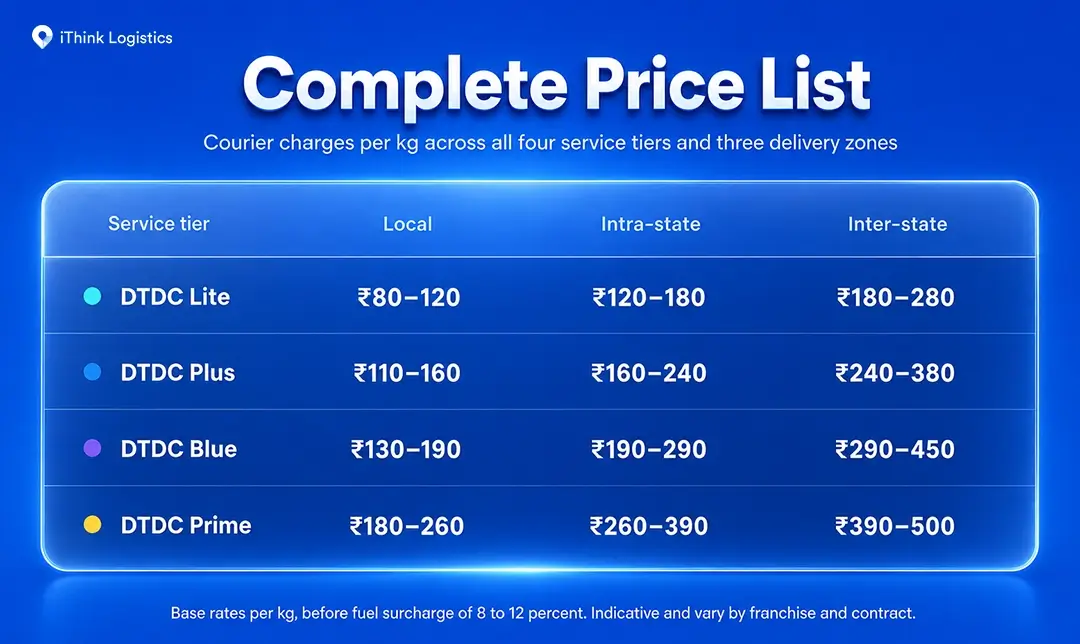
If you ship regularly, this is the chart worth bookmarking. It consolidates every weight slab and every zone across all four DTDC service tiers into a single reference, so you can price a shipment before you get to the counter.
| Weight slab | Zone | Lite | Plus | Blue | Prime |
|---|---|---|---|---|---|
| 500 g | Local | ₹40 to ₹60 | ₹55 to ₹80 | ₹65 to ₹95 | ₹90 to ₹130 |
| 500 g | Intra-state | ₹60 to ₹90 | ₹80 to ₹120 | ₹95 to ₹145 | ₹130 to ₹190 |
| 500 g | Inter-state | ₹80 to ₹120 | ₹110 to ₹160 | ₹130 to ₹190 | ₹180 to ₹260 |
| 1 kg | Local | ₹80 to ₹120 | ₹110 to ₹160 | ₹130 to ₹190 | ₹180 to ₹260 |
| 1 kg | Intra-state | ₹120 to ₹180 | ₹160 to ₹240 | ₹190 to ₹290 | ₹260 to ₹390 |
| 1 kg | Inter-state | ₹180 to ₹280 | ₹240 to ₹380 | ₹290 to ₹450 | ₹390 to ₹500 |
| 2 kg | Local | ₹140 to ₹200 | ₹190 to ₹270 | ₹220 to ₹320 | ₹310 to ₹440 |
| 2 kg | Intra-state | ₹200 to ₹320 | ₹270 to ₹430 | ₹320 to ₹510 | ₹440 to ₹700 |
| 2 kg | Inter-state | ₹320 to ₹520 | ₹430 to ₹700 | ₹510 to ₹830 | ₹700 to ₹1,140 |
| 5 kg | Local | ₹300 to ₹420 | ₹400 to ₹560 | ₹480 to ₹680 | ₹670 to ₹980 |
| 5 kg | Intra-state | ₹440 to ₹680 | ₹590 to ₹910 | ₹700 to ₹1,080 | ₹950 to ₹1,480 |
| 5 kg | Inter-state | ₹700 to ₹1,100 | ₹940 to ₹1,480 | ₹1,120 to ₹1,760 | ₹1,540 to ₹2,420 |
| Each additional kg | Local | ₹55 to ₹75 | ₹70 to ₹100 | ₹85 to ₹120 | ₹120 to ₹180 |
| Each additional kg | Intra-state | ₹80 to ₹120 | ₹110 to ₹160 | ₹130 to ₹190 | ₹170 to ₹260 |
| Each additional kg | Inter-state | ₹130 to ₹200 | ₹170 to ₹260 | ₹200 to ₹310 | ₹280 to ₹430 |
Two things to read alongside this chart. First, every figure is a base rate before fuel surcharge, which adds 8 to 12 percent. Second, the slabs are chargeable weight, not actual weight. If your parcel is bulky and light, the volumetric calculation below decides which row you land on.
DTDC Courier Charges Calculator: How to Estimate Your Cost
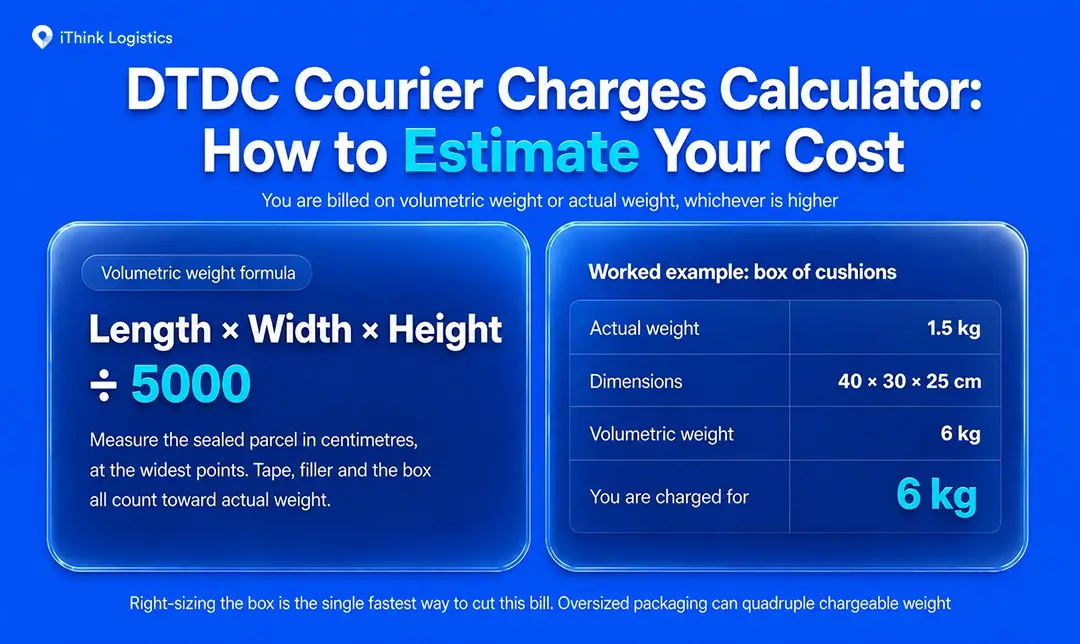
You do not need a DTDC courier charges calculator to get within ten percent of your final bill. You need four inputs and one formula. Here is how to work it out before you book.
The four inputs any DTDC calculator needs
Actual weight. Weigh the parcel packed and sealed, not the product on its own. Tape, filler and the box itself all count.
Dimensions. Measure length, width and height of the sealed parcel in centimetres, at the widest points.
Zone. Local means same city. Intra-state means within your state. Inter-state means across state lines. Remote pin codes carry an extra charge on top.
Service tier. Lite, Plus, Blue or Prime. This is the single biggest swing in your cost, often doubling the same shipment.
The volumetric formula
Volumetric weight equals length multiplied by width multiplied by height, all in centimetres, divided by 5000. Compare that figure to your actual weight. DTDC bills you on whichever is higher, and that number is your chargeable weight.
Worked example
| Input | Value |
|---|---|
| Actual weight | 1.8 kg |
| Dimensions | 35 cm x 28 cm x 20 cm |
| Volumetric calculation | (35 x 28 x 20) divided by 5000 |
| Volumetric weight | 3.92 kg, rounded to 4 kg |
| Chargeable weight | 4 kg (volumetric is higher) |
| Zone and tier | Inter-state, DTDC Lite |
| Base rate | ₹320 to ₹520 for 2 kg, plus 2 additional kg at ₹130 to ₹200 each |
| Estimated total before surcharge | ₹580 to ₹920 |
| Fuel surcharge at 10 percent | ₹58 to ₹92 |
| Estimated final cost | ₹638 to ₹1,012 |
Notice what happened there. A parcel weighing under 2 kilograms got billed as 4 kilograms because the box was oversized. That is roughly ₹300 of avoidable cost on one shipment, and it repeats on every order until the packaging changes.
Where to check live rates
For a live quote, use DTDC’s official online rate calculator or ask your local franchise for a contracted rate card. Any DTDC calculator, official or third party, is only as accurate as the dimensions you feed it, so measure the sealed parcel rather than estimating. If you ship at volume, a courier aggregator dashboard will show you a live DTDC courier calculator quote next to competing carriers on the same lane, which is usually a faster way to sanity-check a rate.
DTDC International Courier Charges
Shipping internationally is where costs climb sharply. Understanding DTDC international courier charges upfront helps you budget accurately and avoid unpleasant surprises at handover.
DTDC International Courier Charges Per Kg by Zone
DTDC groups international destinations into zones, and pricing varies dramatically by region. The table below shows base rates for documents and parcels.
| Zone | Example destinations | 500 g document | 1 kg parcel (per kg rate) |
|---|---|---|---|
| SAARC | Pakistan, Bangladesh, Sri Lanka, Nepal | ₹800 to ₹1,200 | ₹1,400 to ₹2,000 |
| Middle East | UAE, Saudi Arabia, Qatar, Oman | ₹1,200 to ₹1,600 | ₹2,000 to ₹2,800 |
| Europe and Americas | UK, Germany, USA, Canada | ₹1,800 to ₹2,400 | ₹3,200 to ₹4,500 |
| Australia and Far East | Australia, Singapore, Japan, Hong Kong | ₹2,000 to ₹2,600 | ₹3,500 to ₹5,000 |
These are base rates for documents. Merchandise attracts higher charges plus potential customs duties, taxes and clearance fees at the destination country, none of which appear on your DTDC quote.
Document vs. Merchandise: A Critical Distinction
Here is something that catches first-time international shippers off guard: DTDC document courier charges are significantly lower than parcel charges. A 500 g document envelope to the USA costs approximately ₹2,000, while a 500 g merchandise package costs ₹2,400 to ₹2,800.
The difference comes down to clearance. Documents face minimal customs scrutiny and move quickly. Merchandise requires detailed declarations, may attract duties, and takes longer to process at both ends.
DTDC Air Courier Charges
When surface transport will not meet your deadline, DTDC air courier charges buy you dedicated air cargo space and a much shorter transit time. Domestically, air runs roughly 40 to 60 percent above surface rates.
| Mode | 2 kg, Delhi to Chennai | Transit time | When it makes sense |
|---|---|---|---|
| Surface courier | ₹320 to ₹520 | 3 to 5 days | Standard orders with a realistic delivery promise |
| Air courier | ₹480 to ₹780 | 1 to 2 days | Deadline-bound consignments and perishable value |
For international shipments the question does not arise, since almost everything moves by air anyway. Within India, air is a premium you pay only when the date genuinely cannot slip.
How to calculate DTDC Courier Weight Charges?
Understanding DTDC courier weight charges matters because weight sets your base cost. The rule is simple and expensive to ignore: DTDC bills on whichever is higher, actual weight or volumetric weight.
Here is how that plays out on a real shipment. Say you are sending a large but lightweight box of cushions.
| Measurement | Value |
|---|---|
| Actual weight | 1.5 kg |
| Length | 40 cm |
| Width | 30 cm |
| Height | 25 cm |
| Volumetric formula | (40 x 30 x 25) divided by 5000 |
| Volumetric weight | 6 kg |
| Chargeable weight | 6 kg |
You pay for 6 kilograms, not 1.5. On an inter-state Lite shipment that is the difference between roughly ₹250 and roughly ₹830. Four times the cost, same cushions.
How to Reduce DTDC Courier Weight Charges Through Packaging
Compress where you can. Vacuum-sealed clothing and soft goods reduce both weight and volume, and volume is usually the expensive half.
Right-size your boxes. A box that is 20 percent larger than it needs to be inflates volumetric weight by more than 20 percent, because the penalty compounds across three dimensions. Choose packaging that fits snugly.
Strip unnecessary packaging. Thick cardboard and excessive bubble wrap add weight you are paying for on every single order. Understanding net weight vs gross weight makes it obvious how much of your shipping bill is packaging rather than product.
Sellers who move from oversized boxes to vacuum-sealed poly mailers routinely cut average DTDC courier weight charges by 20 to 25 percent. Same products, same service tier, lower chargeable weight.
DTDC Delivery Time: How Many Days Does DTDC Take?
DTDC delivery time depends on the tier you book and the distance the parcel travels. Lite runs on surface transport and takes the longest. Prime is time-definite. Here is what to expect on each.
| Service tier | Local | Intra-state | Inter-state |
|---|---|---|---|
| DTDC Lite | 2 to 3 days | 3 to 4 days | 4 to 6 days |
| DTDC Plus | 1 to 2 days | 2 to 3 days | 2 to 4 days |
| DTDC Blue | 1 to 2 days | 2 days | 2 to 3 days |
| DTDC Prime | Next day | Next day | 1 to 2 days |
Two caveats worth setting expectations around. DTDC express delivery time counts working days, so a Friday pickup on a 2 day service arrives Tuesday, not Sunday. And remote pin codes add a day or two beyond the figures above, regardless of tier.
People often compare DTDC speed post time against India Post. India Post Speed Post typically quotes 2 to 5 days nationwide, which looks similar on paper, but DTDC Plus and Blue hold their transit windows more consistently on ecommerce lanes. If your delivery promise is on your product page, consistency matters more than the headline number.
Factors That Increase DTDC Courier Charges
Beyond weight and distance, several line items can inflate your final DTDC courier service charges. None of them are hidden, but they are easy to forget when you are quoting shipping to a customer.
Fuel Surcharge on DTDC Courier Charges
Like most courier companies, DTDC applies a fuel surcharge that moves with diesel prices. This typically adds 8 to 12 percent to your base rate. You cannot avoid it, but building it into your shipping price prevents margin surprises at month end.
DTDC Remote Area Delivery Charges
Shipping to tier-3 cities or rural locations often attracts an additional ₹30 to ₹100 per shipment. DTDC’s pin code coverage is strong, but reaching the edges of that network costs more to service.
DTDC COD Charges and Fees
Cash on delivery is enormously popular in Indian ecommerce, and it is not free. DTDC charges approximately 2 to 2.5 percent of the amount collected, with a minimum of ₹30 to ₹50 per transaction. On a ₹2,000 COD order that is ₹40 to ₹50 on top of your shipping cost.
DTDC Insurance Charges on Declared Value
Standard shipments include basic cover, typically up to ₹1,000. Declaring a higher value attracts additional insurance, usually 1 to 2 percent of declared value. Shipping a ₹50,000 laptop means ₹500 to ₹1,000 in insurance alone.
DTDC Reweighing and Address Correction Charges
If DTDC finds your declared weight understated, or the delivery address incomplete and needing correction, penalty charges apply. Weigh accurately and validate addresses at checkout. Reweighing penalties are the most avoidable cost on this entire list.
DTDC Courier Charges vs. Competition
So where does DTDC actually sit in the Indian courier market? Here is an honest read across the major players.
DTDC vs Blue Dart: Blue Dart is faster and carries premium branding, but you will pay 30 to 50 percent more for comparable services. For urgent metro-to-metro deliveries, the speed advantage can justify the premium. For everything else, DTDC offers better value per rupee.
DTDC vs Delhivery: Delhivery has taken significant ecommerce share with competitive pricing and a strong technology stack. Rates are broadly comparable to DTDC, sometimes slightly lower. The decision usually comes down to which carrier has better coverage and delivery performance on your specific pin codes.
DTDC vs India Post Speed Post: India Post offers the lowest rates available, often 40 to 60 percent under DTDC. Reliability and tracking quality vary by region, though. If you are weighing the two, our breakdown of Speed Post charges sets out the current rate slabs in full so you can compare like with like.
| Courier | 500 g | 1 kg | 2 kg | Delivery range |
|---|---|---|---|---|
| DTDC | ₹100 | ₹180 | ₹300 | 1 to 3 days (local and regional) |
| Blue Dart | ₹150 | ₹250 | ₹400 | 1 to 2 days (premium express) |
| Delhivery | ₹90 | ₹160 | ₹280 | 2 to 4 days (pan-India) |
| India Post (Speed Post) | ₹59 | ₹106 | ₹212 | 2 to 5 days (nationwide, including remote areas) |
The verdict: DTDC sits in the sweet spot, more consistent than India Post, more affordable than Blue Dart, with coverage that competes with any major player. If you are still shortlisting carriers, our guide to the top courier companies in India compares the full field on rates, coverage and service quality.
Smart Strategies to Reduce Your DTDC Courier Charges
Now the practical part. These are the levers that actually move your shipping bill without compromising delivery quality.
Get Volume Discounts on DTDC Courier Charges
If you ship consistently, DTDC offers meaningful volume discounts. Shipping just 20 to 30 packages a month is usually enough to approach your local franchise about a corporate rate card, and 10 to 20 percent off standard rates is a realistic outcome. For heavier consignments, understanding how freight charges are structured helps you negotiate on the right terms rather than just asking for a discount.
Pick the Right Tier to Cut DTDC Courier Charges
Do not default to Plus or Prime for everything. Look at what your customers actually expect. For most catalogues, 70 percent of shipments could move on Lite at significant savings, with only genuinely urgent items on a faster tier. This is the single largest saving available to most sellers and it costs nothing to implement.
Cut DTDC Weight Charges by Reducing Volumetric Weight
As the worked example above showed, packaging alone can quadruple your chargeable weight. Invest in right-sized packaging that protects the product without adding bulk. Audit your three highest-volume SKUs first, since that is where the compounding saving sits.
Use a Courier Aggregator to Get Lower DTDC Rates
Aggregator platforms pool shipping volume across thousands of sellers and negotiate bulk rates that individual medium-volume shippers cannot access on their own. Booking DTDC through an aggregator typically lands you 15 to 25 percent below standard counter rates, without needing to hit the volume thresholds a direct contract would require.
iThink Logistics works this way. As an ecommerce courier aggregator, it lets you compare real-time rates across multiple courier partners including DTDC, pick the best option for each individual shipment, and manage pickup, tracking and returns from a single dashboard. If you are evaluating platforms, our courier aggregator comparison lays out how the major options differ on pricing, coverage and support.
Prepaid vs COD: Which Lowers DTDC Charges?
Prepaid, clearly. The 2 to 2.5 percent COD fee compounds fast. On 100 monthly orders averaging ₹1,500, you are paying ₹3,000 to ₹3,750 a month purely in COD charges. That is ₹36,000 to ₹45,000 a year. Small prepaid incentives at checkout usually pay for themselves several times over.
Understanding DTDC’s Rate Structure
DTDC handles more than 12.5 million packages every month across its network of over 14,000 pin codes in India. That scale is what allows the company to hold competitive DTDC courier charges while continuing to invest in sorting infrastructure and last-mile capacity.
Recent refinements to the pricing model are worth knowing about:
More granular weight slabs. Rather than jumping straight from 1 kg to 2 kg, many services now price in 500 g increments, which gives you finer control over cost on borderline parcels.
Dynamic zone-based pricing. Rates now reflect actual distance and route efficiency rather than broad zone bands alone. Some regional lanes have become cheaper as a result.
Transparent fuel surcharge indexing. DTDC publishes its fuel surcharge calculation formula, so you can forecast total landed shipping cost instead of discovering it on the invoice.
How to Book a DTDC Courier: Step-by-Step
Booking a DTDC shipment takes about ten minutes at a counter and less than that online. Here is the sequence.
Step 1: Pack and seal the parcel. Use right-sized packaging, seal all seams and remove any old shipping labels or barcodes from reused boxes.
Step 2: Weigh and measure. Record actual weight and all three dimensions of the sealed parcel. Run the volumetric calculation so you know your chargeable weight before you are quoted.
Step 3: Get a rate. Use DTDC’s online rate calculator, or check live rates through an aggregator dashboard if you have an account. Confirm the tier and the expected delivery date.
Step 4: Find your pickup or drop-off point. Use the DTDC branch locator for your nearest franchise, or schedule a pickup if you hold a corporate account.
Step 5: Complete the consignment note. Fill in sender and recipient details, contents description, declared value and service tier. Incomplete addresses are the leading cause of address correction penalties, so include a landmark and a working phone number.
Step 6: Declare value and add insurance if needed. Anything above ₹1,000 in value should be declared. Insurance runs 1 to 2 percent of declared value.
Step 7: Pay and collect your AWB number. Keep the consignment note. The AWB number is what you and your customer will use to track the shipment.
Step 8: Track and share. Enter the AWB on DTDC’s tracking page. If you are running an ecommerce store, push tracking updates to the customer automatically rather than waiting to be asked.
What to do based on your shipping volume
Occasional shippers: Use the online rate calculator before every shipment, default to Lite for anything non-urgent, and weigh parcels accurately to avoid reweighing penalties.
Small businesses shipping 5 to 50 parcels a month: Open a corporate account with DTDC for an immediate 10 to 15 percent discount, add an aggregator for rate comparison, and review your tier mix quarterly.
Medium to large ecommerce sellers: Negotiate volume-based contract rates directly, implement shipping software that picks the optimal courier by pin code, and review your DTDC domestic and international charges monthly. Our ecommerce shipping guide covers the full operational setup, from pickup scheduling through returns handling.
DTDC Courier Charges: Frequently Asked Questions
How much does DTDC charge per kg?
DTDC courier charges per kg start at roughly ₹80 for local delivery on the Lite tier and reach ₹280 per kg for inter-state Lite shipments. Prime, the fastest tier, runs from ₹180 per kg locally to ₹500 per kg inter-state. Rates vary by franchise and contract.
What are DTDC courier charges for 1 kg?
A 1 kg parcel costs approximately ₹80 to ₹120 within the same city, ₹120 to ₹180 within your state, and ₹180 to ₹280 across states on DTDC Lite. Faster tiers cost more: Plus adds around 35 percent and Prime roughly doubles those figures.
What is the DTDC price per kg for inter-state delivery?
Inter-state DTDC courier charges per kg run ₹180 to ₹280 on Lite, ₹240 to ₹380 on Plus, ₹290 to ₹450 on Blue and ₹390 to ₹500 on Prime. Remote pin codes add ₹30 to ₹100, and fuel surcharge adds a further 8 to 12 percent.
How do I calculate DTDC courier charges?
Weigh your parcel, measure it, then calculate volumetric weight as length times width times height divided by 5000. You are charged on whichever weight is higher. Match that chargeable weight to your zone and service tier, then add fuel surcharge, COD fee and insurance.
What is the DTDC rate list for 2026?
The 2026 DTDC rate list covers four tiers across three zones. Lite starts at ₹40 for 500 g locally, and Prime tops out near ₹2,420 for a 5 kg inter-state parcel. The complete rate chart above breaks down every weight slab by tier and zone.
How many days does DTDC courier take to deliver?
DTDC Lite takes 2 to 3 days locally and 4 to 6 days inter-state. Plus delivers in 1 to 4 days and Blue in 1 to 3 days. Prime offers next-day delivery within metros and 1 to 2 days inter-state. All figures are working days.
What are DTDC parcel charges?
DTDC parcel charges begin at ₹40 for a 500 g local shipment on Lite. A 2 kg parcel costs ₹140 to ₹200 locally and ₹320 to ₹520 inter-state. Merchandise parcels cost more than documents of the same weight because they need fuller declarations.
Which DTDC service is cheapest?
DTDC Lite is the cheapest tier. It costs 40 to 60 percent less than Prime for the same parcel, with delivery in 4 to 6 days inter-state. For anything that is not time-sensitive, Lite is the sensible default for both personal and business shipments.
What is the difference between DTDC Lite, Plus, Blue and Prime?
The four tiers trade cost against speed. Lite is the economy option at 4 to 6 days inter-state. Plus delivers in 2 to 4 days at roughly 35 percent more. Blue sits above Plus at 2 to 3 days. Prime is time-definite and costs the most.
How does DTDC calculate volumetric weight?
DTDC multiplies length by width by height in centimetres, then divides by 5000. The result is your volumetric weight in kilograms. You are billed on volumetric weight or actual weight, whichever is higher, so oversized boxes holding light goods cost far more than they should.
What are DTDC international courier charges per kg?
International DTDC courier charges per kg start around ₹1,400 to ₹2,000 for SAARC countries, ₹2,000 to ₹2,800 for the Middle East, ₹3,200 to ₹4,500 for Europe and the Americas, and ₹3,500 to ₹5,000 for Australia and the Far East. Customs duties are extra.
Does DTDC charge extra for cash on delivery?
Yes. DTDC charges approximately 2 to 2.5 percent of the amount collected, with a minimum of ₹30 to ₹50 per shipment. On a ₹2,000 COD order that is ₹40 to ₹50. Prepaid orders avoid this fee entirely and protect your margin per shipment.
What are DTDC courier charges for documents?
Domestic document charges follow the same weight slabs as parcels, starting at ₹40 for 500 g locally. Internationally, documents are cheaper than merchandise: a 500 g document to the USA costs around ₹2,000, while 500 g of merchandise costs ₹2,400 to ₹2,800.
Is DTDC cheaper than Blue Dart?
Yes. Blue Dart typically costs 30 to 50 percent more than DTDC for comparable services. A 1 kg parcel costs roughly ₹180 on DTDC against ₹250 on Blue Dart. Blue Dart is faster on metro-to-metro express, which is where the premium can be justified.
Is DTDC cheaper than India Post Speed Post?
No. India Post Speed Post is 40 to 60 percent cheaper, with 1 kg costing around ₹106 against ₹180 on DTDC. DTDC buys you more consistent transit times, better tracking and stronger support, which matters when you are shipping to paying customers.
Does DTDC offer volume discounts?
Yes. Shipping 20 to 30 parcels a month is usually enough to open a corporate account with your local DTDC franchise and secure 10 to 20 percent off standard rates. Higher monthly volumes support directly negotiated contract rates that go further still.
What is the DTDC fuel surcharge?
The fuel surcharge is a percentage added to your base rate to cover diesel price movement. It typically adds 8 to 12 percent and is revised periodically. DTDC publishes the calculation formula, so you can factor it into your shipping costs in advance.
How can I get lower DTDC courier charges?
Pick the lowest tier that meets your delivery promise, right-size your packaging to cut volumetric weight, push customers toward prepaid to avoid COD fees, open a corporate account once you cross 20 parcels a month, and compare live rates through an aggregator.
The Bottom Line
Smart shipping is not about finding the cheapest courier. It is about paying a fair rate for a delivery date you can actually promise. DTDC sits in that balance well, particularly once you stop defaulting to a premium tier on parcels that were never urgent.
The fastest way to manage it is a single platform. iThink Logistics gives you DTDC, Blue Dart, India Post and more in one dashboard, with bulk rates, unified tracking and AI-driven delivery optimisation. Whether you ship fifty orders a month or five thousand, one platform means less time spent on courier admin and more margin kept per shipment.


