



Introduction
Conversion cost is one of two numbers that build your total manufacturing cost, the other being raw material cost.
As manufacturing continues to be a major contributor to India’s economy, understanding production costs has become increasingly important for businesses looking to improve operational efficiency and profitability.
It shows what it costs to turn materials into a finished product: direct labor plus everything running in the background.
For a D2C brand that manufactures in-house, this number sets the floor under every price you charge. Shipping and return costs then eat into whatever margin sits above that floor.
What Is Conversion Cost?
Conversion cost refers to the total amount a business spends on direct labor and manufacturing overhead to convert raw materials into a finished product. It excludes the cost of the raw materials themselves, since that’s tracked separately as material cost.
Direct labor covers wages paid to workers who physically make the product, such as machine operators or assembly line staff. Manufacturing overhead covers everything else needed to keep production running: factory rent, electricity, equipment depreciation, and supervisor salaries.
Together, these two costs answer a specific question: how much did it cost to turn what you bought into what you sell? That number becomes the foundation for the formula below.
Conversion Cost Formula
Conversion Cost = Direct Labor + Manufacturing Overhead
That’s the full calculation. Add what you paid workers directly on the production line, then add every other cost needed to keep it running. Raw materials stay out of this number completely, since they’re tracked separately as material cost.
This split matters because conversion cost isolates the cost of transformation itself, not what you started with. It’s the number that tells you how expensive your production process is, independent of what materials cost that month.
Direct Labor
Direct labor is the wages and benefits paid to people who physically make the product. Think machine operators, assembly line workers, or anyone whose hands are on the process itself. It does not include office staff, sales teams, or managers who aren’t tied directly to production.
A simple test: if a worker’s job would disappear the moment production stopped, their pay is direct labor.
Manufacturing Overhead
Manufacturing overhead is every other cost needed to keep the factory running, costs that can’t be tied to one specific unit. Factory rent, electricity, equipment depreciation, and supervisor salaries all fall here. So does routine machine maintenance and factory insurance.
None of these costs disappear if you stop making one particular product, which is what separates overhead from direct labor.
Add the two together and you get your conversion cost. Here’s what that looks like with real numbers.
Conversion Cost Example

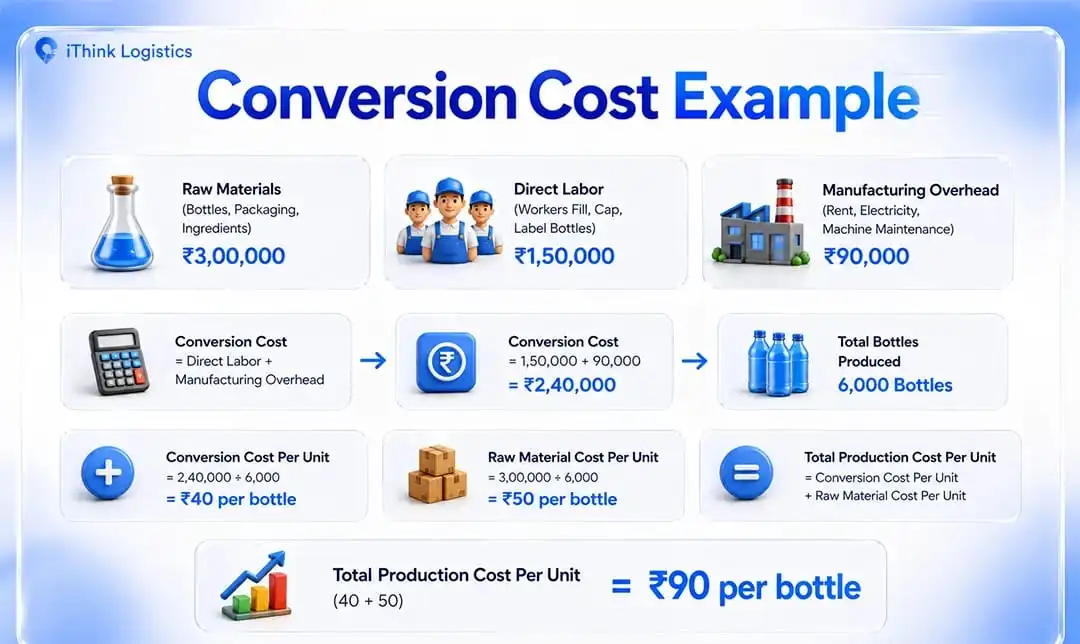
Suppose a D2C skincare brand, Glow Naturals, manufactures its own face serums in a small facility in Pune. Like many Indian D2C brands, it handles manufacturing in-house instead of outsourcing to a contract manufacturer. In March, the brand spends 3,00,000 rupees on raw materials like bottles, packaging, and active ingredients.
Direct labor for the month costs 1,50,000 rupees, covering the workers who fill, cap, and label each bottle. Manufacturing overhead adds up to 90,000 rupees, covering factory rent, electricity, and machine maintenance.
Conversion Cost = Direct Labor + Manufacturing Overhead
Conversion Cost = 1,50,000 + 90,000 = 2,40,000 rupees
The brand produced 6,000 bottles that month. To find the conversion cost per unit, divide the total conversion cost by the number of bottles produced.
Conversion Cost Per Unit = 2,40,000 ÷ 6,000 = 40 rupees per bottle
Raw material cost needs the same treatment. The total spend of 3,00,000 rupees also gets divided across the same 6,000 bottles.
Raw Material Cost Per Unit = 3,00,000 ÷ 6,000 = 50 rupees per bottle
Add the two per-unit numbers together to get the true production cost per bottle.
Total Production Cost Per Unit = Conversion Cost Per Unit + Raw Material Cost Per Unit
Total Production Cost Per Unit = 40 + 50 = 90 rupees per bottle
That 90 rupees is the number Glow Naturals needs to clear on every single bottle, before markup, shipping, or platform fees, just to break even on production.
Every pricing decision starts here. That’s also where conversion cost gets confused with something else: marketing’s cost per conversion.
Conversion Cost vs Cost Per Conversion (Don’t Confuse the Two)
Conversion cost is not the same as cost per conversion in marketing, even though the two get mixed up often. Cost per conversion measures ad spend divided by the number of purchases a campaign generates. It’s a metric used entirely in digital marketing.
Conversion cost, the accounting term this blog covers, measures labor and overhead spent turning raw materials into a finished product. It tracks production efficiency, not marketing efficiency, even though both use the word “conversion.”
If you manufacture your own goods and also run paid ads, you’ll deal with both numbers. But they answer different questions, and the two should never be added together.
Conversion cost also gets confused with a second term inside accounting itself: prime cost. That mix-up is worth clearing up too, since the two numbers are calculated from almost the same inputs.
Conversion Cost vs Prime Cost
Prime cost is the total of direct materials and direct labor used to make a product, without factoring in overhead. Conversion cost and prime cost both use direct labor, but they’re built for different purposes.
Prime cost adds direct labor to raw materials, showing the direct cost of production, the actual process of making the product. Conversion cost adds direct labor to manufacturing overhead (factory rent, electricity, equipment depreciation, and other running costs), showing the cost of the transformation process itself.
Both numbers show up on the same cost sheet. Conflating them hides where your money is actually going.
The table below breaks down exactly where they overlap and where they split.
| Basis | Conversion Cost | Prime Cost |
| Formula | Direct Labor + Manufacturing Overhead | Direct Materials + Direct Labor |
| Includes | Labor and overhead | Materials and labor |
| Excludes | Raw materials | Manufacturing overhead |
| Answers | How much did production itself cost? | How much did the direct inputs cost? |
Direct labor is the only cost both formulas share. Everything else is where the two numbers diverge, depending on whether your bigger spend is people and materials, or keeping the factory running.
For a D2C brand that manufactures in-house, knowing which one is climbing tells you exactly where to cut costs.
Why Conversion Cost Matters for D2C Sellers Who Manufacture
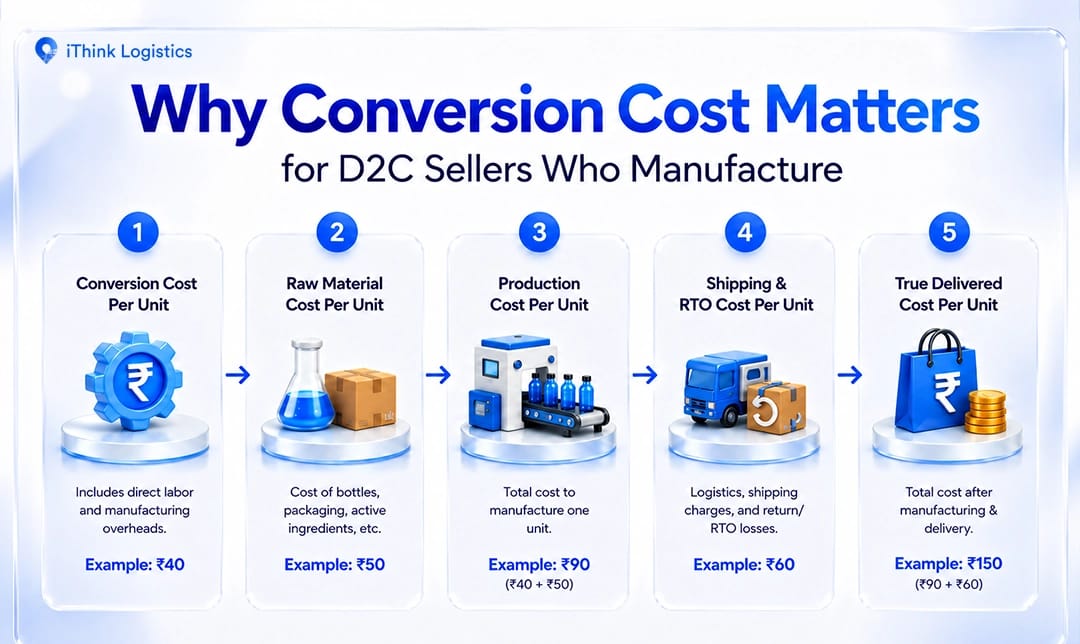
Conversion cost per unit sets the floor under your selling price. If you sell direct to consumers, shipping and RTO costs sit right below that floor. They eat into whatever margin you thought you had.
Raw material cost is the most visible number on any invoice, so it tends to get watched closely. Conversion cost often gets less attention, even though labor rates and overhead can move more from month to month than material prices do.
Labor rates change. Electricity bills spike in summer. A machine breaks down, and repair costs get absorbed into that month’s overhead.
None of this shows up in your selling price unless the conversion cost gets recalculated regularly. A price set once in January can be running on outdated numbers by June.
Here’s where it connects to logistics. Say your conversion cost per unit comes to 40 rupees, with raw materials adding another 50. That puts production cost at 90 rupees per unit.
Add shipping through a courier partner at 60 rupees per order, plus the hit from RTO (return to origin, when a delivery gets sent back undelivered) on cash-on-delivery orders. Your true cost per delivered unit climbs well past 150 rupees.
Pricing on production cost alone can look profitable on paper while actually losing money once shipping and return costs are added in.
This is exactly why sellers who manufacture in-house need visibility into landed cost (the full cost of getting a product into a customer’s hands, not just making it), not just production cost. Conversion cost tells you what it costs to make the product.
This level of cost visibility is especially important in India, where MSMEs account for 35.4% of the country’s manufacturing output. For manufacturers of every size, understanding conversion cost alongside logistics expenses helps support more accurate pricing and better margin management.
Your actual margin depends on what it costs to get that product delivered. That cost runs higher in categories with heavy COD and RTO rates.
Track conversion cost and landed cost together, not in separate spreadsheets that nobody cross-checks. That’s what turns a pricing guess into a pricing decision.
FAQs
Q.1: Why is it called conversion cost?
A: It’s called “conversion cost” because it captures the cost of converting raw materials into a finished product. The two components, direct labor and manufacturing overhead, are exactly what’s needed to carry out that conversion. Raw material cost is tracked separately because it represents what you started with, not what it cost to transform it.
Q.2: What is conversion cost in accounting?
A: In accounting, conversion cost is a manufacturing metric used to calculate ending inventory value and cost of goods sold (the total cost of the products a business has sold). It combines direct labor and manufacturing overhead, excluding raw material cost entirely. Businesses use it to price products correctly and to spot inefficiencies in the production process.
Q.3: What are prime and conversion costs?
A: Prime cost and conversion cost are two ways of grouping the same production expenses. Prime cost adds direct materials and direct labor, showing the direct cost of making a product.
Conversion cost adds direct labor and manufacturing overhead, showing the cost of the production process itself. Direct labor is the only cost the two share.
Conclusion
Tracking conversion cost is only half the picture if you sell directly to consumers. The other half is knowing exactly what each order costs once it leaves your warehouse, including shipping, returns, and all. That’s the kind of order-level cost visibility iThink Logistics helps D2C sellers build into their pricing from day one.


