Introduction
Shipping a product costs money. But how much, and why, is where most businesses lose track.
Freight charges show up on every invoice, every shipment, and every quarter-end cost review. Yet most business owners cannot fully explain what they are paying for, which mode is cheapest for their cargo type, or how to bring those numbers down.
This guide answers exactly that: what is freight charges, what types exist (air, ocean, rail, and container), what actually drives costs, how to calculate them, and what Indian businesses specifically need to know before their next shipment.
What Are Freight Charges? Meaning and Definition
Freight charges are the fees paid by a shipper or consignee to a carrier or logistics provider for transporting goods from a point of origin to a destination by air, sea, rail, or road.
Freight charges are also referred to as “freight costs,” “shipping fees,” “transportation charges,” or “logistics expenses,” depending on the mode of transport and industry context.
Carriers calculate them based on the weight, volume, distance, mode of transport, and nature of goods being moved.
In simpler terms, it is the price of your cargo (parcel) pays to deliver from one place to another.
Freight charges apply every time a product moves from manufacturer to warehouse, warehouse to fulfillment center, or seller to customer.
A 500g package delivering to a customer in Pune carries a freight charge. So does a full truckload moving between your warehouses. They show up on every shipping invoice, affect every product’s final cost, and directly impact how competitively a business can price its goods.
Freight Amount, Freight Value, Freight Expenses: What are the differences?
These terms appear across invoices, accounting sheets, and trade documents. They are related but not the same.
| Term | What It Means | Where You Will See It |
| Freight charges | The total fee paid to transport goods | Shipping invoices, logistics contracts |
| Freight amount | The exact rupee or dollar figure billed for a specific shipment | Invoice line items |
| Freight value | The declared worth of goods being shipped, used for insurance and customs duty calculation | Customs declarations, insurance forms |
| Freight expenses | How transportation costs are recorded in a company’s books | P&L statements, accounting ledgers |
Freight Charges Meaning in Accounting
Freight charges sit under operational expenses in business accounting, but where exactly depends on the direction of the shipment.
Freight-in covers the cost of bringing goods into your business. Raw materials arriving at your factory, inventory reaching your warehouse. Businesses add this to their cost of goods sold (COGS), which directly affects gross margin.
Freight-out covers the cost of sending goods to customers or other locations. This sits under selling or distribution expenses on your P&L, separate from COGS.
Getting this distinction right is not just accounting hygiene. Misclassifying freight-in as freight-out distorts gross margin reporting and leads to pricing decisions built on wrong numbers.
Who Pays Freight Charges?
It depends on the trade terms, specifically Incoterms in international shipping, or the agreement between buyer and seller in domestic trade.
- Freight Prepaid: the shipper (seller) pays the freight charges before dispatch
- Freight Collect: the consignee (buyer) pays upon delivery
- FOB Origin: the buyer takes ownership at the origin point and bears all freight costs from there
- FOB Destination: the seller retains ownership until delivery and covers all freight charges
For most ecommerce businesses in India shipping domestically, the seller pays freight charges upfront and either absorbs them into product pricing or passes them on as a visible shipping fee at checkout.
Understanding what freight charges mean is step one. The next question is what type of freight charge applies to your shipment, because air, ocean, rail, and container freight each work very differently.
Types of Freight Charges in Logistics and Shipping
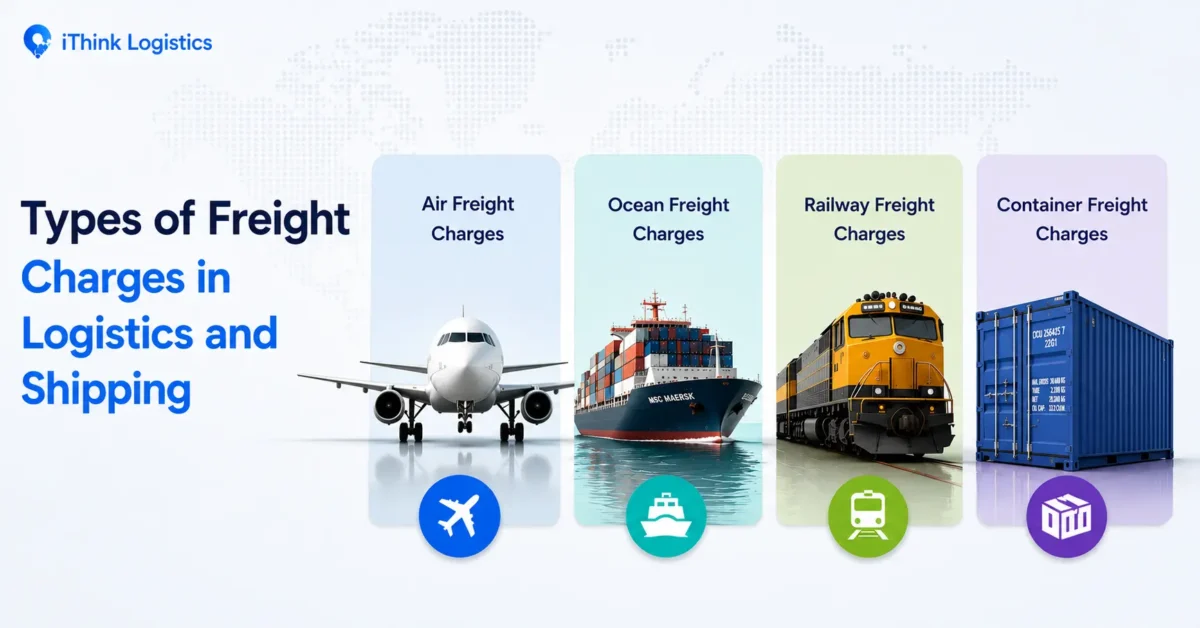
The mode of transport your business chooses determines how costs are calculated, what surcharges apply, and how much flexibility you get on delivery timelines.
Air Freight Charges: Speed vs Cost
Air freight is the fastest way to move goods across long distances. Shipments typically reach international destinations within 1 to 3 days.
Airlines charge based on chargeable weight, whichever is higher between actual weight and volumetric weight.
Volumetric weight formula: Length (cm) x Width (cm) x Height (cm) divided by 6000
A lightweight but bulky package will have a higher volumetric weight than its actual weight. In that case, the airline charges you for the volumetric weight, not the actual weight.
Packaged cushions or assembled furniture parts are common examples where this happens, and many first-time air freight shippers end up paying more than expected because of it.
Air freight rates: in India vary significantly depending on airline, route, season, cargo type, and fuel prices.
Best for: High-value, low-weight goods (electronics, pharmaceuticals, jewellery), time-sensitive shipments, perishables with short shelf lives.
Not ideal for: Bulky, low-margin goods where freight cost would exceed product value.
Ocean Freight Charges and Sea Freight Charges
Ocean freight carries over 80% of global trade by volume. It is slower than air but significantly cheaper for large, heavy, or bulk shipments.
Sea freight charges are quoted per TEU (Twenty-foot Equivalent Unit), one standard 20-foot container. Rates vary by trade lane, shipping line, port of origin, and destination.
| Component | What It Covers |
| Base ocean freight rate | The core charge per container or per kg/CBM for LCL |
| BAF (Bunker Adjustment Factor) | A fuel surcharge that shipping lines add to cover rising or falling global oil prices |
| THC (Terminal Handling Charges) | Port loading and unloading fees at origin and destination |
| Bill of Lading fee | Documentation charge per shipment |
| Destination charges | Port fees, customs, and inland transport at the receiving end |
Typical rates: Typical India–UAE sea freight rates can range from approximately ₹1.2 lakh to ₹2.5 lakh for a 20ft FCL container, depending on season, demand, and carrier pricing.
Best for: Large volume shipments, raw materials, heavy machinery, non-perishable goods with flexible timelines.
Railway Freight Charges in India
Indian Railways operates one of the largest rail freight networks in the world. For bulk domestic shipments like coal, cement, steel, food grains, and fertilizers, it remains the most cost-effective option.
Indian Railways freight pricing varies by commodity type and is often calculated on a tonne-per-kilometer basis. The Ministry of Railways revises these rates periodically.
Key factors that influence railway freight charges:
- Commodity type: Essential goods like food grains attract lower rates; luxury goods attract higher classification
- Distance: Longer routes get marginal rate benefits after a threshold
- Wagon type: Open wagons, flat wagons, and covered wagons carry different tariffs
- Loading type: Full rake versus partial rake affects per-unit cost significantly
Best for: Bulk commodities, heavy industrial goods, long-distance domestic movement where speed is secondary to cost.
Limitation: Rail freight works best for point-to-point movement between rail-connected facilities. Last-mile delivery still requires road transport.
Container Freight Charges: FCL vs LCL
Container freight applies to both ocean and rail shipping. Every shipper eventually faces the FCL vs LCL decision.
| Factors | FCL (Full Container Load) | LCL (Less than Container Load) |
| What it means | You book the entire container | Your cargo shares space with other shippers |
| Pricing basis | Fixed rate per container | Per CBM (cubic metre) or per tonne |
| Best for | Large shipments filling 15+ CBM | Smaller shipments under 15 CBM |
| Transit time | Faster, no consolidation wait | Slightly longer, consolidation adds time |
| Risk | Lower, only your cargo inside | Slightly higher, shared handling |
| Cost at low volume | Expensive, paying for unused space | Cheaper, pay only for what you use |
LCL freight pricing varies significantly depending on route, carrier, season, and cargo category.
If your cargo fills more than half a 20-foot container, FCL almost always works out cheaper per unit than LCL.
Choosing the wrong freight mode does not just slow your shipment. It inflates your per-unit logistics cost across every order you send. But the mode itself is only one side of the equation. The other side is what actually makes those charges go up or come down.
Key Components That Affect Freight Charges and Freight Prices
Two shipments going to the same destination can carry very different freight charges. Here is what drives the difference.
Weight and Volume are the starting point. Carriers charge based on whichever is higher between actual weight and volumetric weight. Dense shipments get charged on actual weight. Light but bulky shipments get charged on volumetric weight. Always calculate both before booking, because getting this wrong on air freight can double your cost.
Distance and Route determine your base rate, but route matters as much as raw distance. A shipment moving through a congested port or a high-demand trade lane costs more than one on a well-serviced route, even over a similar distance. Mumbai to Dubai and Chennai to Dubai will quote differently despite similar mileage.
Mode of Transport sets your cost floor. Air is fastest and most expensive. Sea is slowest and most economical for bulk. Rail sits between the two for domestic bulk movement. Road handles last-mile in almost every case. The wrong mode for your cargo type is one of the most expensive mistakes in logistics, and one of the most common.
Nature of Goods affects what carriers charge beyond the base rate. Fragile, hazardous, oversized, or temperature-sensitive cargo needs special handling, packaging, and documentation. A seller shipping industrial chemicals pays more per kg than one shipping cotton apparel on the same route.
Fuel Surcharges move with global oil prices and can add 10 to 25 percent on top of your base rate. In ocean freight this is called BAF (Bunker Adjustment Factor). In air freight it is called FSC (Fuel Surcharge). Both apply automatically and both fluctuate, which is why a freight rate quoted today may differ from the rate when your shipment actually moves.
Port and Terminal Handling Charges apply every time cargo moves through a port or terminal, covering loading, unloading, storage, and equipment use. On international shipments, these charges hit at both ends, origin and destination, and are often not included in the headline freight rate you receive first.
Seasonal Demand is one of the most underestimated factors. Peak seasons like Diwali, Christmas, and Chinese New Year push demand for cargo space sharply higher. Businesses that plan shipments outside peak windows consistently pay less for identical routes.
Customs duties and taxes do not appear in your carrier’s freight invoice, but they land in your total cost. On cross-border shipments, customs duties, GST, and import taxes can significantly change the economics of a shipment, especially for first-time exporters who budget only for the carrier quote.
Once you know what is driving your freight costs, the logical next step is calculating exactly what a shipment will cost before you book it.
How to Calculate Freight Charges
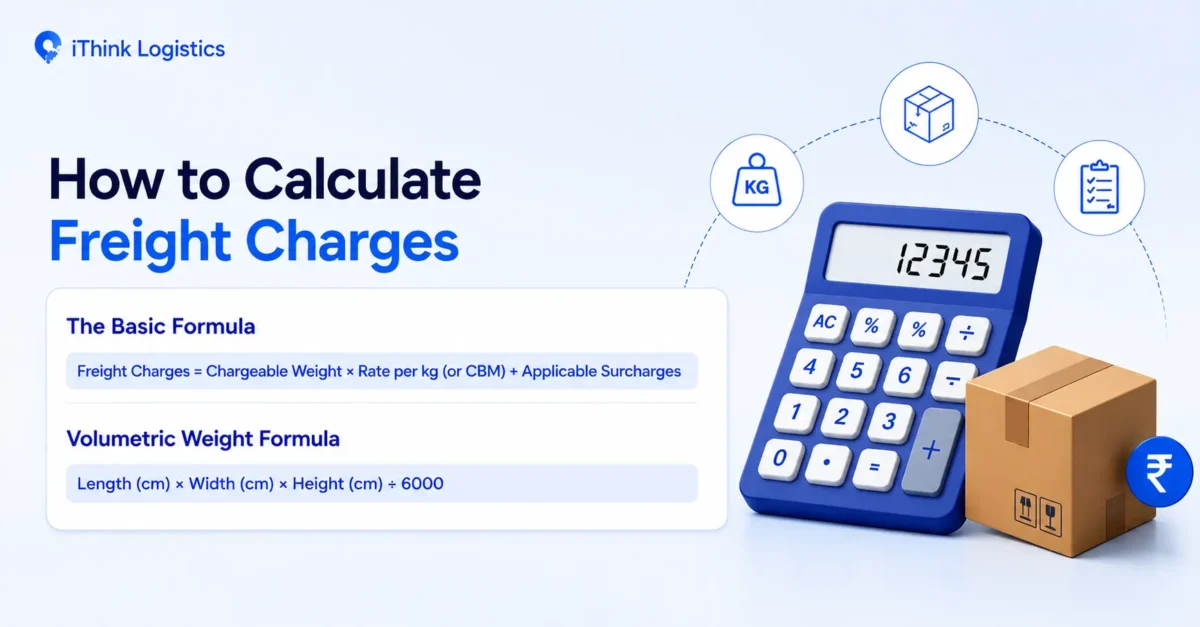
Freight charge calculation is straightforward once you know which weight applies and what the carrier’s rate is.
The Basic Formula
Freight Charges = Chargeable Weight x Rate per kg (or CBM) + Applicable Surcharges
Chargeable weight is always the higher of actual weight or volumetric weight.
Volumetric Weight Formula: Length (cm) x Width (cm) x Height (cm) divided by 6000
Example 1: Air Freight
A seller ships a box with dimensions 60cm x 50cm x 40cm, actual weight 8kg, at an air freight rate of Rs. 180 per kg.
Volumetric weight = 60 x 50 x 40 divided by 6000 = 20kg
Chargeable weight = 20kg (higher than actual 8kg)
Freight charge = 20 x Rs. 180 = Rs. 3,600
Without calculating volumetric weight first, the seller would have expected to pay Rs. 1,440. The difference is Rs. 2,160 on a single shipment.
Example 2: Ocean Freight LCL
A shipment of 3 CBM is moving from Mumbai to Dubai. LCL rate: Rs. 5,000 per CBM. THC and documentation: Rs. 4,500 fixed.
Freight charge = (3 x Rs. 5,000) + Rs. 4,500 = Rs. 19,500
Most courier aggregators and freight platforms offer built-in rate calculators where you enter dimensions, weight, origin, and destination to get instant quotes across multiple carriers. Comparing rates before every booking is the single fastest way to reduce freight costs without changing anything else about your shipment.
Once you know what you are paying, it is worth understanding the difference between what the carrier charges you and what your goods are actually worth, because these two numbers serve very different purposes.
Freight Value vs Freight Amount: What Is the Difference?
These two terms appear on the same documents but serve completely different purposes.
Freight value is the declared worth of the goods inside the shipment. Customs authorities use it to calculate import duties. Insurance providers use it to determine coverage and premium. It has nothing to do with what you pay the carrier.
The freight amount is the actual charge the carrier bills you for moving the shipment. This is what appears as a line item on your shipping invoice.
For example: A business shipping Rs. 200,000 worth of electronics pays a freight amount of Rs. 4,500 to the courier. The Rs. 200,000 is the freight value. Rs. 4,500 is the freight amount.
Confusing the two leads to errors in customs declarations and insurance claims, both of which create delays that cost more than the original mistake.
Knowing the difference also matters inside your own accounts, because freight charges need to land in the right place on your books.
Freight Expenses Meaning in Accounting and Business
Every rupee spent on freight needs to sit in the right place in your accounts. Getting this wrong distorts your margins and leads to pricing decisions built on inaccurate data.
Freight-in covers the cost of receiving goods into your business. Raw materials arriving at your factory, inventory reaching your warehouse. This gets added to COGS and directly affects gross margin.
Freight-out covers the cost of sending goods to customers or distribution points. This sits under selling and distribution expenses on your P&L, separate from COGS.
How freight expenses affect margins
Take an ecommerce business selling a product at Rs. 800 with a landed cost of Rs. 500. A Rs. 60 freight-out charge reduces net margin from 37.5 percent to 30 percent. Scale that across 10,000 monthly orders and the number is not small. Businesses that track freight expenses at this level of granularity find cost-reduction opportunities that those looking at blended monthly averages consistently miss.
Freight expenses do not exist in isolation either. Several external forces determine how high or low those costs run across any given period.
Factors Influencing Freight Prices
Freight prices do not move in a straight line. They respond to a set of forces that operate independently and often simultaneously.
- Global fuel prices set the floor for freight costs across every mode. When crude oil rises, surcharges follow within weeks across air, ocean, and road freight.
- Supply chain disruptions create sudden rate spikes. Red Sea disruptions in 2024 sharply increased ocean freight rates on Asia-Europe trade lanes. Port congestion and carrier capacity cuts produce similar effects, often with little warning.
- Trade route demand determines how competitive pricing is on any given lane. High-volume routes like India to UAE or India to USA have more carriers competing, which keeps rates relatively stable. Thin or indirect routes have fewer options and less pricing leverage for shippers.
- Geopolitical factors including trade sanctions, tariff changes, and border restrictions reroute cargo and create unexpected cost spikes on affected lanes. Shippers with diversified carrier networks absorb these disruptions better than those dependent on a single route or provider.
Knowing what moves freight prices globally helps you anticipate cost changes before they hit your invoice. What determines how those prices play out specifically for Indian businesses is a slightly different set of factors.
Freight Charges in India: What Businesses Should Know

India’s logistics landscape has characteristics that directly shape how freight charges work, both domestically and for cross-border trade.
Road freight dominates last-mile delivery
According to NITI Aayog, over 71 percent of India’s domestic freight moves by road. Road freight rates depend on truck type, route, diesel prices, and toll costs. For ecommerce businesses, the final delivery leg is almost always road-based regardless of what mode carries the primary haul.
Railway freight remains the most cost-efficient option for bulk
Indian Railways periodically revises freight charges, and businesses shipping coal, cement, steel, or agricultural products should track these revisions closely. A rate revision can change the landed cost on bulk orders materially, especially over long distances.
Ocean freight for international trade moves through four major ports
JNPT (Mumbai), Mundra, Chennai, and Nhava Sheva handle the bulk of India’s export and import container traffic. Ocean freight charges from these ports vary by trade lane and season. Exporters who compare rates across multiple shipping lines before booking consistently pay less than those who accept the first quote.
GST on freight charges follows a specific structure
GST on freight charges varies based on the mode of transport and the type of logistics service used.
In India, Goods Transport Agency (GTA) services are taxed under specific GST slabs, and businesses should verify the applicable rate and input tax credit eligibility before calculating total shipping costs.
For ecommerce businesses specifically, domestic freight is also shaped by RTO (Return to Origin) rates. High RTOs mean paying freight charges twice on the same order, once for delivery and once for the return.
Managing NDR (Non-Delivery Report) effectively is one of the fastest ways Indian ecommerce sellers reduce their effective freight cost per order.
How to Reduce Freight Charges for Your Business
Reducing freight costs does not always mean negotiating harder. Most of the time it means shipping smarter.
Consolidate shipments
Five small shipments in a week cost more than one consolidated shipment. Each booking carries its own base charges, documentation fees, and handling costs. Consolidation eliminates most of that duplication.
Match the mode to the cargo
Air freight on a low-value, heavy product is one of the most expensive and common mistakes in logistics. Use air for urgent, high-value, low-weight cargo. Use sea or rail for bulk, non-perishable goods with flexible timelines. Getting this right alone can reduce freight cost per unit by 30 to 60 percent on the right shipment profile.
Optimise your packaging dimensions
Since volumetric weight drives charges on air and most courier shipments, a smaller box directly lowers your freight cost. Switching from a 30cm x 30cm x 30cm box to a 25cm x 25cm x 25cm box cuts volumetric weight by nearly 42 percent, with no change to the product inside.
Compare rates across carriers before every booking
Rates vary significantly across carriers for the same route and weight. Comparing rates across multiple carriers can help businesses reduce shipping costs.
Platforms like iThink Logistics give you instant access to rates from 25+ courier partners in one place, so the best rate is visible before you commit rather than after.
Negotiate volume-based contracts
Once your monthly shipment volume crosses a consistent threshold, carriers will negotiate. Volume commitments in exchange for rate discounts are standard practice. Most businesses wait too long to start that conversation.
Conclusion
Freight charges touch every part of your business. They affect how you price products, how competitively you can offer free shipping, how accurately your books reflect true margins, and how efficiently your supply chain runs.
The businesses that manage freight costs well are not the ones with the biggest shipping volumes or the most negotiating power. They are the ones that understand what they are paying for, match the right mode to each shipment, calculate chargeable weight before booking, and compare rates across carriers consistently.
If you ship regularly and want to stop leaving money on the table, start with one step: compare rates across carriers before your next booking. iThink Logistics gives you instant access to rates from 25+ courier partners in one place, so the best rate is always visible before you commit.
Which freight mode does your business rely on most, and has the cost ever surprised you? Drop it in the comments below.
FAQs
Q.1: What is freight charges, and what do they mean?
A: Freight charges are the fees paid to a carrier for transporting goods from one location to another. The charge covers the cost of moving cargo by air, sea, rail, or road and varies based on weight, volume, distance, and mode of transport. Freight charges are also called “freight costs,” “shipping charges,” or “transportation fees” depending on the context.
Q.2: How are freight charges calculated?
A: Carriers calculate freight charges by multiplying the chargeable weight (whichever is higher between actual weight and volumetric weight) by the applicable rate per kg or CBM, then adding surcharges like fuel, handling, and documentation fees.
Q.3: What is the difference between freight value and freight amount?
A: Freight value is the declared worth of the goods being shipped, used for customs and insurance purposes. The freight amount is the actual charge billed by the carrier for moving the shipment. The two are separate figures that appear on different documents.
Q.4: Why do freight prices fluctuate?
A: Freight prices fluctuate due to changes in global fuel prices, seasonal demand spikes, carrier capacity, port congestion, geopolitical disruptions, and trade route demand. No freight rate is permanently fixed, which is why comparing rates before every booking matters.
Q.5: Which is cheaper: air freight or sea freight?
A: Sea freight is significantly cheaper for large or heavy shipments. Air freight is significantly more expensive than sea freight on a per-kg basis. For urgent, high-value, low-weight cargo, air freight’s speed often justifies the higher cost.
Q.6: Are freight charges and shipping charges the same?
A: They are often used interchangeably, but “freight charges” typically refer to bulk or commercial cargo movement, while “shipping charges” refer to smaller parcel or courier deliveries. In e-commerce, shipping charges usually include freight plus last-mile delivery costs.
Q.7: What are freight charges per kg?
A: Freight charges per kg refer to the rate a carrier applies for every kilogram of chargeable weight. For air freight in India, typical rates range from Rs. 120 to Rs. 300 per kg depending on the airline, route, and season. For domestic courier shipments, per-kg rates vary by zone and carrier.
Q.8: What are freight charges in accounting?
A: In accounting, freight charges are operational expenses split into freight-in (cost of receiving goods, added to COGS) and freight-out (cost of sending goods, recorded under selling expenses). The distinction matters for accurate gross margin reporting.
Author