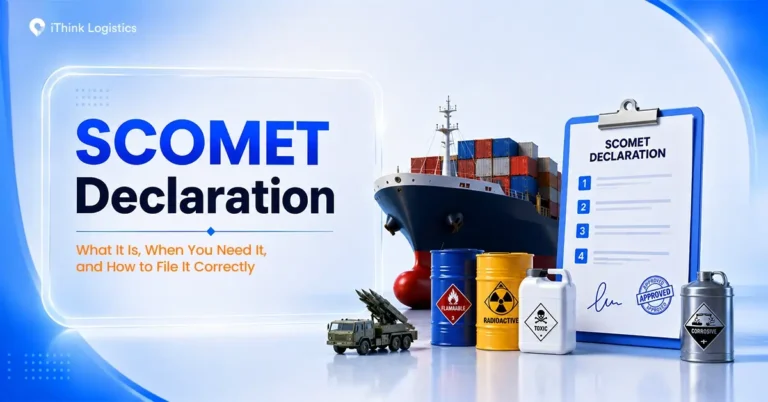
If your export falls under India’s SCOMET list, you’ll need a SCOMET authorization before the shipment can leave the country. It’s easy to assume that SCOMET rules only apply to defense equipment or hazardous chemicals.
In reality, exporters must classify their products correctly because control depends on technical specifications, not just product names.
Many exporters only discover this during product classification or customs clearance, especially when Customs seeks clarification on whether a shipment falls under the SCOMET list.
This guide covers exactly what a SCOMET declaration is, when it’s mandatory, how to fill it out, and what happens if you skip it or get it wrong.
What Is a SCOMET Declaration?
A SCOMET declaration is a self-certification used in shipping bill documentation to indicate whether goods are covered by India’s SCOMET list. It states one of two things: either your goods do not fall under India’s SCOMET list of controlled dual-use items, or they do and are supported by a valid export authorization issued by the DGFT.
The declaration is simple. Don’t assume SCOMET is just for defense or chemicals. Always check if your product is on the SCOMET list before filing the shipping bill.
If it is, declare your export authorization to Customs.
What Is SCOMET? Full Form and Meaning
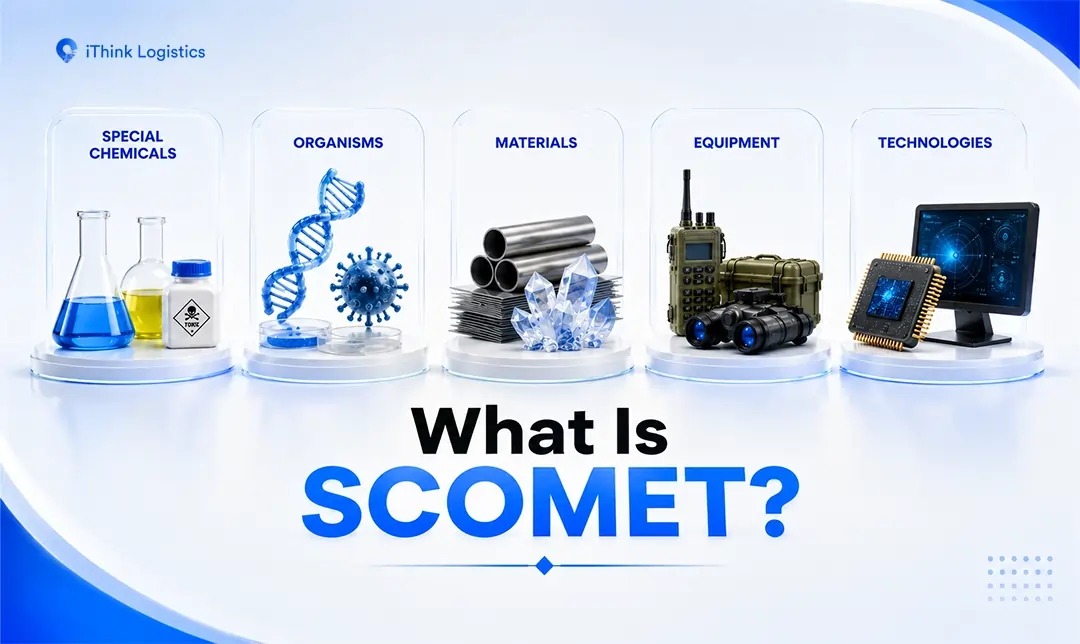
SCOMET stands for Special Chemicals, Organisms, Materials, Equipment and Technologies. It’s India’s export control list for dual-use items, goods and technologies that have legitimate civilian or industrial purposes but could also be diverted for military use or weapons development.
The list is maintained by the Directorate General of Foreign Trade (DGFT) under the Ministry of Commerce and Industry, and it is intended to keep India aligned with international non-proliferation commitments such as the Wassenaar Arrangement and the Missile Technology Control Regime.
If an item on your invoice matches a SCOMET control entry based on its technical parameters rather than its general description, you can’t export it without prior authorization unless a specific exemption applies.
The SCOMET List: Categories 0 Through 8
The SCOMET list has nine categories, 0 to 8. Each covers a different type of controlled item.
| Category | What It Covers |
| 0 | Nuclear materials and nuclear-related equipment |
| 1 | Toxic chemical agents and related chemicals |
| 2 | Micro-organisms and toxins |
| 3 | Materials and materials-processing equipment |
| 4 | Nuclear-related equipment not covered under Category 0 |
| 5 | Aerospace systems, equipment, and components |
| 6 | Munitions list |
| 7 | Semiconductors, quantum technologies, and cryogenic systems |
| 8 | Special materials, electronics, sensors, lasers, navigation, and marine equipment |
Category 7 is new. It covers emerging technologies such as semiconductors and quantum technologies. If you export electronics or advanced materials, check this category, even if SCOMET never applied to you before.
HS code alone isn’t enough. SCOMET classification depends on your product’s technical specs and control parameters. Even small technical differences can put your product on the list. Get classification right.
Once you know if your product is controlled, figure out when you need to declare it during export.
When Is a SCOMET Declaration Mandatory?
The declaration is required when your shipment needs to be declared to Customs as SCOMET-compliant. This requirement often causes confusion because exporters may assume it only applies to products that are obviously military or defense-related.
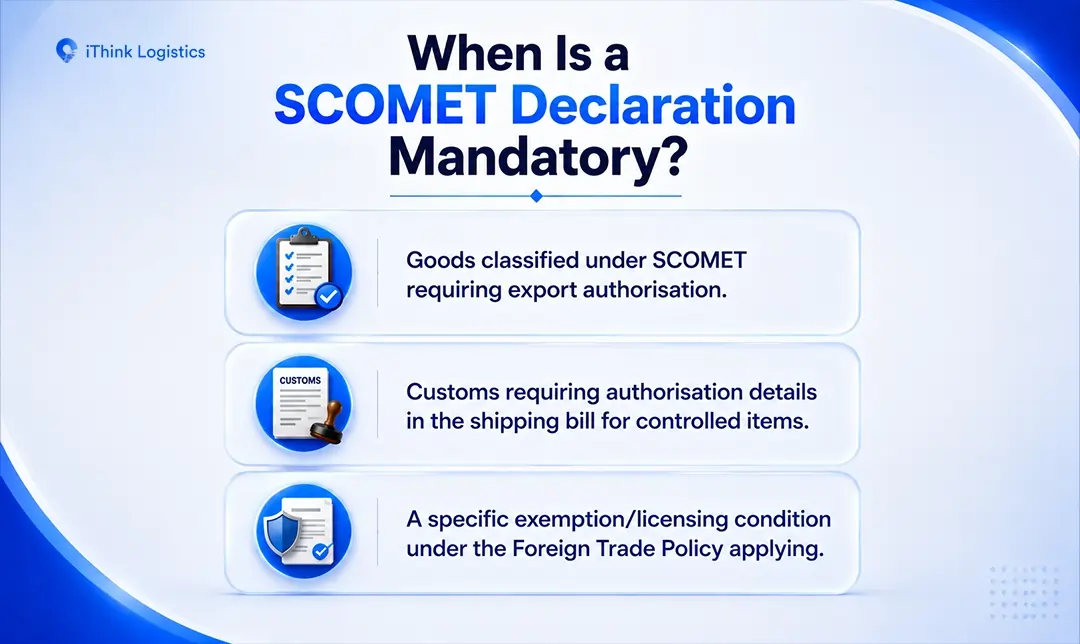
You need to file it in these situations:
- When the goods are classified under the SCOMET list and require export authorization from DGFT.
- When customs requires the relevant SCOMET authorization details to be declared in the shipping bill for controlled items.
- When a specific exemption or licensing condition under the Foreign Trade Policy applies.
If you’re an importer who brings in components and re-exports finished goods, this applies to you too. If you import components and later re-export finished goods, assess the outbound shipment independently to determine whether SCOMET requirements apply, separate from whatever classification applied on the way in.
Once you know when to declare, focus on what details to include.
SCOMET Declaration Format
Prepare the declaration on your company letterhead, sign it, and submit it with your shipping bill on ICEGATE either yourself or through your customs broker.
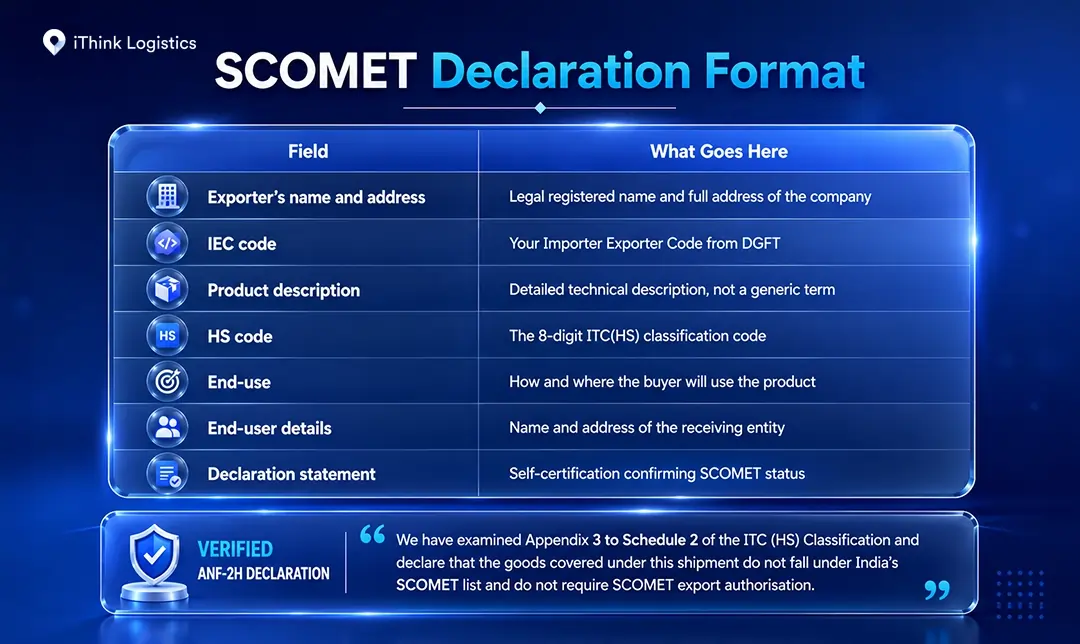
The exact format may vary depending on customs requirements and your customs broker, but these are the details commonly included in a SCOMET declaration.
A typical non-SCOMET declaration includes the following information:
| Field | What Goes Here |
| Exporter’s name and address | Legal registered name and full address of the company |
| IEC code | Your Importer Exporter Code from DGFT |
| Product description | Detailed technical description, not a generic term |
| HS code | The 8-digit ITC(HS) classification code |
| End-use | How and where the buyer will use the product |
| End-user details | Name and address of the receiving entity |
| Declaration statement | Self-certification confirming SCOMET status |
A commonly used declaration format is:
“We have examined Appendix 3 to Schedule 2 of the ITC (HS) Classification and declare that the goods covered under this shipment do not fall under India’s SCOMET list and do not require SCOMET export authorization.”
Two things matter most when filling this out. First, the product description needs to be specific. For Example: “Metal equipment” won’t cut it; “precision 5-axis CNC milling machine, Model X3000, tolerance 0.005mm” will.
Second, check your product’s technical specifications against the latest SCOMET control list before signing the declaration, because SCOMET classification depends on the applicable control parameters and not the HS code alone.
SCOMET Policy: The Regulatory Framework Behind It
The SCOMET policy is set out in India’s Foreign Trade Policy 2023 and the Foreign Trade (Development & Regulation) Act.
Its job is to balance two things that often pull in opposite directions: keeping legitimate trade moving and preventing sensitive technology from reaching the wrong hands.
The policy aligns India’s export controls with the guidelines and control lists of 4 international regimes, like the Wassenaar Arrangement, the Missile Technology Control Regime (MTCR), the Australia Group, and the Nuclear Suppliers Group (NSG).
As these international control lists evolve, India updates the SCOMET list to remain aligned with its international commitments.
Understanding the policy framework helps explain why certain products require additional export authorization before they can be shipped.
SCOMET License: When a Declaration Alone Isn’t Enough
If your product actually falls under one of the nine SCOMET categories (0-8), a plain non-applicability declaration won’t work. You need a SCOMET export license, also called an authorization, issued by the DGFT after inter-ministerial review.
The review process involves multiple government departments depending on the SCOMET category. Technical and security assessments may include agencies such as the Ministry of External Affairs, the Ministry of Defense, the Department of Atomic Energy, and the Department of Defense Production before DGFT issues an authorization.
A SCOMET license is valid for 24 months and can be revalidated for 6-month periods, for a combined extension of up to 12 months.
Once the required authorization is in place, the next step is to complete the declaration and submit the required details in the export documentation.
How to File a SCOMET Declaration: Step-by-Step
Before you begin, keep the required information ready. This may include your IEC, ITC (HS) code, product specifications, end-use details, end-user information, supporting documents, and, where applicable, a valid DGFT export authorization.
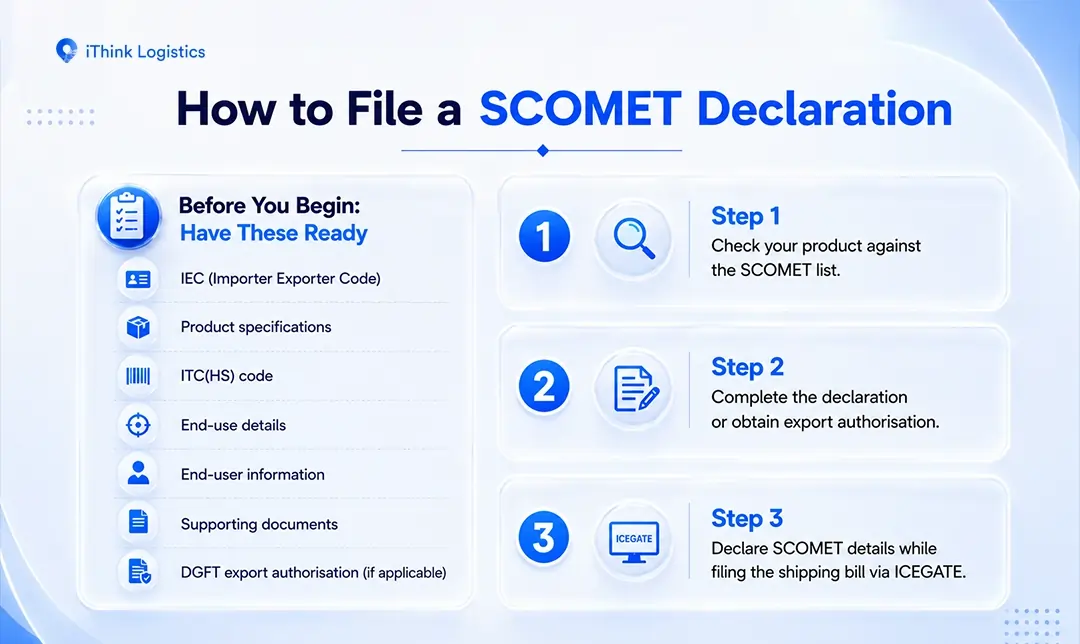
Step 1: Check whether your product is covered under the SCOMET list
Compare your product’s control parameters with the latest SCOMET list published by DGFT. Don’t rely on the ITC (HS) code alone, as SCOMET classification depends on the applicable technical control parameters.
Step 2: Complete the declaration or obtain a SCOMET export authorization
If your product is not covered under the SCOMET list, prepare the applicable declaration using accurate exporter, product, and end-user details.
If your product is on the SCOMET list, apply for an SCOMET export authorization through the DGFT portal.
Complete the application, upload the required supporting documents, and submit it for approval.
Step 3: Declare the SCOMET details while filing the shipping bill
After the export authorization is issued, provide the SCOMET export authorization number and other applicable authorization details while filing the shipping bill through ICEGATE.
Customs verifies these details before granting export clearance. For non-SCOMET goods, submit the applicable declaration with the shipping bill documentation.
Understanding the filing process is important, but knowing the consequences of getting it wrong is just as important.
Need help with the DGFT application?
If you’re applying for an SCOMET export authorization for the first time, DGFT has published a detailed user manual that explains each stage of the online application process, including IEC selection, product details, end-user information, document uploads, declaration, and final submission.
Visit: Official DGFT User Manual
Penalties for Getting This Wrong
Failing to comply with India’s SCOMET export control requirements can lead to serious legal and regulatory consequences. The penalties depend on the nature of the violation and the applicable laws.
Under the Foreign Trade (Development and Regulation) Act, 1992, non-compliance with export control requirements can attract monetary penalties. Depending on the violation, DGFT may also suspend or cancel an Importer Exporter Code (IEC) or take other regulatory action under the Foreign Trade Policy and applicable laws.
Where a violation falls under the Weapons of Mass Destruction, and their Delivery Systems (Prohibition of Unlawful Activities) Act, 2005, additional criminal penalties may apply, including imprisonment and fines, depending on the offense committed under the Act.
Understanding these consequences makes it easier to see why exporters should verify their SCOMET obligations before every shipment.
FAQs
Q.1: What is the full form of SCOMET?
A: SCOMET stands for Special Chemicals, Organisms, Materials, Equipment and Technologies. It is India’s export control list for dual-use items, including certain goods, software, and technologies regulated under the Foreign Trade Policy.
Q.2: Is a SCOMET declaration mandatory for all exports?
A: Yes. Every export shipment from India requires a SCOMET declaration. If the goods are not covered under the SCOMET list, exporters submit a self-declaration. If the goods are SCOMET-controlled, the relevant export authorization details must be declared while filing the shipping bill.
Q.3: What is a SCOMET certificate?
A: A “SCOMET certificate” is not an official term under the Foreign Trade Policy. In practice, it usually refers to the SCOMET export authorization issued by the competent authority after the required review. It differs from the SCOMET declaration, which is the exporter’s self-declaration of the shipment’s SCOMET status.
Q.4: How many categories are in the SCOMET list?
A: The SCOMET list contains nine categories, numbered 0 through 8. The latest version of Appendix 3 to Schedule 2 of the ITC (HS) Classification should always be checked, as the control list may be updated through DGFT notifications.
Q.5: What is a SCOMET letter?
A: An SCOMET letter generally refers to the exporter’s declaration, on company letterhead, confirming whether the goods are covered by the SCOMET list or, where applicable, providing the relevant SCOMET export authorization details for Customs.
Q.6: Where can I find the official SCOMET list?
A: The official DGFT SCOMET list is published as Appendix 3 to Schedule 2 of the ITC (HS) Classification on the DGFT website. Always refer to the latest version before exporting, as DGFT may update control entries and technical parameters through notifications.
Getting SCOMET Compliance Right
Getting SCOMET compliance right starts with accurate product classification and complete export documentation.
Before every shipment, verify your product against the latest SCOMET list, describe it using its actual technical parameters, and ensure that all required declarations or authorizations are correctly submitted.
Since DGFT updates the SCOMET list through notifications, checking the latest requirements before export can help you avoid unnecessary compliance issues.
If you’re shipping internationally and want help with export documentation and logistics, iThink Logistics can support your shipping operations and keep you organized throughout the export process.
Have a question about SCOMET declarations or export compliance? Drop it in the comments below, and we’ll help you find the right answer.
Author