


Introduction
If you sell online in India, everything your sourcing decides your profit. A great product with the right price, quality, and supplier can make your brand; a bad sourcing decision can drain margins, increase returns, and even stop your growth.
But Indian sellers don’t have it easy. You deal with MOQ (Minimum Order Quantity)-heavy suppliers, fragmented wholesale markets, unorganized manufacturers, price fluctuations, and quality issues that appear only after you send the product to customers.
That’s exactly why this guide exists. This isn’t a generic, global article. You’ll learn India-specific sourcing strategies, supplier checks, negotiation scripts, cost formulas, and practical tips used by high-performing D2C and marketplace sellers.
By the end, you’ll know exactly how to choose the right products, find reliable suppliers, calculate your margins, and avoid costly mistakes.
What Is Product Sourcing? (With India Context)
Product sourcing definition: is simply the process of finding, evaluating, and purchasing the right products for your online store from the right supplier.
It includes identifying what to sell, choosing trustworthy vendors (wholesalers, manufacturers, B2B platforms, or dropshipping partners), checking quality, negotiating prices, and ensuring the products can be delivered consistently.
In India, product sourcing typically starts with wholesale markets, then moves to domestic manufacturers or B2B portals like IndiaMART, Trade India, and Udaan eventually grows into private label sourcing.
Popular Sourcing Methods for Indian eCommerce Sellers
Most sourcing guides focus on global suppliers. But India’s product sourcing process is very different, more unorganised, more negotiation-driven, and more relationship-based. Below are the sourcing methods that actually work for Indian marketplace and D2C sellers, along with the pros, risks, and when to choose each.
Local Wholesale Markets
For many Indian sellers, wholesale markets are the easiest place to start. You get ready stock, flexible MOQs (Minimum Order Quantity), and quick validation for new categories.
Popular sourcing hubs across India:
- Delhi: Sadar Bazaar, Gandhi Nagar, Chandni Chowk, Nehru Place, Karol Bagh
- Surat: Textile Market, Ring Road Market, Raghukul Textile Market
- Bengaluru: Chickpet Market, Malleswaram Market, Avenue Road
- Mumbai: Crawford Market, Bhiwandi, Gandhi Market
- Jaipur: Bapu Bazaar, Johari Bazaar, Sanganer Market, Nehru Bazaar
Why sellers prefer these markets:
- Immediate stock availability
- Easy to touch and inspect products
- Helps you experiment with categories before committing
Challenges to expect:
- Packaging is rarely eCommerce-ready
- Quality varies shop-to-stop
- Majority are traders, not manufacturers (so margins are tighter)
How negotiation works in these markets:
- Build a friendly conversation first and you’ll get better pricing
- Ask for “trial batch pricing” for your first order
- Cash or UPI settlements usually get better deals
- Don’t hesitate to walk away; sellers often quote lower if you start moving forward
Indian B2B Platforms
Platforms like IndiaMART, TradeIndia, Udaan, and Meesho Supplier Hub give you wider reach without travelling. But they need smart filtering to avoid unreliable traders.
Checklist when analysing supplier listings:
- Does their product range match one category or too many? (too many = trader)
- Are images consistent and original?
- Do they share material specs clearly?
- Are replies personalised or copy-paste?
How to avoid middlemen:
- Ask for a short factory or warehouse video tour
- Request raw-material or manufacturing details
- Google Maps the address manufacturers usually sit in industrial areas
- Ask for MSME/GST certificates (traders avoid sharing these)
Domestic Manufacturers (Private Labeling)
If you plan to build a brand, not just resell products, you’ll eventually move to domestic manufacturing. This will gives you consistent quality, better margins, and branded packaging.
When it’s the right time to switch:
- Your product already sells well
- You need stronger quality control
- You want custom colours, designs, or packaging
- Solid Financial Plan
- Traders’ prices leave you little margin (while above all ticks the boxes)
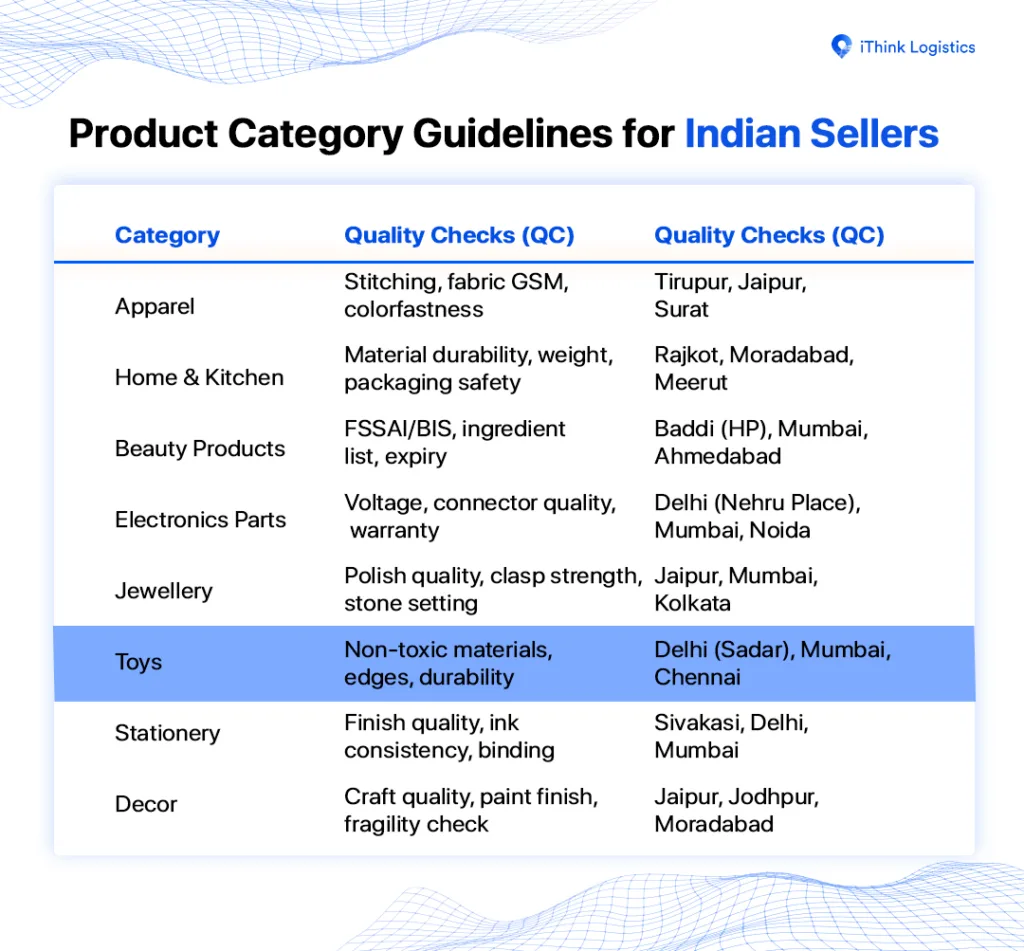
Major manufacturing clusters in India:
- Tirupur: T-shirts, cotton wear
- Chennai: Automobiles, Auto Components
- Rajkot: Kitchenware, tools
- Jaipur: Ethnic wear, jewellery
- Ludhiana: Winter wear, sportswear
Manufacturing helps you scale sustainably.
Dropshipping for Indian Sellers
Dropshipping is a good way to test product ideas quickly without investing in inventory, but it isn’t the most reliable option for long-term scaling in India. It works best for low-risk categories such as accessories, home décor, stationery, phone, covers and items that are lightweight and have predictable demand. The biggest challenges usually come from poor logistics, inconsistent product quality, and higher return rates.
To reduce these risks, always order samples before listing, choose Indian dropshipping suppliers like Meesho, India Mart, and others for faster fulfilment, and set clear customer expectations in your product descriptions. Think of dropshipping as a validation tool, not a full business model as once a product gains traction, shift to stocking or manufacturing for better margins and control.
How to Find Winning Products in India
Finding a profitable product is the most crucial step in ecommerce product sourcing, and the process becomes easier when you know what signals to look for.
4.1 Trend & Market Demand Research Tools
Use a mix of tools to spot early demand:
- Google Trends: Seasonal spikes
- Amazon Best Sellers: Real-time top categories
- Flipkart Trending: Price sensitivity
- Meesho Trends: Mass-market demand
- Instagram/TikTok: Viral product ideas
In ecommerce product sourcing, the best products usually combine steady demand, good margins, and strong visual appeal. People buy with emotion not with logic.
4.2 Competitive Analysis
Before sourcing, check: Is the market already too crowded? As there are 2 market. Red ocean market and blue ocean market, where blue ocean is have very less crowd while red ocean big crowd already competing for small pie out of it.
Check:
- Number of sellers
- Review patterns
- Pricing gap between top 3 listings
- Add-on costs (packaging, returns)
Quick price benchmark formula:
Benchmark Price = ∑ Competitor Prices
———————————
Number of Competitors
How Indian Sellers Can Use AI to Improve Product Sourcing
AI is not here to replace sourcing, it makes it faster and smarter.
5.1 AI for Idea Generation
Use prompts like: “Give me 20 trending home & kitchen products under ₹300 with high demand and low competition in India.” Start testing different prompt with specification, requirement and you will get Good product ideas to test and get started.
5.2 Competitor Intelligence Tools
AI can help you:
- Extract top competitor keywords
- Analyse negative reviews
- Identify gaps in product features
- Predict pricing sweet spots
5.3 Supplier Risk Scoring with AI
AI can help you quickly assess whether a supplier is trustworthy by turning a simple checklist into a risk score. Just feed details like document availability, response quality, pricing clarity, and product consistency into an AI tool. It will highlight gaps, flag possible risks, and compare multiple suppliers so you don’t rely on guesswork. This makes your shortlisting more objective and reduces the chance of choosing an unreliable partner.
5.4 AI for Negotiation & Communication
AI tools can also speed up your communication. You can generate ready-to-send RFQs (Request for Quotations), negotiation messages, MOQ (Minimum Order Quantity) reduction requests, and even payment-term agreements. This ensures your messages are professional, clear, and consistent especially when you’re handling multiple suppliers at the same time. It saves time and also helps you negotiate better without sounding inexperienced.
How to Shortlist Reliable Suppliers in India
Choosing the right supplier is one of the most important steps in the product sourcing process, because a bad partner can affect your pricing, quality, margins, and delivery timelines. A reliable supplier should meet the following checkpoints:
- Clear product catalog
- Consistent communication
- Reasonable MOQ
- Transparent pricing
- Ready to provide invoices
- Can show factory or warehouse
Difference between manufacturer vs trader:
- Manufacturers know production details
- Traders sell broad categories with little knowledge
- Manufacturer pricing changes less frequently
A strong supplier evaluation at this stage ensures the rest of your product sourcing process moves smoothly and reduces long-term risks.
The Ultimate 10-Step Supplier Verification Checklist (India-Focused)
Use this before placing any order:
- Verify GST number
- Check MSME or company registration
- Ask for a factory/warehouse video call
- Order samples
- Test packaging
- Review specs carefully
- Ask for previous customer references
- Request transparent pricing breakup
- Compare WhatsApp vs catalog specs
- Place a small trial order first
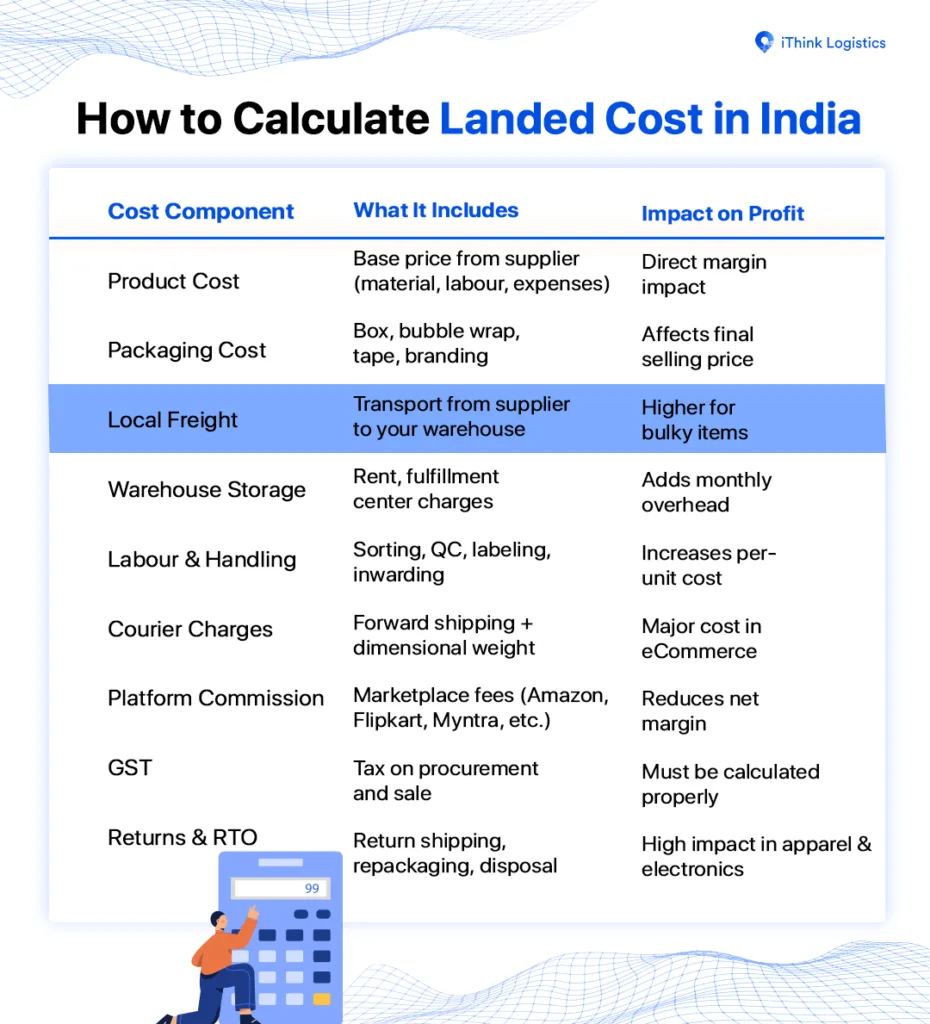
How to Calculate Landed Cost in India
Most sellers calculate only the “product price.” Here’s the real formula:
Profit Margin Forecasting Before You Source
Every category has a realistic margin range.
Ideal Profit Margin
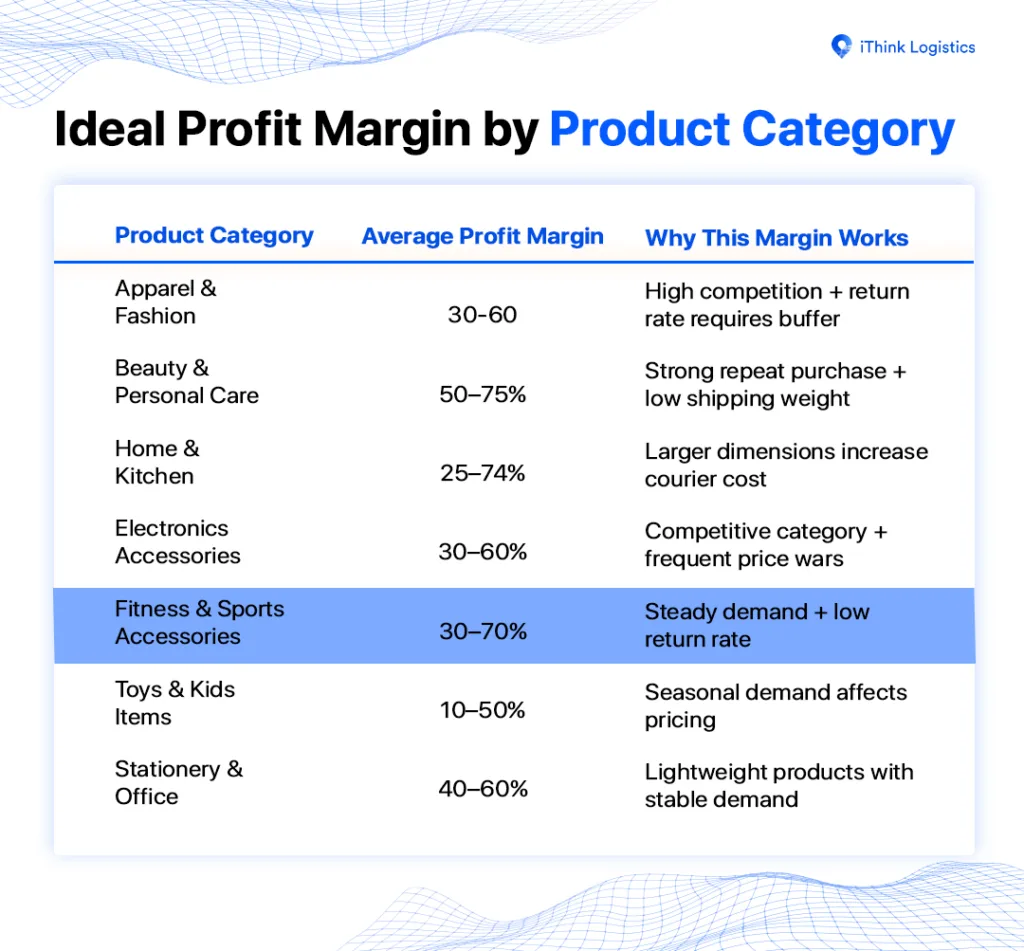
Margin formula: [(Selling Price – Cost of Goods Sold) / Selling Price] × 100
Quality Control Process for Indian Sellers
Your QC shouldn’t start after you get the parcel it starts before production.
Steps:
- Set Quality Standard
- Pre-production sample approval
- Checks at Multiple production stages
- Final production sample
- 3rd-party QC if order is large
- Packaging quality checks
Catch issues early to reduce later issues and loses.
Packaging Standards to Reduce Returns
Platforms have strict rules:
- Amazon: 3-layer packaging for fragile items
- Flipkart: Mandatory polybag thickness
- Drop tests recommended for all breakables
Eco-friendly options:
- Kraft boxes
- Paper-based cushioning
- Recyclable poly mailers
Good packaging increases brand trust and reduces damage complaints.
12. Logistics Planning Before Sourcing
Before placing any order, it’s important to understand the logistics costs that will follow. Local freight charges from the supplier, dimensional weight (volumetric weight) impact, warehouse storage fees, and courier restrictions on items like liquids, batteries, or electronics can all change your actual profitability. Considering these factors early ensures you don’t source a product that becomes too expensive or too difficult to ship later.
13. How to Negotiate With Suppliers
Negotiation in India is less about hard bargaining and more about building trust. Suppliers respond better when they see long-term potential, not just one-time orders. Start by being clear about your needs, share your business plan related to orders and all honestly, and keep communication respectful this alone improves your chances of getting better pricing and terms.
Smart negotiation tactics that work in Indian markets:
- Start with smaller trial orders: Ask for “trial batch pricing.” Most suppliers agree because they want repeat business.
- Show that you’re serious: Share your expected monthly volume once scaling begins. Indian suppliers value stability.
- Negotiate beyond pricing: Ask for free packaging upgrades, lower MOQs, or faster dispatch instead of only discounts.
- Use comparison politely: Mention that you are evaluating 2–3 suppliers not to pressure them, but to signal market awareness.
- Ask for transparent breakup: Cost per unit, packaging cost, shipping, taxes. Clear breakdowns reduce surprise price hikes.
To avoid sudden price increases:
- Get quotations in writing.
- Confirm that prices are valid for a specific duration.
- Re-check raw material price trends in their industry (cotton, steel, plastics).
Negotiation works best when you combine clarity, consistency, and long-term thinking. A good supplier relationship often gives you better margins than the cheapest price.
14. Ready-to-Use Supplier Communication Templates
RFQ Template: “Hi, I’m looking for 100 units of [product]. Please share price, MOQ, material details, packaging options, and delivery timeline.”
Sample Request: “I’d like to test your quality. Can you share 1–2 samples with detailed specs and packaging?”
Negotiation Script: “We like your product but your MOQ is high. If the first batch performs well, we will order regularly. Can you allow a smaller MOQ for now?”
15. Common Sourcing Mistakes Indian Sellers Must Avoid
Many new sellers rush into sourcing and end up losing margin, time, and trust. Avoiding a few common mistakes can save you from costly decisions.
The biggest sourcing mistakes to watch out for:
- Skipping samples: Never list a product without checking quality, packaging, and real feel. Photos don’t reflect defects or durability.
- Believing “factory rate” without proof: Traders often use this line. Ask for GST details, product specialization, and a quick video of the facility.
- Ignoring packaging cost: Good packaging can increase cost by ₹5–₹25 per unit. If you ignore this, your profit margin drops instantly.
- Copying trends blindly: Trending products look attractive, but many are saturated or low-margin. Validate demand and check competition before buying.
- Over-ordering inventory: One wrong bulk purchase can block your working capital for months. Start small and scale only after confirming sales.
- Relying on a single supplier: If they delay production or change prices, your entire business stops. Always build 2–3 backup options.
Avoiding these mistakes not only protects your margin but also keeps your business flexible as you grow.
16. Supplier Red Flags to Watch For
Good suppliers make scaling easy. Bad suppliers can ruin your reputation overnight. Spotting early warning signs helps you avoid unreliable partners.
Stop and rethink the moment you see:
- Unrealistically low pricing: If the price looks too good, the quality or material grade is usually compromised.
- Slow or inconsistent replies: Delayed communication now often turns into delayed shipments later.
- No GST, MSME, or invoices: This signals poor credibility and increases your risk during disputes or returns.
- Frequent changes in product specs: If the supplier keeps “updating” design, weight, or material, quality issues will follow.
- Inconsistent story about the factory: Different answers about location, capacity, or staff usually means they’re a middleman.
A reliable supplier remains transparent, consistent, and responsive. If something feels off in the early conversations, it’s better to walk away than risk your brand.
Conclusion
Sourcing in India is full of opportunities—but only if you approach it with the right strategy. Start small, verify everything, test demand, and scale slowly. When you combine strong sourcing with the right logistics partner, your eCommerce business becomes more stable, profitable, and ready for growth.
FAQs
Q.1: What is product sourcing in eCommerce?
A: Product sourcing is the process of finding, evaluating, and buying products from suppliers to sell online. It includes choosing the right markets, manufacturers, B2B platforms, and negotiating terms.
Q.2: How do I start product sourcing for my eCommerce store in India?
A: Begin with market research, shortlist trending products, check competition, explore suppliers on IndiaMART/wholesale markets, request samples, calculate landed cost, and then place a small trial order.
Q.3: What is the best product sourcing method for Indian sellers?
A: For beginners: local wholesale markets.
For scaling sellers: domestic manufacturers/private label.
For testing ideas: dropshipping.
For large margins: international sourcing.
Q.4: How do I find reliable suppliers in India?
A: Check GST and MSME details, ask for factory videos, request samples, compare pricing transparency, and evaluate communication speed and accuracy.
Q.5: Which products are most profitable to source in India?
A: Categories with proven margins include home & kitchen, fashion accessories, toys & baby products, beauty & personal care, and small electronics.
Q.6: How do I avoid fake or middlemen suppliers on IndiaMART or TradeIndia?
A: Ask for raw material details, manufacturing capacity, factory walk-through videos, and cross-check their address on Google Maps.
Q.7: Is dropshipping profitable in India?
A: Yes—for testing new products. But for long-term growth, switching to bulk sourcing or private label gives better quality control, faster delivery, and higher margins.
Q.8: How can AI help in my product sourcing process?
A: AI can analyze trends, compare supplier data, write RFQs, negotiate MOQ, predict demand, and score supplier risk based on documentation and communication.
Q.9: What costs should I calculate before sourcing a product?
A: Landed cost = product cost + packaging + local freight + platform commission + payment gateway fee + taxes + buffer for returns.
Q.10: What are the common mistakes sellers make during product sourcing?
A: Skipping samples, choosing the cheapest supplier, ignoring packaging rules, trusting “factory rate” claims, and placing large orders before testing.





Leave a Reply