


India has roughly 19,000 active PIN codes. Your courier probably delivers well to a few hundred of them.
That mismatch is where most ecommerce sellers quietly lose money, one failed delivery, one RTO, one unhappy customer at a time. The fix isn’t a better courier. It’s not relying on just one.
Multiple courier partners let you match each shipment to whichever carrier actually performs best for that destination, package, and delivery speed, instead of routing everything through a single network.
Get the mix right, and costs drop while delivery gets faster and more reliable.
For reference, you can check India’s official PIN code directory to understand the breadth of India’s delivery network.
What Multiple Courier Partners Actually Means
Multiple courier partners means working with more than one shipping or courier company to handle your ecommerce deliveries, so every order goes to the carrier that performs best for that pin code, package type, and delivery speed, instead of routing everything through a single network.
Think of it like a cricket team. You don’t send your fastest bowler in to bat. Right player, right job, every time.
That’s the whole logic behind courier allocation, once you strip away the jargon.
Matching Orders to the Right Courier

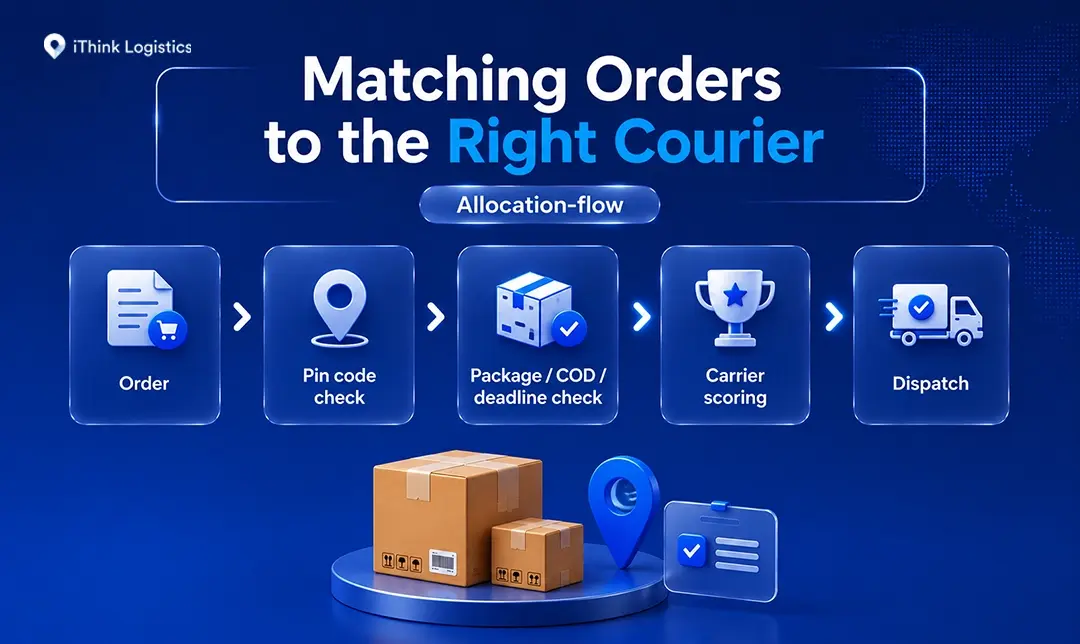
A same-day Mumbai delivery and a cash-on-delivery shipment to a small town in Bihar are not the same job. Treating them the same way is where most inefficiency comes in.
A multi-courier setup lets your system pick a carrier based on a handful of things that actually matter:
- Destination PIN code and serviceability
- Package weight and dimensions
- COD or prepaid status
- Delivery deadline
- The courier’s own track record on that specific route
iThink’s AI Recommendation Engine runs on exactly this logic. It weighs over many parameters per shipment, same-day pickup capability, NDR history, RTO trends, and PIN code performance, before it ever suggests a courier.
Where the Real Cost Savings Come From
Blended shipping cost is the true cost of a delivery once you add forward freight, COD fees, fuel surcharges, handling charges, and expected RTO costs together, not just the courier’s quoted rate.
Here’s the trap most sellers fall into: a courier quoting seventy rupees looks cheaper than one quoting seventy-eight.
But if the cheaper one fails delivery more often and triggers a return shipment, that eight-rupee “saving” disappears fast.
Multi-courier rate comparison helps you avoid this by picking the most cost-effective carrier per shipment rather than one flat rate for everything.
How much you actually save depends on your shipment mix, your negotiated rates, and your zones, so treat any number you hear as a starting point, not a promise.
Nobody’s doing this comparison by hand for every single order. That’s what a courier aggregator is for: comparing your options and automatically recommending a partner based on cost, serviceability, and performance.
Speed Doesn’t Have to Mean One Speed
A festive gift needs to move fast. A routine restock order doesn’t.
Multiple courier partners let you treat these differently:
- Same-day and next-day orders go to your fastest local partner.
- Standard shipments go to whoever’s cheapest and reliable.
- Remote pin codes go to whichever partner actually has last-mile reach there.
You stop overpaying for express speed on orders that don’t need it. And you stop missing deadlines on the ones that do.
The RTO Problem, and Why It’s Not Just About the Customer
RTO, or Return to Origin, happens when a courier cannot complete a delivery after repeated attempts and sends the shipment back to your warehouse, adding return freight costs and delaying resale of that stock.
It’s tempting to blame RTO entirely on flaky customers. But delivery success can vary just as much by courier, route, address quality, and how good the local delivery agent actually is.
Curious how this plays out in practice? Here’s why RTO happens in Indian ecommerce, in more depth.
Sending COD orders in a tricky pin code to whichever courier has the stronger delivery-success history there tends to help, though results shift by region and courier.
Combine that with tighter COD failure management and the whole funnel gets noticeably tighter.
When One Courier’s Bad Week Becomes Your Bad Week
A strike. A sudden weather disruption. A festival sale that overwhelms one network’s capacity.
Any of these can choke a single courier overnight slow to delivery, and if that’s your only courier, their problem is now your problem.
Multiple partners give you a release valve. Shift volume away from whoever’s struggling, keep dispatching, keep moving.
During Diwali or a big sale event, that flexibility is often the entire difference between shipments going out on time and packages stacking up in your warehouse.
No Courier Owns the Whole Map
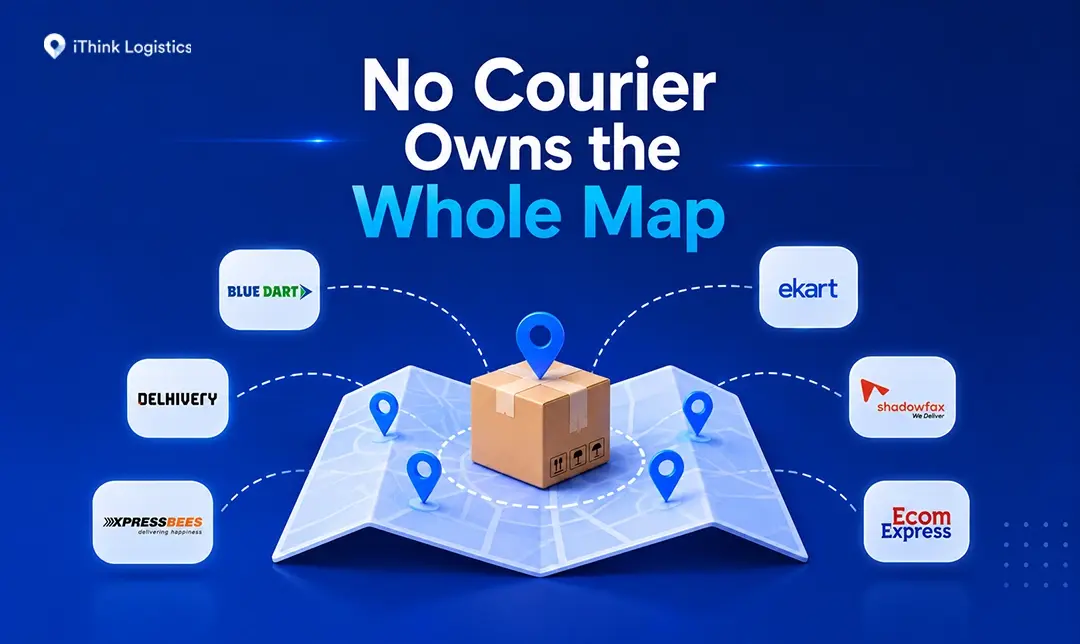
One partner might dominate Mumbai and Pune. Another might be stronger in the Northeast or in specific Tier 2 and Tier 3 pockets where local reach matters more than national scale.
A good aggregator network already brings these regional and national partners together for you, so “pin code not serviceable” stops being a reason you lose a sale.
Worth noting: iThink Logistics itself provides access to 29,000+ serviceable pin codes through its combined courier network, which is a good reminder that serviceability and raw pin code count aren’t the same thing.
Single Courier vs. Multi-Courier, Side by Side
Once you register an aggregator, here’s how single and multi-courier setups actually compare
| Factor | Single Courier | Multiple Courier Partners |
| Pin code coverage | Limited to one network | Combined reach across every partner on the platform |
| Pricing | One rate card, no comparison | Rates compared automatically, best option picked per shipment |
| RTO control | Little flexibility | Route around zones where one partner keeps failing |
| Peak season risk | High, single point of failure | Volume shifts to whoever has capacity |
| COD handling | One remittance cycle | Pick partners with faster payout cycles |
| Setup effort | Simple, one relationship to manage | One registration, no separate courier onboarding |
| Delivery speed options | One service level for everyone | Same-day for priority orders, standard for the rest |
| Accountability | One direct point of contact | Tracking and NDR handling centralized on one dashboard |
| Data visibility | Whatever that courier’s own portal shows | Performance data across all partners in one place |
That combined view is what makes it possible to actually track performance instead of just guessing which courier is working.
The Numbers That Actually Tell You Something
Adding couriers without tracking them is just adding complexity for no reason. A few numbers separate the ones worth keeping from the ones worth dropping.
| Metric | Why It Matters |
| Pickup success rate | Are orders even leaving your warehouse on time? |
| First-attempt delivery rate | A proxy for delivery agent quality |
| On-time delivery percentage | Are you keeping the promise you made the customer? |
| RTO percentage | Your real failed-delivery and COD risk |
| Average transit time | Tells you which courier suits which lane |
| Cost per delivered order | Far more honest than the quoted freight rate |
Track these by courier and by PIN code, and the weak performers tend to show themselves.
Building a Courier Mix That Actually Works
There’s no magic number here. Start with two or three strong primary carriers, then add backup or specialist partners once your shipment data shows you need them.
Getting there doesn’t mean negotiating with each courier one by one:
- Pull your last two to three months of shipment data by PIN code and courier.
- Identify your top two or three delivery zones by volume.
- Register with a courier aggregator like iThink Logistics. The onboarding team connects your business, and you get access to every courier partner on the platform in one step.
- Check PIN code-level performance inside the aggregator dashboard to see which courier delivers best in each zone.
- Choose the right courier per shipment based on that performance data, and keep tracking the six metrics from the table above.
With everything in one dashboard, the real work now is keeping that setup running smoothly.
The Part Nobody Mentions: More Couriers Means More Admin
An aggregator gives you one dashboard, but it doesn’t remove all the admin work.
Behind that dashboard, you’re still dealing with several couriers. Each one has its own tracking updates, COD payment schedule, and billing format.
Someone on your team still needs to check invoices, follow up on COD payments, and make sure every courier is pulling its weight.
The answer isn’t fewer couriers. It’s treating this checking as a regular weekly or monthly task, not something you only glance at when a number looks off.
This is exactly the kind of work a good aggregator platform takes off your hands, and it’s worth a closer look.
This Is Where a Courier Aggregator Earns Its Place
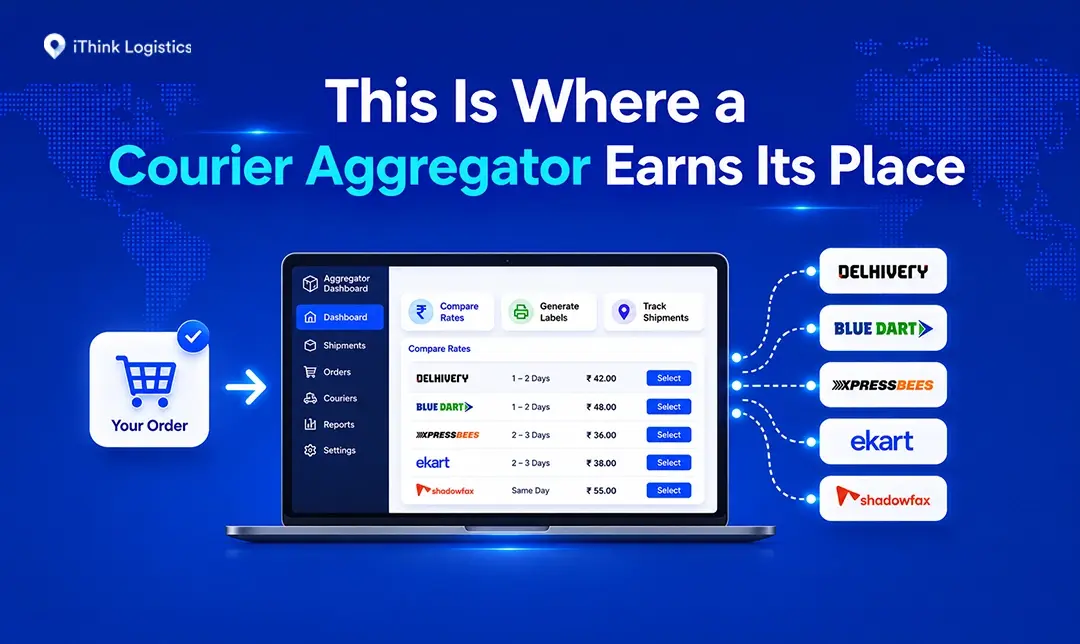
A courier aggregator is a platform that connects you to multiple courier partners through a single dashboard, so you can compare rates, generate labels, and track every shipment without logging into separate courier portals.
This is what turns ‘managing five couriers’ from a spreadsheet nightmare into one dashboard your team can actually stay on top of.
Automated, AI-driven NDR handling and centralized COD reconciliation both build on this same idea.
If you want the fuller picture, here’s how logistics aggregator platforms in India actually fit into all this.
FAQs
How many courier partners should an ecommerce business use?
There’s no universal number. A practical starting point is two or three strong primary carriers, with backup or specialist partners added once your shipment data shows a real need.
Is multi-courier shipping only useful for large brands?
Not at all. Even a business with modest shipment volumes can compare two or three courier partners for its key delivery zones and spot real differences in cost, serviceability, and performance.
Does using multiple couriers increase my shipping cost?
Usually the opposite. Comparing rates across partners tends to lower your average cost per order, though how much depends on your shipment mix and negotiated rates.
What’s the difference between a courier partner and a courier aggregator?
A courier partner is one delivery company, say Delhivery or Bluedart. A courier aggregator connects you to several of them through a single dashboard.
How does RTO affect blended shipping cost?
Every RTO adds a return freight charge on top of what you already paid to ship it forward, which pushes your real cost per delivered order well past the quoted rate.
Can I switch couriers for an order after it’s already been picked up?
In most cases, no. Once a shipment is manifested with a courier, that decision is locked in, so allocation has to happen before dispatch, not after.
Do all couriers handle COD orders the same way?
No. COD success rates and remittance cycles vary by courier and by region, which is exactly why routing COD orders selectively makes such a difference.
How do I spot which courier is underperforming in a specific pin code?
Watch RTO percentage and first-attempt delivery rate by courier and by pin code over time. The weak spots tend to show up on their own.
Will adding more couriers slow down my warehouse?
It can, if you’re managing it by hand. A centralized dashboard or aggregator keeps labeling and tracking in one place, no matter how many couriers you’re running.
Conclusion
Multiple courier partners aren’t about running more accounts for the sake of it. They’re about giving every order its best shot at reaching the customer on time, without paying more than you should.
Start small, track the six numbers that matter, and let the data tell you which courier earns more of your volume.
Which courier has surprised you the most, in a good or bad way? Drop it in the comments, other sellers reading this are probably wondering the same thing.


