iThink Logistics | Blogs

Ecommerce

High Profit Margin Businesses in India: 15 Most Profitable Ideas for 2026

Last updated 09/09/2026
Reviewed by Divyesh Trivedi
High Profit Margin Businesses in India: 15 Most Profitable Ideas for 2026

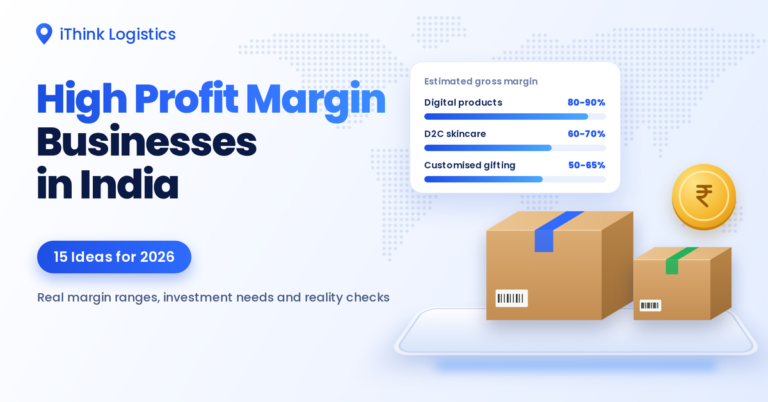
The highest profit margin businesses in India are digital products and online courses, at an estimated 80 to 90 percent gross margin. D2C skincare and cosmetics follow at 60 to 70 percent. Customised gifting runs at 50 to 65 percent, and artificial or silver jewellery at 50 to 70 percent. Cloud kitchens and packaged food sit just behind at 50 to 60 percent.

In this guide, a high profit margin business means a gross margin above 50 percent. That is measured after the cost of goods and delivery, before marketing and overheads. Why does the benchmark matter? A 60 percent margin business can absorb a bad ad month. A 25 percent one cannot.

One note on scope. This guide covers business models you can start, not listed companies with the highest reported margins.

iThink Logistics ships for more than 37,000 e-commerce brands. So we see what most margin articles skip: the gap between spreadsheet margin and the margin left after shipping, COD and returns.

What Is a High Profit Margin Business?

A high profit margin business sells for far more than it costs to make and deliver. It typically leaves a gross margin above 50 percent. The formula is simple:

Profit margin = (Revenue minus Costs) divided by Revenue, expressed as a percentage (Investopedia).

Gross margin counts only the cost of goods and fulfilment. Net margin also subtracts marketing, salaries, platform fees, rent and taxes. So net margin is always lower, often far lower, than gross margin. When an article calls a business “70 percent profitable”, it almost always means gross margin.

High margins usually come from one of four sources:

  • No unit cost, as with digital products
  • Brand pricing power, as with skincare
  • Personalisation, as with custom gifting
  • Skill scarcity, as with consulting

How to read these ranges: the margin and investment figures in this guide are estimates. They are based on typical selling prices and input costs for small Indian sellers, not audited company data. Every figure is gross margin unless stated otherwise, and your own numbers will depend on sourcing, pricing and returns.

Which Business Is Most Profitable in India?
Which Business Is Most Profitable in India?

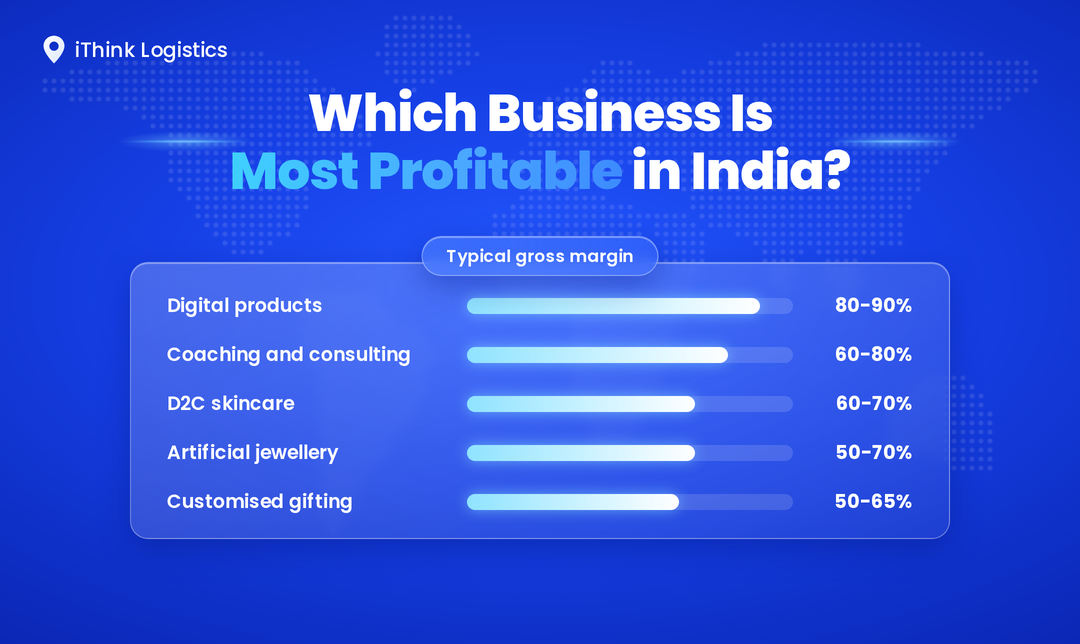
The most profitable business in India by margin is selling digital products and online courses. It can clear an estimated 80 to 90 percent gross margin, with no unit cost, inventory or delivery.

Have capital and want a saleable asset at the end? Then a D2C skincare or cosmetics brand with owned distribution is the most profitable choice. It runs at 60 to 70 percent gross margin, with far higher revenue ceilings.

So the honest answer depends on your capital. Under Rs. 50,000, digital products win. Above Rs. 3 lakh, a branded consumable wins, because margin multiplied by repeat purchase beats margin alone.

Business TypeEstimated Gross MarginInvestment LevelMain Margin Risk
Digital products and online courses80 to 90 percentVery lowAd costs and refunds
D2C skincare and cosmetics60 to 70 percentMediumCustomer acquisition cost
Artificial and silver jewellery50 to 70 percentLow to mediumReturns and damage
Customised gifting and printing50 to 65 percentLowRush delivery costs
Coaching and consulting60 to 80 percentVery lowYour own time is the cap
Cloud kitchen and packaged food50 to 60 percentMedium to highWastage and aggregator commissions
Candles and home fragrance55 to 70 percentLowBreakage in transit
Pet products40 to 60 percentLow to mediumHeavy parcels
Refurbished goods20 to 35 percentMediumWarranty claims

Treat these as ranges to plan against, not guarantees. Your real margin moves with sourcing volume, discounting and return rate.

15 High Profit Margin Business Ideas in India

These are the most profitable business ideas in India for 2026. Each has an estimated margin range, an investment estimate and the one operational reality that eats margin if ignored.

1. Digital Products and Online Courses

Templates, presets, ebooks, Notion systems, recorded courses, paid communities and stock assets.

Estimated margin: 80 to 90 percent gross.

Why margins are high: your hundredth sale costs nothing to produce. There is no packaging, shipping or return handling. Pricing follows the value of the outcome, not the cost.

Starting investment: Rs. 5,000 to Rs. 30,000.

Reality check: almost all your cost becomes paid acquisition. If cost per sale passes 40 percent of price, that 90 percent gross margin turns thin fast.

Software and SaaS tools for SMEs follow the same margin logic. They need far more capital and technical skill, so this guide leaves them out.

2. D2C Skincare and Cosmetics

Own-label serums, cleansers, sunscreens, lip and hair products made through a contract manufacturer.

Estimated margin: 60 to 70 percent gross.

Why margins are high: formulation and filling costs are low next to retail price. Brand, packaging and claims carry the pricing. Redseer expects India’s beauty and personal care market to reach US$ 40 billion by 2030.

Real example: Minimalist, a Jaipur-based skincare brand launched in 2020, sold a 90.5 percent stake to Hindustan Unilever in 2025.

Starting investment: Rs. 1.5 lakh to Rs. 5 lakh, including minimum order quantities and testing.

Reality check: minimum order quantities lock up cash. A slow SKU sitting in a warehouse is a common way beauty founders lose money despite good margins.

3. Customised Gifting and Printing

Personalised mugs, frames, hampers, engraved items, corporate gifting kits and occasion boxes.

Estimated margin: 50 to 65 percent gross.

Why margins are high: personalisation removes price comparison, because no competitor sells the identical item. Corporate bulk orders also price better than retail.

Starting investment: Rs. 25,000 to Rs. 1.5 lakh, depending on whether you buy printing equipment.

Reality check: gifting runs on deadlines, so same-day and next-day delivery is a real cost. Build express shipping into the price instead of absorbing it.

4. Artificial and Silver Jewellery

Oxidised, kundan, temple and minimal everyday jewellery from Jaipur, Rajkot or Hyderabad, sold under your own brand.

Estimated margin: 50 to 70 percent gross.

Why margins are high: cluster sourcing costs are low, and the product is light to ship. Design and styling set the price, not material cost.

Real example: GIVA, a Bengaluru silver jewellery brand set up in 2019, now sells online and through its own stores in cities such as Bengaluru, Mumbai, Delhi and Pune (GIVA).

Starting investment: Rs. 30,000 to Rs. 1.5 lakh.

Reality check: fashion jewellery sees high returns, and a returned piece often cannot be resold as new. Each return costs you two-way shipping plus any piece you cannot resell, so returns eat margin fast.

5. Cloud Kitchen and Packaged Food Brands

A delivery-only kitchen, or a packaged snack and staples brand run from a licensed facility.

Estimated margin: 50 to 60 percent gross on food, before aggregator commissions.

Why margins are high: ingredients are usually a minority of the menu price. There is no dine-in rent or service staff. India’s snacks market is projected to roughly double between 2025 and 2034 (IMARC).

Starting investment: Rs. 2 lakh to Rs. 8 lakh, including an FSSAI licence and kitchen equipment.

Reality check: Swiggy and Zomato commissions of 22 to 35 percent, as reported by Business Standard, can take a large bite out of a 55 percent margin. Your own ordering channel is what protects it.

6. Dropshipping with Private Labels

Selling supplier-made products under your own brand and packaging, with the supplier shipping each order.

Estimated margin: 25 to 45 percent gross. It rises to 50 percent or more once you private-label and buy in volume.

Why margins are high: private labelling breaks the price comparison that kills plain dropshipping. You also carry no inventory or warehouse cost.

Starting investment: Rs. 15,000 to Rs. 75,000.

Reality check: you do not control delivery speed or packaging, and both show up in reviews. Our dropshipping in India guide covers vetting suppliers on fulfilment, not just price.

7. Home Decor and Handicrafts

Block-printed textiles, brass and wooden pieces, pottery, macrame, jute goods and handmade lighting.

Estimated margin: 50 to 70 percent gross in India, and higher on export orders.

Why margins are high: artisan sourcing is cheap, and buyers pay for design and story rather than materials. Overseas buyers often pay more for handmade Indian goods.

Starting investment: Rs. 50,000 to Rs. 2.5 lakh.

Reality check: decor is bulky and fragile, so volumetric weight often beats actual weight. Learn how volumetric weight is charged before you price anything.

8. Pet Products

Treats, grooming products, toys, beds, apparel and supplements for dogs and cats.

Estimated margin: 40 to 60 percent gross, with treats and supplements at the top.

Why margins are high: pet parents buy on trust and ingredients, not price. Consumables get reordered, which spreads acquisition cost over many orders.

Real example: Heads Up For Tails started in 2008 with a mall kiosk and grew to dozens of stores and dog spas across several states (The Better India).

Starting investment: Rs. 75,000 to Rs. 3 lakh.

Reality check: pet food and litter are heavy. Shipping a 5 kg parcel can wipe out the margin on a Rs. 600 order, so start with light, high-value SKUs.

9. Phone and Tech Accessories

Cases, cables, chargers, earphones, stands, screen guards and laptop sleeves, own-label or curated.

Estimated margin: 45 to 65 percent gross on cases and lifestyle accessories. It is lower on electronics facing brand-name rivals.

Why margins are high: landed cost on a printed case or braided cable is a small fraction of retail. Buyers also treat accessories as impulse buys.

Starting investment: Rs. 25,000 to Rs. 1 lakh.

Reality check: marketplaces are crowded and price-led here. Design-led or device-specific niches hold margin far better than generic listings.

10. Candles and Home Fragrance

Soy candles, reed diffusers, room sprays, incense and gifting sets.

Estimated margin: 55 to 70 percent gross.

Why margins are high: wax, wicks and fragrance are a small part of a finished candle’s retail price. The category sells heavily as gifts, which supports premium pricing.

Starting investment: Rs. 20,000 to Rs. 80,000. That makes it one of the cheapest high-margin product businesses to start.

Reality check: glass breakage in transit kills margin. Proper e-commerce packaging is not optional.

11. Organic and Wellness Products

Supplements, ayurvedic formulations, cold-pressed oils, millet foods and gut-health products.

Estimated margin: 50 to 70 percent gross on supplements, 30 to 45 percent on organic staples.

Why margins are high: buyers judge supplements on claims, certification and trust, not weight. They are consumables, so customers reorder. India’s healthy snacks market alone was worth about US$ 3.13 billion in 2025 (IMARC).

Starting investment: Rs. 2 lakh to Rs. 6 lakh, including FSSAI or AYUSH licensing and lab testing.

Reality check: claims are regulated and compliance is strict. A recall or blocked listing costs more than the margin you gained by rushing.

12. Coaching and Consulting

Business consulting, career coaching, finance advisory, fitness coaching, exam prep and corporate training.

Estimated margin: 60 to 80 percent, since your main cost is your own time.

Why margins are high: there is no cost of goods, and pricing follows the client’s outcome. One retainer client can match the profit of hundreds of product orders.

Starting investment: Rs. 5,000 to Rs. 50,000.

Reality check: your hours cap revenue, and income stops when you do. Turning expertise into courses or group programmes breaks that ceiling.

13. Tailoring and Boutique Fashion

Made-to-measure ethnic wear, custom blouses, alterations and small-batch boutique collections.

Estimated margin: 45 to 65 percent gross on made-to-order. That beats ready-made, because nothing is produced without a paying customer.

Why margins are high: made-to-order means almost no dead stock. Fit and customisation also command a premium mass brands cannot match.

Starting investment: Rs. 30,000 to Rs. 2 lakh.

Reality check: turnaround time is your reputation. One late wedding order costs more in lost referrals than the order was worth.

14. Refurbished Goods

Phones, laptops, tablets, cameras and appliances, tested, repaired and resold with a warranty.

Estimated margin: 20 to 35 percent gross. That is the lowest here, but on a high ticket size.

Why margins hold: phones and laptops carry a high ticket price, so the rupee margin per unit stays meaningful even at 25 percent. Working capital also turns fast when sourcing is good.

Starting investment: Rs. 1 lakh to Rs. 5 lakh, almost all of it stock.

Reality check: warranty claims and transit damage decide whether this works. Ship insured and record condition at dispatch.

15. Export of Indian Handicrafts

Handmade Indian textiles, decor, jewellery and gifts sold to buyers in the US, UK, Europe, the Gulf and Australia.

Estimated margin: 60 to 80 percent gross. The same product can often sell for much more abroad than in India.

Why margins are high: the gap between Indian sourcing costs and overseas retail prices is wide. Marketplaces like Etsy also remove the need for a distributor.

Starting investment: Rs. 75,000 to Rs. 3 lakh, including IEC registration, samples and export-grade packaging.

Reality check: handled badly, international shipping and customs can eat a big share of each order. Get the export documentation right and compare international shipping partners before you list.

Small Businesses with High Profit Margins (Under Rs. 1 Lakh Investment)

Here are seven small businesses with high profit margins you can start in India for under Rs. 1 lakh.

BusinessEstimated MarginStarting CostWhy It Works at Small Scale
Digital products and courses80 to 90 percentRs. 5,000 to Rs. 30,000No inventory, no delivery, no minimum order quantity
Coaching and consulting60 to 80 percentRs. 5,000 to Rs. 50,000Revenue from the first client, no stock at risk
Candles and home fragrance55 to 70 percentRs. 20,000 to Rs. 80,000Small batches, raw materials bought as you sell
Customised gifting50 to 65 percentRs. 25,000 to Rs. 80,000Print-on-order means you buy stock only after payment
Artificial jewellery50 to 70 percentRs. 30,000Light parcels, cluster sourcing, low minimums
Resin and craft products50 to 65 percentRs. 15,000 to Rs. 50,000Handmade at home, priced on design rather than material
Social media management70 to 85 percentUnder Rs. 10,000Skill-based retainers with no cost of goods at all

The pattern is consistent. Small businesses keep high margins when they sell something with no unit cost, or produce only after payment. Both remove the two margin killers: dead stock and idle capacity.

High Demand Business in India: Where Demand and Margin Overlap

A high demand business in India is not automatically profitable. The ones worth starting sit where high demand meets high margin. That overlap is smaller than most idea lists suggest.

High demand and high margin. D2C personal care, supplements, gifting, candles and digital products. Demand is growing, customers buy again, and pricing follows brand or outcome. This is the zone to build in.

High demand and thin margin. Grocery, generic electronics, mobile recharge and price-led marketplace reselling. Volume is huge, but margins are thin, so you need scale or capital most new founders lack. New founders often mistake market size for opportunity.

Low demand and high margin. Niche B2B services and specialist handmade goods. These can be excellent businesses, but they need patience and a narrow audience.

Chasing demand without margin is one of the most common ways small businesses fail. Rs. 10 lakh a month at 8 percent margin leaves less than Rs. 2 lakh a month at 65 percent. The first also carries far more operational risk. Check margin first, then check demand.

How to Protect Your Margins as You Scale
How to Protect Your Margins as You Scale

For D2C brands, shipping is one of the biggest costs after the product itself, and one of the few you can control directly. An ad auction sets your marketing costs. Your own decisions set your shipping costs.

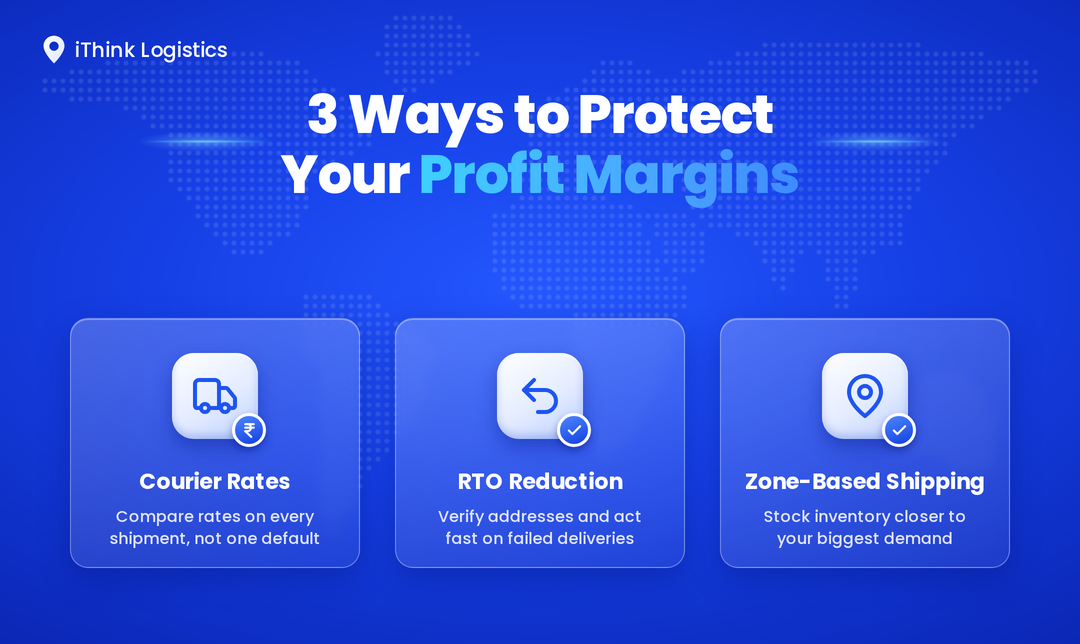
Three levers matter most.

Courier rate optimisation. Couriers price the same parcel differently by weight slab, zone and service type. Comparing rates per shipment, instead of using one default partner, lets you pick the cheaper option for each order. Also check whether you are billed on volumetric weight. Bulky, light parcels are where overbilling hides.

RTO reduction. A returned COD order costs forward freight, return freight and handling, with zero revenue. According to ET Prime Research, 25 to 30 percent of COD orders in India end up as RTO, against 2 to 3 percent for prepaid orders (Dazeinfo). At that level, RTO alone can erase a thin net margin. Unicommerce found that brands using prepaid incentives, pin-code-based courier routing and address checks cut RTO sharply (Unicommerce). Prompt NDR follow-up helps too. Our guide on what RTO is and why it happens breaks down the causes.

Zone-based shipping decisions. Shipping within your zone usually costs less than shipping across the country. Once volumes justify it, stock inventory near your biggest demand clusters. Start with how shipping zones are calculated, then read 7 ways to reduce e-commerce shipping cost.

Ship Smarter, Keep More Margin with iThink Logistics

A high margin business stays high margin only if delivery does not quietly take the difference. iThink Logistics gives Indian D2C brands discounted rates across multiple couriers on one dashboard. Each order can go with the cheapest, most reliable partner for that pin code.

AI-driven NDR management works failed deliveries before they become RTOs. COD remittance is tracked and predictable. A rate calculator lets you compare partners before you set your website price.

Start shipping with iThink Logistics and see what your current freight is costing you.

FAQs on Profitable Businesses in India

Which business is most profitable in India?

Digital products and online courses are the most profitable business in India by margin, at an estimated 80 to 90 percent gross. There is no unit cost or delivery. With more capital, a D2C skincare brand is most profitable at scale, at 60 to 70 percent with strong repeat purchase.

What is the most profitable business in India to start from home?

Digital products, online coaching, candle making, customised gifting and artificial jewellery are the most profitable home-based businesses. All five run above 50 percent margin. Each needs under Rs. 1 lakh to start and no commercial premises until volumes grow.

Which small businesses have the highest profit margins?

Digital products lead at 80 to 90 percent, followed by social media management at 70 to 85 percent and consulting at 60 to 80 percent. Candles and artificial jewellery follow at 50 to 70 percent. Each avoids inventory risk by selling a skill or producing only after payment.

What are high profit margin business ideas with low investment?

Under Rs. 50,000, the strongest high profit margin business ideas are digital products, online coaching, print on demand, customised gifting and handmade candles or resin products. You can validate each with a handful of orders before committing more capital.

Is a high demand business always profitable?

No. Grocery, generic electronics and price-led reselling have huge demand but thin margins. Little is left after marketing and shipping. Profit depends on margin and repeat purchase, not demand alone, so always check margin first.

What is the difference between gross margin and net profit margin?

Gross margin subtracts only the cost of goods and fulfilment from revenue. Net profit margin also subtracts marketing, salaries, platform fees, rent and taxes. A D2C brand can show 60 percent gross margin and still earn a small net margin, or even a loss.

Can I start a high profit margin business in a Tier 2 or Tier 3 city in India?

Yes. Artificial jewellery, handicrafts, home decor, organic staples and digital products all work well outside metros. Many sourcing clusters, like Jaipur and Rajkot, sit in these cities. Lower rent and labour costs can also help margins.

What mistakes cause high-margin businesses to fail in India?

The most common mistakes are chasing demand without checking margin, locking cash in slow-moving stock, and ignoring returns. Underpricing shipping and relying on one ad channel also hurt. Most high-margin businesses fail on operations, not on the idea.

How much of my profit margin gets lost to shipping and returns?

It depends on order value, weight and your COD share. RTO is often the bigger leak: 25 to 30 percent of COD orders in India end up returned, per ET Prime Research. Each RTO costs two-way freight with no sale. Comparing courier rates and working failed deliveries early protects most of that margin.

Should I start a product-based business or a service-based business for higher margins?

Service and digital businesses usually earn higher margins, an estimated 60 to 90 percent, because there is no cost of goods. Physical products typically land at an estimated 40 to 70 percent. Products, however, build a brand asset you can scale or sell later.

Author

  • Divyesh profile Pic

    Divyesh Trivedi, VP West & North at iThink Logistics, brings 18+ years in logistics and supply chain, writing on fulfillment and business growth

Leave a Reply

Your email address will not be published. Required fields are marked *

09/09/2026

Reading Time: 12 minutes

The highest profit margin businesses in India are digital products and online courses, at an estimated 80 to 90 percent gross margin. D2C skincare and cosmetics follow at 60 to 70 percent. Customised gifting runs at 50 to 65 percent, and artificial or silver jewellery at 50 to 70 percent. Cloud kitchens and packaged food sit just behind at 50 to 60 percent.

In this guide, a high profit margin business means a gross margin above 50 percent. That is measured after the cost of goods and delivery, before marketing and overheads. Why does the benchmark matter? A 60 percent margin business can absorb a bad ad month. A 25 percent one cannot.

One note on scope. This guide covers business models you can start, not listed companies with the highest reported margins.

iThink Logistics ships for more than 37,000 e-commerce brands. So we see what most margin articles skip: the gap between spreadsheet margin and the margin left after shipping, COD and returns.

What Is a High Profit Margin Business?

A high profit margin business sells for far more than it costs to make and deliver. It typically leaves a gross margin above 50 percent. The formula is simple:

Profit margin = (Revenue minus Costs) divided by Revenue, expressed as a percentage (Investopedia).

Gross margin counts only the cost of goods and fulfilment. Net margin also subtracts marketing, salaries, platform fees, rent and taxes. So net margin is always lower, often far lower, than gross margin. When an article calls a business “70 percent profitable”, it almost always means gross margin.

High margins usually come from one of four sources:

  • No unit cost, as with digital products
  • Brand pricing power, as with skincare
  • Personalisation, as with custom gifting
  • Skill scarcity, as with consulting

How to read these ranges: the margin and investment figures in this guide are estimates. They are based on typical selling prices and input costs for small Indian sellers, not audited company data. Every figure is gross margin unless stated otherwise, and your own numbers will depend on sourcing, pricing and returns.

Which Business Is Most Profitable in India?

Which Business Is Most Profitable in India?

The most profitable business in India by margin is selling digital products and online courses. It can clear an estimated 80 to 90 percent gross margin, with no unit cost, inventory or delivery.

Have capital and want a saleable asset at the end? Then a D2C skincare or cosmetics brand with owned distribution is the most profitable choice. It runs at 60 to 70 percent gross margin, with far higher revenue ceilings.

So the honest answer depends on your capital. Under Rs. 50,000, digital products win. Above Rs. 3 lakh, a branded consumable wins, because margin multiplied by repeat purchase beats margin alone.

Business TypeEstimated Gross MarginInvestment LevelMain Margin Risk
Digital products and online courses80 to 90 percentVery lowAd costs and refunds
D2C skincare and cosmetics60 to 70 percentMediumCustomer acquisition cost
Artificial and silver jewellery50 to 70 percentLow to mediumReturns and damage
Customised gifting and printing50 to 65 percentLowRush delivery costs
Coaching and consulting60 to 80 percentVery lowYour own time is the cap
Cloud kitchen and packaged food50 to 60 percentMedium to highWastage and aggregator commissions
Candles and home fragrance55 to 70 percentLowBreakage in transit
Pet products40 to 60 percentLow to mediumHeavy parcels
Refurbished goods20 to 35 percentMediumWarranty claims

Treat these as ranges to plan against, not guarantees. Your real margin moves with sourcing volume, discounting and return rate.

15 High Profit Margin Business Ideas in India

These are the most profitable business ideas in India for 2026. Each has an estimated margin range, an investment estimate and the one operational reality that eats margin if ignored.

1. Digital Products and Online Courses

Templates, presets, ebooks, Notion systems, recorded courses, paid communities and stock assets.

Estimated margin: 80 to 90 percent gross.

Why margins are high: your hundredth sale costs nothing to produce. There is no packaging, shipping or return handling. Pricing follows the value of the outcome, not the cost.

Starting investment: Rs. 5,000 to Rs. 30,000.

Reality check: almost all your cost becomes paid acquisition. If cost per sale passes 40 percent of price, that 90 percent gross margin turns thin fast.

Software and SaaS tools for SMEs follow the same margin logic. They need far more capital and technical skill, so this guide leaves them out.

2. D2C Skincare and Cosmetics

Own-label serums, cleansers, sunscreens, lip and hair products made through a contract manufacturer.

Estimated margin: 60 to 70 percent gross.

Why margins are high: formulation and filling costs are low next to retail price. Brand, packaging and claims carry the pricing. Redseer expects India’s beauty and personal care market to reach US$ 40 billion by 2030.

Real example: Minimalist, a Jaipur-based skincare brand launched in 2020, sold a 90.5 percent stake to Hindustan Unilever in 2025.

Starting investment: Rs. 1.5 lakh to Rs. 5 lakh, including minimum order quantities and testing.

Reality check: minimum order quantities lock up cash. A slow SKU sitting in a warehouse is a common way beauty founders lose money despite good margins.

3. Customised Gifting and Printing

Personalised mugs, frames, hampers, engraved items, corporate gifting kits and occasion boxes.

Estimated margin: 50 to 65 percent gross.

Why margins are high: personalisation removes price comparison, because no competitor sells the identical item. Corporate bulk orders also price better than retail.

Starting investment: Rs. 25,000 to Rs. 1.5 lakh, depending on whether you buy printing equipment.

Reality check: gifting runs on deadlines, so same-day and next-day delivery is a real cost. Build express shipping into the price instead of absorbing it.

4. Artificial and Silver Jewellery

Oxidised, kundan, temple and minimal everyday jewellery from Jaipur, Rajkot or Hyderabad, sold under your own brand.

Estimated margin: 50 to 70 percent gross.

Why margins are high: cluster sourcing costs are low, and the product is light to ship. Design and styling set the price, not material cost.

Real example: GIVA, a Bengaluru silver jewellery brand set up in 2019, now sells online and through its own stores in cities such as Bengaluru, Mumbai, Delhi and Pune (GIVA).

Starting investment: Rs. 30,000 to Rs. 1.5 lakh.

Reality check: fashion jewellery sees high returns, and a returned piece often cannot be resold as new. Each return costs you two-way shipping plus any piece you cannot resell, so returns eat margin fast.

5. Cloud Kitchen and Packaged Food Brands

A delivery-only kitchen, or a packaged snack and staples brand run from a licensed facility.

Estimated margin: 50 to 60 percent gross on food, before aggregator commissions.

Why margins are high: ingredients are usually a minority of the menu price. There is no dine-in rent or service staff. India’s snacks market is projected to roughly double between 2025 and 2034 (IMARC).

Starting investment: Rs. 2 lakh to Rs. 8 lakh, including an FSSAI licence and kitchen equipment.

Reality check: Swiggy and Zomato commissions of 22 to 35 percent, as reported by Business Standard, can take a large bite out of a 55 percent margin. Your own ordering channel is what protects it.

6. Dropshipping with Private Labels

Selling supplier-made products under your own brand and packaging, with the supplier shipping each order.

Estimated margin: 25 to 45 percent gross. It rises to 50 percent or more once you private-label and buy in volume.

Why margins are high: private labelling breaks the price comparison that kills plain dropshipping. You also carry no inventory or warehouse cost.

Starting investment: Rs. 15,000 to Rs. 75,000.

Reality check: you do not control delivery speed or packaging, and both show up in reviews. Our dropshipping in India guide covers vetting suppliers on fulfilment, not just price.

7. Home Decor and Handicrafts

Block-printed textiles, brass and wooden pieces, pottery, macrame, jute goods and handmade lighting.

Estimated margin: 50 to 70 percent gross in India, and higher on export orders.

Why margins are high: artisan sourcing is cheap, and buyers pay for design and story rather than materials. Overseas buyers often pay more for handmade Indian goods.

Starting investment: Rs. 50,000 to Rs. 2.5 lakh.

Reality check: decor is bulky and fragile, so volumetric weight often beats actual weight. Learn how volumetric weight is charged before you price anything.

8. Pet Products

Treats, grooming products, toys, beds, apparel and supplements for dogs and cats.

Estimated margin: 40 to 60 percent gross, with treats and supplements at the top.

Why margins are high: pet parents buy on trust and ingredients, not price. Consumables get reordered, which spreads acquisition cost over many orders.

Real example: Heads Up For Tails started in 2008 with a mall kiosk and grew to dozens of stores and dog spas across several states (The Better India).

Starting investment: Rs. 75,000 to Rs. 3 lakh.

Reality check: pet food and litter are heavy. Shipping a 5 kg parcel can wipe out the margin on a Rs. 600 order, so start with light, high-value SKUs.

9. Phone and Tech Accessories

Cases, cables, chargers, earphones, stands, screen guards and laptop sleeves, own-label or curated.

Estimated margin: 45 to 65 percent gross on cases and lifestyle accessories. It is lower on electronics facing brand-name rivals.

Why margins are high: landed cost on a printed case or braided cable is a small fraction of retail. Buyers also treat accessories as impulse buys.

Starting investment: Rs. 25,000 to Rs. 1 lakh.

Reality check: marketplaces are crowded and price-led here. Design-led or device-specific niches hold margin far better than generic listings.

10. Candles and Home Fragrance

Soy candles, reed diffusers, room sprays, incense and gifting sets.

Estimated margin: 55 to 70 percent gross.

Why margins are high: wax, wicks and fragrance are a small part of a finished candle’s retail price. The category sells heavily as gifts, which supports premium pricing.

Starting investment: Rs. 20,000 to Rs. 80,000. That makes it one of the cheapest high-margin product businesses to start.

Reality check: glass breakage in transit kills margin. Proper e-commerce packaging is not optional.

11. Organic and Wellness Products

Supplements, ayurvedic formulations, cold-pressed oils, millet foods and gut-health products.

Estimated margin: 50 to 70 percent gross on supplements, 30 to 45 percent on organic staples.

Why margins are high: buyers judge supplements on claims, certification and trust, not weight. They are consumables, so customers reorder. India’s healthy snacks market alone was worth about US$ 3.13 billion in 2025 (IMARC).

Starting investment: Rs. 2 lakh to Rs. 6 lakh, including FSSAI or AYUSH licensing and lab testing.

Reality check: claims are regulated and compliance is strict. A recall or blocked listing costs more than the margin you gained by rushing.

12. Coaching and Consulting

Business consulting, career coaching, finance advisory, fitness coaching, exam prep and corporate training.

Estimated margin: 60 to 80 percent, since your main cost is your own time.

Why margins are high: there is no cost of goods, and pricing follows the client’s outcome. One retainer client can match the profit of hundreds of product orders.

Starting investment: Rs. 5,000 to Rs. 50,000.

Reality check: your hours cap revenue, and income stops when you do. Turning expertise into courses or group programmes breaks that ceiling.

13. Tailoring and Boutique Fashion

Made-to-measure ethnic wear, custom blouses, alterations and small-batch boutique collections.

Estimated margin: 45 to 65 percent gross on made-to-order. That beats ready-made, because nothing is produced without a paying customer.

Why margins are high: made-to-order means almost no dead stock. Fit and customisation also command a premium mass brands cannot match.

Starting investment: Rs. 30,000 to Rs. 2 lakh.

Reality check: turnaround time is your reputation. One late wedding order costs more in lost referrals than the order was worth.

14. Refurbished Goods

Phones, laptops, tablets, cameras and appliances, tested, repaired and resold with a warranty.

Estimated margin: 20 to 35 percent gross. That is the lowest here, but on a high ticket size.

Why margins hold: phones and laptops carry a high ticket price, so the rupee margin per unit stays meaningful even at 25 percent. Working capital also turns fast when sourcing is good.

Starting investment: Rs. 1 lakh to Rs. 5 lakh, almost all of it stock.

Reality check: warranty claims and transit damage decide whether this works. Ship insured and record condition at dispatch.

15. Export of Indian Handicrafts

Handmade Indian textiles, decor, jewellery and gifts sold to buyers in the US, UK, Europe, the Gulf and Australia.

Estimated margin: 60 to 80 percent gross. The same product can often sell for much more abroad than in India.

Why margins are high: the gap between Indian sourcing costs and overseas retail prices is wide. Marketplaces like Etsy also remove the need for a distributor.

Starting investment: Rs. 75,000 to Rs. 3 lakh, including IEC registration, samples and export-grade packaging.

Reality check: handled badly, international shipping and customs can eat a big share of each order. Get the export documentation right and compare international shipping partners before you list.

Small Businesses with High Profit Margins (Under Rs. 1 Lakh Investment)

Here are seven small businesses with high profit margins you can start in India for under Rs. 1 lakh.

BusinessEstimated MarginStarting CostWhy It Works at Small Scale
Digital products and courses80 to 90 percentRs. 5,000 to Rs. 30,000No inventory, no delivery, no minimum order quantity
Coaching and consulting60 to 80 percentRs. 5,000 to Rs. 50,000Revenue from the first client, no stock at risk
Candles and home fragrance55 to 70 percentRs. 20,000 to Rs. 80,000Small batches, raw materials bought as you sell
Customised gifting50 to 65 percentRs. 25,000 to Rs. 80,000Print-on-order means you buy stock only after payment
Artificial jewellery50 to 70 percentRs. 30,000Light parcels, cluster sourcing, low minimums
Resin and craft products50 to 65 percentRs. 15,000 to Rs. 50,000Handmade at home, priced on design rather than material
Social media management70 to 85 percentUnder Rs. 10,000Skill-based retainers with no cost of goods at all

The pattern is consistent. Small businesses keep high margins when they sell something with no unit cost, or produce only after payment. Both remove the two margin killers: dead stock and idle capacity.

High Demand Business in India: Where Demand and Margin Overlap

A high demand business in India is not automatically profitable. The ones worth starting sit where high demand meets high margin. That overlap is smaller than most idea lists suggest.

High demand and high margin. D2C personal care, supplements, gifting, candles and digital products. Demand is growing, customers buy again, and pricing follows brand or outcome. This is the zone to build in.

High demand and thin margin. Grocery, generic electronics, mobile recharge and price-led marketplace reselling. Volume is huge, but margins are thin, so you need scale or capital most new founders lack. New founders often mistake market size for opportunity.

Low demand and high margin. Niche B2B services and specialist handmade goods. These can be excellent businesses, but they need patience and a narrow audience.

Chasing demand without margin is one of the most common ways small businesses fail. Rs. 10 lakh a month at 8 percent margin leaves less than Rs. 2 lakh a month at 65 percent. The first also carries far more operational risk. Check margin first, then check demand.

How to Protect Your Margins as You Scale

How to Protect Your Margins as You Scale

For D2C brands, shipping is one of the biggest costs after the product itself, and one of the few you can control directly. An ad auction sets your marketing costs. Your own decisions set your shipping costs.

Three levers matter most.

Courier rate optimisation. Couriers price the same parcel differently by weight slab, zone and service type. Comparing rates per shipment, instead of using one default partner, lets you pick the cheaper option for each order. Also check whether you are billed on volumetric weight. Bulky, light parcels are where overbilling hides.

RTO reduction. A returned COD order costs forward freight, return freight and handling, with zero revenue. According to ET Prime Research, 25 to 30 percent of COD orders in India end up as RTO, against 2 to 3 percent for prepaid orders (Dazeinfo). At that level, RTO alone can erase a thin net margin. Unicommerce found that brands using prepaid incentives, pin-code-based courier routing and address checks cut RTO sharply (Unicommerce). Prompt NDR follow-up helps too. Our guide on what RTO is and why it happens breaks down the causes.

Zone-based shipping decisions. Shipping within your zone usually costs less than shipping across the country. Once volumes justify it, stock inventory near your biggest demand clusters. Start with how shipping zones are calculated, then read 7 ways to reduce e-commerce shipping cost.

Ship Smarter, Keep More Margin with iThink Logistics

A high margin business stays high margin only if delivery does not quietly take the difference. iThink Logistics gives Indian D2C brands discounted rates across multiple couriers on one dashboard. Each order can go with the cheapest, most reliable partner for that pin code.

AI-driven NDR management works failed deliveries before they become RTOs. COD remittance is tracked and predictable. A rate calculator lets you compare partners before you set your website price.

Start shipping with iThink Logistics and see what your current freight is costing you.

FAQs on Profitable Businesses in India

Which business is most profitable in India?

Digital products and online courses are the most profitable business in India by margin, at an estimated 80 to 90 percent gross. There is no unit cost or delivery. With more capital, a D2C skincare brand is most profitable at scale, at 60 to 70 percent with strong repeat purchase.

What is the most profitable business in India to start from home?

Digital products, online coaching, candle making, customised gifting and artificial jewellery are the most profitable home-based businesses. All five run above 50 percent margin. Each needs under Rs. 1 lakh to start and no commercial premises until volumes grow.

Which small businesses have the highest profit margins?

Digital products lead at 80 to 90 percent, followed by social media management at 70 to 85 percent and consulting at 60 to 80 percent. Candles and artificial jewellery follow at 50 to 70 percent. Each avoids inventory risk by selling a skill or producing only after payment.

What are high profit margin business ideas with low investment?

Under Rs. 50,000, the strongest high profit margin business ideas are digital products, online coaching, print on demand, customised gifting and handmade candles or resin products. You can validate each with a handful of orders before committing more capital.

Is a high demand business always profitable?

No. Grocery, generic electronics and price-led reselling have huge demand but thin margins. Little is left after marketing and shipping. Profit depends on margin and repeat purchase, not demand alone, so always check margin first.

What is the difference between gross margin and net profit margin?

Gross margin subtracts only the cost of goods and fulfilment from revenue. Net profit margin also subtracts marketing, salaries, platform fees, rent and taxes. A D2C brand can show 60 percent gross margin and still earn a small net margin, or even a loss.

Can I start a high profit margin business in a Tier 2 or Tier 3 city in India?

Yes. Artificial jewellery, handicrafts, home decor, organic staples and digital products all work well outside metros. Many sourcing clusters, like Jaipur and Rajkot, sit in these cities. Lower rent and labour costs can also help margins.

What mistakes cause high-margin businesses to fail in India?

The most common mistakes are chasing demand without checking margin, locking cash in slow-moving stock, and ignoring returns. Underpricing shipping and relying on one ad channel also hurt. Most high-margin businesses fail on operations, not on the idea.

How much of my profit margin gets lost to shipping and returns?

It depends on order value, weight and your COD share. RTO is often the bigger leak: 25 to 30 percent of COD orders in India end up returned, per ET Prime Research. Each RTO costs two-way freight with no sale. Comparing courier rates and working failed deliveries early protects most of that margin.

Should I start a product-based business or a service-based business for higher margins?

Service and digital businesses usually earn higher margins, an estimated 60 to 90 percent, because there is no cost of goods. Physical products typically land at an estimated 40 to 70 percent. Products, however, build a brand asset you can scale or sell later.

Author

  • Divyesh profile Pic

    Divyesh Trivedi, VP West & North at iThink Logistics, brings 18+ years in logistics and supply chain, writing on fulfillment and business growth

Leave a Reply

Your email address will not be published. Required fields are marked *