Your order volume, fulfillment costs, growth plans, and inventory complexity decide this. Not gut feel.
The right choice depends on whether building your own warehouse still costs less than outsourcing to a 3PL. That changes as your COD share, return rate, and order count grow.
Most comparisons stop at “3PL scales, in-house controls.” That is true. But it does not tell a founder in Pune or Ahmedabad when to actually switch. This guide walks through the real decision criteria.
What Is In-House Logistics?
In-house logistics means your business runs every part of fulfillment itself. Warehousing, packing, inventory, and shipping all sit under your own roof. No 3PL sits between you and your customer’s doorstep.

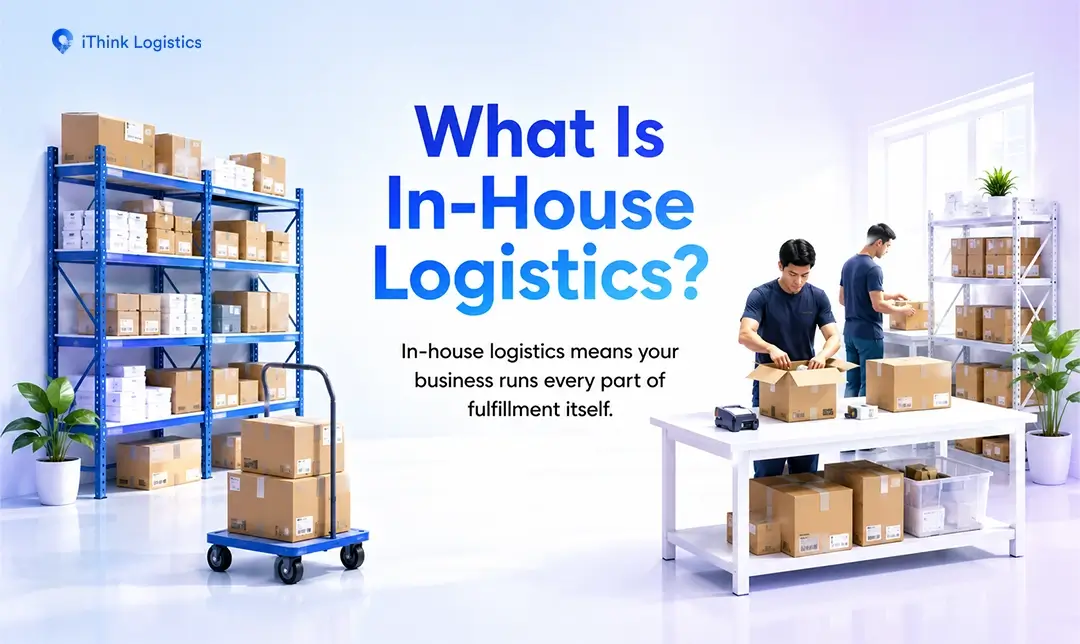
You choose the warehouse layout. You set your own quality checks. You pick the couriers.
That control has a price tag. Rent, racking, packing staff, and a warehouse management system all come out of your pocket. Busy season or not.
In-house tends to fit brands with fragile or made-to-order products. It also fits founders still packing orders themselves.
If that sounds like you, the next section shows what you trade away for that control.
What Is 3PL (Third-Party Logistics)?
A 3PL is a specialist provider that runs some or all of your fulfillment. It uses its own fulfillment network, warehouse infrastructure, staff, and technology to manage logistics on your behalf.
You plug into their network instead of building your own.
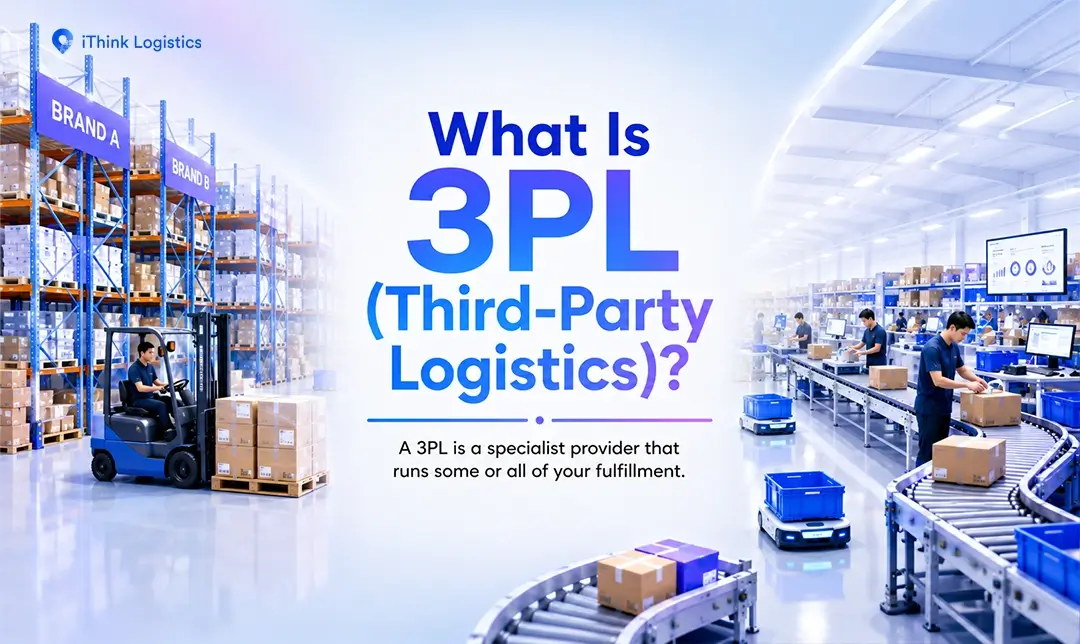
A solid 3PL brings courier tie-ups across cities and a ready WMS. Most Indian D2C brands underrate one thing here: built-in processes for COD collection and RTO handling.
You give up some day-to-day control. In exchange, you get speed and a lower entry cost. The table below puts both models side by side.
3PL vs In-House Logistics: The Real Comparison
| Factor | In-House | 3PL |
| Control | Full control over every step | Shared. You set SLAs, they execute |
| Setup cost | High upfront spend on space and racking | Low to no upfront cost |
| Scalability | Slow. Needs more space and staff | Fast. Scales with demand |
| Technology | You build and maintain your own WMS | Usually included in the service |
| Speed to new cities | Slower to launch | Faster. Plugs into an existing network |
| Risk | You carry all of it | Shared with the provider |
| COD and RTO handling | Manual reconciliation, in-house NDR follow-up | Built-in remittance cycles and RTO teams |
That last row rarely shows up in comparisons like this. For Indian D2C brands, it is often the one that decides the outcome.
COD reconciliation and RTO follow-up eat more hours than founders expect, until someone is doing it full time.
Cost is where that time shows up on paper. So let us break it down.
The Real Cost of 3PL vs In-House Logistics
Direct costs are the obvious ones. Warehouse rent, staff salaries, packaging, and WMS licenses. Easy to compare on a spreadsheet.
Indirect costs quietly eat margin instead. Hiring and training staff, insurance, downtime from patchy systems, and your own time managing all of it. These rarely make it into a founder’s first cost comparison.
Here is an illustrative example, not a fixed rate. Say you’re in-house setup costs Rs 1.8 lakh a month in rent, staff, and supplies. At 900 orders shipped, that works out to Rs 200 per order before courier charges.
Suppose a 3PL quotes a lower per-order fee than that. If their total cost comes in below your in-house number, outsourcing becomes cheaper.
That total should include storage, pick-and-pack, and overhead, not just the headline per-order rate. Actual 3PL pricing varies by SKU, weight, storage, and geography, so run this comparison with your own numbers.
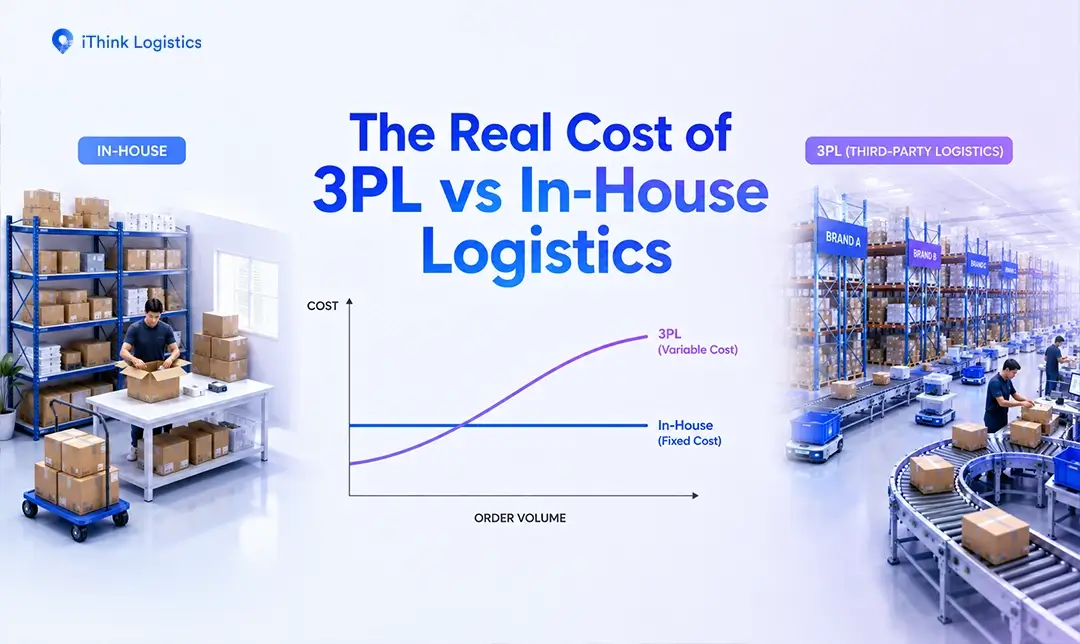
In-house is a fixed-cost model. You pay for space and staff whether volumes are low or high that month. A 3PL turns that into a variable cost instead.
You pay only for what you actually ship. The provider absorbs the swing between your slow months and your festive season spike.
Industry cost analyses generally place the break-even point somewhere between 500 and 1,000 monthly orders. Past that range, 3PL fulfillment fees usually benefit from bulk shipping rates that in-house shipping cannot match.
For Indian D2C brands, that threshold moves with your COD share and RTO rate. Most of these benchmarks come from US-focused cost data that does not account for either.
The Real Decision Criteria: Volume, COD, and RTO
This is the part most guides skip. There is no universal order count or COD percentage that triggers a switch.
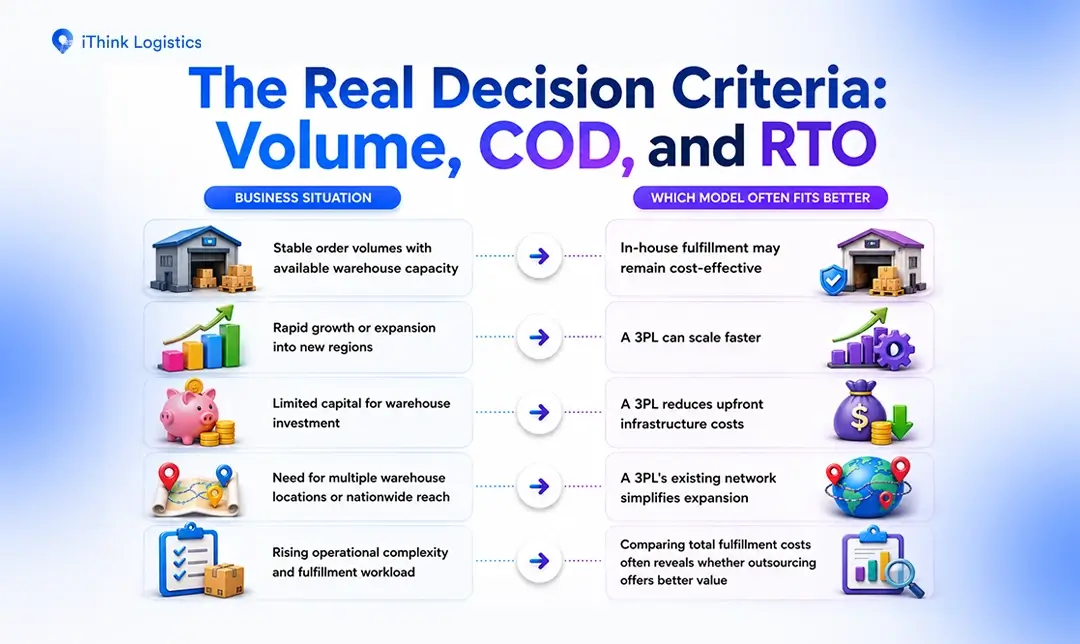
Your break-even point depends on labor costs, warehouse rent, SKU mix, and service requirements. Here is how to weigh it.
| Business situation | Which model often fits better |
| Stable order volumes with available warehouse capacity | In-house fulfillment may remain cost-effective |
| Rapid growth or expansion into new regions | A 3PL can scale faster |
| Limited capital for warehouse investment | A 3PL reduces upfront infrastructure costs |
| Need for multiple warehouse locations or nationwide reach | A 3PL’s existing network simplifies expansion |
| Rising operational complexity and fulfillment workload | Comparing total fulfillment costs often reveals whether outsourcing offers better value |
As COD becomes a larger share of your total orders, reconciliation, remittance tracking, and returns management demand more operational effort.
At that point, many brands evaluate whether a 3PL’s established processes reduce that workload.
No fixed percentage marks the switch. It comes down to how much staff time COD and RTO are already consuming.
RTO adds its own cost layer. Every returned order means a second shipping leg, plus manual NDR follow-up if you handle it in-house.
A 3PL with a dedicated reverse logistics team treats this as routine work. For your own warehouse staff, it is closer to a fire drill.
Two brands shipping the same monthly order count can face very different fulfillment costs.
COD share, return rate, inventory complexity, staffing, and warehouse expenses all shape whether staying in-house or outsourcing works out cheaper.
When In-House Logistics Still Makes Sense
Stay in-house if your order volume is steady and predictable. Also stay if your products need special handling, like fragile items or premium unboxing.
Low COD and RTO numbers help too, since reconciliation is not eating real time yet. If your team already knows fulfillment and growth has not outpaced them, there is no rush to switch.
When a 3PL Makes Sense for D2C Brands
Move to a 3PL once order volume is climbing fast. Also move once COD reconciliation is dragging on your cash flow, or RTO has turned returns into someone’s full-time job.
It is also the right call when entering new states. Building a warehouse to test demand there rarely makes sense.
The Hybrid Model: Keep One City In-House, Outsource the Rest
You do not have to pick one model for your entire business. Many growing D2C brands in India keep a small warehouse in their home city, say Mumbai or Bangalore.
That warehouse handles same-day fulfillment and their highest-touch SKUs. Everything shipping to Tier 2 and Tier 3 cities goes through a 3PL’s wider network instead.
This way, you keep control where it matters most: your local market and flagship products. You still get national reach, without ten separate warehouse leases.
It also lets you scale more easily during festive season spikes, using the 3PL’s existing warehouse network and capacity. Your own warehouse does not have to absorb that surge alone.
How to Choose the Right 3PL Partner
Once you decide a 3PL is the right move, check these six things before you sign anything.
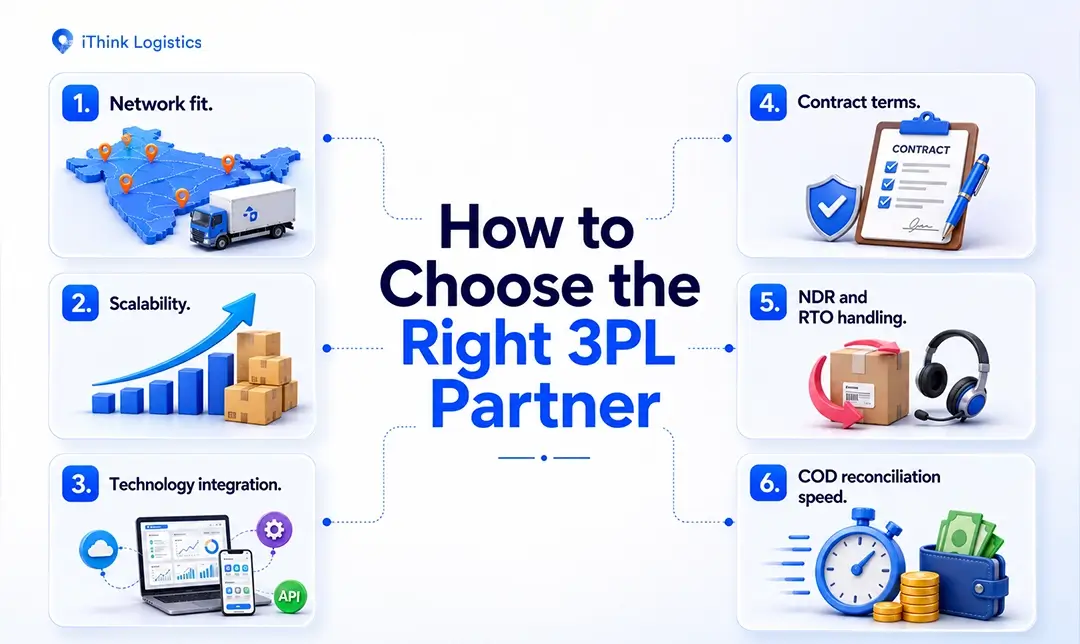
Network fit
Pin code coverage that actually matches where your customers order from, not just major metros.
Scalability
Confirm the provider scales with you, not just around your current volume, and ask what happens during a festive-season surge.
Technology integration
Check that their systems connect cleanly with your WMS, OMS, and ERP, so inventory data stays accurate on both sides.
Contract terms
Look for realistic SLAs and clear risk allocation. The agreement should leave room to improve over time, not lock you into a rigid one-size-fits-all contract.
NDR and RTO handling
Dedicated processes here, not a footnote mention. This is where most Indian D2C brands get burned by generic 3PLs.
COD reconciliation speed
Ask exactly how fast COD gets collected and paid out to you.
Do not choose on price alone. A cheaper rate card that skimps on RTO handling or COD speed often costs more. Count the operational time it demands from your team before you sign.
FAQs
What is the difference between 3PL and in-house logistics?
In-house logistics means your business runs its own warehousing, staff, and shipping. A 3PL is an outside provider that handles some or all of that, using its own infrastructure. You pay per order or per service.
How many monthly orders justify switching from in-house to a 3PL?
There is no universal order threshold. Many brands start evaluating a 3PL as volumes grow and fulfillment gets more complex. Expansion into new regions also often needs more warehouse capacity than in-house can build cost-effectively.
Does a high COD percentage change the decision?
Yes. As COD grows as a share of your orders, reconciliation and remittance tracking take more staff time. Many brands evaluate a 3PL specifically because its built-in COD process reduces that load.
How does RTO rate affect the cost comparison?
A higher RTO rate adds a second shipping leg to every returned order. It also adds manual NDR follow-up if handled in-house. 3PLs with dedicated reverse logistics teams generally handle this more cheaply.
Can a D2C brand run both models at once?
Yes. Many Indian D2C brands keep a small warehouse in their home city for flagship products. They use a 3PL’s network for other cities and seasonal spikes.
What should I check before choosing a 3PL in India?
Confirm their PIN code coverage matches your actual customer base. Ask how they handle COD reconciliation and RTO specifically, and check how well their system integrates with your store.
Conclusion
Working out whether your volume, COD share, and RTO rate justify a switch? iThink Logistics’ 3PL, NDR+, and Early COD tools are built around exactly these numbers for Indian D2C brands. Talk to our team to see where your business stands.