What is logistics management? It is the process of planning, moving, and storing goods so they reach the right customer in the right condition. For an Indian ecommerce brand shipping to Tier 1, 2, and 3 cities, this decides between a repeat customer and a refund.
What Is Logistics Management?
Logistics management is the part of supply chain management that plans, implements, and controls the efficient, effective forward and reverse flow and storage of goods, services, and related information between the point of origin and the point of consumption. Its purpose is to meet customer requirements.
In simple terms, logistics management makes sure a product gets from warehouse to doorstep without delay or damage. It does this while keeping cost and speed in balance. It covers everything in between: transportation, warehousing, inventory, packaging, and returns
For an ecommerce seller, this is not a back-office function tucked away from customers. It shows up directly in delivery speed, RTO rates, and the reviews a brand earns after every order.
Get it right, and shipping becomes a quiet advantage. Get it wrong, and no amount of marketing spend can undo a late or damaged delivery.
Logistics Management vs. Supply Chain Management

People often use these two terms as if they mean the same thing. They don’t.
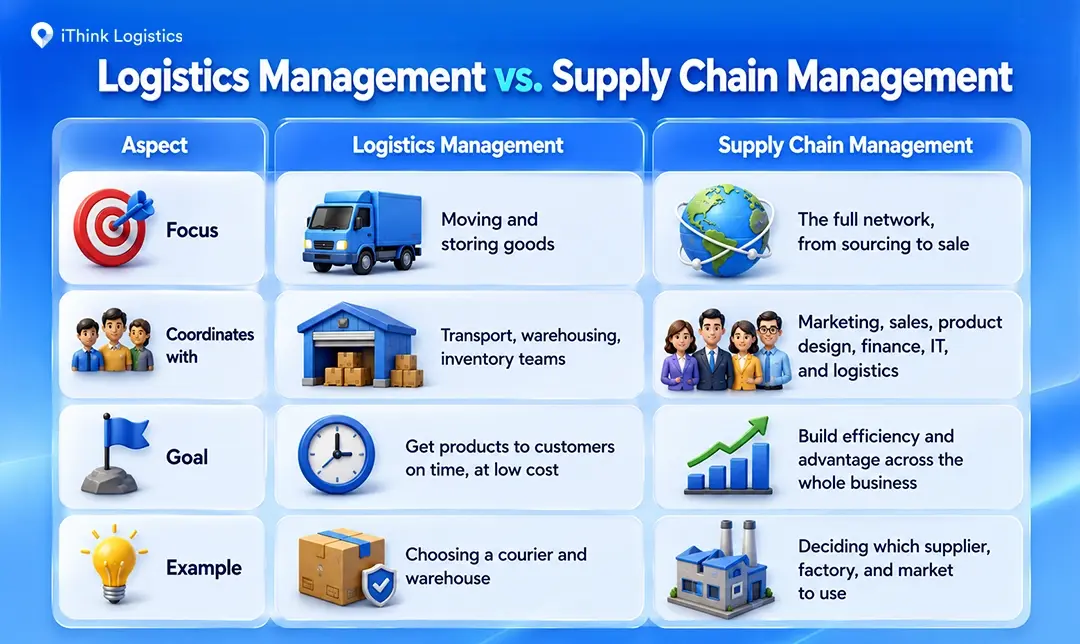
Supply chain management is the entire network: sourcing raw materials, manufacturing, supplier relationships, and final delivery. Logistics management is one part of that network, focused only on movement and storage.
| Aspect | Logistics Management | Supply Chain Management |
| Focus | Moving and storing goods | The full network, from sourcing to sale |
| Coordinates with | Transport, warehousing, inventory teams | Marketing, sales, product design, finance, IT, and logistics |
| Goal | Get products to customers on time, at low cost | Build efficiency and advantage across the whole business |
| Example | Choosing a courier and warehouse | Deciding which supplier, factory, and market to use |
Every logistics decision is a supply chain decision. Not every supply chain decision is a logistics one.
Think of it this way: supply chain management decides which factory and supplier you use. Logistics management decides how the finished product reaches the customer’s door. Once you separate the two, the next question is what logistics management promises to deliver in practice.
This distinction matters beyond definitions. When a seller hires for a “logistics manager” role, the job usually covers transport, warehousing, and delivery. It rarely includes vendor sourcing or product design.
Keeping the scope clear avoids confusion when building a team or briefing a new logistics partner.
The 7 Rs of Logistics Management
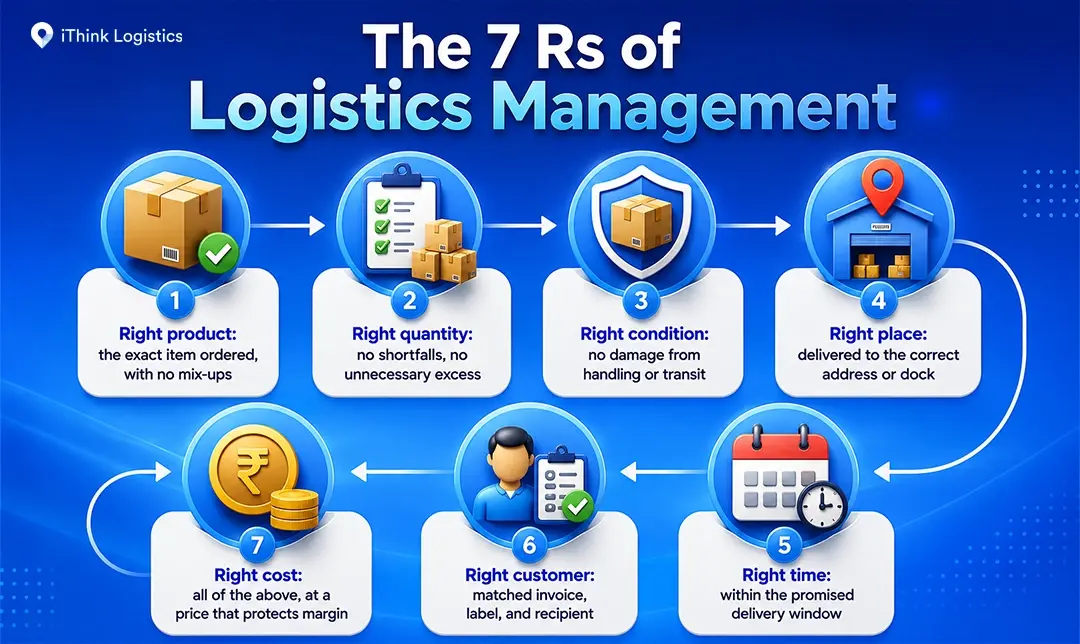
Logistics teams around the world measure success against a simple framework: the 7 Rs. It’s one of the most widely used mental models in the field, though its origin isn’t tied to one source.
- Right product: the exact item ordered, with no mix-ups
- Right quantity: no shortfalls, no unnecessary excess
- Right condition: no damage from handling or transit
- Right place: delivered to the correct address or dock
- Right time: within the promised delivery window
- Right customer: matched invoice, label, and recipient
- Right cost: all of the above, at a price that protects margin
Miss even one of these Rs, and the result is a return, a bad review, or a lost customer. A single wrong pincode entry, for instance, can turn a right product into a wrong delivery within seconds.
That is why the types of logistics management below exist: each one is built to protect a different R.
Types of Logistics Management
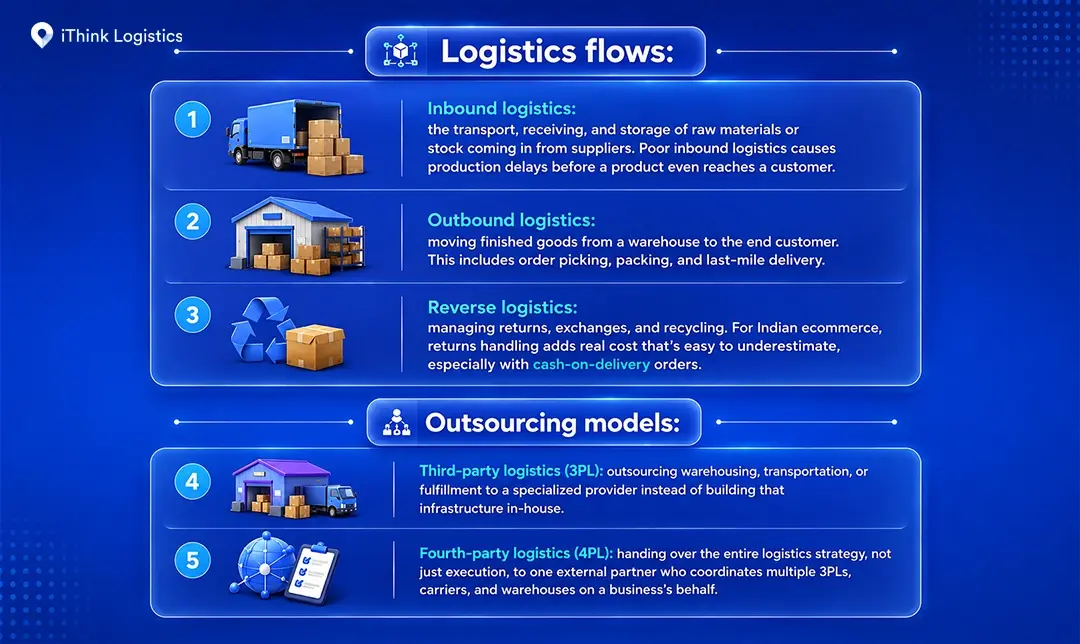
Logistics management is not one single activity. It splits into distinct flows, each covering a different stage of the goods movement cycle.
Logistics flows:
- Inbound logistics: the transport, receiving, and storage of raw materials or stock coming in from suppliers. Poor inbound logistics causes production delays before a product ever reaches a customer.
- Outbound logistics: moving finished goods from a warehouse to the end customer. This includes order picking, packing, and last-mile delivery.
- Reverse logistics: managing returns, exchanges, and recycling. For Indian ecommerce, returns handling adds real cost that’s easy to underestimate, especially with cash-on-delivery orders.
Beyond these flows, many businesses also choose an outsourcing model to run them:
Outsourcing models:
- Third-party logistics (3PL): outsourcing warehousing, transportation, or fulfillment to a specialized provider instead of building that infrastructure in-house.
- Fourth-party logistics (4PL): handing over the entire logistics strategy, not just execution, to one external partner who coordinates multiple 3PLs, carriers, and warehouses on a business’s behalf.
Most businesses run all three flows at once, often without naming them separately. A D2C brand receiving fabric, shipping orders, and processing returns runs inbound, outbound, and reverse logistics at once.
Whether that brand also uses a 3PL or 4PL is a separate decision. It’s about who executes the work, not which flow it belongs to. Knowing which flow is underperforming makes it much easier to fix the actual bottleneck instead of guessing.
Functions and Components of Logistics Management
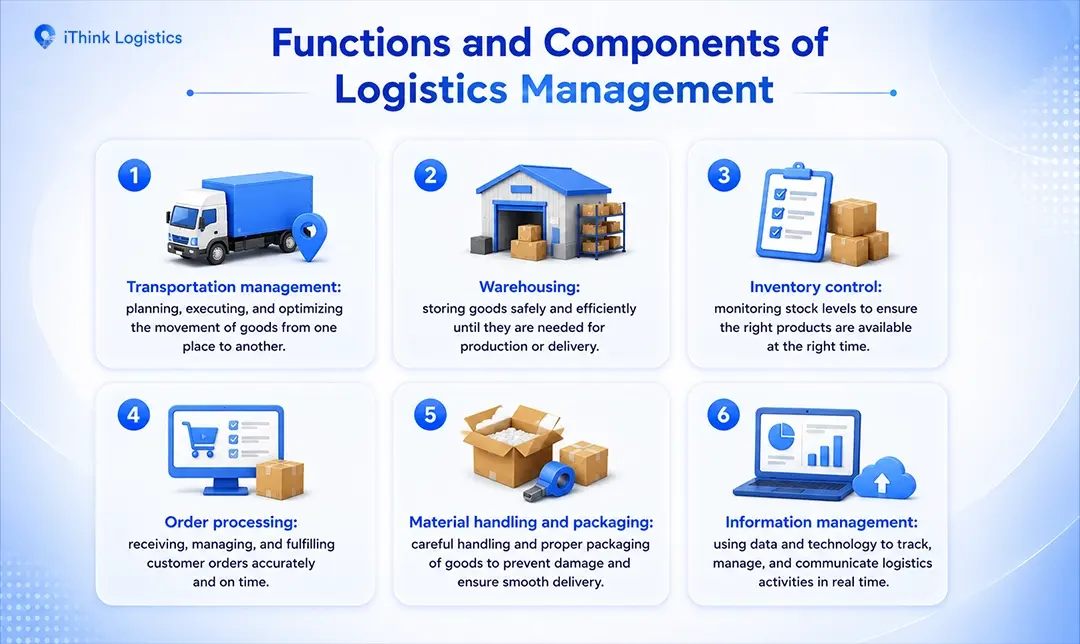
Types describe the different stages of movement. Functions describe the specific jobs that keep each stage running, and every logistics team needs all six working together.
- Transportation management: choosing the mode, carrier, and route that balances speed against cost. For many sellers, this is one of the largest cost lines in logistics.
- Warehousing: storing goods safely and organizing space for fast picking. Layout decisions here directly affect how quickly an order gets packed.
- Inventory control: keeping stock levels accurate enough to avoid both stockouts and overstocking. Real-time visibility across warehouses makes this far easier to manage.
- Order processing: receiving, verifying, and fulfilling customer orders without errors. A single wrong SKU at this stage cascades into a return later.
- Material handling and packaging: protecting goods from damage during storage and transit, while keeping packaging cost proportional to the product’s value.
- Information management: tracking shipments and sharing status data across the supply chain, so both the seller and the customer know exactly where an order stands.
These functions are closely linked. A warehouse with poor inventory control tends to create order errors downstream, even with a strong transport network. Weak information management hides the problem until a customer complains.
This is why logistics management needs one plan, not five separate departments working alone. When these functions sit on a single system, a delay in one area gets caught before it reaches the customer. It doesn’t just surface later as a bad review.
Logistics Management for an Indian D2C Brand: A Real Example
Picture a D2C skincare brand based in Mumbai, selling across India through its own website and a marketplace listing.
Sixty percent of its inventory sits in a Bhiwandi warehouse, close enough to serve Mumbai, Pune, and Nashik same-day. The rest moves by surface transport to a second hub in Delhi NCR, covering the north.
For express orders in metro cities, the brand uses air cargo. For everyday deliveries, it relies on two last-mile courier partners known for strong cash-on-delivery collections. COD remains a significant payment method in Indian ecommerce.
When a return arrives from a Tier 2 city, reverse logistics takes over: pickup, quality check, then restocking or disposal.
Behind this sits a single tracking system, so support can answer “where is my order” without calling three couriers. That kind of visibility is what turns scattered vendors into one coherent logistics operation.
Warehouse location, carrier mix, and returns handling are all logistics management decisions. None of it touches sourcing or manufacturing, and that’s exactly the line that separates logistics from the wider supply chain.
In-House Logistics vs. Outsourcing to a Partner
Once a brand sees how many moving parts logistics management involves, the next decision is who runs it.
Building logistics in-house means owning warehouses, negotiating directly with transporters, and hiring a dedicated team to track every shipment. It gives full control, but it also means carrying the infrastructure cost and the operational risk alone. Every new city added to the delivery map means another set of vendor relationships to manage.
Outsourcing to a logistics partner, often a 3PL or courier aggregator, shifts that weight elsewhere. A good partner already has carrier relationships, warehouse networks, and tracking technology in place. The seller doesn’t have to build any of it from scratch.
This is the gap a platform like iThink Logistics is built to close for Indian ecommerce sellers. Instead of managing multiple couriers separately, a seller gets one dashboard covering shipping, NDR handling, and branded tracking. That single view replaces what would otherwise be a spreadsheet stitched together from five different courier logins.
For a business shipping a small volume of orders, in-house logistics can work fine. As volume and delivery locations grow, an aggregator model can lower cost per shipment and reduce failed deliveries.
iThink’s own recommendation engine compares more than 200 parameters, including demographic performance and pincode, to suggest the best courier per shipment. A single in-house team rarely has the data to run comparisons at that scale.
Importance, Objectives, and Scope of Logistics Management
A few common objectives guide logistics management: efficient operations, easier communication, lower costs, a competitive edge, and tighter inventory control. These goals reinforce each other, so a weak link in one usually shows up as a cost spike somewhere.
The scope of logistics management stretches across the full order lifecycle. It starts the moment a supplier ships raw material. It ends only when a customer keeps the product or finishes a return.
A few principles guide how logistics management is actually run day to day:
- Plan ahead of demand spikes instead of reacting to them, especially around festive sale periods when order volumes can rise sharply
- Keep communication constant between warehouse, transport, and customer service teams, so a delay gets flagged before a customer has to ask
- Build a contingency plan for disruptions before they happen, whether that’s a monsoon-hit route or a courier strike
- Automate repetitive tracking and reporting wherever possible, freeing the team to handle exceptions instead of routine updates
- Review performance data regularly and adjust routes or carriers based on it, rather than sticking with a courier out of habit
Why does this matter enough to invest in? According to a 2025 DPIIT-NCAER assessment, India’s logistics cost stood at 7.97 percent of GDP for 2023-24. That’s a sharp recalibration from the 13 to 14 percent figures long cited before it.
A customer rarely sees your sourcing or manufacturing. They always see whether the order arrived on time and in one piece. That single impression shapes whether they order again.
FAQs
What is logistics management in simple words?
Logistics management is the process of planning and controlling how goods move from origin to customer, covering transportation, storage, and order fulfillment along the way.
What is the main goal of logistics management?
The main goal is to deliver the right product, in the right quantity and condition, to the right customer, at the right time and cost.
What is the difference between logistics and supply chain management?
Logistics management handles the movement and storage of goods. Supply chain management is the broader network that also includes sourcing, manufacturing, and supplier relationships.
What are the main types of logistics management?
The main logistics flows are inbound, outbound, and reverse logistics. Businesses also choose outsourcing models such as third-party logistics (3PL) and fourth-party logistics (4PL) to run these flows.
What are the core functions of logistics management?
The core functions are transportation, warehousing, inventory control, order processing, material handling, packaging, and information management.
Why is logistics management important for ecommerce businesses?
It directly affects delivery speed, RTO rates, and customer satisfaction, making it one of the most visible parts of the entire buying experience.
Should a growing ecommerce brand handle logistics in-house or outsource it?
Smaller order volumes can often be managed in-house. As volume and delivery locations grow, many sellers find that outsourcing to a 3PL or courier aggregator helps lower cost per shipment.
What is reverse logistics and why does it matter in India?
Reverse logistics covers returns, exchanges, and recycling. It matters more in India because cash-on-delivery orders carry a higher return rate than prepaid orders.
What are the 7 Rs of logistics management?
The 7 Rs are right product, right quantity, right condition, right place, right time, right customer, and right cost.
How does logistics management affect the cost of a product?
Logistics affects cost through transportation, warehousing, fulfillment, and returns. At the national level, a 2025 DPIIT-NCAER assessment put India’s logistics cost at 7.97 percent of GDP for 2023-24.
What is the scope of logistics management?
The scope covers the entire order lifecycle, starting when a supplier ships raw material and ending only when a customer keeps the product or completes a return.
Does a small ecommerce brand need a 3PL or courier aggregator right away?
Not necessarily. A brand shipping a small number of orders a month can often manage logistics directly, and only needs a partner once order volume or delivery locations grow.