


Introduction
When an order shows “NDR” on your courier dashboard, it usually comes without context. Just a failed delivery update and an order that didn’t reach the customer. At that moment, most sellers think the same thing: will this still get delivered, or is it going to come back as RTO with extra cost?
In logistics, NDR (Non-Delivery Report) is raised when a delivery attempt fails due to reasons like an incorrect address, the customer not being available, or refusal at the doorstep. It simply means the delivery didn’t go through and needs action.
For most eCommerce businesses, this is where things get tricky. Once the shipment is handed over to a courier partner, visibility becomes limited. And if the issue is not handled quickly, that NDR often turns into a return.
Most NDR cases are recoverable but only if the right action is taken within the first attempt window
What Is NDR? Full Form and Meaning in Logistics
NDR (Non-Delivery Report) is a status used in logistics when a courier is unable to deliver a shipment after a delivery attempt. It notifies the seller about a failed delivery and the reason behind it.
NDR does not mean the order is cancelled. It means the delivery has failed for now and can still be recovered if the issue is resolved in time.
Why NDR Happens in eCommerce Deliveries
NDR is usually the result of a failed delivery attempt, but the reason behind that failure can vary from order to order. Knowing these reasons matters because it helps you decide whether the order can still be recovered or is likely to return.
These reasons can also vary based on order type, location, and courier partner performance.
Some of the most common reasons include:
Call did not receive to drop shipment:
Delivery rescheduled by customer: The customer requests a later delivery date, which delays the process and increases the chances of multiple failed attempts.
Incorrect or Changed Address: Missing house numbers, wrong PIN codes, or unclear landmarks make it difficult for the delivery agent to locate the customer.
Customer not available: The delivery attempt is made, but no one is present to receive the order at that time.
COD Payment unavailable: The customer doesn’t have COD payment available during delivery time, so it gets marked for reattempt later as customer payment availability.
Phone number unreachable: If the delivery agent cannot contact the customer because the phone is ringing, it is not picked up, or the phone number has changed or is unreachable, then it is marked as NDR.
Order refused at delivery: More common in COD orders where customers change their mind at the doorstep. This is one of the highest-cost NDR reasons since the shipment has already completed its forward journey.
Fake delivery attempt: In some cases, a delivery agent marks the order as undelivered without actually visiting the address. This is more common in Tier 2 and Tier 3 cities and is one of the harder NDR causes to detect without courier-level tracking.
Damages/Lost Product: When products get damaged during shipping or get lost, it is marked as NDR.
Operational or service issues: Routing problems, hub delays, natural disasters, closed premises, temporary inaccessible areas, or misrouted shipments from the courier side can also trigger an NDR with no fault on the customer’s end.
In most cases, these issues are not final. The order is still in transit, and the delivery depends on how quickly the right action is taken, and most courier partners allow only 12 to 36 hours before a pending NDR moves toward RTO.
How NDR Leads to RTO and What It Costs

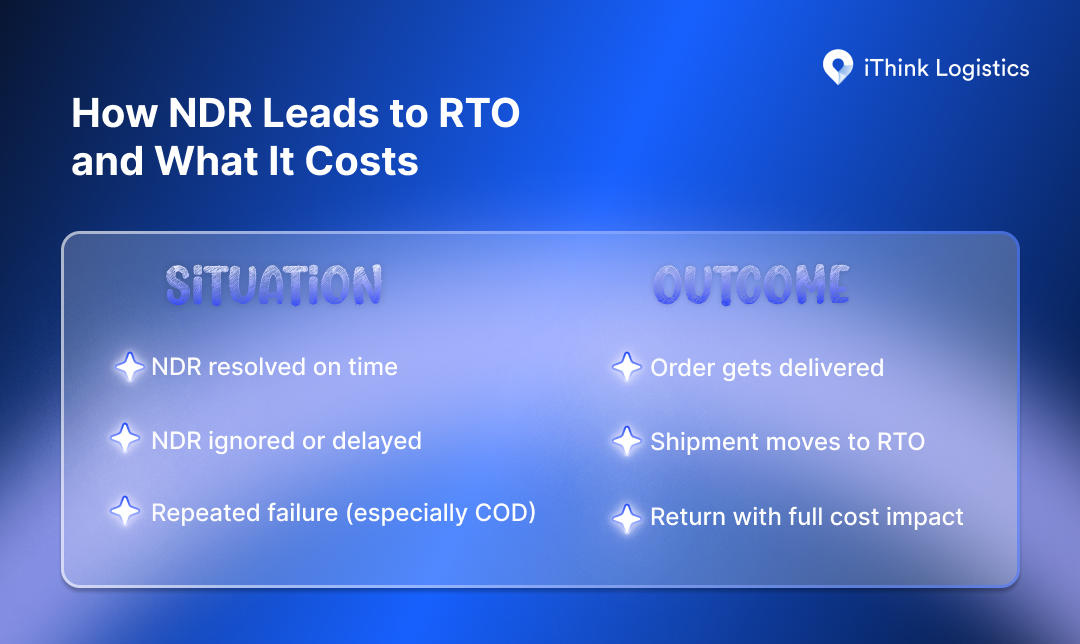
An NDR does not immediately mean the order will be returned. In most cases, courier partners attempt delivery again after the first failure. However, if the issue behind the NDR is not resolved, repeated failed attempts eventually lead to the shipment being marked as RTO (Return to Origin).
The flow is simple. A delivery attempt fails, an NDR is raised, and the courier may try again. If the same issue continues, the shipment is sent back to the seller.
This is where the real impact begins.
Every return to origin means you are paying for both forward and reverse logistics without completing the delivery. Along with that, there is a loss of revenue, possible product damage, and a negative customer experience.
In practical terms:
| Situation | Outcome |
| NDR resolved on time | Order gets delivered |
| NDR ignored or delayed | Shipment moves to RTO |
| Repeated failure (especially COD) | Return with full cost impact |
For most sellers, this is not just an operational issue. It directly affects margins, especially at scale, where even a small percentage of failed deliveries can lead to significant losses.
At this point, the focus shifts from understanding NDR to controlling it before it turns into a return.
Cost Impact of NDR on Sellers
When an NDR turns into an RTO, the impact goes beyond operations. It directly affects your cost and margins on every order.
Here’s what sellers typically face:
Forward shipping loss: You pay for shipping the order to the customer, even if it is not delivered.
Reverse shipping cost: Once marked as RTO, you also bear the cost of bringing the shipment back.
Product damage risk: Multiple handling and transit increase the chances of damage, especially for fragile or high-value items.
Lost revenue: The sale does not go through, and in many cases, the same customer may not reorder.
For high-volume sellers, even a small percentage of NDRs turning into RTO can significantly reduce overall profitability.
In a COD-heavy business, this adds up fast industry data suggests over 25% of COD orders across eCommerce end up as RTO, meaning close to half your cash-on-delivery shipments may never convert into revenue.
At this point, the focus shifts from understanding the impact to actively reducing NDR before it leads to these losses.
How iThink Logistics Helps Manage NDR
Once NDR starts impacting delivery and costs, the focus shifts to how quickly and efficiently these cases are handled. This is where having the right system in place makes a difference.
This becomes especially useful for sellers handling high order volumes across multiple regions.
Typically, NDR teams proactively resolves delivery issues by identifying failed attempts, coordinating with customers, and ensuring successful order fulfillment.
But with iThink Logistics, logistics management is not handled courier by courier. It is managed from a single dashboard across multiple delivery partners.
Multi-courier dashboard: View and manage all NDR orders in one place instead of logging into different courier panels.
Real-time alerts: Get notified as soon as an NDR is raised, so action can be taken without delay.
Automated reattempts: Trigger delivery reattempts based on predefined rules, reducing manual follow-ups.
Address intelligence: Identify incomplete or risky addresses early to avoid delivery failures.
Courier-level visibility: Track which courier partners have higher NDR rates across specific pin codes or order types.
This last point becomes important at scale. When you can compare performance across couriers, you can make better decisions on which partner to use for different regions.
Instead of reacting after a delivery fails, the focus shifts to preventing repeat failures and improving overall delivery success.
How to Reduce NDR in eCommerce Deliveries
Reducing NDR is less about reacting after a failed delivery and more about preventing issues before they happen. Most delivery failures follow patterns, and once you identify them, they can be controlled with the right steps.
Here are some practical ways to reduce NDR:
Address validation at checkout
Ensure customers enter complete and accurate address details, including house number, landmark, and correct pin code. Even small gaps here often lead to failed deliveries.
COD confirmation before dispatch
For cash-on-delivery orders, a quick confirmation call or message helps reduce last-minute refusals.
Clear customer communication
Sending order updates through SMS or WhatsApp keeps the customer informed about delivery timelines and reduces missed deliveries.
OTP-based delivery for high-risk orders
Adding an OTP verification step at the time of delivery helps reduce fake attempts and ensures the order is handed over to the right person.
Courier selection based on pin code performance
Not all couriers perform the same across regions. Choosing the right courier for specific pin codes can significantly reduce delivery failures.
These steps do not eliminate NDR completely, but they help reduce its frequency and improve delivery success rates over time.
In addition to these steps, having visibility into NDR cases in real time helps take faster action when issues do occur.
At this stage, it also becomes important to address some common questions sellers have around NDR and how it works in real scenarios.
Conclusion
NDR is not the end of a delivery. It is an early signal that something needs attention.
For most sellers, the difference between a successful delivery and a return comes down to how quickly the issue is handled. Acting early on NDR cases can help recover orders, reduce returns, and protect margins.
With the right visibility and control across courier partners, managing NDR becomes more predictable and less reactive. Instead of dealing with repeated returns, the focus shifts to improving delivery success over time.
If you want better control over how NDR is handled across your shipments, having a centralized system that gives you real-time insights and control can make a measurable difference.
FAQs
Q.1: What is the full form of NDR in logistics?
A: NDR stands for Non-Delivery Report. In logistics and eCommerce, it is a status generated by a courier partner when a delivery attempt fails. The NDR notifies the seller about the failure and the reason behind it — such as an incorrect address, customer unavailability, or refusal at the doorstep — so that the right action can be taken before the shipment is returned.
Q.2: What is the difference between NDR and RTO?
A: NDR (Non-Delivery Report) is raised when a delivery attempt fails. At this stage, the shipment is still in transit and can be recovered. RTO (Return to Origin) happens when all delivery attempts are exhausted without a resolution — the shipment is then sent back to the seller. Think of NDR as the warning and RTO as the outcome. Every RTO starts as an NDR, but not every NDR has to become an RTO.
Q.3: How many delivery attempts are made before an order becomes RTO?
A: Most courier partners make up to three delivery attempts before marking a shipment as RTO. However, the number can vary by courier and order type. More importantly, sellers typically have a window of 12 to 36 hours after each NDR is raised to take action — provide updated address details, confirm customer availability, or request a reattempt. If no action is taken within this window, the shipment moves closer to RTO with each failed attempt.
Q.4: What should a seller do immediately after an NDR is raised?
A: The first step is to identify the reason behind the failed delivery — whether it is an address issue, the customer being unreachable, or a refusal. Once the reason is clear, the seller should contact the customer directly to collect correct details or confirm availability, and then pass that information to the courier partner before the next attempt.
Acting within the first 12 to 24 hours gives the best chance of a successful reattempt. Sellers managing high volumes should have a centralised system that flags NDRs in real time so no case is missed or delayed.

