Introduction
India’s e-commerce market has hit $159.25 billion by 2026. With 300 million active shoppers and the rise of 10-minute quick commerce, the opportunity has never been larger.
But here is the hard truth: Over 30% of new e-commerce sellers in India fail within 1st year.
Not because they had bad products. Not because the market was too competitive. But because they followed the “influencer blueprint,” focusing only on aesthetics and ads while ignoring the operational “silent killers”:
- The RTO Trap: 35 out of 100 orders come back, and you paid shipping both ways.
- Commission Burn: After marketplace fees, shipping, and packaging, that ₹500 product nets you ₹40.
- Compliance Lag: The first bulk order is ready, but the GSTIN is still processing. Three weeks lost before a single sale.
This isn’t just a “how-to” blog. It is an operational roadmap showing how to start an ecommerce business in India step by step, so you can build a business that doesn’t just look good on Instagram but actually delivers at scale and with profit.
What You’ll Learn in This Guide:
- How to pick the right business idea, structure, and model before spending a single rupee
- Every registration you actually need, and which ones can wait
- How to source products, set up your store, and get payments running.
- Which marketplaces suit which products, and how to choose without wasting commission
- How to ship smarter, reduce RTO, and protect your margins from day one
- What it realistically costs to start and where to find funding if you need it
1. What are the Best eCommerce Business Ideas in India for 2026?
Every online store begins with one fundamental question: what are you going to sell? Before thinking about registration, structure, or platforms, you need a business idea that aligns with your investment capacity, logistics realities, and market demand.
While there are hundreds of niches to explore, the most profitable eCommerce business ideas in 2026 are driven by three trends: sustainability, personalization, and convenience.
Before picking a product or category, run it through these four filters:
Market demand: Is there consistent search volume or purchase behavior for this product?
Profit margin: After shipping, platform fees, and returns, is there enough left?
Shipping profile: Lightweight, non-fragile products have lower RTO risk and lower logistics costs
Competition: Can you differentiate, or are you entering a race to the bottom on price?
Low Investment Ideas Worth Considering
- Dropshipping: Low capital entry, no inventory required. Best suited for validated niches with reliable suppliers. Like, DSers, AliExpress, SaleHoo, and many more.
- Handmade and Artisan Products: Jewelry, pottery, textiles, high differentiation, and strong demand on platforms like Etsy and ONDC.
- Subscription Boxes: Curated niche products (healthy snacks, beauty samples, books) with recurring revenue potential.
Home-Based Ideas with eCommerce Potential
- Pet Supplies and Grooming Products: India’s pet care market is growing rapidly among millennial and Gen Z owners.
- Tiffin and Healthy Food Services: High demand in urban areas, scalable through platforms like Swiggy and direct D2C ordering.
- Personalized Beauty and Skincare: Private-label D2C brands in clean beauty are among the fastest-growing categories in 2026.
Trending Categories in 2026
Some product categories are growing faster than others in India’s eCommerce market. If you’re looking for high-demand niches, consider:
- Eco-friendly and sustainable products
- Health and wellness supplements
- Personalized beauty and skincare
- Smart home accessories
- Baby and maternity essentials
These categories benefit from growing demand in Tier-2 and Tier-3 cities, increasing digital payment adoption, and strong repeat-purchase behavior.
Once you know what you want to sell, the next step is choosing the right legal structure for your business because the structure you pick today will affect your taxes, liability, and ability to raise funding tomorrow.
2. What are the Different Types of Business Ownership in India?
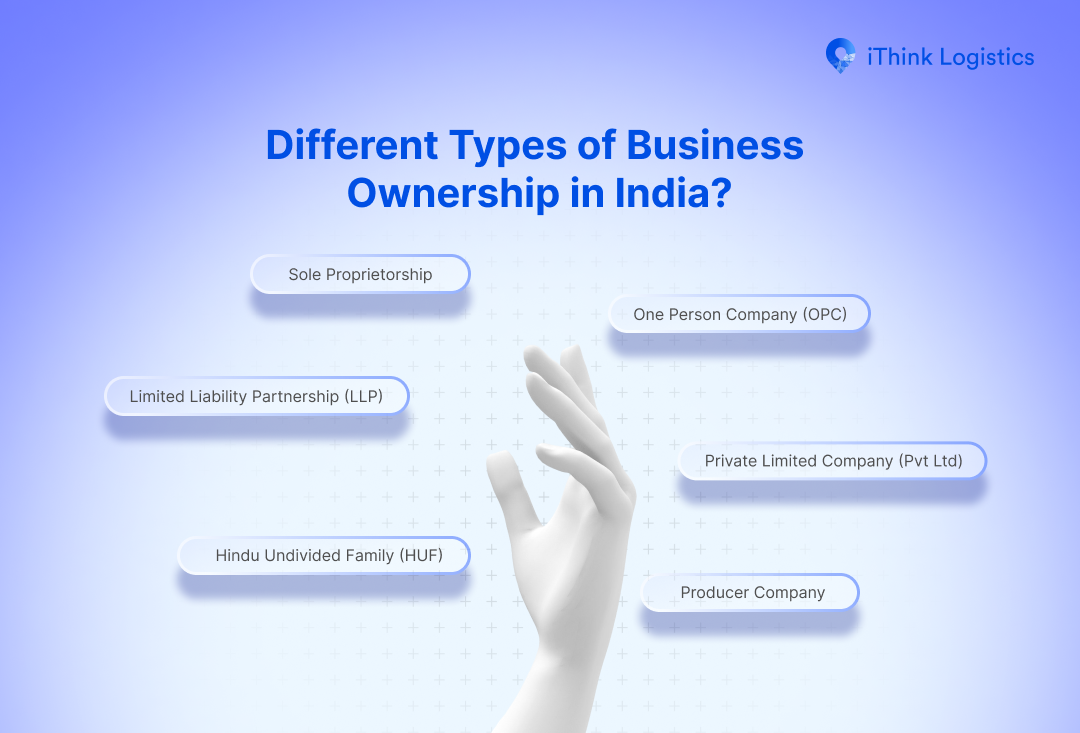
Choosing the wrong structure is one of the most common compliance mistakes new sellers make. Here are the ten types available in India, and which ones actually suit an ecommerce business.
Here are the 10 types of business ownership in India:
Sole Proprietorship: Easiest to start, zero separation between you and the business. If it defaults, your personal assets are at risk. Best for marketplace sellers testing the waters.
OPC (One Person Company): Solo founder with liability protection. Your personal assets stay safe even if the business fails.
LLP: Two co-founders, personal assets protected from business debts. Common starting point for D2C brands.
Pvt Ltd: Best if you plan to raise funding or scale. Comes with higher compliance costs, so factor that in from day one.
HUF (Hindu Undivided Family): Family-run structure with tax benefits. Relevant for businesses selling traditional, artisan, or regional products online.
Producer Company: Built for farmers, artisans, and craft producers operating collectively. Relevant for agricultural D2C brands and handmade goods sellers on platforms like ONDC or Etsy.
Partnerships, Public Limited Companies, Joint Ventures, and Section 8 Companies exist but are not practical starting points for ecommerce businesses.
Regardless of which structure you choose, GST registration is mandatory for Amazon, Flipkart, and Meesho; all require it before onboarding. More on this in the registration section below.
Your choice of business ownership in India comes down to three factors: whether you’re starting alone or with a partner, whether you need personal liability protection, and whether you plan to raise external funding.
3. How to Choose Your eCommerce Business Model
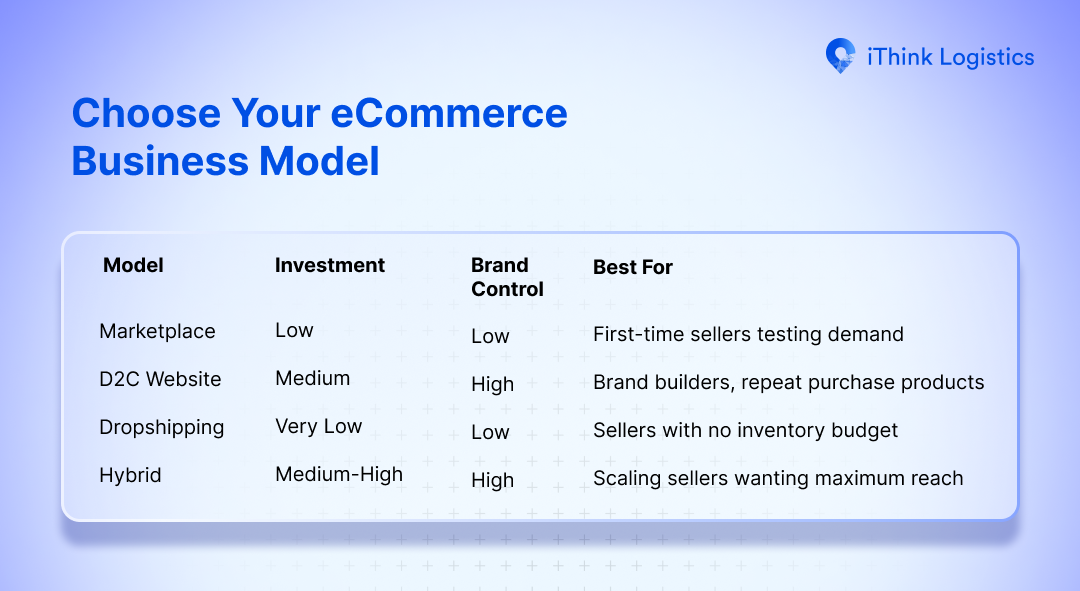
The business model you choose determines your startup costs, daily operations, profit margins, and the level of control you have over your brand. Getting this decision right before registration saves you from having to restructure later.
There are four primary ecommerce models to consider:
Marketplace Seller: List your products on Amazon, Flipkart, or Meesho and sell to their existing customer base. Lowest barrier to entry, but you pay 15–30% commission per sale and have limited control over branding and customer relationships.
D2C Website: Build your own store on Shopify, WordPress, or WooCommerce and sell directly to customers. Higher startup cost but full brand control, better margins, and direct access to customer data.
Dropshipping: Sell products without holding inventory. Your supplier ships directly to the customer. Very low capital requirement, but lower margins and heavy dependence on supplier reliability.
Hybrid: Combine your own website with marketplace listings for maximum reach. Best for sellers who have validated their product and are ready to scale.
Quick Comparison
| Model | Investment | Brand Control | Best For |
| Marketplace | Low | Low | First-time sellers testing demand |
| D2C Website | Medium | High | Brand builders, repeat purchase products |
| Dropshipping | Very Low | Low | Sellers with no inventory budget |
| Hybrid | Medium-High | High | Scaling sellers wanting maximum reach |
How to Pick Based on Your Situation
- Starting with a capital of under ₹50,000: Go to the marketplace or dropshipping first. Spend on ads and learning, not on inventory you are not sure will sell.
- Building a brand with repeat customers: Own website or hybrid. Every order on a marketplace is the platform’s customer, not yours. Your own store fixes that.
- Selling niche, artisan, or regional products: D2C website combined with ONDC. You get direct customer relationships without paying 25 to 30% commission on every sale.
Why ONDC is Becoming Important for New Sellers
ONDC (Open Network for Digital Commerce) is a government-backed open network that connects sellers to buyers across multiple apps, including Paytm, PhonePe, and Magicpin, without paying the 15–30% commission that traditional marketplaces charge.
According to ONDC website, it currently lives across 616+ cities with over 7.64+ lakh sellers onboarded, ONDC is particularly valuable for small sellers, artisan brands, and regional product businesses looking to reduce marketplace dependency from day one.
Once you have decided how you want to sell, the next step is to make it legally operational: register your business so you can open a bank account, list on platforms, and collect payments.
4. How to Register an Online Business in India
Here are the key registrations every ecommerce business in India needs, along with which ones apply only to specific business types.
Registrations Required Before You Start Selling
1. MCA Portal Business Incorporation: Register your business on the Ministry of Corporate Affairs (MCA) portal. This is where your business name gets approved, and your Certificate of Incorporation is issued.
Use the SPICe+ (Simplified Proforma for Incorporating a Company Electronically) form during incorporation to get PAN, TAN and GST together.
Home → Login → MCA Services → Company Services → SPICe+
For a detailed walkthrough of the registration process, read our complete guide on how to register an online business in India, which will answer all queries in the process.
2. GST Registration: GST is non-negotiable; Amazon, Flipkart, and Meesho won’t onboard you without a GSTIN, regardless of your turnover. It also lets you claim Input Tax Credit on shipping, warehousing, and marketing expenses, directly reducing your operating costs.
3. PAN and TAN: PAN is your business tax identity for all financial transactions. TAN is needed only if your business deducts tax at source on salaries or vendor payments. If you used SPICe+ during incorporation, both are issued automatically.
Do Early for Business Benefits
4. MSME / Udyam Registration: Free, instant, and 100% online via the Udyam portal. You need Aadhaar, PAN, Bank Details, and GSTIN to complete it.
Under Section 43B(h) of the Income Tax Act, B2B buyers must pay MSME-registered sellers within 45 days or lose their own tax deductions, a critical cash flow protection for growing sellers.
Only If Applicable to Your Business
5. IEC (Import Export Code): Mandatory if you import products or sell internationally. IEC is a 10-digit code issued by the DGFT and required for all cross-border shipments.
6. FSSAI and Industry Licenses: These are mandatory for food, health supplements, and packaged goods. Check your product category for specific certifications before listing on any marketplace.
7. Shop and Establishment Act: Mandatory in most states for businesses operating from a physical office or warehouse. Most banks also require this certificate to open a Business Current Account.
| Registration | Authority | Timeline | Govt Fee |
| Business Incorporation | MCA SPICe+ | 7–10 days | Varies |
| GST Registration | GSTN Portal | 5–7 days | Free |
| MSME / Udyam | Udyam Portal | Instant – 5 days | Free |
| IEC Code | DGFT | 2–3 days | ₹500 |
Operational Note: Open a dedicated business current account as soon as you receive your Certificate of Incorporation and GSTIN. This keeps your personal and business finances separate from day one.
5. How to Source Products and Manage Inventory
Once you know your business model, the next practical question is where your products come from and how you manage stock without tying up all your capital.
Three Sourcing Models: Pick Based on Your Business
Manufacture directly: You work with a factory to produce products under your brand. Highest upfront investment and MOQ commitment, but best margins and full brand control. Suited for private label D2C brands with validated demand.
Buy from wholesalers: Purchase existing products in bulk from distributors and resell. Lower investment than manufacturing, faster to start, but lower differentiation. Works well for marketplace sellers in categories like electronics accessories, home goods, and fashion basics.
Dropshipping suppliers: No inventory held. Supplier ships directly to your customer. Lowest capital requirement, but you lose control over packaging, delivery timelines, and return handling, all of which affect your seller ratings on marketplaces.
How to Find Reliable Suppliers in India
- IndiaMart and TradeIndia for domestic manufacturers and wholesalers
- Alibaba for international sourcing, if you have an IEC code
- Trade fairs like the India International Trade Fair or regional textile and handicraft expos for artisan and niche products
- Always request samples before committing to an order.
- Check the supplier’s GST registration and past buyer reviews before finalizing.
- Start with small trial orders before scaling volume.
Inventory Planning: Start Lean, Scale Later
The most common inventory mistake new ecommerce sellers make is overstocking based on optimism rather than data. Start with the minimum viable stock quantity, enough to fulfill your first 30 days of projected orders, and reorder based on actual sales quantity.
Key principles for new sellers:
- Set a reorder point: the stock level at which you trigger a new order, before you run out.
- Track sell-through rate: how quickly each product sells relative to what you stocked
- Clear dead stock early: use promotions or bundling before storage costs compound.
Product Selection Tips That Reduce Operational Risk
Once you’ve validated your product idea, apply these four criteria to assess how it will perform operationally:
- Lightweight and compact: lower shipping cost per unit, lower RTO (return to origin) means lower financial impact.
- Non-fragile: fewer damaged-in-transit complaints and return claims
- High repeat purchase rate: subscription boxes, consumables, and refillables drive better customer lifetime value
- Low seasonal dependency: products that sell year-round are easier to plan inventory for than festival-only items
Once you know what you are selling and where it comes from, the next step is setting up the store or platform where customers will actually buy it.
6. How to Set Up Your eCommerce Store
Your store is where everything you have built so far, your product, your brand, your pricing, meets your customer. Getting the setup right from day one prevents costly platform migrations later.
First Decision: Own Website or Marketplace?
Before building anything, confirm you actually need your own website at this stage.
| Situation | Right Choice |
| Testing a new product with no audience | Start on a marketplace |
| Building a brand with repeat customers | Own website from day one |
| Selling artisan or niche products | Own website + ONDC |
| Scaling after marketplace validation | Hybrid — both |
If you are building a D2C brand or plan to own your customer relationship long term, an independent website is non-negotiable. Marketplace algorithms control your visibility. Your own store does not.
Choosing Your Website Platform
Shopify: Best for beginners and D2C brands. Built-in Indian payment gateway integrations (Razorpay, PayU, CCAvenue), COD setup, and mobile-optimized themes out of the box. Starts at approximately ₹1,994 per month. No technical knowledge required.
WooCommerce: Best for sellers who want full control and lower long-term costs. Runs on WordPress, requires hosting setup, but is highly customizable. Suited for sellers with some technical comfort or a developer on hand.
Wix: Best for very early-stage sellers who want to launch quickly with minimal setup. Good for testing, but less scalable than Shopify and WooCommerce (WordPress).
Other platforms worth knowing:
Magento suits large catalogues with complex customization needs, Squarespace works well for design-led brands like jewelry or home decor, and BigCommerce is a strong Shopify alternative for sellers who want more built-in features without relying on paid apps.
If you are selling primarily through WhatsApp or Instagram, Dukaan and Instamojo offer quick store setup with built-in payment and delivery options built specifically for the Indian market.
Non-Negotiables Before You Go Live
Regardless of which platform you choose, these four elements must be in place before your first sale:
Product pages: High-quality images from multiple angles, clear pricing, size/variant options, and a benefit-led description. Your product page is your salesperson.
Checkout optimization: Enable multiple payment options from day one, including UPI, COD, debit/credit cards, and BNPL. Better have an optimized track order page with it!
Mobile optimization: Over 70% of ecommerce traffic in India comes from mobile devices. Test every page on a phone before launching. If it is slow or hard to navigate on mobile, fix it first.
Basic trust signals: Return policy page, contact information, and SSL certificate (https) are the minimum required for a customer to feel safe buying from an unknown brand.
Operational Note: Before launching, place 2–3 test orders yourself. Check the full customer journey, product discovery, add to cart, checkout, payment confirmation, and order confirmation email. Fix what breaks before your real customers find it.
With your store set up and ready to receive orders, the next critical decision is how customers will pay you and how you ensure every payment method Indians actually use is available at checkout.
7. Payment Features Every eCommerce Business Needs
Your payment setup starts with choosing the right gateway and enabling the methods your customers prefer.
Payment Gateways: Your Core Infrastructure
A payment gateway processes every transaction in your store. The three most used options for Indian ecommerce businesses are Razorpay (best for D2C brands, supports UPI, EMI, and COD verification), PayU (strong marketplace and enterprise adoption), and CCAvenue (broad bank compatibility, multi-currency support).
All three integrate directly with Shopify, WooCommerce, and major Indian marketplaces.
Payment Methods You Must Offer
- UPI: Largest payment method in India, over 27.1 billion transactions in Jan 2026 alone
- COD: 40–60% of Tier-2 and Tier-3 orders are still cash on delivery, especially for first-time purchases where customers are hesitant to pay online.
- EMI and BNPL: Increase average order value. For D2C stores, integrating third-party options like LazyPay and Simpl alongside bank card EMIs covers the widest buyer base. Platforms like Amazon and Flipkart offer built-in pay-later options for marketplace sellers.
- Debit/Credit Cards: Standard for urban and premium buyers
- International Payments: Stripe or PayPal for cross-border D2C sales
Despite the rise of UPI, COD remains non-negotiable for new brands with no established trust. Removing it to avoid return risk will cost more in lost sales than the returns themselves would cost.
Tracking Payments
Every platform has its own dashboard. Amazon, Flipkart, and Meesho show full settlement reports in your seller account. Shopify and WooCommerce give real-time visibility through your payment gateway dashboard.
With payments in place, the next decision is which marketplaces and platforms you will actually sell on.
8. Which Marketplaces Should You Sell On?
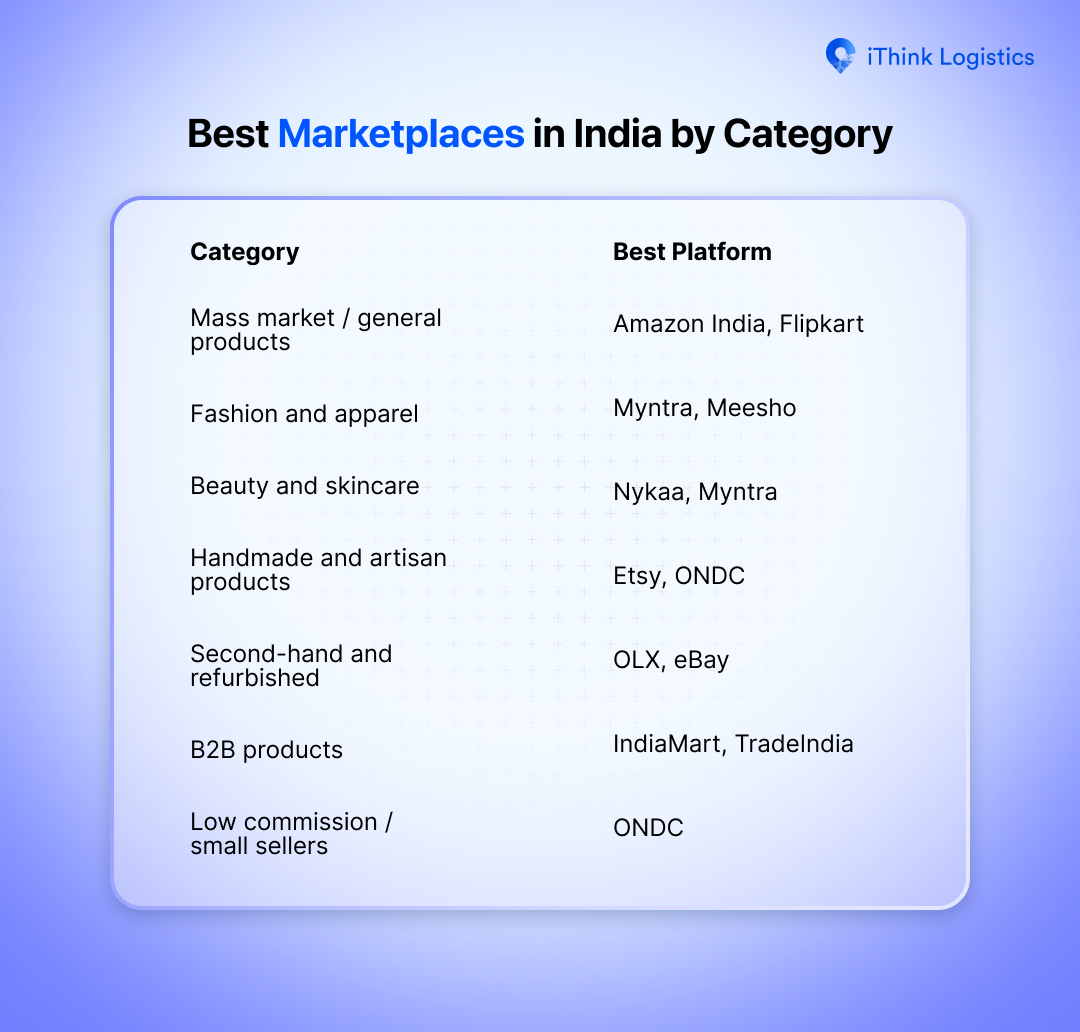
With your business model already chosen, the question now is which specific platform best fits your product, because choosing the wrong marketplace wastes fees, time, and effort on a platform where your target audience is not present.
D2C Website vs Marketplace: The Core Decision
With your model already chosen, the question now is which specific platform within it best fits your product.
Five Factors to Evaluate Before Committing
- Product-market fit: Does your category already sell well on this platform? High existing demand means built-in buyer intent.
- Target audience alignment: A premium skincare brand belongs on Nykaa or Myntra, not Meesho, where buyers expect low prices
- Integrated logistics: Platforms with built-in fulfillment (Amazon FBA, Flipkart Fulfillment) reduce operational complexity for new sellers
- Seller tools and support: Advertising, analytics, and seller support quality vary significantly across platforms
Best Marketplaces in India by Category
| Category | Best Platform |
| Mass market / general products | Amazon India, Flipkart |
| Fashion and apparel | Myntra, Meesho |
| Beauty and skincare | Nykaa, Myntra |
| Handmade and artisan products | Etsy, ONDC |
| Second-hand and refurbished | OLX, eBay |
| B2B products | IndiaMart, TradeIndia |
| Low commission / small sellers | ONDC |
With your selling channels chosen, the next make-or-break decision is how your orders actually get delivered and how you prevent returns from eating your margins.
9. Shipping and Fulfillment: Where Most eCommerce Businesses Lose Money
You can have the right product, the right store, and the right payment setup and still lose money. For most new ecommerce businesses in India, logistics is where the money quietly disappears.
Most new sellers think shipping is just a cost.
It isn’t.
It’s the difference between a 5-star review and a refund and whether your unit economics are viable at scale.
Direct Courier vs Shipping Aggregator: Which Model Suits You
New sellers have two options for fulfilling orders:
Direct courier partnerships: You negotiate directly with a single courier company (Delhivery, Blue Dart, XpressBees). Simpler to manage, but you are locked into one carrier’s rates, pin code coverage, and performance. If that carrier has a bad week in your key delivery zone, your customers feel it.
Shipping aggregator: A platform that connects you to multiple courier partners and automatically assigns the best carrier for each shipment based on destination, weight, and delivery timeline. You get competitive rates, broader pin code coverage, and the flexibility to switch carriers without renegotiating contracts.
For new sellers, the aggregator model is almost always the better starting point, with lower rates through volume pooling, no minimum shipment commitments, and access to multiple shipping/ courier partners from day one.
Three Metrics Every eCommerce Seller Must Track
Delivery TAT (Turnaround Time): The time between order placement and delivery. Customer expectations in metros are now 1–2 days. Tier-2 and Tier-3 cities expect 3–5 days. Consistently missing TAT leads to increased cancellations and negative reviews.
Pin Code Coverage: The percentage of your target market your courier can actually reach. Tier-2 and Tier-3 cities now account for over 60% of ecommerce orders in India. If your courier cannot reliably serve these pin codes, you are leaving the majority of the market behind.
RTO Rate (Return to Origin): The percentage of shipments that fail delivery and return to you. The national average RTO rate in India ranges from 25% to 40%, depending on the category and geography. Every returned shipment costs you forward shipping, reverse shipping, and the time your capital is tied up in unsold inventory.
What is RTO and How to Reduce It
RTO happens when a shipment cannot be delivered because the customer is unavailable, the address is incorrect, the COD payment is refused, or the order was placed impulsively, and the customer no longer wants it.
Each RTO order costs a new seller ₹80–₹200 in combined forward and reverse logistics charges before accounting for the lost sale. At scale, a 30% RTO rate can make an otherwise profitable business unviable.
Five Ways to Reduce RTO
- Order confirmation calls or WhatsApp messages filter out fake or impulsive orders before shipping costs are incurred.
- Address validation at checkout uses pin code-level serviceability checks so undeliverable addresses are flagged before the order is confirmed.
- COD verification: Send an OTP or payment link before dispatching COD orders to confirm buyer intent.
- Delivery intelligence tools: AI-driven systems flag high-risk addresses or pin codes based on historical delivery failure data.
- Fast dispatch: Orders shipped within 24 hours usually see lower RTO rates than orders dispatched after 48–72 hours.
How iThink Logistics Helps
iThink Logistics is a shipping/ courier aggregator built specifically for Indian ecommerce sellers. Through a single dashboard, you get access to 25+ courier partners, automated carrier selection based on delivery performance, COD management, real-time tracking, and RTO-reduction tools, without negotiating separate contracts with each carrier.
Whether you are shipping 10 orders a day or 10,000, the platform scales with your business and gives you the visibility to make logistics decisions based on data rather than guesswork.
With fulfillment handled, the final operational piece is getting customers to your store in the first place and keeping them coming back.
10. Marketing and Growing Your eCommerce Business
Getting your first customer costs more than keeping an existing one. The most sustainable ecommerce businesses in India build marketing engines that span three layers: organic discovery, paid acquisition, and customer retention.
Organic Marketing: Build Traffic Without Ad Spend
Organic channels take longer to build but compound over time and cost nothing per click.
- SEO: Optimize your product pages and blog content for keywords your buyers are actively searching. A well-ranked product page drives free, high-intent traffic indefinitely.
- Instagram Reels and YouTube Shorts: Short-form video is the dominant product discovery channel in India right now. Product demos, unboxing videos, and before-and-after content consistently outperform static posts.
Paid Marketing: Accelerate What’s Already Working
Never run paid ads on an unvalidated product. Once you have proof of demand, paid channels amplify it.
- Google Shopping Ads: Captures high-intent buyers actively searching for your product. Best for sellers with clear product categories and competitive pricing
- Meta Ads (Facebook and Instagram): Best for discovery-driven categories like fashion, beauty, home decor, and gifting. Highly effective for retargeting web
- Influencer Marketing: Micro-influencers with 5,000–50,000 followers consistently deliver better ROI for new brands than celebrity endorsements. Their audiences are more engaged, and their content feels more authentic.
Stop Losing Customers You Already Paid to Acquire
Acquiring a new customer costs 5–7 times as much as retaining an existing one. Build retention into your operations from day one:
- WhatsApp Broadcasting: Build a customer list and use broadcast messages for new launches, restocks, and offers. WhatsApp has the highest open rate of 90-98% among marketing channels in India.
- Post-purchase follow-up: A WhatsApp or email message after delivery asking for a review builds trust and generates social proof
- Loyalty incentives: Repeat purchase discounts, referral programs, and early access to new products reward your best customers.
- Review management: Actively respond to both positive and negative reviews across all marketplaces. Sellers with higher review scores consistently rank better in marketplace search results.
With your marketing engine in place, the last question most new sellers have is a practical one: how much does all of this actually cost to set up?
11. How Much Does It Cost to Start an eCommerce Business in India?
One of the most common reasons people delay starting is uncertainty about cost. The honest answer is: it depends on your model, but you can start with less than most people think.
Estimated Startup Cost Breakdown
| Cost Component | Marketplace Seller | D2C Website | Dropshipping |
| Business registration | ₹1,500–₹10,000 | ₹1,500–₹10,000 | ₹1,500–₹10,000 |
| GST registration | Free | Free | Free |
| Initial inventory | ₹15,000–₹50,000 | ₹20,000–₹1,00,000 | ₹0 |
| Website/store setup | ₹0 (marketplace) | ₹2,000–₹5,000/month | ₹2,000–₹5,000/month |
| Photography/content | ₹2,000–₹10,000 | ₹5,000–₹20,000 | ₹2,000–₹5,000 |
| Initial marketing | ₹5,000–₹20,000 | ₹10,000–₹50,000 | ₹5,000–₹20,000 |
| Estimated total | ₹25,000–₹90,000 | ₹40,000–₹2,00,000 | ₹10,000–₹40,000 |
What You Can Start With as Low as ₹25,000
A marketplace seller model with a focused product selection is the most capital-efficient entry point. With ₹25,000, you can cover:
- Business and GST registration
- A small initial inventory batch (30–50 units of a lightweight product)
- Basic product photography
- Your first month of marketplace advertising
The key is starting with one product, one marketplace, and one target customer to validate before you expand.
Which option works best depends on how much capital you need and how quickly you plan to scale your business:
Funding Options for New eCommerce Sellers
If self-funding is not enough to cover your startup costs, here are the most practical options for new Indian ecommerce businesses:
Self-funded / Bootstrapped: The most common starting point. Start lean, reinvest early profits, and scale gradually without debt pressure.
Business loans: Banks and NBFCs offer working capital loans for registered businesses. Having a Pvt Ltd or LLP structure, a business bank account, and a GST history makes approval significantly easier.
MSME government schemes: MSME-registered businesses can access subsidized loans through SIDBI (Small Industries Development Bank of India), Mudra Loans (up to ₹10 lakh for micro businesses), and state-level startup schemes. Registration on the Udyam portal is the entry point for all of these.
Startup India: If you are registered as a startup with DPIIT, you get access to a fund of funds, tax exemptions for three years, and a self-certification compliance framework that reduces early-stage regulatory burden.
Conclusion
Starting an ecommerce business in India in 2026 is genuinely achievable but only if you treat it as an operational challenge, not just a marketing exercise.
The three silent killers from the intro, RTO, commission burn, and compliance lag, are all solvable. Register the right structure, choose your selling model before you build, source products that travel well, set up every payment method your customers actually use, and partner with a logistics provider that gives you data and flexibility rather than locking you into a single carrier.
The businesses that survive past their first year are not the ones with the best Instagram feed. They are the ones that got their unit economics right from day one.
If logistics is where you want to start getting it right, iThink Logistics gives you access to 25+ courier partners, automated carrier selection, COD management, and RTO reduction tools all from a single dashboard built for Indian ecommerce sellers.
FAQs
Q.1: Can I start an ecommerce business in India with zero investment?
A: Not exactly zero, but you can start with very little. Dropshipping is the closest option because you don’t hold inventory and only order from the supplier after a customer pays. With around ₹10,000–₹15,000, you can cover GST registration, a basic store setup, and a few test orders.
Q.2: How many products do I need to start selling on Amazon or Flipkart?
A: You can start with just one product. Most new sellers begin with 3–5 SKUs in the same category to test demand without locking too much money in inventory. Starting small helps you understand pricing, reviews, and return rates before expanding your catalogue.
Q.3: What is the 80/20 rule in ecommerce?
A: It means roughly 20% of your products will drive 80% of your revenue. Most sellers discover this after 2 to 3 months; a handful of SKUs perform well, and the rest sit. Once you identify those top performers, the job becomes making sure they never go out of stock and stay competitively priced. The same rule applies to customers. A small group of repeat buyers usually accounts for the bulk of your actual profit, which is why retention matters more than most new sellers realize.
Q.4: What licenses do I actually need to start an ecommerce business in India?
A: For most sellers, GST registration and basic business incorporation are required to sell on marketplaces like Amazon or Flipkart. If you sell food or supplements, you also need an FSSAI license. Importing products requires an IEC code, and some states may require Shop and Establishment registration.
Q.5: Can I run an ecommerce business from home in India?
A: Yes. Many sellers start from home using their residential address for GST registration and business records. A separate commercial space is usually only required if you operate a physical office or warehouse under the Shop and Establishment Act.
Q.6: What is a realistic profit margin for a new ecommerce seller in India?
A: Most marketplace sellers earn around 10–20% net margin after fees, shipping, returns, and advertising. In the early months it can be lower while you optimize pricing and reduce return rates.
Q.7: Do I need a trademark before selling online in India?
A: No, you can start selling without one. However, a trademark becomes important as your brand grows. For example, a registered trademark allows you to access Brand Registry on Amazon, which helps protect your listings and unlock advanced brand features.
Q.8: What are the 4 types of ecommerce?
A: The most common models are:
- B2C (Business to Consumer): Businesses selling directly to customers through marketplaces or websites
- B2B (Business to Business): Businesses selling products in bulk to other companies
- C2C (Consumer to Consumer): Individuals selling to other individuals on platforms like classifieds
- D2C (Direct to Consumer): Brands selling directly through their own websites
Most new sellers start with B2C on marketplaces and later expand to D2C.
Q.9: How long does it take to start making money from an ecommerce business in India?
A: The first sale on marketplaces can happen within a few weeks if the product has demand and competitive pricing. However, consistent profit usually takes 3–6 months while you gather reviews, optimize listings, and understand return rates and marketing costs.
Q.10: Is GST required if I only sell through Instagram or WhatsApp?
A: GST becomes mandatory once your annual turnover crosses ₹20 lakh (₹10 lakh in special category states). However, many payment gateways require a GSTIN to activate their services, and marketplaces like Amazon or Flipkart require it from the start.