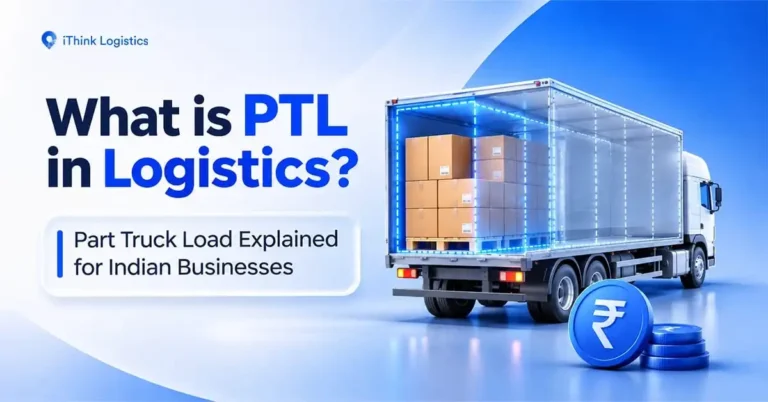
PTL in logistics stands for Part Truck Load. Your goods share a truck with other shippers, and you pay only for the space you use. It suits consignments too heavy for a courier and too small to fill a truck.
Booking a full truck load (FTL) for loads like these means paying for empty space. iThink Logistics helps Indian sellers choose between the two and book either.
What Does PTL Mean in Logistics?
PTL in logistics means Part Truck Load, a road freight service where your goods share a truck with other shippers. You pay for the weight or space your goods occupy, not for the whole truck. It sits between courier parcels and a full truck load.
PTL Full Form and Definition
The full form of PTL in logistics is Part Truck Load. Overseas guides often use the term partial truckload, usually for a truck that makes few stops. Indian carriers do not share one definition, so the same term can describe slightly different services.
PTL here is a freight term. It has no link to pick-to-light, the warehouse picking system that shares the acronym. Before you book, check whether your shipment is the right size for PTL.
What Size of Shipment Counts as PTL?
No single size defines PTL across carriers. Each carrier sets its own minimum and maximum for weight and volume. Ask for these limits before you book.
Use a simple test. PTL fits when courier rates climb too high but your goods fill only part of a truck. Space matters as much as weight, because bulky goods fill a truck faster than their weight suggests.
The upper limit is a price question. Once the PTL charge on your route nears the cost of a full truck, FTL is the better booking. Next, see how a PTL consignment moves from your door to the buyer.
How Does PTL Work in India?
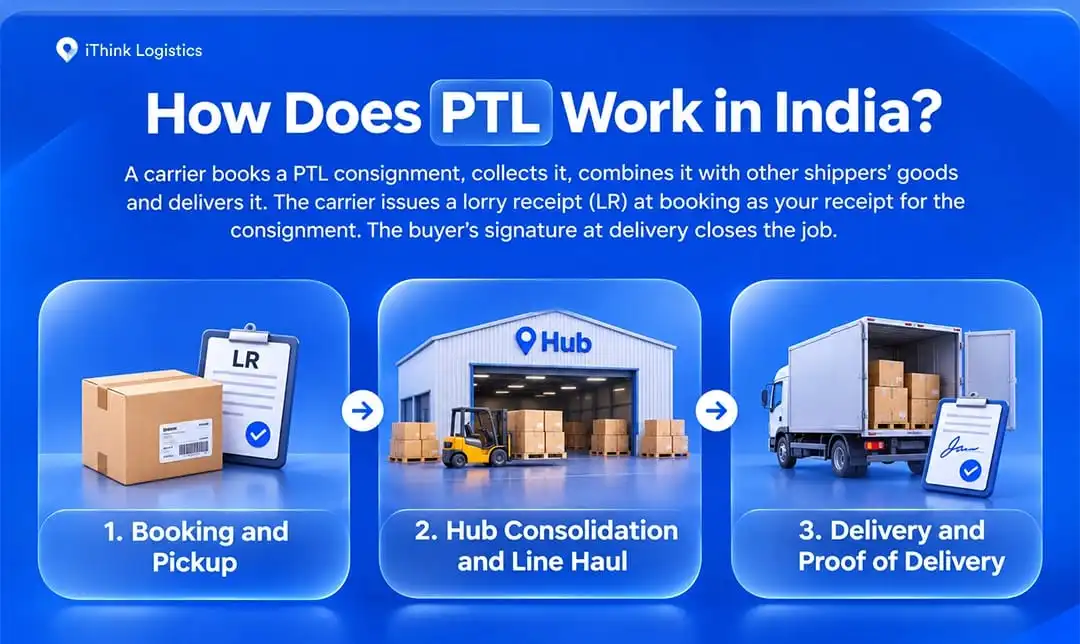
A carrier books a PTL consignment, collects it, combines it with other shippers’ goods and delivers it. The carrier issues a lorry receipt (LR) at booking as your receipt for the consignment. The buyer’s signature at delivery closes the job.
Booking and Pickup
Share the pickup address, delivery address, goods description, carton count and weight with the carrier. The carrier confirms the price for your load. Pack cartons strongly and number each one.
The carrier then collects the goods from your premises, or you drop them at a booking branch. Read the lorry receipt before you hand over the consignment. It must show the correct package count, weight and goods description.
After booking, your goods enter the carrier’s network.
Hub Consolidation and Line Haul
PTL in logistics works through consolidation. Carriers collect consignments from many sellers and sort them by destination. Many Indian carriers do this at a hub, then run a line-haul truck to a hub near the buyer.
Others run a direct truck with fewer stops. Ask your carrier which model it uses. A hub route adds handling, while a direct truck may wait until the vehicle fills.
Once the truck reaches the destination, the final stage begins.
Delivery and Proof of Delivery
At the destination, the carrier delivers to the buyer’s door or holds the goods at its branch for collection. Check the LR to confirm which option you booked.
The buyer signs for the goods, and that signed proof of delivery closes the consignment. Ask the carrier how fast it shares the scanned copy. Next, compare PTL with the other road freight modes.
PTL vs LTL vs FTL: What Is the Difference?
PTL and LTL share truck space, while FTL gives one shipper the whole truck. FTL costs the most per trip and usually moves fastest, while PTL and LTL cost less for smaller loads but take longer. Your load size and deadline decide which one fits.
The table below compares the three modes on the points that decide most bookings. For pricing and how to choose, see our FTL vs PTL vs LTL guide.
| Factor | PTL | LTL | FTL |
|---|---|---|---|
| Truck use | A fixed part of a truck, shared with other shippers | Space on a shared truck | Whole truck, one shipper |
| Typical load | Medium consignments | Small consignments | Large loads that fill a truck |
| You pay for | Weight or space used | Weight, often with a minimum charge | The truck, per trip |
| Transit time | Moderate | Often the longest, due to sorting | Usually the fastest |
| Handling | Moderate | Highest | Lowest |
PTL vs LTL: Do the Terms Overlap in India?
In India, PTL in logistics usually means booking a fixed part of a truck, while LTL pools your goods with many shippers’ consignments. Some carriers still use the two terms loosely, so the same load can get either label.
Judge the service, not the label. Ask whether your goods pass through hubs, how many stops the truck makes and how the carrier charges. With that clear, compare PTL against booking a full truck.
PTL vs FTL: Which Fits Your Load?
If your goods fill most of a truck, or the deadline is tight, book FTL. Smaller loads with some flexibility on timing belong in PTL.
You can use both. Book FTL for large restocks and PTL for smaller regional orders. Price is the next question most buyers ask.
How Is PTL Priced?
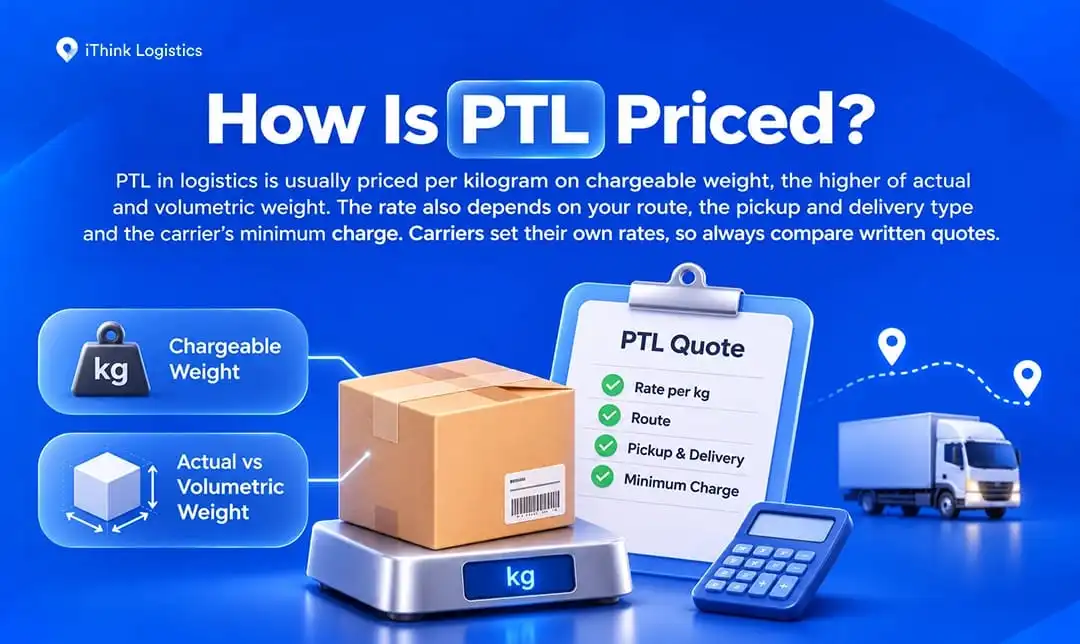
PTL in logistics is usually priced per kilogram on chargeable weight, the higher of actual and volumetric weight. The rate also depends on your route, the pickup and delivery type and the carrier’s minimum charge. Carriers set their own rates, so always compare written quotes.
How Chargeable Weight Works
Light cartons can still fill a lot of truck space. So carriers compare actual weight with volumetric weight and charge whichever is higher.
Volumetric weight comes from the carton’s length, width and height, converted with a factor the carrier sets. That factor differs between carriers, so ask for it in writing.
Tighter packing lowers your chargeable weight. Fewer, well-filled cartons usually cost less than many half-empty ones. Next, see what else changes the rate.
Other Factors That Change the Rate
Three factors move a PTL quote up or down. Our freight charges guide explains each line of a freight quote.
- Longer distances and less busy routes usually cost more than short, busy ones.
- Door pickup and door delivery cost more than branch drop-off and branch collection.
- Many carriers apply a minimum charge per consignment, so very small loads cost more per kilogram.
Once you know the cost drivers, the benefits of PTL are easier to judge.
Benefits of PTL for Indian Sellers
PTL in logistics lets Indian sellers move medium-sized consignments by road without paying for a whole truck. You pay for the space your goods use, so freight cost tracks your actual volume. That makes it a practical first step into truck freight.
These five benefits matter most for sellers moving stock across India.
- Lower freight cost. You pay for the space or weight your goods use, not for empty truck space.
- Right size for medium loads. Cartons and pallets that outgrow courier rates still have a fitting option.
- Wider route access. Shared carrier networks reach routes where booking a full truck makes no sense.
- Lower cost of entry. A growing seller can start moving stock by truck without a full truck commitment.
- Flexible volumes. Shipment size can change from month to month, and you pay for what you ship.
These gains come with trade-offs worth knowing before you book.
Limitations of PTL
PTL in logistics has three main limitations. Transit can run longer than FTL, goods get handled more often and you control less of the schedule. Each one has a practical fix, and knowing it before you book reduces surprises.
Longer Transit Than FTL
Sharing a truck means consolidation and extra stops, so PTL usually takes longer than FTL. Ask the carrier how often trucks leave on your route, and add a buffer to your delivery promise.
More handling brings the second trade-off.
More Handling Points
Goods are handled more often than in FTL, so the risk of damage or mix-ups rises. Use strong cartons, fill empty space inside them and number every package.
Palletise where you can, and photograph the goods before dispatch. Control over timing is the third trade-off.
Less Control Over Schedule
The carrier plans the truck around many shippers, so you cannot set an exact departure time. Agree on a pickup window with the carrier, and ask for tracking updates and the scanned delivery copy.
Keeping these limits in mind, decide when PTL is the right call.
When Should You Choose PTL?
Choose PTL when your shipment is larger than a courier parcel but well under a full truck. Use it when cost matters more than the fastest delivery, or when your shipment size changes month to month. Large or urgent loads belong in FTL.
Choose PTL When
PTL in logistics is a good fit in these situations.
- Your goods are too heavy or bulky for courier rates.
- You ship to dealers, distributors or warehouses in other cities.
- You restock regularly and cannot wait to fill a whole truck.
Sellers new to B2B shipping can start with PTL because it needs no full truck commitment.
When FTL or Courier Fits Better
FTL is better when your goods fill most of a truck or must arrive on a fixed date. A courier is better for small, light parcels.
Once you know PTL fits, the next step is choosing a provider.
How to Choose a PTL Provider
Choose a PTL provider by checking route coverage, size limits, pricing clarity, tracking and the claims process. A clear lorry receipt, written chargeable weight terms and quick proof of delivery signal a reliable carrier. Compare at least two written quotes before you book.
What to Check Before Booking
Ask every carrier the same six questions before you commit.
- Does the carrier cover your pickup and delivery pin codes?
- What are the minimum and maximum consignment sizes?
- How is chargeable weight calculated, and which factor does the carrier use?
- Is there a minimum charge per consignment?
- How do tracking and proof of delivery work?
- How does the carrier handle damage or shortage claims, and do you need separate shipping insurance?
A carrier that answers all six clearly is ready for your first booking.
Book PTL with iThink Logistics
iThink Logistics offers part truck load and full truck load options, so you can match the mode to your cargo. To start, explore the bulk shipping service and choose PTL or FTL for your next consignment.
FAQs on PTL in Logistics
What is PTL in logistics?
PTL in logistics stands for Part Truck Load, a road freight service where goods share a truck. You pay only for the weight or space your consignment uses. It suits loads too large for a courier and too small for a full truck.
What is the full form of PTL?
The full form of PTL in logistics is Part Truck Load. Overseas sources also call it partial truckload, and Indian carriers may describe slightly different services under the name. In freight it means shared truck space, unlike the pick-to-light warehouse system.
What is the difference between PTL and LTL?
In India, PTL usually books a fixed part of a truck, while LTL pools your goods with many shippers’ consignments. Carriers set their own cut-offs, so the labels can overlap. Ask whether your goods pass through hubs, how many stops the truck makes and how the carrier charges.
Is PTL cheaper than FTL?
Yes, PTL in logistics is usually cheaper than FTL for loads that do not fill a truck. You pay only for the space or weight you use. FTL can win on price once your load nearly fills the truck, so compare quotes for both.
How is PTL priced in India?
PTL in logistics is usually priced per kilogram on chargeable weight, the higher of actual and volumetric weight. Route, pickup and delivery type and the carrier’s minimum charge also affect the quote. Rates vary by carrier, so compare written quotes.
What is the minimum weight for PTL?
The minimum weight for PTL in logistics depends on the carrier, so confirm it before booking. Some carriers set a minimum weight, others apply a minimum charge per consignment. Ask about both, along with the maximum size they accept.
When should a small business use PTL?
Small businesses should use PTL when a shipment is too big for a courier but does not fill a truck. It also suits businesses whose shipment sizes change from month to month. Move to FTL as your volumes grow and fill more of the truck.
Does PTL need an e-way bill?
Usually yes, if the consignment value is above ₹50,000. Some states set different limits for movement inside the state, and certain goods are exempt. Check the rules on the e-way bill portal for your route before dispatch.
Author