A courier works for a few parcels, and a full truck works once you have enough stock to fill it. But a few pallets for a retailer barely fill a truck, and couriers aren’t built for them.
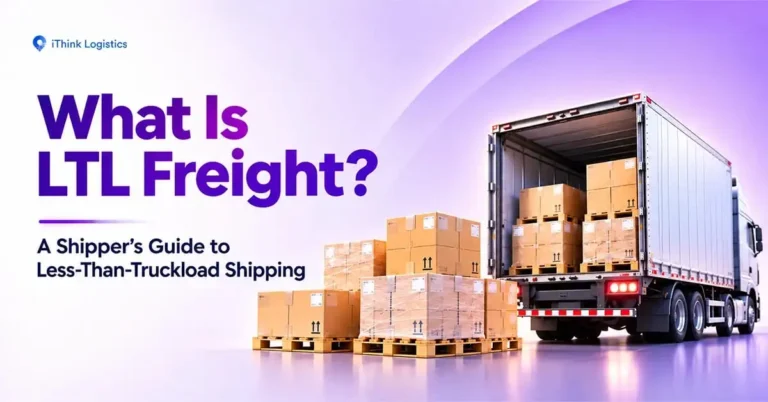
That in-between load is where LTL shipping (less than truckload) fits. Your goods share a truck with other shippers’ cargo, and you pay only for your share.
In India, sharing a truck also affects the paperwork, the price and who pays for damage.
LTL shipping at a glance
- What it is: Freight on a shared truck, billed for your share.
- Best for: Loads that outgrew a courier but fill only a small share of a truck.
- Watch out for: Slower transit, more handling, and quotes that are hard to compare.
What Is LTL Shipping?
LTL shipping, short for less-than-truckload, is a freight service where several shippers’ cargo travels on one truck. The transporter groups the consignments, and each shipper pays only for the weight or space its goods take up.
Think of it as the middle option. A courier moves parcels, and a full truckload (FTL) books the whole truck for one shipper.
LTL shipping covers the gap: B2B loads, usually cartons or pallets, that are too small to book a whole truck but too big to ship as courier parcels.
You’ll also hear PTL (part truckload) in the same breath. Where LTL ends and PTL begins isn’t fixed (every transporter sets its own weight cut-off), so two quotes for the same load can come back with different names.
The easiest way to see what sharing means is to follow one consignment from pickup to delivery.
5 Steps of How LTL Shipping Works
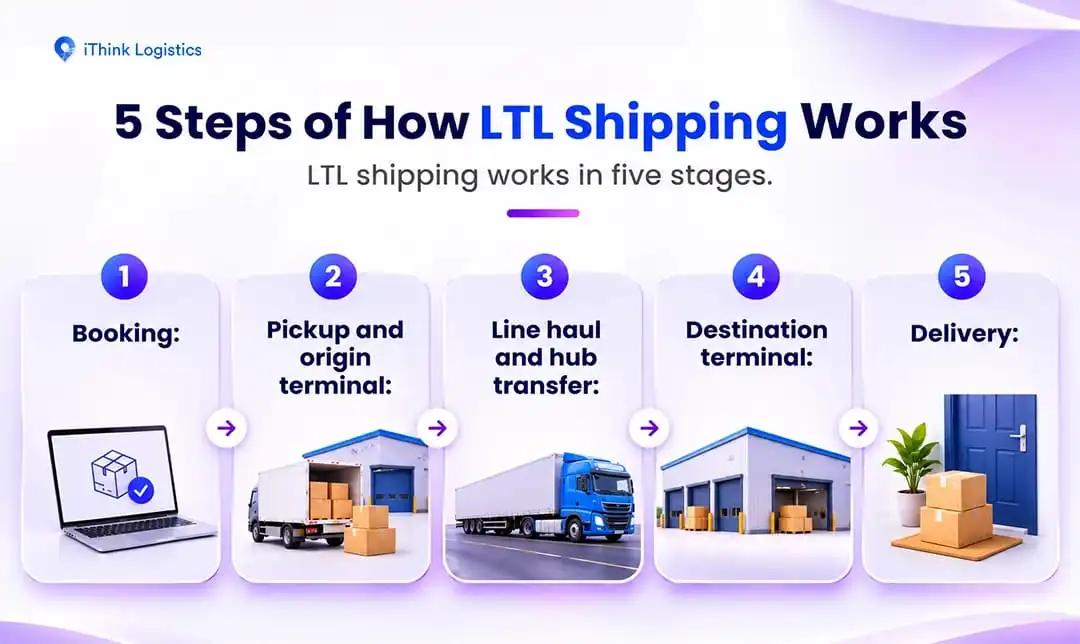
LTL shipping works in five stages.
Say you run a Jaipur home-décor brand and are restocking a retailer in Bengaluru. Here’s the journey:
- Booking: You pack the cartons on pallets, note their weight and size, and book with a transporter. Share the destination and declared value. The transporter then issues a goods receipt, also called a lorry receipt (LR).
- Pickup and origin terminal: A vehicle collects your pallets and takes them to a local terminal. There, staff sort them and group them with other consignments heading the same way.
- Line haul and hub transfer: Your grouped load moves on a larger vehicle for the long run between cities, known as line haul. It often passes through a central hub, where goods can switch vehicles. If an e-way bill applies, the transporter updates the vehicle details (Part B) whenever the goods change vehicles.
- Destination terminal: Your pallets reach a terminal near Bengaluru, where the transporter separates them by delivery address.
- Delivery: A local vehicle takes your pallets to the retailer, who checks them and signs the proof of delivery.
It works a bit like a connecting flight: your pallets don’t always stay on one vehicle from pickup to drop. Every transfer means more loading and unloading, and extra pickups along the route can slow transit.
Whether that trade-off pays off depends on your load, so that’s where we’ll look next.
When Does LTL Shipping Make Sense?
To decide whether LTL shipping suits your load, ask these four questions:
- Does the load fill most of a truck? If so, a PTL or FTL quote can cost less per kg. As your load grows, LTL stops being the cheaper option.
- Is the delivery date firm? Terminal stops and extra pickups slow LTL, so if you need delivery on a fixed date, confirm the deadline with the transporter.
- Can the goods take rough handling? Sturdy cartons cope with repeated loading. For fragile goods, FTL is usually safest because no other cargo shares the truck.
- Are you restocking in small lots? Regular small consignments to distributors, retailers, or warehouses suit LTL shipping, because you never wait to fill a truck.
Your Jaipur consignment doesn’t fill a truck, has a flexible date, can take repeated handling and is a small restock. All four answers point to LTL.
The same four questions work for any B2B shipping decision. If your answers lean the other way, get FTL and PTL quotes for the same route.
How Is LTL Shipping Priced in India?
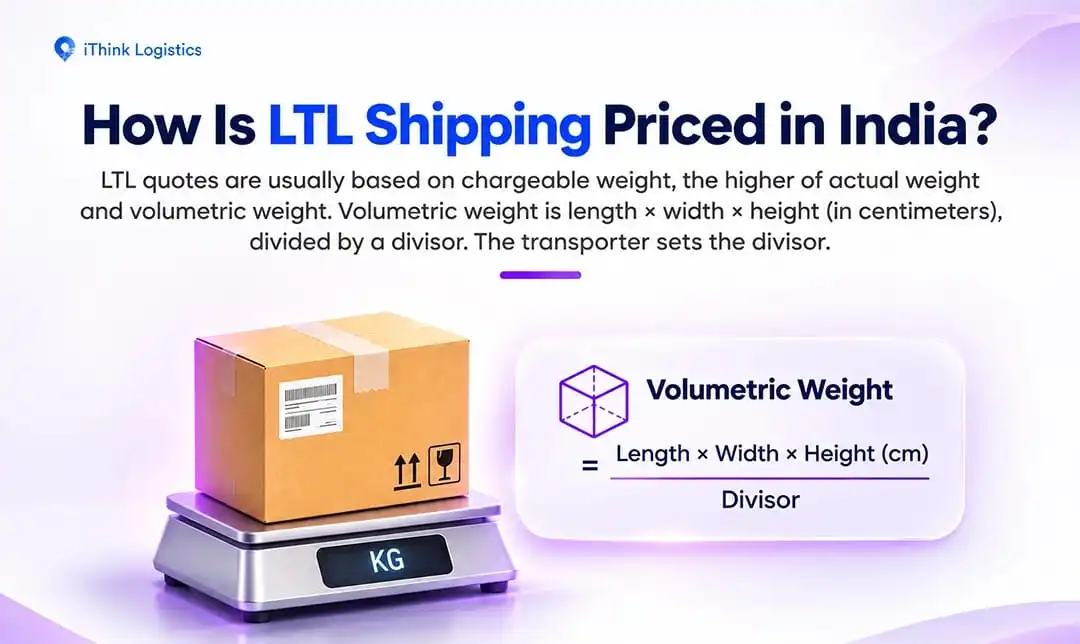
LTL quotes are usually based on chargeable weight, the higher of actual weight and volumetric weight. Volumetric weight is length × width × height (in centimetres), divided by a divisor. The transporter sets the divisor.
Work out your chargeable weight
Let’s price your Jaipur consignment. Say your cartons are light but bulky, and one measures 60 × 50 × 40 cm and weighs 10 kg. Its volume is 120,000 cubic centimetres, so here is what you’d pay for at three different divisors:
| Divisor | Volumetric weight | You pay for |
|---|---|---|
| 4,000 | 30 kg | 30 kg |
| 5,000 | 24 kg | 24 kg |
| 6,000 | 20 kg | 20 kg |
Your carton’s actual weight is 10 kg, so volumetric weight wins every time. Couriers commonly use 5,000, but freight transporters set their own divisor. So ask every transporter for its divisor before you compare quotes.
What else goes into your quote
Weight is only the base. Depending on the rate card, these can add to your quote:
- Distance and route: Longer routes generally cost more, and hard-to-reach addresses can raise the rate.
- Docket charge: A fixed fee per consignment.
- Fuel surcharge: An add-on that accounts for changes in fuel prices.
- ODA surcharge: Applies to pin codes the transporter doesn’t serve directly.
- Minimum chargeable weight: A rate card can set one, so ask whether your quote has it.
If you’ve read US guides, you’ll have seen freight class everywhere. Indian quotes usually run on kilograms, tonnes and truck length instead.
Our guide to volumetric weight covers the formula in more detail. Our freight charges guide explains each line of a freight quote.
Cost also changes with the mode, so here is how LTL compares with the alternatives.
How Is LTL Shipping Different From PTL, FTL and Courier?
LTL and PTL both let you ship without booking a full truck. LTL combines your goods with many other shippers’ goods, while PTL books a fixed part of a truck. Transporters set their own cut-offs, so the names can overlap.
FTL books the whole truck for one shipper, and a courier moves parcels through its own network. Here’s how the four compare on what you’ll deal with when you book:
| Factors | LTL | PTL | FTL | Courier |
|---|---|---|---|---|
| What you book | A share of a truck, with other shippers | A fixed part of a truck | The whole truck | A slot in the courier’s parcel network |
| How the price is built | Chargeable weight or space used | The space you book | One rate per truck | Per parcel, on actual or volumetric weight |
| What you tell the transporter | Weight and dimensions | The space you need, such as 15 ft of a 32 ft truck | The truck size, from 14 ft to 32 ft | The weight and size of each parcel |
| Route | Through hubs, where goods can switch vehicles | The truck’s planned route | Direct, pickup to delivery | Sorting centres and a local delivery network |
| Transit | Often the slowest, with extra pickups | In between, based on the load plan | Fastest, with no stops for other cargo | Depends on the service you pick |
| Damage risk | Highest, with repeated loading and unloading | Moderate | Lowest | Parcels also pass through several sorting stages |
| Booking document | Lorry receipt (LR) | Lorry receipt (LR) | Lorry receipt (LR) | AWB label |
| If goods are lost or damaged | A common carrier’s liability for a total loss is capped at ten times the freight, unless you agree to a higher risk rate | Same rule | Same rule | Depends on the courier’s terms and any cover you add |
| Best for | Small consignments, flexible dates | Loads too big for a courier, too small for a truck | Large, fragile or urgent loads | Parcels and small orders |
Where does your Jaipur consignment fit?
Run your consignment through each mode:
- Courier: Unlikely. Parcel networks aren’t built for pallets, though some couriers take heavy consignments, so it costs nothing to ask.
- FTL: No. A few pallets barely fill a truck, so you’d pay for the space.
- PTL: Maybe. If your Bengaluru retailer needs the stock by a fixed date, get a PTL quote too.
- LTL: Yes. You share the truck, pay for your share, and have some flexibility on your date.
Because cut-offs vary, ask what each quote prices: the truck, the space, or the weight. Our FTL vs PTL vs LTL guide shows how to compare quotes fairly.
That lorry receipt is only one of the documents you’ll handle, so let’s look at the paperwork next.
What Paperwork and Legal Cover Apply to LTL Shipping in India?
Your consignment needs four documents: your invoice or delivery challan, the goods forwarding note, the goods receipt (also called the lorry receipt, or LR), and, above ₹50,000, an e-way bill.
A goods forwarding note (GFN) is the form a sender fills in when booking goods with a common carrier, a transport company that carries goods by road for hire. It states the goods’ value and flags any hazardous items.
Who pays if goods are damaged or late?
The Carriage by Road Rules, 2011, made under the Carriage by Road Act, 2007, cap a common carrier’s liability for a total loss at ten times the freight. It never goes above the value you declared in the goods forwarding note.
You can raise that cap by agreeing to a higher risk rate, so declare the true value and consider insuring valuable goods separately. Delay is judged against the delivery period you agree in the note, so get it in writing.
The e-way bill
An e-way bill is needed when the consignment value exceeds ₹50,000; below that, it’s optional. States can set different limits for movement within the state, so check the e-way bill portal before dispatch.
LTL adds one wrinkle: the transporter can issue one consolidated e-way bill covering every consignment on the vehicle. It has no validity of its own, so your consignment must still arrive within its own e-way bill’s validity.
With the paperwork sorted, you’re ready to book.
How Do You Book and Prepare an LTL Shipment?
To book LTL shipping, get written quotes on one route, confirm terms, pack the goods, and prepare documents. Work through these steps in order:
- Ask 2 or 3 transporters for a written quote for the same route, goods, and pickup date.
- Ask each one how it defines LTL, what the quote covers and how it calculates chargeable weight.
- Ask how many hub transfers your goods will make and whether other shippers’ cargo shares the truck.
- Pack cartons firmly, label each with the receiver’s name, address, and phone number, and record the weight and dimensions.
- Fill in the goods forwarding note with the true value and nature of the goods, and keep the goods receipt. Have your invoice or delivery challan ready, plus the e-way bill for goods above ₹50,000.
- On delivery, check the goods and note any damage on the receipt before you sign.
Moving bulk loads on a regular route? iThink Logistics handles LTL, PTL, FTL, and air cargo bookings from one bulk shipping platform. Share your route and monthly tonnage to request a quote.
The FAQs below answer what shippers ask most before a first LTL booking.
FAQs
Shippers most often ask these questions when comparing LTL with other options.
What is the full form of LTL in logistics?
LTL stands for less than truckload. It describes freight that shares a truck with other shippers’ goods instead of booking the whole vehicle. You pay only for the weight or space your consignment uses.
Is LTL cheaper than FTL?
LTL is usually cheaper for small loads because you pay only for the weight or space you use. As the load grows, the gap narrows, and near a full truck an FTL quote can cost less.
How long does LTL shipping take?
LTL usually takes longer than FTL because of extra pickups and consolidation at terminals. The exact time depends on the route and the transporter. Ask for the delivery period in writing, and include it in the goods forwarding note.
What is the difference between LTL and FTL?
FTL books a whole truck for one shipper, while LTL shares a truck with other shippers. FTL runs direct with less handling. LTL costs less for small loads but moves through terminals.
What is the difference between LTL and PTL?
LTL combines your goods with many shippers’ goods, while PTL books a fixed part of a truck. Transporters set their own cut-offs. The same load can be LTL with one provider and PTL with another.
What size shipment counts as LTL?
There is no single cut-off, because each transporter sets its own. LTL usually covers consignments that fill only a small share of a truck. Ask your transporter for its weight and space limits.
Is a courier service the same as LTL?
No, a courier moves parcels through its own parcel network, while LTL moves pallets and larger cartons on shared trucks. Choose LTL when your consignment is too big or heavy for a courier.
How much does LTL shipping cost in India?
No single rate applies, because the quote depends on chargeable weight, distance, route, and demand. Freight quotes can also carry a docket charge, a fuel surcharge, and out-of-delivery-area charges. Ask for a written quote on your exact route.
What are the advantages and disadvantages of LTL shipping?
LTL saves money on small loads and avoids waiting to fill a truck. The drawbacks are slower transit, more handling and harder-to-compare quotes. For loads that fill most of a truck, PTL or FTL usually costs less.
Is an e-way bill needed for LTL shipments?
An e-way bill is required when the consignment value exceeds ₹50,000, and is optional below that. The transporter can cover several consignments on one vehicle with a consolidated e-way bill. States can set their own limits for movement within the state.
Who pays if goods are damaged in LTL transit?
A liable common carrier pays up to ten times the freight, and never above your declared value. That ceiling comes from the Carriage by Road Rules, 2011, and a higher risk rate can raise it. Declare the true value on the goods forwarding note, and consider separate insurance.
Final Thoughts: Is LTL Shipping Right for Your Next Consignment?
Look at your next consignment before you book it. If it fills only a small share of a truck and the date can move, get an LTL quote. Ask two or three transporters, and compare them on cost per kg.
Want those quotes from one place? iThink Logistics handles LTL, PTL, FTL, and air cargo bookings from one bulk shipping platform. Share your route and monthly tonnage to request a quote.
Which route would you try with LTL first? Tell us in the comments, and share this guide with whoever books your freight.
Author