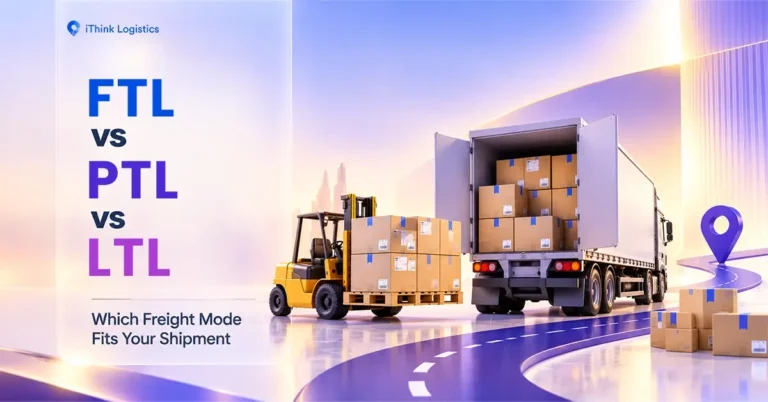
Picture a Ludhiana brand sending 3 tonnes of winter stock to Chennai. One transporter calls it LTL, and another calls it PTL, because each sets its own cut-off. That’s why FTL vs PTL vs LTL quotes can’t be compared by name alone.
They call each different based on the trucks available: one transporter has a 15 ft truck, and you take full-truck FTL, while another transporter has a 32 ft truck, and if you ask for 15 ft space, they will call it PTL, so the load is the same, but the naming is different based on the truck size.
Here’s how to compare them by cost per kg and match your load to a mode.
What Is the Difference Between FTL, PTL and LTL?
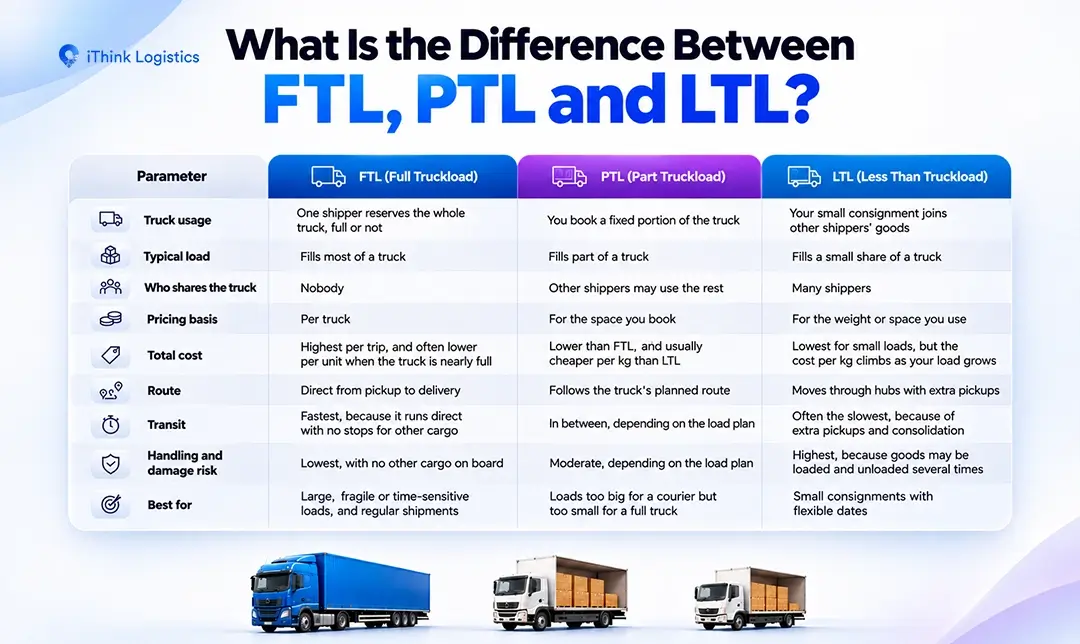
FTL, PTL, and LTL are the three ways to book road freight. They differ by how much of a truck your goods use, who shares it, and how you pay. FTL books the whole truck, PTL books a fixed part, and LTL shares space through a hub network.
That choice shapes your price, your transit time, and how many hands touch your cartons. Here’s how the three modes compare side by side.
| Parameter | FTL (Full Truckload) | PTL (Part Truckload) | LTL (Less Than Truckload) |
| Truck usage | One shipper reserves the whole truck, full or not | You book a fixed portion of the truck | Your small consignment joins other shippers’ goods |
| Typical load | Fills most of a truck | Fills part of a truck | Fills a small share of a truck |
| Who shares the truck | Nobody | Other shippers may use the rest | Many shippers |
| Pricing basis | Per truck | For the space you book | For the weight or space you use |
| Total cost | Highest per trip, and often lower per unit when the truck is nearly full | Lower than FTL when you book only part of a truck, and usually cheaper per kg than LTL | Lowest for small loads, but the cost per kg climbs as your load grows |
| Route | Direct from pickup to delivery | Follows the truck’s planned route | Moves through hubs with extra pickups |
| Transit | Fastest, because it runs direct with no stops for other cargo | In between, depending on the load plan | Often the slowest, because of extra pickups and consolidation |
| Handling and damage risk | Lowest, with no other cargo on board | Moderate, depending on the load plan | Highest, because goods may be loaded and unloaded several times |
| Best for | Large, fragile or time-sensitive loads, and regular factory-to-warehouse runs | Loads too big for a courier but too small for a full truck | Small consignments with flexible dates |
Before you pick one, it helps to see how each mode works in practice, starting with FTL.
What Is FTL (Full Truckload)?
FTL (full truckload) is a freight mode where one shipper books an entire truck for a single consignment. The truck carries only that shipper’s goods and runs straight to the destination, even if it is not full.
The catch: you pay for the whole truck either way, so the right FTL truck type matters.
Even a well-matched truck can leave space empty. When your load fills only part of a truck, that’s where PTL comes in.
What Is PTL (Part Truckload)?
PTL (part truckload) is a freight mode where you book a fixed part of a truck. You pay only for that space, and other shippers may use the rest. PTL in logistics sits between a courier parcel and a full truck.
You may also see PTL written as partial truckload. You get dedicated space, though the truck’s load plan still shapes your delivery timeline.
But for a few cartons, even a fixed part of a truck can be more than you need. LTL is built for that case.
What Is LTL (Less Than Truckload)?
LTL (less than truckload) is a freight mode where your small consignment shares a truck with goods from other shippers. The provider combines loads at hubs, so you pay only for the weight or space you use.
The trade-off is time and handling. Extra pickups can slow transit, and your cartons may be loaded and unloaded several times along the way.
That’s the textbook picture of all three modes, though. Real quotes get messier once providers apply their own rules.
Why Do PTL and LTL Mean Different Things Across Providers?
Providers set their own cut-offs for PTL and LTL. Say two providers define them like this:
- Provider A: LTL for 1 to 6 tonnes, PTL for 7 to 12 tonnes.
- Provider B: LTL for 1 to 2 tonnes, PTL for 3 to 8 tonnes.
So a 3-tonne load is LTL with A but PTL with B. The same goes for anything up to 6 tonnes. That’s why identical cargo can get such different quotes.
Online guides add to the confusion. Many come from the US and Canada, so they count pallets and linear feet. They price LTL by freight class, a system maintained by the US-based National Motor Freight Traffic Association.
Indian bookings usually talk in tonnes, kg, and truck length, from 14 ft to 32 ft. Those numbers do not map neatly onto a US pallet count.
Before you book, ask every provider four questions:
- How do you define PTL and LTL, and by what weight or space?
- Will other shippers’ goods share my truck?
- How many stops or hub transfers will my goods go through?
- Does my quote price the truck, the space, or the weight?
The last answer matters most, because it decides what you actually pay for.
FTL vs PTL vs LTL Cost: How Do They Compare?
FTL charges per truck, PTL by the space you book, and LTL by the weight or space you use. Those three bases explain why quotes for the same route rarely match.
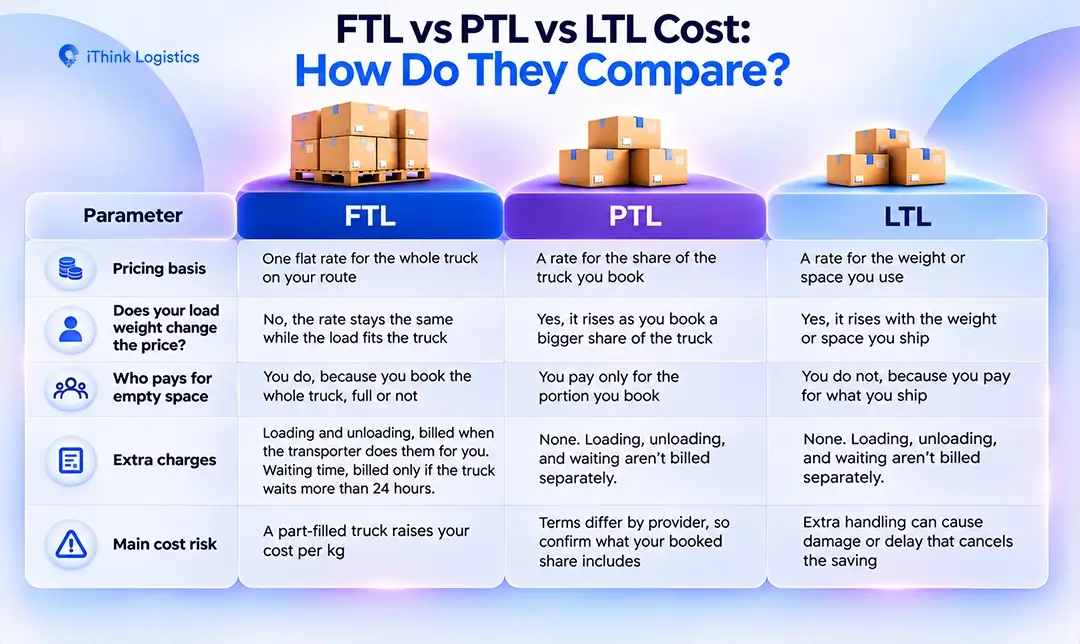
This table shows what each mode charges for, and which extra charges to expect.
| Pricing basis | One flat rate for the whole truck on your route | A rate for the share of the truck you book | A rate for the weight or space you use |
| Does your load weight change the price? | No, the rate stays the same while the load fits the truck | Yes, it rises as you book a bigger share of the truck | Yes, it rises with the weight or space you ship |
| Who pays for empty space | You do, because you book the whole truck, full or not | You pay only for the portion you book | You do not, because you pay for what you ship |
| Extra charges | Loading and unloading, billed when the transporter does them for you. Waiting time, billed only if the truck waits more than 24 hours. | None. Loading, unloading, and waiting aren’t billed separately. | None. Loading, unloading, and waiting aren’t billed separately. |
| Main cost risk | A part-filled truck raises your cost per kg | Terms differ by provider, so confirm what your booked share includes | Extra handling can cause damage or delay that cancels the saving |
FTL stays flat while LTL climbs with every extra kg, so at some weight the two prices cross. Where they cross decides which one costs less.
Is LTL Always Cheaper Than FTL?
No. LTL costs less for small loads, but the gap closes as your load grows. Once your goods fill most of a truck, one truck rate can beat a stack of per-kg charges.
Request both quotes for the same route before you decide.
How Do You Compare Quotes Fairly?
FTL and LTL price different things, so compare them on a common base. Follow these steps:
- Ask every provider to quote the same route, goods, and pickup date.
- Divide each total by your shipment weight to get a cost per kg.
- Check what each total includes: tolls, loading, unloading, and waiting time.
Bulky, light cartons can also count as heavier through volumetric weight. Ask each provider how it calculates chargeable weight. Although it’s the norm, charges are based on actual or volumetric weight, whichever is more.
If you ship the same lane often, ask about contract rates. Our guide to spot market freight rates and contract rates explains the difference. The freight charges guide also breaks down each line of a quote.
With the cost basis clear, the choice gets much simpler.
How Do You Choose Between FTL, PTL and LTL?
Choosing between FTL vs PTL vs LTL comes down to four things. Load size, budget, delivery date, and cargo fragility. Start with load size, because the answer depends on the truck, and Indian trucks carry very different loads.
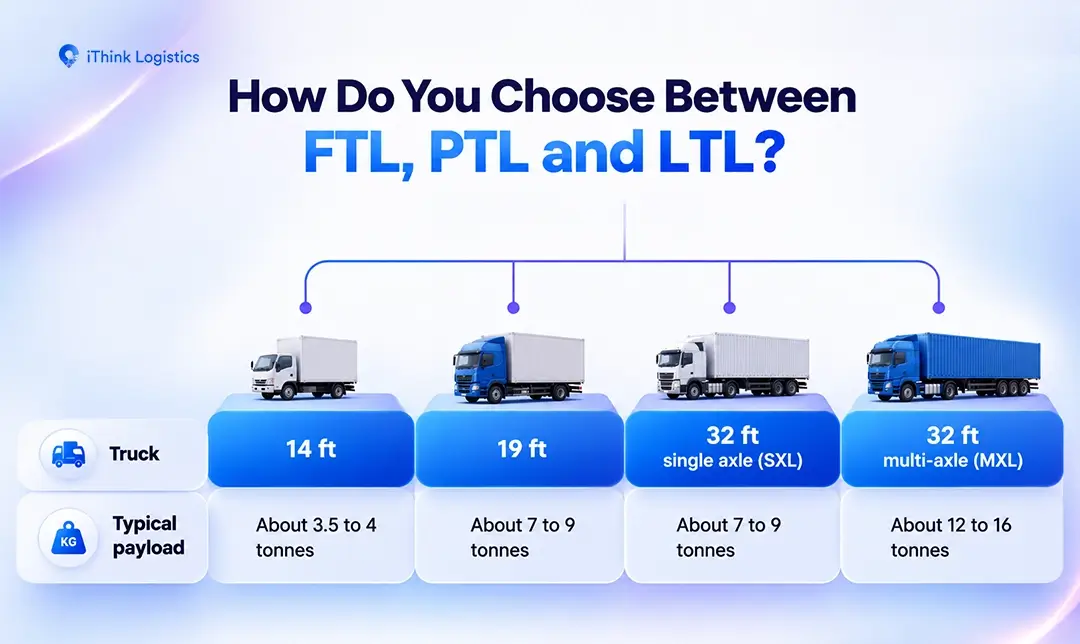
This table shows typical payloads for common truck lengths.
| Truck | Typical payload |
| 14 ft | About 3.5 to 4 tonnes |
| 19 ft | About 7 to 9 tonnes |
| 32 ft single axle (SXL) | About 7 to 9 tonnes |
| 32 ft multi-axle (MXL) | About 12 to 16 tonnes |
Payload varies by model and body type, so confirm it with your provider. A 3-tonne load fills most of a 14 ft truck, so FTL fits. The same load fills roughly a quarter or less of a 32 ft MXL, so PTL fits.
Now add budget, timing, and fragility. This table matches common situations to a mode.
| Your situation | Best-fit mode | Why |
| Your goods fill most of a truck | FTL | One truck rate, direct transit and minimal handling |
| Your goods fill part of a truck and the delivery date is firm | PTL | You book only the space you need, with dedicated room for your cartons |
| Your consignment is small and the date is flexible | LTL | You pay for the weight or space you use |
| Cost is your main priority and the cartons are sturdy | LTL | You share the truck, and sturdy cartons tolerate the extra handling |
| The load is large and the goods are fragile, high value or temperature-sensitive | FTL | No other cargo on board, no hub transfers and a choice of truck type |
| You must hit a strict delivery schedule | FTL | The truck runs direct, so no other pickups delay it |
| You are restocking a warehouse in one full load | FTL | One pickup, one drop and one shipment to track |
| You ship the same lane every week | FTL or PTL, based on volume | Repeat volume may qualify for better rates |
Back to our Ludhiana brand: restocking a Chennai store is a classic B2B shipping job. Those 3 tonnes fill roughly a quarter of a 32 ft multi-axle truck. If the store needs them by Friday, PTL fits, because you book that share and skip paying for the rest.
Can You Use All Three Modes?
Yes. The Ludhiana brand might send its Chennai restock as PTL and book a full truck for a big seasonal dispatch. A few cartons for a small dealer can go as LTL.
You don’t have to pick one mode for everything. Choose it shipment by shipment, based on how much you send and how often. A route with big weekly loads may suit FTL, while a route you use rarely may suit LTL.
Moving bulk loads on a regular route? iThink Logistics handles LTL, PTL, FTL, and air cargo bookings from one bulk shipping platform. Choose your monthly tonnage and request a quote.
Whichever mode you pick, the paperwork stays the same.
What Paperwork Applies to All Three Modes?
Here’s the simple part: every mode needs the same core documents. They are an invoice or delivery challan, a Lorry Receipt (LR), and an e-way bill for consignments valued above ₹50,000.
Under Rule 138 of the CGST Rules, you need the e-way bill ready before the goods move. It has two parts. Part A holds the goods and invoice details, and Part B holds the vehicle number, which your transporter usually adds.
Missing paperwork can hold your consignment at an inspection point, so don’t skip this step. Rules change, so confirm current limits on the e-way bill portal before dispatch.
Before you request quotes, it’s worth clearing up a few common questions.
FAQs
What is the difference between FTL, PTL and LTL?
FTL books a whole truck, PTL a fixed part of one, and LTL shares a truck with other shippers. FTL gives direct transit and less handling. LTL costs less for small loads, and PTL sits between the two.
What do FTL, PTL and LTL stand for?
In logistics, FTL stands for full truckload, PTL for partial truckload, and LTL for less-than-truckload. Some providers write PTL as partial truckload, and definitions vary, so confirm how yours uses the term.
Is LTL cheaper than FTL?
LTL is usually cheaper for small loads because you pay only for the weight or space you use. To find the break-even point, divide the FTL shipment quote by the LTL rate per kg. Above that weight, FTL costs less per kg.
Is PTL cheaper than FTL?
PTL is usually cheaper than FTL when your load fills only part of a truck. You pay only for the space you book. If your load nears a full truck, compare both quotes, since the gap may be small.
How much do FTL, PTL and LTL cost in India?
No single rate applies, because each quote depends on your route, truck, load weight, and season. GST adds to every total, and FTL can also add loading, unloading, and waiting time. Ask each provider for a written quote for your route, then compare cost per kg.
Which mode is safest for fragile goods?
FTL is usually safest because no other cargo shares the truck and goods skip hub transfers. PTL can also work for smaller fragile loads. LTL carries the most handling risk, so pack fragile cartons carefully if you use it.
How do I choose between FTL, PTL and LTL for a small business?
Start with how much of a truck your goods fill, then weigh budget, urgency, and fragility. Small loads with flexible dates fit LTL, mid-size loads with firm dates fit PTL, and near-full loads fit FTL. Compare written quotes before you book.
Are PTL and LTL the same thing in India?
Not always. Providers define the two differently, so the same load can count as PTL with one and LTL with another. Ask whether your goods share a truck, how many stops they make, and what your quote prices.
What is the difference between FCL and FTL?
FCL is full container load, a sea freight term where you book a whole shipping container. FTL is full truckload, the road freight equivalent where you book a whole truck. Both give one shipper exclusive use of the space.
Where can I book FTL, PTL and LTL online in India?
Use a freight platform or shipping aggregator that offers all three modes. iThink Logistics covers LTL, PTL, FTL, and air cargo for bulk shipments. Choose your monthly tonnage, request a quote, and compare it with your other options.
Final Thoughts: Which of FTL, PTL or LTL Fits Your Next Load?
Open your last three dispatches. Note how much of a truck each load filled and what you paid per kg. Any route that left a truck half empty should get a fresh quote.
Your best mode changes as your volumes grow. A route that suits LTL today may suit PTL later.
Ready to price your routes? Share your monthly tonnage with iThink Logistics and request a quote for the right mode.
Shipping smaller parcels too? Create a free iThink account to manage couriers, tracking, and RTO tools from one dashboard.
Which of FTL, PTL, or LTL do you use on your busiest route, and why? Drop your route and load size in the comments.
Know someone comparing quotes right now? Share this guide with your team.
Author