Ship 5 kg to a customer, and you print a label. Ship 500 kg to a retailer, and you may also need a lorry receipt, an e-way bill, and a booked delivery slot.
That gap is B2B shipping: goods moving from one business to another, usually in cartons or pallets, and often under rules the buyer sets.
What Is B2B Shipping?
B2B shipping moves goods from one business to another, such as from a manufacturer to a distributor. Unlike B2C, loads are typically bulk and go to commercial addresses. They need invoices, an e-way bill above the value limit, and often a booked delivery slot.
Who Is the Sender and Receiver in B2B Shipping?
In plain terms, B2B shipping depends on who sends and who receives. If a business sends and a business receives, the shipment is B2B. A carton of samples between two companies still counts.
Shipment size doesn’t decide it, though B2B shipments are usually larger and need more paperwork and planning.
B2B Shipping Examples From India
In India, B2B shipping shows up in flows like these:
- An appliance brand sends finished goods to a dealer in another state.
- A wholesaler restocks a retailer’s shop or warehouse.
- A D2C brand moves inventory to a marketplace warehouse.
- A supplier sends raw material to a factory.
- A brand moves stock between its own warehouses.
Typical senders include FMCG and apparel brands, appliance and electronics makers, pharma distributors, and industrial suppliers. From the outside, each flow looks like a parcel. The comparison below shows where they differ.
How Is B2B Shipping Different From B2C Shipping?
B2B shipping moves bulk goods between businesses on a plan, while B2C shipping sends single orders to homes. In India, the gap shows up in ten places:
| Factor | B2C shipping | B2B shipping |
| Receiver | A person at home | A business, warehouse or store |
| Typical load | One item or a small box | Many cartons, pallets or tonnes |
| Delivery address | Residential | Commercial, often with fixed receiving hours |
| Delivery timing | Door delivery, usually without a fixed slot | Planned, sometimes a booked slot |
| Documents | Label and invoice | GST invoice, packing list, lorry receipt and, for loads over ₹50,000, an e-way bill |
| Proof of delivery | Signature or OTP at the door | Signed POD, then a goods receipt at the buyer’s end |
| Transport | Courier parcel network | Usually freight (LTL, PTL, FTL) or air cargo |
| Handling at delivery | Handed over at the door | Unloaded at a dock, sometimes with a forklift or ramp |
| Shipment frequency | Often a one-off order | Repeat shipments, often on a schedule |
| Cost of a miss | One unhappy customer | A stalled shelf, line or restock |
A late parcel annoys one buyer, but a late pallet can stall a store opening or a production line. Warehouse picking and packing also differ, so B2B and B2C order fulfillment need different setups.
B2B Shipping vs B2B Logistics vs Freight vs Bulk Shipping: What Is the Difference?
This table separates the four terms by what each one covers:
| Term | What it means | Example |
| B2B shipping | Moves bulk goods and commercial cargo from one business to another. | A dealer order sent from one city to another |
| B2B logistics | Covers procurement, warehousing, freight transport, documentation, and tracking between businesses. | A brand’s whole flow, from factory floor to shelf |
| Freight | Means goods carried by truck, rail, air, or sea, the act of carrying them, and the charge for doing so. | Cartons on a truck, and the freight charge on the invoice |
| Bulk shipping | Means loose commodities in huge quantities (bulk cargo) or, in business use, packed loads above parcel volume. | Several pallets going to one buyer |
B2B Shipping
B2B shipping moves bulk goods, palletized freight, and other commercial cargo between businesses, such as from a manufacturer to a wholesaler, distributor, retailer, or fulfillment center.
In India, it usually runs on a GST invoice, a lorry receipt, and, for loads over ₹50,000, an e-way bill, and it ends when the buyer signs for the delivery.
B2B Logistics
B2B logistics involves planning and handling goods and raw materials between commercial enterprises, from procurement and warehousing to freight transport, documentation, and tracking. It often runs on contracts and service levels rather than one-off orders, and B2B shipping is the transport part of it. Freight is the next term that gets mixed up.
Freight
Freight means goods carried by truck, rail, air, or sea, the act of carrying them, and the charge for doing so. Multimodal freight combines two or more of those modes, and B2B freight shipping is the part of B2B shipping that moves this way.
A courier usually handles parcels, while freight usually handles pallets and trucks. B2B courier services cover business loads that have outgrown parcel networks.
Bulk Shipping
In commodity trade, bulk shipping moves loose, unpackaged goods such as coal, grain, or oil in very large quantities, usually called bulk cargo.
In business logistics, it usually means moving packed loads above parcel volume, such as cartons, pallets, or several tonnes, between companies by LTL, PTL, or FTL truck or by air cargo. iThink Bulk Shipping is a service built for that second meaning.
When Does a Business Need B2B Shipping Instead of Parcel?
You need B2B shipping when your loads outgrow a courier parcel, or your buyers set delivery rules. Your own dispatch history will show it.
Five Signs You Have Outgrown Parcel
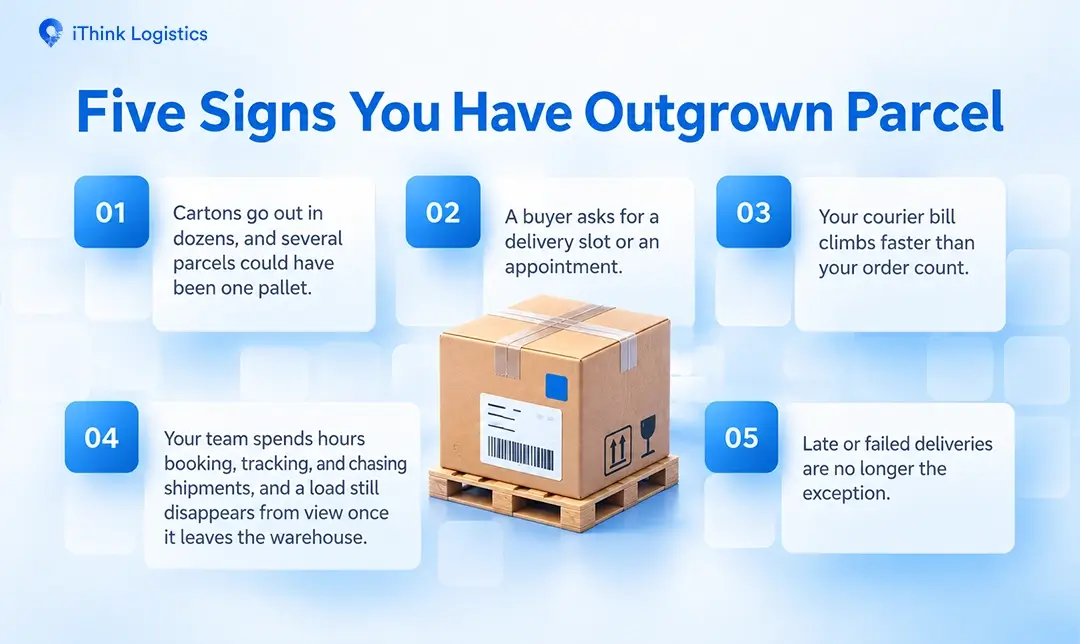
Run last month’s dispatches through this checklist:
- Cartons go out in dozens, and several parcels could have been one pallet.
- A buyer asks for a delivery slot or an appointment.
- Your courier bill climbs faster than your order count.
- Your team spends hours booking, tracking, and chasing shipments, and a load still disappears from view once it leaves the warehouse.
- Late or failed deliveries are no longer the exception.
Two or more of these mean parcel shipping is costing you control. Unused truck space is another place the money goes, as the next part shows.
Why You Pay for a Half-Empty Truck
When you book a full truck, you generally pay for the whole truck, even if it’s half-empty. Many businesses pay for space they never use. Shared and part-load modes exist to fix that.
Before you pick a mode, it helps to see how a B2B shipment actually moves.
How Does a B2B Shipment Move in India, Step by Step?
A B2B shipment typically moves in seven steps, from the buyer’s purchase order to the signed receipt at their dock. Four decisions run through every step: mode, papers, price, and place.
Mode is how the load travels, and papers are the documents it needs. Price is what you pay, and place is where and when the buyer receives it.
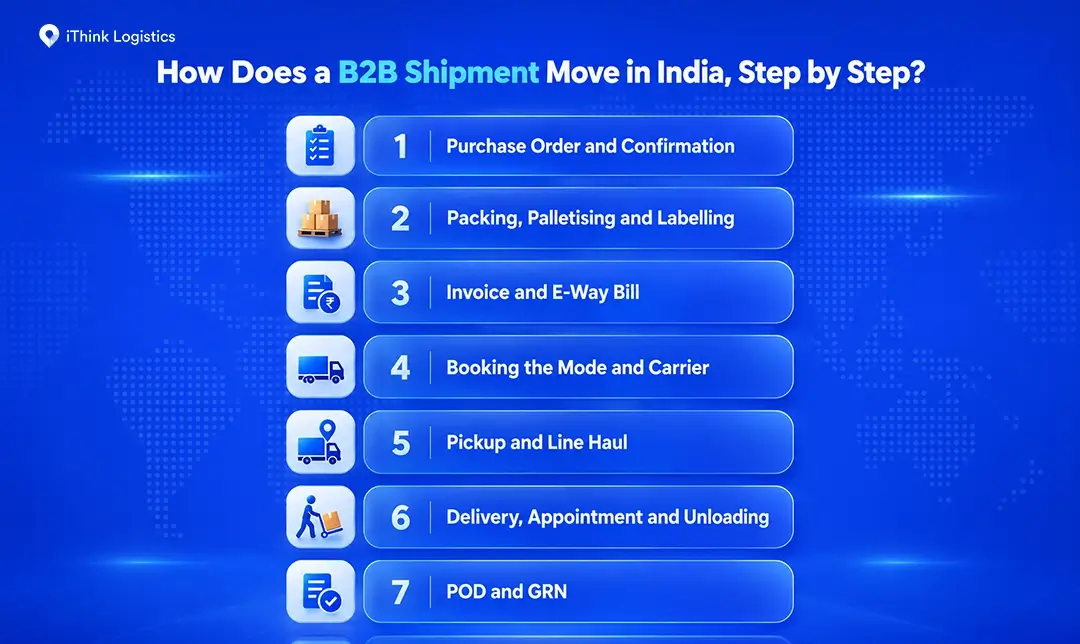
Treat these as typical steps. Your mode and agreement set the details.
1. Purchase Order and Confirmation
The buyer sends a purchase order, and you confirm the quantity, price, and delivery address.
An incorrect address or quantity at this stage often comes back days later as a rejection, so check both before you pack the stock.
2. Packing, Palletising and Labelling
Pack the cartons so they survive handling, and stack them on pallets if the load needs it.
Every carton should carry the consignee, address, and contents, because unlabelled or mixed cartons slow unloading at the buyer’s dock. Even well-packed stock can’t move without its paperwork.
3. Invoice and E-Way Bill
Raise the GST invoice and packing list. Generate the e-way bill before the goods leave if the consignment value is above the limit.
Where it breaks: authorities can detain a vehicle and its goods if the e-way bill is missing or invalid. On taxable goods, release can require a penalty equal to 200% of the tax payable. With papers in order, you can book the mode.
4. Booking the Mode and Carrier
Pick the mode that fits the load, then book it with a carrier or partner. Confirm route, pickup date, and rate before you ship.
Where it breaks: booking by habit instead of by load means overpaying or waiting. Once booked, the load needs to be collected.
5. Pickup and Line Haul
The carrier collects the goods and moves them between cities by road or air. Line haul is the long middle leg of that journey.
Where it breaks: a late pickup pushes every later step back; after the long haul comes arrival at the buyer’s dock.
6. Delivery, Appointment, and Unloading
The vehicle reaches the buyer’s warehouse or store, often within set receiving hours or a booked slot. Staff unload and check the load against the invoice.
Where it breaks: a missed slot can mean a refused or rescheduled delivery. Delivery is not finished until the buyer signs.
7. POD and GRN
The buyer signs the proof of delivery, then checks the goods and records them in a goods receipt note (GRN). Keep both, because they support payment and any dispute.
Where it breaks: damage or shortage not noted at signing is hard to claim later. With the route clear, the next choice is the mode itself.
Which B2B Shipping Mode Fits Your Load?
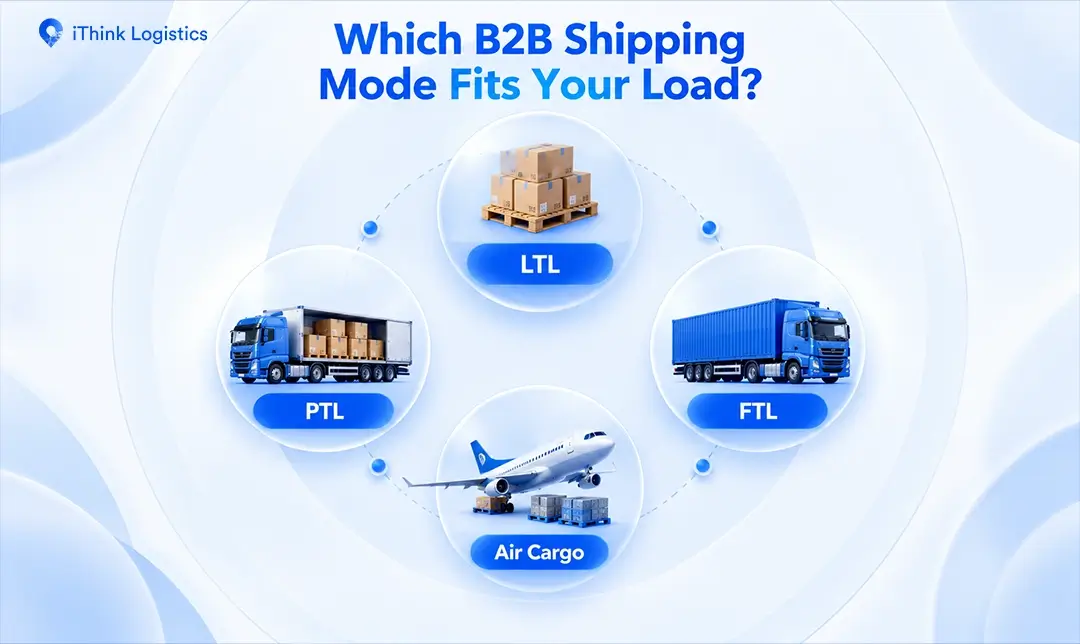
A B2B shipping mode is how a load travels. Options are shared truck space (LTL), a fixed part of a truck (PTL), a whole truck (FTL), or air cargo. Your mode sets speed, cost, and control.
LTL
LTL (less than truckload) means your goods share truck space with other consignments. You pay only for the space you use. It suits smaller loads that do not need a dedicated truck.
When a load needs its own slice of a truck, PTL takes over.
PTL
PTL (part truckload) means you book a fixed portion of a truck. It fits loads too big for a courier but too small for a full truck. You get a clear shipping schedule and pay only for what you book.
When the load fills the truck, FTL is the cleaner choice.
FTL
FTL (full truckload) gives you the whole truck for one shipment. Your goods travel direct, with no stops for other cargo, which makes it the fastest surface option for high-volume orders.
When surface is too slow, air cargo is the alternative.
Air Cargo
Air cargo suits loads that must arrive in about 1 to 2 days. It moves between major cities by air and is tracked at every step. It costs more than surface transport, so keep it for loads where the date cannot slip.
The winning mode depends on your starting location.
When to Move From Parcel to Freight
Price the same load as parcels on the rate calculator first, then compare it with a freight quote.
Your next step depends on where you stand:
- A D2C brand with a first wholesale order should price PTL and FTL and ask the buyer for receiving rules.
- A manufacturer or wholesaler ought to match each route to a mode instead of defaulting to one.
- An operations head fighting failed deliveries should start with delivery slots and exception tracking.
- Anyone comparing partners should use the six checks later in this guide.
Whichever applies to you, the matrix below gives a first pass.
A Decision Matrix
Check your situation against this table, then confirm with your actual route and tonnage:
| Your situation | Likely mode | Why |
| Small, flexible load, no rush | LTL | You pay only for the space you use |
| Mid-size load with a clear timeline | PTL | A fixed portion of a truck, with a set timeline |
| Large load to one destination | FTL | The whole truck, direct |
| Urgent load between major cities | Air cargo | Built for 1 to 2 day deadlines |
| Several loads, different destinations | More than one mode | An aggregator can book every mode in one place |
Which B2B shipping mode fits which load
Which Documents Does a B2B Shipment Need in India?
B2B shipping documents prove what is moving, who owns it, who carries it, and who received it. In India, they usually include a GST invoice, packing list, e-way bill, lorry receipt, and proof of delivery (POD).
This table shows who issues each document, and when:
| Document | Issued by | When | Why it matters |
| GST invoice | Seller | At or before dispatch | Records the sale and the tax |
| Packing list | Seller | At packing | Lets the buyer check the contents |
| E-way bill | Whoever moves the goods, usually the seller; the transporter in set cases | Before the goods move, for consignments worth over ₹50,000 | Records the movement for tax authorities |
| Lorry receipt (LR) | Transporter | When the transporter accepts the goods, or once loading is done | Shows what the transporter received: weight, packages, and details |
| Proof Of Delibery (POD) | Receiver signs | At delivery | Proves delivery |
| GRN | Buyer | After checking the goods | Often the basis for payment and disputes |
| Delivery challan | Sender | At dispatch, instead of an invoice, when goods move without a sale | Covers moves that are not sales, such as job work; an e-way bill may still apply |
Documents in a B2B shipment: who issues what, and when
GST Invoice and Packing List
The GST invoice records the sale, including both parties’ GSTINs and the tax. When goods move without a sale, such as goods sent for job work, a delivery challan can replace it. The packing list records each carton’s contents so that the buyer can check the delivery, and the e-way bill comes next.
E-Way Bill
Generate an e-way bill on the GST portal before the goods move. For inter-state movement, the consignment value limit is ₹50,000, and intra-state rules can differ by state. Validity runs one day per 200 km or part of it, so a 650 km run gets four days.
Overdimensional cargo gets one day per 20 km. Check the live rules on the e-way bill portal before you generate one. The transporter’s own document comes next.
Lorry Receipt and Consignment Note
The transporter issues a lorry receipt (LR), also called a consignment note, when it accepts your goods. It records the load, the route, and the parties. Under the Carriage by Road Act, 2007, the consignor also signs a goods forwarding note declaring the consignment’s value.
After delivery, two more documents close the loop.
POD and GRN
The proof of delivery (POD) is the receiver’s signed acknowledgment. The goods receipt note (GRN) is the buyer’s record after checking quantity and condition. Keep both until you settle the invoice.
With the papers sorted, the next question is what the shipment will cost.
How Is B2B Shipping Priced?
Four things set the price of B2B shipping: the mode, the chargeable weight, the route, and add-on charges, plus GST.
Chargeable weight is usually the higher of the actual and volumetric weight, which converts a load’s space into weight.
Chargeable Weight
Weigh the load and measure its space. The carrier usually compares the two and bills the higher figure. Divisors differ by mode and carrier, so your agreement should state the method.
That figure then meets the base rate.
What Drives the Base Rate
Five things move the base rate up or down:
- The mode you choose
- The tonnage you ship
- The route and distance
- The delivery area at the destination
- Special handling for fragile, heavy, or oversized goods
Urgency can lift it further, and add-on charges sit on top.
Add-On Charges and GST
Add-on charges are the extras that sit on top of the base rate. They are normal in freight and should never come as a surprise: a clear partner lists each one in the rate card and announces any change in advance, with the new rate and the date it starts.
Common ones include a fuel surcharge that follows fuel prices, out-of-delivery-area (ODA) fees, loading and unloading fees, and detention when a vehicle waits. GST applies on top.
For road freight by a goods transport agency, the rate is 5% without input tax credit or 18% with it. Under forward charge, the transporter bills the GST; under reverse charge, the registered recipient pays it.
Who pays the freight charges also matters: with prepaid freight, the sender usually pays and gets the invoice; with freight collect (also called to-pay), the receiver pays on delivery.
A worked example shows how the pieces combine.
A Worked Example (Illustrative)
Freight bill = chargeable weight x rate + add-on charges + GST.
Say a load weighs 600 kg but takes up space equal to 800 kg. The carrier bills 800 kg, so base freight is 800 times your per-kg rate. This is an illustration, not a quote.
Shippers who book ad hoc may get spot-market freight rates, which move with demand. Contract rates hold for an agreed period and terms. Locking a rate is the last piece.
How Rates Are Fixed Upfront
A quote that leaves out add-ons isn’t the full price. Ask for the complete rate card before you book. With iThink Bulk Shipping, you agree on rates and SLA upfront, and iThink adds nothing outside that.
Cost is only half the story, because the last leg decides whether the buyer accepts the load.
Know your mode, tonnage, and route? Get a bulk shipping quote.
What Happens at the Delivery End?
Buyers often set the delivery rules, so expect receiving hours, booked slots, and dock checks.
Appointment-Based Delivery
Some buyers accept deliveries only in a booked slot. You book the slot, confirm it, and reschedule when the vehicle will miss it. iThink Bulk Shipping lets you book, reschedule, or confirm slots for appointment-based and mall deliveries.
Malls and retail warehouses have their own rules.
Mall and Retail Warehouse Delivery
Malls and retail warehouses can set their own receiving rules, so ask the buyer for them before you dispatch. Pass those rules to your transport partner so the driver arrives with the right papers and slot.
Also ask how the buyer unloads, whether by dock, forklift, or ramp, so the vehicle and crew fit the site.
Even with the rules in hand, buyers still refuse deliveries for a few common reasons.
Why Deliveries Get Rejected
Typical reasons a buyer refuses a delivery include:
- A missed slot
- A quantity or item mismatch with the invoice
- Damaged cartons
- Missing documents
Even careful shipments can still arrive late or damaged, so know what to do.
What If a B2B Shipment Is Delayed or Damaged or Returned ?
Act at delivery: note the problem on the proof of delivery, photograph it, and raise a claim under your agreement. The Carriage by Road Act requires written notice of loss or damage within 180 days of booking before you can bring a suit. Your agreement may set a shorter window, so check it before the first shipment.
Carrier Liability vs Insurance
Carrier liability is what the transporter owes you under the law and your contract. The Carriage by Road Act limits a common carrier’s liability to a prescribed amount. You can raise that limit by paying the carrier’s higher risk rate. Insurance is separate coverage you buy for the goods. Shipping insurance can cover high-value loads, so ask what your agreement covers before you ship.
Good records make any claim easier.
What to Document at Delivery
For every problem load, keep a short record:
- Shortage or damage written on the POD before you sign
- Photos of cartons, labels and the vehicle
- The LR, invoice and GRN
- The date and time you reported it
Records support a claim, but spotting a delay early can avoid one.
Why Exception Tracking Matters
Catch a delay early, and you can fix it; catch it late, and it usually becomes a claim. iThink Bulk Shipping flags pickup failures and transit delays early and tracks every shipment from pickup to delivery.
Not every problem is damage, because some shipments come back.
Returns in B2B Shipping
One B2B return can mean whole cartons or a pallet. Agree on the return window, the inspection steps, and who pays return freight before the first shipment. Put those terms in your agreement, not in an email conversation.
With the risks mapped, you can judge who should carry your freight.
How Do You Choose a B2B Shipping Partner?
Choose the partner whose network, pricing clarity, and tracking match your loads, then confirm it in writing.
Aggregator, Direct Transporter or 3PL
Pick by load mix: one route and one mode may suit a direct transporter, while mixed loads suit an aggregator. You will find many logistics companies in India, from national carriers to top 10 aggregators, so shortlist based on the loads you ship.
Whichever type you pick, test it against the same six questions.
Six Checks Before You Sign
Put these six questions to every partner on your shortlist:
- Does the network reach your delivery pincodes?
- Can it handle LTL, PTL, FTL, and air under one account?
- Are all add-on charges in writing?
- Do you get tracking from pickup to delivery?
- Can it handle appointment and mall deliveries?
- Who flags delays, how fast, and who answers your call?
Written answers to all six make the later comparison easy
About iThink Logistics Bulk Shipping
iThink Bulk Shipping is a B2B courier service for businesses shipping beyond parcel volume. It combines LTL, PTL, FTL, and air cargo through 7+ courier and freight partners across 14,000+ pincodes.
It already serves 70+ businesses, has shipped 400+ tonnes, and you agree on rates upfront in your SOP.
A good partner helps, but you can avoid the mistakes below. Talk to the Bulk Freight team
Five B2B Shipping Mistakes Indian Businesses Make
Each of these is easy to fix before your next dispatch:
- Booking a parcel courier for a pallet load.
- Generating the e-way bill late, or not at all.
- Accepting a quote without checking chargeable weight and add-on charges.
- Skipping the buyer’s delivery rules.
- Signing the POD without noting damage.
If you are still weighing a decision, the questions below are the ones shippers ask most.
FAQs
Q.1: What is B2B shipping?
A: B2B shipping is the transport of goods from one business to another. A wholesaler restocking a retailer is a typical case. It differs from parcel delivery in load size, documents, and delivery rules.
Q.2: What is the difference between B2B and B2C shipping?
A: B2B shipping moves bulk goods between businesses, while B2C shipping delivers single orders to consumers. B2B needs more documents, planned deliveries, and freight pricing. B2C runs on parcel networks and slab rates.
Q.3: Is B2B shipping defined by shipment size?
A: No, the sender and receiver define it. A small carton between two companies is still B2B. Size affects the mode and the price, not the definition.
Q.4: What are the main types of B2B shipping in India?
A: The main modes are LTL, PTL, FTL, and air cargo. LTL shares truck space, and PTL books a fixed portion of a truck. FTL books the whole truck, and air cargo suits 1- to 2-day deadlines.
Q.5: Which documents are required for B2B shipping in India?
A: Common B2B documents include a GST invoice, packing list, lorry receipt, and proof of delivery. An e-way bill is also required for consignments above the value limit, which is ₹50,000 for inter-state movement. Intra-state rules can differ by state, so check yours.
Q.6: How is B2B shipping charged?
A: Four things set the charge: mode, chargeable weight, route, and add-ons, plus GST. Chargeable weight is usually the higher of actual and volumetric weight. Ask for every add-on in writing.
Q.7: What is B2B standard shipping?
A: People use ‘B2B standard shipping’ loosely for ordinary, non-expedited movement of goods between businesses. It isn’t a fixed industry category, so the mode depends on size, destination, and timeline.
Q.8: What is the difference between B2B shipping and B2B logistics?
A: B2B shipping is the movement of goods. B2B logistics also covers warehousing, inventory, and order handling. Shipping is one part of logistics.
Q.9: How do I choose a B2B shipping provider?
A: Check network reach, mode coverage, pricing in writing, tracking, and delivery slot handling. Then confirm rates and service levels in an agreement before your first shipment.
Q.10: Is Delhivery B2B or B2C?
A: Delhivery serves both. It offers parcel services and also runs B2B logistics for enterprises.
The Bottom Line
B2B shipping is less about finding the cheapest truck and more about knowing exactly what you are booking. Lock in the mode, paperwork, price, and delivery slot before dispatch to reduce surprises at the dock.
If your loads have outgrown parcel, iThink Bulk Shipping puts LTL, PTL, FTL, and air cargo under one network. Share your mode, tonnage, and route, and the Bulk Shipping crew will put together a quote.
Author