Yes, Etsy works in India for both buyers and sellers, though sellers face real restrictions. Indian shoppers can buy on Etsy’s website and app with prices shown in rupees. Delivery depends on whether each seller ships to India.
Etsy is available in India for sellers too, with conditions. New Indian shops need a GSTIN and Payoneer payouts. They can sell only to buyers outside India. This guide covers both sides, as of 2026.
Does Etsy Work in India? The Short Answer
As of 2026, Etsy works in India for buyers and sellers, with conditions on the seller side.
For buyers: Etsy works normally. Browse Etsy India or the Etsy app, set your currency to INR, and pay with an international-enabled card. Whether an item reaches you depends on whether that seller ships to India.
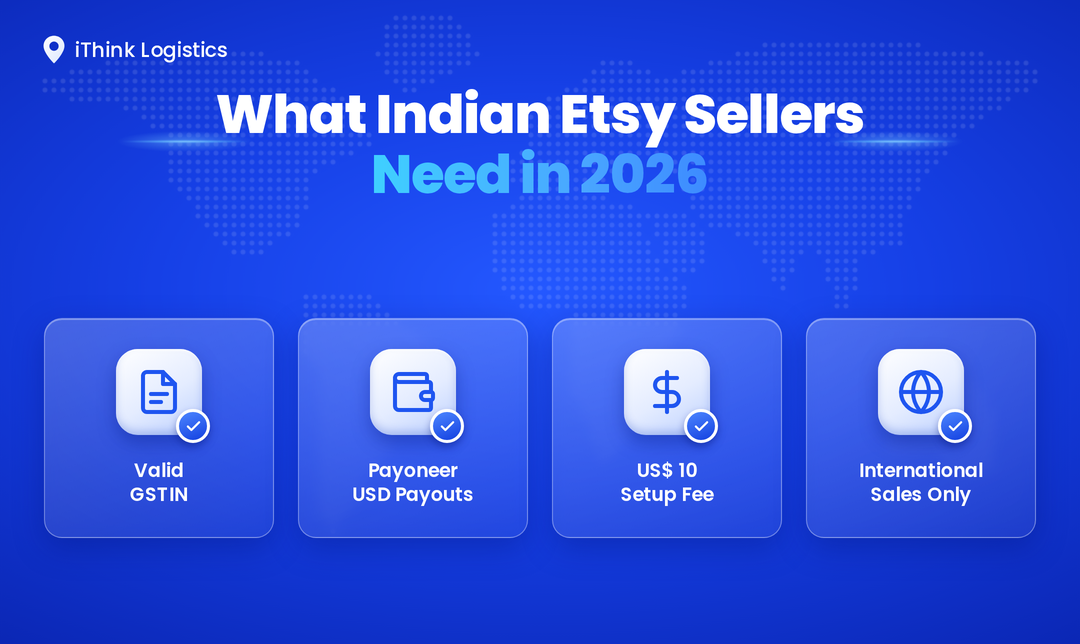
For sellers: Etsy paused new Indian seller registrations in late 2023. It reopened onboarding around June 2025 with stricter rules. Every Indian shop needs a valid, regular GSTIN, and payouts go through Payoneer in US dollars.
New Indian shops can currently sell only to international buyers. These rules have changed several times since 2023, so check Etsy’s help page for Indian sellers before you register.
Does Etsy Work in India for Sellers? The 2026 Rules
Yes, you can sell on Etsy in India again, but the rules are very different from a few years ago. Here is what every new Etsy seller in India should know before registering.
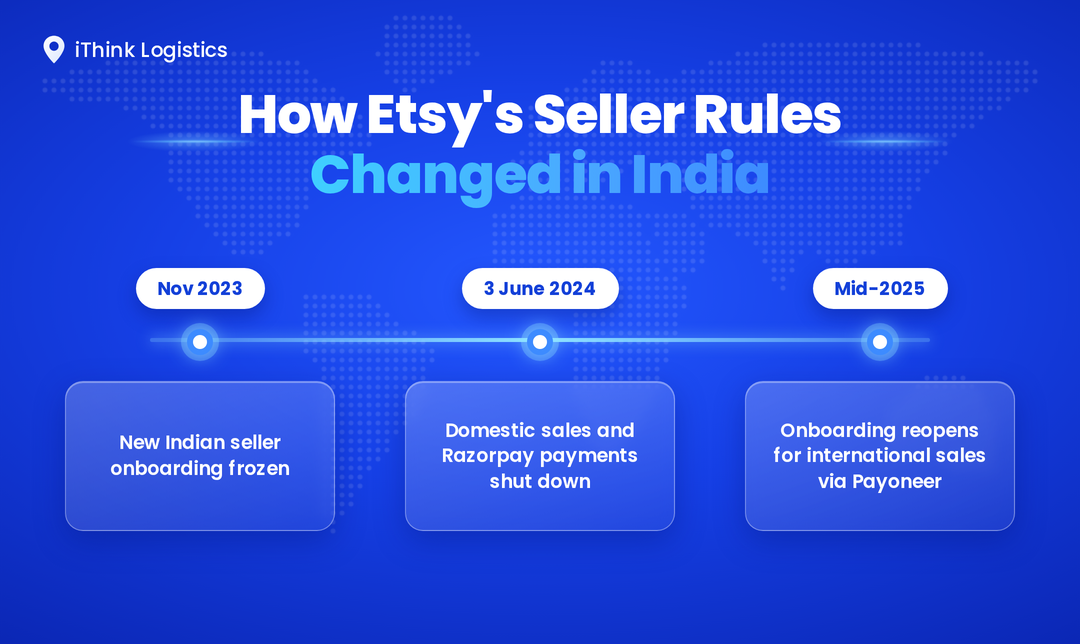
How the rules changed: a short timeline
- Late 2023 (around November): Etsy paused new seller onboarding from India (ShipGlobal).
- 3 June 2024: Etsy ended domestic sales for Indian sellers and retired India Payments, its Razorpay-powered system. Existing sellers had to move to Etsy Payments to keep selling abroad (Etsy Community).
- Around June 2025: Onboarding reopened under Etsy Payments with Payoneer, for international sales only.
Can Indian sellers use Razorpay on Etsy? No. Razorpay powered India Payments, Etsy’s old payment system for Indian sellers. Etsy stopped offering it on 3 June 2024, so no seller can use it today.
What an Etsy seller in India needs today
- A valid, regular GSTIN. Etsy requires an active GSTIN to sell, and shops without one can be suspended (Etsy Help).
- A Payoneer account linked to your Indian bank. Etsy deducts its fees from each sale, then deposits the rest in US dollars to your Payoneer account every Monday. You then withdraw to your bank, which usually takes 2 to 5 business days. Payoneer may charge a withdrawal fee and set a minimum amount (Etsy Help).
- A one-time setup fee of US$ 10, paid during onboarding.
- International buyers only. New shops opened in India cannot accept domestic orders at this time.
- PAN on file. Etsy reports the tax it withholds against your PAN and GSTIN. Without an active GSTIN, the tax authorities may be unable to credit that tax to you (Etsy Help).
Etsy Fees and Taxes for Indian Sellers
These are the charges Etsy applies to Indian shops in 2026 (Etsy Fees Policy, regulatory fee page).
| Charge | Rate | How it applies |
|---|---|---|
| Shop setup fee | US$ 10, one time | Paid once during onboarding. |
| Listing fee | US$ 0.20 per listing (about Rs. 19) | Listings last four months and renew for another US$ 0.20. |
| Transaction fee | 6.5 percent | Charged on item price plus shipping. |
| Payment processing fee | 5 percent plus Rs. 25 per order | Charged on the full order total, including shipping. |
| Regulatory operating fee | 0.05 percent | Charged on item price plus shipping. It was 0.29 percent before 22 June 2026. |
| Currency conversion fee | 2.5 percent | Applies only if your listing currency is not US dollars. List in US dollars to avoid it. |
| Offsite Ads fee | 15 percent, or 12 percent after US$ 10,000 in sales | Charged only on orders that come from Etsy’s own ads. Capped at US$ 100 per order. |
| TDS (tax deducted at source) | 0.1 percent | Deducted by Etsy where you have given a PAN or GSTIN. |
| TCS (tax collected at source) | 0.5 percent | Collected by Etsy and reported against your GSTIN. |
Etsy charges the Offsite Ads fee only when a buyer clicks one of its ads and orders within 30 days. Shops under US$ 10,000 in sales over 365 days can opt out. Past that mark, the ads are compulsory for the life of the shop.
Worked example: Take a US$ 30 item with US$ 10 shipping, listed in US dollars. The order total is US$ 40. Etsy’s charges on that order are:
- Listing fee: US$ 0.20
- Transaction fee, 6.5 percent: US$ 2.60
- Payment processing, 5 percent plus Rs. 25: US$ 2.00 plus Rs. 25 (about US$ 0.26 at Rs. 95 to the dollar)
- Regulatory operating fee, 0.05 percent: US$ 0.02
- Currency conversion fee: none, because the listing is in US dollars
Etsy’s fees come to about US$ 5.10, or roughly 13 percent of the order. You keep about US$ 34.90 before TDS, TCS and Payoneer charges.
If the sale came from an Offsite Ad at 15 percent, Etsy takes another US$ 6.00. You then keep about US$ 28.90.
TDS and TCS are not in that total. They are prepaid taxes, credited to your tax account when your PAN and GSTIN are correct. Next, check who can actually buy from an Indian shop.
Can I sell on Etsy from India within India?
No. If your goal is Indian buyers, Etsy is the wrong channel for now. Etsy says digital items from Indian shops can be bought in any region except India (Etsy Help). Unlike Amazon India or Meesho, Etsy is not an India-focused marketplace. Use those, or your own store, for domestic sales.
What sells well from India globally
Popular categories for Indian sellers include handicrafts and block-printed textiles, silver and artificial jewellery, home decor and brassware, and wedding stationery. Digital products like printables and templates skip shipping and customs entirely. For more ideas, see our list of trending and profitable e-commerce business ideas.
The Etsy Seller Handbook is a useful next read on how to sell on Etsy from India, from listing photos to pricing.
Does Etsy Deliver to India?
Yes, Etsy delivers to India, but only from sellers who ship here. Each Etsy shop sets its own shipping profile. So availability changes listing by listing, not across the whole site.
Sellers who already ship worldwide will usually deliver to India. Many smaller shops ship only within their own country or region. Digital downloads need no shipping at all.
Delivery times vary widely. Express courier can take about a week, while standard post can take several weeks. The time depends on the origin country, the shipping method and customs clearance, so always check the estimate on the listing. Customs duties may also apply on arrival.
How to Check If an Etsy Seller Ships to India
- Open the listing and scroll to the shipping and returns section, just below the price.
- Find the “ships from” country and the destination selector. Set the destination to India.
- If the seller ships here, you will see a shipping cost and an estimated delivery window. If not, the listing will tell you it does not ship to your country.
- Check the estimated delivery date, not just dispatch time. The gap between them is the international transit.
- On search results, set your location to India in the filters. Listings that cannot reach you are then hidden or pushed down.
Customs Duty and Import Charges on Etsy Orders in India
Etsy states that buyers are generally responsible for duties, taxes, tariffs and customs clearance fees on international orders. Most of these charges fall due once the package arrives (Etsy Help).
Some sellers ship DDP (delivered duty paid), and you pay the charges at checkout. Others ship DDU (delivered duty unpaid), and the courier collects customs duty and IGST at delivery. Etsy does not estimate these charges for you, and suggests checking with your local customs office.
Whether charges apply depends on the item’s value and category, its origin and Indian import rules at arrival. Treat listing price plus shipping as a starting figure. Your true landed cost may be higher on expensive orders.
How to Buy from Etsy in India (Step by Step)
Buying from Etsy in India works like anywhere else, with two extra checks: shipping availability and landed cost.
- Create an Etsy account. Sign up on etsy.com/in-en or the app with your email, Google, Facebook or Apple login. The Indian site is a localised view of the same global marketplace.
- Set your region to India and currency to INR. You will find this in settings or at the bottom of the desktop page. Prices then show in rupees.
- Filter for items that ship to India. Use the location filter on search results. That hides shops that cannot deliver to you.
- Check shipping cost and delivery window. Confirm the item ships to India. Note shipping cost separately, and read the delivery estimate, not just processing time.
- Message the seller if anything is unclear. Ask about courier choice, tracking and whether duties are prepaid. Get the answer before you pay.
- Pay with an international-enabled card. Since 2020, Indian banks have let you switch international use on or off for each card (Business Today), so turn it on in your banking app first. Your bank may add a foreign currency markup.
- Track the shipment and plan for customs. Use the tracking link on your Etsy order page. If duty applies, the courier will usually contact you before delivery.
Two quick tips. Digital downloads carry no shipping or customs risk. For physical items, group purchases from one seller where you can. One larger parcel ships cheaper than three small ones.
Orders paid through Etsy checkout are covered by Etsy’s Purchase Protection if an item does not arrive, arrives damaged or does not match its description.
Selling on Etsy from India? Shipping Is Your Biggest Operational Question
New Indian shops sell only to international buyers. So every physical order is a cross-border shipment that you price and arrange yourself. Etsy does not ship for you.
You have three broad options:
- India Post is often the cheapest option for light parcels. But it is slower, and tracking can be less detailed once the parcel leaves India.
- Global couriers like FedEx, DHL and UPS are fast and fully tracked. Their per-parcel cost can be high relative to a small item’s value, though.
- A cross-border shipping aggregator sits in between. You get negotiated rates across carriers and one tracking view.
Get three things right before your first listing goes live:
- Price shipping into the product. International freight can be a large share of a low-priced item’s value. Decide whether to absorb it, charge it or offer “free shipping” at a higher price.
- Pack for weeks, not days. International parcels are handled many more times. Our export packaging guide for Indian D2C sellers covers what survives the journey.
- Get the paperwork right first time. Commercial invoices, HS codes and declared values are where parcels get stuck. Read our export documentation and compliance guide, and check whether you need an IEC code.
Also learn the de minimis thresholds in your main markets. They decide whether your buyer faces a customs bill on arrival. Surprise customs bills can lead to unhappy buyers and poor reviews.
Export Paperwork for Etsy Orders from India
Every physical Etsy order from India is an export, so a few documents apply before the parcel leaves. Digital downloads ship nothing, so no shipping bill applies to them. Have these in place before your first order ships:
- IEC (Importer Exporter Code). Commercial exporters need an IEC from DGFT, issued against your PAN. Your courier uses it to file the shipping bill.
- LUT (Letter of Undertaking). File it on the GST portal in Form RFD-11 before your first export of each financial year. It lets you export without paying IGST. Without it, you pay IGST on every export and claim a refund later.
- CSB-V (courier shipping bill). This is the customs declaration for commercial courier exports. Your courier files it using your IEC, GSTIN and HS code. Ask for a CSB-V on courier parcels, and read what CSB-IV and CSB-V are for the difference.
- FIRA and e-FIRA (proof of payment). Payoneer provides a digital FIRA you can download for your payouts. Your bank can use it to issue an e-FIRA and, for goods, an e-BRC. Keep these with your invoices and shipping bills.
- No courier value limit. DGFT Notification 67/2025-26 removed the Rs. 10 lakh per-consignment limit on courier exports. It took effect on 1 April 2026. Most Etsy parcels sit far below that value, so the change matters mainly for high-value pieces such as silver jewellery.
Your shipping partner should tell you who files each document. To compare cross-border options, see international shipping with iThink Logistics.
How iThink Logistics Helps Indian Sellers Ship Worldwide
If your Etsy shop sells only abroad, your logistics partner is part of your product. iThink Logistics gives Indian sellers international shipping across multiple global carriers from one dashboard. You get discounted cross-border rates a single small shop would struggle to negotiate.
Share end-to-end tracking with overseas buyers through a white-label tracking page. You also get guidance on export documentation, so parcels move through customs instead of sitting in it.
Start shipping internationally with iThink Logistics.
FAQs About Etsy in India
Is Etsy available in India for shopping?
Yes. Etsy is available in India through its website and app. Set your currency to INR, pay with an international-enabled Indian card, and buy from any shop that ships to India. Digital downloads need no shipping.
Does Etsy deliver to India?
Yes, but delivery depends on the seller, not on Etsy. Each shop chooses which countries it ships to. Check the listing’s shipping section and set the destination to India before ordering.
How long does Etsy delivery to India take?
It varies from about a week by express courier to several weeks by standard post. Timing depends on the origin country, shipping method and customs. Check the estimated delivery date on each listing before you order.
Does Etsy work in India for new sellers?
Yes. Etsy paused Indian seller onboarding in late 2023 and reopened it around June 2025. New shops need a valid GSTIN, a Payoneer account and a US$ 10 setup fee. They can sell only to international buyers.
Can Indian sellers sell to buyers within India on Etsy?
No. Etsy ended domestic sales for Indian sellers on 3 June 2024. As of 2026, shops opened in India can sell only internationally. For Indian buyers, use Amazon India, Meesho or your own store alongside Etsy.
How much does it cost to sell on Etsy in India?
You pay a one-time US$ 10 setup fee, then US$ 0.20 per listing and 6.5 percent of each sale. Payment processing adds 5 percent plus Rs. 25 per order, and a 0.05 percent regulatory fee applies. Offsite Ads and currency conversion can add more in some cases.
Do I pay customs duty on Etsy orders in India?
Possibly. Etsy says buyers are generally responsible for duties, taxes and clearance fees, usually due on arrival. Some sellers prepay duty at checkout. Budget beyond the listed price on higher-value orders.
Can Indian sellers use Razorpay to accept Etsy payments?
No. Razorpay powered Etsy’s old India Payments system. Etsy retired it on 3 June 2024. Indian sellers now receive payouts only through Payoneer, in US dollars.
What is Etsy India?
Etsy India (etsy.com/in-en) is the Indian-localised version of the global Etsy marketplace, with prices in rupees. Indian buyers shop the same global catalogue as everyone else, and Indian sellers list on the same platform.
Is Etsy popular in India?
Etsy is not a mainstream shopping site in India the way Amazon India, Flipkart or Meesho are, partly because Indian sellers cannot sell domestically on it. For Indian artisans and small brands, though, it is a route to buyers abroad.
How is Etsy different from Amazon India or Meesho?
Amazon India and Meesho are built for Indian buyers and domestic delivery. Etsy is a global marketplace for handmade, vintage and craft items. Indian sellers can use Etsy only for international sales.
Author