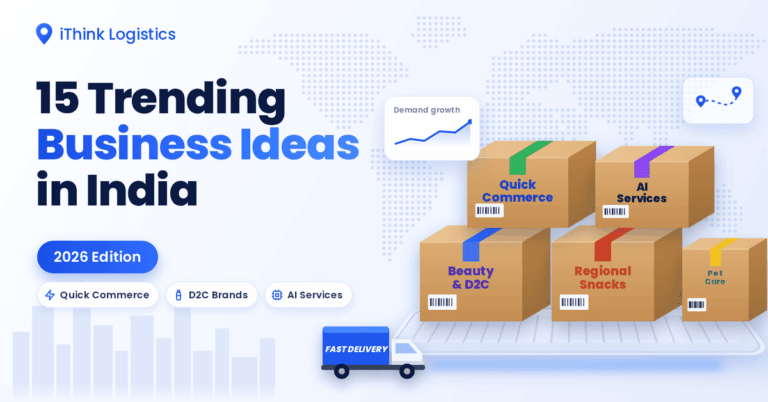
The most trending business ideas in India for 2026 are D2C beauty brands and regional packaged food. Hyperlocal quick-commerce supply and AI automation services are close behind. Pet care and digital products round out the leaders.
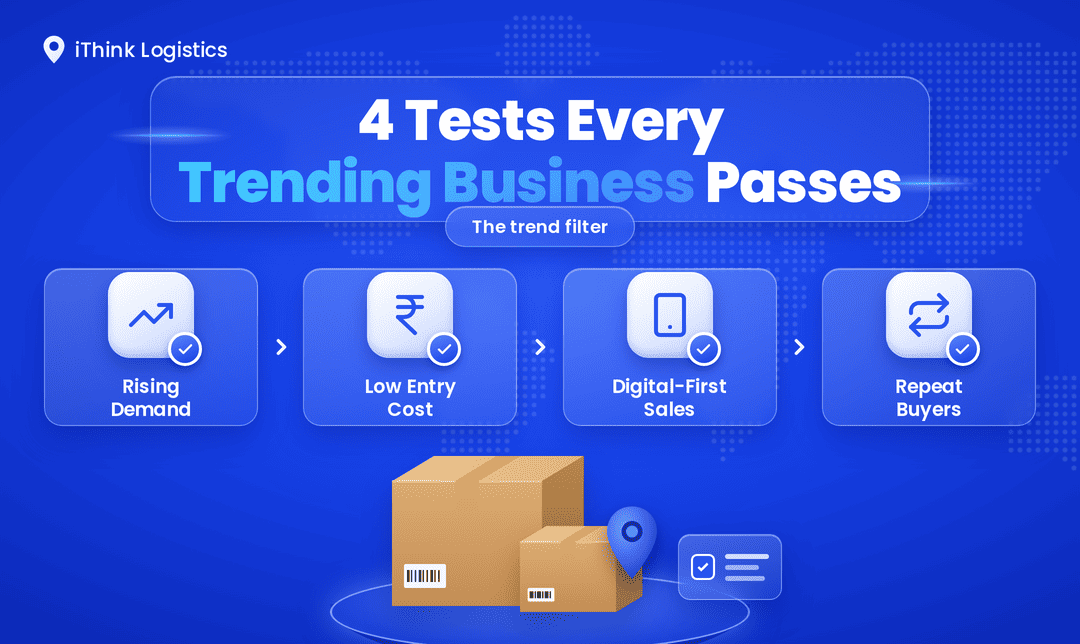
Every idea here passed four tests: rising demand, a low entry cost, digital-first sales and repeat buyers. iThink Logistics ships for more than 37,000 e-commerce brands, so we see which categories keep shipping month after month.
What Makes a Business “Trending” in India Right Now?
Trending business ideas in India share four traits, and all four must hold at once.
- Demand is rising, not just large. Search interest, marketplace listings and repeat orders are all growing year on year.
- The entry barrier is low. It passes the Rs. 2 lakh test: you can start a lean version for under Rs. 2 lakh. No factory or retail lease is needed.
- Distribution is digital-first. You reach customers through Instagram, WhatsApp, a Shopify store or a marketplace, not shelf space.
- Customers come back. Acquiring a buyer once and selling to them four times is what turns a trend into a business.
Ideas that clear all four are worth building. Ideas that clear only the first are usually somebody else’s marketing.
The timing also favours new founders. India’s e-commerce market was worth about US$ 125 billion in 2024. It is projected to reach US$ 345 billion by 2030, according to Infisum’s Smart Growth in a Fast Market report. The same report expects 420 to 440 million online shoppers by 2030. It also finds that tier-2 and tier-3 cities now account for 66 percent of new D2C orders. More buyers in more pin codes changes which businesses are realistic to start.
Top Trending Business Ideas in India for 2026
Most of the 15 ideas below are product businesses, which need shipping and sit closest to iThink’s daily work. A few service ideas suit founders who would rather sell a skill than hold stock. We chose all 15 for demand and entry cost, not margin.
Each entry covers the same four points, so you can compare ideas side by side. Investment ranges are rough estimates and vary by city, scale and sourcing.
1. D2C Personal Care and Beauty Brands
What it is: Skincare, haircare or grooming products sold under your own label. A contract manufacturer makes them, while you own the brand, pricing and customer.
Why it is booming: Household and personal care make up about half of India’s FMCG sales. Redseer expects Gen Z and Gen Alpha to drive nearly half of India’s beauty and personal care spending by 2030. Ingredient-led and regional brands are taking share that national players once owned.
Starting investment: Rs. 1.5 lakh to Rs. 5 lakh. Your first batch, packaging, product testing and a simple online store use most of it.
How orders reach customers: Your own Shopify or WooCommerce store plus Instagram. A courier aggregator handles prepaid and COD deliveries across pin codes.
2. Homemade Food and Regional Snacks
What it is: Packaged pickles, masalas, laddoos, millet snacks and filter coffee. These are made in a small licensed kitchen and sold nationally.
Why it is booming: IMARC puts India’s snacks market at about Rs. 50,590 crore in 2025, growing near 8 percent a year to 2034. Migrants in metros often look for food from their home state. Small regional brands can serve that niche better than national ones.
Starting investment: Rs. 50,000 to Rs. 2 lakh, including FSSAI registration or licence, food-grade packaging and a small production setup.
How orders reach customers: Instagram and WhatsApp orders at first, then a website. Choose surface or air shipping based on shelf life.
3. Sustainable and Reusable Products
What it is: Bamboo toothbrushes, steel straws, cloth bags, refill cleaners, menstrual cups and plastic-free packaging for other brands.
Why it is booming: India banned identified single-use plastic items from 1 July 2022 (PIB). That pushed households and businesses towards alternatives, including sustainable packaging for other brands.
Starting investment: Rs. 40,000 to Rs. 1.5 lakh, mostly inventory and packaging design.
How orders reach customers: Amazon and Flipkart for discovery, your own store for repeat buyers. The parcels are light, so they ship cheaply.
4. Pet Care Products
What it is: Treats, grooming kits, beds, toys and supplements for dogs and cats. Pick one niche, such as dog treats, and sell under your own label or in a curated store.
Why it is booming: Redseer valued India’s pet care market at about US$ 3.5 billion in 2024 and expects US$ 7 billion by 2028. Food, treats and litter are bought again and again, which makes repeat orders likely.
Starting investment: Rs. 75,000 to Rs. 3 lakh, depending on whether you manufacture or resell.
How orders reach customers: Subscription-style repeat orders through your own store, shipped monthly. COD still matters outside the top eight cities.
5. Ethnic Wear and Jewellery Resale
What it is: Sarees, kurta sets, lehengas and artificial or silver jewellery sourced from Surat, Jaipur or Tiruppur. You resell them online under your own brand.
Why it is booming: Wedding and festive demand runs all year across India’s regions. Social commerce lets you build a following before holding much stock.
Starting investment: Rs. 30,000 to Rs. 2 lakh. It drops further if you start with made-to-order.
How orders reach customers: Instagram live selling and WhatsApp catalogues, then a store. Fashion sees frequent returns, so read our guide on reducing returns in e-commerce before you scale.
6. Dropshipping and Print on Demand
What it is: You list products on your store, and a supplier makes and ships each order after purchase. Print on demand covers t-shirts, mugs, posters and phone cases with your designs.
Why it is booming: It removes inventory risk entirely. That makes it a popular first test for new founders. Design-led niches like regional humour work well because generic listings compete on price.
Starting investment: Rs. 10,000 to Rs. 50,000, mostly store setup and ad testing.
How orders reach customers: Straight from the supplier or print partner. Our guide to dropshipping in India covers supplier selection and delivery timelines.
7. Digital Products and Online Courses
What it is: Digital goods you package once and deliver by download or login. Examples include Notion templates, photo presets, recorded courses and paid communities.
Why it is booming: Creator platforms have made checkout and delivery simple. Courses and templates can be sold in regional languages as well as English. There is no shipping and no COD risk.
Starting investment: Rs. 5,000 to Rs. 30,000, mostly your time plus a course platform.
How orders reach customers: Instant delivery by email or member login. Along with local services and the AI agency, this is one of three ideas with zero logistics.
8. Home Decor and Handicrafts for Export
What it is: Handmade Indian pieces such as block-printed linens, brassware, pottery and jute decor. You sell them to overseas buyers on marketplaces or your own site.
Why it is booming: Marketplaces such as Etsy and Amazon Global Selling let small sellers reach overseas buyers without a trade fair. See our list of products to export from India.
Starting investment: Rs. 50,000 to Rs. 2.5 lakh. This covers your Import Export Code, sample stock and sturdy export packaging.
How orders reach customers: Cross-border shipping with tracking and correct export documentation. Incomplete paperwork is a common reason parcels get held at customs.
9. Refurbished Electronics
What it is: Sourcing used phones, laptops and tablets, restoring them to working order and selling them with a written warranty.
Why it is booming: Refurbished devices sell at a clear discount to new ones. A written warranty reduces the risk buyers worry about most. Trade-in programmes keep a steady supply of used devices coming in.
Starting investment: Rs. 1 lakh to Rs. 5 lakh. Stock takes most of it, so start with a small batch.
How orders reach customers: Insured, high-value shipping with signature confirmation. Read our guide to shipping fragile and high-value items.
10. Health Supplements and Wellness Products
What it is: Own-label protein powders, vitamin gummies, sleep aids and ayurvedic blends, made by a contract manufacturer.
Why it is booming: More buyers now spend on preventive health, and healthy food is growing with them. Supplements are consumables, so a monthly pack means a monthly reorder.
Starting investment: Rs. 2 lakh to Rs. 6 lakh. Licences from FSSAI or AYUSH and third-party lab tests come first.
How orders reach customers: Your own store plus marketplaces, with subscription reorders shipped monthly.
11. Baby and Kids Products
What it is: Organic clothing, wooden toys, feeding essentials, baby skincare and learning kits for toddlers.
Why it is booming: Parents tend to research baby products closely and pay for safety and ingredients. Children outgrow clothes and toys quickly, which creates repeat demand. Our roundup of baby product brands in India shows the category today.
Starting investment: Rs. 75,000 to Rs. 3 lakh, plus certification costs where safety standards apply.
How orders reach customers: Your own store and marketplaces. Pack carefully, since damaged items quickly turn into returns.
12. Agri Products and Organic Staples
What it is: Cold-pressed oils, unpolished millets, single-origin spices, jaggery, honey and A2 ghee, sold direct from producing regions.
Why it is booming: Buyers pay more for products they can trace to a farm or region. NIQ finds e-commerce holds 21 percent of FMCG sales in the top eight metros and 7 percent nationally. That gives small producers a direct route to buyers.
Starting investment: Rs. 50,000 to Rs. 2 lakh, including FSSAI licensing and leak-proof packaging.
How orders reach customers: These parcels are heavy, so cost per order matters. Check weight slabs with a rate calculator before you set prices.
13. Local Services Going Online
What it is: Tutoring, fitness coaching, home repairs, appliance servicing, beauty at home and pet grooming, booked online instead of by word of mouth.
Why it is booming: Customers increasingly find local providers through Google search and WhatsApp. A free Google Business Profile puts you on Maps. Service businesses need no inventory and very little capital.
Starting investment: Rs. 5,000 to Rs. 50,000, mostly listings, a booking page and basic tools.
How orders reach customers: You deliver the service in person or online, so there is no shipping. With Rs. 10,000 and a skill, this is the cleanest place to start.
14. Hyperlocal Quick-Commerce and Dark-Store Supply
What it is: Supplying or partnering with Blinkit, Zepto and Instamart-style operators, or running a hyperlocal delivery store yourself. The next frontier is tier-2 and tier-3 cities, which will need local suppliers.
Why it is booming: Bain and Flipkart expect quick commerce to drive 45 to 50 percent of India’s incremental e-retail GMV by 2030. Most new centres sit in the top ten cities, and Bain says adoption beyond Tier 1 is still unproven. Our guide on how to build an on-demand hyperlocal business model covers the setup.
Starting investment: Rs. 1 lakh to Rs. 5 lakh, depending on whether you supply products or run delivery.
How orders reach customers: Delivery within the same city, often within hours. Of every idea here, this one is a logistics business at its core.
15. AI Automation Agency for Local Businesses
What it is: Building chatbots, WhatsApp automation and simple AI workflows for Indian SMEs and MSMEs. Clinics, coaching centres, D2C brands and real estate firms are common first clients.
Why it is booming: Many small businesses want AI tools but lack the time to set them up. WhatsApp Business is already how many Indian SMEs talk to customers, so automating it has clear value. One working demo is often the best sales pitch.
Starting investment: Rs. 10,000 to Rs. 50,000, mostly software subscriptions and a basic website.
How orders reach customers: Everything is delivered online, so there is no shipping. Most agencies bill a setup fee plus a monthly retainer.
Booming Businesses in India: Which Sectors Are Growing Fastest?
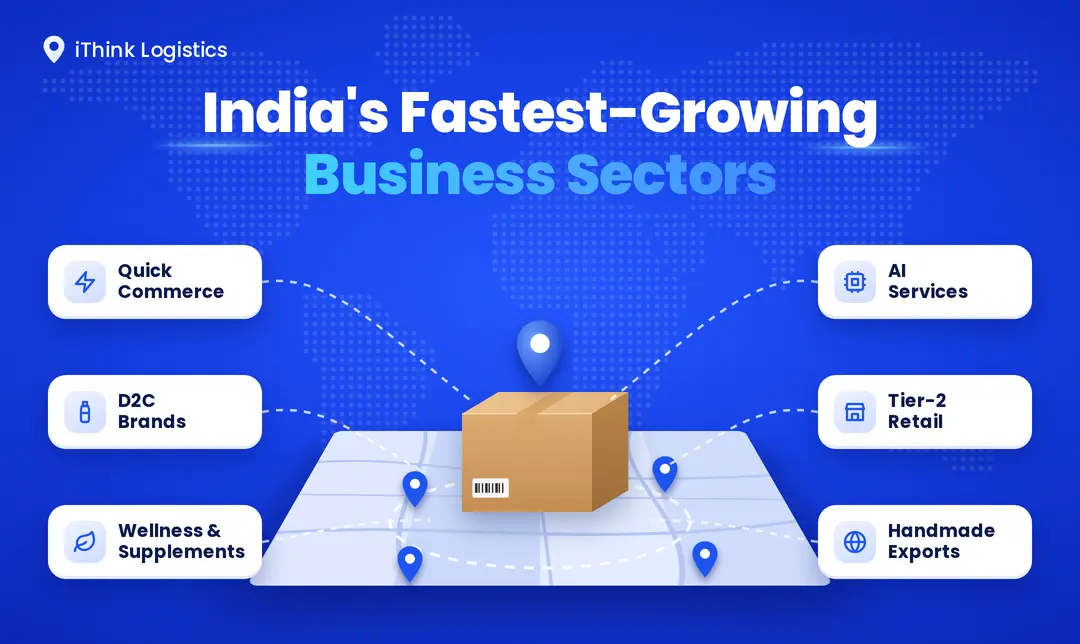
The fastest-growing booming business in India is quick commerce. D2C e-commerce, wellness, skills-led education and tier-2 retail digitisation follow.
Quick commerce. Quick commerce. Bain and Flipkart value the market at US$ 10 to 11 billion GMV in 2025, doubling yearly for two years. They project US$ 65 to 70 billion by 2030 (How India Shops Online 2026). The openings go beyond delivery into dark-store supply, packaging and small-batch FMCG.
D2C e-commerce. McKinsey sizes India’s D2C market at US$ 10 to 12 billion in 2025. It expects US$ 55 to 60 billion by 2030, about five times in five years.
Wellness. Preventive health, supplements and better-for-you food keep gaining buyers. IMARC expects India’s healthy snacks market to grow from US$ 3.13 billion in 2025 to US$ 4.77 billion by 2034.
Education-adjacent services. Upskilling, exam coaching and hobby classes can now be taught online. Many students still choose a teacher they trust over a large platform.
Tier-2 and tier-3 retail digitisation. Buyers in smaller cities now place 66 percent of new D2C orders, according to Infisum. COD-friendly checkout and regional-language support help brands serve these buyers.
Most Popular Business in India by Category
Small retail shops, such as kirana stores, are the most common business in India. Among new online founders, D2C beauty and personal care is one of the most popular choices. It pairs repeat purchase with a low manufacturing barrier.
| Category | Most Popular Business Type | Why It Leads |
|---|---|---|
| Retail and D2C | Beauty and personal care brands | High repeat purchase, contract manufacturing removes the factory, strong online demand |
| Food | Cloud kitchens and packaged regional snacks | Low overhead, delivery-native, FSSAI licensing is online |
| Services | Digital marketing, tutoring and AI automation | Zero inventory, skill-based pricing, can start the same week |
| Sustainable | Reusable and eco-friendly everyday products | Single-use plastic ban plus rising conscious-consumer demand |
| Fashion | Ethnic wear and artificial jewellery | Year-round festive and wedding demand, cluster sourcing keeps costs low |
| Electronics | Accessories and refurbished devices | Accessories sell on impulse, refurbished wins on price |
| Export | Handicrafts, textiles and home decor | Handmade goods often sell for more overseas |
Choosing between two of these? Pick the one where you can answer a customer’s question without research. Category knowledge is a real advantage in year one.
How to Choose the Right Business Idea for You
Run any shortlisted idea through these five filters before you spend money.
- Budget. Decide how much you can lose without changing your life. Then pick an idea whose starting range fits inside it.
- Skill overlap. Choose a category where you already understand the customer. Product knowledge shortens the learning curve more than capital does.
- Time commitment. Running this after work? Digital products, print on demand and resale suit a side hustle. Food businesses need daily production hours.
- Online or offline. Want to sell nationally from day one? Choose an online-first idea. If your edge is a local reputation, a service business will beat a national brand.
- Product or service. Services reach revenue faster, with no inventory. Products build an asset you can sell later, but they carry stock, packaging and delivery.
This table ranks all 15 ideas by starting investment, lowest first. It also applies the Rs. 2 lakh test from earlier. Pass means the whole range fits within Rs. 2 lakh, and lean start means only the low end does.
| Rank | Idea | Starting investment | Rs. 2 lakh test | Needs shipping? |
|---|---|---|---|---|
| 1 | Digital products and online courses | Rs. 5,000 to Rs. 30,000 | Pass | No |
| 2 | Local services going online | Rs. 5,000 to Rs. 50,000 | Pass | No |
| 3 | Dropshipping and print on demand | Rs. 10,000 to Rs. 50,000 | Pass | Yes, supplier ships |
| 4 | AI automation agency | Rs. 10,000 to Rs. 50,000 | Pass | No |
| 5 | Ethnic wear and jewellery resale | Rs. 30,000 to Rs. 2 lakh | Pass | Yes |
| 6 | Sustainable and reusable products | Rs. 40,000 to Rs. 1.5 lakh | Pass | Yes |
| 7 | Homemade food and regional snacks | Rs. 50,000 to Rs. 2 lakh | Pass | Yes |
| 8 | Agri products and organic staples | Rs. 50,000 to Rs. 2 lakh | Pass | Yes |
| 9 | Home decor and handicrafts for export | Rs. 50,000 to Rs. 2.5 lakh | Lean start | Yes |
| 10 | Pet care products | Rs. 75,000 to Rs. 3 lakh | Lean start | Yes |
| 11 | Baby and kids products | Rs. 75,000 to Rs. 3 lakh | Lean start | Yes |
| 12 | Refurbished electronics | Rs. 1 lakh to Rs. 5 lakh | Lean start | Yes |
| 13 | Hyperlocal quick-commerce and dark-store supply | Rs. 1 lakh to Rs. 5 lakh | Lean start | Local delivery only |
| 14 | D2C personal care and beauty brands | Rs. 1.5 lakh to Rs. 5 lakh | Lean start | Yes |
| 15 | Health supplements and wellness products | Rs. 2 lakh to Rs. 6 lakh | At the limit | Yes |
Supplements start at the limit, because licences and lab tests come before the first sale.
Check compliance early too. Most product businesses need a registered business entity. Food businesses also need FSSAI registration or a licence.
GST registration has two triggers. Sell goods to a buyer in another state and you must register from the first sale. Turnover does not matter under Section 24 of the CGST Act.
Sell goods only inside your own state, and the limit is Rs. 40 lakh a year in most states. The limit is Rs. 20 lakh for service businesses, and for goods in states such as Telangana and Uttarakhand.
Marketplace sellers must register too, with a narrow exemption for small sellers who ship within one state. A chartered accountant can confirm your exact case.
Udyam (MSME) registration is free and optional, and our MSME registration guide explains the benefits.
For a margin-first view of these ideas, read our guide to high profit margin businesses in India.
One thing surprises many new product sellers. Once orders arrive daily, shipping becomes the biggest operational question. Manual booking, COD reconciliation and failed deliveries stop fitting in a spreadsheet.
Starting a Product Business? Here Is How iThink Logistics Helps
Every product idea on this list ends in the same place: a parcel that must reach a customer while leaving you a margin. iThink Logistics gives new and growing D2C sellers one dashboard for that job.
You get multiple courier partners with discounted rates from your very first order. COD works across serviceable pin codes, with tracked remittance. NDR management acts on failed deliveries before they turn into returns. And a rate calculator helps you price shipping correctly before launch.
Sign up free and start shipping.
FAQs on Trending Businesses in India
Which business is trending in India right now?
D2C personal care and beauty and regional packaged food are the most trending businesses in India right now. Hyperlocal quick-commerce supply, AI automation services, pet care and digital products follow close behind. Each combines rising demand with a low entry cost.
What are the latest business ideas in India with low investment?
The latest business ideas in India under Rs. 50,000 are digital products, print on demand, dropshipping, AI automation services and online tutoring. You can start each from home with a laptop. None requires holding inventory before your first sale.
Which business is booming in India in 2026?
Quick commerce is booming fastest. Bain and Flipkart count US$ 10 to 11 billion in 2025 and project US$ 65 to 70 billion by 2030. For individual founders, the practical picks are D2C brands, wellness products and supplying the quick-commerce ecosystem.
What is the most popular business in India?
Small retail shops, such as kirana stores, are the most common business in India overall. Among new online businesses, beauty and personal care D2C brands are a leading choice. Repeat purchase is high, contract manufacturing removes the need for a factory, and products are small to ship.
Can I start a trending business from home?
Yes. Digital products, print on demand, dropshipping, AI automation, tutoring and small-batch food can all run from home. As volumes grow, product businesses need storage space and a home-based shipping setup with doorstep pickup.
Is AI a trending business idea in India in 2026?
Yes. An AI automation agency for local businesses is one of the most discussed trending business ideas in India for 2026. You build chatbots and WhatsApp workflows for SMEs. It needs under Rs. 50,000 to start and no inventory.
What is trending in quick commerce in India right now?
Quick commerce is still adding fulfilment centres fast, but growth stays concentrated in big cities. Bain and Flipkart count more than 7,000 micro-fulfilment centres, with two-thirds of new ones in the top ten cities. Adoption beyond Tier 1 cities is unproven, so founders may prefer supplying local products and packaging over running delivery.
Which trending business idea needs no inventory?
Digital products, AI automation agencies, local services (such as tutoring) and dropshipping all need no inventory. The first three also need no shipping at all. That makes them the lowest-risk way to test whether you can find and keep paying customers.
How much can I earn from a trending business idea in India?
Earnings vary widely by idea, capital and execution, so no single figure is honest. Service and digital businesses can turn profitable quickly because costs are low. Product businesses usually take longer but can scale further once repeat customers build up.
Author