
One missed count at the dock can cascade into a hundred failed deliveries. The warehouse receiving process is the first checkpoint in your fulfillment chain, and it’s usually the one businesses audit least.
Every step that follows, picking, packing, shipping, depends on what gets recorded here. A miscount at this stage stays hidden in your data until an order fails weeks later.
What Is the Warehouse Receiving Process?
The warehouse receiving process is the set of steps a warehouse follows to accept, verify, and record incoming inventory before storage. It starts when a shipment hits the dock. It ends when goods are confirmed, logged in the WMS, and cleared for putaway.
This one process feeds everything else. A shipment counted wrong today throws off stock levels for every order tomorrow.
Most warehouses follow six to eight consistent steps, whether they run manual checks or barcode scanning. The payoff for doing this well shows up long after the truck leaves the dock.
Why Warehouse Receiving Matters
A weak receiving process rarely stays contained to the dock. It shows up later, as stockouts, mismatched orders, slower fulfillment.
- Inventory accuracy: Inventory stock counts match what’s actually on the shelf, so picking doesn’t fail on missing items.
- Faster fulfillment: Verified inventory becomes sellable the moment it clears the dock, not days later.
- Fewer losses: Damaged or short shipments get caught and logged before they turn into write-offs.
- Supplier accountability: Documented discrepancies give you real leverage in claims and renegotiations.
These benefits only show up when the process is mapped clearly. Here’s how a shipment moves through the warehouse.
Warehouse Receiving Process Flow
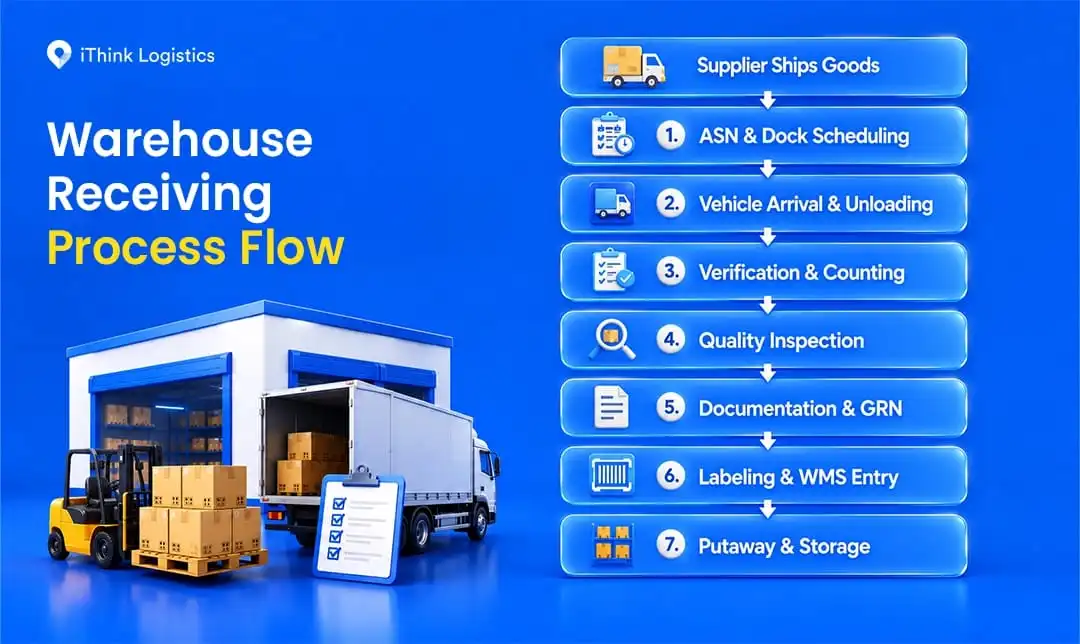
A warehouse receiving process isn’t always linear. If verification or inspection turns up a problem, goods move to a hold or quarantine area instead of continuing to put away. The OS&D framework further below covers exactly what happens next.
Receiving vs. Inspection vs. Putaway: What’s the Difference
These three terms get used interchangeably. They’re not the same thing, and each has its own failure point.
| Stage | What Happens | Where It Fails |
| Receiving | Verifying a shipment matches its purchase order | Wrong quantities go unnoticed before storage |
| Inspection | Checking condition, quality, and compliance | Damaged or defective stock enters inventory undetected |
| Putaway | Moving verified goods to their storage location | Items get misplaced, slowing future picking |
Receiving confirms what arrived. Inspection confirms its condition. Putaway decides where it goes. Businesses that fold all three into one step are usually the ones whose inventory errors start right here.
Step-by-Step: The Warehouse Receiving Process
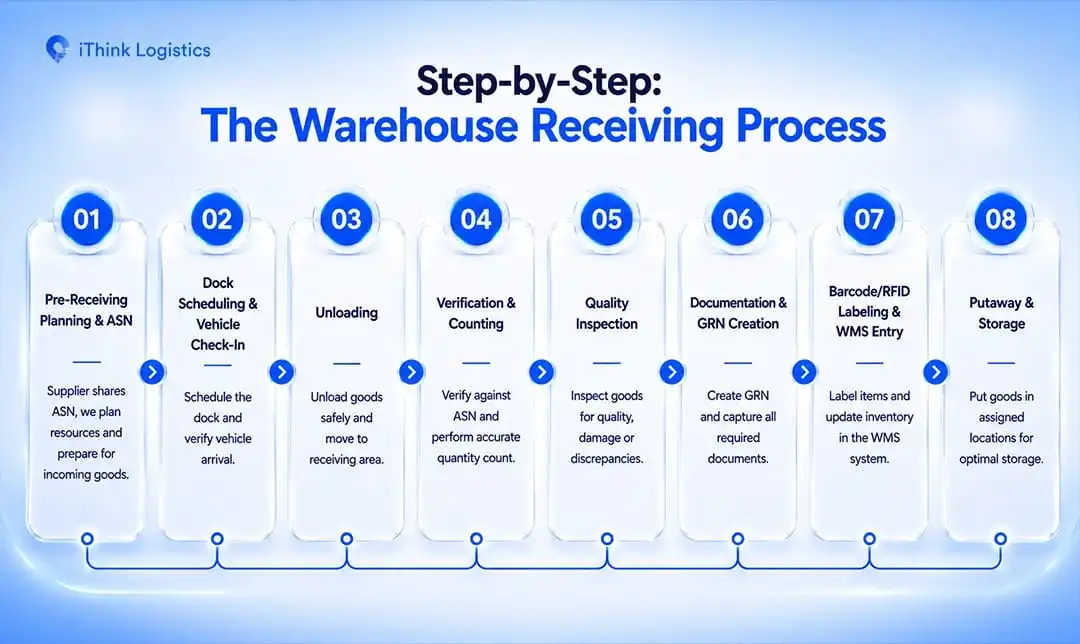
Each step below builds on the one before it. Roughly 70% of the real work in receiving happens right here.
Step 1: Pre-Receiving Planning & ASN
This step happens before the truck arrives. Suppliers send an Advance Shipment Notice (ASN) listing SKUs, quantities, and arrival time. The warehouse uses it to pre-assign a dock slot and staff.
Step 2: Dock Scheduling & Vehicle Check-In
Dock scheduling gives each vehicle a specific time slot and door. Gate staff check the vehicle, driver, and shipment reference against that appointment before waving it through, stopping misrouted deliveries before they reach the floor.
Step 3: Unloading
Staff transfer goods from the vehicle to the floor using forklifts, pallet jacks, or manual handling. Bays usually run in reverse delivery order to speed things up. Goods land in a staging area first, never straight into storage.
Step 4: Verification & Counting
This is where most receiving problems actually surface. Staff cross-check the physical shipment against the purchase order, ASN, and packing slip, counting by pallet, carton, or SKU depending on volume.
High-value shipments often get a blind count: staff count without seeing the expected quantity, which removes bias. Any gap gets logged here, before it becomes a billing dispute later. This is exactly where the OS&D framework gets triggered.
Step 5: Quality Inspection
Staff examine seal integrity, product condition, and packaging quality. High-value categories get a full inspection; lower-risk items get a random sample check. Anything that fails moves to a hold area, never the sales floor.
Step 6: Documentation & GRN Creation
This step generates the Goods Receipt Note, or GRN, the document that turns a delivery into an official inventory record. It lists verified quantity, condition, and any discrepancies against the purchase order.
Accounts uses it to release payment. Procurement uses it to track supplier performance, since repeated GRN discrepancies from one vendor are an early warning sign.
Step 7: Barcode/RFID Labeling & WMS Entry
Every item or pallet needs a scannable identifier before entering the system. If the supplier hasn’t labeled the shipment to GS1 barcode standards, staff apply tags now. One scan updates the WMS in real time, making the inventory searchable across every location.
Step 8: Putaway & Storage
The verified, labeled inventory moves to its final spot, a shelf, bin, or pallet rack. The WMS picks that location based on product velocity or size. Once confirmed, the item becomes available for picking, and receiving formally hands off to normal operations.
Warehouse Receiving Documents You Need
Documentation turns a physical delivery into a verified inventory record; without it, receiving is just unloading.
| Document | Purpose | When It’s Used |
| Purchase Order (PO) | States what was ordered, in what quantity, at what price | Created before shipping |
| Advance Shipment Notice (ASN) | Confirms contents and expected arrival | Sent by supplier before dispatch |
| Delivery Challan | Accompanies goods in transit within India | Checked at the dock |
| Invoice | Records commercial value for accounting and tax | Matched against the GRN for payment |
| Bill of Lading (BOL) | Transporter’s receipt and contract | Signed at carrier handover |
| Goods Receipt Note (GRN) | Confirms official acceptance, with discrepancies noted | Generated after verification |
| Inspection Report | Documents condition and quality findings | Filed with the GRN for flagged items |
Even one missing document slows the whole process. Verification and GRN creation both depend on having something to check against.
Types of Warehouse Receiving Methods
Not every shipment gets handled the same way. Warehouses typically pick one of four methods based on product type and turnaround needs.
- Standard receiving: Goods get verified against the purchase order before acceptance, the default for most inventory.
- Cross-dock receiving: Goods move from inbound dock to outbound vehicle with little to no storage, suited to fast-moving stock.
- Blind receiving: Staff count without seeing expected numbers first, removing bias and catching supplier-side errors.
- Direct-to-stock receiving: Pre-verified shipments from trusted suppliers skip inspection and go straight to storage.
Which method you use matters less than what happens the moment something doesn’t match.
Handling Discrepancies: The OS&D Framework for Warehouse Receiving
The OS&D framework classifies every receiving discrepancy into one of three types: Overage, Shortage, or Damage. Each pairs with a specific action.
| Discrepancy | Definition | Action |
| Overage | More units received than the PO states | Log the excess; hold from putaway until procurement approves |
| Shortage | Fewer units received than ordered | File a partial GRN; raise a claim with supplier or transporter |
| Damage | Physical defects found on inspection | Photograph it, segregate the stock, start a supplier claim |
Warehouses that treat OS&D as a formal checkpoint, not a case-by-case call, catch far fewer surprises during an inventory audit three months later.
Warehouse Receiving Checklist
A written checklist keeps the process consistent no matter who’s on shift. At minimum, it should cover:
- Confirm ASN details and assign a dock slot before arrival
- Verify vehicle and driver identity at check-in
- Unload into a designated staging area, never directly to storage
- Cross-check quantities against the PO, ASN, and packing slip
- Inspect for damage, expired dates, or seal tampering
- Log any OS&D discrepancy immediately, with photos where relevant
- Generate the GRN and update the WMS
- Apply barcode or RFID labels before putaway
- Confirm the final storage location in the system
Warehouse Receiving KPIs & Benchmarks
Warehouse receiving KPIs turn “we think it’s working” into a number you can track week over week.
| KPI | Target Benchmark | Why It Matters |
| Dock-to-stock time | Under 24 hours; best-in-class under 4 | Directly delays picking and fulfillment |
| Receiving accuracy | Above 99% | Drives every downstream inventory decision |
| Vendor compliance rate | Above 95% | Flags suppliers who need renegotiation |
| Put-away cycle time | Under 2 hours for standard goods | Inventory sits unsellable until this closes |
| Discrepancy rate | Under 1% | Signals whether receiving controls work |
If you only track one number, start with dock-to-stock time. A slow figure almost always traces back to a bottleneck in inspection, documentation, or putaway.
Warehouse Receiving Best Practices
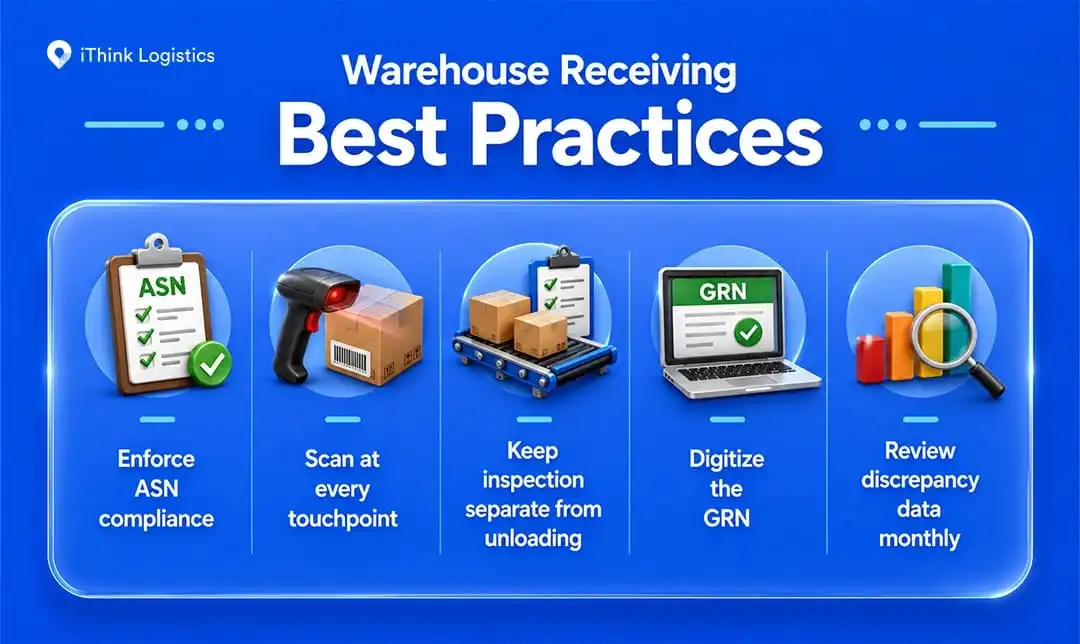
A handful of consistent habits move these numbers more than any single tool.
- Enforce ASN compliance: Shipments with no advance notice go into a slower lane, protecting the schedule for suppliers who follow the process.
- Scan at every touchpoint: Barcode or RFID cuts manual entry errors fast, since data comes from a scan, not a keyboard.
- Keep inspection separate from unloading: Combining both in one space creates congestion and rushed checks.
- Digitize the GRN: A digital receipt note updates the WMS the moment it’s created.
- Review discrepancy data monthly: A recurring OS&D pattern from one supplier is worth a renegotiation, not another logged incident.
Common Warehouse Receiving Mistakes & How to Avoid Them
Most receiving errors trace back to a small, repeatable set of habits.
| Mistake | Impact | Solution |
| Trusting the packing slip without counting | Records don’t match physical stock | Physically verify quantity, even for trusted suppliers |
| Delayed WMS entry | Phantom stockouts: stock exists but isn’t visible | Enter GRN data the same shift it’s received |
| Skipping inspection to save time | Damaged stock enters inventory undetected | Full checks for high-value items, spot checks for the rest |
| No dedicated staging area | Goods mix with existing inventory before verification | Keep a marked staging zone separate from storage |
Businesses receiving goods in India carry one more layer most global guides skip.
India-Specific Considerations: GST, E-Way Bill & GRN
Every inbound shipment above a set value threshold needs a valid e-way bill, generated under GST rules. Staff should verify it against the invoice at the dock, not after.
The invoice needs accurate GST details. A mismatch between the e-way bill, invoice, and shipment can trigger compliance problems beyond the warehouse. The GRN should reference the GST invoice number directly, so accounts can reconcile without a manual check.
For sellers running warehouses across states, e-way bill validity windows are tied to distance and vehicle type. This affects dock scheduling for interstate shipments. Folding this check into Step 6 keeps tax compliance in sync with receiving.
Warehouse Receiving Process Example
Picture a D2C apparel brand shipping 800 orders a day. A restock of 2,000 units arrives. The supplier sent an ASN a day earlier, so the warehouse already has a dock slot and staff ready.
| Time | What Happens |
| 9:00 AM | Truck arrives; gate staff verify it against the appointment |
| 9:15 AM | Staff unload into the staging zone and begin the count |
| 9:45 AM | Count comes up short: 1,980 units instead of 2,000 |
| 10:00 AM | Team logs the shortage under OS&D and files a partial GRN |
| 10:15 AM | Claim raised with the supplier for the missing 20 units |
| 11:00 AM | Remaining units clear inspection and get barcoded |
| 11:30 AM | Inventory enters the WMS; putaway routes it to a fast-pick zone |
| 2:00 PM | Full batch shows as available, under six hours dock to shelf |
That kind of consistency isn’t luck. It comes from a process that catches problems at the dock instead of three weeks later during a stock count.
How iThink Logistics Supports Efficient Receiving
Whether you manage your own warehouse or work with a fulfillment partner, reviewing your receiving process regularly catches errors before they reach a customer.
iThink Logistics works with D2C and SME sellers managing 50,000+ daily shipments across 29,000+ pincodes in India, and receiving discipline is part of what keeps that volume moving cleanly.
Frequently Asked Questions
What is the warehouse receiving process?
The set of steps a warehouse follows to accept, verify, and record inventory before storing it, from ASN scheduling through putaway.
What are the steps in the warehouse receiving process?
ASN and dock scheduling, unloading, verification and counting, quality inspection, documentation and GRN creation, labeling and WMS entry, and putaway.
What documents are needed during warehouse receiving?
A purchase order, ASN, delivery challan, invoice, bill of lading, goods receipt note, and inspection report.
What is a Goods Receipt Note (GRN)?
The official document confirming a warehouse has received and verified a shipment, including any noted discrepancies.
What is the difference between receiving and putaway?
Receiving verifies a shipment matches its purchase order and checks its condition. Putaway moves the verified goods to their storage location.
How does a WMS improve the warehouse receiving process?
It updates inventory in real time as items get scanned. It cuts manual entry errors and assigns putaway locations by product velocity.
What KPIs should you track for warehouse receiving?
Dock-to-stock time, receiving accuracy, vendor compliance rate, put-away cycle time, and discrepancy rate.
Conclusion
Receiving discipline compounds. A warehouse that catches a discrepancy at the dock spends less time firefighting later, and more time shipping on schedule.
As order volumes grow, the gap widens between a warehouse with a documented OS&D process and one without. Build that discipline now, while volume is manageable. It’s far harder to retrofit once errors are already baked into your inventory records.
Author