Every retail merchant eventually hits a hard wall when sourcing inventory. You find a manufacturer, request a rate card, and get a blunt reply: “Our MOQ is 500 units.”
Minimum Order Quantity (MOQ) is the lowest number of units a supplier requires you to purchase in a single order to process your production run.
Suppliers will turn you away if you try to order less than this threshold. Alternatively, they will quote an inflated per-piece price that depletes your retail margin. This metric dictates your upfront cash flow requirements and inventory risk.
Understanding how to calculate and negotiate this baseline is what separates profitable retail brands from failed e-commerce experiments.
What Is Minimum Order Quantity (MOQ)?
Suppliers do not choose their minimum order sizes at random. The number represents the exact operating point at which a production run becomes profitable for their facility.
Minimum Order Quantity (MOQ) is the lowest volume of inventory or total order value that a manufacturer must sell to cover their fixed setup costs and secure a baseline profit margin.
Sellers often assume factories set high minimums out of greed. The reality is tied to manufacturing physics. If a factory runs a batch below their metric, they lose money on labor and machine calibration.
Many Indian manufacturers now set this baseline by total invoice value instead of unit volume. You might see a term like “minimum order value ₹50,000” instead of a piece count. Both models serve the exact same purpose for the factory floor. They ensure the client covers the basic cost of turning the machinery on.
MOQ Full Form and Origin
The phrase behind the acronym is simple.
MOQ stands for Minimum Order Quantity, a standard commercial term used in wholesale procurement, manufacturing, and international trade.
Procurement teams and factory agents rarely use the full phrase during active negotiations. They rely entirely on the acronym when drafting proforma invoices or quoting freight rates.
You must distinguish this B2B term from its use in consumer-facing settings on retail platforms. Marketplaces like Amazon and Shopify allow businesses to require a minimum purchase quantity per order. That consumer cap prevents low-value shipments. However, it operates independently from the factory-side manufacturing minimums discussed here.
Why Suppliers Enforce Minimum Order Quantities
Factories operate on tight margins that depend entirely on volume efficiency.
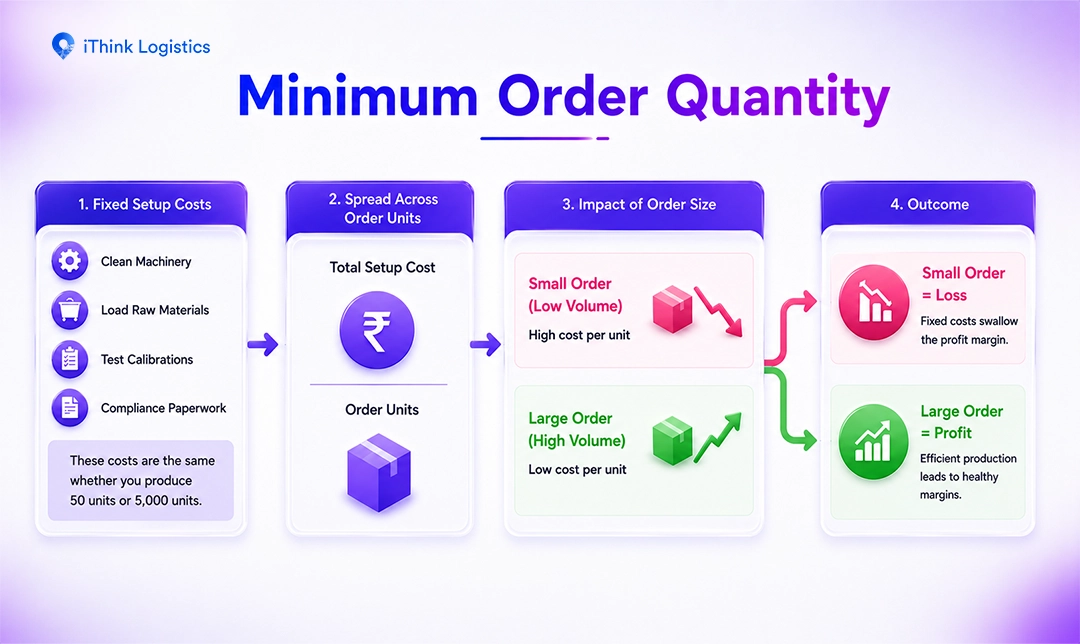
Every production cycle requires substantial fixed investments before a single item is created. Workers must clean machinery, load raw materials, run test calibrations, and process compliance paperwork. These tasks require identical time and labor whether the factory produces 50 units or 5,000 units.
A small order causes those fixed setup costs to swallow the entire profit margin. The manufacturer loses money by fulfilling the batch.
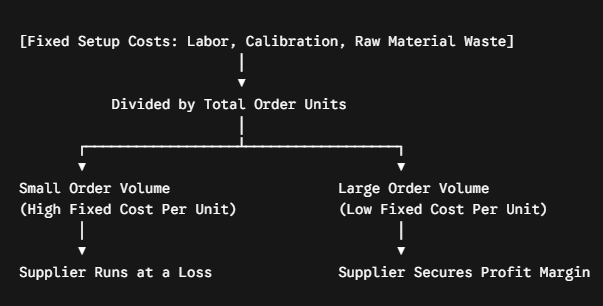
Predictability also drives this supplier requirement. Bulk orders allow factories to procure raw materials at steep discounts from their own upstream vendors. It ensures their staff remains fully utilized without dead periods between small, erratic custom jobs.
Simple MOQ vs Complex MOQ
Procurement requirements change drastically depending on how heavily you customize a product line.
A Simple MOQ is a single-variable purchase restriction applied to a finished product, whereas a Complex MOQ contains multiple stacked conditions covering raw materials, colors, variants, and total order value.
Standard wholesale items usually carry a straightforward restriction. A supplier selling stock plastic bottles might state a flat requirement of 500 pieces per order. You either meet the number or look elsewhere.
Complex structures appear the moment you request custom manufacturing. An apparel factory in Tirupur might require a total order of 1,000 shirts. Simultaneously, they may demand a minimum of 300 pieces per color variant because their fabric dye vats require a specific fluid volume to operate. You must meet all sub-conditions for your order to be approved.
How to Calculate Minimum Order Quantity
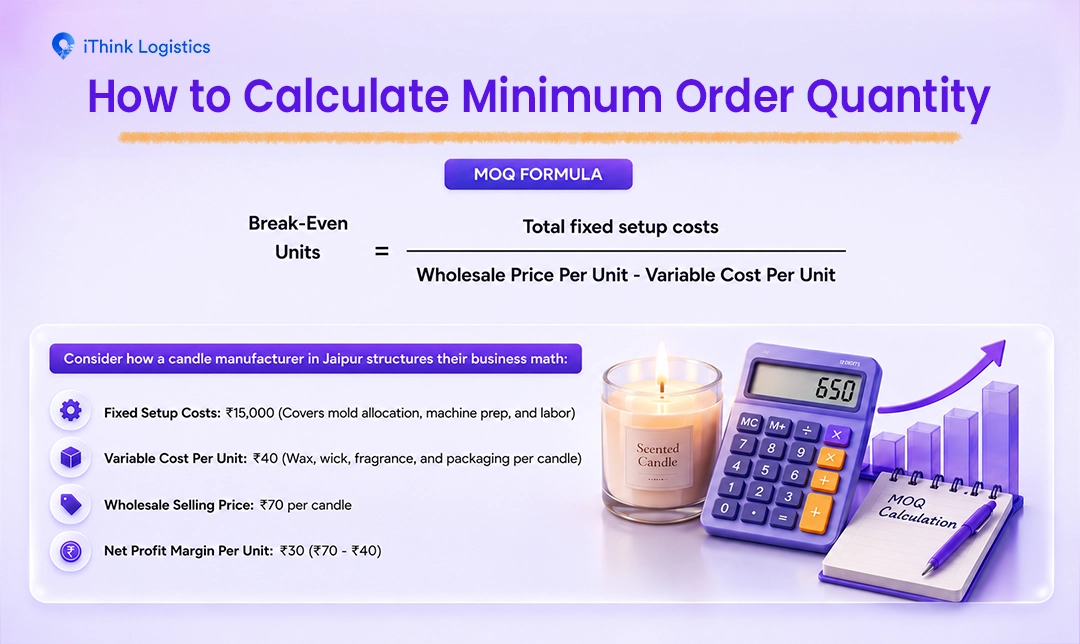
Manufacturers use a specific formula to ensure every production run clears their financial break-even point.
To calculate Minimum Order Quantity, a supplier divides their total fixed setup costs by their net profit margin per unit, then adds a percentage buffer to secure an acceptable return on investment.
Break-Even Units = Total fixed setup costs
—————————————————————-
Wholesale Price Per Unit – Variable Cost Per Unit
Consider how a candle manufacturer in Jaipur structures their business math:
- Fixed Setup Costs: ₹15,000 (Covers mold allocation, machine prep, and labor)
- Variable Cost Per Unit: ₹40 (Wax, wick, fragrance, and packaging per candle)
- Wholesale Selling Price: ₹70 per candle
- Net Profit Margin Per Unit: ₹30 ($₹70 – ₹40$)
The factory divides the ₹15,000 setup cost by the ₹30 unit margin. This reveals a strict break-even point of 500 units. Selling exactly 500 units yields zero profit for the factory owners. To make the project viable, the supplier adds a buffer and sets their official quote at 650 units.
MOQ vs EOQ: Key Differences
Sellers frequently confuse these two acronyms because both influence order volumes. They represent opposite sides of the negotiation table.
MOQ is the minimum order threshold set by a supplier to protect their factory margin, while Economic Order Quantity (EOQ) is an internal calculation used by buyers to minimize total inventory holding and ordering costs.
| Metric | MOQ (Minimum Order Quantity) | EOQ (Economic Order Quantity) |
| Primary Creator | The Manufacturer / Supplier | The Buyer / Retail Merchant |
| Financial Focus | Factory Production Efficiency | Warehouse Holding Costs & Cash Flow |
| Controllability | Rigid (Altered only via negotiation) | Dynamic (Calculated via internal data) |
| Target Goal | Covers Fixed Manufacturing Costs | Minimizes Total Inventory Investment |
Operational friction occurs when your internal demand calculation lands below the factory restriction. If your optimal purchase size is 200 units but the factory floor requires 500, you face a capital dilemma. You must choose between holding excess stock or paying a premium price per piece.
High MOQ vs Low MOQ Trade-offs
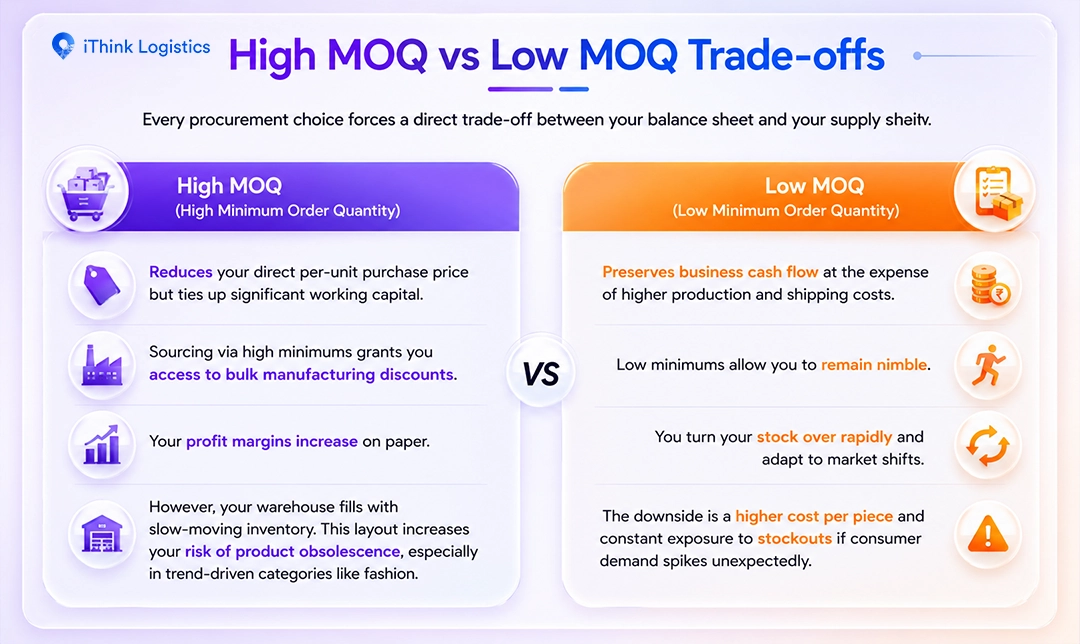
Every procurement choice forces a direct trade-off between your balance sheet and your supply chain safety.
A High MOQ reduces your direct per-unit purchase price but ties up significant working capital, whereas a Low MOQ preserves business cash flow at the expense of higher production and shipping costs.
Sourcing via high minimums grants you access to bulk manufacturing discounts. Your profit margins increase on paper. However, your warehouse fills with slow-moving inventory. This layout increases your risk of product obsolescence, especially in trend-driven categories like fashion.
Low minimums allow you to remain nimble. You turn your stock over rapidly and adapt to market shifts. The downside is a higher cost per piece and constant exposure to stockouts if consumer demand spikes unexpectedly.
Benefits of MOQ for Suppliers and Buyers
A well-calibrated purchase threshold brings predictability to both sides of the commercial relationship.
For manufacturers, the benefit centers on streamlined production scheduling. It eliminates the logistical chaos of processing tiny, erratic orders. They can buy raw materials in predictable bulk quantities, lowering their internal operating costs.
For retail buyers, matching a factory requirement unlocks real economies of scale. It guarantees you are receiving a true wholesale price rather than a marked-up distributor rate. This volume commitment gives you leverage to demand stricter quality control guarantees and priority production slots during peak shipping seasons.
Setting Your Own Minimum Order Quantity
D2C brands often transition from being buyers to setting their own order restrictions on retail storefronts.
Setting an internal retail MOQ protects your business from fulfilling low-value customer orders that cost more to pack and ship than they generate in gross revenue.
E-commerce plugins for Shopify and WooCommerce make it easy to enforce minimum cart thresholds. Calculate your average picking, packing, and courier costs before implementing a rule. If shipping a single ₹150 item costs you ₹80 in logistics fees, your net margin disappears.
Ensure your restriction matches your product category. A high minimum works for corporate gifting or bulk grocery packs. Applying that same rule to premium lifestyle items will cause immediate cart abandonment.
How MOQ Decisions Impact Shipping Costs
Your procurement volume dictates your entire logistics framework and inbound freight strategy.
High minimums result in fewer, massive inbound shipments. This volume allows you to use Ocean Freight or Full Truckload (FTL) shipping, which offers the lowest possible per-unit transport cost. Your warehousing costs will rise because you must store that massive inventory payload.
Low minimums trigger the opposite financial loop. You end up ordering small batches frequently. This pattern forces you into Less-than-Truckload (LTL) shipping or air courier modes, thereby driving up your inbound logistics costs.
High MOQ Procurement Low MOQ Procurement
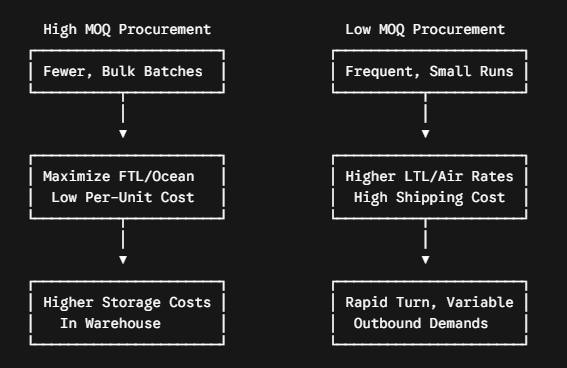
Your outbound fulfillment must remain incredibly flexible to survive these shifts. Automated logistics platforms like iThink Logistics resolve this operational tension. The software integrates directly with your store to compare courier rates across multiple domestic partners in real time. This ensures that even if low procurement runs lead to erratic outbound shipping patterns, your individual parcel delivery costs remain optimized based on weight and destination pincode.
How to Negotiate a Lower MOQ
Factory metrics are rarely as rigid as sales agents claim during your initial inquiry.
- Trade Volume for Margin: Offer to pay a 10% to 20% premium on your per-unit cost in exchange for a lower initial production run.
- Combine Component Subsets: Ask the factory to produce different color variations using identical underlying materials or molds to satisfy their combined material threshold.
- Inquire About Overstock Batches: Ask if the manager has leftover stock or component parts from a canceled production run by another brand that they want to liquidate.
- Utilize Consolidated Trading Partners: Work through a local sourcing agent who aggregates production needs from multiple small brands to hit the factory floor minimum collectively.
Frequently Asked Questions
What is MOQ in supply chain management?
An MOQ applies to every tier of an international supply chain. A factory’s restriction to a brand is often dictated by the raw-material minimums imposed by chemical or fabric refineries upstream.
What is the difference between a minimum order and an MOQ?
Minimum order is a broad retail term that can apply to a total currency value at checkout. MOQ is the precise terminology used in commercial manufacturing to define production volume floors.
Can you permanently negotiate an MOQ down?
Yes. Suppliers will lower their volume demands once you establish a reliable payment history and provide a consistent quarterly purchasing forecast.
How does MOQ protect cash flow?
It protects the supplier’s cash flow by preventing unpaid setup labor. It hurts the buyer’s cash flow by tying up capital in upfront inventory storage.
Author