
The Canton Fair is the biggest trade show in the world, with more than 32,000 exhibitors over three phases. Every spring and autumn, buyers from 223 countries visit Guangzhou. For Indian eCommerce sellers, it enables access to factory-direct pricing, verified suppliers, and new product categories, removing intermediaries.
This guide covers everything you need to know, from registration and travel to post-fair shipping, customs clearance, and import costs, so you know exactly what to do before, during, and after the fair.
What is the Canton Fair?
The Canton Fair, officially known as the China’s Import and Export Fair, and also referred to as the Guangzhou trade fair, is the world’s largest trade exhibition, bringing together over 32,000 exhibitors from the electronics, machinery, textiles, food, and consumer goods industries.
Since 2009, China has been the world’s biggest exporter. The Canton Fair China is where buyers from all over the world can see this manufacturing ecosystem up close. For Indian online sellers and buyers, it gives them a rare chance to meet verified manufacturers, compare products in person, and get factory-direct prices.
To attend, buyers register online and present valid business credentials, as only verified participants are allowed entry.
Canton Fair 2026 Dates, Phases & Product Categories
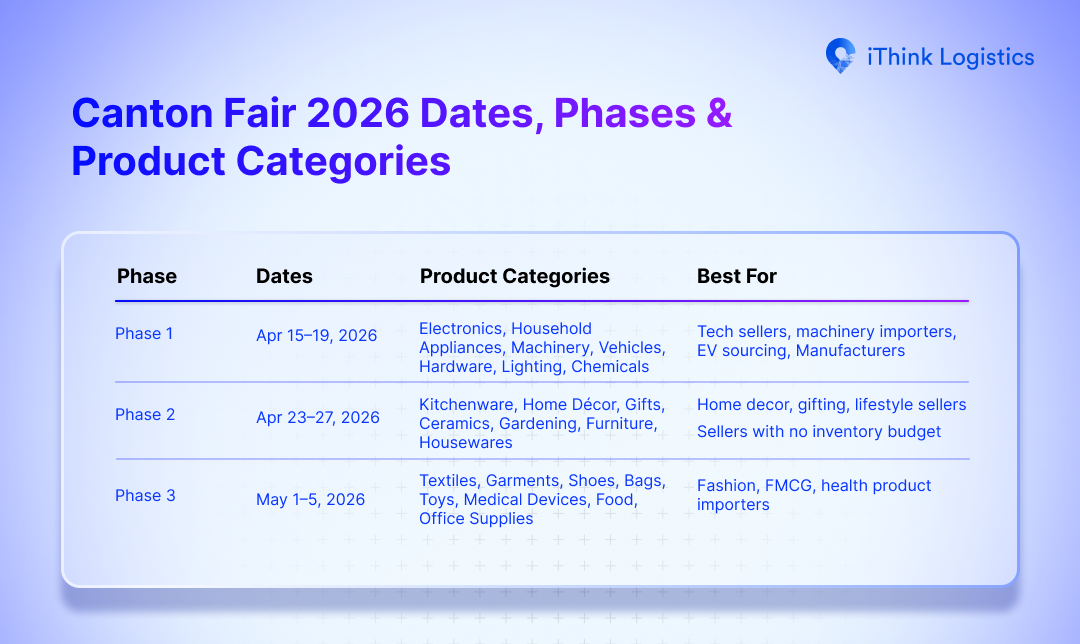
The 139th Spring Edition of the Canton Fair will run from April 15 to May 5, 2026, across three phases. Each phase lasts 5 days (9:30 AM to 6:00 PM) with a 3-day gap in between.
Don’t try to cover all three phases. Pick the one that matches your product category and focus your time there. The table below maps each phase to its categories so you can plan a targeted visit.
Canton Fair 2026 Phase Breakdown
| Phase | Dates | Product Categories | Best For |
| Phase 1 | Apr 15–19, 2026 | Electronics, Household Appliances, Machinery, Vehicles, Hardware, Lighting, Chemicals | Tech sellers, machinery importers, EV sourcing, Manufacturers |
| Phase 2 | Apr 23–27, 2026 | Kitchenware, Home Décor, Gifts, Ceramics, Gardening, Furniture, Housewares | Home decor, gifting, lifestyle sellers |
| Phase 3 | May 1–5, 2026 | Textiles, Garments, Shoes, Bags, Toys, Medical Devices, Food, Office Supplies | Fashion, FMCG, health product importers |
Who Should Visit the Canton Fair?
People who buy, sell, and scale products should go to the Canton Fair. It’s worth attending if you fit into one of these groups:
- Ecommerce sellers looking to source new products or switch to factory-direct suppliers.
- Private-label brands need OEM (Original Equipment Manufacturer) and ODM (Original Design Manufacturer) to produce custom products.
- Retail importers and wholesalers buy in bulk and negotiate directly with factories.
- Export traders identify trending products before they enter Indian markets.
Control is the biggest benefit of sourcing in person. You can check a product’s quality in person, compare prices from different suppliers right away, and discuss prices in person before making a decision.
Whether you are browsing Canton Fair Phase 2 products like home décor, ceramics, and gifts or sourcing electronics in Phase 1, each phase serves a distinct buyer profile. Attend the one that matches your business.
For Indian sellers, sourcing products from China directly through the Canton Fair means factory-level pricing without middleman markups, better margins, and lower sourcing risk.
How to Register for the Canton Fair 2026?
Canton Fair Registration is free if done in advance through the official Canton Fair website. Skip it, and you pay 100 RMB (approx ₹1344) at the gate and miss out on the Canton Fair invitation letter needed for your China business visa.
First-time buyers:
- Visit the official Canton Fair website.
- Click “Buyer” in the header menu, then “Register.”
- Select “Overseas Buyer” and fill in your personal and company details.
- Verify your account via the confirmation email.
- Once verified, log in, select “I don’t have a buyer badge,” complete the additional information, and submit.
- Once approved, you will receive your Canton Fair entry badge. It used for entry in the Canton Fair and is valid for multiple future sessions.
Note: For full registration details, visit the official details page of Canton Fair website.
Returning buyers:
- Log in to your existing account.
- Update any outdated details and request a fresh invitation letter.
- Download your updated buyer badge.
After registration, use the invitation letter to apply for a Chinese Business (M) Visa. This is a required step for Indian attendees. Apply early, as processing can take 2–3 weeks.
If you lose your badge, a replacement fee of 200 RMB (approximately ₹2688) applies.
How to Plan Your Visit (Travel & Business Prep)
A little preparation before you leave India saves a lot of confusion once you are on the ground in Guangzhou.
Getting There
The Canton Fair China address is No. 382, Yuejiang Zhong Road, Haizhu District, Guangzhou 510335, China. The easiest way to get there is by Metro Line 8, alight at Pazhou or Xingangdong station. For more details on direction, you can check here.
Indian attendees can book a Canton Fair package that includes flights, visa assistance, accommodation, and ground transport. Staying at hotels near Canton Fair saves both travel time and daily commute costs during the fair.
Documents to Carry
- Valid passport (6+ months validity)
- Chinese Business (M) Visa
- Canton Fair invitation letter (Important to apply for Visa to attend fair)
- Buyer badge or QR code
- Return flight tickets and hotel confirmation.
- Passport-sized photographs and recent bank statements (for visa)
- Business documents like GST certificates/incorporation certificate, business cards, and company letterhead
Questions to Ask Suppliers at the Fair
- Ask whether the supplier is a factory or a trading company. Factories typically offer lower prices, while trading companies can provide a wider variety of products.
- Production capacity: Can your supplier consistently handle your order volume?
- MOQ for trial orders: Most suppliers will negotiate the MOQ down if you offer a slightly higher unit price.
- Lead time during peak season: Clarify any supplier questions to ensure accurate inventory planning ahead of the Indian festive seasons.
- Request client references from the supplier. Ask which major brands or retailers they currently supply to verify reliability.
- Customisation options: For private label or OEM requirements
- Payment terms: You can pay with TT – Telegraphic Transfer (30% deposit, 70% before shipment), LC, or Alibaba Trade Assurance. If a supplier asks for 100% up front, ask them why before moving forward, because this is not common, no matter how convincing they seem.
What Happens After You Finalize a Supplier at the Canton Fair?
Most buyers think the job ends at order placement. It doesn’t.
Logistics, compliance, and shipping determine your actual profit margins. A single bad freight decision, missed HS code, or failed quality inspection can wipe everything you negotiated at the fair.
Here’s exactly what to do after you’ve locked in a supplier.
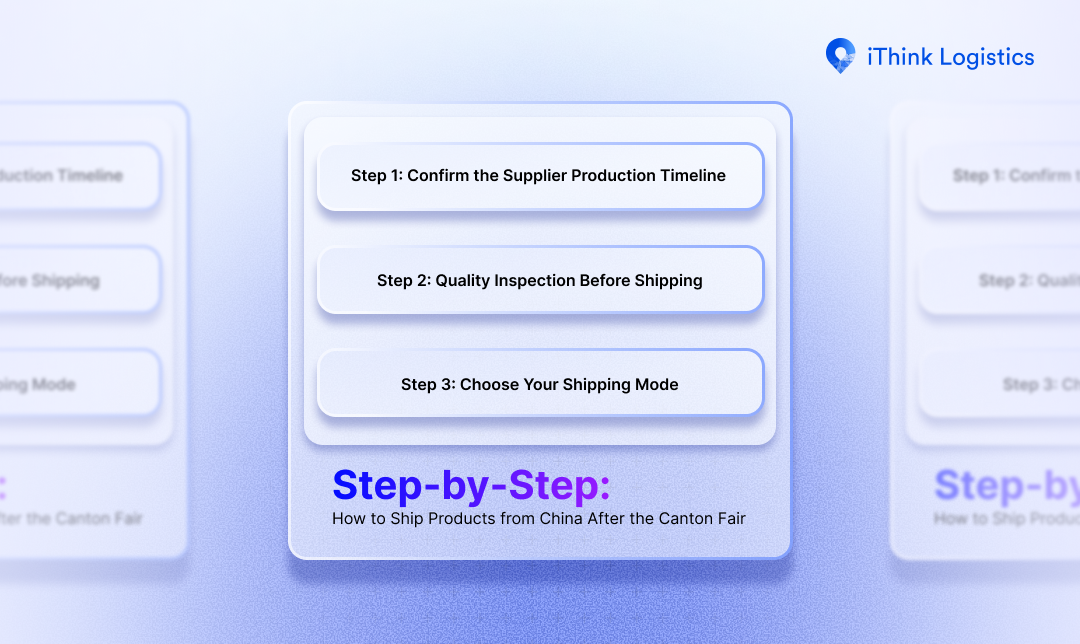
Step-by-Step: How to Ship Products from China After the Canton Fair
Step 1: Confirm the Supplier Production Timeline
Before shipment begins, get a written production timeline from your supplier. Know exactly how long each stage takes:
- Pre-production & tooling: 1–2 weeks
- Manufacturing: 2–4 weeks
- Factory to port: 3–7 days
- Ocean freight to India: 20–40 days
- Air freight to India: 3–10 days
Note: All timelines listed are approximate estimates and may vary depending on the supplier, product type, order volume, port conditions, geopolitical situations and time of year. Confirm actual schedules with your supplier and freight forwarder before placing your order.
The total order-to-delivery time for sea freight typically runs 45–60 days. So, plan your inventory accordingly.
Step 2: Quality Inspection Before Shipping
Once 80% or more of the order is made and packed, book a Pre-Shipment Inspection (PSI). PSI checks that your products meet your requirements and follow Indian import rules before they leave the factory.
Skipping this step is the most expensive mistake importers make, as later discovered defects after arrival cost far more to resolve than an inspection fee upfront.
Step 3: Choose Your Shipping Mode
| Mode | Cost Range | Transit Time | Best For | Recommended For Indian Sellers |
| Air Freight | ₹233–₹513/kg | 3–8 days | High-value, time-sensitive goods | First orders, samples, festive stock |
| Sea Freight | ₹186.63/kg (LCL) | 14–30 days | Large, heavy shipments | Bulk imports, regular restocking |
| Express | ₹699.85+ / kg | 2-4 days | Urgent, small shipments | Samples, urgent replenishment |
| Rail Freight | ₹186626 – ₹279939 by medium container not in kg | 10–20 days | Mid-volume, bulky cargo | Cost-sensitive shipments (select routes) |
Step 4: Export Documentation from China
Must have all documents from your supplier before shipment moves:
- Commercial Invoice: Product details, unit price, total value
- Packing List: itemised description, weight, and volume
- Bill of Lading / Air Waybill: issued by the carrier
- Sales Contract: proof of sale and ownership transfer
- Certificate of Origin (COO): where goods were originally made important for customs in India
- Issuance Certificate: Usually required for CIF contracts.
Step 5: Customs Clearance in India
Hire a licensed customs broker to handle clearance to avoid delays, penalties, and misfiled paperwork.
Documents Required for Customs Clearance in India:`
Core Documents
- Bill of Entry (BOE)
- Invoice
- Packing list
- Bill of Lading/ Airway bill (BL/AWB)
Financial Documents
- LC/Bank proof
- Insurance
Compliance & Declarations
- GATT Form (valuation declaration)
- Importer declaration
Product-Specific
- Certificate of Origin (COO)
- Catalogue
- Test reports
Conditional Licenses
- BIS / FSSAI / WPC
Pay all applicable duties and taxes before goods are released. Details on what you’ll owe are covered in the next section.
Common Mistakes Buyers Make After the Canton Fair
Sourcing the right product is only half the job. These are the mistakes that eat into margins after the fair is over:
- Wrong HS code classification: Your import duty is calculated based on the HS code assigned to your product. A wrong code means either overpaying on duties or facing penalties during customs clearance. Always verify the correct HS code before filing.
- Ignoring import duties upfront: Many first-time importers calculate profit margins based solely on the product price. Factor in basic customs duty, IGST, and social welfare. Surcharge before placing the order, not after.
- Skipping cargo insurance: Sea freight takes 14–30 days. A lot can go wrong in transit. Cargo insurance is a small cost relative to the value of a full shipment; skipping it is an unnecessary risk.
- Skipping pre-production samples: Always request a golden sample before approving bulk production. Defects found later are your problem, not the supplier’s.
- Letting the supplier arrange shipping: Suppliers will use their preferred freight forwarder, which is rarely the cheapest or most reliable option for Indian importers. Book freight independently and evaluate your options before committing.
- No last-mile delivery plan: Goods cleared at the port still need to reach your warehouse or fulfillment center. Not having a last-mile partner lined up leads to delays and additional storage charges at the port.
Import Duties, Taxes & Compliance (India-Focused)
Before placing an order at the Canton Fair, understand the total landed cost when your goods arrive in India.
Required Documents
- Importer Exporter Code (IEC)
- GST registration, which is required to claim IGST input tax credit
Duties & Taxes on Imports from China After Canton Fair
| Charge | What It Means |
| Basic Customs Duty (BCD) | Primary import duty, varies by product category |
| Social Welfare Surcharge | 10% of the BCD |
| IGST | 5%–28%, paid by the importer at customs (claimable as input tax credit) |
| Anti-Dumping Duty (ADD) | Applied on specific goods where dumping is identified |
| Compensation Cess | Applicable on certain luxury or sin goods |
| Value for IGST Assessment | Total value on which IGST is calculated = Assessable Value (CIF) + Basic Customs Duty + Social Welfare Surcharge + any applicable duties (like ADD, Safeguard Duty, etc.) |
| Total Import Duty and Taxes Payable | Final amount payable = BCD + SWS + IGST + any additional duties or cess (ADD, Compensation Cess, etc.) |
Key Compliance Points
- The HS code determines duty: if you classify something incorrectly, it could get you in trouble, cause delays, or hold up your shipment.
- Customs valuation checks: If the value you declare is too low, customs may review it and charge you more duties.
- Products that are restricted or regulated: Before you order certain items, such as those that require certifications like BIS, FSSAI, or WPC, check them out.
- IGST is paid in India: The importer pays IGST at the port of entry and can claim it as an input tax credit.
Working with a licensed customs broker and the right shipping partner can help ensure everything is done correctly, especially for first-time importers.
How Logistics Partners Help After Trade Fairs
Once orders are placed, logistics becomes the most critical part of the import process. A reliable logistics partner ensures cost control, compliance, and timely delivery without you having to manage operational complexity.
- Shipment consolidation: Combine orders from multiple suppliers into a single shipment to save significant shipping costs.
- Freight booking: Choose the best mode of transportation (air, sea, rail, or express) based on your delivery times and budget.
- Customs & compliance handling: Manage documentation, duty calculation, and clearance to avoid delays or penalties at Indian ports.
- Warehousing support: Store goods in China or India for a short time to line up production and shipping schedules.
- End-to-end tracking: Get real-time visibility from factory dispatch in China to final delivery in India.
A good logistics partner doesn’t just move shipments; it also helps you save money, stay compliant, and grow your imports in a smart way.
How iThink Logistics Supports Post-Canton Fair Imports
Once your Canton Fair orders land in India, iThink Logistics takes over, handling fulfillment, courier selection, and eCommerce dispatch so your imported goods move from port to customer without losing margin on the final leg.
- AI-powered courier selection: Automatically matches your shipment to the most cost-efficient and reliable courier for delivery across India
- eCommerce fulfillment integration: Direct integration with your selling platforms for faster order processing and dispatch
- Dedicated support: Single point of contact for your India-side logistics, including NDR management and returns
- Competitive shipping rates: Access to multiple courier partners under one platform without manual comparison
Already selling internationally from India? iThink’s international shipping handles exports to 180+ countries with real-time tracking, platform integrations, and competitive freight rates.
Import to India shipping is coming soon, so if you are sourcing from Canton Fair or from the international market to India and want end-to-end logistics support, stay tuned.
Explore iThink Logistics for India fulfillment
Explore iThink international shipping for exports
[Be the first to know when India import shipping launches.]
Estimated Cost to Import from China After the Canton Fair
Costs vary by shipment type, volume, season, and route. Here are India-specific estimates for China-to-India imports:
| Shipment Mode | Estimated Cost |
| Standard Air Freight | ₹233–₹513 per kg |
| Express Air (Priority) | ₹699.85+ per kg |
| Sea Freight (LCL) | ₹88,000 – ₹1,67,000 per container |
| Rail Freight (FCL) | ₹186626 – ₹279939 by medium container not in kg |
These are estimates and will vary based on current fuel surcharges, port congestion, seasonality, and customs duties. Always get a freight quote before finalising your order cost.
Conclusion
The Canton Fair is where supplier relationships begin, but your margins are decided by what happens after: freight selection, customs compliance, duty calculation, and last-mile delivery. Sellers who plan the entire import journey, not just the sourcing trip, are the ones who stay profitable.
If you need help managing the China-to-India leg, iThink Logistics handles everything from pickup to final delivery.
FAQs
Q.1: Is the Canton Fair worth it?
A: Yes, especially if you’re serious about sourcing from China. Meeting verified manufacturers in person, comparing products side by side, and negotiating face-to-face gives far more confidence than online sourcing. For Indian sellers building direct supplier relationships, it’s worth the trip.
Q.2: Can small businesses import from China?
A: Yes. Small businesses can successfully import from China by starting with small minimum order quantities (MOQs), asking for samples before placing large orders, and including duties and shipping costs in the price up front. The Canton Fair is good for businesses of all sizes.
Q.3: How long does shipping from China to India take?
A: By air: 3–8 days
By sea: 14–30 days
Including production time, total order-to-delivery typically takes 45–60 days for sea freight.
Q.4: What is the cheapest way to ship goods from China to India?
A: The best way to save money is to ship by sea (FCL or LCL). It takes longer but costs a lot less per kg, so it’s great for shipping a lot of things at once with flexible deadlines.
Q.5: Do I need an import license?
A: Yes. An Import Export Code (IEC) is mandatory for all imports into India. Depending on the product, additional certifications may be required, such as BIS (electronic products), FSSAI (food products), or WPC (wireless devices).
Author





Great article! Understanding import duty from China to India helps businesses estimate their total import costs.